Trump govt, desperate to save the failing nuclear industry, rushes to build geewhiz new nukes

|
U.S. Department of Energy rushes to build advanced new nuclear reactors, Science By Adrian Cho. 20, 2020 In the latest effort to revive the United States’s flagging nuclear industry, the Department of Energy (DOE) aims to select and help build two new prototype nuclear reactors within 7 years, the agency announced last week. The reactors would be the centerpiece of DOE’s new Advanced Reactor Demonstration Program, which will receive $230 million this fiscal year. Each would be built as a 50-50 collaboration with an industrial partner and ultimately could receive up to $4 billion in funding from DOE….But even some proponents of nuclear power doubt the program will spur construction of new commercial reactors as long as natural gas and renewable energy remain relatively cheap. “New builds can’t compete with renewables,” says Robert Rosner, a physicist at the University of Chicago. “Certainly not now.”
……the U.S. nuclear industry has struggled for decades. Its fleet now comprises 96 reactors, down from 113 in the early 1990s. More reactors are slated to close and the nuclear industry’s share of the electricity supply is expected to start to fall. In spite of that dreary picture, engineers have continued to develop designs for advance reactors they say would be safer and more efficient. The Trump administration wants to breathe new life into the nuclear industry. In April, DOE announced plans to increase domestic uranium mining and establish a national uranium reserve. And it will put $160 million of the $230 million Congress provided for the reactor demonstration program toward selecting two designs to be built posthaste, most likely at DOE’s Idaho National Laboratory (INL). The program aims to incubate ideas that aren’t already well along in development, says Ashley Finan, a nuclear engineer and director of the National Reactor Innovation Center at INL. For example, DOE is already working with NuScale Power to develop the company’s factory-built small modular reactors, which means it isn’t eligible for the new program. The money also won’t go to the development of a reactor called the Versatile Fast Neutron Source, which DOE has already begun to prepare to build at INL and which will serve as a facility for materials science research. Some observers say the initiative is unrealistic. DOE officials may struggle to identify the most promising of the many disparate designs, predicts M. V. Ramana, a physicist at the University of British Columbia, Vancouver. “You’re be comparing apples, oranges, grapes, plums, everything,” he says. The 7-year time frame also strains credulity, Ramana says, especially as DOE wants the reactors to pass licensing reviews at the Nuclear Regulatory Commission, which typically takes several years. “It’s absurd to think they can do it.” … Ramana questions whether the U.S. nuclear industry can be saved. Although issues of dealing with waste and the public’s apprehension about radioactivity remain, the biggest issue confronting the nuclear industry is the high capital cost of new reactors, which can be $7 billion or more. In deregulated markets, utility companies cannot afford such capital expenses, which is why cheaper renewables may ultimately replace nuclear energy, he says. “This is a sunset industry,” he says, “and the sooner you recognize that the better.” ……. Ramana questions whether the U.S. nuclear industry can be saved. Although issues of dealing with waste and the public’s apprehension about radioactivity remain, the biggest issue confronting the nuclear industry is the high capital cost of new reactors, which can be $7 billion or more. In deregulated markets, utility companies cannot afford such capital expenses, which is why cheaper renewables may ultimately replace nuclear energy, he says. “This is a sunset industry,” he says, “and the sooner you recognize that the better.” https://www.sciencemag.org/news/2020/05/us-department-energy-rushes-build-advanced-new-nuclear-reactors# |
|
Feds spent 20 years warning Michigan dam was in danger before it failed
Feds spent 20 years warning Michigan dam was in danger before it failed, By Kyle Feldscher
May 21, 2020 Thousands in Michigan evacuate after two dams fail (CNN)Federal regulators have warned for more than 20 years of inadequate spillways at a Michigan dam that was breached Tuesday, sending floodwaters raging into a city of more than 40,000.
10 buildings to be demolished at Santa Susana Nuclear Field Laboratory
…The Trump administration said on Wednesday it would tear down 10 buildings at the U.S. government’s former Santa Susana Field Laboratory northwest of Los Angeles that was left contaminated by decades of nuclear, rocket fuel and liquid metal testing. The buildings set for demolition were part of a radioactive materials handling facility at the more than 2,800-acre Santa Susana site in the Ventura County foothills, which opened in the late 1940s ordered cleaned up under a court-ordered 2010 consent decree. … https://www.devdiscourse.com/article/international/1060091-reuters-us-domestic-news-summary
Earthquake close to Yucca Mountain’s selected nuclear waste site

Nevada Earthquake Raises More Doubts about Yucca Mountain by John Freeland https://blogs.agu.org/terracentral/2020/05/17/nevada-earthquake-raises-more-doubts-about-yucca-mountain/ 17 May 20, On Friday, May 15, 2020, a magnitude 6.5 earthquake rocked Nevada and portions of California. With the epicenter located about 22 miles west of Tonopah, NV, no serious damage was recorded aside from cracked highway pavement in the mostly remote surroundings, far from population centers.
Reportedly, Nevada has not seen an earthquake of this size since 1954. Worth noting, the earthquake epicenter is about 100 miles away from the Yucca Mountain Nuclear Waste Repository, as depicted on the above aerial image.
The Yucca Mountain Nuclear Repository is, by authority of legislation passed in 1982 and 1987, currently the designated single facility for permanent disposal of high level nuclear waste. A time-line of the related events briefly describes the story of the Yucca Mountain Repository. Locals see the project as a source of jobs but state-wide there is strong opposition. After all, there are no nuclear power generating facilities in Nevada. According to Rep. Ruben Kihuen (D-Nev), “if you generate nuclear waste, you should keep it in your own backyard. Don’t send it to our backyard.”
The safety of Yucca Mountain has been debated for nearly forty years. I’ve previously posted on the topic here and here. An interesting analysis of political and other factors swirling around the project is “How Safe is Yucca Mountain?”As the map to the right (USGS craton map) [on original] shows, the Yucca Mountain site is not in an ideal location in terms of tectonic activity.
Located near the boundary of the “accretionary belt” and the “deformed craton” the region has a history of volcanic activity within the past 2 million years and Nevada is ranked third in the nation for earthquakes. As Dr. Cochran points out in his paper cited above, Nevada was selected largely for political reasons. The federal government already owned the Nevada Test Site property, which had been used for years for weapons testing. It is remote, however, remote areas of the United States are often found out west where there is higher seismicity. Whether we want to or not, we as a nation will have to figure out a solution to permanent nuclear waste disposal with some 90,000 tons now in temporary storage.
So where should it go? North or South Dakota? Eastern Montana? Predicting the long-term future of seismic events appears to be dicey. As Nevada Seismological Laboratory Director Graham Kent puts it “We like to think everything’s the way it is and it doesn’t change that much,” he said. “I think the last few months we’ve learned with the pandemic that that’s not the case.”
Global heating is making hurricanes more extreme
Global warming is making hurricanes stronger, study says, Doyle Rice, USA TODAY, 18 May 20
- Scientists studied 40 years of satellite images to reach their conclusions.
- Tropical cyclones are some of nature’s most powerful and destructive storms.
- Much of the death and destruction from hurricanes comes from storms of Category 3 strength or higher.
Who says we can’t control the weather?
Human-caused global warming has strengthened the wind speeds of hurricanes, typhoons and cyclones around the globe, a new study released Monday said.
These storms, collectively known as tropical cyclones, are some of nature’s most powerful and destructive storms. Category 5 Hurricane Dorian, for example, laid waste to portions of the Bahamas last year as the storm’s 185-mph winds cut through the nation like a buzzsaw.
Scientists studied 40 years of satellite images to reach their conclusions.
“Our results show that these storms have become stronger on global and regional levels, which is consistent with expectations of how hurricanes respond to a warming world,” said study lead author James Kossin of the National Oceanic and Atmospheric Administration.
Global warming, aka climate change, is caused by the burning of fossil fuels such as coal, oil and gas, which release greenhouse gases such as carbon dioxide into the Earth’s atmosphere. This has caused the planet to warm to levels that cannot be explained by natural factors.
The study was led by scientists from NOAA and the University of Wisconsin and was published in the peer-reviewed journal Proceedings of the National Academy of Sciences.
Kerry Emanuel, a hurricane expert at the Massachusetts Institute of Technology who was not involved in the study, said the findings were “much in line with what’s expected,” according to the New York Times.
Scientists said that the chances of hurricanes becoming a Category 3 or higher have increased each of the past four decades. Much of the death and destruction from hurricanes comes from storms of Category 3 strength or higher, which are known as “major” hurricanes……. https://www.usatoday.com/story/news/nation/2020/05/18/global-warming-making-hurricanes-stronger-study-suggests/5216028002/
Over 100 public interest organisations call on Canadian govt to halt decision on nuclear waste disposal
Groups ask Ottawa to press ‘pause’ on nuclear waste disposal https://www.tbnewswatch.com/local-news/groups-ask-ottawa-to-press-pause-on-nuclear-waste-disposal-2361184 ‘There’s no rules’ for evaluating an underground storage site, spokesperson says. By: Gary Rinne OTTAWA — More than 100 public interest organizations, environmental groups and others are calling on the federal government to suspend all decision-making regarding radioactive nuclear waste disposal.
In a letter to Natural Resources Minister Seamus O’Regan, they describe Canada’s current nuclear waste policy as “deficient,” saying it must be improved in consultation with the public and Indigenous peoples.
Among the signatories are numerous groups in northern Ontario, including Thunder Bay-based Environment North and Keep Nuclear Waste Out of Northwestern Ontario.
The letter follows a February report from the International Atomic Energy Agency which recommended that the government “enhance” its existing radioactive waste management policy.
The IAEA said the policy framework “does not encompass all the needed policy elements nor a detailed strategy” required for long-term nuclear waste management.
The signatories say their request is urgent because the regulator, the Canadian Nuclear Safety Commission, is pressing ahead with licensing decisions on a number of radioactive waste projects.
“Fearing Canada’s deficient radioactive waste framework will imprint itself on decisions affecting the health and safety of future generations and the environment, signees urged Canada to provide leadership, and establish sufficient guidance and federal policy,” they said in a statement Tuesday.
The groups also want Ottawa to establish objectives and principles to underly a nuclear waste policy, and that the government identify “the problems and issues exposed by existing and accumulating radioactive waste.”
The Nuclear Waste Management Organization is currently studying potential future underground nuclear waste storage sites in the Ignace area and South Bruce in southern Ontario.
Brennan Lloyd of North Bay-based Northwatch said NWMO’s search for a future repository is “part and parcel” of concerns about Canada’s overall approach to managing radioactive waste issues.
Nuclear waste disposal isn’t the only pressing matter, Lloyd said, but “we have lots of concerns about the Nuclear Waste Management Organization, their operation…going back to 2002 when the Nuclear Waste Fuels Act allowed the industry to create the NWMO.”
She added that “the lack of a solid set of rules around radioactive waste, we believe, does affect how the NWMO has conducted itself, but even more importantly it may affect the review process if the NWMO ever actually arrives at a site that they can in some way present as having the support of a host community.”
According to Lloyd, there are no rules as to how such a proposal would be evaluated.
She said that in 1996, the federal government presented a Radioactive Waste Policy Framework that’s less than a page long, and it’s problematic that “almost 25 years later, that’s still all we have in the way of real policy, strategy, rules around radioactive waste at the national level.”
Canadian Nuclear Safety Commission staff have recently proposed regulatory documents, Lloyd said, “which are really very general descriptions of how they might go about issuing a licence for various activities. And they really lack rigour.”
She said two of the five regulatory documents the CNSC plans to bring forward next month deal directly with nuclear waste burial.
“One is around how you would assess the long-term performance of a deep geological repository, and one is about how you would characterize a site that was being considered. And both of them are just incredibly weak documents,” Lloyd maintained.
“The dividing line is between ‘shall’ and ‘should.’ The CNSC documents are all ‘should’ or ‘may.’ Which means there’s no rules.”
Lloyd and the other signatories to the letter ask Minister O’Regan to instruct the CNSC to stop developing radioactive waste management and nuclear decommissioning documents until new, overarching policies and strategies are in place.
Massive deregulation of America’s radioactive wastes
 Environmentalists Fault Sending ‘Very Low Level’ Nuclear Waste to Landfills https://www.nbcbayarea.com/investigations/environmentalists-fault-sending-very-low-level-nuclear-waste-to-landfills/2292805/ By Jaxon Van Derbeken,-20 May 20 The federal Nuclear Regulatory Commission has proposed a rule “reinterpretation” that would allow commercial landfills to start taking in low level radioactive waste, in lieu of the four currently licensed disposal facilities nationwide.
Environmentalists were quick to attack the proposed rule change by the U.S. Nuclear Regulatory Commission, saying that under the plan, the public would not be automatically notified when a landfill qualifies for a waiver of the current regulations.
This is the most massive deregulation of radioactive waste in American history,” said Daniel Hirsch, head of an environmental watchdog group and former director of the Program on Environmental and Nuclear Policy. “And they are doing it under the cover of the coronavirus pandemic, when everyone’s attention is rightly focused on other things.”
Under Proposed Rule No. 2020-0065, what the commission considers a “reinterpretation” of existing rules, hundreds of landfills nationwide could submit applications for an exemption of the current rules requiring that all low-level nuclear waste be sent to either Washington state, Utah, Texas or South Carolina.
Environmentalists were quick to attack the proposed rule change by the U.S. Nuclear Regulatory Commission, saying that under the plan, the public would not be automatically notified when a landfill qualifies for a waiver of the current regulations.
“This is the most massive deregulation of radioactive waste in American history,” said Daniel Hirsch, head of an environmental watchdog group and former director of the Program on Environmental and Nuclear Policy. “And they are doing it under the cover of the coronavirus pandemic, when everyone’s attention is rightly focused on other things.”
Under Proposed Rule No. 2020-0065, what the commission considers a “reinterpretation” of existing rules, hundreds of landfills nationwide could submit applications for an exemption of the current rules requiring that all low-level nuclear waste be sent to either Washington state, Utah, Texas or South Carolina.
To qualify for an exemption, a landfill would need to submit an analysis of the types of waste they would receive and that they could meet radiation exposure limits.
Hirsch said that under the proposed regulatory language, private landfills wouldn’t have to notify neighbors.
“You could be living next to a nuclear dump, and never even know it,” he said.
The NRC contends its plan is safe. In a statement, the commission said it intends to relax regulations for disposing of “very low level” waste, such as the concrete from decommissioned nuclear reactors. Such waste, the commission says, poses little risk to the public, while allowing for reduced costs and lower radiation exposure to drivers while they are transporting it.
Critics, like Jeff Ruch, West Coast head of PEER, Public Employees for Environmental Responsibility, say there aren’t nearly enough safeguards.
“If you get the exemption, you could put it in your backyard,” he said. “There’s no tracing process, there’s no monitoring — this, in essence exempts them from any form of regulatory or public health safeguard, and that’s the concern.”
The NRC told us that companies that are disposing of the radioactive materials, along with participating landfills, would share the responsibility of complying with the rules under the exemption system, adding: “We would not allow such disposals if we felt public health and safety and the environment would not be protected.”
Disclosure aside, critics said they are concerned that the restrictions for landfills would not be as strict as the ones in place for the four licensed facilities. Under the proposed rules, residents near newly participating landfills could be exposed to as much as two and half times the level regulatorily allowed around the four licensed disposal sites, Hirsch said.
The commission said that the proposed permitted landfill exposure level would be the same as allowed around decommissioned nuclear plants.
The nuclear industry has yet to weigh in on the proposal, but the deadline for public comment has been extended to July. The five member commission is then expected to take up the matter.
If the plan is approved, it could mean dramatically reduced costs of disposing contaminated soil around San Francisco’s old Hunters Point Naval Shipyard, which is slated for development. Clearing that site could involve hauling away as many as 100,000 truckloads of contaminated soil. Right now, the soil in the area is being retested following allegations of wrongdoing by the previous testing firm, Tetra Tech, that the company denies.
Nuclear power policy now a low priority for Philippines govt
|
Nuclear policy approval stalls during crisis, Business World May 20, 2020 THE approval of a proposed policy pushing for nuclear energy has been relegated to a lower priority as the government focuses on containing the public health and economic fallout from the pandemic, officials said.Energy Undersecretary William Felix B. Fuentebella said the government is fully focused on arresting the spread of coronavirus disease 2019 (COVID-19).
‘Di siya masyadong nabigyan ng highlight kasi ang tutok ng buong government (sa) COVID (The nuclear policy is not a priority because the government’s focus is on fighting COVID),” he said. Separately, Energy Secretary Alfonso G. Cusi told reporters that the Department of Energy is still waiting for the approval of President Rodrigo R. Duterte of its proposed executive order pushing for the establishment of nuclear power infrastructure, which it submitted on Feb. 20. The department wanted the regulatory and legal framework for nuclear power, along with the national policy, to be approved within the present government’s term due to the long gestation period for building nuclear power plants…….https://www.bworldonline.com/nuclear-policy-approval-stalls-during-crisis/ |
|
Trump wants USA to hugely increase its nuclear weaponry

- Russian president said his arsenal also should be strengthened
- Obama has sought to both modernize and reduce U.S. weapons
President-elect Donald Trump said Thursday the U.S. should increase its nuclear arsenal, an apparent reversal of a decades-long reduction of the nation’s atomic weaponry that came hours after Russian President Vladimir Putin reiterated calls for his country’s arsenal to be reinforced.
“The United States must greatly strengthen and expand its nuclear capability until such time as the world comes to its senses regarding nukes,” Trump said in a Twitter post…….(subscribers only) https://www.bloomberg.com/news/articles/2016-12-22/trump-says-u-s-nuclear-arsenal-must-be-greatly-expanded
Time that Japan faced up to the folly of its nuclear fuel cycle dream
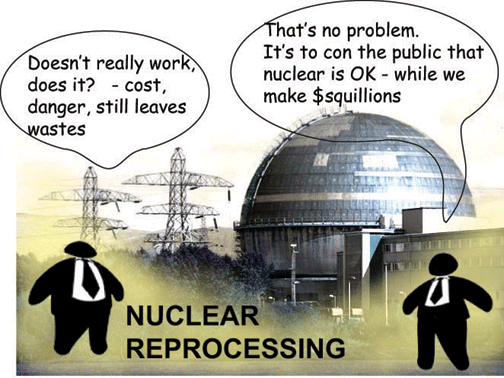
As the situation stands, plutonium will start to pile up with no prospects of it being consumed. Reducing the amount produced is also an issue that needs to be addressed.
The United States and Britain have already pulled out of a nuclear fuel cycle.
|
Editorial: Time to set a course away from Japan’s troubled nuclear fuel cycle https://mainichi.jp/english/articles/20200518/p2a/00m/0na/029000c, May 18, 2020 (Mainichi Japan) The Rokkasho Nuclear Fuel Reprocessing Facility being constructed in the northern Japan prefecture of Aomori has cleared a safety inspection by the Nuclear Regulation Authority (NRA). Spent fuel from Japan’s nuclear power plants will be reprocessed at this facility, which will play a key role in Japan’s “nuclear fuel cycle” policy. Under the policy, uranium and plutonium extracted from such fuel is to be processed for further use. Japan Nuclear Fuel Ltd., the operator of the reprocessing facility, aims to complete construction by autumn next year, but there are no immediate prospects of the facility going into operation. On top of this, due to changes in the circumstances surrounding nuclear power, the meaning of the facility’s existence is no longer clear. The first issue to consider is declining demand for the use of fuel to be reprocessed at the facility. Such fuel was originally destined to go mainly to the Monju fast-breeder reactor in the western Japan prefecture of Fukui, but a spate of problems with the sodium-cooled reactor led to a decision in 2016 to decommission it. There are no plans to construct a replacement facility. There were also plans to use reprocessed fuel at nuclear power stations to generate electricity, but there are only four reactors that can handle it, far fewer than the 16 to 18 originally planned. As the situation stands, plutonium will start to pile up with no prospects of it being consumed. Reducing the amount produced is also an issue that needs to be addressed. Japan already possesses more than 45 metric tons of surplus plutonium, and there are fears in international society that it could be converted for use in nuclear weapons. In 2018, the government pledged to reduce the amount. A realistic approach is not to reprocess the fuel in the first place. Forming the backdrop to Japan’s persistence with fuel reprocessing is the problem of how to handle the large amount of spent nuclear fuel being stored on the grounds of the reprocessing facility. If Japan gives up on its nuclear fuel cycle policy, then the spent fuel will be sent back to nuclear power plants across the country. But those facilities are already pressed for storage space, making it difficult for them to accept the spent fuel. The total cost of the reprocessing facility, including construction and maintenance costs, stands at 14 trillion yen. Some of the cost will be tacked onto electricity bills. There is a need to rethink the question of whether the public is receiving benefits commensurate with the huge investment into the facility. NRA Chairman Toyoshi Fuketa said he would check with the minister of economy, trade and industry whether operation of the reprocessing plant was in line with the nation’s energy policy. In the wake of the 2011 Great East Japan Earthquake and tsunami and the ensuing nuclear disaster, many countries across the world turned in the direction of abandoning nuclear power. There are sufficient uranium resources in the world, and the justification for reprocessing as “effective utilization of limited resources” has faded. The United States and Britain have already pulled out of a nuclear fuel cycle. Japan must avoid a situation in which it wastes time by sticking to a national policy and becomes laden with risks. The country should squarely face up to the fact that it is in a no-win situation, and search for an alternative to the nuclear fuel cycle policy. |
Sellafield’s safety dilemma- risk of coronavirus versus risk of nuclear accident


|
Sellafield work must resume despite coronavirus lockdown in case of ‘nuclear incident’, says boss LancsLive By Steve Robson, Ian Molyneaux, 12 MAY 2020The boss of Sellafield has said decommissioning work needs to resume despite the coronavirus lockdown in case there is a ‘nuclear incident’.
The site near Seascale has been running at less than a fifth of normal operations for several weeks due to the Covid-19 pandemic, with around 1,500 key staff in work. Normally, Sellafield would have up to 8,000 people on site every day. At the beginning of May, a further 120 people came back to work, mainly attending off-site offices in Warrington to access specialist equipment and software. The company says it is making its way through a “cautious, limited, phased restart of work over the coming weeks”. Now Chief executive Martin Chown admitted he is faced with a difficult decision, but said it is vital Sellafield restarts some work. It is understood this refers to the decommissioning of old facilities that have the potential to cause a nuclear hazard if left to mothball…….. It is understood that a broad set of principles for restarting work at Sellafield have been agreed including a maximum of 3,500 people working on any one site at any given time, a maximum of 25per cent of staff working at off-site facilities, and work on construction sites only approved on the basis staff do not interact with the rest of the site. …. https://www.lancs.live/news/local-news/sellafield-work-must-resume-despite-18234403 |
The international nuclear weapons race

https://www.rferl.org/a/russia-pakistan-among-biggest-spenders-on-nuclear-weapons/30618712.html
A moment of reckoning – when coronavirus meets climate change
 A moment of reckoning – when coronavirus meets climate change A moment of reckoning – when coronavirus meets climate change Cyclones in the Pacific and pandemics tell us a lot about global inequality and highlight our futile pursuit of profit, Aljazeera Dr Jale Samuwai, 18 May 20 In the midst of economic shocks and border closures caused by the coronavirus pandemic, the Pacific region has yet again been ravaged by a Category 5 cyclone that left a trail of destruction across four Pacific island countries in a span of four days from April 5 to 8.The economic toll from Cyclone Harold and the response to the coronavirus pandemic to Pacific economies is yet to be determined, but they have for sure rolled backed significant economic gains in these countries. The economic, social and environmental impacts of the pandemic, exacerbated by climate-induced disasters such as tropical Cyclone Harold, will reverberate well into the future for these countries. COVID-19 and climate change have re-emphasised the fragility of Pacific economies and their acute vulnerability to global phenomena. Oxfam’s report on the potential economic impact of the coronavirus – Dignity not Destitution – demonstrates that the scenario unfolding in the Pacific is a reality that most vulnerable and poor developing countries in the Global South could relate to in light of the current global precarity and uncertainty. The Pacific double whammy brings us to an important moment for the world to reexamine our current approach to development, specifically the dominant economic model that prioritises profit over people and the environment. Both COVID-19 and climate change continue to expose the failures in our economic structures and the need to change our approach to how our economies are governed. Inequality – the common denominatorInequality is perhaps the most obvious flaw of the current economic model. Both cyclones and pandemics exacerbate the persistent inequalities at different levels of our societies. Those who are bound to suffer the most from the extreme effects of these two phenomena are the poorest and the “have nots” in societies. In a global economy where the world’s richest one percent of people have more than twice as much wealth as 4.6 billion of the poorest people on earth, according to a report by Oxfam in 2020, the ability of the majority of the population right now to access the resources they need to holistically build their resilience and bounce back from global crisis is severely limited and in some cases non-existent. Oxfam’s briefing, Dignity not Destitution, forecasts that half a billion more people are now likely to be pushed into poverty because of the pandemic without an urgent and a human-oriented emergency global rescue package that is compassionate towards the needs of world’s poorest and vulnerable countries. What we need is a global rescue package that not only focuses on protecting small businesses but one that also provides safety nets to the most vulnerable populations. Importantly, the pandemic and climate change have once again shone a harsh light on the persistent social gendered inequalities in our communities……… We are now approaching a crossroads; we can either continue with the business-as-usual way of development, or we can change: We transform the way we do things and build an economy that nurtures our people and our planet. This is the political choice that is at stake. For our sake, and the sake of our children, we urge our leaders to choose the latter, because sticking with the status quo will only bring about more suffering and destruction to our world. https://www.aljazeera.com/indepth/opinion/moment-reckoning-coronavirus-meets-climate-change-200423105300035.html |
|
Comprehensive Nuclear Test Ban Treaty at risk, due to Donald Trump’s accusations ?
The report made waves for raising “concerns” about China’s adherence to a “zero-yield” nuclear testing standard, as called for by the 1996 Comprehensive Nuclear Test Ban Treaty. Although neither the United States or China has ratified the treaty, both have signed it, and both claim to abide by a nuclear testing moratorium.
US allegations in this regard are nothing new……….
Although US accusations are unlikely to be true, they could give a convenient pretext to officials who want to withdraw the US signature from the treaty, allowing the United States to resume its own nuclear testing. In fact, that may be the entire point. ……..
The treaty bans nuclear explosions, including hydronuclear testing, but it doesn’t prohibit all nuclear experiments. For example, it doesn’t prohibit preparations for nuclear tests, meaning that nuclear-weapon states can continue to maintain and staff their sites, and even place devices in boreholes or tunnels, provided that they don’t set them off. Both Russia and the United States conduct subcritical experiments (weapons-related work not involving an explosive chain reaction) and have been for decades. Since they are not generating yield, they are permissible under the treaty. In its rebuttal of the compliance report, Russia makes clear that it carries out “so-called subcritical tests, which,” it adds, “in no way run counter to our obligations in this area.”………
Why withdrawal would be lose-lose. If the United States is simply looking for a pretext to withdraw its signature so it can resume nuclear testing, that would be a lose-lose proposition.
First, it would give up a constraint on its strategic rivals, without receiving any clear benefits from its newfound freedom of action. While most nuclear weapon states have retained their capabilities to conduct tests by maintaining their tests sites and keeping staff on the books, they would all face different challenges to a resumption.
For China and the Russia, these obstacles can be overcome quickly, due to the nature of their political systems. Their test sites are maintained and appear to be in a state of readiness. For them, the main question would be whether they want to lose their diplomatic advantage by moving first to break the moratorium………
Perhaps the worst consequence of withdrawal, though, is that the United States would give up leverage to prevent future North Koreas from trying to join the nuclear club………..
…..the United States and Russia, if both were parties, could agree to mutual visits falling short of on-site inspections. They could decide on close monitoring of nuclear test sites. They could agree on the notification and monitoring of permitted activities, such as subcritical testing. Because the United States has not ratified, these options are not on the table. But it’s not too late. https://thebulletin.org/2020/05/will-the-trump-administrations-accusations-doom-the-nuclear-test-ban-treaty/
Antarctic krill threatened by warming waters – climate change’s danger to the marine ecosystem
Climate change threatens Antarctic krill and the sea life that depends on it The Conversation, Devi Veytia, PhD student , University of Tasmania, Stuart Corney, Senior lecturer, University of Tasmania, 19 May 20,
The Southern Ocean circling Antarctica is one of Earth’s richest marine ecosystems. Its food webs support an abundance of life, from tiny micro-organisms to seals, penguins and several species of whales. But climate change is set to disrupt this delicate balance.
What we found
Antarctic krill are one of the most abundant animal species in the world. About 500 million tonnes of Antarctic krill are estimated to exist in the Southern Ocean.
Antarctic krill play a critical role in the ocean’s food webs. But their survival depends on a delicate balance of food and temperature. Scientists are concerned at how climate change may affect their population and the broader marine ecosystem.
Krill growth depends largely on ocean temperature and the abundance of its main food source, phytoplankton (microscopic single-celled plants)………
Krill growth habitat shifted south as suitable ocean temperatures contracted towards the poles. Combined with changes in phytoplankton distribution, growth habitat improved in spring but deteriorated in summer and autumn.
This early end to the growth season could have profound consequences for krill populations. The krill life cycle is synchronised with the Southern Ocean’s dramatic seasonal cycles. Typically this allows krill to both maximise growth and reproduction and store reserves to survive the winter.
A shift in habitat timing could create a mismatch between these two cycles.
For example, female krill need access to plentiful food during the summer in order to spawn. Since larger females produce exponentially more eggs, a decline in summer growth habitat could result in smaller females and far less spawning success.
Why this matters
Krill’s significant role in the food chain means the impacts of these changes may play out through the entire ecosystem.
If krill shift south to follow their retreating habitat, less food would be available for predators on sub-Antarctic islands such as Antarctic fur seals, penguins and albatrosses for whom krill forms a significant portion of the diet.
In the past, years of low krill densities has coincided with declines in reproductive success for these species…….. https://theconversation.com/climate-change-threatens-antarctic-krill-and-the-sea-life-that-depends-on-it-138436
1 This Month
23 April – WEBINAR – Why new nuclear reactors are the wrong tools for decarbonization Thursday, April 23 • 1 AM – 2 AM AEST


Pine Ridge Uranium is the real threat, not Tehran- Tell Burgum: Stop the Extraction.
Chernobyl: The Lost Tapes – A good documentary on Chernobyl on SBS available On Demand for the next 3 weeks– https://www.sbs.com.au/ondemand/tv-program/chernobyl-the-lost-tapes/2352741955560
To see nuclear-related stories in greater depth and intensity – go to https://nuclearinformation.wordpress.com
-
Archives
- April 2026 (241)
- March 2026 (251)
- February 2026 (268)
- January 2026 (308)
- December 2025 (358)
- November 2025 (359)
- October 2025 (376)
- September 2025 (257)
- August 2025 (319)
- July 2025 (230)
- June 2025 (348)
- May 2025 (261)
-
Categories
- 1
- 1 NUCLEAR ISSUES
- business and costs
- climate change
- culture and arts
- ENERGY
- environment
- health
- history
- indigenous issues
- Legal
- marketing of nuclear
- media
- opposition to nuclear
- PERSONAL STORIES
- politics
- politics international
- Religion and ethics
- safety
- secrets,lies and civil liberties
- spinbuster
- technology
- Uranium
- wastes
- weapons and war
- Women
- 2 WORLD
- ACTION
- AFRICA
- Atrocities
- AUSTRALIA
- Christina's notes
- Christina's themes
- culture and arts
- Events
- Fuk 2022
- Fuk 2023
- Fukushima 2017
- Fukushima 2018
- fukushima 2019
- Fukushima 2020
- Fukushima 2021
- general
- global warming
- Humour (God we need it)
- Nuclear
- RARE EARTHS
- Reference
- resources – print
- Resources -audiovicual
- Weekly Newsletter
- World
- World Nuclear
- YouTube
-
RSS
Entries RSS
Comments RSS
 nuclear-news