USA Republicans and Democrats can’t agree on funding to help Covid-9 victims, but there’s always money for war.
|
by
The annual approval of the gargantuan U.S. military budget is one of the most reliable rituals in Congress. It is so ordinary and overwhelmingly bipartisan, it’s barely considered newsworthy, and few outlets follow the details of exactly how much the government is allocating to a nuclear weapons buildup, or deployments to the Asia Pacific, or the steady creep of U.S. military bases across the continent of Africa. Even under President Trump, when the Democratic leadership claims to have struck a more confrontational posture, those same leaders have repeatedly handed him bloated military budgets, as we saw Wednesday with Congress’ bicameral approval of a roughly $740 billion military budget for 2021. ,,,,,,,,,,,,, this is no ordinary year. As Congress races to pass the NDAA for 2021, it does so in a country that is hurtling toward months that could be among “the most difficult in the public health history of this nation,” according to Dr. Robert Redfield, the director of the Centers for Disease Control and Prevention. Along with this health crisis, whose scale in the United States was entirely preventable, comes economic devastation: Lines for food banks are stretching for miles and, according to one study, one in six people is food insecure. As of September, one in six adults said they live in a house that’s behind on rent. ………. As the pandemic was raging, Congress had no problem passing legislation to continue U.S. military violence. The Senate version of the NDAA passed on July 23 in a vote of 86 – 14, while the House version was approved July 21 by 295 – 125. This defense bill was then approved December 2 by both chambers of Congress. …………
While entirely routine at this point, it’s useful to highlight on the eve of yet another massive Pentagon handout how the budget for war could instead go toward life-preserving social goods. This is useful, not to buy into austerity notions of scarcity, but simply to show the profound immorality of where our public resources go. When it comes to military spending, the sky is the limit. Space Force? Sure. Roughly $21.9 billion for nuclear weapons programs? No problem. But when it comes to keeping people alive, U.S. political imagination is significantly more constrained. Right off the bat in March, Democratic leader Rep. Nancy Pelosi (Calif.) shot down universal, robust cash payments to keep people afloat, even as high-profile figures like Sen. Bernie Sanders (I‑Vt.) and Rep. Rashida Tlaib (D‑Mich.) called for such measures. ………
we should not allow bipartisan agreement on military spending to simply fade into the background, as an unremarkable and immutable fact of U.S. politics. That we can find the money for war but not for coronavirus relief exposes the moral rot at the center of U.S. politics, a rot that must be dug out and expunged if we are to get through this crisis. https://www.commondreams.org/views/2020/12/04/congress-deadlocked-covid-relief-came-together-fund-pentagon-740-billion?utm_campaign=shareaholic&utm_medium=Social&utm_source=twitter
|
|


The next ”Great Tide” will devastate nuclear reactors and their radioactive wasies on the Suffolk and Essex coasts
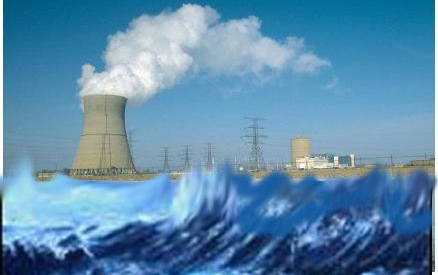 The next ‘Great Tide’, Exposed to rising tides and storm surges, Britain’s nuclear plants stand in harm’s way, Beyond Nuclear International, By Andrew Blowers, 4 Dec 20,
‘It was now that wind and sea in concert leaped forward to their triumph.’
Hilda Grieve: The Great Tide: The Story of the 1953 Flood Disaster in Essex. County Council of Essex, 1959
The Great Tide of 31 January/1 February 1953 swept down the east coast of England, carrying death and destruction in its wake. Communities were unaware and unprepared as disaster struck in the middle of the night, drowning over 300 in England, in poor and vulnerable communities such as Jaywick and Canvey Island on the exposed and low-lying Essex Coast.
Although nothing quite so devastating has occurred in the 67 years since, the 1953 floods remain a portent of what the effects of climate change may bring in the years to come.
Since that largely unremembered disaster, flood defences, communications and emergency response systems have been put in place all along the east coast of England, although it will only be a matter of time before the sea reclaims some low-lying areas.
Among the most prominent infrastructure on the East Anglian coast are the nuclear power stations at Sizewell in Suffolk and Bradwell in Essex, constructed and operated in the decades following the Great Tide.
Sizewell A (capacity 0.25 gigawatts), one of the early Magnox stations, operated for over 40 years, from 1966 to 2006. Sizewell B (capacity 1.25 gigawatts), the only operating pressurised water reactor in the UK, was commissioned in 1995 and is currently expected to continue operating until 2055.
Further down the coast, Bradwell (0.25 gigawatts) was one of the first (Magnox) nuclear stations in the UK and operated for 40 years from 1962 to 2002, becoming, in 2018, the first to be decommissioned and enter into ‘care and maintenance’.
These and other nuclear stations around our coast were conceived and constructed long before climate change became a political issue. And yet the Magnox stations with their radioactive graphite cores and intermediate-level waste stores will remain on site until at least the end of the century.
Meanwhile, Sizewell B, with its highly radioactive spent fuel store, will extend well into the next. Inevitably, then, the legacy of nuclear power will be exposed on coasts highly vulnerable to the increasing sea levels and the storm surges, coastal erosion and flooding that accelerating global warming portends.
Managing this legacy will be difficult enough. Yet it is proposed to compound the problem by building two gargantuan new power stations on these sites, Sizewell C (capacity 3.3 gigawatts) and Bradwell B (2.3 gigawatts) to provide the low-carbon, ‘firm’ (i.e. consistent-supply) component of the energy mix seen as necessary to ‘keep the lights on’ and help save the planet from global warming.
But these stations will be operating until late in the century, and their wastes, including spent fuel, will have to be managed on site for decades after shutdown. It is impossible to foresee how any form of managed adaptation can be credibly sustained during the next century when conditions at these sites are unknowable.
New nuclear power is presented as an integral part of the solution to climate change. But the ‘nuclear renaissance’ is faltering on several fronts. It is unable to secure the investment, unable to achieve timely deployment, unable to compete with much cheaper renewables, and unable to allay concerns about security risks, accidents, health impacts, environmental damage, and the long-term management of its dangerous wastes.
It is these issues that will be played out in the real-world context of climate change. There is an exquisite paradox here. While nuclear power is hubristically presented as the ‘solution’ to climate change, the changing climate becomes its nemesis on the low-lying shores of eastern England. ………. https://wordpress.com/read/feeds/72759838/posts/3061243158

China’s changing aims for nuclear weapons
MYTHS OR MOVING TARGETS? CONTINUITY AND CHANGE IN CHINA’S NUCLEAR FORCES,War on the Rocks, AUSTIN LONG 6 Dec 20, The nuclear arsenal of the People’s Republic of China and its plans to use it are in the middle of an unprecedented shift. Just over a decade ago, China’s long-range nuclear force structure consisted of a handful of inaccurate, silo-based intercontinental ballistic missiles (ICBMs) that were kept at low readiness with nuclear warheads stored separately. Chinese posture was demonstrably one of retaliation, with a clearly articulated policy of “no-first-use” of nuclear weapons, while force readiness and command and control of those forces were both poorly suited for anything else.
In 2020, China’s nuclear posture and force structure has changed dramatically. Its arsenal has grown and diversified even as readiness and command and control have improved. By 2030, the country’s force structure and posture will be similar to America’s and Russia’s in many ways (albeit probably not at parity). Yet, in a recent article in these virtual pages, David Logan dismisses claims that China is reconsidering the fundamental role of nuclear weapons in its strategy as “dangerous myths.” He argues that China’s policy of no-first-use “is still intact” and dismisses as fiction the claim “that China has developed and deployed an array of nuclear war-fighting capabilities, including tactical nuclear weapons.” While the ultimate destination of China’s nuclear posture remains uncertain, the trajectory is clear. Changes to China’s nuclear war-fighting capabilities and policies are not myths. Instead, they are moving targets, evolving as Chinese leaders reflect on China’s role in the world and the requirements that role places on the country’s nuclear arsenal. In this article, I review what is publicly known about these moving targets. First, it briefly traces the post-Cold War trajectory of China’s nuclear posture. Second, it addresses the role of the DF-26 intermediate range missile in Chinese posture for “tactical” nuclear weapons. Third, it reviews China’s no-first-use policy. Fourth, it presents evidence on the last time an authoritarian state declared a policy of no-first use — the Soviet Union in the 1980s. It concludes with observations on the possible consequences of change in Chinese nuclear posture for U.S. strategy and nuclear posture…………………. https://warontherocks.com/2020/12/myths-or-moving-targets-continuity-and-change-in-chinas-nuclear-forces/ |
|
||||||||||

Three Mile Island – radiation is forever – will nuclear waste storage withstand flooding?
 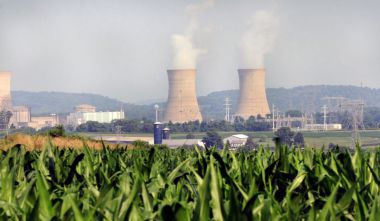 Radiation is forever’: How long will it take to clean up Three Mile Island? [Lancaster Watchdog] lancaster Online, Radiation is forever’: How long will it take to clean up Three Mile Island? [Lancaster Watchdog] lancaster Online, SEAN SAURO | Staff Writer , 6 Dec 20, Traveling Route 441 across Lancaster County’s northwestern border, motorists, for decades, have been able to look out toward the Susquehanna River to see a pair of cooling towers stretching skyward from the now-defunct Three Mile Island nuclear power plant.For almost as long, Eric Epstein said he’s kept a watchful eye, worrying about safety on the island, where a 1979 partial reactor meltdown remains the worst commercial nuclear accident in U.S. history. And Epstein, a Harrisburg-based nuclear watchdog, said those concerns persist even as plant owners move forward to dismantle its reactors — a process likely to take nearly 60 years. Even after that, he said, some nuclear waste is expected to remain onsite, just north of Conoy Township in the river. Plans exist for both, separately owned reactors on the island. Unit 2, the site of the partial meltdown, has remained inactive since 1979. And Unit 1 was taken offline last year. Epstein shared his concerns last week in the days after it was announced that officials at the U.S. Nuclear Regulatory Commission approved a Unit 2 license transfer that would move ownership of the reactor and related assets from FirstEnergy to TMI-2 Solutions. The subsidiary of Utah-based EnergySolutions would lead the decommissioning. That transfer is likely to wrap up by the end of 2020, FirstEnergy spokeswoman Jennifer Young said………………. “Decommissioning work can begin after the license transfer is completed, but TMI-2 Solutions would have to provide a more specific timeline for its projected start date,” NRC spokesman Neil Sheehan said. While most of the highly radioactive fuel was removed from Unit 2 by the mid-1990s, the upcoming decommissioning work is expected to cost at least $1 billion, paid for with ratepayer funds set aside for that purpose. According to an EnergySolutions timeline, the two-phased Unit 2 decommissioning is scheduled for completion in 2037, with “a potential area set aside for waste storage facilities” on the island. All along, Epstein has remained skeptical of the plan for Unit 2, where interior conditions largely remain a mystery due to high radiation levels, which have precluded close inspection. Those fears have only been exacerbated by the idea that waste could be stored on the island, where Epstein believes natural disasters like flooding could lead to released radiation, he said. “The plant was not designed to be a high-level radioactive waste site. Everybody agrees the radioactive waste shouldn’t be on an island,” Epstein said. “This is like putting waste on an airplane with no place to land. At some point, that plane is going to crash.” EnergySolutions officials did not return messages left with them about the decommissioning by Friday afternoon. However, Unit 1 owners at Exelon provide some insight into their separate decommissioning plan, which also will require some on-site storage — likely to begin in 2022, when spent fuel is moved into casks. “Dry cask storage will require robust metal canisters placed in a massive concrete housing,” according to Exelon spokesman David Marcheski. It is storage that officials claim will be able to withstand a 100-year flood. The Unit 1 decommissioning process is expected to wrap up in 2078, costing about $1.2 billion, covered by a related trust fund. https://lancasteronline.com/news/local/radiation-is-forever-how-long-will-it-take-to-clean-up-three-mile-island-lancaster/article_643a5aea-3676-11eb-a87d-1ffabfe61953.html |
|
Good Biden-Kim Relationship Necessary to Avoid a Nuclear Crisis
Because North Korea has nuclear weapons, the Biden administration cannot unilaterally impose terms on Pyongyang. Refusal to even talk with Pyongyang until it takes steps to denuclearize is a foolish and dangerous approach. Such an approach will likely inflame tensions and return Washington to a tense nuclear standoff with Pyongyang that poses a risk of miscalculation and accidental escalation into a nuclear war. Biden may be under pressure to be “tough” on North Korea to differentiate himself from Trump’s alleged cozy relationship with the North Korean dictator. However, a hostile stance toward Pyongyang will only make North Korea feel more insecure and drive Kim to pursue further nuclear development to ensure his regime’s survival.
Texas and New Mexico reject interim nuclear waste storage
 Texas, New Mexico resisting interim nuclear waste storage By Gary Martin Las Vegas Review-Journal, 6 Dec 20, WASHINGTON — President Donald Trump and Congress moved this year to develop interim nuclear waste storage sites, a temporary fix until the 30-year stalemate over Yucca Mountain is settled.But locations in New Mexico and Texas that were once embraced for their potential for jobs and economic development now face local opposition similar to that in Nevada that has resulted in the decadeslong delay in building a permanent repository. Texas, New Mexico resisting interim nuclear waste storage By Gary Martin Las Vegas Review-Journal, 6 Dec 20, WASHINGTON — President Donald Trump and Congress moved this year to develop interim nuclear waste storage sites, a temporary fix until the 30-year stalemate over Yucca Mountain is settled.But locations in New Mexico and Texas that were once embraced for their potential for jobs and economic development now face local opposition similar to that in Nevada that has resulted in the decadeslong delay in building a permanent repository.
Governors in New Mexico and Texas have pleaded with the federal government to stop or delay the process that could place tons of spent nuclear fuel rods in their states. Private groups have proposed to take the spent nuclear fuel and temporarily store the waste at locations near Carlsbad, New Mexico, and west of Odessa in Andrews County, Texas. But the welcome has turned to concern by residents who fear the interim storage of nuclear waste will become permanent if the federal government fails to develop the Yucca Mountain nuclear repository north of Las Vegas, as required by law, or find and develop another suitable location. The New Mexico congressional delegation wrote a letter to the Nuclear Regulatory Commission urging the agency to delay the decision-making process and allow more time for public comment on a license sought by Holtec International to build an interim storage facility. “Any proposal to store commercial spent nuclear fuel raises a number of health, safety and environmental issues,” the delegation wrote. Those issues include “potential impacts on local agriculture and industry, issues related to the transportation of nuclear waste, and disproportionate impacts on Native American communities,” the lawmakers warned. New Mexico Gov. Michelle Lujan Grisham, a Democrat, in a letter to President Donald Trump, said she was opposed to interim storage of nuclear waste, citing the safety of residents. Target for terrorists? In Texas, the facility proposed by Interim Storage Partners has drawn opposition from oil and gas producers, the agriculture industry and Gov. Greg Abbott, a Republican, who said placing the waste near oil fields would make an inviting target for terrorists. Shipping nuclear waste also would present a hazard to public health, Abbott said in letters to Trump and the NRC earlier this year. Meanwhile, environmental groups in both states have lodged their opposition to the proposed plants and urged Lujan Grisham to create a state agency to prevent an interim site from becoming a permanent storage facility for nuclear waste…………. https://www.reviewjournal.com/news/politics-and-government/texas-new-mexico-resisting-interim-nuclear-waste-storage-2206303/
|
|
UK’s Ministry of Defence keeping seret most of the unsatisfactor report on safety of nuclear bomb sites

 REVEALED: Nuclear bomb sites hit by fire safety problems and staff shortages, The National, By Rob Edwards 5 Dec 20, NUCLEAR bomb sites across the UK have fire safety problems as well as shortages of safety regulators and engineers, according to a new report from the Ministry of Defence (MoD).
But most of the MoD’s latest internal assessment of the safety of nuclear weapons has been kept secret for “national security” reasons – prompting fury from politicians and campaigners. They have attacked the nuclear secrecy as “deeply alarming” and “completely unacceptable”. The official attitude to nuclear safety was a “disgrace”, they said.
Previous nuclear safety assessments, revealed by The Ferret, have highlighted “regulatory risks” 86 times. Many involved the Trident warheads and nuclear submarines based on the Clyde.
The new MoD report also disclosed “significant weaknesses” on safety at non-nuclear sites. These included “serious deficiencies” on fire safety and “significant risk” from old fuel facilities – particularly on the Falkland Islands in the South Atlantic.
The MoD accepted that there were “infrastructure issues”, but insisted that they were being addressed. Defence nuclear programmes were “fully accountable” to UK ministers, it said.
The MoD has posted online the 2019-20 report from the Defence Safety Authority, which brings together seven regulators, a safety team and an accident investigation unit operating within the MoD. They are overseen by the authority’s director general, air marshal Sue Gray.
But the report said that the entire section from the Defence Nuclear Safety Regulator (DNSR), which is responsible for ensuring safety of the nuclear weapons programme, has been “marked SECRET” and given only “limited distribution”.
The MoD has previously released 10 annual DNSR reports following a challenge under freedom of information law in 2010. They flagged up risks of accidents, ageing submarine reactors, spending cuts and much else.
But in 2017 the MoD abruptly ceased publishing the reports, insisting that they had to be kept under wraps to protect national security. In 2019 that decision was challenged by campaigners at a UK information tribunal, whose verdict is still awaited.
he latest safety authority report, however, does contain a few details of nuclear risks buried in its 80 pages. It doesn’t specify which bases were affected, but they are likely to include the two major nuclear weapons sites, at Faslane on the Clyde and at Aldermaston in Berkshire.
In a discussion of problems with “fire safety assurance” across all MoD sites, the report said: “Particular issues have been noted at defence nuclear sites, where discussions continue between defence and statutory regulators.”
Between April 2019 and March 2020 as many as 374 fires were reported on all MoD sites. Although there had been some improvements “there is still more to do to reinforce the capability of defence to manage fire safety,” the report said.
A section on the “maturity” of the DNSR as a nuclear safety regulator disclosed that it was facing an 11 per cent shortage of staff in 2020-21. Shortfalls had been mitigated by the secondment of two senior staff from the UK Government’s nuclear power watchdog, the Office for Nuclear Regulation, and from the nuclear weapons company, AWE.
This had been supplemented by “making full use of partial retirees, graduate placements and development posts during 2019-20,” the report said. But these stopgap measures were failing………………
The Scottish National Party expressed concern about “a pattern of failure” on MoD safety. “Worryingly, the findings of this report reflect significant non-compliance with security and safety regulations at sensitive sites, including those where there are nuclear materials,” said the party’s defence spokesperson, Stewart McDonald MP.
“Not only is nuclear power and weaponry not safe, it is expensive, and not being handled properly under this Tory Government’s watch. The UK Government needs to transition away from nuclear entirely.”
MCDONALD described the nuclear safety failures as “alarming” and accused the MoD of “a lack of regard for public safety and transparency”. He pointed out that the UK Government’s civil nuclear watchdog, the Office for Nuclear Regulation, had criticised MoD secrecy.
The Scottish Green MSP for the west of Scotland, Ross Greer, called for nuclear weapons to be completely scrapped. “It is deeply alarming that the MoD continues to shroud so much secrecy over the safety issues with Britain’s weapons of mass destruction,” he said.
“We’ve known for years of significant issues at sites like Faslane and on the submarines themselves, so continued attempts to hold information back from the public are totally out of order.”
Lynn Jamieson, chair of the Scottish Campaign for Nuclear Disarmament, said: “The MoD’s tolerance of unsafe regimes is a disgrace for an organisation supposedly overseeing our protection. This adds to the urgency of nuclear disarmament.”
According to the Ministry of Defence, the annual assurance report and recommendations were currently being reviewed. Information that “could compromise national security” would not be published, the MoD said.,,,,,,,,,,,, https://www.thenational.scot/news/18923905.revealed-nuclear-bomb-sites-hit-fire-safety-problems-staff-shortages/
Court ruling doubts the credibility of nuclear safetysassessments by Japan’s Nuclear Regulation Authority
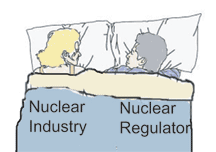 Ruling calls for review of NRA’s nuclear reactor safety screening, http://www.asahi.com/ajw/articles/13991979, A court ruling cast serious doubt over the credibility of safety assessments by the Nuclear Regulation Authority with regard to the operations of nuclear reactors.
The ruling called into question the safety of reactors restarted with NRA approval after being shut down in the aftermath of the 2011 Fukushima nuclear disaster.
It also underscored an urgent need for a sweeping review of the nuclear regulation system as a whole.
The Osaka District Court on Dec. 3 struck down the NRA’s endorsement of safety measures for the No. 3 and No. 4 reactors at the Oi nuclear power plant in Fukui Prefecture.
It invalidated the green light the nuclear safety watchdog gave in 2017 to Kansai Electric Power Co.’s plan to restart the two reactors.
The court said the NRA’s safety assessment was not fully in accordance with new tougher nuclear safety standards introduced after the catastrophic accident at the Fukushima No. 1 nuclear plant and screening guidelines based on those standards.
The ruling labeled the NRA’s decision as “unreasonable,” asserting there were “errors and deficiencies that cannot be overlooked” in the process of examining and approving anti-earthquake measures the electric utility adopted for the reactors.
In designing measures to protect a reactor against major earthquakes, the operator estimates the maximum possible ground motion generated by an earthquake around the reactor, called “reference ground motion.” It develops steps to ensure the safety of the reactor based on this estimate and requests for NRA approval for restarting the reactor.
The NRA examines the plan and determines whether the estimate is appropriate and the proposed safety measures are sufficient. It grants approval and authorization if it decides the plan meets the new safety standards.
Kansai Electric Power determined the reference ground motion by calculating the magnitude of the maximum credible earthquake based on its own assumptions concerning the length and width of faults around the reactors.
But residents of Fukui and six other prefectures filed a lawsuit to question the utility’s estimate of the reference ground motion. They argued that the utility’s estimate only represents an “average” for the spectrum of possible quakes, meaning that the safety measures are not based on the maximum strength of a possible earthquake in the area.
They cited a newly included provision in the NRA’s screening guidelines that says consideration should be given for the “variability” that arises due to the calculation methods used.
The plaintiffs claimed the NRA’s approval of the anti-quake measures was illegal because it was based on the utility’s questionable reference ground motion figure.
The government countered this argument by saying the utility’s calculation has a sufficient margin of error that makes it unnecessary to consider variability. But the court sided with the plaintiffs.
The ruling puts weight on the reasons for the NRA’s own decision to introduce the “variability” provision into the guidelines and demands that the screening process strictly follow strictly the established procedures.
The NRA should respond to the ruling by first reviewing the process of the safety screening of the two reactors at the Oi plant. It is possible that the screening of other reactors was similarly flawed. The ruling is likely to arouse anxiety among residents living in the vicinity of reactors that have been brought back online. The NRA should make a sincere and convincing response to the court decision.
The No. 3 and No. 4 reactors at the Oi plant are currently offline for regular maintenance. Debate is unnecessary in stating that the utility must not rush to restart the reactors.
Even without the triple meltdown at the Fukushima plant, it is amply obvious that this nation could be hit by unexpectedly severe natural disasters, such as earthquakes, tsunami and volcanic eruptions, at any time.
That makes it all the more important to establish nuclear power standards based on the principle of erring on the side of safety and ensure that safety screening and regulation are strictly based on the standards.
The government, which seems to be bent on restarting reactors, should take this imperative to heart.
Hokkaido’s ski areas could lose popularity, due to plans to house nuclear wastes
|
The towns of Suttsu and Kamoenai have both applied for preliminary feasibility surveys to be considered for a site that will store waste from the nation’s nuclear power plants. The cash-starved towns struggling with declining populations are poised to each pocket 2 billion yen ($19 million) promised by the government for taking part in the studies alone. Although whole selection process takes 20 years, the applications have touched off an outpouring of opposition from locals as well as from across the country, including from Hokkaido Gov. Naomichi Suzuki, who assailed the central government for “slapping the face with money.” The concern is especially palpable in the resort towns of Niseko and Kutchan, which are part of the Niseko resort area. “To outsiders, it might as well be Niseko that is undergoing a survey,” said Shinichi Maeda, an owner of a restaurant in Kutchan. “It’s possible that foreign investors who had previously valued Niseko will pull out one by one.” Suttsu is located about 40 km west of the town of Niseko, which will see no economic benefit from the study but will surely be hit by the anxiety the plan will generate………… the possibility of hosting a nuclear waste site, however remote, is enough to rail up opposition. The owner of a tourism business in Kutchan believes in local production and consumption, and uses seafood from Shiribeshi. But that may have to change. “Foreign customers are sensitive,” said the owner. “If the nuclear waste issue gains prominence, it’ll become hard to use” locally made seafood. In Japan, there is still no final repository for nuclear waste — it is stored in interim locations. After the 2011 Fukushima nuclear disaster raised public awareness, countries across the globe have struggled to find permanent places to store the waste. When Kamoenai announced it would apply for an initial survey in October, The Associated Press reported the story with the headline “2 remote Japan towns seek to host nuclear waste storage site.” The article was carried by news outlets all over the world. Last month, five citizens groups presented the Hokkaido governor with a petition signed by 450,000 people opposing the feasibility survey for the two towns. The signatures were collected nationwide. The preliminary studies underway in the two towns are becoming an issue that could undermine tourism throughout Hokkaido……….. |
|
UK doesn’t have policies in place ready for COP26 Paris climate summit
climate summit since Paris in 2015, and quite possibly one of the most
important international gatherings in history. It’s the moment when
countries need to make good on the commitment they signed up to in Paris to
limit the average global temperature rise to 1.5 degrees Celsius, and agree
to reduce their greenhouse gas emissions at the scale and speed that’s
required. On Friday we learned what the UK is proposing – cutting carbon
emissions by 68 per cent by 2030 – but, at present, we do not have the
policies in place to achieve it.
https://inews.co.uk/opinion/climate-change-targets-welcome-policies-radical-enough-meet-them-782737
Every second counts — Beyond Nuclear International

Peace Boat ensures the words of last Hiroshima-Nagasaki survivors are heard
Every second counts — Beyond Nuclear International
President-elect Joe Biden – in the grip of the “new nuclear” industry
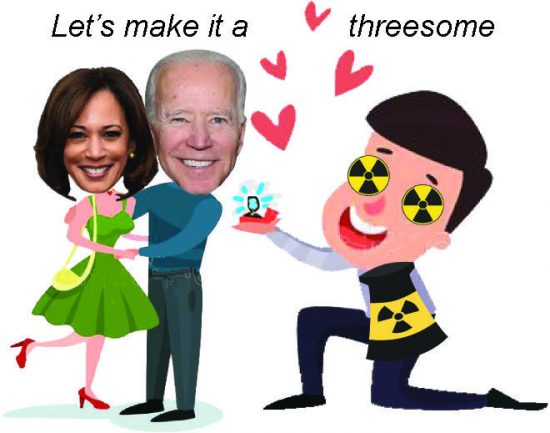 Biden, once a critic, may boost nuclear power, Peter Behr, E&E News reporter , December 3, 2020 When mismanagement of a nuclear plant on the Lower Delaware River forced an emergency shutdown in 1994, harsh criticism came from a junior U.S. senator whose state lay opposite the Salem, N.J., plant 3 miles away.”For more than a decade, I have sought expanded oversight, enforcement and sanctions to make the Salem facility operate according to the law,” then-Sen. Joe Biden (D-Del.) said, accusing the operator and the Nuclear Regulatory Commission of turning a blind eye to serious, repeated safety issues, including dangerously degraded reactor equipment.
Fast-forward a quarter-century, and now it is President-elect Biden who has included proposals for a new generation of nuclear reactors in his clean energy platform, parting ways with “no-nuke” progressives further to his left.
It isn’t clear how hard Biden will fight in the next few years to support the possible development of a fleet of still-experimental, billion-dollar reactors that wouldn’t come online until at least the 2030s.
A second issue centers on the 95 operating U.S. reactors, some of which may close prematurely because they are losing money, plant owners warn. Getting public support to hold on to the plants’ zero-carbon electricity has been an issue for state governors, but not the White House, so far.
In the 2020 presidential campaign, Biden focused his support for nuclear power on new designs……
“Joe Biden was the first Democratic presidential candidate who’s ever actively talked about advanced nuclear power” as part of the campaign platform, said Jeff Navin, acting chief of staff at the Department of Energy in President Obama’s first term. Navin heads governmental affairs and public policy for TerraPower LLC in Bellevue, Wash., which won an $80 million DOE contract in October to further its novel reactor design.
Navin said he does not think that Vice President-elect Kamala Harris’ reservations about nuclear power as a senator will turn into opposition as Biden’s No. 2. Harris, for example, had opposed the 2018 Nuclear Energy Innovation and Modernization Act — co-sponsored by Sen. Cory Booker (D-N.J.), her 2019 opponent in the Democratic presidential primary — citing reactor safety and nuclear waste disposal concerns………
“Things we’ve seen out of the Biden campaign and the transition team are very promising for a continuation and even acceleration of programs and policies that will support nuclear energy,” said John Kotek, policy development vice president for the Nuclear Energy Institute, the industry’s chief lobbying organization. Kotek was assistant DOE secretary for nuclear energy in the Obama administration. ………
But Biden will hear from environmental policy advocates and nuclear power opponents protesting that the NRC has gone too far to streamline and reduce costs of safety oversight on old reactors as well as safety reviews of new reactor designs.
“The Biden administration will have to turn first to regulatory issues and repair the damage that’s been done at the NRC over the past four years” under President Trump, said Matthew McKinzie, director of the nuclear, climate and clean energy program at the Natural Resources Defense Council.
There are still too many critical questions about new reactor designs to justify writing them into clean energy plans, McKinzie said. “We are very far from an understanding of whether they could ever be commercialized,” he said……..
Transition choices
To head his transition team on energy, Biden chose one of the top technology experts in the Obama administration, Arun Majumdar, founding director of the Advanced Research Projects Agency-Energy (ARPA-E), which funds experimental energy technologies. Majumdar now directs a Stanford University energy institute (Energywire, Nov. 19).
Others on the Biden-Harris transition team bring specific expertise on nuclear issues, including Rachel Slaybaugh, a nuclear engineering professor at the University of California, Berkeley, and a senior technical adviser at ARPA-E……. https://www.eenews.net/stories/1063719675
Reject Michele Flournoy as U.S. Defense Secretary – too close to military-industrial-complex

|
Rejecting Michèle Flournoy, Progressives Demand Biden Pick Pentagon Chief ‘Untethered’ From Military-Industrial Complex
“We urge President-elect Joe Biden and U.S. senators to choose a secretary of defense who is unencumbered by a history of advocating for bellicose military policies and is free of financial ties to the weapons industry.” Common Dreams, Jake Johnson, staff writer-4 Dec 20, |
|
Iran awaits incoming Biden U.S. administration – is unlikely to avenge the assassination of nuclear scientist
|
By TOI STAFF 4 Dec 20, Iran is unlikely to retaliate for the assassination of top nuclear scientist Mohsen Fakhrizadeh before US President-elect Joe Biden takes office, in order not to jeopardize a potential change in American policy on sanctions relief, the US envoy to Iran and Venezuela said Thursday.Fakhrizadeh, the scientist previously said by Israel and the US to head Iran’s rogue nuclear weapons program, was killed in a military-style ambush Friday on the outskirts of Tehran. The attack reportedly saw a truck bomb explode and gunmen open fire on Fakhrizadeh……… srael has long been suspected of carrying out a series of targeted killings of Iranian nuclear scientists nearly a decade ago, in a bid to curtail Iran’s rogue nuclear weapons program. It has made no official comment on the matter. Israeli TV coverage noted that Friday’s attack was far more complex than any of the previous incidents. https://www.timesofisrael.com/us-envoy-iran-unlikely-to-avenge-assassination-of-nuclear-scientist/ |
|


Analysis: why Michèle Flournoy should not be U.S. Secretary of Defense
|
Keep in mind Flournoy‘s extensive defense industry ties. In 2002 she went from positions in the Pentagon and the National Defense University to the mainstream but hawkish Center for Strategic and International Studies, which is largely funded by industry and Pentagon contributions. Five years later, she co-founded the second-most heavily contractor-funded think tank in Washington, the highly influential Center for a New American Security (CNAS). That became a stepping stone to her role as under secretary of defense for policy in the Obama administration. From there she rotated to the Boston Consulting Group, after which the firm’s military contracts expanded from $1.6 million to $32 million in three years. She also joined the board of Booz Allen Hamilton, a consulting firm laden with defense contracts. In 2017 she co-founded WestExec Advisors, helping defense corporations market their products to the Pentagon and other agencies. Though WestExec Advisors does not reveal its clients, Flournoy has stated, “Building bridges between Silicon Valley and the U.S. government is really, really important,” even a “labor of love.” WestExec is also careful not to designate Flournoy as a lobbyist, which could run afoul of Biden’s likely prohibitions against appointing “lobbyists” to senior positions. But a WestExec source did tell an interviewer, “We’ll tell you who to go talk to” and what to tell them. This simply circumvents the legalities; it is lobbying by remote control. In a CNAS article this July, Flournoy laid out a plan embraced by candidate Biden and other Democrats, “Sharpening the U.S. Military’s Edge: Critical Steps for the Next Administration.” The piece reveals Flournoy’s corporate outlook and outlines how the next secretary of defense should manage the Pentagon. The nature of any Pentagon administration stems from the quality of the people selected to run it. Addressing this central question, Flournoy states:
Nowhere does she list ethics, character, objectivity, or independence from contractor, service, or political biases, all qualities stunningly missing from Trump’s Pentagon as well as earlier ones………….. Pork, unmentioned by name, also rears its head in the Flournoy article. She advocates various funds, organizations, and a “center of excellence” to monetize technology. Again, history counts. In 2010 the House initiated a Rapid Innovation Fund to support technology development, just as Flournoy proposes. In actuality, it turned out to be an earmarking slush fund so members of Congress could satisfy local interests and circumvent new rules in Congress to pretend to end earmarks. Flournoy would likely expand this contractor self-funding process inside the Defense Department. Once it shows up in a Pentagon spending bill, the congressional add-ons will proliferate, given how voraciously today’s Congress stuffs earmarks into defense bills. Another word that does not appear in the Flournoy article is “audit.” The Defense Department is the only major federal agency that has never passed an audit, despite statutory and constitutional mandates. Some feeble progress has been made in recent years, but without far stronger action, it will be many years before the department delivers to Congress and the public clean audits of contractor spending and profits, much less routine audits of agency and contractor fraud. Under an uninterested Flournoy, it would be an even longer time…………… None of the Biden/Flournoy/Clinton thinking is new. Recall slogans from the George W. Bush and Clinton administrations like “transformation” and “revolution in military affairs” that promised modernized forces for affordable costs. In reality, the outcome of those promises has been shrinking combat forces, more program failures, weapon fleets growing steadily older, and troops training less—all at ever-growing cost. To explain, we need to examine some Pentagon budget history. Defense spending is now at an all-time post-World War II high no matter how you adjust for inflation—barring three years, 2010 to 2012, of even higher spending under President Barack Obama. Looking at yearly appropriations since the Korean War (unadjusted for inflation in order to avoid the Pentagon’s doctored inflation indices), the figure below reveals that the Pentagon budget has never fallen below a steady 5% growth curve, except for a brief departure in the late Obama and early Trump years. This 65 years’ worth of inexorable spending growth has been unaffected by dramatic changes in America’s actual national security needs, revisions of U.S. national strategies, the rise or collapse of perceived enemies, or—for the most part—who is president or whether we are at war or peace. Second, throughout this perpetual budget expansion, the Army, Air Force, and Navy have been shrinking—with the shrinkage accelerating during the period of highest spending growth: the period since 9/11. Moreover, the added money and smaller forces have not resulted in overall modernization. Our smaller inventories of armored vehicles, ships and aircraft are all today dramatically older, on average, than at any time in modern history. Nor are these forces better trained, nor their equipment better maintained. Indeed, all of these measures have been declining significantly, especially now. How can so much more money lead to smaller, older, less effective forces? ………….. Beyond hardware and technology, we need to do a far more intelligent job of understanding the never-ending evolution of tactics and forms of warfare……….. Mercenary parties have no part in that process. We need to listen to military leaders who have experienced both defeat and victory on the battlefield while remaining free of industry influence and careerism; engineers and scientists who have developed proven, useful technologies; and industry leaders who have delivered successful, affordable products and eschewed self- and corporate-interest. The Flournoy plan proposes no such rigorous evaluation or evaluators of new ideas and new weapons. Under her plan, the students wouldn’t just grade their own exams; they would write them and then demand we reward them handsomely for doing so. Instead of this toxic plan, we need to select, nominate, and confirm a new generation of defense leaders who have demonstrated the ethics, competence, independence, and spine to produce a stronger national defense and a more honest system for delivering it. The president-elect should be asking who those people are. https://www.pogo.org/analysis/2020/11/should-michele-flournoy-be-secretary-of-defense/ |
|
1 This Month
Chernobyl: The Lost Tapes – A good documentary on Chernobyl on SBS available On Demand for the next 3 weeks– https://www.sbs.com.au/ondemand/tv-program/chernobyl-the-lost-tapes/2352741955560

of the week–London Campaign for Nuclear Disarmament

Tell the Ukrainian Government to Drop Prosecution of Peace Activist Yurii Sheliazhenko
To see nuclear-related stories in greater depth and intensity – go to https://nuclearinformation.wordpress.com
-
Archives
- April 2026 (126)
- March 2026 (251)
- February 2026 (268)
- January 2026 (308)
- December 2025 (358)
- November 2025 (359)
- October 2025 (376)
- September 2025 (257)
- August 2025 (319)
- July 2025 (230)
- June 2025 (348)
- May 2025 (261)
-
Categories
- 1
- 1 NUCLEAR ISSUES
- business and costs
- climate change
- culture and arts
- ENERGY
- environment
- health
- history
- indigenous issues
- Legal
- marketing of nuclear
- media
- opposition to nuclear
- PERSONAL STORIES
- politics
- politics international
- Religion and ethics
- safety
- secrets,lies and civil liberties
- spinbuster
- technology
- Uranium
- wastes
- weapons and war
- Women
- 2 WORLD
- ACTION
- AFRICA
- Atrocities
- AUSTRALIA
- Christina's notes
- Christina's themes
- culture and arts
- Events
- Fuk 2022
- Fuk 2023
- Fukushima 2017
- Fukushima 2018
- fukushima 2019
- Fukushima 2020
- Fukushima 2021
- general
- global warming
- Humour (God we need it)
- Nuclear
- RARE EARTHS
- Reference
- resources – print
- Resources -audiovicual
- Weekly Newsletter
- World
- World Nuclear
- YouTube
-
RSS
Entries RSS
Comments RSS
 nuclear-news