Botches and crisis in France’s nuclear energy system
|
Sueddeutsche Zeitung 7th Dec 2020, Group therapy with President. In the industrial forge in Le Creusot, components for nuclear power stations were tampered with. Now the French President wants to give the nuclear industry new impetus. Le Creusot, important components for France’s nuclear power plants and nuclear weapon systems are manufactured. In a country that gets 70 percent of its electricity from nuclear fission and believes in its status as a nuclear power, Le Creusot can see itself as a critical infrastructure. Emmanuel Macron is going there this Tuesday.
**************
The critical branch of the nuclear industry is itself in a critical condition after costly breakdowns and scandals. So the President wants to give encouragement to the industry that, after the Second World War, contributed more than any other to theFrench self-image.
**************
Macron will assure the top managers of the energy company EDF, the power plant builder Orano and the military shipyard Naval
Group, who have gathered in Le Creusot, that they are still “a trump card”, as it is called in Macron’s environment. And: the man who rules France’s nuclear button will announce the construction of a new nuclear submarine. **************
Nevertheless, French nuclear power is in crisis. A few days ago, the network operator RTE warned that electricity would be scarce in winter: Many of the 56 reactors in the country, which once knew an abundance of nuclear power, urgently need maintenance and are therefore shut down. The shutdown of the breakdown-prone power plant in Fessenheim, Alsace, in the summer, which was also carried out under pressure from Germany, is less significant. The shortage is exacerbated by the abandonment of coal-fired
electricity in recent years and the slow expansion of renewable energies. Macron wants to drive that forward. **************
At the same time, the life of the old nuclear power plant is to be extended – and up to six new, more powerful
reactors are likely to be built. Even if the prototype of these reactors, which is currently being built in Normandy, costs more than twelve billion euros instead of the originally estimated 3.5 billion euros. The botch in Le Creusot is also to blame for the rise in costs.https://www.sueddeutsche.de/wirtschaft/atomkraft-macron-frankreich-1.5140488 |
European Commission excludes nuclear power from the EU’s proposed green finance taxonomy,
  Energy Transition 8th Dec 2020, As we approach the end of a tumultuous 2020, with the UK finally to leave the European Union on 31 December after its transition period expires, the EU – primarily the Commission – itself has continued to refine the parameters of its sustainable energy strategy, which has been constructedvery much in the face of the pressures of the unprecedented global pandemic. Energy Transition 8th Dec 2020, As we approach the end of a tumultuous 2020, with the UK finally to leave the European Union on 31 December after its transition period expires, the EU – primarily the Commission – itself has continued to refine the parameters of its sustainable energy strategy, which has been constructedvery much in the face of the pressures of the unprecedented global pandemic.David Lowry has the details. One big issue has been whether nuclear power should have any role, and if so, what? This debate has had a long gestation period. For example, the green taxonomy, which some see as the most sensitive part of a European Commission plan on sustainable finance – which aims at shifting financial flows towards the decarbonisation of the economy – were presented in May 2018 by then Commission Vice-President Valdis Dombrovskis, who underlined that financing the energy transition could not be financed with public money alone.
Then, on 28 March 2019, the European Parliament voted on the proposed classification for sustainable assets, which would have excluded nuclear power from receiving a green stamp of approval on financial markets. The text voted in Parliament also excludes fossil fuels and gas infrastructure from the EU’s proposed green finance taxonomy, which aims to divert investments away from polluting industries into clean technologies.
|
Federal funding for new nuclear reactors is a serious mistake that blocks swift ation on climate
|


December 9 Energy News — geoharvey

Opinion: ¶ “Ohi Ruling Could Signal Trouble Ahead For Nuclear Reactor Restart Plans” • The Ohi case is unique because it’s the first time a court has specifically ruled against the central government over the way it operates its screening process for nuclear reactor safety and over the nature of its earthquake safety standards, adapted […]
December 9 Energy News — geoharvey
Small Nuclear Reactors (SMRs) if they work, will arrive too late to make a difference to global heating
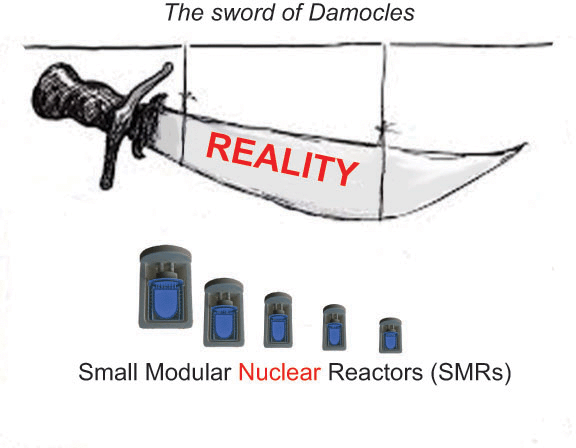 Is nuclear power the answer?, DECEMBER 8, 2020 JOHN QUIGGIN
The last (I hope) extract from the climate change chapter of Economic Consequences of the Pandemic. I’m in two minds about whether this is really needed. The group of pro-nuclear environmentalists seems to be shrinking towards a hard core who can’t be convinced (and some of them, like Shellenberger turn out to have been concern trolls all along). But every now and then I run across people who seem open-minded enough, but haven’t caught up with the bad news on nuclear.
Debates about decarbonizing electricity generation inevitably raise the issue of nuclear power. Since nuclear power generates no carbon dioxide emissions (except in the construction phase) it is a potential solution to climate change, with a strong body of advocates.
Some of this advocacy may be dismissed as point-scoring. Rightwing pundits who oppose any action on climate change simultaneously promote nuclear power as carbon free, with the aim of embarrassing environmentalist. There is, however, a small but vocal group of nuclear power advocates who are convinced that a massive expansion of nuclear power is the only way to replace coal-fired power………
Today the choice is not between new nuclear and new or existing coal. It is whether to allocate investment to building nuclear plants or to accelerating the shift to solar and wind energy.
The key problem is not safety but economics. New plants are safer and more sophisticated than those that failed in the past, but they are also massively more expensive to build, and quite costly to operate. The capital costs of recent projects in the US, France and Finland (none yet complete) have been around $10/kw, compared to $1/kw or less for solar. And, whereas solar PV is essentially costless to operate, the operating costs of nuclear power plants are around 2c/kwH. Even when solar PV is backed up with battery storage, it is cheaper to build and to operate, than new nuclear.
The facts speak for themselves. Over the last decade, only two or three reactors have commenced construction each year, not even enough to replace plants being retired. This isn’t the result of pressure from environmentalists or alarm about the safety of nuclear plants. The slowdown is evident in countries like China, where public opinion has little influence on policy decisions, and in countries where public opinion is generally favorable to new nuclear power. China failed to reach its 2020 target of 58 GW of installed power, and currently has only about 15 GW of nuclear power under construction. That compares to 55 GW of new solar and wind capacity installed in 2019 alone.
It is clear by now that large-scale nuclear reactors have no future. The last hope for nuclear power rests on Small Modular Reactors. The idea is that, rather than building a single large reactor, typically with a capacity of 1 GW, smaller reactors will be produced in factories, then shipped to the site in the required number. The leading proponent of this idea is Nuscale Power, which currently has a contract with UAMPS to supply a pilot plant with a dozen 60MW modules.
It remains to be seen whether SMR’s will work at all. Even if they do, it is not clear that the reduced costs associated with off-site manufacturing will offset the loss of the scale economies associated with a large boiler, let alone yield power at a cost competitive with that of solar PV.
In any case, the issue is largely irrelevant as far as the climate emergency is concerned. NuScale’s pilot plant, with a total capacity of 720 MW, is currently scheduled to start operation in 2029. Large-scale deployment will take at least a decade more .
If we are to have any chance of stabilising the climate, coal-fired power must be eliminated by 2030, and electricity generation must be decarbonized more or less completely by 2035. SMRs, if they work, will arrive too late to make a difference. ….https://johnquiggin.com/2020/12/08/is-nuclear-power-the-answer/#more-17451
Canada’s Coalition for Responsible Energy Development sceptical about Small Nuclear Reactors
Questions abound about New Brunswick’s embrace of small nuclear reactors
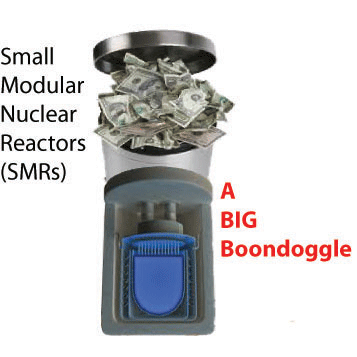 Critics question business case, but CEO says the market is ‘screaming’ for the units, Jacques Poitras · CBC News Dec 07, 2020
When Mike Holland talks about small modular nuclear reactors, he sees dollar signs.
When the Green Party hears about them, they see danger signs.
The loquacious Progressive Conservative minister of energy development recently quoted NB Power’s eye-popping estimates of the potential economic impact of the reactors: thousands of jobs and a $1 billion boost to the provincial economy.
“New Brunswick is positioned to not only participate in this opportunity, but to be a world leader in the SMR field,” Holland said in the legislature last month.
Green MLAs David Coon and Kevin Arseneau responded cheekily by ticking off the Financial and Consumer Services Commission’s checklist on how to spot a scam.
Is the sales pitch from a credible source? Is the windfall being promised by a reputable institution? Is the risk reasonable?
For small nuclear reactors, they said, the answer to all those questions is no.
“The last thing we need to do is pour more public money down the nuclear-power drain,” Coon said, reminding MLAs of the Point Lepreau refurbishment project that went $1 billion over budget. …….
Premier Blaine Higgs is a fervent supporter, but in the last provincial election the Liberals promised they’d do even more than Higgs to promote them.
Under Brian Gallant, the Liberals handed $10 million to two Saint John companies working on SMRs, ARC Nuclear and Moltex Energy.
Greens point to previous fiascoes
The Greens and other opponents of nuclear power fear SMRS are the latest in a long line of silver-bullet fiascoes, from the $23 million spent on the Bricklin in 1975 to $63.4 million in loans and loan guarantees to the Atcon Group a decade ago.
“It seems that [ARC and Moltex] have been targeting New Brunswick for another big handout … because it’s going to take billions of dollars to build these things, if they ever get off the drawing board,” said Susan O’Donnell, a University of New Brunswick researcher.
O’Donnell, who studies technology adoption in communities, is part of a small new group called the Coalition for Responsible Energy Development formed this year to oppose SMRs.

“What we really need here is a reasonable discussion about the pros and cons of it,” she said……..
What we didn’t see was a market analysis,” O’Donnell said. “How viable is the market? … They’re all based on a hypothetical market that probably doesn’t exist.”
O’Donnell said her group asked for the full report but was told it’s confidential because it contains sensitive commercial information………..
The market is screaming for this product,” Rory O’Sullivan, CEO of Moltex said, adding “all of the utilities” in Canada are interested in Moltex’s reactors ……
ARC’s CEO Norm Sawyer is more specific, guessing 30 per cent of his SMR sales will be in Atlantic Canada, 30 per cent in Ontario and 40 per cent in Alberta and Saskatchewan — all provincial power grids.
O’Donnell said it’s an important question because without a large number of guaranteed sales, the high cost of manufacturing SMRs would make the initiative a money-loser.
The cost of building the world’s only functioning SMR, in Russia, was four times what was expected.
An Australian government agency said initial cost estimates for such major projects “are often initially too low” and can “overrun.”
Up-front costs can be huge
University of British Columbia physicist M.V. Ramana, who has authored studies on the economics of nuclear power, said SMRs face the same financial reality as any large-scale manufacturing.
“You’re going to spend a huge amount of money on the basic fixed costs” at the outset, he said, with costs per unit becoming more viable only after more units are built and sold.
He estimates a company would have to build and sell more than 700 SMRs to break even, and said there are not enough buyers for that to happen. ….
O’Sullivan says: “In fact, just the first one alone looks like it will still be economical,” he said. “In reality, you probably need a few … but you’re talking about one or two, maximum three [to make a profit] because you don’t need these big factories.”
‘Paper designs’ prove nothing, says expert
Ramana doesn’t buy it.
“These are all companies that have been started by somebody who’s been in the nuclear industry for some years, has a bright idea, finds an angel investor who’s given them a few million dollars,” he said.
“They have a paper design, or a Power Point design. They have not built anything. They have not tested anything. To go from that point … to a design that can actually be constructed on the field is an enormous amount of work.
Both CEOs acknowledge the skepticism about SMRs.
“I understand New Brunswick has had its share of good investments and its share of what we consider questionable investments,” said ARC’s CEO Norm Sawyer….
But he said ARC’s SMR is based on a long-proven technology and is far past the on-paper design stage “so you reduce the risk.”
Moltex is now completing the first phase of the Canadian Nuclear Safety Commission’s review of its design, a major hurdle. ARC completed that phase last year.
But, Ramana said there are problems with both designs. Moltex’s molten salt model has had “huge technical challenges” elsewhere while ARC’s sodium-cooled system has encountered “operational difficulties.” …..
federal Natural Resources Minister Seamus O’Regan told CBC earlier this year that he’s “very excited” about SMRs…..
O’Donnell said while nuclear power doesn’t emit greenhouse gases, it’s hardly a clean technology because of the spent nuclear fuel waste.
Government support is key
She also wonders why, if SMRs make so much sense, ARC and Moltex are relying so much on government money rather than private capital.
…….. So far, Ottawa hasn’t put up any funding for ARC or Moltex. During the provincial election campaign, Higgs implied federal money was imminent, but there’s been no announcement in the almost three months since then.
Last month the federal government announced $20 million for Terrestrial Energy, an Ontario company working on SMRs.
…….O’Donnell said her group plans to continue asking questions about SMRs.
“I think what we really need is to have an honest conversation about what these are so that New Brunswickers can have all the facts on the table,” she said. https://www.cbc.ca/news/canada/new-brunswick/questions-small-nuclear-reactors-1.5828784
Nuclear powered electric vehicles? not existing, and not likely
|
One promising option, according to scientists at Argonne National Laboratory, is small nuclear reactors. Engineer Derek Kultgen is leading efforts at Argonne to develop a microreactor — about the size of two home water heaters — that is specifically designed to charge electric trucks at rest stops across the country lacking EV charging stations………… One promising, carbon-free charging option, according to scientists at Argonne National Laboratory, is small nuclear reactors………. Small nuclear reactors could be ideal for e-truck charging, he said……. In August, the Nuclear Regulatory Commission issued a final safety evaluation report endorsing NuScale Power’s small modular nuclear reactor design (Greenwire, Aug. 31). ……. Critics, however, say there’s insufficient evidence that small reactors are safer than nuclear power plants. It could also take years before they’re ready to be deployed, whereas new solar and wind resources could be built much more quickly. The microreactor being designed at Argonne, for example, is not being planned for construction at this point. NuScale’s design is the first to gain approval by the NRC, and even that project is still more than one year away from coming online, said Edwin Lyman, director of nuclear power safety at the Union of Concerned Scientists. Many proposed microreactor applications — including this one from Argonne — are inappropriate uses of nuclear energy, according to Lyman. “The Department of Energy is desperately trying to think of applications for all sorts of nuclear reactors, no matter how improbable or impractical they are, and I think this is a good example,” he said…….. Cost, security questionsWhile the concept is worth considering as a potential charging tool, some issues would need to be addressed before truck stop microreactors could become a reality, said Rick Mihelic, director of emerging technologies at the North American Council for Freight Efficiency. Opposition to nuclear power could delay the distribution of the microreactors, he said. A network of microreactors would also add to the country’s nuclear waste problem, for which there is no permanent disposal solution. It could be difficult to make the microreactors economical as well. To overcome that barrier, the researchers would need to find a way to mass-produce them, Buongiorno said. “If they are deployed each a little differently, each built at a different location with a different workforce, then achieving good economics may prove hopeless,” he said. Opposition to nuclear power could delay the distribution of the microreactors, he said. A network of microreactors would also add to the country’s nuclear waste problem, for which there is no permanent disposal solution. It could be difficult to make the microreactors economical as well. To overcome that barrier, the researchers would need to find a way to mass-produce them, Buongiorno said. “If they are deployed each a little differently, each built at a different location with a different workforce, then achieving good economics may prove hopeless,” he said……. https://www.eenews.net/stories/1063719531 |
|
Microwave Radiation ‘Most Plausible’ Cause Of Diplomats’ Ailments
Microwave Radiation ‘Most Plausible’ Cause Of Diplomats’ Ailments, Report Says, NPR
|
December 6, 2020
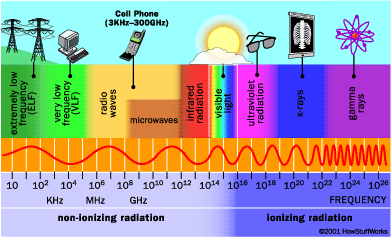
Heard on Morning Edition Microwave radiation is the “most plausible” cause of migraines, dizziness, memory loss and other ailments that dozens of U.S. diplomats have complained of while serving in Cuba and China, a new report says.
Since 2016, the so-called Havana syndrome has afflicted more than 40 U.S. diplomats at the U.S. Embassy in the Cuban capital and at least a dozen more at the U.S. Consulate in Guangzhou, China. At the request of the State Department, the National Academies of Sciences, Engineering, and Medicine investigated and produced a 64-page report. “The committee [of experts] felt that many of the distinctive and acute signs, symptoms, and observations reported by the Department of State employees are consistent with the effects of directed, pulsed, radiofrequency energy,” the report said. Radiofrequency energy includes radio waves and microwaves. “What we can say is that something real and significant clinically happened to these people,” Dr. David Relman, a Stanford University professor who led the study, said in an interview with NPR. “At least some, if not many, of the signs and symptoms that were reported in these patients can be explained by this particular form of microwave radiation,” he added. The report noted that individual cases varied but that many diplomats described a common pattern: The sudden onset of a perceived loud sound, a sensation of intense pressure or vibration in the head, and pain in the ear or more diffusely in the head. Most individuals reported that the sound or these other sensations seemed to originate from a particular direction and were perceived only when the individual was in a specific physical location. Some also reported sudden onset of tinnitus, hearing loss, dizziness, unsteady gait, and visual disturbances.” Some of the diplomats have complained that the State Department has been slow or reluctant to provide sufficient support. A number of them have retired, saying their ailments were so debilitating they could no longer work. ………https://www.npr.org/2020/12/06/943531538/microwave-radiation-most-plausible-cause-of-diplomats-ailments-report-says |
Russian Ambassador to U.S. Sees Hope for Nuclear Arms Treaty Extension
He said several times during the forum that the Kremlin has been pushing the White House on an extension of its terms but has not received a formal answer.
The whole world depends on the United States-Russia relationship.”
On START, he added, “we need time to work out new security agreements” that cover a range of issues from missile defense, intermediate-range missiles, hypersonics and potential space weapons. For this reason, Russia has offered to extend the treaty’s term for up to five years “without pre-conditions.”
The United States wants China to be part of any new START negotiations, but Antonov said Beijing is “not happy with such an invitation.” The ambassador said Moscow wants the United Kingdom and France, both nuclear powers and NATO members, to be involved if the talks are broadened……. https://news.usni.org/2020/12/07/russian-ambassador-to-u-s-sees-hope-for-nuclear-arms-treaty-extension
For the first time ever, a Japanese court rules against a government approval on nuclear safety
 Japan court nixes approval of post-Fukushima nuclear safety steps, KYODO NEWS – Dec 4, 2020 ,
A Japanese court on Friday, for the first time, revoked the government’s approval of operating a nuclear plant under new safety regulations developed in the wake of the 2011 Fukushima nuclear disaster.
The Osaka District Court ruled in favor of about 130 plaintiffs who claimed that the Nos. 3 and 4 reactors of Kansai Electric Power Co.’s Oi nuclear plant in Fukui Prefecture are vulnerable to a major earthquake.
A Japanese court on Friday, for the first time, revoked the government’s approval of operating a nuclear plant under new safety regulations developed in the wake of the 2011 Fukushima nuclear disaster.
The Osaka District Court ruled in favor of about 130 plaintiffs who claimed that the Nos. 3 and 4 reactors of Kansai Electric Power Co.’s Oi nuclear plant in Fukui Prefecture are vulnerable to a major earthquake.
In the ruling, Presiding Judge Hajime Morikagi said the Nuclear Regulation Authority’s safety screening “has errors and flaws that should not be overlooked” as its estimates needed to factor in a potentially much larger earthquake around the plant…..
It is the first time a Japanese court has withdrawn government approval granted to a power company to operate a nuclear plant under the safety standards set in 2013 following the meltdowns at the Fukushima Daiichi power plant triggered by a major earthquake and ensuing tsunami.
While the two reactors in Oi in the central Japan prefecture have been idle due to regular inspections since earlier this year, the ruling will not take effect if the NRA appeals the decision.
But the ruling may have an impact on the operations of not only the nuclear plant on the Sea of Japan coast but also other reactors in the country that went back online under the new rules…….
The utility, meanwhile, has decided to decommission the aging Nos. 1 and 2 reactors at the Oi plant. https://english.kyodonews.net/news/2020/12/8c717cf8568d-urgent-japan-court-nullifies-approval-of-oi-nuclear-reactor-safety-steps.html
France and European Union have not yet agreed on nuclear reform
France yet to agree with EU over nuclear reform: official, By Gwénaëlle Barzic-PARIS (Reuters) 7 Dec 20, – France and the European Union are yet to reach a firm agreement over Paris’s plans for a reform of its nuclear industry, an Elysee presidential palace official said on Monday, amid talks that will entail a reorganisation of power group EDF.
The talks between France and the European Commission include the ARENH price mechanism under which competitors can get access to nuclear energy produced by EDF. Because EDF is a state-owned utility, the EU has a say on its reform on competition grounds.
The looming reform, which would see EDF’s nuclear business separated from others such as renewable energy, has already raised hackles among labour unions, fearful that a split will have consequences for jobs.
“There is not yet an agreement with the Commission on some of the key parametres,” an official with the Elysee presidential palace said, speaking ahead of President Emmanuel Macron’s visit to a nuclear equipment factory run by a EDF subsidiary Framatome on Tuesday.
The official said it was too soon to say when the new legislation on the nuclear sector could emerge.
France is due to cut its reliance on nuclear energy from 75% to 50% by 2035, but must also decide by 2023 whether to commission next generation EPR reactors.
The government will be seeking more information from EDF by the middle of next year about the cost, timeframe and feasibility of new projects, the Elysee official said.
Concerns about Holtec taking ownership of Palisades nuclear plant – public meeting this week

 Public meeting about ownership change for Palisades nuclear plant comes this week, By STEVE CARMODY • DEC 6, 2020
This week, federal regulators will hold a public meeting to discuss plans to transfer the operating license for the Palisades nuclear power plant.
Entergy Corp. agreed to sell the aging nuclear plant in southwest Michigan to Holtec Intl. in 2018. ………
If the Nuclear Regulatory Commission approves the license transfer, the Camden, New Jersey based company will oversee the decommissioning of Palisades starting in 2022.
“The problem with Holtec is they’re going to try to do as little clean up as they can get away with,” says Kevin Kamps with Beyond Nuclear, a nuclear waste watchdog, “They’re going to take as many short cuts on high level waste management as they can get away with…and then pocket all the remaining money.”
Kamp wants to see state and local officials play a greater role in decommissioning plans and potential future uses for the site on the shores of Lake Michigan.
Legislation to create a “Nuclear Decommissioning Citizens Advisory Panel” has stalled in a state House committee. …..https://www.michiganradio.org/post/public-meeting-about-ownership-change-palisades-nuclear-plant-comes-week
This week’s nuclear news

The big news worldwide continues to be about the coronavirus, which is still raging in many countries, especially in the USA. Meanwhile the race to develop and implement vaccines is already on.
Today’s Google headlines on nuclear issues – weapons and Iran dominate the stories.
The global energy revolution.
Correcting 5 wrong opinions about the Treaty on the Prohibition of Nuclear Weapons. Living with the Nuclear Prohibition Treaty: nuclear weapons states would be unwise to attack it.
Nuclear power hinders fight against climate change.
Standard nuclear reactor designs are still too costly, and safety features are only a third of nuclear costs.
Solar energy is bullish in the market; the same can’t be said for nuclear.
The creeping carbon costs of digital communication.
Book review: The Case for Degrowth.
Extradition hearing of Julian Assange – defence witnesses destroy myths, demonstrate his integrity
JAPAN. Japanese local governments depend on “nuclear money”. Destructive potential of over a million tons of radioactive water into the Pacific. Fukushima nuclear reactor no.1 – debris prevented from falling into fuel storage pool. Nuclear disaster: Fukushima schools frozen in time. Survey finds that most Fukushima evacuees do not intend to return. No. 2 reactor at Tohoku Electric Power Co’s Onagawa nuclear power plant for restart, despite problems. Surveys to identify nuclear waste disposal site begin in Hokkaido.
TAIWAN. Taiwanese protest plan to dump water from Japan nuclear plant into sea.
UK
- Depressing news for the nuclear lobby in UK, Western Europe – Boris Johnson’s government adding nuclear power to its long list of failures. UK government losing enthusiasm for new nuclear power stations, as grim financial realities set in.
- Cheap and effective, but solar energy is omitted from UK govt’s 10 point plan. Mayor of London announces solar and energy efficiency projects funded by ‘Green New Deal’.
- Large and small nuclear reactors should not be included in UK’s ‘clean, green’ 10 point plan. Inaccuracies in Boris Johnson’s document # supporting nuclear power development. [ Norton anti-virus has decided that this, by respected Dr David Lowry, is a suspicious site ] Britain’s enthusiasm for nuclear power stations is waning.
- The Irish sea – plagued by dumped munitions and radioactive trash.
- British govt’s foolhardy plan to pay up for non existent Rolls Royce small nuclear reactors. UK government wastes tax-payer money on small and large nuclear reactors that will never be cheap or safe.
- Sizewell C nuclear plant ‘not value for money’, and would sabotage the govt’s pledge for nature. Destruction of habitat, Coronation Wood to be felled, for Sizewell C nuclear project, British govt produced no evidence that nuclear plants are essential, in secret deals for the convenience of the nuclear industry.
- 30-day public consultation about UK’s Sizewell nuclear reactor project. Bankrupt AREVA, resuscitated as ‘Framatome’, joins the the Sizewell C nuclear build Consortium. £525 million pledged to build UK small nuclear reactors, no funding package yet revealed for £20 billion Sizewell plant. UK government’s plans for Sizewell and Wylfa nuclear stations are wavering, with doubts about costs.
- Hazardous plan for Peel Ports to take over the decommissioning of Britain’s dead nuclear submarines .
- Hinkley Point B nuclear reactor offline now, and will be shut down earlier than planned. Both Hinkley Point B and Hunterston B nuclear power stations will close early due to cracks in graphite cores. £132billion and counting –
- Britain’s nuclear decommissioning mess could take 120 years. British MP’s continue to botch it in the ever more costly saga of Britain’s “old” nukes and “new” nukes. UK tax-payers foot huge bill for incompetence of Nuclear Decommissioning Authority (NDA). UK’s beautiful Lake District – no “final solution” for the nuclear waste problem..
USA.
- Could a mad, unhinged US president, push the nuclear button? The Biden- Harris administration can change nuclear weapons policy, make it safer, and much cheaper. President Joe Biden will have just 16 days from Inauguration Day to rescue the new START Treaty
- Beware the “madness of militarism” – Biden likely to appoint war-loving Michèle Flournoy as Defense Secretary.
- Trump still has the awesome power to launch America’s nuclear arsenal. It is likely that Trump gove the nod for assassination of Iran nuclear scientist. European security officials fear that Trump may trigger a war against Iran. Trump’s Impact on Nuclear Proliferation, Treating Foreign Policy as a Business. Trump administration pulls out of Open Skies treaty with Russia.
- For Joe Biden – an early trial problem – the UN Treaty on the Prohibition of Nuclear Weapons. How a nuclear weapons officer came to support the Treaty Prohibiting Nuclear Weapons. A New U.S. Missile Defense Test May Have Increased the Risk of Nuclear War. Closer to nuclear war – as USA tests ICBM intercept. Resuming nuclear testing is unnecessary — and unsafe Investigative journalism – Joe Biden’s ” transition team”includes men with strong links to the weapons industry. With Joe Biden in Charge, No More Flashy Kim Jong Un Summits.
- Prison, big fines, for Catholic anti nuclear activists. Anti-Nuclear Pacifists Get Federal Prison Terms for Nonviolent Protest.
- A mock B61-12 nuclear bomb dropped for the first time. USA revives plan for fast reactor, despite terrorism risks .
- USA looks to get $18billion now, maybe $40billion later, in flogging off nuclear reactors to Poland.
- Former CEO of failed V.C. Summer nuclear project pleads guilty to fraud charges. Ohio Attorney General Dave Yost has filed a second lawsuit to stop bailout of nuclear reactors. Ohio likely to require nuclear reactor audit before renewing bailout.
- 30 more years for Wisconson’s old nuclear power station? Is this a good idea?
- Dismantling Duke Energy’s Crystal River nuclear plant.
- Unanswered questions cloud the future of NuScam’s Small Modular Nuclear Reactor project. Concerns in Utah cities about costs and safety of NuScam’s small nuclear reactor scheme.
- The intractible problem of San Onofre’s, and indeed, America’s, nuclear waste. NRC approves financially dodgy sale of Indian Point Nuclear Station to Holtec. Lack of safety documents in Los Alamos National Laboratory’s handling of radioactive wastes. Waste Isolation Pilot Plant – building of ventilation shaft is halted, due to Covid-19 and planning problems. Slowly moving lawsuit on the health impacts of a national nuclear laboratory.
- Danger to San Onofre nuclear waste, from ocean’s king tides. Why we shouldn’t be talking about nuclear waste “disposal”.
INDIA. Cybersecurity breach at Kudankulam Nuclear Power Plant (KKNPP) undetected for over 6 months.
EUROPE. The effect on Europe of the UN Treaty on the Prohibition of Nuclear Weapons.
FRANCE. Extended shutdown for work on Flamanville nuclear reactor build. Greenpeace launches legal appeal against French nuclear safety authority allowing extension of lifetime of nuclear reactors. Concern in France over lack of expert inspection of nuclear sites. Orano, formerly Areva, targeted by judicial investigation for corruption. Corruption investigation into AREVA’s sale of Nigerian uranium. New comic book investigates the dilemma about France’s nuclear wastes.
CANADA. Canada’s environmental groups join to oppose experimental Small Nuclear Reactors (SMRs). Small Modular Nuclear Reactors, the nuclear industry’s latest pipe dream. Canadian government’s misplacing funding into unviable small nuclear reactors for North West Territories. Safety dangers of small modular nuclear reactors (SMRs). In the face of public opposition, Ottawa delays small nuclear reactor plan. Ontario could get clean renewable energy from neighbouring provinces, with no need for nuclear power.
IRAN. Architect of its nuclear programme assassinated – Iran vows retaliation. Tehran’s UN ambassador says rival Saudi Arabia is looking for an excuse to build nuclear weapons and blaming Iran. Iran admits breach of nuclear deal discovered by UN inspectorate. Iran slams European criticism on expanding nuclear programme. What’s behind the assaisnation of Iran’s top nuclear scientist?
BANGLADESH. Bangladesh draws up a nuclear disaster response plan.
GERMANY. Uranprojekt –The Nazi Nuclear Program.
RUSSIA. Russia’s latest nuclear icebreaker had to abort maiden Arctic voyage. Russia claims to have successfully tested an “unstoppable” nuclear missile.
UKRAINE. First canister of used nuclear fuel loaded into Chernobyl storage facility. Comprehensive research now shows that irradiated areas near Chernobyl have fewest mammals.
SAUDI ARABIA. Saudi minister says nuclear armament against Iran ‘an option’.
NORTH KOREA. North Korea sparks new nuclear weapons fears.
ROMANIA. European Commission approves Romania’s purchase of nuclear reactors.
RWANDA.. Growing opposition to nuclear power in Rwanda
AUSTRALIA Victorian Parliament: Legislative Council Committee finds that nuclear ban should stay. Victorian Government Inquiry confirms that there is no future in nuclear power. Inquiry confirms nuclear energy’s ‘proven risks’. Victorian Inquiry finds nuclear power costly and risky.
Britain’s nuclear industry is greatly threatened by climate change
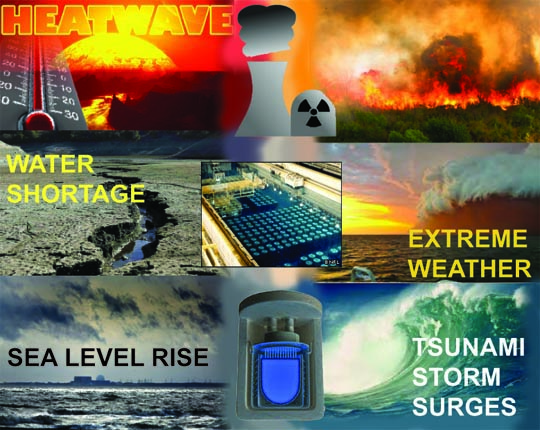
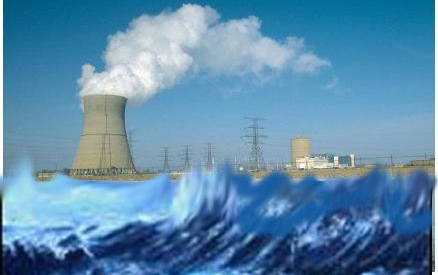 The next ‘Great Tide’, Exposed to rising tides and storm surges, Britain’s nuclear plants stand in harm’s way, Beyond Nuclear International, By Andrew Blowers, 4 Dec 20,
“……………….Apart from Hinkley Point C, which will probably struggle on through a combination of political inertia and a nuclear ideology increasingly remote from economic reality, there remain two projects – Sizewell C and Bradwell B – still in the frame, although precariously so. For both sites, climate change may prove the showstopper. These coastal, low-lying sites are highly vulnerable to the impacts of climate change, including sea level rise, flooding, storm surges, and coastal processes.
This was recognised as an issue in the rather equivocal statement that accompanied designation of the sites in 2011. Referring to Bradwell (similarly to Sizewell), it was considered ‘reasonable to conclude that any likely power station development within the site could potentially be protected against flood risk throughout its lifetime, including the potential effects of climate change, storm surge and tsunami, taking into account possible countermeasures’. …..
About a quarter of the world’s nuclear power stations are on coasts or estuaries. The sites on the east coast and Severn Estuary are especially vulnerable to flooding, tidal surges, and storms. Potential impacts include loss of cooling and problems of access and emergency response in the event of a major incident and inundation of the plant, including spent fuel storage facilities.
In areas like the east coast of England, natural protection from saltmarshes, mudflats, shingle beaches, sand dunes and sea cliffs has been rapidly declining. Recent projections indicate substantial parts of the coast below annual flood level in 2100 and a loss of between a quarter and a half of the UK’s sandy beaches, leading to extensive inland flooding. The problems of managing such coasts through adaptive measures such as managed realignment and hard defenses may be insuperable in the uncertain circumstances of climate change over the next century. It seems imprudent and irresponsible to contemplate development of new nuclear power stations in conditions which may become intolerable.
Climate predictions have focused especially on the period up to the end of the century, by which time planned new nuclear power stations starting up in the 2030s will only just have ceased operating. At the turn of the next century the legacy of today’s new build will become the decommissioning wastes of tomorrow, adding to that already piled up in coastal locations. ……
Beyond 2100 sea levels continue rising and the radioactive legacy of new nuclear power stations will remain at the sites, in reactor cores and in spent fuel and waste stores exposed to the destructive processes of climate change. It is predicted that decommissioning and clean-up of new build sites will last for most of the next century.
The logistics, let alone the cost of transplanting, decommissioning and decontaminating the redundant plant and wastes to an inland site, if one could be found, would be well beyond the range of managed adaptation. The government’s claim that it ‘is satisfied that effective arrangements will exist to manage and dispose of the wastes that will be produced from new nuclear power stations’ is an aspiration, and by no means a certainty……..https://wordpress.com/read/feeds/72759838/posts/3061243158
1 This Month
Chernobyl: The Lost Tapes – A good documentary on Chernobyl on SBS available On Demand for the next 3 weeks– https://www.sbs.com.au/ondemand/tv-program/chernobyl-the-lost-tapes/2352741955560

of the week–London Campaign for Nuclear Disarmament

Tell the Ukrainian Government to Drop Prosecution of Peace Activist Yurii Sheliazhenko
To see nuclear-related stories in greater depth and intensity – go to https://nuclearinformation.wordpress.com
-
Archives
- April 2026 (126)
- March 2026 (251)
- February 2026 (268)
- January 2026 (308)
- December 2025 (358)
- November 2025 (359)
- October 2025 (376)
- September 2025 (257)
- August 2025 (319)
- July 2025 (230)
- June 2025 (348)
- May 2025 (261)
-
Categories
- 1
- 1 NUCLEAR ISSUES
- business and costs
- climate change
- culture and arts
- ENERGY
- environment
- health
- history
- indigenous issues
- Legal
- marketing of nuclear
- media
- opposition to nuclear
- PERSONAL STORIES
- politics
- politics international
- Religion and ethics
- safety
- secrets,lies and civil liberties
- spinbuster
- technology
- Uranium
- wastes
- weapons and war
- Women
- 2 WORLD
- ACTION
- AFRICA
- Atrocities
- AUSTRALIA
- Christina's notes
- Christina's themes
- culture and arts
- Events
- Fuk 2022
- Fuk 2023
- Fukushima 2017
- Fukushima 2018
- fukushima 2019
- Fukushima 2020
- Fukushima 2021
- general
- global warming
- Humour (God we need it)
- Nuclear
- RARE EARTHS
- Reference
- resources – print
- Resources -audiovicual
- Weekly Newsletter
- World
- World Nuclear
- YouTube
-
RSS
Entries RSS
Comments RSS
 nuclear-news