United Arabs Emirate’s nuclear power station cut corners on safety
Al Jazeera 1st Aug 2020, Paul Dorfman, an honorary senior research fellow at the Energy Institute,
University College London and founder and chair of the Nuclear Consulting
Group, has criticised the Barakah reactors’ “cheap and cheerful” design
that he says cuts corners on safety.
Dorfman authored a report (PDF) last
year detailing key safety features Barakah’s reactors lack, such as a “core
catcher” to literally stop the core of a reactor from breaching the
containment building in the event of a meltdown. The reactors are also
missing so-called Generation III Defence-In-Depth reinforcements to the
containment building to shield against a radiological release resulting
from a missile or fighter jet attack. Both of these engineering features
are standard on new reactors built in Europe, says Dorfman.
French company EDF fined – it spread false information on cost of Hinkley nuclear power project
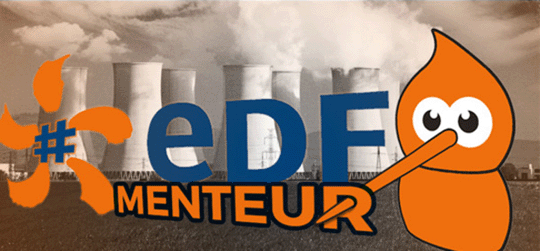 Bunham-on-sea.com 1st Aug 2020, The French market watchdog has levelled a £4.5m fine against energy giant
EDF for misleading investors about the cost of the Hinkley Point C nuclear
project. Regulators say the French state-owned energy company spread
“false information” about its agreement with the Government to build
the nuclear plant near Burnham-On-Sea.
AMF, France’s financial markets
authority, says the company may have set EDF’s share price “at an
abnormal or artificial level” by claiming in a news release dated October
2014 that the terms of its deal with the UK government were “unchanged”
from the 2013 agreement.
Chinese minority owner of Hinkley nuclear project appoints CEO from China’s military area
New head of Chinese investor in Hinkley nuclear plant brings military links
China General Nuclear’s role in the Hinkley Point C nuclear power station has come under scrutiny recently
Telegraph ByEd Clowes1 August 2020 China General Nuclear, the
minority owner of the Hinkley Point C power station, has appointed a chairman with close ties to the Chinese Communist Party and the country’s military nuclear programme.
leader of the state-owned conglomerate last week, speaking on the virtues
of Communism and the value of a strong nuclear industry. He previously
served as deputy general manager at China National Nuclear Corporation, the
organisation responsible for developing the country’s nuclear weapons.
and called on his colleagues to build a company that was more infused with
Communist ideals.
strategy held at its own university, which is designated as an official
Communist Party school. Mr Changli spoke of “in-depth implementation of
general secretary Xi Jinping’s important expositions on high-quality
development”, and said: “We must be good commanders and good
combatants.” CGN owns a 33.5pc stake in the £22.5bn Hinkley Point C
project in Somerset where it has partnered with EDF, the French energy
giant.
Westminster and stoke speculation that the civil nuclear company will be
merged with CNNC.https://www.telegraph.co.uk/business/2020/08/01/new-head-chinese-investor-hinkley-nuclear-plant-brings-military/
Who flew drones over the nuclear reactors?
|
Mystery at Arizona’s Palo Verde nuclear plant: Who flew drones over the reactors? AZ Central,
Ryan RandazzoArizona Republic, Security guards at Palo Verde Nuclear Generating Station west of Phoenix noticed something odd on a September night last year.Five or six drones buzzed over the perimeter fence of the nuclear plant— the largest power generator in the United States — 50 miles west of Phoenix. They went across the open desert where security guards practice “force-on-force” simulated combat drills to sharpen their skills to ward off an assault, over heavy-duty gates and arrived at the protected area around the concrete-domed reactors. They stayed for nearly an hour, and came back the next night for a repeat performance. Nobody except the drones’ pilots knows whether this was a case of hobbyists touring the plant out of curiosity, or something much more nefarious, intended to disrupt a massive power source for customers from Texas to California. And nobody in any official capacity seems to know who piloted the drones that night or the next……… Security guards at Palo Verde Nuclear Generating Station west of Phoenix noticed something odd on a September night last year. Five or six drones buzzed over the perimeter fence of the nuclear plant— the largest power generator in the United States — 50 miles west of Phoenix. They went across the open desert where security guards practice “force-on-force” simulated combat drills to sharpen their skills to ward off an assault, over heavy-duty gates and arrived at the protected area around the concrete-domed reactors. They stayed for nearly an hour, and came back the next night for a repeat performance. Nobody except the drones’ pilots knows whether this was a case of hobbyists touring the plant out of curiosity, or something much more nefarious, intended to disrupt a massive power source for customers from Texas to California. And nobody in any official capacity seems to know who piloted the drones that night or the next……… Security guards at Palo Verde Nuclear Generating Station west of Phoenix noticed something odd on a September night last year. Five or six drones buzzed over the perimeter fence of the nuclear plant— the largest power generator in the United States — 50 miles west of Phoenix. They went across the open desert where security guards practice “force-on-force” simulated combat drills to sharpen their skills to ward off an assault, over heavy-duty gates and arrived at the protected area around the concrete-domed reactors. They stayed for nearly an hour, and came back the next night for a repeat performance. Nobody except the drones’ pilots knows whether this was a case of hobbyists touring the plant out of curiosity, or something much more nefarious, intended to disrupt a massive power source for customers from Texas to California. And nobody in any official capacity seems to know who piloted the drones that night or the next……. The Palo Verde incidents are apparently not the first time something like this has happened. One NRC email discusses “several high-speed” drone overflights of the Limerick Generating Station in Pennsylvania approximately eight months prior. Another indicates there had been 42 drone incidents in three years. APS officials said some of those were at Palo Verde. What if the pilots meant harm?At least one person in the NRC was concerned last year that an airspace restriction from the FAA wasn’t sufficient. “I would point out that restricted airspace will do nothing to stop an adversarial attack and even the detection systems identified earlier in this email chain have limited success rates, and there is even lower likelihood that law enforcement will arrive quickly enough to actually engage with the pilots,” wrote Joseph Rivers, a senior security adviser with the Nuclear Regulatory Commission who recently retired…… A columnist for Forbes went even further, speculating that the drones could have made three-dimensional maps of the power plant to assist a later attack. …… https://www.azcentral.com/story/money/business/energy/2020/07/31/drones-flew-over-palo-verde-nuclear-plant-arizona-pilots-unknown/5551928002/ |
|
|
BOOKS on The New Nuclear Threat
|
|



The WHO says coronavirus is a once-in-a century crisis that will impact lives for decades
Deaths from coronavirus as at early August 2020
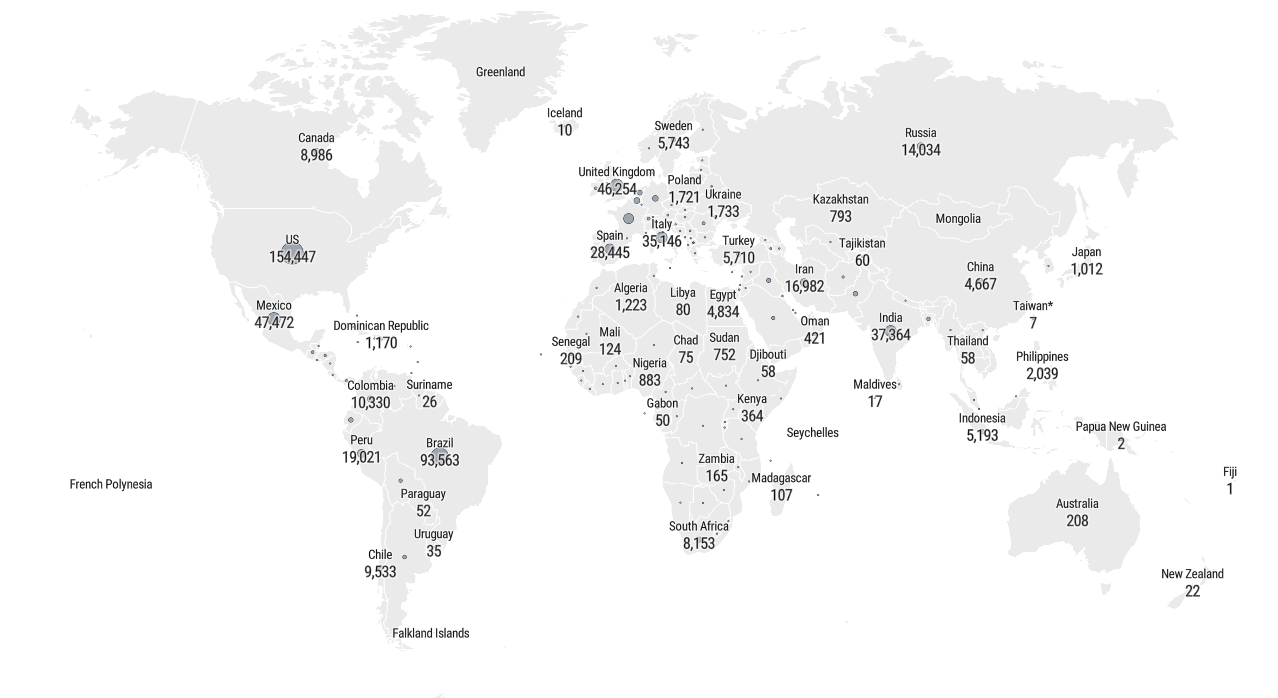
The WHO says coronavirus is a once-in-a century crisis that will impact lives for decades, SBS World News, 2 Aug 20, The World Health Organization committee “highlighted the anticipated lengthy duration of this COVID-19 pandemic”.
The World Health Organization has warned the coronavirus pandemic is likely to be “lengthy” after its emergency committee met to evaluate the crisis six months after sounding the international alarm.
The committee “highlighted the anticipated lengthy duration of this COVID-19 pandemic”, the WHO said in a statement, and warned of the risk of “response fatigue” given the socio-economic pressures on countries.
The panel gathered Friday for the fourth time over the coronavirus crisis, half a year on from its January 30 declaration of a public health emergency of international concern (PHEIC) – the WHO’s highest level of alarm………
Warning over crisis fatigue
Several countries around the world have imposed strict lockdowns in a bid to control the spread of the respiratory disease, plunging economies into sharp contraction.
The committee urged the WHO to provide nuanced, pragmatic guidance on COVID-19 management “to reduce the risk of response fatigue in the context of socio-economic pressures”.
The panel urged the WHO to support countries in preparing for the rollout of proven therapeutics and vaccines.
Warning over crisis fatigue
Several countries around the world have imposed strict lockdowns in a bid to control the spread of the respiratory disease, plunging economies into sharp contraction.
The committee urged the WHO to provide nuanced, pragmatic guidance on COVID-19 management “to reduce the risk of response fatigue in the context of socio-economic pressures”.
The panel urged the WHO to support countries in preparing for the rollout of proven therapeutics and vaccines.
It called for improved understanding of the epidemiology and severity of COVID-19, including its long-term health effects.
And the committee wanted more light shed on the dynamics of the virus, such as “modes of transmission, shedding, potential mutations; immunity and correlates of protection”.
The near six-hour gathering was hosted at the WHO’s headquarters in Geneva, with some participants joining via video-link.
The committee will reconvene within the next three months……..https://www.sbs.com.au/news/the-who-says-coronavirus-is-a-once-in-a-century-crisis-that-will-impact-lives-for-decades
The potential for a new coronoavirus, with bats as a possible transmitter
The next coronavirus may already be circulating in bats, study suggests, by Tom Avril, Philadelphia Inquirer, While the exact origin of the coronavirus remains murky, scientists have been racing to determine how it jumped from animals to humans so they can prevent another pandemic.
The next one could just be a matter of time, a study published this week suggests. The authors said a virus with similar ability to infect humans may already be out there, carried by a type of bats known for having horseshoe-shaped “leafs” on their noses.
Scientists made that prediction after constructing a family tree of the coronavirus — tracing its ancestry by comparing its genetic code with that of other coronaviruses found in bats, humans, and a scaly animal called the pangolin.
The lineage of the virus that causes COVID-19 appears to have branched off from its closest viral relatives about 40 to 70 years ago, the authors wrote in Nature Microbiology. And other viruses in the same branch of the family likely share a similar ability to latch onto cells in human airways, said Maciej F. Boni, a Pennsylvania State University biologist and lead study author.
“It’s very likely there are lots of other lineages that nobody knows about, because nobody has sampled, that are circulating quietly in bats,” he said. “Potentially all of them could have this ability to infect human cells.”……
by using a battery of statistical techniques, the scientists identified three genetic regions in the coronavirus that appeared to have remained intact for decades. They identified the same three regions in another coronavirus that came from a bat found in Yunnan, a province in southern China near Laos.
That virus cannot infect humans but is otherwise highly similar to the one causing the pandemic, which was first identified in human patients in the city of Wuhan. The two viruses seem to have branched apart in the family tree sometime in the 1960s, and almost certainly have undiscovered cousins with the potential to infect humans, said Boni, who collaborated with scientists in Europe and China…….
By itself, the presence of similar coronaviruses in bats would not mean another pandemic is imminent, said Kevin Olival, vice president for research at EcoHealth Alliance, a nonprofit that works with scientists worldwide to protect people and animals from infectious disease…….
What is not in dispute is that viruses have been jumping from animals to humans for centuries, and that it will happen again.
And coronaviruses carried by bats are a prime suspect.
Sure enough, as the world now knows too well, that came true. https://www.inquirer.com/health/coronavirus/covd19-bats-china-virus-origin-penn-state-rna-genetics-20200729.html
United Arab Emirates new nuclear power risks further destabilising the Gulf region
destabilizing the volatile Gulf region, damaging the environment and
raising the possibility of nuclear proliferation,” Paul Dorfman, a
researcher at University College London’s Energy Institute, wrote in an
op-ed in March. Noting that the U.A.E. had other energy options, including
“some of the best solar energy resources in the world,” he added that
“the nature of Emirate interest in nuclear may lie hidden in plain sight
— nuclear weapon proliferation.”
https://www.nytimes.com/2020/08/01/world/middleeast/uae-nuclear-Barakah.html
Costs of Vogtle nuclear expansion just keep going up, Coronavirus making this worse
Costs of nuclear expansion at Georgia power plant spiking, Sun Herald, THE ASSOCIATED PRESS, AUGUST 01, 2020 ATLANTA
The costs of expanding Georgia Power’s nuclear plant are growing, and at least part of the price hike is tied to the coronavirus outbreak and the rising number of workers diagnosed with the COVID-19 disease.
Southern Company, the Atlanta-based parent company for Georgia Power, forecasts it will cost $149 million more than previous projections for its share of expanding Plant Vogtle, which was already billions of dollars over its original budget and years behind schedule.
The Atlanta Journal-Constitution reports the company said Georgia Power could eventually ask state regulators to charge customers for the latest price tag increase.
Southern Company said the pandemic continues to affect work at Vogtle……. https://www.sunherald.com/news/business/article244660932.html
Gorbachev renews call to oppose nuclear weapons
Gorbachev renews call to oppose nuclear weapons Asahi Shimbun
August 1, 2020 A message to participants of the International Symposium for Peace 2020 “The Road to Nuclear Weapons Abolition” on Aug. 1, 2020, at Nagasaki
Dear participants of the symposium,
Dear Nagasaki Mayor Taue,
Dear representatives of The Asahi Shimbun,
To my important colleagues and friends,
I feel very happy to be able to address all of you taking part in this symposium seeking a world without nuclear weapons. It is symbolic that this meeting is taking place in the city of Nagasaki. Like Hiroshima, Nagasaki 75 years ago suffered great damage from the atomic bomb explosion, which killed tens of thousands of victims and left behind people with disabilities on the scorched earth. I once visited the city, and those memories have remained with me until now………. http://www.asahi.com/ajw/articles/13584606
Experts wonder why Oil-rich UAE is opening the Arab world’s first nuclear power plant.
Oil-rich UAE opens the Arab world’s first nuclear power plant. Experts question why, By Ivana Kottasová and Mohammed Tawfeeq, CNN, August 1, 2020, Why oil rich UAE is developing nuclear power 02:35
The United Arab Emirates has launched a nuclear energy plant on Saturday, the first such project in the oil-rich Arab world.
August 2 Energy News — geoharvey

Opinion: ¶ “‘Getting Back To Normal’ Is The Last Thing Governments Should Be Doing” • Normal is a society with 99% of the wealth owned by 1% of the people. Normal is pollution that kills more Americans each year than Covid-19. Normal is a Senate that funds fighter jets before human beings. America may not […]
International Red Cross and Red Crescent Movement urges all nations to end the nuclear era
 International Red Cross and Red Crescent Movement urges all nations to end the nuclear era https://reliefweb.int/report/world/international-red-cross-and-red-crescent-movement-urges-all-nations-end-nuclear-era , Geneva, 31 July 2020 –Seventy-five years ago, on the morning of August 6, 1945, a B-29 warplane released a terrifying new weapon on Hiroshima.
The nuclear bomb wiped out the city, instantly killing an estimated 70,000 people and leaving tens of thousands more suffering horrific injuries. Three days later, on 9 August, a second nuclear bomb devastated the city of Nagasaki, immediately killing 39,000 people.
By 1950, an estimated 340,000 people had died because of the bombs’ effects, including from illnesses caused by exposure to ionizing radiation. The International Committee of the Red Cross (ICRC) and the Japanese Red Cross Society witnessed the unimaginable suffering and devastation, as medical and humanitarian personnel attempted, in near-impossible conditions, to assist the dying and injured.
The 75th anniversary of the bombings of Hiroshima and Nagasaki comes even as the risk of use of nuclear weapons has risen to levels not seen since the end of the Cold War. Military incidents involving nuclear states and their allies have increased in frequency, and nuclear-armed states have made explicit threats to use nuclear weapons.
Additionally, agreements to eliminate existing arsenals are being abandoned as new nuclear weapons are being developed, putting the world on the dangerous path of a new nuclear arms race. These developments add urgency to the international community’s efforts to prohibit and eliminate these unacceptable weapons. The indisputable evidence of their catastrophic impact makes it extremely doubtful that their use could ever comply with international humanitarian law.
The horror of a nuclear detonation may feel like distant history. But today the risk of nuclear weapons being used again is high. Treaties to reduce nuclear arsenals and risks of proliferation are being abandoned, new types of nuclear weapons are being produced, and serious threats are being made. That’s an arms race, and it’s frightening. We must push all states to ban nuclear weapons and push nuclear weapons states to negotiate, in good faith, steps towards their elimination,” said Peter Maurer, president of the International Committee of the Red Cross (ICRC).
“The international community would not be able to help all those in need after a nuclear blast. Widespread radiation sickness, a decline in food production, and the tremendous scale of destruction and contamination would make any meaningful humanitarian response insufficient. No nation is prepared to deal with a nuclear confrontation,” said Francesco Rocca, president of the International Federation of Red Cross and Red Crescent Societies (IFRC).
Proving the wide support for a nuclear-free world, 122 states in July 2017 adopted the Treaty on the Prohibition of Nuclear Weapons (TPNW). The treaty will become legally binding for countries that ratify it after 50 do so; to date 40 have. The treaty prohibits the development, testing, production, stockpiling, stationing, transfer, use and threat of use of nuclear weapons. For nuclear-armed states that join the treaty, it provides for a time-bound framework for the verified elimination of their nuclear weapons program.
Mr Maurer and Mr Rocca commended the states that have already joined the TPNW and encouraged all others to follow suit, ensuring the events of 1945 never occur again. The two leaders said it was crucial that the TPNW becomes a new norm of international humanitarian law.
“Not since the end of the Cold War has it been more urgent to call attention to catastrophic consequences and fundamental inhumanity of nuclear weapons. We must signal in a clear and unambiguous manner that their use, under any circumstances, would be unacceptable in humanitarian, moral and legal terms,” said Mr Rocca.
There are over 14,000 nuclear bombs in the world, thousands of which are ready to be launched in an instant. The power of many of those warheads is tens of times greater than the weapons dropped on Nagasaki and Hiroshima.
“Weapons with catastrophic humanitarian consequences cannot credibly be viewed as instruments of security,” said Mr Maurer.
South Carolina’s $9 billion nuclear fiasco – another legal saga develops, criminal investigation coming

3 years later: How the fallout from SC’s $9 billion nuclear fiasco continues Post and Courier, By Avery G. Wilks and Andrew Brown awilks@postandcourier.com abrown@postandcourier.com, Jul 31, 2020
- It has been three years since two of South Carolina’s largest electric utilities abandoned their $9 billion effort to build two nuclear reactors, but the legal, political and financial consequences continue to ripple across the Palmetto State.
The scuttled V.C. Summer expansion in Fairfield County is now widely considered one of the biggest business failures in the state’s history. The announcement of the project’s cancellation on July 31, 2017, shook South Carolina’s power industry, state government and business community.
The two homegrown S.C. utilities that partnered on the project were thrown into disarray. Investigations were initiated by state lawmakers, financial regulators and federal law enforcement officials.
The state and federal court systems were flooded overnight with lawsuits by investors, ratepayers, construction workers and lenders. The state regulatory system that backed the project for nearly a decade was called into question.
And more than 1.7 million utility customers with S.C. Electric & Gas, Santee Cooper and the state’s 19 local electric cooperatives realized they might be forced to pay billions of dollars more for a power plant that will never produce a watt of electricity.
Much has changed since Santee Cooper and SCE&G’s leaders suddenly announced the project’s collapse. But the saga isn’t over quite yet. Here is a breakdown of where things stand. Continue reading
1 This Month
Chernobyl: The Lost Tapes – A good documentary on Chernobyl on SBS available On Demand for the next 3 weeks– https://www.sbs.com.au/ondemand/tv-program/chernobyl-the-lost-tapes/2352741955560

of the week–London Campaign for Nuclear Disarmament

Tell the Ukrainian Government to Drop Prosecution of Peace Activist Yurii Sheliazhenko
To see nuclear-related stories in greater depth and intensity – go to https://nuclearinformation.wordpress.com
-
Archives
- April 2026 (152)
- March 2026 (251)
- February 2026 (268)
- January 2026 (308)
- December 2025 (358)
- November 2025 (359)
- October 2025 (376)
- September 2025 (257)
- August 2025 (319)
- July 2025 (230)
- June 2025 (348)
- May 2025 (261)
-
Categories
- 1
- 1 NUCLEAR ISSUES
- business and costs
- climate change
- culture and arts
- ENERGY
- environment
- health
- history
- indigenous issues
- Legal
- marketing of nuclear
- media
- opposition to nuclear
- PERSONAL STORIES
- politics
- politics international
- Religion and ethics
- safety
- secrets,lies and civil liberties
- spinbuster
- technology
- Uranium
- wastes
- weapons and war
- Women
- 2 WORLD
- ACTION
- AFRICA
- Atrocities
- AUSTRALIA
- Christina's notes
- Christina's themes
- culture and arts
- Events
- Fuk 2022
- Fuk 2023
- Fukushima 2017
- Fukushima 2018
- fukushima 2019
- Fukushima 2020
- Fukushima 2021
- general
- global warming
- Humour (God we need it)
- Nuclear
- RARE EARTHS
- Reference
- resources – print
- Resources -audiovicual
- Weekly Newsletter
- World
- World Nuclear
- YouTube
-
RSS
Entries RSS
Comments RSS
 nuclear-news