Nuclear crime seems to have actually still been worth it for South Carolina fraudsters
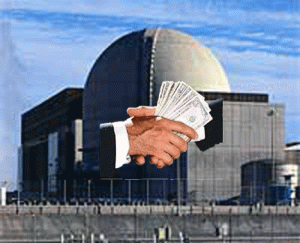 Executive admits fraud in fleecing ratepayers and shareholders https://wordpress.com/read/feeds/72759838/posts/2851460855 By Linda Pentz Gunter

“It looks like crime might well pay after all.”
That was the weary and only slightly tongue-in-cheek conclusion drawn by longtime anti-nuclear campaigner, Tom Clements recently, after a former South Carolina nuclear utility executive pled guilty to fraud in federal court.
Clements is the director of Savannah River Site Watch, but his activism has, for decades, extended well beyond the perimeter of that vast nuclear site.
For years, Clements and others have followed — and attempted to stand in the way of — the forced march of South Carolina ratepayers toward nuclear fiasco. When it finally unraveled in late July, there was only cautious cause for celebration.
On July 23, Stephen Byrne, the former COO of SCANA, the South Carolina utility originally in charge of the construction of two new nuclear reactors in the state, pled guilty in a massive nuclear conspiracy that defrauded ratepayers, deceived regulators and misled shareholders.
Byrne is charged with lying about progress on two Westinghouse AP 1000 reactors under construction — and since abandoned — at the V.C. Summer site, where costs ballooned to more than $9 billion.
The lies — or “intentional misrepresentations” as court documents described them — were necessary to make the case that the two new reactors would be finished on time, thereby qualifying the company for $1.4 billion in future federal tax credits.
But when Clements did the math, Byrne still came out ahead. “One of the court filings says Byrne earned $6.3 million from 2015-2017,” Clements said. “The project originally started with a filing with the SC Public Service Commission in 2008 and ended in July 2017. His plea agreement says he will pay a $1 million fine, though the judge could make it higher.”
So yes, crime still pays.
And so did South Carolina ratepayers. They were bilked of at least $2 billion until the project faltered and finally collapsed. A class action law suit and decisions by judges will see millions returned to ratepayers.
Ironically, the Nuclear Energy Institute, the industry’s lobbying group, gave Byrne the opportunity to explain exactly how ratepayers could be fleeced in advance to save money. In this 2012 NEI video, Byrne describes how Construction Work in Progress (CWIP) would allow the utility to collect funds from ratepayers in advance rather than waiting for construction completion — which has now, of course, not happened, even though customers paid for two new reactors that failed to materialize.
Byrne, who began cooperating with investigators about two years into the now three year-long investigation, could face jail time and a fine, but will likely testify against his co-conspirators to reduce his punishment.
For the time being, the judge has let him go home without even requiring he post the $25,000 bond. Sentencing could be years down the road. Clements believes Byrne “should face prison time” and that he “must fully reveal the criminal role of others in the conspiracy that has been so disastrous for ratepayers.”
Two other top SCANA executives could also be in the FBI’s crosshairs by now — former CEO Kevin Marsh and former chief financial officer Jimmy Addison.
Early warning signals of trouble to come sounded in February 2020, when Byrne and Marsh were charged with civil fraud by the Securities and Exchange Commission (SEC). The agency said the pair “lied and deceived shareholders, regulators, and the public regarding the construction of two new nuclear units at the V.C. Summer site, which the company abandoned amid massive cost overruns in July 2017,” according to reporting in Energy and Policy.
The thoroughly duped — or possibly hopelessly biased — S.C. Public Service Commission, had earlier “allowed SCE&G to raise its electric rates nine times to finance the doomed V.C. Summer Nuclear Station project,” reported the Charlotte Observer.
But by January 2019, the PSC had changed its mind, saying that “SCE&G intentionally misled the commission about a failing nuclear reactor construction project to win electric rate hikes.”
Clements joined other protesters outside the Columbia, SC courthouse where Byrne pled guilty to his offenses. “As he scurried into the federal courthouse, Byrne refused to tell us if he would apologize for his crime against ratepayers,” Clements said.
He, along with other South Carolina activists, and with support of Friends of the Earth, had consistently opposed the state law (CWIP, described in the NEI video), that had allowed the utility to fleece ratepayers in advance of completion of the reactors. The groups had also contested approval of the two-reactor project before the SC PSC since 2008.
As Clements watched Byrne enter the courthouse, finally forced to face up to his crimes, he basked, for a brief moment, in the glow of the celebratory light at the end of the tunnel.
“I’m glad there is going to be a little bit of justice,” Clements told the Post and Courier. And in an email, he wrote: “Nukes bring fraud, graft and corruption wherever they go. The next charges here will be more serious, I think.”
The Post and Courier described the nuclear debacle as “one of the worst economic calamities in South Carolina history”.
But while there may eventually be a day of reckoning — and sentencing — until then, South Carolina ratepayers could keep right on paying.
That is because, when SCANA went bankrupt over the Summer debacle, Dominion Energy took over. Dominion, says Clements, “will file a rate-hike request next month and the cost to ratepayers for the nuclear construction debacle will go up.”
Nuclear blackmail in Illinois — Beyond Nuclear International

Ratepayers robbed of renewables as well as cash
Nuclear blackmail in Illinois https://wordpress.com/read/feeds/72759838/posts/2851460456
Exelon stranglehold on energy legislation runs long and deep
By David Kraft, 9 Aug 20
The recent Illinois lobbying corruption scandal involving Exelon Corporation, its subsidiary Commonwealth Edison and Democratic House Speaker, Michael Madigan, demonstrates the extent to which nuclear “power” is about more than electrons.
The FBI arrests of the Ohio House Speaker and five others in a $60 million bribery/corruption scheme; the $10 billion Exelon nuclear bailout in New York; the questionable circumstances surrounding Exelon’s 2016 PepCo merger; and the South Carolina $9 billion SCANA fraud case, suggest that this may be a national pandemic.
All of this was summarized nicely in a recent New York Times opinion column, “When Utility Money Talks,” (8/2/20).
However, the situation in Illinois with Exelon, and its subsidiary ComEd, has been longstanding and particularly egregious.
For decades, Exelon’s stranglehold on Illinois energy legislation, in cooperation with the currently investigated Mr. Madigan, has stuck Illinois with more reactors (14) and high-level radioactive waste (>11,000 tons) than any other state. It has also severely stifled expansion of renewable energy and energy efficiency, and hampered the Illinois energy transformation to renewables needed to deal with the worsening climate crisis.
For decades, the Illinois environmental community has seen renewables expansion thwarted because no significant renewable energy buildout could occur without concessions to either Exelon or ComEd, and without Speaker Madigan’s approval. The most recent instance was the 2016 $2.35 billion bailout of three uncompetitive Exelon reactors.
This “nuclear blackmail” politics has forced environmentalists wanting to see new legislation pass that would expand renewables, into a reluctant and grudging alliance with Exelon, but on Exelon’s terms, with capacity market “reform” rewarding both renewables and ten of the company’s operating reactors.
If passed in its presently proposed form, this new legislation would provide yet another nuclear bailout under the disguise of “market-based reform.”
To ratchet up the pressure to enact this nuclear prop-up even more, Exelon CEO Chris Crane, in Exelon’s 2Q quarterly earnings call with analysts, once again dangled the prospect of closing up to six reactors if this market-based-bailout is not granted in 2021.
Under the current ongoing FBI corruption investigation, this reluctant alliance of necessity has turned disastrous, given the political toxicity of any current association with either ComEd or Exelon.
It is just and reasonable that ComEd executives (and the so-called “bad apples” who “retired” already), should be penalized and prosecuted for their misdeeds, even if they are reportedly “cooperative.”
However, a $200 million “settlement” penalty for a $34 billion corporation, which for decades has gouged billions from Illinois ratepayers through admittedly corrupt illegal practices, is a slap on the wrist.
Further, the $200 million penalty agreement provides no restitution for the decades-long societal damage done via nuclear pay-for-play.
Illinois rate payers deserve restitution from these and any predatory, corrupt companies that would engage in such activities. This may require explicit legislation. How can one logically or ethically assert that ill-gotten gains (e.g., the 2016 $2.35 billion nuclear bailout) are still “good for the public” when bribery and corruption were used to get them?
Last Fall, a spokesperson for Illinois Gov. JB Pritzker stated, “The governor’s priority is to work with principled stakeholders on clean energy legislation that is above reproach.” Gov. Pritzker – your moment of truth has arrived.
We urge the governor and the legislature to begin the restitution process by repealing the $2.3 billion 2016 nuclear bailout. Further, and as others like Crain’s Joe Cahill have suggested, Crane must step down completely from all functions at Exelon.
The legislature should also enact explicit utility ethics legislation, with transparent oversight of utility contracting and philanthropic giving activities, to insure that this kind of corrupt behavior is not repeated.
And if Crane’s threat of imminent reactor closure is true, then community just-transitions legislation to protect those negatively impacted communities should be a priority of the legislature.
As NEIS has maintained — and advocated since 2014 — it’s the reactor communities (and equally adversely affected coal mining and power plant communities) that need state support and bailouts when plants are threatened with closure, not profitable private corporations like Exelon.
Finally, we support the FBI’s continued investigation into the activities of Speaker Madigan, his associates, and other legislators if necessary, to ferret out the remaining political corruption that has abetted this corporate larceny.
This is the only way to send a significant and lasting message that nuclear pay-for-play in Illinois is over.
David Kraft is the director of Nuclear Energy Information Service
A doctor who is a hibakusha speaks out for the Treaty on Prohibition of Nuclear Weapons
Dr. Masao Tomonaga Surviving the nuclear bomb at Nagasaki 75 years ago showed me nuclear weapons shouldn’t exist https://www.nbcnews.com/think/opinion/surviving-nuclear-bomb-nagasaki-75-years-ago-showed-me-nuclear-ncna1236148
People like me learned firsthand the results of using nuclear weapons. A full-scale nuclear war would destroy both the world and humanity as we know it. Aug. 9, 2020, By Dr. Masao Tomonaga, vice president, International Physicians for the Prevention of Nuclear War
It has been 75 years since August 9, 1945, when the atomic bombing of Nagasaki opened the nuclear weapon age. I was 2 years old, and only 1 1/2 miles from ground zero of the nuclear explosion in there; I was, fortunately, unhurt by the blast itself. I was rescued by my mother from a half-destroyed wooden house just before it burned down.
I am one of a dwindling number of hibakusha — atomic bomb survivors; we are now, on average, 83 years old. Many of us still die of radiation-induced cancers and leukemia from the bombs dropped on our cities in 1945 because that exposure to radiation — when most of us were just 10 years old or younger — led to gene abnormalities in many organs that are still causing malignant diseases today.
That means, legally and morally, the human toll of the bombings is still unfolding and the total number of casualties cannot yet be calculated.
Only two atomic bombs of what we would, today, consider a rather small size were used by the United States in Japan: They were 20 kilotons (Nagasaki) and 15 kilotons (Hiroshima), whereas the common size today is a few hundred kilotons. Still, one 15- and one 20-kiloton bomb were enough to devastate two medium-sized Japanese cities and kill 200,000 or more people, either instantaneously or within five months due to acute radiation injuries and skin burns.
Almost the same numbers of hibakusha survived the immediate aftermath, only to go on living with the fear of both contracting radiation-related disorders and passing malignant genetic diseases onto their children.
We hibakusha learned firsthand the horrible human consequences of using nuclear weapons and thus have long feared that a full-scale nuclear war would destroy both the world and humanity as we know it. This made us determined to fight for nuclear abolition — for the sake of the rest of humanity.
Many hibakusha came together years ago, drawing emotional energy from one another, to begin a campaign against nuclear weapons and move humanity forward by spreading our testimonies worldwide and warning of the global danger of human extinction.
In our first success, we hibakusha witnessed the passage of the Nuclear Non-Proliferation Treaty in 1970 by the United Nations, which gave us hope for a nuclear weapon-free world.
Sadly, as we approached the 50th anniversary of the passage of the NPT, the push for nuclear disarmament had almost stopped, and it seemed like the race for nuclear weapons might begin anew. The U.S., for instance, in August 2019 abandoned the Intermediate-Range Nuclear Forces Treaty (signed by U.S. President Ronald Reagan in 1987), the New Strategic Arms Reduction Treaty (signed by U.S. President Barack Obama and Russian President Dmitry Medvedev in 2010) is set to expire next year, and other countries are building new, smaller nuclear weapons.
To push back against this new nuclear arms race, we hibakusha collaborated with the non-nuclear weapon states and many nongovernmental organizations such as ICAN, the International Campaign to Abolish Nuclear Weapons, to establish a Treaty on the Prohibition of Nuclear Weapons. We finally succeeded in July 2017, and since then, the TPNW has been signed and ratified by 43 countries — close to the 50 needed for it to become official under international law.
However, we are facing a serious opposition to the TPNW by the nuclear states, all of whom refuse to sign and ratify the treaty. There is a continuing belief in the nuclear weapon states and the allied countries under their “nuclear umbrella” — including many NATO states, Japan, Australia and Canada — that nuclear weapons are still necessary to keep peace.
Here in Japan, we hibakusha shed tears when our government declared at the United Nations Assembly in 2017 that it would not sign or ratify the TPNW, despite Japan being the only nation to experience nuclear attacks and know in the greatest detail the human consequences and social destruction of the weapons. The nuclear umbrella offered under the U.S.-Japan Security Treaty for the past 60 years has bound Japan tightly to U.S. political and military leaders, who oppose the treaty.
Surprisingly Rapid Increase in Scale and Intensity of Fires in Siberia
|
NASA/NOAA Satellites Observe Surprisingly Rapid Increase in Scale and Intensity of Fires in Siberia, SciTech Daily By KASHA PATEL, NASA EARTH OBSERVATORY AUGUST 7, 2020 Abnormally warm temperatures have spawned an intense fire season in eastern Siberia this summer. Satellite data show that fires have been more abundant, more widespread, and produced more carbon emissions than recent seasons.The area shown in the time-lapse sequence above includes the Sakha Republic, one of the most active fire regions in Siberia this summer. The images show smoke plumes billowing from July 30 to August 6, 2020, as observed by the Visible Infrared Imaging Radiometer Suite (VIIRS) on NASA/NOAA’s Suomi NPP satellite and the Moderate Resolution Imaging Spectroradiometer (MODIS) on NASA’s Terra satellite. Strong winds occasionally carried the plumes as far as Alaska in late July. As of August 6, approximately 19 fires were burning in the province……
Estimates show that around half of the fires in Arctic Russia this year are burning through areas with peat soil—decomposed organic matter that is a large natural carbon source. Warm temperatures (such as the record-breaking heatwave in June) can thaw and dry frozen peatlands, making them highly flammable. Peat fires can burn longer than forest fires and release vast amounts of carbon into the atmosphere. …… “The destruction of peat by fire is troubling for so many reasons,” said Dorothy Peteet of NASA’s Goddard Institute for Space Studies. “As the fires burn off the top layers of peat, the permafrost depth may deepen, further oxidizing the underlying peat.” Peteet and colleagues recently reported that the amount of carbon stored in northern peatlands is double the previous estimates. Fires in these regions are not just releasing recent surface peat carbon, but stores that have taken 15,000 years to the accumulate, said Peteet. They also release methane, which is a more potent greenhouse gas than carbon dioxide. “If fire seasons continue to increase in severity, and possibly in seasonal extent, more peatlands will burn,” said Peteet. “This source of more carbon dioxide and methane to our atmosphere increases the greenhouse gas problem for us, making the planet even warmer.”…… https://scitechdaily.com/nasa-noaa-satellites-observe-surprisingly-rapid-increase-in-scale-and-intensity-of-fires-in-siberia/ |
|
No. The U.S. did not need to drop a second nuclear bomb on Japan
 Did the U.S. Need to Drop a Second Atomic Bomb on Japan? NEWSWEEK, BY DAVID BRENNAN ON 8/9/20 “……… The atomic bombings of Hiroshima and Nagasaki together killed somewhere between 129,000 and 226,000 people, the vast majority of them civilians. Then, it was argued that the bombs were the only way to defeat the forces of Imperial Japan, which were fighting tooth and nail for every inch of Japanese territory against the Allies……… Did the U.S. Need to Drop a Second Atomic Bomb on Japan? NEWSWEEK, BY DAVID BRENNAN ON 8/9/20 “……… The atomic bombings of Hiroshima and Nagasaki together killed somewhere between 129,000 and 226,000 people, the vast majority of them civilians. Then, it was argued that the bombs were the only way to defeat the forces of Imperial Japan, which were fighting tooth and nail for every inch of Japanese territory against the Allies………This has remained the dominant view through most of the post-war era, even with the shifting debate on whether the bombings constituted war crimes. …….
But not everyone agrees that the bombs were necessary. Miyako Taguchi is the daughter of two atomic bomb survivors—known as hibakusha—who lived in Nagasaki at the end of the war. Now living in New York, she told Newsweek that she grew up some 30 minutes walk from ground zero.
Even as a child she felt nervous about the incident and recalled how big a role it played in Nagasaki’s culture and story. Taguchi even remembers how the city’s hot, humid summer days would make her think of the unimaginable heat of an atomic blast and how it must have felt for those caught in it. As she got older, Taguchi said she better understood what happened to her family’s home town and the horrors that befell them—horrors that her family members were reluctant to recall. As the anniversary approaches each year, she said these feelings resurface. Taguchi told Newsweek that the bombing was “inhuman,” regardless of arguments about the lives that the attacks hypothetically saved elsewhere. When hearing people advocate for the bombs, Taguchi said she struggles to control her temper. ……. by explaining her family’s experience Taguchi said she hopes she can make some people reconsider their assumption that the attack was necessary. “It’s very difficult to change other people’s minds,” she said, especially when they know little about what really happened on that fateful day….. the Soviet Union declared war on Japan at midnight on August 8, 1945—hours before Nagasaki was destroyed. More than the atomic bombs, the Soviet entry into the war against Japan was the final nail in Tokyo’s coffin, according to Tsuyoshi Hasegawa—a Japanese-American historian who is an expert in Soviet Russian and Japanese history. Hasegawa noted that Japanese leaders were seeking Soviet mediation for talks with the U.S. during the closing stages of the war, even after the first atomic bomb killed tens of thousands of people in Hiroshima. “The Hiroshima bomb did not change Japanese policy to seek mediation,” Hasegawa told Newsweek. “So in that sense that was not the decisive factor… I would say that the Soviets entering the war was a more decisive factor.” “The Soviet Union was the last hope for the Japanese government to terminate the war,” he added. “That hope was totally dashed.” Had the Soviets not entered the war, “I think the Japanese government would have continued to seek mediation from Moscow.” Emperor Hirohito took the “sacred decision” to surrender early in the morning of August 10, military and political leaders having met throughout August 9 following the Soviet entry into the war. The emperor informed citizens of the surrender on August 15. Hasegawa said that the Nagasaki bomb did not dominate the emperor’s decision, as the full extent of the damage and casualties were not known until August 10. The Nagasaki explosion was contained in the Urakami Valley, protecting the parts of the city spread across the nearby hills including the city’s civil defence headquarters which sent out the first reports of the explosion. “The extent of the damage of Nagasaki was not properly reported to Tokyo throughout August 9,” Hasegawa said. Another theory for both atomic bombs is that while they were not necessarily needed to defeat Japan, U.S. leaders wanted to show the Soviet Union what their weapons of mass destruction could do……… Hasegawa said the accepted history of the atomic bombs in the U.S.—and much of the Western world—argues that both bombs were necessary to bring Japan to its knees. It gained popularity and acceptance, he believes, for psychological reasons. “The use of atomic bombs really, really bothered the conscience of Americans—it’s a psychological factor,” he said. “They really wanted to believe that what we did, the terrible thing that we did was necessary.” Hasegawa also said that the prevailing history of the war has been too U.S.-centric, allowing American explanations to take root with little challenge. Many American scholars treat the Soviet Union factor as a sort of “side show,” he said, and write the history of the atomic bombs with little attention given to the Japanese decision making process. https://www.newsweek.com/second-atomic-bomb-hiroshima-1523608 |
|
|
Fukushima’s contaminated waste water – more serious than previously thought
 Fukushima’s Contaminated Wastewater Could Be Too Risky to Dump in the Ocean, https://www.gizmodo.com.au/2020/08/fukushimas-contaminated-wastewater-could-be-too-risky-to-dump-in-the-ocean/ Dharna Noor :August 7, 2020 Almost a decade ago, the Tohoku-oki earthquake and tsunami triggered an explosion at Japan’s Fukushima Daiichi Nuclear Power Plant, causing the most severe nuclear accident since Chernobyl and releasing an unprecedented amount of radioactive contamination in the ocean. In the years since, there’s been a drawn out cleanup process, and water radiation levels around the plant have fallen to safe levels everywhere except for in the areas closest to the now-closed plant. But as a study from the Woods Hole Oceanographic Institution published in Science on Thursday shows, there’s another growing hazard: contaminated wastewater.
Radioactive cooling water is leaking out of the the melted-down nuclear reactors and mixing with the groundwater there. In order to prevent the groundwater from leaking into the ocean, the water is pumped into more than 1,000 tanks. Using sophisticated cleaning processes, workers have been able to remove some of this contamination and divert groundwater flows, reducing the amount of water that must be collected each day. But those tanks are filling up, and some Japanese officials have suggested that the water should dumped into the ocean to free up space.
But according to the new study, that’s not the only radioactive contaminant left in the tanks. By examining TEPCO’s own 2018 data, WHOI researcher Ken Buesseler found that other isotopes remain in the treated wastewater, including carbon-14, cobalt-60, and strontium-90. He found these particles all take much longer to decay than tritium, and that fish and marine organisms absorb them comparatively easily.
“[This] means they could be potentially hazardous to humans and the environment for much longer and in more complex ways than tritium,” the study says.
Though TEPCO’s data shows there is far less of these contaminants in the wastewater tanks than tritium, Buesseler notes that their levels vary widely from tank to tank, and that “more than 70% of the tanks would need secondary treatment to reduce concentrations below that required by law for their release.”
The study says we don’t currently have a good idea of how those more dangerous isotopes would behave in the water. We can’t assume they will behave the same way tritium does in the ocean because they have such different properties. And since there are different levels of each isotope in each different tank, each tank will need its own assessment.
“To assess the consequences of the tank releases, a full accounting after any secondary treatments of what isotopes are left in each tank is needed,” the study said.
Buesseler also calls for an analysis of what other contaminants could be in the tanks, such as plutonium. Even though it wasn’t reported in high amounts in the atmosphere in 2011, recent research shows it may have been dispersed when the explosion occurred. Buesseler fears it may also be present in the cooling waters being used at the plant. That points to the need to take a fuller account of the wastewater tanks before anything is done to dump them in the ocean.
“The first step is to clean up those additional radioactive contaminants that remain in the tanks, and then make plans based on what remains,” he said in a statement. “Any option that involves ocean releases would need independent groups keeping track of all of the potential contaminants in seawater, the seafloor, and marine life.”
Many Japanese municipalities have been pushing the government to reconsider its ocean dumping plans and opt to find a long-term storage solution instead, which makes sense, considering exposure to radioactive isotopes can cause myriad health problems to people. It could also hurt marine life, which could have a devastating impact on fishing economies and on ecosystems.
“The health of the ocean — and the livelihoods of countless people — rely on this being done right,” said Buesseler.
Las Vegas Sun presents numerous arguments against nuclear testing in Nevada
 When it comes to nuclear tests in Nevada, numbers just don’t add up, https://m.lasvegassun.com/news/2020/aug/09/when-it-comes-to-nuclear-tests-in-nevada-numbers-j/ Sunday, Aug. 9, 2020
On the anniversary of a meaningful day in history, we present this argument opposing the Trump administration’s idea of resuming live testing of nuclear weapons near Las Vegas.
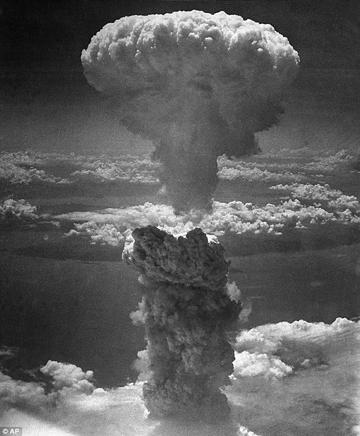
75: Years ago, to the day, when the last atomic bomb was dropped in anger.
110,000-210,000: Estimated death toll of the bombs dropped on Hiroshima and Nagasaki on Aug. 6 and Aug. 9, 1945, respectively.
2,000-plus: Nuclear tests that have been conducted since the end of World War II by the U.S., Russia and six other countries.
1,021: Number of detonations that occurred in 928 tests conducted in Nevada, with some tests involving more than one device.
100: Number of above-ground detonations in Nevada from 1951 to 1962.
65: In miles, the distance between Las Vegas and the Nevada Test Site (now the Nevada National Security Site).
74: Yield, in kilotons, of the largest above-ground device detonated at the Nevada Test Site, which occurred in 1957. The bomb delivered the equivalent of 74,000 tons of TNT.
35: Combined yield, in kilotons, of the bombs dropped on Hiroshima and Nagasaki.
5: Number of men who were positioned below a nuclear explosion in July 1957 for a government film designed to prove to the public that above-ground testing was safe. The film was part of a larger, years-long campaign to convince Nevadans and our neighbors not to worry about the effects of testing.
11,000: Number of cancer deaths stemming from above-ground testing in Nevada, as estimated by the Centers for Disease Control and Prevention in a 2003 report. That number is disputed, however, with some researchers saying the death toll may have been many times that based on how far the fallout would have traveled. One study estimated the minimum number of dead at 145,000.
1.3: Yield, in megatons, of the largest detonation at the site, part of the “Boxcar” underground test of 1968. That’s the equivalent of 1.3 million tons of TNT.
20: According to one estimate, the above-ground tests in Nevada sent 20 times more radioactive material into the atmosphere than was released during the Chernobyl catastrophe.
$2 billion: Amount Congress would eventually pay to Nevadans and downwinders exposed to radiation from test blasts.
1.6 trillion: Gallons of groundwater contaminated by radiation from below-ground tests, according to one estimate. That equates to 16 years worth of Nevada’s allotment of water from the Colorado River.
28: Years that have passed since the United States placed a moratorium on nuclear testing.
0: Number of detonations currently needed to ensure that stockpiled nuclear weapons are safe, secure, reliable and effective. Modern computers and physics equipment have made live testing unnecessary.
0: Number of Southern Nevada’s congressional delegates who support resumption of nuclear testing at the site. Sens. Catherine Cortez Masto and Jacky Rosen, and Reps. Dina Titus, Susie Lee and Steven Horsford, all spoke out in opposition. In a prepared statement, Rosen said Nevadans “do not want to return to a time when the ground shook and radiation exposure was a fact of life,” and that “any actions that could place Nevadans’ health and safety at risk should be off the table.”
0: Number of tests that would be allowed at the site under legislation introduced by Titus and recently approved by the House. “I did not introduce this ban lightly, but it was necessary to prevent President Trump from recklessly threatening Nevadans’ health and potentially restarting a global arms race,” Titus said in a prepared statement.
0: The number of reasons we can find to support Trump’s plan.
Nagasaki urges world ban on nuclear weapons 75 years after US atomic bomb blast
 Nagasaki urges world ban on nuclear weapons 75 years after US atomic bomb blast https://www.sbs.com.au/news/nagasaki-urges-world-ban-on-nuclear-weapons-75-years-after-us-atomic-bomb-blast 9 Aug 20, Survivors of the atomic bombing of Nagasaki have urged world leaders to do more for a nuclear weapons ban on the 75th anniversary of the US attack.
The Japanese city of Nagasaki has marked its 75th anniversary of the US atomic bombing, with the mayor and dwindling survivors urging world leaders including their own to do more for a nuclear weapons ban.
At 11.02am, the moment the B-29 bomber Bockscar dropped a 4.5-ton plutonium bomb dubbed “Fat Man”, Nagasaki survivors and other participants stood in a minute of silence to honour more than 70,000 dead.
The 9 August 1945 bombing came three days after the United States dropped its first atomic bomb on Hiroshima, the world’s first ever nuclear attack that killed 140,000.
Purpose of nuclear bombing of Nagasaki? to test a new weapon – an immoral purpose
 Harry Truman and the nuclear bombs dropped on Hiroshima and Nagasaki, Frank Jackson, 9 Aug 20 Whether the bombing of Hiroshima or the entry of the Soviet Union into the war was the crucial event in causing the Japanese surrender can never be conclusively settled (Hiroshima at 75: bitter row persists over US decision to drop the bomb, 5 August). However, very little is said about the motives for the second bomb, on Nagasaki three days later. Few argued that it was necessary to reinforce the message of Hiroshima. Rather, the military and scientific imperative was to test a different bomb design – “Fat Man”, an implosion type using plutonium, as opposed to the uranium of Hiroshima’s “Little Boy”. To my mind that, destroying a mainly civilian city for such reasons, makes it even more of a war crime, if that is possible, than the bombing of Hiroshim.a
Former co-chair, World Disarmament Campaign https://www.theguardian.com/world/2020/aug/07/harry-truman-and-the-nuclear-bombs-dropped-on-hiroshima-and-nagasaki
Nuclear scandals in Ohio and Illinois raise serious issues about the role of government in the electricity sector.
  Twin nuclear scandals in Ohio and Illinois show why politicians shouldn’t be picking energy winners and losers: Josiah Neeley and Michael Haugh https://www.cleveland.com/opinion/2020/08/twin-nuclear-scandals-in-ohio-and-illinois-show-why-politicians-shouldnt-be-picking-energy-winners-and-losers-josiah-neeley-and-michael-haugh.html Aug 09, 2020 “……… two very similar political scandals involving the nuclear industry are playing out in Ohio and Illinois. In both cases, the operators of nuclear power plants are alleged to have bribed the state’s speaker of the house in exchange for enactment of favorable treatment and government bailouts. Twin nuclear scandals in Ohio and Illinois show why politicians shouldn’t be picking energy winners and losers: Josiah Neeley and Michael Haugh https://www.cleveland.com/opinion/2020/08/twin-nuclear-scandals-in-ohio-and-illinois-show-why-politicians-shouldnt-be-picking-energy-winners-and-losers-josiah-neeley-and-michael-haugh.html Aug 09, 2020 “……… two very similar political scandals involving the nuclear industry are playing out in Ohio and Illinois. In both cases, the operators of nuclear power plants are alleged to have bribed the state’s speaker of the house in exchange for enactment of favorable treatment and government bailouts.
These twin scandals raise serious issues about the role of government in the electricity sector.
Take Illinois first. On July 17, electric utility Commonwealth Edison (ComEd) admitted in court documents that it had directed jobs and contracts to associates of Illinois speaker Michael Madigan in exchange for favorable treatment by the legislature, such as approval of rate increases. ComEd is paying a $200 million fine to avoid prosecution. Madigan has denied the charges.
The situation in Ohio is even wilder. The 82-page criminal complaint for federal racketeering, money laundering and bribery alleges that the speaker of the Ohio House essentially set up a “dark money” account into which eventually was poured over $61 million by a power company and others that stood to benefit from legislation. The money was used partly to finance primary candidates over an election cycle to secure the vote for the top leadership position in the Ohio House of Representatives. Perhaps even more disgusting, the bulk of it, $38 million, was allegedly used for ads to defeat a referendum attempt and to harass and buy off signature gathers who were trying to keep the legislation from going into effect via a vote of the people.
The major alleged funder of this effort was FirstEnergy Corp., identified as Company A Corp. in the complaint, then-owner through a subsidiary of the only two nuclear plants in Ohio. In return, the speaker allegedly delivered a $1 billion bailout of FirstEnergy’s failing nuclear plants in House Bill 6 and set up his own little fiefdom of representatives.
Corruption is as old as human history. But it’s worth considering whether there is something about the way that power plants are operated and regulated that makes scandals like those in Ohio and Illinois more likely. In Ohio, a person identified as Company A Corp.‘s CEO provided an answer in comments detailed in the complaint about a provision added to HB 6 in the Ohio Senate to “decouple” the company’s revenue from the amount of energy sales. Under this provision, if the utility made less money in a year than it had in 2018, it could add a surcharge to customers’ bills to make up the difference. As the CEO bragged to investors, the provision would help make them “somewhat recession-proof.” Revenue guarantees may be a great deal for electric providers, but they aren’t necessarily for consumers. Nevertheless, they are actually the norm throughout much of the United States. This is because electric providers were once all government-sanctioned monopolies, the rates of which were set to cover their costs plus a set percentage of profit. In recent decades, some states have moved away from this model, introducing more competition into the system, but there are still too many avenues open for government intervention. One of the main arguments used in favor of HB 6 was that the state had already intervened to support alternative energy, and so it was only fair to bail out nuclear plants, too.
Ultimately, there are two ways for a business to make money. One is through the market. The other is through politics. The more space we give to the latter, the more likely we are to see corruption. And the one who will definitely pay for this corruption is the customer. Josiah Neeley is a resident senior fellow in energy with the R Street Institute. Michael Haugh is a senior fellow with the R Street Institute. The libertarian-leaning institute favors free-market solutions.
|
|
Trump administration keen for nuclear power, – so is Joe Biden
 Trump Administration Pivots To Nuclear Energy, Finds Lever Against China, Russia, Forbes, Dipka Bhambhani, 9 Aug 20, Trump Administration Pivots To Nuclear Energy, Finds Lever Against China, Russia, Forbes, Dipka Bhambhani, 9 Aug 20, Expanding U.S. commercial nuclear power abroad could become the Trump administration’s strongest lever against Chinese hegemony and Russian expansion in the global market. The U.S. Department of Energy, which is leading the national initiative, is on an aggressive timeline—five to seven years—to bring new advanced nuclear reactors for electric power to the international market. A senior Energy Department official told Forbes it’s a matter of national security……. a year ago, President Trump asked his Energy Secretary, Dan Brouillette, to assemble a nuclear energy working group to find ways to expand the U.S. nuclear energy industry in an effort to compete globally. ……
This May, DOE released Restoring America’s Competitive Nuclear Energy Advantage, a blueprint to transform a U.S. nuclear industry notorious for massive facilities, long construction timelines, cost overruns and a sour public opinion.
Baranwal has launched the $230 million Advanced Reactor Demonstration Program (ARDP) currently calling on the U.S. private sector to apply to demonstrate they can construct smaller, more efficient, more affordable advanced reactors that can be commercially available within five to seven years. Applications are due August 12.
…..the issue is bipartisan, giving it breath to continue regardless of who wins in the presidential election in November.
For about a dozen years, the U.S. government poured money into nuclear energy research and development (R&D) at DOE’s national laboratories. Now, the U.S. government will use those existing platforms, resources, materials and expertise to help commercialize private sector innovation and bring new nuclear reactors to the world market. ……. Government Financing for Nuclear is Lining Up DOE’s blueprint tacitly instructed the U.S. Development Finance Corporation (DFC), formerly the Overseas Private Investment Corporation, to remove legacy policies that prevented it from investing in nuclear power projects overseas. A few weeks ago, DFC did just that. It said it would “prioritize support of advanced nuclear technology in emerging and frontier markets that adheres to the highest safety standards.” DOE also cited a role for the U.S. Export-Import Bank (EXIM Bank). Last November, Republican and Democratic lawmakers agreed to President Trump’s request to reauthorize the country’s export credit agency. EXIM Bank is chartered to finance and facilitate the sale of U.S.-made products for export. Forbes reported extensively on the long-term value of the reauthorization, proving useful for global nuclear energy. …… Chinese officials told Forbes the country would be willing to sign new 123 agreements with the U.S. and welcomes continued cooperation, not an adversarial relationship. China and the U.S. established a 123 agreement about two decades ago led by the DOE’s assistant secretary of international affairs in the Clinton administration, Robert Gee, now president of Gee Strategies Group in Washington. Zheng Dongdong, director of China’s Department of Energy Research, said, “Nuclear energy expansion is a global issue that should be considered with global perspective.” Zheng is also China’s assistant secretary-general of the Energy Investment Professional Committee under the Investment Association of China, an administrative arm of China’s Ministry of Civil Affairs, which promotes global investment in China. Zheng said the energy relationship with the U.S. has not always been strained. In 2007, China, the United States, France, Japan, and Russia jointly established the Global Nuclear Energy Partnership, a multilateral effort to share R&D of advanced nuclear energy technologies, adopt safe, reliable global nuclear energy power systems and promote nonproliferation. “This is a good platform and a very effective means to strengthen global nuclear energy cooperation,” Zheng said…… https://www.forbes.com/sites/dipkabhambhani/2020/08/07/trump-administration-pivots-to-nuclear-energy-finds-lever-against-china-russia/#70baa6f547b1 |
|

Nuclear bomb devastation killed ove 90% of the doctors and nurses in Hiroshima
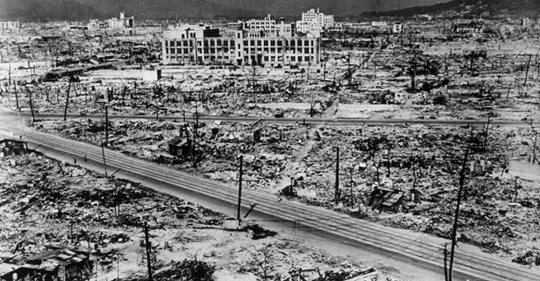
The horrific impact of the bomb was exacerbated by the fact that more than 90 percent of Hiroshima’s doctors and nurses were killed or injured by the bomb, while the blast left 42 out of 45 of the city’s civilian hospitals and two large army hospitals non-functional, according to the The International Campaign to Abolish Nuclear Weapons (ICAN).
This meant it was nearly impossible for the scores of injured to access aid, and most died without any care to ease their suffering from severe burns and radiation poisoning.
Before the attack Hiroshima had around 200 doctors, but the vast majority perished leaving only about 30 physicians who were able to perform their normal duties, according to a report created by the United States Strategic Bombing Survey.
Furthermore, more than 1,600 nurses out of nearly 1,800 were also killed, while medical stocks and supplies were also mostly destroyed.
Any hospitals within around 3,000 feet of ground zero were completely destroyed with almost everyone in them dying.
Two other large hospitals made from reinforced concrete that were located nearly 5,000 feet from the blast’s epicenter remained standing. However, the interiors suffered severe damage and around 90 percent of the occupants died, with many killed due to falling plaster, flying glass and fire.
Several medical centers that were located more than 7,000 feet away from ground zero also remained standing, although many were so badly damaged that they were not able to function.
The lack of medical facilities and staff only served to exacerbate the situation, as one eyewitness to the aftermath, Father Siemes, a German-born Jesuit professor who was in Hiroshima when the bomb fell, described, recounting the scene at an improvised first aid station.
“Iodine is applied to the wounds but they are left uncleansed. Neither ointment nor therapeutic agents are available. Those that have been brought in are laid on the floor and no one can give them any further care. What could one do when all means are lacking? Among the passersby, there are many who are uninjured,” he wrote.
“In the official aid stations and hospitals, a good third or half of those that had been brought in died. Everything was lacking, doctors, assistants, dressings, drugs, etcetera.”
Medical help had to be sent into the city from the outside, however, this took some time to arrive and several individuals who came to assist also ended up dying due to the high levels of lingering radiation.
On the 75th anniversary of the bombing, the International Physicians for the Prevention of Nuclear War (IPPNW), the only international medical organization dedicated to the abolition of nuclear weapons, told Newsweek that there can be “no useful medical response” to even a single nuclear attack on one city in their view.
“The infrastructure necessary would be destroyed and the personnel needed would be killed or badly wounded,” Chuck Johnson, IPPNW Director of Nuclear Programs, said. “Even a relatively small nuclear war would have atmospheric effects beyond the immediate blast, fire, and radiation, which could threaten billions of people with starvation due to crop failure. An all out nuclear war between the U.S. and Russia would end civilization and threaten to extinguish all human life.”
“We agree with President Reagan’s statement that ‘nuclear war can never be won and must never be fought,’ and are greatly concerned by the growing development of a new nuclear arms race among the nine nuclear weapons states.”
However, Johnson said the organization was “greatly encouraged” on the 75th anniversary of the first nuclear weapons attack on a human population, that three more nations—Nigeria, Ireland, and Niue—have become states parties to the UN Treaty on the Prohibition of Nuclear Weapons. This leaves only seven more states to submit ratification papers for the nuclear ban treaty to enter into force.”
“We look forward to the day when the UN declares that rogue nations which persist in developing and possessing nuclear weapons must listen to the world community and cease their activities which threaten all of us.”
Ways to get rid of nuclear weapons – ideas from Africa

Lessons from two pan-African giants on how to achieve genuine nuclear disarmament, The Conversation August 6, 2020 Joelien Pretorius, Associate Professor in Political Studies, University of the Western Cape “…………There are at least two traditions of African thought on nuclear weapons, traceable to their most vocal exponents: Kwame Nkrumah, the scholarly first president of independent Ghana, and Ali Mazrui, the renowned Kenyan scholar.
Both Nkrumah and Mazrui associated nuclear weapons with imperialism and racism, but proposed different approaches to address the problem they present. Nkrumah’s was an abolitionist non-violent approach. He argued for nuclear non-proliferation and disarmament and saw nuclear imperialism as the exploitation of smaller states and indigenous people and territory for nuclear tests and uranium mining.
Mazrui, on the other hand, argued for nuclear proliferation before nuclear disarmament could take place. His view was that the dominant policy towards nuclear weapons afforded some states the political privilege of having them, while denying this right to others. What he called nuclear imperialism.
Nkrumah’s approach arguably became the African approach to nuclear weapons. As a leading member of the Non Aligned Movement, Africa’s participation in the global nuclear order was directed through the organisation in the pursuit of nuclear disarmament. Closer to home, the achievement of an Africa Nuclear Free Zone treaty in 2009 was a direct outflow of Nkrumah’s approach.
Mazrui’s approach never had much official traction.
I argue that to end nuclear imperialism, African states have to reconcile Nkrumah’s and Mazrui’s approaches to nuclear weapons.
Reconciling the two approaches
Tackling nuclear imperialism would require African countries to sign up to the Treaty on the Prohibition of Nuclear Weapons, or the Ban Treaty, of 2017. This treaty is a first step toward eliminating the weapons themselves and the systems of control and exploitation they make possible. African states participated in the treaty process. More than 20 have signed the treaty and five have so far ratified it.
It would also require African states to withdraw from the Nuclear Non Proliferation Treaty. All African states are currently members of this treaty. But, after 50 years in existence, there is little hope that it will deliver genuine nuclear disarmament.
Reconciling Nkrumah’s idealism and Mazrui’s realism helps us see these treaties for what they are: the Ban Treaty is based on humanitarian concerns and the equality of states; the Non Proliferation Treaty legalises a few states’ nuclear hegemony indefinitely.
It is time for African states to lead in creating a new non-nuclear order.
Where both of them stood
An internationalist and pan-Africanist, Nkrumah saw abolition as the answer to nuclear weapons. He saw them as the “sword of Damocles” hanging over humanity. Embedded in the global peace movement of the time, he advocated for “positive action” – an outflow of Gandhiist non-violence. He attended and hosted several conferences with an anti-nuclear agenda, including an assembly in 1962 on the theme “A world without the bomb”.
Although many Africans lost faith in the value of non-violence and preferred a military solution to imperialism, Nkrumah’s approach to nuclear weapons did not fade. It was enmeshed with the position espoused by the Non Aligned Movement, and was the position adopted by the African National Congress in South Africa in 1994.
For his part, Mazrui believed African states should not pursue a nuclear weapon free zone and should leave the 1970 Nuclear Non Proliferation Treaty……
Mazrui saw the Non Proliferation Treaty as a trap that smacked of racism, where major powers got to say “such and such a weapon is not for Africans and children under 16”.
Mazrui was thus “advocating nuclear proliferation as the only realistic path to nuclear disarmament. This was a total inversion of the Western consensus.”
Wasted opportunities
The five nuclear powers have wasted many opportunities to negotiate the nuclear disarmament that the 50-year-old Non Proliferation Treaty binds them to. Instead, key nuclear arms control treaties have been discarded and all the nuclear weapon states are modernising their arsenals.
The treaty has also not stopped proliferation: four other states have since acquired nuclear weapons – Israel, India, Pakistan and North Korea.
Mazrui was right. In practice, the treaty is at most a status quo treaty that has come to legalise a small club being able to wield nuclear weapons – what India calls nuclear apartheid.
The treaty is not just about separating states into haves and have nots; it is also a stick to beat the have nots into submission.
In the Iraq War of 2003 the US used stopping nuclear proliferation as a false premise to justify making war on that country and is today doing the same to sanction Iran. States without nuclear weapons accepted the Non Proliferation Treaty in the hope that it would deliver a world without nuclear weapons, but that hasn’t happened and their patience is running out.
The efforts of the majority of states that went outside the Non Proliferation Treaty forum to negotiate the Treaty on the Prohibition of Nuclear Weapons three years ago, to make nuclear weapons illegal for all, without exception, need to succeed. The Ban Treaty will enter into force when 50 states have ratified it. The number currently stands at 40.
The Ban Treaty was only possible because of a broad international coalition emphasising the unacceptable humanitarian consequences of nuclear weapons.
To end nuclear imperialism, African states have to reconcile Nkrumah and Mazrui’s approaches by not only joining the Ban Treaty, but also withdrawing from the Non Proliferation Treaty. This will signal that African states will only take part as equals in global nuclear governance where these weapons are illegal for all. https://theconversation.com/lessons-from-two-pan-african-giants-on-how-to-achieve-genuine-nuclear-disarmament-144009
Australia’s ICAN and Conservation Council of Western Australia commemorate Hiroshima Day


On August 5th, people from across Australia gathered, via Zoom, to commemorate the nuclear bombing of Hiroshima, and to hear speakers from ICAN Autralia (International Campaign to Abolish Nucleat Weapons).
Medlissa Clarke spoke of the human effects of this catastrophe, and of the efforts over time, towards disarmament. The biggest leap forward in this has been, in 2017, the U.N. Treaty on the Prohibition of Nuclear Weapons. The Treaty now has over 200 nations signed up, with 40 ratifications – not far from the 50 required to make it international law.
Most Australians want a nuclear weapons free world.But Australia’s policy does endorse nuclear weapons. A future Labor government might change that.
Dimity Hawkins described the misery experienced by the Japanese, the agonising stories of the survivors. Since Hiroshima, the nuclear bombs developed are greatly stronger, and have been tested over many years, on the Marshall Islands, on Maralinga, South Australia, and on other Pacific Islands, in nuclear colonialism that has never properly been cleaned up. Australia is part of that nuclear chain. But now,the survivors are speaking out. Red Cross and Red Crescent, the world’s greatest non government emergency service is strongly behind the Treaty movement, and the indigenous people, particularly Australia’s Aboriginals .
Former Senator Scott Ludlam commemorated the Hibakusha, and the impact of the nuclear weapons industry on indigenous people world-wide. He drew attention to the ?proud statement of U.S. Strategic Command – that their nuclear weapons are to be used in a “safe, secure and lethal way”.
The Treaty was an Australian initiative, brought about by the work of, at first, a few, who by-passed official systems, and went out getting signatures, setting up ICAN, which became an international movement.-, – showing that people can do this, have an effect and an influence. As cities will be the places to bear the catastrophe of nuclear annihilation, many Mayors of many have City Councils have signed up to the Treaty. The Treaty shows that no-one can now claim that nuclear weapons are acceptable, in the same way as biological and chemical warfare are unacceptable.
For information on the continuing CCWA webinar series go to http://www.ccwa.org.au/yellowcake_country_webinar_series
Russia will regard any incoming missile as a nuclear attack
|
Russia warns it will see any incoming missile as nuclear VLADIMIR ISACHENKOV
MOSCOW (AP) 7 Aug 20, — Russia will perceive any ballistic missile launched at its territory as a nuclear attack that warrants a nuclear retaliation, the military warned in an article published Friday. The harsh warning in the official military newspaper Krasnaya Zvezda (Red Star) is directed at the United States, which has worked to develop long-range non-nuclear weapons. The article follows the publication in June of Russia’s nuclear deterrent policy that envisages the use of atomic weapons in response to what could be a conventional strike targeting the nation’s critical government and military infrastructure. In the Krasnaya Zvezda article, senior officers of the Russian military’s General Staff, Maj.-Gen. Andrei Sterlin and Col. Alexander Khryapin, noted that there will be no way to determine if an incoming ballistic missile is fitted with a nuclear or a conventional warhead, and so the military will see it as a nuclear attack. “Any attacking missile will be perceived as carrying a nuclear warhead,” the article said. “The information about the missile launch will be automatically relayed to the Russian military-political leadership, which will determine the scope of retaliatory action by nuclear forces depending on the evolving situation.”……….https://apnews.com/888e0816c6fa7f58b9ad4f1e97993643 |
|
|
1 This Month

of the week – Shut Down Drone Warfare!


Tell the Ukrainian Government to Drop Prosecution of Peace Activist Yurii Sheliazhenko

Petition to revoke the licensing of the Near Surface Nuclear Disposal Facility (NSDF) at Chalk River. https://www.ourcommons.ca/petitions/en/Petition/Details?Petition=e-7247
To see nuclear-related stories in greater depth and intensity – go to https://nuclearinformation.wordpress.com
-
Archives
- April 2026 (114)
- March 2026 (251)
- February 2026 (268)
- January 2026 (308)
- December 2025 (358)
- November 2025 (359)
- October 2025 (376)
- September 2025 (257)
- August 2025 (319)
- July 2025 (230)
- June 2025 (348)
- May 2025 (261)
-
Categories
- 1
- 1 NUCLEAR ISSUES
- business and costs
- climate change
- culture and arts
- ENERGY
- environment
- health
- history
- indigenous issues
- Legal
- marketing of nuclear
- media
- opposition to nuclear
- PERSONAL STORIES
- politics
- politics international
- Religion and ethics
- safety
- secrets,lies and civil liberties
- spinbuster
- technology
- Uranium
- wastes
- weapons and war
- Women
- 2 WORLD
- ACTION
- AFRICA
- Atrocities
- AUSTRALIA
- Christina's notes
- Christina's themes
- culture and arts
- Events
- Fuk 2022
- Fuk 2023
- Fukushima 2017
- Fukushima 2018
- fukushima 2019
- Fukushima 2020
- Fukushima 2021
- general
- global warming
- Humour (God we need it)
- Nuclear
- RARE EARTHS
- Reference
- resources – print
- Resources -audiovicual
- Weekly Newsletter
- World
- World Nuclear
- YouTube
-
RSS
Entries RSS
Comments RSS
 nuclear-news