Sudden resignation of head of USA’s National Nuclear Security Administration
Gordon-Hagerty, who became the first woman to lead the NNSA in February 2018, sent her letter of resignation to the White House Friday, according to a pair of senior NNSA officials, speaking to Defense News on background.
The NNSA is a semi-autonomous office located within the Department of Energy. While the Defense Department manages the delivery systems of the nuclear force — ships, planes and missiles — NNSA has oversight over the development, maintenance and disposal of nuclear warheads. While the agency falls under the purview of DoE, much of its budget is set by the Nuclear Weapons Council, which is largely controlled by Defense Department officials.
Per the sources, the resignation was driven by almost a year of clashes between Gordon-Hagerty’s office and Secretary of Energy Dan Brouillette. That fight first seeped into public earlier this year, when Brouillette sought to cut NNSA’s budget request. Defense officials, backed by supporters from Congress, went to the White House and forced the issue in NNSA’s favor.
Tensions never truly receded and continued to play out in Congress during the fiscal 2021 budget season. Senate Armed Services Committee chairman Sen. Jim Inhofe, R-Okla., led pro-defense lawmakers in an effort to give the Pentagon more official control over NNSA; House lawmakers created several pieces of legislation that would give the Energy department more control.
The issue seemed to come to a head when the Department of Energy Organization and Management Improvement Act, passed by the House Committee on Energy and Commerce Sept. 9, changed language that made the NNSA a quasi-independent entity, in essence folding the agency more fully under DOE’s control. The move was seen by NNSA officials as an attempt by Brouillette to outright destroy the agency………. https://news.yahoo.com/head-nuclear-weapons-agency-unexpectedly-184158751.html
Japan: the next generation of LDP leaders embrace both carbon neutrality and the elimination of nuclear energy.
Nuclear Power and Japan’s 2050 Climate Pledge
Japan’s latest carbon-neutrality pledge puts the spotlight on the challenges facing the country’s nuclear power industry. The Diplomat , By Tom Corben,, November 05, 2020 In his inaugural address to the Diet last month, Japan’s Prime Minister Suga Yoshihide officially announced that his government would revise the country’s carbon-neutrality commitments, aiming for zero emissions by 2050. Suga expressed his intent to “put maximum effort into achieving a green society…..
Of course, the nuclear lobby’s entrenched interests at the highest levels of the government and within the LDP itself will likely continue to frustrate efforts to comprehensively revise Japan’s nuclear energy policies. Indeed, there is every chance that the revised Basic Energy Plan due next year will maintain, if not expand, the share of Japan’s energy mix allocated to nuclear power. Still, without significant changes to the regulatory environment, a more favorable business environment, or a major shift in public opinion or political support, at present it is difficult to see Japan’s nuclear power industry making a major contribution to Japan’s carbon-neutrality goals in the coming decades.
Putin orders Russian government to try to meet Paris climate goals
Putin orders Russian government to try to meet Paris climate goals
President Vladimir Putin has signed a decree ordering the Russian government to try to meet the 2015 Paris Agreement to fight climate change, but stressed that any action must be balanced with the need to ensure strong economic development.
Exploring the reasons why Britain is to ‘re-nationalise’ it’s nuclear weapons
UK Government move to ‘re-nationalise’ Britain’s nuclear weapons, The National
|
By Martin HannanMultimedia Journalist 6th NovemberEARLIER this week the UK Government slipped out a story about Britain’s nuclear deterrent in the form of a ministerial statement that hardly anyone noticed.
It indicated that the Atomic Weapons Establishment (AWE) headquartered on the former site of RAF Aldermaston is effectively going to be re-nationalised. Stripped of civil-servant speak, the statement says that the UK Government is exercising its right to end early a 25-year contract with a consortium of companies that run AWE plc. From next year AWE will become an arms-length operation wholly owned by the Ministry of Defence. That will include AWE’s presence at the Royal Naval Armaments depot at Coulport on Loch Long which services the Clyde Submarine Base at Faslane, home to Britain’s Trident submarines. The statement indicates the change is on grounds of efficiency. It read: “The change in Model will remove the current commercial arrangements, enhancing the MoD’s agility in the future management of the UK’s nuclear deterrent, whilst also delivering on core MoD objectives and value for money to the taxpayer. Forgive the cynical view but that all says “in other words, we’re back in complete charge and will spend what we like on the replacement for Trident with no need for reports to shareholders and that public sort of stuff”. WHEN WAS AWE ORIGINALLY PRIVATISED? THE Act to effectively privatise Aldermaston was passed under John Major’s Tory Government in 1991. The transfer of a previously MoD-run facility to the private sector caused some controversy at the time, but went ahead anyway……….. WHY IS THIS HAPPENING? GOOD question. Obviously somebody somewhere is not happy. Ending a 25-year contract four years early is not a usual tactic of HM Government – quite the opposite with contracts often renewed “on the nod”. It could also be an advance move in a long-rumoured possible project for the MoD to take back more sites and facilities and run them as arms-length operations. Babcock and other private contractors at Faslane and elsewhere will have taken note of the move. ARE ALDERMASTON AND SCOTLAND LINKED? THE convoys that take nuclear weapons between Coulport/Faslane and Aldermaston have been a worry for anti-nuclear campaigners for decades. In an independent Scotland, the Westminster Government would be asked to remove Trident and its ilk, which has always begged the question – what is the MoD’s plan B for Trident or its replacement after independence? Answer: there isn’t one. Go on, ask them yourselves. https://www.thenational.scot/news/18850871.uk-government-move-re-nationalise-britains-nuclear-weapons/ |
|
Canada’s Bruce County Council postpones voting on nuclear waste bunker plan
 Bruce County defers vote to support the science behind a nuclear waste bunker, By Janice MacKay, Blackburn News, November 5, 2020 Bruce County Council has agreed to defer the vote on a motion made at today’s meeting to accept the Nuclear Waste Management’s proposed Deep Geologic Repository to store used nuclear fuel as a matter of settled science.Michelle Stein of the group “no DGR South Bruce” told council via skype Thursday during their meeting that the motion was premature when the science isn’t settled on the proposed nuclear fuel Repository…….. Bruce County defers vote to support the science behind a nuclear waste bunker, By Janice MacKay, Blackburn News, November 5, 2020 Bruce County Council has agreed to defer the vote on a motion made at today’s meeting to accept the Nuclear Waste Management’s proposed Deep Geologic Repository to store used nuclear fuel as a matter of settled science.Michelle Stein of the group “no DGR South Bruce” told council via skype Thursday during their meeting that the motion was premature when the science isn’t settled on the proposed nuclear fuel Repository……..
She says moving the waste could add increased risk as it is transported through local municipalities. She worries that since there is no nuclear fuel DGR operating in the world, developing one in South Bruce would be an experiment which could put local rivers and waterways at risk. She added that the nuclear fuel waste would also still need to be stored at the surface, as “the nuclear waste needs to go into cooling pools, and then it needs to be stored above ground for approximately 30 years before it’s even cool enough to be moved.” https://blackburnnews.com/uncategorized/2020/11/05/bruce-county-defers-vote-support-science-behind-nuclear-waste-bunker/ |
|
Covid-19 divides and weakens the nuclear sector in South Africa
 Covid-19 divides and weakens the nuclear sector in South Africa, Daily Maverick, By Chris Yelland• 5 November 2020 Covid-19 divides and weakens the nuclear sector in South Africa, Daily Maverick, By Chris Yelland• 5 November 2020
The coronavirus crisis is undermining the business plan and turnaround strategy at the Nuclear Energy Corporation of South Africa. The resulting losses are creating debilitating divisions between labour, middle and senior management, executives and boards of Necsa and its subsidiaries – as well as wage increases Following a tumultuous operational and management period for several years, with massive financial losses, new Nuclear Energy Corporation of South Africa (Necsa) chairperson David Nicholls and acting CEO Ayanda Myoli presented a restructuring and turnaround plan to Parliament on 20 May 2020……… While many considered the turnaround plan to be hopelessly optimistic even before the Covid-19 crisis in South Africa from March 2020, the impact of the national and international lockdowns are estimated to have resulted in the Necsa group taking a massive hit, which would increase the expected loss for 2020/21 to more than R300-million. …… While many considered the turnaround plan to be hopelessly optimistic even before the Covid-19 crisis in South Africa from March 2020, the impact of the national and international lockdowns are estimated to have resulted in the Necsa group taking a massive hit, which would increase the expected loss for 2020/21 to more than R300-million. https://www.dailymaverick.co.za/article/2020-11-05-covid-19-divides-and-weakens-the-nuclear-sector-in-south-africa/ |
|
Nuclear Technology Germany Association says Small Nuclear Reactors (SMRs) will always be more expensive than large ones.
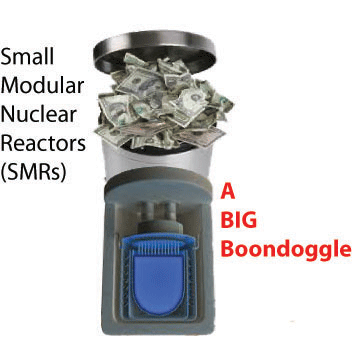 German nuclear industry cautious about usefulness of small reactors for energy transition, Nuclear phase-out Technology, Clean Energy Wire, Süddeutsche Zeitung , 6 Nov 20 Small Modular Reactors (SMR) are increasingly hailed as an effective way for using nuclear power to curb the climate crisis without the major risks associated with conventional nuclear plants, but Germany’s nuclear industry is sceptical whether the small reactors really can help boost international climate action, Christian J. Meier writes for the Süddeutsche Zeitung German nuclear industry cautious about usefulness of small reactors for energy transition, Nuclear phase-out Technology, Clean Energy Wire, Süddeutsche Zeitung , 6 Nov 20 Small Modular Reactors (SMR) are increasingly hailed as an effective way for using nuclear power to curb the climate crisis without the major risks associated with conventional nuclear plants, but Germany’s nuclear industry is sceptical whether the small reactors really can help boost international climate action, Christian J. Meier writes for the Süddeutsche Zeitung
……… Nicolas Wendler of industry association Nuclear Technology Germany (KernD) says SMRs are always going to be more expensive than bigger reactors due to lower power output at constant fixed costs, as safety measures and staffing requirements do not vary greatly compared to conventional reactors. In terms of levelised energy costs, SMRs will always be more expensive than big plants.” In order for SMRs to be profitable, these should run at maximum utilisation most of the time, Wendler argues, concluding that the potential on the German market would not be much greater than what is needed to adjust oscillating renewable power production…. https://www.cleanenergywire.org/news/german-nuclear-industry-cautious-about-usefulness-small-reactors-energy-transition
|
U.S. Navy to spend $billions on two Columbia-class nuclear missile submarines
|
US Navy inks $9.4B contract for two Columbia-class nuclear missile submarines, Defense News
By: David B. Larter 6 Nov 20, WASHINGTON — The U.S. Navy announced Thursday it had inked a $9.47 billion contract with builder General Dynamics Electric Boat for the full construction cost of the lead boat of the Columbia-class ballistic missile submarine, as well as advanced procurement money for the second boat, the future USS Wisconsin.
The announcement marks the end of the beginning for the Columbia class, which the Navy has for years said is its top priority. The 12-ship class will replace the retiring Ohio-class submarines. The Columbia is slated to make its first patrol in 2031, and the Navy says it must meet the timeline to maintain continuous sea-based deterrent patrols……. The Columbia program is a massively expensive undertaking, with the Navy estimating it will run about $7.5 billion per hull over the class. By 2026, when the Navy will be buying one Columbia per year, considering the FY21′s roughly $20 billion shipbuilding request as a guide, Columbia would eat up to 38 percent of the Navy’s shipbuilding money……. https://www.defensenews.com/naval/2020/11/05/navy-inks-contract-for-two-columbia-class-nuclear-missile-submarines/ |
|
Texas governor wants Trump to oppose nuclear waste dump plan
Gov. Abbott Asks Trump for Help with Nuclear Waste in West Texas, Sanangelo Live, MATT TRAMMELL, NOV 6, 2020, ANDREWS, TX – Governor Greg Abbott sent a letter to President Trump last week urging him to put a stop to storing high levels of nuclear waste in rural West Texas.
In the letter sent to President Trump, on Sep. 29, Abbott gave a number of reasons for his opposition.
The main concerns the Governor has is the risk the nuclear material will bring to the Permian Basin.
Here is the full letter: [ but extract only posted here]
Dear Mr. President: Thank you for all you do to ensure a prosperous economy and strong energy industry in the United States. I write to express my opposition to the license applications to the Nuclear Regulatory Commission (NRC) for the consolidated interim storage of spent nuclear fuel and high-level waste at proposed sites within the state of Texas and within the state of New Mexico, close to the Texas border. A stable oil and gas industry is essential to the economy, and crucial to the security of our great nation. Allowing the interim storage of spent nuclear fuel and high- level nuclear waste at sites near the largest producing oilfield in the world will compromise the safety of the region.
The proposed facilities would be sited in the Permian Basin Region, which is the largest producing oilfield in the world ……..the Permian Basin is a significant economic and natural resource for the entire country, and the proposed storage facilities would place America’s recovering economy and energy security at great risk.
The NRC is currently evaluating issuance of a 40-year license to Interim Storage Partners (ISP) for a consolidated interim storage facility in west Texas as well as issuance of a 40-year license to Holtec International for such a facility in southeastern New Mexico. As proposed, the ISP facility would store commercial spent nuclear fuel and reactor-related materials, presenting a radiological risk greater than currently authorized for storage and disposal in Texas. ISP has also indicated it may seek to renew the license for an additional 20 years, which would result in an operating life of 60 years, or until a permanent facility is established. ……..https://sanangelolive.com/news/politics/2020-11-06/gov-abbott-asks-trump-help-nuclear-waste-west-texas
UK govt’s spin to Scotland, promoting nuclear submarines – but the Scots are nae sae daft
 We cannot defeat our real enemies by using nuclear weapons, https://www.thenational.scot/news/18850915.cannot-defeat-real-enemies-using-nuclear-weapons/, Jim Taylor, Edinburgh, 6 Nov 20
At the conclusion of the programme, Rear Admiral John Weale tells us that no-one really wants nuclear weapons … but “we are planning to have them for the next 50 years”.
So it’s a done deal, whether we Scots support it or not. Our UK Union membership means we will be forced against our will to be party to this inhumane weapon system, and the increased danger it puts us in with its continued location at Faslane.
Trident’s replacement is currently reckoned to cost around £200 billion, before any expected design, construction, operational cost overruns and other usual ongoing cost increases. With the potential for a further cycle of replacement during the next 50 years, going forward, the cost to the nation will rise exponentially.
Clearly the Royal Navy took the unprecedented step to permit this programme being made at the behest of the UK Government trying to warm our feelings about nuclear weapons, recognise a “need” for them and in the hope this will drive a wedge in Scotland’s drive to call upon its Claim of Right and independence.
Isn’t the UK Government’s mistake assuredly that Scots are nae sae daft?
Nuclear now costs twice the price of renewables and the gap is growing. No need for Hinkley C, Sizewell, Bradwell etc

 North writes,
” ………The Green Party have been arguing for many years in recognition of the work by Friends of the Earth, the Centre for Alternative Technology (CAT) in Wales and many others, that we do not need ‘further expansion of nuclear and gas turbines’ but to be far more clever about our energy use, easy to do now that renewables are cheaper than nuclear and new gas.
CAT has been at the forefront of development of research on renewable technology and Green building for some 50 years.
Their latest report ‘Zero Carbon Britain (Rising to the Climate Emergency)’ clearly demonstrates that the UK has the tools and technology to efficiently power this country with 100 per cent renewable technology (read the executive summary, it’s only eight pages long).
By using energy more efficiently we can power down by 60 per cent with particularly large savings in heating buildings and transport.
There is absolutely no need for nuclear power in our energy mix and we cannot afford it, let alone pay for cleaning up the sites at the end which taxpayers always end up paying for.
Nuclear now costs twice the price of renewables and the gap is growing.
How many Herald readers know that the electricity from the Hinkley Point nuclear reactor will cost UK consumers £92.50 per Kwh (the most recent offshore wind turbine fields are half of this)?
The deal was signed by (former Prime Minister) Theresa May and supported by Labour and Lib Dems.
The profits are going to the Chinese government which will run it for 40 years. The French firm (EDF) that has been building Hinkley Point and wants to build more nuclear reactors in the UK wants to cushion the financial blow of future nuclear power stations in this country by charging electricity customers a few extra pounds every month on their bill even now.
This is referred to as a new funding model, I’d call it a rip-off. Are people really happy to put billions of pounds into the coffers of the Chinese government and EDF rather than invest, as part of a Green New Deal, in insulation and draught-proofing of UK homes to keep us warmer, take over two and a half million households out of fuel poverty and permanently reduce everyone’s fuel bills. https://www.cravenherald.co.uk/opinion/opinion_letters/18824349.letter-no-need-nuclear-power/
Nuclear power – simply unaffordable for the Philippines
|
DOE to submit ‘nuclear power plan’ to Duterte this December, Manila Bulletin, November 6, 2020, by Myrna M. Velasco” For BNPP’s repowering, Duterte previously instructed the energy department to also undertake a study on that proposal; and to assess the cost impact that will have on consumers’ pockets.
But on that particular sphere, Senate Committee on Energy Chairman Sherwin T. Gatchalian sounded off cynicism on claims that electricity rates in the Philippines will go down with the proposed repowering of the mothballed 620-megawatt BNPP project. “It’s not true that prices are lower because of the layers of technology that shall be integrated into the nuclear power facility to ensure its safe operations,” he claimed. Gatchalian noted that in Vietnam’s case, that country shelved its planned nuclear power development after determining that the resulting power price will just be comparable with other electric generating facilities — and yet there’s great degree of risk that they have to manage on the safety aspect of technology deployment. ………In the Philippines, the propounded revival of BNPP’s operations had been hurdled by concerns of ‘social acceptance’ in the many years that already passed; and there are also questions on where to source the US$1.0 billion to US$2.0 billion funding for BNPP’s rehabilitation.The other major issue is which entity shall be designated to operate the plant, since the Electric Power Industry Reform Act (EPIRA) already prohibits state-run National Power Corporation (NPC) from engaging into operation or investments in power generation… |
A new nuclear power plant at Sizewell is the wrong choice for a zero carbon Britain
|
A new nuclear power plant at Sizewell is the wrong choice for a zero carbon Britain, The climate column: The proposed Sizewell C will not produce electricity until about 2040, which it means it cannot reduce the UK’s carbon emissions with the speed necessary to avoid catastrophic tipping points The Independent , Donnachadh McCarthy@DonnachadhMc 6 Nov 20,
Just weeks ago, the Climate Assembly set up by parliament rejected nuclear power as an answer to creating a zero-carbon economy. This was due to cost, safety and difficulties with waste storage and decommissioning. Yet Boris Johnson is reported to be about to commit Britain to buying another hugely expensive nuclear power station. As this new plant would not be producing electricity until about 2040, it means it cannot reduce the UK’s carbon emissions with the speed necessary to avoid catastrophic tipping points, whereas cheaper renewables can be up and running within a couple of years of being commissioned. Consider the following analogy. Four years ago, you needed to replace your gas boiler and a company came along and offered to sell you the world’s most expensive experimental boiler ever. It’s been trying to build the first four of them for over 20 years but had not yet got any actually working. The first one it tried to build, in Finland, is already 13 years behind schedule and has more than tripled in price. The second one it tried to build, in France, is 10 years behind schedule, now costs six times the original quote and has encountered monumental safety issues. They then tell you the boiler was filled with lethal toxins, which if the boiler’s seals broke, could explode and kill everybody in your house. All your neighbours would have to be permanently evacuated immediately without being allowed to collect their lethally contaminated belongings and the area around your boiler would become an exclusion zone for generations. The sales-person added that the boiler will cost up to twice as much to run as your current boiler. They demanded you sign a 35-year inflation-proofed deal that makes it difficult to switch to a cheaper renewable energy supplier or use energy efficiency measures to reduce your need for the boiler. Every single bank refused to lend you the money to install your new boiler, as they believed it was a financially insane project to lend money to. There was another problem. The experimental boiler continuously produces highly-toxic explosive waste that the supplier, after 70 years of trying, still has no idea what to do with. You would have to store it in your cellar, until somebody miraculously comes up with a way to store it safely for millennia. The salesperson neglected to add that you had to pay for the costs of removing the boiler at the end of its life but that the process takes hundreds of years to complete. I tell you this imaginary tale to try and explain the utter insanity of what the UK government did when it signed the contract with EDF Energy to build a new Hinkley Point nuclear power plant in 2016. Hinkley is already a year behind schedule and nearly £3bn over budget.
And now imagine this. Despite all of the above and knowing that renewable energy alternatives have already fallen to less than half of the cost of this experimental boiler and that new renewable electricity storage technologies have been likewise collapsing in price, the same contractor comes back to you to persuade you to buy another of these hugely expensive boilers for your second home. Unlike almost every single government in the world, Boris Johnson’s government is reported to be planning on announcing in the next few weeks that the UK will agree to build a second new EDF nuclear power plant at Sizewell in Suffolk. Why would any supposedly sane country sign such crazy energy contracts? ……… https://www.independent.co.uk/voices/nuclear-power-plant-sizewell-boris-johnson-b1622086.html |
|
The most frightening prospect – Trump remaining still in control of nuclear weaponry
 The Guardian view on the election endgame: end Trump’s war on the truthm Editorial, 6 Nov 20 https://www.theguardian.com/commentisfree/2020/nov/06/the-guardian-view-on-the-election-endgame-end-trumps-war-on-the-truth
Around the world former democracies are slipping into autocracy. The United States is not immune
Since he took office Donald Trump has posed a grave threat to democracy. His wild, relentless post-poll fight against reality this week has shown just how dangerous he can be. Designed to give his supporters a rationale for their anger over losing the popular vote, the falsehoods raised troubling questions about when, and how, Mr Trump will leave the White House.
The bad news is that it won’t be anytime soon. Democracy in America is rare in giving a president more than 10 weeks of power after losing an election. Mr Trump is using this time to ratchet up the rhetoric to a fever pitch, seeding the idea that society is irreconcilably at odds with itself. This is profoundly damaging to America, a fact that cable networks have thankfully and belatedly woken up to after election day. Around the world former democracies are slipping into autocracy. The United States is not immune.
The fact is Mr Trump will lose the popular vote by millions of votes and only America’s outdated electoral college has saved him from a crushing defeat. The president should be preparing to leave the White House, not be instructing his lawyers. Perhaps Mr Trump cannot afford to lose. Presidential immunity from prosecution vanishes once Mr Trump leaves office, a consideration that may weigh heavily given the ongoing investigations by the New York district attorney into reported“protracted criminal conduct at the Trump Organization”. Mr Trump denies any wrongdoing.
or months it has been obvious that Mr Trump would claim victory and fraud should he lose the election. He has refused to say he would accept a peaceful transfer of power. The polls, he claimed, could not be trusted. Without a shred of shame, Mr Trump appears willing to challenge the validity of the vote in any state he loses, seeking to undermine the electoral process and ultimately invalidate it.
This is a dangerous moment. There’s no evidence of widespread illegal votes in any state. Yet a fully fledged constitutional crisis over the process of counting ballots is on the cards because Mr Trump is demanding recounts and court cases while conditioning his base to view the election in existential terms. Last year, in an influential and prescient analysis, Ohio University’s Edward B Foley wargamed how a quarrel over mail-in ballots in Pennsylvania could lead to a disputed result in the 2020 presidential election.
The most frightening scenario, said Prof Foley, was “where the dispute remains unresolved on January 20, 2021, the date for the inauguration of the new presidential term, and the military is uncertain as to who is entitled to receive the nuclear codes as commander-in-chief”. This ends with the US attorney general, William Barr, announcing that it is legally sound for Mr Trump to be recognised as re-elected for a second term while Democrats call for nationwide protests to dislodge the squatters in the White House. It would be better to avoid such a predicament rather than plan to get into it.
Republicans must not be seduced by Mr Trump into manipulating the electoral system, through political and legal battles, to defy the popular will for partisan advantage. The Grand Old Party has profited from voter suppression and gerrymandering to keep an emerging Democratic majority at bay. But these darker impulses have given rise to Mr Trump and an unhealthy reliance on a shrinking coalition of overwhelmingly white Christian voters paranoid about losing power.
Joe Biden looks to have done enough to win the White House. He will have his work cut out when he gets there, needing to rebuild the US government’s credibility after Trumpism hollowed out its institutions. That means offering hope to a country that faces a pandemic and an economic recession. He will have to reassert America’s role as the global problem-solver. Under Mr Trump the “indispensable nation” disappeared when it was needed the most. By any reasonable standard Mr Biden should not have to continue to run against Mr Trump. He must be allowed to get on with running America.
 |
ReplyForward
|
Biden inches towards presidency and overhaul of global climate action — RenewEconomy

A republican controlled senate will not be a barrier to a likely Biden presidency undertaking a massive shake-up of American and international climate action. The post Biden inches towards presidency and overhaul of global climate action appeared first on RenewEconomy.
Biden inches towards presidency and overhaul of global climate action — RenewEconomy
1 This Month
23 April – WEBINAR – Why new nuclear reactors are the wrong tools for decarbonization Thursday, April 23 • 1 AM – 2 AM AEST


Pine Ridge Uranium is the real threat, not Tehran- Tell Burgum: Stop the Extraction.
Chernobyl: The Lost Tapes – A good documentary on Chernobyl on SBS available On Demand for the next 3 weeks– https://www.sbs.com.au/ondemand/tv-program/chernobyl-the-lost-tapes/2352741955560
To see nuclear-related stories in greater depth and intensity – go to https://nuclearinformation.wordpress.com
-
Archives
- April 2026 (275)
- March 2026 (251)
- February 2026 (268)
- January 2026 (308)
- December 2025 (358)
- November 2025 (359)
- October 2025 (376)
- September 2025 (257)
- August 2025 (319)
- July 2025 (230)
- June 2025 (348)
- May 2025 (261)
-
Categories
- 1
- 1 NUCLEAR ISSUES
- business and costs
- climate change
- culture and arts
- ENERGY
- environment
- health
- history
- indigenous issues
- Legal
- marketing of nuclear
- media
- opposition to nuclear
- PERSONAL STORIES
- politics
- politics international
- Religion and ethics
- safety
- secrets,lies and civil liberties
- spinbuster
- technology
- Uranium
- wastes
- weapons and war
- Women
- 2 WORLD
- ACTION
- AFRICA
- Atrocities
- AUSTRALIA
- Christina's notes
- Christina's themes
- culture and arts
- Events
- Fuk 2022
- Fuk 2023
- Fukushima 2017
- Fukushima 2018
- fukushima 2019
- Fukushima 2020
- Fukushima 2021
- general
- global warming
- Humour (God we need it)
- Nuclear
- RARE EARTHS
- Reference
- resources – print
- Resources -audiovicual
- Weekly Newsletter
- World
- World Nuclear
- YouTube
-
RSS
Entries RSS
Comments RSS
 nuclear-news