What Frogs Can Teach Us about the State of the World
We currently find ourselves on the other side of a stark but intangible line created by the climate tipping points we’ve blown past for and at our leisure, the virulent diseases we’ve helped spread, and the habitats we’ve destroyed in the name of peace and quiet. Being on this side of the line is a lot like grieving: we are in an “after” time.
And, as with other forms of grieving, in times defined by disease and mass extinction, we need to bear witness. We can be quiet and press record to capture what is still there. We can cup our hands around our ears and listen.
 What Frogs Can Teach Us about the State of the World, By tracking amphibian songs, citizen scientists are helping us understand what’s happening to our environment, The Walrus , BY CAITLIN STALL-PAQUET 18 Sept 20,
T’S AN HOUR after sunset, one night in early April, and I’m standing on the side of a dirt road in my hometown of Frelighsburg, Quebec, with my hands cupped around my ears. I’m listening for the calls of anurans—amphibians without a tail, so frogs and toads. I am here, more specifically, to hear the croaks of wood frogs, which are one of the first species to peek their little brown heads out after a long winter of hibernation.
This isn’t just recreational listening, mind you—this is also for science. I am a volunteer observer, one of several who are gathering data about dwindling amphibian populations in this region. Continue reading
Nuclear waste transport , and legal action – UK
Due to numerous safety issues with storage of high-level waste at Biblis, the BUND Hessen has filed a lawsuit saying it will take legal action against the now reinstated transport licence. With last Sunday’s local German elections in North Rhine-Westphalia, the Greens achieved a record result with 20% and there will be green mayors in the former capital Bonn, Münster and the anti-nuclear stronghold Aachen.
http://www.no2nuclearpower.org.uk/wp/wp-content/uploads/2020/09/Plain-sailing.docx
The revolving door between government members and the nuclear industry
New nuclear role for former Cabinet minister, News and Star , By Federica BedendoReporter A former Cabinet minister has been appointed as the Nuclear Decommissioning Authority’s social value specialist.18th September
Hazel Blears will provide advice to the whole of the NDA group on how to increase the social, economic and environmental impact of its work to decommission and clean up the UK’s oldest nuclear sites.
She is a nationally recognised expert in this field and is chairman of the Social Investment Business and a trustee of the Social Mobility Foundation. Ms Blears is also a former cabinet minister and, during her time as an MP, was one of the authors of the Social Value Act……. https://www.newsandstar.co.uk/news/18725570.new-nuclear-role-former-cabinet-minister/
Plutonium in Hinkley nuclear mud dumping, but National Resources Wales’ call for full testing is ignored

 Campaigners claim NRW has been ignored as mud sampling from nuclear plant gets underway, https://nation.cymru/news/campaigners-claim-nrw-has-been-ignored-as-mud-sampling-from-nuclear-plant-gets-underway/ Campaigners claim NRW has been ignored as mud sampling from nuclear plant gets underway, https://nation.cymru/news/campaigners-claim-nrw-has-been-ignored-as-mud-sampling-from-nuclear-plant-gets-underway/
17th September 2020 EDF Energy has commenced taking samples of mud from the construction of a new nuclear power plant without the agreement of National Resources Wales, according to the group opposing plans to dump the sediment in the sea off Cardiff Bay.In February NRW received an application from EDF, who want to dump 800,0000 tonnes of mud dredged as part of building work for the new plant at Hinkley Point, the site of the disused Hinkley Point A facility near Bridgwater in Somerset. Two years ago, EDF were given permission to dump 300,000 tonnes of mud from the site off the Cardiff coast, despite protests and following a Senedd debate. GeigerBay, a coalition of scientists, experts, individuals and organisations formed to oppose the plans, are pressing for extensive testing of the sediment following what they say is evidence of plutonium contamination, a claim that Westminster’s Environment Agency (EA) denies. A notice published last month confirmed sedimentation survey sampling is now underway despite the lack of an agreement on the scope and location of the testing. In a letter to the Expert Committee set up by the Welsh Government to examine the issues around the proposed dump, GeigerBay say: “EDF have proceeded with the sampling (core extraction) operations by the Jack up Barge Excalibur, disregarding the lack of approval. “They apparently think they can ignore NRW as the operations are in English waters and approved by the Marine Management Organisation (the government body that regulates and plans marine activities in the seas around England). “With uncertainties surrounding the planning, licensing and scoping we reiterate our point that testing must include at the very least toxicity testing, a full assessment of the nuclides present in the sediment, and a full exploration of the likelihood of transfer of nuclear pollutants onto land because of the risk to humans and wildlife. “Is the Expert Committee aware that sampling has commenced, and considered everything that that entails?” A petition against the dumping has secured over 10,000 signatures, triggering another debate in the Senedd. |
|
U.S. general says that North Korea has a ”small” number of nuclear weapons (over 70?)
|
N. Korea has ‘small number’ of nuclear weapons: US general, Korea Herald, By Yonhap, Sept 18, 2020 WASHINGTON — North Korea has a “small number” of nuclear weapons, the vice chairman of the US Joint Chiefs of Staff said Thursday, although that number was not defined. Air Force Gen. John Hyten told a virtual forum that the specific numbers were “classified” and in many ways hard to understand. “But a small number is a confident characterization of nuclear capabilities that can threaten their neighbors or the United States,” he said in a symposium hosted by the National Defense University’s Center for the Study of Weapons of Mass Destruction. Hyten offered no further explanation of what he meant by “a small number.” The US has never officially discussed its assessment of North Korea’s nuclear capabilities, but the communist state is widely estimated to possess more than 70 nuclear warheads. In its latest annual report,” North Korean Tactics,” published in July, the US Army said the North is “estimated” to possess 2,500 to 5,000 tons of chemical weapons. With regard to its nuclear arsenal, however, the report simply states “estimates for North Korean nuclear weapons range from 20 to 60 bombs, with the capability to produce six new devices each year.” North Korea has conducted six nuclear tests, between October 2006 and September 2017. Hyten’s remark follows a recently renewed controversy, at least in Seoul, over Pyongyang’s nuclear capabilities. In his latest book, “Rage,” Washington Post journalist Bob Woodward discusses a US response to a North Korean attack that he says could include the use of up to 80 nuclear weapons……….. http://www.koreaherald.com/view.php?ud=20200918000129 |
|
While other nations seek conciliation, agreement, the U.S. will declare that all international sanctions are back in force
 US to declare nuclear sanctions on Iran are restored, Rome Sentinel, September 17, 2020 US to declare nuclear sanctions on Iran are restored, Rome Sentinel, September 17, 2020WASHINGTON — In defiance of overwhelming opposition, the United States is preparing to declare that all international sanctions against Iran have been restored. Few countries believe the move is legal, and such action could provoke conflict at the United Nations. Despite an agreement brokered during the Obama administration, Iran still pursues nuclear enrichment necessary to produce nuclear weapons. The Associated Press story did not mention that an explosion two months ago at Natanz, Iran, destroyed a key facility likely used to manufacture high quality centrifuges essential for refining uranium for such weapons. President Donald Trump’s administration will announce on Saturday that U.N. sanctions on Iran eased under the 2015 nuclear deal are back in force. Other members of the U.N. Security Council, including U.S. allies, disagree and have vowed to ignore the step. The Trump administration already has slapped extensive sanctions on Iran, but could impose penalties on countries that don’t enforce the U.N. sanctions it claims to have reimposed. Trump plans to address Iran in a speech to the General Assembly on Tuesday. ……. https://romesentinel.com/stories/us-to-declare-nuclear-sanctions-on-iran-are-restored,103958 |
|
USA DID have a plan to drop 80 nuclear weapons on Nortrh Korea
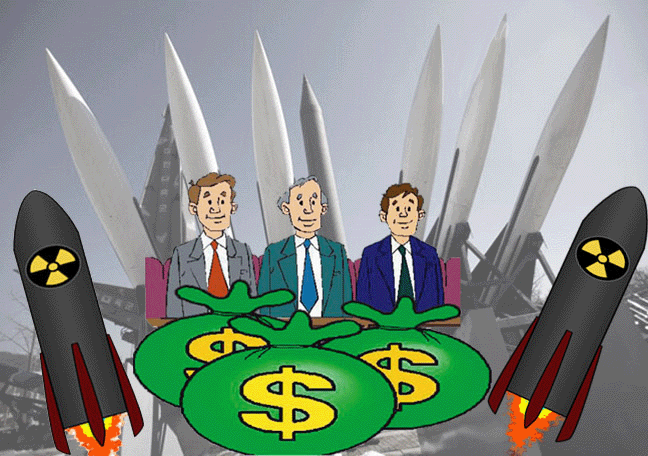 Yes, The United States DidDraw Up A Plan To Drop 80 Nuclear Weapons On North Korea, In 2017, a war between North Korea and the United States was “much closer than anyone would know,” President Trump claims. The Drive BY THOMAS NEWDICK, SEPTEMBER 18, 2020.
Current nuclear war plans are among any nuclear-armed military’s most closely guarded secrets. Details of one such attack plan recently became available, however, revealing that the United States envisaged using 80 nuclear weapons in case of war with North Korea. The way this particular detail emerged is also pretty unusual — the associated passage appeared in U.S. journalist Bob Woodward’s book Rage, detailing President Trump’s administration, which was published this week.
In an interview with NPR, Woodward cleared up any confusion, noting that the 80 nuclear weapons were part of a U.S. attack plan — OPLAN 5027, which would include ‘decapitating’ the North Korean regime of dictator Kim Jong-un.
Woodward said that Mattis confided in him that he was not worried that Trump might launch a preemptive strike against North Korea. Instead, the source of his angst was the North Korean leader in Pyongyang.
In fact, such was Mattis’s level of concern that he would sleep in his gym clothes, Woodward claims. “There was a light in his bathroom… if he was in the shower and they detected a North Korean launch.”
There were alarm bells set up in Mattis’s bedroom and kitchen too, and on more than one occasion during the summer of 2017 they sounded the alert, and he entered the communications room in his Washington DC residency. Woodward explains that Mattis’s car was also constantly followed by an SUV with a team equipped to plot the flight path of any incoming missile, whether it was threatening Japan, South Korea, or the United States. If Mattis considered the missile hostile, he had a mobile communications link to issue launch orders to shoot it down. …………
Clearly, the status of a nuclear-armed North Korea provided much pause for thought within the U.S. administration during Mattis’ tenure as Secretary of Defense. That a strike plan against North Korea involving 80 nuclear weapons was discussed between the president and his defense secretary isn’t all that hard to imagine………..
One of the options under consideration in Washington was OPLAN 5015, a nuclear strike to take out the North Korean leadership, which Woodward also refers to, drawing again from his extensive interviews with Trump. Specifically, Woodward mentions “updating” such a plan — after all, Kim Jong-un and his predecessors will have always been priority targets in the case of an all-out war. ……………… https://www.thedrive.com/the-war-zone/36519/yes-the-united-states-did-draw-up-a-plan-to-drop-80-nuclear-weapons-on-north-korea
USA taxpayers set up by government in the effort to save uneconomic nuclear power

|
The Nuclear Sector Gets A State-Sponsored Lifeline, Oil Price, By Haley Zaremba – Sep 16, 2020, The United States’ nuclear sector is in trouble. And it has been for years now. While the United States remains the largest producer of nuclear energy in the world, producing about one-third of the world’s total nuclear power supply, the industry has been in a state of decline for quite a while. The nuclear sector has never recovered from the influx of cheap natural gas that came along with the domestic shale revolution, and now the country’s aging nuclear fleet faces even bigger problems coming down the pike. Nuclear, like so many other industries (especially in the energy sector), was hit very hard by the pandemic. As Oilprice reported earlier this summer, climate change will hold particularly difficult challenges in store for the nuclear sector, which has to keep its reactors cooled down at all times to avoid meltdowns. And heat is just one risk factor–there are also extreme weather events and catastrophic floods to consider. In 2019, Bloomberg carried out a review of “correspondence between the commission and owners of 60 plants” and made some particularly worrying discoveries. According to nuclear companies’ own risk assessments, “54 of their [60] facilities weren’t designed to handle the flood risk they now face.”
……..Just two weeks after Oilprice wondered “Can The Nuclear Industry Survive COVID-19?,” however, the U.S. Department of Energy (DOE) offered the nuclear sector a lifeline. On June 18, the DOE announced “it would be awarding more than $65m in nuclear energy research, crosscutting technology development, facility access, and infrastructure awards.” According to reporting by PowerTechnology, “the awards fall under the department’s nuclear energy programs – the Nuclear Energy University Programme, the Nuclear Energy Enabling Technologies, and the Nuclear Science User Facilities.” ………The wide scope of these projects points to the multiplicity and complexity of the challenges faced by the U.S. nuclear industry today. While the money awarded by the DOE this June is a good sign for the sector, this is not the first time the DOE has tried to bail out the U.S.’ ailing nuclear industry. “Since 2009, the Office of Nuclear Energy, part of the US Department of Energy, has allocated more than $800m to research, aiming to boost American leadership in clean energy innovation and train the next generation of nuclear engineers and scientists,” Power Technology writes. https://oilprice.com/Alternative-Energy/Nuclear-Power/The-Nuclear-Sector-Gets-A-State-Sponsored-Lifeline.html
|
|
|
September 18 Energy News — geoharvey

Opinion: ¶ “The Climate Alarms Are Blaring – Are People Not Hearing Them?” • One has to wonder – are we unable to perceive the climate’s warning signs? As human beings, we have the ability to learn that for every action, there is a reaction. However, it seems that we as a species are choosing […]
September 18 Energy News — geoharvey
Grief in Western America, as inequities, wildfires, and climate change collide
Climate change is making wildfires bigger, fiercer, and deadlier, fueling a new kind of despair on the West Coast—and beyond. Wired 16 Sept 20, GRIEF HAS SETTLED over the western US, along with the thick haze of smoke pouring from dozens of massive wildfires up and down California, Oregon, Colorado, and Washington. It’s grief over the thousands of structures and at least 33 lives lost so far; grief over another villain conspiring with Covid-19 to lock people indoors; grief that the orange-hued dystopia of Blade Runner is now a reality in smoky San Francisco; grief over losing any sense of normalcy, or indeed a clear future.Enveloping all of those emotions—packaging them into an overwhelming feeling of doom—is climate grief, as psychologists call it, the dread that humans have thoroughly corrupted the planet, and that the planet is now exacting its revenge. Wildfires were around before human-made climate change, but by pulling a variety of strings, it’s made them bigger, fiercer, and ultimately deadlier, creating what fire historian Steve Pyne has dubbed the Pyrocene, an Age of Flames.
By burning fossil fuels, we’ve primed the landscape to burn explosively, and by pushing human communities deeper and deeper into what was once wilderness, we’re provided plenty of opportunities for ignition—and plenty of opportunities for grief as these forces catastrophically combine.
“So much is out of our control,” says Adrienne Heinz, a research psychologist at the Stanford University School of Medicine, who studies the effects of disasters like wildfires and the Covid-19 pandemic. “We lose our sense of personal agency over how we will live—the decisions are made for us.”
It shifts from grief over what’s happening with our climate—can we feel safe in our own communities?—to despair, the differentiator being that you don’t feel like tomorrow is going to be any better than today,” Heinz adds. “That’s where it gets really dark.”
For the people of Northern California, an exhausting parade of massive wildfires have marched across the landscape over the past several autumns, with many people having to evacuate several years in a row. Last October, the Kincade Fire burned 120 square miles. The November before, the Camp Fire destroyed the town of Paradise and killed 86 people. And in October 2017, the Tubbs Fire obliterated 5,600 structures and killed 22.
“The catchphrase—kind of with a bitterness around here—is, ‘This is the new normal,’” says Barbara Young, a licensed marriage and family therapist in Healdsburg, north of San Francisco, who had to evacuate last month. “And so with that, I think it’s implied that this isn’t going away—our climate is changing. These aren’t flukes, this is the trend. And I think everyone is very clear that this is not a one-off. This is every year now.” ……………
Thus inequities, wildfires, and climate change collide. Each massive problem on its own is difficult for the human mind to parse, much less all three together. “I am doing a lot of work with people on really increasing psychological self-care, spiritual self-care, physical self-care, and to help that fatigue,” says Young, the therapist in Healdsburg. “And I do think that is connected with climate grief. Finally, maybe we are forced to see how interconnected everything is.” https://www.wired.com/story/climate-grief-is-burning-across-the-american-west/
Western Canadians do not want ”Small” nuclear reactors in Sakatchewan
Premier asks Trudeau to support nuclear reactors in upcoming throne speech, Yorkton This Week Michael Bramadat-Willcock – Local Journalism Initiative (Canada’s National Observer) / Yorkton This Week, SEPTEMBER 16, 2020 Premier Scott Moe has sent a letter to Prime Minister Justin Trudeau outlining Saskatchewan’s priorities ahead of the federal throne speech on Sept. 23. In it, he is asking Trudeau to support nuclear development in the province.
Moe wants the development of small modular nuclear reactors, also known as SMRs, in Saskatchewan to be part of Trudeau’s green agenda. ……..
In December, Moe signed a memorandum of understanding with the premiers of Ontario and New Brunswick to work together on further developing the nuclear industry. ……..
In his letter, the premier also focused on support for the oil and gas sectors, and pushed for pausing the carbon tax.
The Supreme Court of Canada will hear arguments on the federal carbon tax at the same time as the throne speech is delivered. …………
But western Canadians don’t all see eye-to-eye on the deployment of nuclear reactors, even small ones.
Committee for Future Generations outreach co-ordinator Candyce Paul of La Plonge at the English River First Nation earlier told Canada’s National Observer that while they haven’t been consulted on any aspects of the plan, all signs point to the north as a site for the reactors.
On Tuesday, Paul called it ironic that Moe spoke of western alienation from Ottawa when many in the north feel the same way about Regina.
“Trudeau, please represent the people of northern Saskatchewan because Scott Moe does not,” Paul said.
Paul’s group fights nuclear waste storage in Saskatchewan and was instrumental in stopping a proposal that considered Beauval, Pinehouse and Creighton as storage locations in 2011.
“When we informed the communities that they were looking at planning to bury nuclear waste up here in 2011, once they learned what that entailed, everybody said, ‘No way.’ Eighty per cent of the people in the north said, ‘No way, absolutely not.’ It didn’t matter if they worked for Cameco or the other mines. They said, if it comes here, we will not support it coming here,” Paul said in an interview last month. ………..
Paul said the intent behind using SMRs is anything but green and that the real goal is to prop up Saskatchewan’s ailing uranium industry and develop oilsands in the northwest.
“He’s put it right in the letter. His fear is they’re going to put out a green policy that will hurt the oil and gas sector,” Paul said.
“They’ve been looking for a way to bring the tar sands to northern Saskatchewan. We all know the mess that makes. Using small modular reactors is not lessening the carbon impact.”
She said in August that communities around Canada, and especially in the Far North, have long been pitched as sites for SMR development and nuclear waste storage, but have refused.
“None of our people are going to get trained for operating these. It supports people from other places. It doesn’t really support us,” Paul said.
Paul said on Tuesday that SMRs under 200 megawatts are currently excluded from environmental impact assessments, which means a lack of opportunity for public input.
She also said that interconnected water systems in the north would mean pollution would travel quickly into the ecosystem if there was a mishap at a reactor site.
Brooke Dobni, professor of strategy at the University of Saskatchewan’s Edwards School of Business, told Canada’s National Observer in August that any development of small reactors would take a long time.
“It could be a good thing, but on the other hand, it might have some pitfalls. Those talks take years,” Dobni said.
He said nuclear reactors face bigger challenges that have to be addressed before they can go ahead, such as public support for protecting the environment, the high cost of building infrastructure, and containing nuclear fallout and radiation.
“Anything nuclear is 25 years out if you’re talking about small reactors, those kinds of things to power up the city,” Dobni said.
“That technology is a long ways away and a lot of it’s going to depend on public opinion.
“The court for that is the court of public opinion, whether or not people want that in their own backyard, and that’s the whole issue anywhere in the world.”
On Tuesday, Paul asked the federal government to invest in critical infrastructure instead.
“We need money spent in a serious way. Not on small modular reactors that could happen in 25 years. We need things now. To bring us up to the standards in our health system, we need health facilities. The public doesn’t want the government subsidizing industries that are about to go bust. It’s a waste of money,” Paul said.
“We have extreme needs that aren’t being met by industry and never will be met by industry. Trudeau, put the money where you want to make some real reconciliation happen.”https://www.yorktonthisweek.com/regional-news/premier-asks-trudeau-to-support-nuclear-reactors-in-upcoming-throne-speech-1.24204052
In tropical areas, increasing heat and humidity will make life almost unbearable
 Climate explained: will the tropics eventually become uninhabitable? https://theconversation.com/climate-explained-will-the-tropics-eventually-become-uninhabitable-145174 James Shulmeister– 16 Sept 20, Professor, School of Earth and Environmental Sciences, University of Canterbury What is the impact of temperature increases in the tropics? How likely is it that regions along the Equator will be uninhabitable due to high wet bulb temperatures such as 35℃ and more in places like Singapore? Do we have models that suggest how likely this is and at what time frames?More than 3.3 billion people live in the tropics, representing about 40% of the world’s population. Despite some areas of affluence, such as Singapore, the tropics are also home to about 85% of the world’s poorest people and are therefore particularly susceptible to the impacts of climate change. Climate explained: will the tropics eventually become uninhabitable? https://theconversation.com/climate-explained-will-the-tropics-eventually-become-uninhabitable-145174 James Shulmeister– 16 Sept 20, Professor, School of Earth and Environmental Sciences, University of Canterbury What is the impact of temperature increases in the tropics? How likely is it that regions along the Equator will be uninhabitable due to high wet bulb temperatures such as 35℃ and more in places like Singapore? Do we have models that suggest how likely this is and at what time frames?More than 3.3 billion people live in the tropics, representing about 40% of the world’s population. Despite some areas of affluence, such as Singapore, the tropics are also home to about 85% of the world’s poorest people and are therefore particularly susceptible to the impacts of climate change.
The tropics are expected to experience rising temperatures and changes to rainfall, and the question is whether this could make this region uninhabitable. How would this happen? Heat stressHumans regulate their body temperature in warm conditions through sweating. The sweat evaporates and cools the skin. But if conditions are humid, sweating and evaporation are much less effective. Humans can survive and function in quite high temperatures if humidity is low, but as humidity increases our ability to function decreases rapidly. This effect is measured by a heat stress index which shows the apparent temperature you feel under different relative humidity conditions. From a human health point of view, the wet bulb temperature is critical. This is the temperature a thermometer covered in a wet cloth would measure, and it reflects the maximum amount of cooling that can be achieved by evaporation. High wet bulb temperatures are more problematic to human health than high absolute temperatures. Wet bulb temperatures above 35℃ are life-threatening because they cause hyperthermia, which means the body cannot cool down and the internal body temperature exceeds 40℃. Climate modelling predictions used by the Intergovernmental Panel on Climate Change (IPCC) for the period from 2080-2100 suggest warming in the tropics of about 1.6℃ under mid-range emissions scenarios and up to 3.3℃ under high emissions scenarios, with error margins of about 0.5℃ on both predictions. Different parts of the world respond in different ways to warming from greenhouse gas emissions. The projected warming in the tropics represents about 40% of the expected temperature rise in the Arctic. High-latitude regions – far north or south of the Equator – warm more rapidly than the global average because excess heat in the tropics creates a temperature and pressure gradient. This drives heat up to higher elevations and higher latitudes through an atmospheric circulation called the Hadley cell. The stronger the gradient, the more heat is exported. Hot in the cityThere is one additional factor: urbanisation. Singapore is a good place to look at actual climate change in the tropics. Records from Singapore indicate temperatures have increased by 1.1℃ over 42 years to 2014. This is nearly twice the average global rate of warming over recent decades and is opposite to expectations. The difference appears to be due to a heat island effect caused by the city itself. This is important because changes in land use amplify background global climate change and put tropical cities at greater risk of extreme heat. As populations are concentrated in cities, this increases the risk to human health. The mean average temperature for Singapore is about 27℃, whereas Jakarta in Indonesia is slightly warmer. At the scale of predicted mean annual temperature change, neither of these cities would become uninhabitable. But even a small temperature increase would make life more challenging. This is made worse in at least some parts of the tropics, because total rainfall is increasing, suggesting a long-term rise in humidity. For example, average rainfall in Singapore increased by more than 500mm from 2,192mm in 1980 to 2,727mm in 2014. Deadly heatPeople working outdoors are at higher risk, as are vulnerable populations, including the elderly. Under the IPCC’s high-emission trajectory, heat-related deaths in Jakarta in August are expected to rise from about 1,800 in 2010 to nearly 27,000 in 2050. Even allowing for a significant increase in elderly people as the Indonesian population ages, this means about 15,000 excess deaths in this month. Estimates under high-emission predictions for the tropics and mid-latitudes suggest about a 40% decline in the ability to undertake manual work during the warmest month by 2050. These impacts will be stronger in the seasonally wet tropics (such as the Northern Territory of Australia), where more extreme warming is expected than in the equatorial zone. Predictions for Darwin, in northern Australia, suggest an increase in days with temperatures above 35℃ from 11 days a year in 2015 to an average of 43 days under the mid-range emission scenario (IPCC’s RCP4.5 scenario) by 2030 and an average of 111 (range 54-211) days by 2090. Under the higher emission scenario (IPCC’s RCP8.5), an average of 265 days above 35℃ could be reached by 2090. In summary, while absolute temperatures are expected to rise more slowly in the tropics when compared with higher latitudes and polar regions, the combination of heat and rising humidity will make life challenging, but not impossible. |
|
As Hitachi exits the project, UK government to announce funding for Wylfa nuclear project next month
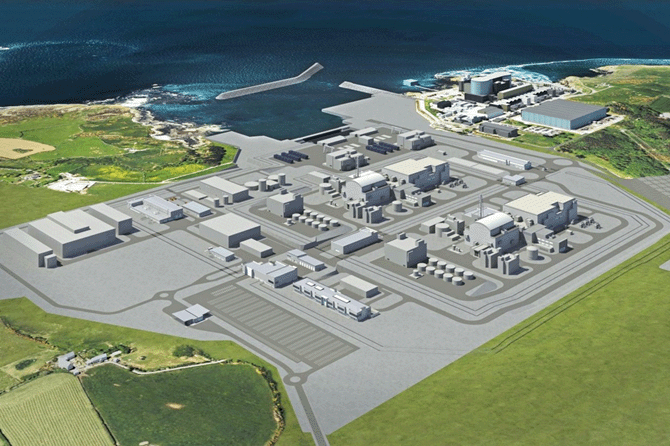 Hitachi Abandons $26 Billion Nuclear Power Project in U.K. Bloomberg Green, By Stephen Stapczynski and Rachel Morison16 September 2020,
-
U.K. due to make statement on financing model next month
- U.K. government says still committed to building new nuclear
Hitachi Ltd. exited a long-planned U.K. nuclear power project despite the most generous support package for an atomic station in Britain, a bad omen for future projects.
The Japanese company announced Wednesday that it decided to withdraw from the Wylfa power project in Wales, citing a worsening investment environment due to the Covid-19 pandemic. Work has been suspended on the 20 billion-pound ($26 billion) venture since January 2019 after the company failed to reach a financing agreement with the U.K. government.
The decision is the latest setback for nuclear’s revival, which supporters promote as the carbon-free solution for reliable power at a time of growing climate change concerns. Cost overruns and cheaper competition is stifling projects and developers in Japan, the U.S. and the U.K.
Britain is one of a handful of developed countries still building nuclear reactors, with the government putting them at the middle of an effort to attract billions of pounds of investment in new low-carbon power plants and create thousands of jobs. However, financing these prohibitively expensive infrastructure projects has become a hurdle, especially in the face of cheaper natural gas and renewables.
A financing package offered to Hitachi in 2019 wasn’t enough to attract additional private investor interest. The U.K. has been considering a funding model that would have seen the state shouldering more of the construction risk. The outcome of that consultation has been delayed.
The U.K. said it had offered a package that “went well beyond what any government has been willing to consider in the past.” Atomic energy still forms a key plank of energy policy including in small and advanced modular reactors.
A financing package offered to Hitachi in 2019 wasn’t enough to attract additional private investor interest. The U.K. has been considering a funding model that would have seen the state shouldering more of the construction risk. The outcome of that consultation has been delayed.
The U.K. said it had offered a package that “went well beyond what any government has been willing to consider in the past.” Atomic energy still forms a key plank of energy policy including in small and advanced modular reactors.
Prospects for the Wylfa plant looked more optimistic last month when Horizon Nuclear Power Ltd., Hitachi’s subsidiary developing the project, said it was engaged with the U.K. government on reviving the project.
The future of how the U.K. finances new nuclear is expected to be announced in the government’s long anticipated energy white paper next month……… https://www.bloomberg.com/news/articles/2020-09-16/hitachi-abandons-u-k-nuclear-power-project-in-blow-to-industry
Huge costs of decommissioning Britain’s ”Magnox” nuclear failities just keep going up
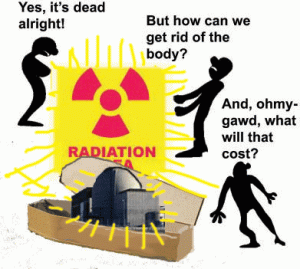 UK spending watchdog warns on costs of cleaning up old nuclear plants
Decommissioning charge has risen by £3bn since 2017 and there remains ‘inherent uncertainty’ over final bill, NAO finds, Nathalie Thomas in Edinburgh, SEPTEMBER 11 2020, Estimates of the cost to clear up 12 of the UK’s earliest nuclear power sites have increased by nearly £3bn since 2017 and there remains “inherent uncertainty” over the final bill, the country’s public spending watchdog has warned.
-
Archives
- February 2026 (228)
- January 2026 (308)
- December 2025 (358)
- November 2025 (359)
- October 2025 (376)
- September 2025 (258)
- August 2025 (319)
- July 2025 (230)
- June 2025 (348)
- May 2025 (261)
- April 2025 (305)
- March 2025 (319)
-
Categories
- 1
- 1 NUCLEAR ISSUES
- business and costs
- climate change
- culture and arts
- ENERGY
- environment
- health
- history
- indigenous issues
- Legal
- marketing of nuclear
- media
- opposition to nuclear
- PERSONAL STORIES
- politics
- politics international
- Religion and ethics
- safety
- secrets,lies and civil liberties
- spinbuster
- technology
- Uranium
- wastes
- weapons and war
- Women
- 2 WORLD
- ACTION
- AFRICA
- Atrocities
- AUSTRALIA
- Christina's notes
- Christina's themes
- culture and arts
- Events
- Fuk 2022
- Fuk 2023
- Fukushima 2017
- Fukushima 2018
- fukushima 2019
- Fukushima 2020
- Fukushima 2021
- general
- global warming
- Humour (God we need it)
- Nuclear
- RARE EARTHS
- Reference
- resources – print
- Resources -audiovicual
- Weekly Newsletter
- World
- World Nuclear
- YouTube
-
RSS
Entries RSS
Comments RSS
 nuclear-news