This week’s news – climate, pandemic, nuclear
Every year there’s a ”Year of” something. I’m thinking that 2020 should be called the Year Of Obfuscation”, (another wonderful word that I’ve learned. ) The world needs to cut through this mixture of lies and omissions.
For a start, there’s the wealth of propaganda concerning the coronavirus pandemic. For various reasons, it’s THE topic right now for disinformation. Some world leaders minimise or deny the seriousness of the pandemic. Meanwhile, the WHO reports record increase in daily virus cases. Second wave of coronavirus continues to sweep across Europe.
Climate change denialism thrives, ( -you can add “extinction denial”too.) A climate change denialist is given top role at a major U.S. science agency. But – It’s Climate Change, Stupid. The Berkeley Earth Project– shows that it’s gotten warmer pretty much everywhere and that there really is no factor that can explain this warming other than anthropogenic emissions.
As for nuclear news, tap “nuclear”into Google news, and you will get a stream of articles touting small nuclear reactors as the big future for curing climate change. A rare find in such a stream – Nuclear power is not climate-effective, even if only because of comparative costs and delays.
Some bits of good news – Some positive COVID-19 trends emerged in August in parts of the US, and elsewhere. – New York Turned the World’s Largest Garbage Dump into a Green Oasis of Native Grasses That Also Powers Homes
“Event attribution science” assesses the big role of climate change in weather extremes. Endless summers, endless wildfires. Earth may temporarily pass dangerous 1.5℃ warming limit by 2024, major new report says .
United in Science report: Climate Change has not stopped for COVID19– Why climate change has the potential to cause more pandemics.
Importance of the ocean’s biological carbon pump. Climate engineering: Modelling projections oversimplify risks
Compelling new documentary ‘I am Greta Thunberg’.
INJUSTICE at work? The extradition trial of Julian Assange. Julian Assange’s extradition hearing in London. What can we expect? Professor Paul Rogers – a witness explaining how Julian Assange is to be extradited for POLITICAL REASONS. https://www.youtube.com/watch?v=tLJj_L56-YA
Treaty for the Prohibition of Nuclear Weapons (TPNW) is getting close to the 50 ratifications needed to bring it into legal force.
Investigative journalism -Big Oil is cheating the public on “recycling” of plastic.
Global population slowdown – good news for the planet’s ecology.
ARCTIC. The Arctic is transitioning from a climate of snow and ice to one of water and rain. Climate change causing major changes in Arctic insect communities. Climate change and the loss of sea otters. Russian nuclear submarines ‘hunted’ by NATO forces in the Barents sea.
AFRICA. Senegal suburbs remain under water days after ‘exceptional rainfall’ Farmland submerged as severe floods hit Nigeria
|
EUROPE. Climate activists mourn receding glaciers in the Alps
|
CANADA. Campaign against nuclear fuel waste storage in South Bruce, Canada. Bruce County divided over becoming permanent site to store Canada’s nuclear waste.
JAPAN. Opposition in Kamoenai to hosting nuclear waste dump. Suttsu, Hokkaido residents oppose radioactive waste dump plan. Fukushima’s citizen radiation testers still on the job. Radioactive soil plan casts shadow over Fukushima village. “The nuclear plant took everything…” Tokyo Olympics must be held at ‘any cost’, says Japanese minister.
USA.
- American TV news covers wildfires, but mostly is careful not to mention climate change. Climate change should be the central focus of the American presidential debates. Unprecedented wildfires in three American states.
- Joe Biden, if President would re-enter nuclear deal with Iran.
- Donald Trump’s claim to have a new secret new weapon system, blowing a defense secret! Donald Trump says US has incredible nuclear weapons; denies leaking classified info. What a way to spend tax-payers’money! $13.3 billion to Northrop Grumman for new nuclear missiles. Donald Trump confuses the experts with his claims about secret new nuclear weapon. In “The Button,” former Defense Secretary William J. Perry and Tom Z. Collina survey the dangers of nuclear escalation. A Republican voter changes sides – wants nuclear disarmament.
- No good reason for USA to start testing nuclear weapons again . Arizona’s cancer toll from nuclear testing: the fight for recognition and compensation.
- Nuclear waste disposal problem National Nuclear Security Administration’s elephant in the desert.
- Connecticut senate candidate Ryan Fazio‘s very bad idea – to build more nuclear power plants.
- More reports of drones flying near Paolo Verde nuclear power plant, and others, and over spent nuclear fuel storage sites.
- The sorry history of the Vogtle nuclear boondoggle: it must be stopped. Dominion Energy wants to prolong old nuclear reactors – yet again! Broad support among Ohio lawmakers for the repeal of nuclear bailout law. Ohio’s House Bill 60 – bailing out nuclear power, will not save consumers money.
- NuScam’s ”Small” Nuclear Reactor Design Is Approved, but cost, safety, public acceptance, hurdles loom against them.
- U.S. federal government must speed up Los Alamos nuclear waste cleanup and do it properly. Bob Halstead has done a great job defending Nevada from nuclear waste dumping at Yucca Mountain.
UK.
- Scottish peace activist calls for timetable for the removal of nuclear weapons and submarines if independence is achieved. Unmarked ?nuclear convoy with strong military police guard sweeps through Bristol city centre.
- Petition to Wales Parliament – demands an environmental assessment on Hinkley nuclear mud dumping.
- A powerful message on the seismic dangers in Hinkley Point C nuclear construction. It would be cheaper to pull out now. Hinkley Point B nuclear station could close down early – EDF.
- Suffolk County Council unable to back £20billion Sizewell new nuclear power station as the present plan stands. EDF made exaggerated and unrealistic claims about local jobs to be provided by Sizewell nuclear power project.
- Britain’s National Audit Office warns on costs of cleaning up old nuclear plants. Magnox nuclear clear-up cost soars to £9bn. Huge challenge to decontaminate Dounreay: ‘World’s deepest nuclear clean-up‘. UK. For thehighly radioactive Dounreay nuclear site, a mobile robot will be used to identify the toxic structures.
- In 1951, Winston Churchill suggested dropping nuclear bombs on Russia.
CHINA. Effective nuclear arms control engagement with China – the View from Beijing.
FRANCE. France’s secrecy over its deplorable history of nuclear bomb testing in Algeria. France’s weekly nuclear power generation drops.
SAUDI ARABIA. IAEA Providing Support for Saudi Arabia as It Plans to Adopt Nuclear Energy
SPAIN. Spain’s Asco 1 nuclear plant taken offline for three-day halt
INDIA. India and China both have a nuclear no-first-use policy– nuclear war between them is less likely.
SOUTH KOREA. South Korea’s nuclear reactors affected by Typhoon Haishen: 2 reactors stopped.
IRAN. Iran has halted numerous cyber-attacks on its nuclear plants.
INDIA. The impediments to India’s nuclear power dream.
UKRAINE. Chernobyl nuclear power plant gets special permission to run ‘hot’ tests with nuclear waste.
UNITED ARAB EMIRATES. United Arab Emirates’ unnecessary nuclear power push could bring dangerous, catastrophic consequences.
NORTH KOREA. The United States and its allies must learn how to live safely with a nuclear North Korea.
AUSTRALIA. Australia’s environmental scientists are being gagged. Australia’s environmental law: the danger in moving powers to the States. Dissent and anger: Senate divided over nuke dump push . Deep disagreement on federal radioactive waste plan.
France’s secrecy over its deplorable history of nuclear bomb testing in Algeria

|
Algeria: France urged to reveal truth about past nuclear tests, https://www.theafricareport.com/41067/algeria-france-urged-to-reveal-truth-about-past-nuclear-tests/, By Farid Alilat, Thursday, 10 September 2020, A study released shows the presence of waste tied to French nuclear tests in Algeria done during the 1960s. Jeune Afrique/The Africa Report had a chance to consult the report.
On 13 February 1960 at 7:04 a.m., France tested its first nuclear bomb, named Gerboise bleue, over Reggane. At the time, the French authorities explained that the tests were being conducted in uninhabited and deserted areas. However, at least 20,000 people were living at the sites, which still to this day have yet to be fully decontaminated. What waste remains of the 17 nuclear tests France carried out in Algeria between 1960 and 1967? What kind of condition is it in, and what repercussions does it have on the health of residents and the environment? Is France ready to assist Algerians in locating this waste and decontaminating sites, at a time when both countries show a willingness to work together on a memorial initiative regarding the colonial past? More than 60 years after Gerboise bleue, was conducted, a report from the International Campaign to Abolish Nuclear Weapons (ICAN) recommends that France answer these questions and provide Algeria with assistance in cleaning up the relevant sites. ‘Radioactivity Under the Sand’, a study led by Patrice Bouveret, director of the French Centre for Documentation and Research on Peace and Conflicts (Observatoire des armements), and Jean-Marie Collin, co-spokesperson for ICAN France, provides a comprehensive review of the presence of French nuclear waste in Algeria. Between February 1960 and February 1967, France carried out 17 atmospheric and underground nuclear tests in the Reggane and Hoggar regions, not far from a natural museum housing cave paintings which date back to the Neolithic period. Nine of these tests were conducted after Algeria gained independence in July 1962.
In accordance with a clause contained in the Evian Agreements of March 1962, France was permitted to continue its testing programme until 1967. On paper, the testing came to an end that year. However, the Algerian government under Chadli Bendjedid’s presidency secretly granted the French permission to continue carrying out tests at the B2-Namous site in Reggane until 1986. Radioactive materials left out in the openAlthough some of the facilities used for the tests were dismantled prior to and after the programme’s shutdown, waste is still present both above and below ground. At the end of the Algerian War, the two parties failed to negotiate a clause which would have forced France to decontaminate the sites or provide Algerians with archives and documentation related to the nuclear tests. “After seven years [from 1960 to 1967] of conducting a range of tests, the two sites at Reggane and In Ekker were handed over to Algeria without providing for any procedures to control and monitor radioactivity,” reads a December 1997 report from the French Senate. The institution acknowledged that the French authorities displayed “a certain lack of concern”, noting that local residents “could have been treated with at least a little consideration”. According to the authors of the ICAN report: “From the beginning of nuclear tests, France set up a policy of burying all waste in the sand. Everything that may have been contaminated by radioactivity had to be buried.” This included planes, tanks and other equipment. Worse still, radioactive materials (vitrified sand and contaminated rocks and lava) were left out in the open, thereby exposing the population and the environment to assured danger.
The report also mentions that since France is not subject to any obligation under agreements it has established with Algeria, it has never revealed the location or quantity of the buried waste. The authors add: “The nuclear past should no longer remain buried deep in the sand.” Lack of transparencyIn a 1996 ‘classified defence’-level report held in the archives of the French Ministry of Defence and which remains classified, the French authorities indicate that the tests had been halted without taking any initiative to provide documentation to their Algerian counterparts. “No memorandum and no report have been found that provide information about the radiological condition of the launch bases when they were returned to the Algerian authorities [in 1967],” the report reads. Not only does waste remain under the sand, but “the sites are not subject to checks for radioactivity and are even less the subject of campaigns to raise awareness among local residents about the health risks”. Although the Morin Law of 2010 (of which France recognised victims through its nuclear testing ) opened the doors to granting compensation to nuclear test victims in French Polynesia and Algeria, it failed to take environmental consequences into account. The Treaty on the Prohibition of Nuclear Weapons (TPNW), adopted in July 2017 and signed by Algeria, requires State Parties to take measures to assist the residents and areas contaminated by the tests. In addition, the treaty stipulates that “a State Party that has used or tested nuclear weapons or any other nuclear explosive devices shall have a responsibility to provide adequate assistance to affected States Parties, for the purpose of victim assistance and environmental remediation”. The issue is that, thus far, France has declined to sign the TPNW. What’s more, a lack of transparency still dominates. For example, ICAN’s report cites a secret agreement between France and Algeria regarding nuclear decontamination which was reportedly signed during former French President François Hollande’s visit with his Algerian counterpart, Abdelaziz Bouteflika, in Algiers in December 2012. The agreement concerned the notorious B2-Namous site in Reggane. A set of recommendationsWill the memorial initiatives recently undertaken by both countries – with the appointment of two experts, Benjamin Stora for France and Abdelmadjid Chikhi for Algeria – be a game changer for this chapter of history which continues to put a strain on relations between France and Algeria? According to Algeria’s veterans affairs minister, the memorial initiatives integrate the nuclear waste question. In keeping with these efforts, ICAN’s report recommends that the two parties hold discussions and that France improve Algerian citizens’ access to French medical archives, as well as that French legislation from 2010 “delineating the affected areas in the Sahara” be amended “so that they can be expanded, as was done for French Polynesia”. Other recommendations concern nuclear waste, with the report suggesting that “France should provide the Algerian authorities with a full list of sites where contaminated waste was buried, in addition to the precise location of each of these sites (latitude and longitude), a description of this material, as well as the type and thickness of the materials used to cover them”. The report also proposes that France “provide Algeria with the plans of the French Alternative Energies and Atomic Energy Commission’s [CEA] underground installations under the Reggane plateau military base, as well as the plans of the various galleries excavated in the Tan Afella mountain”. On 13 February 1960 at 7:04 a.m., France tested its first nuclear bomb, named Gerboise bleue, over Reggane. At the time, the French authorities explained that the tests were being conducted in uninhabited and deserted areas. However, at least 20,000 people were living at the sites, which still to this day have yet to be fully decontaminated. |
|
|
Nuclear power is not climate-effective, simply because of comparative costs and delays

 This is a thorough analysis of the costs and time delays of nuclear power, as compared with those of energy efficiency and renewables. It does show that in the fight to stop climate change, the push for nuclear is a wasteful distraction.
My only problem with this argument is that it seems to imply that, apart from its exorbitant costs and delays, nuclear power might be effective. Not so!
Nuclear reactors make climate change worse, September 13, 2020 by beyondnuclearinternational
Being carbon-free does not establish climate-effectiveness, By Amory B. LovinsMost U.S. nuclear power plants cost more to run than they earn. Globally, the World Nuclear Industry Status Report 2019 documents the nuclear enterprise’s slow-motion commercial collapse—dying of an incurable attack of market forces. Yet in America, strong views are held across the political spectrum on whether nuclear power is essential or merely helpful in protecting the Earth’s climate—and both those views are wrong. In fact, building new reactors, or operating most existing ones, makes climate change worse compared with spending the same money on more-climate-effective ways to deliver the same energy services. Those who state as fact that rejecting (more precisely, declining to bail out) nuclear energy would make carbon reduction much harder are in good company, but are mistaken. If you haven’t heard this view before, it’s not because it wasn’t published in reputable venues over several decades, but rather because the nuclear industry, which holds the microphone, is eager that you not hear it. Many otherwise sensible analysts and journalists have not properly reported this issue. Few political leaders understand it either. But by the end of this article, I hope you will. For the details and documentation behind this summary, please see pp. 228–256 of the World Nuclear Industry Status Report 2019. A supporting paper provides simple worked examples of how to compare the “climate-effectiveness” of different ways to decarbonize the electricity system. Nuclear power’s potential role in the global climate challenge If the nuclear one-tenth of global electricity generation displaced an average mix of fossil-fueled generation and nothing else, it would offset 4% of fossil-fuel CO2 emissions. So in an era of urgent climate concern, should nuclear power continue, shrink, or expand? In May 2020, a report by the International Energy Agency claimed that not sustaining and even expanding nuclear power would make climate solutions “drastically harder and more costly.” To check that claim, we must compare nuclear power with other potential climate solutions. Here I’ll use only two criteria—cost and speed—because if nuclear power has no business case or takes too long, we need not address its other merits or drawbacks. How should we compare different ways to provide electrical services in a carbon-constrained world? Our society built coal-fired power plants by counting cost but not carbon. Nuclear advocates defend their preference by counting carbon but not cost. But to protect the climate, we must save the most carbon at the least cost and in the least time, counting all three variables—carbon and cost and time. Costly options save less carbon per dollar than cheaper options. Slow options save less carbon per year than faster options. Thus even a low- or no-carbon option that is too costly or too slow will reduce and retard achievable climate protection. Being carbon-free does not establish climate-effectiveness. Since in reality money and time are both limited, our priorities in providing energy services must be informed by relative cost and speed. Lower cost saves more carbon per dollar. Faster deployment saves more carbon per year. We need both. Buying nuclear power displaces buying some mixture of fossil-fueled generation, renewable generation, and efficient use. Nuclear owners strive to beat coal and gas while their allies often disparage or suppress renewables. Yet most US nuclear plants are uneconomic just to run, so many are closing. To keep milking those old assets instead, their powerful owners seek and often get multi-billion-dollar bailouts from malleable state legislatures for about a tenth of the US nuclear fleet so far. Such replacement of market choices with political logrolling distorts prices, crowds out competitors, slows innovation, reduces transparency, rewards undue influence, introduces bias, picks winners, invites corruption, and even threatens to destroy the competitive regional power markets where renewables and efficiency win. Yet many political leaders think climate’s urgency demands every option, including preserving nuclear power at any cost. So what is that cost, construed in the narrowest economic terms? Costs of new nuclear power vs. competing options Costly options save less carbon per dollar than cheaper options. Slow options save less carbon per year than faster options. Thus even a low- or no-carbon option that is too costly or too slow will reduce and retard achievable climate protection. Being carbon-free does not establish climate-effectiveness. Since in reality money and time are both limited, our priorities in providing energy services must be informed by relative cost and speed. Lower cost saves more carbon per dollar. Faster deployment saves more carbon per year. We need both. Buying nuclear power displaces buying some mixture of fossil-fueled generation, renewable generation, and efficient use. Nuclear owners strive to beat coal and gas while their allies often disparage or suppress renewables. Yet most US nuclear plants are uneconomic just to run, so many are closing. To keep milking those old assets instead, their powerful owners seek and often get multi-billion-dollar bailouts from malleable state legislatures for about a tenth of the US nuclear fleet so far. Such replacement of market choices with political logrolling distorts prices, crowds out competitors, slows innovation, reduces transparency, rewards undue influence, introduces bias, picks winners, invites corruption, and even threatens to destroy the competitive regional power markets where renewables and efficiency win. Yet many political leaders think climate’s urgency demands every option, including preserving nuclear power at any cost. So what is that cost, construed in the narrowest economic terms? Costs of new nuclear power vs. competing options On 7 November 2019, the eminent 170-year-old financial house Lazard published its 13th annual snapshot of relative 2019-$ prices for different ways to generate a megawatt-hour of electricity. The analysis is authoritative though imperfect. ……. Lazard’s comparison between new electricity resources is stark:…… New nuclear plants will save many-fold less carbon per dollar than competing carbon-free resources, in proportion to their relative costs. And new reactors’ expected performance must be tempered by historical experience: of the 259 power reactors ordered in the US, by mid-2017 only 28 units or 11% had been built, were still competitive in their regional markets, and hadn’t suffered at least one outage lasting at least a year. Should existing nuclear plants keep operating? Today’s hot question, though, is not about new US reactors, which investors shun, but about the existing reactors, already averaging about a decade beyond their nominal original design life. Most now cost more to run—including major repairs that trend upward with age—than their output can earn. They also cost more just to run than providing the same services by building and operating new renewables, or by using electricity more efficiently. So let’s go step by step through an eyechart about nuclear operating costs—which exclude original construction and financing costs (all sunk and usually amortized), but include those costs that need not be paid if the plant is closed………….. closing a top-quartile-cost nuclear plant and buying efficiency instead, as utilities could volunteer or regulators require, would save considerably more carbon than continuing to run the nuclear plant. Some modern renewables too can now rival efficiency’s cost and could compete for that opportunity. Thus, while we close coal plants to save carbon directly, we should also close distressed nuclear plants and reinvest their large saved operating cost in cheaper options to save carbon indirectly. These two climate-protecting steps are not alternatives; they are complements. Replacing a closed nuclear plant with efficiency or renewables empirically takes only 1–3 years. If owners don’t give such advance notice—a common tactic to extort subsidies by making closure more disruptive—more natural gas might temporarily be burned, but then more than offset over the following years by the carbon-free substitutes. California’s biggest utility will therefore replace its well-running Diablo Canyon reactors with least-cost carbon-free resources to save money and carbon and to help the grid work better. To get these outcomes, we must track not just carbon but also money and time. Investing judiciously, not indiscriminately, saves the most carbon per dollar. What about per year? Which technologies are faster to deploy?……………. Global carbon-free electricity is now less than one-third nuclear. Counting also carbon-free production of non-electric energy—biofuels and modern renewable heat—nuclear power struggles to sustain less than one-fourth of the world’s carbon-free final energy use. Why pay more to revive it at the expense of faster and cheaper competitors? Sustaining uneconomic reactors would not only divert public funding from more climate-effective competitors but also constrain their sales and degrade the competitive markets where they thrive. Slowing and blocking the fastest and cheapest climate solutions harms climate protection. How high can US nuclear subsidies go? Meanwhile, back in the United States, the climate-effectiveness of continued nuclear operations is not discussed; the conversation focuses solely on carbon, not on cost or time. Indeed, the industry’s immense lobbying power has now hatched a brazen new way to make taxpayers or customers pay for existing nuclear plants and disadvantage their most potent supply-side competitor (modern renewable power), and reduce and retard climate protection while claiming to increase it. Rarely have so many been so deceived so thoroughly, for so long, at such cost.……..https://beyondnuclearinternational.org/2020/09/13/nuclear-reactors-make-climate-change-worse/ |
|
Russian nuclear submarines ‘hunted’ by NATO forces in the Barents sea
NATO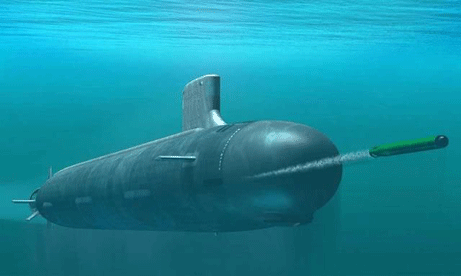 forces organized ‘a hunt’ of a nuclear Russian submarine in the Barents , Military, By Boyko Nikolov On Sep 13, 2020 MOSCOW, (BM) – NATO ships made an attempt to “take the pincers” of the Russian submarine in the waters of the Barents Sea, according to the Nation-news resource on September 12, learned BulgarianMilitary.com.
It is noted that the Russian submarine, which was “hunted” by NATO forces, is equipped with nuclear warheads and means of delivering them with Poseidon torpedoes. The American submarine, in turn, has Harpoon torpedoes and Tomahawk cruise missiles in its arsenal.
A similar incident is also reported in May 2020 in waters belonging to the Northern Sea Route. And also about the flight of a group of NATO bombers over the waters of the East Siberian Sea.
Such actions are assessed by the National Center for Defense Management of the Russian Federation as provocative.
US and British Navy maneuvers into Barents Sea are a signal to Moscow
For the first time since the mid-80s, under the supervision of the Russian fleet, four American and one British ship entered the Barents Sea, which indicates a growing intensity of the confrontation between the great powers in the Arctic, writes The Washington Times.
According to the newspaper, the purpose of this operation was to send a signal to Moscow, as well as to check the readiness of the Navy for action in any weather conditions.
Meanwhile, Norwegian officials refused to participate in this British-American operation – which speaks of its “provocative essence.”
According to officials of the US Navy, these exercises are necessary in order for the US armed forces to be ready to operate in various climatic conditions, including in the Arctic. However, the Trump administration does not particularly hide its intentions to repulse other states – mainly Russia, but also assertive China – that are trying to establish control over strategically important Arctic territories.
As expected, Moscow was not happy about the joint British-American operation. Russian media reported that the Northern Fleet is actively monitoring American and British ships in the Barents Sea.
So far, there have been no reports of close contact between Russian and American ships – as well as news of high-profile statements by senior Russian officials. However, as The Washington Times notes, recalling that it carefully monitors what is happening, Moscow sent a clear signal that it considers this Arctic territory to be its own.
According to American officials, on May 1, they notified Russia of an impending operation in order to avoid an “unintentional exacerbation.”According to officials of the US Navy, these exercises are necessary in order for the US armed forces to be ready to operate in various climatic conditions, including in the Arctic. However, the Trump administration does not particularly hide its intentions to repulse other states – mainly Russia, but also assertive China – that are trying to establish control over strategically important Arctic territories.
As expected, Moscow was not happy about the joint British-American operation. Russian media reported that the Northern Fleet is actively monitoring American and British ships in the Barents Sea.
So far, there have been no reports of close contact between Russian and American ships – as well as news of high-profile statements by senior Russian officials. However, as The Washington Times notes, recalling that it carefully monitors what is happening, Moscow sent a clear signal that it considers this Arctic territory to be its own.
According to American officials, on May 1, they notified Russia of an impending operation in order to avoid an “unintentional exacerbation.”………….. https://bulgarianmilitary.com/2020/09/13/nato-forces-organized-a-hunt-of-a-nuclear-russian-submarine-in-the-barents-sea/
American TV news covers wildfires, but mostly is careful not to mention climate change
 Most wildfire coverage on American TV news fails to mention link to climate crisis
A media watchdog analysis found that just 15% of broadcast news segments over a September weekend made the connection to climate breakdown, https://www.theguardian.com/environment/2020/sep/11/american-tv-news-california-oregon-fires-climate-crisis Lois Beckett in Los Angeles and Maanvi Singh in San Francisco
Most news coverage of the wildfires raging in California, Washington and Oregon on American TV channels made no mention of the connection between the historic fires and climate crisis, according to a new analysis from Media Matters
Reviewing coverage aired over the 5-8 September holiday weekend, the progressive media watchdog group found that only 15% of corporate TV news segments on the fires mentioned the climate crisis. A separate analysis found that during the entire month of August only 4% of broadcast news wildfire coverage mentioned climate crisis.
Wildfires are raging in states across the American west, burning record acreage in California, Washington and Oregon. The wave of fires was first sparked and stoked by a spate of unusual weather in August, including rare lightning storms that hit parts of California that were vulnerable to fire because drought and heat had dried out vegetation. The fires came before low-elevation, coastal parts of the state reached peak fire season in the autumn when fierce offshore winds have driven the biggest fires in recent years.
The fires that hit Oregon in recent days were stoked by dry conditions and rare easterly winds.
Although untangling the weather conditions from climate crisis is complicated, it’s clear that overall, in recent years “fire risk is increasing dramatically because of climate change”, said Chris Field, who directs the Stanford Woods Institute for the Environment. Global heating has given rise to drier, hotter conditions and more frequent, extreme droughts that have left the landscape tinder-dry and prone to explosive blazes.
Although California’s landscape has long been prone to fire, climate crisis has “put pressure on the entire system”, Field said, throwing it out of balance and giving rise to more extreme, catastrophic events. The current fires expanding with such explosive force have burned more acreage within a few weeks than what has burned in previous years.
A consensus of research has made clear that extreme heat and drought fueled by global heating has left the American west tinder-dry and especially vulnerable to runaway fires. A 2019 study found that from 1972 to 2018, California saw a five-fold increase in the areas that burned annually. Another study estimates that without human-caused climate crisis, the area that burned between 1984 and 2015 would have been half of what it actually was. And a research paper published last month suggests that the number of autumn days with “extreme fire weather” – when the risk of wildfires is extremely high – has more than doubled over the past two decades. “Our climate model analyses suggest that continued climate change will further amplify the number of days with extreme fire weather by the end of this century,” the researchers write, “though a pathway consistent with the UN Paris commitments would substantially curb that increase.”
Climate crisis is not the only factor driving the barrage of blazes across the region. Ironically, a century of suppressing fires – extinguishing the natural, necessary fires in western forests and other wildlands to protect homes and timber – has led to an accumulation of fire-fueling vegetation. “A deficit of fire, concatenated with the effects of climate change have led us here,” said Don Hankins, a fire ecologist at California State University, Chico.
Media Matters singled out two TV news journalists who are regularly talking about the role of climate crisis: the CBS meteorologist and climate specialist Jeff Berardelli and NBC’s Al Roker.
The Media Matters analysis also noted that so far, 2020 has been the third year in a row during which corporate broadcast TV news discussed the impacts of climate crisis in fewer than 5% of wildfire segments.
Suffolk County Council unable to back £20billion Sizewell new nuclear power station as the present plan stands
regarding many of these issues is “very disappointing” considering how early in the development process the council raised its concerns. The draft Relevant Representation lists the areas where it believes EDF Energy needs to undertake further work. Council leader Matthew Hicks added: “Suffolk County Council has always supported the principle of a new nuclear power station at Sizewell, recognising the important contribution to the national energy strategy and the large economic boost such a development could bring
to our county.
https://www.eadt.co.uk/news/sizewell-c-not-supported-by-suffolk-county-council-1-6833606
Importance of the ocean’s biological carbon pump
|
$500 billion question: what’s the value of studying the ocean’s biological carbon pump? EurekAlert WOODS HOLE OCEANOGRAPHIC INSTITUTION, Research News 12 Sept 20, The ocean plays an invaluable role in capturing carbon dioxide (CO2) from the atmosphere, taking in somewhere between five to 12 gigatons (billion tons) annually. Due to limited research, scientists aren’t sure exactly how much carbon is captured and stored–or sequestered–by the ocean each year or how increasing CO2 emissions will affect this process in the future. A new paper published in the journal Science of the Total Environment from the Woods Hole Oceanographic Institution (WHOI) puts an economic value on the benefit of research to improve knowledge of the biological carbon pump and reduce the uncertainty of ocean carbon sequestration estimates. Using a climate economy model that factors in the social costs of carbon and reflects future damages expected as a consequence of a changing climate, lead author Di Jin of WHOI’s Marine Policy Center places the value of studying ocean carbon sequestration at $500 billion. “The paper lays out the connections between the benefit of scientific research and decision making,” says Jin. “By investing in science, you can narrow the range of uncertainty and improve a social cost-benefit assessment.” Better understanding of the ocean’s carbon sequestration capacity will lead to more accurate climate models, providing policymakers with the information they need to establish emissions targets and make plans for a changing climate, Jin adds. With co-authors Porter Hoagland and Ken Buesseler, Jin builds a case for a 20-year scientific research program to measure and model the ocean’s biological carbon pump, the process by which atmospheric carbon dioxide is transported to the deep ocean through the marine food web. The biological carbon pump is fueled by tiny plant-like organisms floating on the ocean surface called phytoplankton, which consume carbon dioxide in the process of photosynthesis. When the phytoplankton die or are eaten by larger organisms, the carbon-rich fragments and fecal matter sink deeper into the ocean, where they are eaten by other creatures or buried in seafloor sediments, which helps decrease atmospheric carbon dioxide and thus reduces global climate change. Rising carbon dioxide levels in the atmosphere, a result of human activity such as burning fossil fuels, warms the planet by trapping heat from the sun and also dissolves into seawater, lowering the pH of the ocean, a phenomenon known as ocean acidification. A warmer, more acidic ocean could weaken the carbon pump, causing atmospheric temperatures to rise–or it could get stronger, with the opposite effect. ………. Key Takeaways * The ocean takes up an estimated five to 12 gigatons of carbon dioxide per year through a process known as the biological carbon pump. * More accurate estimates of the ocean’s capacity to remove carbon from the atmosphere will lead to more accurate climate models which could improve carbon emissions policies. * The global economic benefit of studying the ocean’s biological pump is $500 billion, if the science leads to policy decisions that mitigate the effects of climate change. https://www.eurekalert.org/pub_releases/2020-09/whoi-bq091020.php |
|
Suttsu, Hokkaido, residents oppose radioactive waste dump plan
Residents Oppose Hokkaido Town’s Radioactive Waste Site Plan https://www.nippon.com/en/news/yjj2020091000878/residents-oppose-hokkaido-town%27s-radioactive-waste-site-plan.html Suttsu, Hokkaido, Sept. 11 (Jiji Press)–Many residents of a Japanese town considering hosting a final disposal facility for high-level radioactive waste have voiced opposition to the plan at a briefing session organized by the municipal government.The meeting was the fourth of its kind for residents of the town of Suttsu in the northernmost Japan prefecture of Hokkaido. The first such session was held on Monday.
At Thursday’s meeting, which was opened to the press, Suttsu Mayor Haruo Kataoka explained the reasons for considering applying for a literature survey, the first stage of a three-stage research process to select the location of the final disposal site for high-level radioactive waste from nuclear power plants.
Some 260 residents attended the session, which lasted for over three hours from 6:30 p.m. (9:30 a.m. GMT).
Participating residents voiced concerns that the move will lead to harmful rumors about the town, and that if the town receives subsidies from the Japanese government as a result of applying for the literature survey, it will have no choice but to become a final disposal site. Some said that detailed discussions should be held after the mayoral election in the town next year.
Magnox nuclear clear-up cost soars to £9bn
|
Magnox nuclear clear-up cost soars to £9bn https://www.constructionenquirer.com/2020/09/11/magnox-nuclear-clear-up-cost-soars-to-9bn/ Aaron Morby, 13 Sept 20, The cost of decommissioning the Magnox nuclear reactor estate has continued to soar despite efforts to control the budget. Fresh estimates of the cost of getting all Magnox sites cleared and safely enclosed has increased by £2.7bn to £8.7bn since 2017. An investigation by the National Audit Office warns that while the Nuclear Decommissioning Authority has made major progress sorting out its delivery procedures, costs are likely to continue to rise as it gets to grips with the scope of work. The expected cost is now double the original contract price when the initial clean-up deal was signed in 2014 with Cavendish Fluor Partnership to decommission two nuclear research sites and 10 Magnox sites. Since then the Nuclear Decommissioning Authority terminated the contract more than nine years early following a high court challenge to both the procurement by losing bidder Bechtel and changes in scope of work. The NAO this morning warned that costs are likely to be subject to further change, largely because of the inherent uncertainties involved in cleaning up the UK’s nuclear sites. It recommended that the NDA needs to increase its understanding of the condition of sites and the volume and complexity of remaining decommissioning work. It also said the NDA needed to explore with its subsidiaries how future contracts can better support the timely and effective management of underperformance. Gareth Davies, the head of the NAO, said: “Since the failure of the original Magnox contract in 2017, the NDA has made progress in a number of areas. “It renegotiated the contract, avoided further legal disputes and got on with decommissioning the power plants. “However, the NDA now knows that it will cost significantly more to take the sites to the care and maintenance stage of the decommissioning process, though there remains inherent uncertainty about the final cost. “It still needs to ensure it has a solid understanding of the condition of each Magnox site and the costs of cleaning them up.” |
|
|
A powerful message on the seismic dangers in Hinkley Point C nuclear construction. It would be cheaper to pull out now.
Radiation Free Lakeland 12th Sept 2020, Seismic Warnings – if not now when will the Government Scrap Hinkley C? This week there was yet another earthquake recorded in the Bristol area. It was small but significant, contributing to the well documented seismic activity of the area. If eyewatering costs, long delays, a mental and physical health crisis among the employees building Hinkley Point C are not enough to scrap this hubristic nuclear new build plan then the seismic warnings should be.
This insane project next to operational reactors has seen the geological stresses of the biggest pours of concrete in the UK
alongside three huge tunnels being bored below the seabed. German based multi-national company Herrenknecht built the hugely expensive tunnel boring machines which will be dumped under the Bristol Channel once done.
A total of 38,000 concrete segments are needed to support the tunnels, which would transfer 120,000 litres of water per second for the new nuclear plant when finished. The Bristol area is seismically active so to put increased geological stress deliberately in the vicinity of existing nuclear reactors is the kind of hubris that disaster movies are made of.
Scrapping Hinkley C now and paying off the developers would be far cheaper and far safer than continuing down this route to nuclear disaster.
UN nuclear ban treaty needs 6 more ratifications
The treaty prohibits the development, possession and use of nuclear weapons and was adopted with the support of 122 countries and territories three years ago.
Ireland and three other countries ratified the treaty last month, bringing the total number of ratifications to 44. The latest ratifications coincided with the 75th anniversaries of the atomic bombings of Hiroshima and Nagasaki.
The International Campaign to Abolish Nuclear Weapons, or ICAN, plans to calls on more countries to ratify the treaty in events at the UN headquarters to mark the International Day for the Total Elimination of Nuclear Weapons on October 2 and United Nations Day on October 24.
The treaty will come into effect 90 days after the number of ratifications reaches 50.
Nuclear powers, as well as Japan and other countries protected by the US nuclear umbrella, have not signed it.
The sorry history of the Vogtle nuclear boondoggle: it must be stopped.

At crucial crossroads, nuclear plant must be stopped, https://www.augustachronicle.com/opinion/20200912/guest-column-at-crucial-crossroads-nuclear-plant-must-be-stopped By Glenn Carroll, Sep 12, 2020 .
|
In 1977, a small group of thoughtful, committed Georgians started a grassroots anti-nuclear group to oppose nuclear power, nuclear weapons and radioactive waste and to promote alternative visions for renewable energy and world peace. At the same time, Georgia Power was resuming construction of Vogtle 1 and 2, having nearly gone bankrupt three years earlier while attempting to build a four-reactor nuclear compound with a budget of $1 billion. Only 10 weeks after breaking ground, incredibly, Vogtle construction ground to a halt with Georgia Power on the brink of bankruptcy. Georgia Power was saved by two emergency rate hikes thanks to the Georgia Public Service Commission and by selling shares of its hole-in-the-ground Vogtle to most of Georgia’s rural electric cooperatives and municipal power systems. So, in 1977, construction started back up for a two-unit Vogtle with a $640 million budget. In 1979, the year Georgia Power predicted would see blackouts without more power supply, Georgia Power was instead the most overbuilt utility in the country. Vogtle was only 1% complete and it was clear that there was no need for additional power, yet Georgia Power stubbornly stuck to its nuclear goals and in 1989, Vogtle 1 and 2 came on-line at a cost of $6.4 billion — a whopping 1,000% over budget. There are many compelling arguments against nuclear power: the risk of a catastrophic accident, out-of-control construction costs and the still-unsolved radioactive waste problem. Nuclear reactors produce materials that can be used to make nuclear weapons. Nuclear radiation exposure can cause birth defects and cancer. And then there’s that whiff of corporate socialism arising from nuclear’s dependence on government subsidies. All of these negative factors have spun the present-day global nuclear industry into a downward spiral towards obsolescence. Reactors are retiring faster than they are coming online. In 2001, 30 new reactors were ordered in the U.S., but the so-called “nuclear renaissance” rapidly fizzled leaving only Georgia Power and Vogtle. Meanwhile, renewable energy, in particular solar power, has become abundant and cheap, and solar and wind have been the fastest-growing energy sector for the past several years. This is the historic crossroads at which Georgia Power now finds itself building the only new reactors in the United States. Lessons learned? Let’s take a look. Some things remain the same. The unfinished Vogtle project’s budget and construction timeline have already doubled, and experts are saying Georgia Power is destined to go even further over budget and miss the deadline. Again. In the most recent construction monitoring report filed with the PSC, the company claims to have spent more than $1.5 billion in construction costs over the most recent six months. Those are total costs, Georgia Power only reports its 45.7% share of project costs which are $701 million for the six-month period. These skyrocketing costs, amounting to $8.5 million every day, have gone up, according to Georgia Power because of high absenteeism and the loss of skilled craft and management, at least in part because of having more than 800 cases of COVID-19 sidelining workers and crews since the pandemic began. Nuclear Watch South has conducted legal interventions before the PSC to call for the cancellation of Vogtle, showing that Vogtle is still not needed using Georgia Power’s own annual report performance data. Compiling 10 years of figures from Georgia Power’s SEC-filed annual reports tells a revealing story — Georgia Power’s electricity sales remain flat, showing an annual growth rate of less than .3%. Georgia Power’s existing portfolio of electric capacity is chronically underutilized. Last year, Georgia Power idled 31% of its existing capacity, even after shutting down 3,000 megawatts of polluting coal plants. Vogtle, if it is ever finished at a projected price tag of $27 billion, will add a puny 6% capacity — a radioactive capacity that the company simply does not need. But here’s the real shocker: Georgia Power’s profits have somehow skyrocketed in the midst of the Vogtle construction debacle. Georgia Power profits jumped by 20% when Vogtle construction began, steadily rising from the new high watermark. The regulated monopoly posted a whopping 20.5% profit in 2019! So one lesson was clearly learned by Georgia Power: It may not have yet learned how to pull off construction of a nuclear reactor, but it sure has mastered the art of making money. Georgia law empowers the PSC to cancel an unneeded power project. The same law protects Georgia Power to recover costs which were prudently invested in the canceled project, barring fraud or malfeasance. Georgians do not need to have one more dime extracted from them to build an unneeded radioactive waste factory in these times of economic downturn and ever-present fear of a novel coronavirus. Here at the crossroads of history in 2020, there has never been a better time to stop Plant Vogtle. The writer is coordinator of Nuclear Watch South, formerly Georgians Against Nuclear Energy. She has been active in nuclear issues for more than 30 years. |
|
Climate change and the loss of sea otters
Loss of sea otters accelerating the effects of climate change, New research published in Science reveals that the influence of a key predator governs the pace of climate impacts on Alaskan reefs EurekAlert, BIGELOW LABORATORY FOR OCEAN SCIENCES , 13 Sept 20, The impacts of predator loss and climate change are combining to devastate living reefs that have defined Alaskan kelp forests for centuries, according to new research published in Science.
“We discovered that massive limestone reefs built by algae underpin the Aleutian Islands’ kelp forest ecosystem,” said Douglas Rasher, a senior research scientist at Bigelow Laboratory for Ocean Sciences and the lead author of the study. “However, these long-lived reefs are now disappearing before our eyes, and we’re looking at a collapse likely on the order of decades rather than centuries.”
The coral-like reefs, built by the red alga Clathromorphum nereostratum, are being ground down by sea urchins. Sea urchins exploded in number after their predator, the Aleutian sea otter, became functionally extinct in the 1990’s. Without the urchins’ natural predator to keep them in check, urchins have transformed the seascape – first by mowing down the dense kelp forests, and now by turning their attention to the coralline algae that form the reef.
Clathromorphum produces a limestone skeleton that protects the organism from grazers and, over hundreds of years, forms a complex reef that nurtures a rich diversity of sea life. With kelp gone from the menu, urchins are now boring through the alga’s tough protective layer to eat the alga – a process that has become much easier due to climate change.
“Ocean warming and acidification are making it difficult for calcifying organisms to produce their shells, or in this case, the alga’s protective skeleton,” said Rasher, who led the international team of researchers that included coauthors Jim Estes from UC Santa Cruz and Bob Steneck from University of Maine. “This critical species has now become highly vulnerable to urchin grazing – right as urchin abundance is peaking. It’s a devasting combination.”………..
The results of the experiment confirmed that climate change has recently allowed urchins to breach the alga’s defenses, pushing this system beyond a critical tipping point.
“It’s well documented that humans are changing Earth’s ecosystems by altering the climate and by removing large predators, but scientists rarely study those processes together,” Rasher said. “If we had only studied the effects of climate change on Clathromorphum in the laboratory, we would have arrived at very different conclusions about the vulnerability and future of this species. Our study shows that we must view climate change through an ecological lens, or we’re likely to face many surprises in the coming years.”……..https://www.eurekalert.org/pub_releases/2020-09/blfo-los090420.php
1 This Month


Tell the Ukrainian Government to Drop Prosecution of Peace Activist Yurii Sheliazhenko

Petition to revoke the licensing of the Near Surface Nuclear Disposal Facility (NSDF) at Chalk River. https://www.ourcommons.ca/petitions/en/Petition/Details?Petition=e-7247


of the week – STOP SMALL MODULAR REACTORS IN CANADA
To see nuclear-related stories in greater depth and intensity – go to https://nuclearinformation.wordpress.com
-
Archives
- March 2026 (204)
- February 2026 (268)
- January 2026 (308)
- December 2025 (358)
- November 2025 (359)
- October 2025 (376)
- September 2025 (258)
- August 2025 (319)
- July 2025 (230)
- June 2025 (348)
- May 2025 (261)
- April 2025 (305)
-
Categories
- 1
- 1 NUCLEAR ISSUES
- business and costs
- climate change
- culture and arts
- ENERGY
- environment
- health
- history
- indigenous issues
- Legal
- marketing of nuclear
- media
- opposition to nuclear
- PERSONAL STORIES
- politics
- politics international
- Religion and ethics
- safety
- secrets,lies and civil liberties
- spinbuster
- technology
- Uranium
- wastes
- weapons and war
- Women
- 2 WORLD
- ACTION
- AFRICA
- Atrocities
- AUSTRALIA
- Christina's notes
- Christina's themes
- culture and arts
- Events
- Fuk 2022
- Fuk 2023
- Fukushima 2017
- Fukushima 2018
- fukushima 2019
- Fukushima 2020
- Fukushima 2021
- general
- global warming
- Humour (God we need it)
- Nuclear
- RARE EARTHS
- Reference
- resources – print
- Resources -audiovicual
- Weekly Newsletter
- World
- World Nuclear
- YouTube
-
RSS
Entries RSS
Comments RSS
 nuclear-news