THe Arctic’s slow-moving underwater nuclear disaster – Russia’s radioactive trash

 Russia’s ‘slow-motion Chernobyl’ at sea, BBC By Alec Luhn2nd September 2020, ”…………………………. Beneath some of the world’s busiest fisheries, radioactive submarines from the Soviet era lie disintegrating on the seafloor. Decades later, Russia is preparing to retrieve them………. Russia’s ‘slow-motion Chernobyl’ at sea, BBC By Alec Luhn2nd September 2020, ”…………………………. Beneath some of the world’s busiest fisheries, radioactive submarines from the Soviet era lie disintegrating on the seafloor. Decades later, Russia is preparing to retrieve them……….With a draft decree published in March, President Vladimir Putin set in motion an initiative to lift two Soviet nuclear submarines and four reactor compartments from the silty bottom, reducing the amount of radioactive material in the Arctic Ocean by 90%. First on the list is Lappa’s K-159.
|
|

Over 800 coronavirus cases among workers at Vogtle nuclear project, may increase costs and delays

|
Georgia nuclear project reports more than 800 COVID-19 cases to date, https://www.ajc.com/ajcjobs/georgia-nuclear-project-
 reports-more-than-800-covid-19-cases-to-date/P4BXNDI5ONHX7BSPCPTJYZNWYE/ By Matt Kempner, 20 Sept 20, The Atlanta Journal-Constitution, Georgia Power’s massive nuclear expansion project has had more than 800 workers who have tested positive for COVID-19 since the coronavirus pandemic began. reports-more-than-800-covid-19-cases-to-date/P4BXNDI5ONHX7BSPCPTJYZNWYE/ By Matt Kempner, 20 Sept 20, The Atlanta Journal-Constitution, Georgia Power’s massive nuclear expansion project has had more than 800 workers who have tested positive for COVID-19 since the coronavirus pandemic began.
In a new filing with the state, Georgia’s largest electric provider said it has weathered another wave of cases at the Plant Vogtle project underway south of Augusta, but that the number of new cases is receding again. Georgia Power said more than 700 of the workers who tested positive are now eligible to return to work, and that there were 109 active confirmed cases as of Friday. A spokesman declined to disclose if any workers have been hospitalized or died, citing privacy laws. About 7,000 workers are stationed on site after 2,000 were sent home in April in hopes of reducing the virus’ spread and dealing with growing absenteeism. The virus has been blamed for further slowing the project, which is already years behind schedule and billions of dollars over budget. Independent monitors for the Georgia Public Service Commission warned in June that even without considering the impact of COVID-19, Vogtle’s costs will rise by another $1 billion and the project is “highly unlikely” to have its two new reactors in service by November 2021 and November 2022, respectively. In a filing made public Monday, the company said it continues to plan for the scheduled operation dates. But Georgia Power said it recognizes “that the project may continue to experience challenges and that unanticipated events, or failure to meet the current plan, may require further revision to the site work plan, capital cost forecast, and/or project schedule.” In a July filing, the company said costs for its share of the project are expected to be $149 million over current forecasts and that it later may ask state regulators to charge customers for the increase. After coronavirus cases rose early in the pandemic, the project went several weeks without any new confirmed cases on the site, according to the company’s latest filing. But the confirmed cases grew again. Then, in recent weeks, “the site has followed the general trend in the region with a decline in the number of active cases.” |
|
|
Sea ice at its lowest state in 5,500 years in Bering sea

 in the region is lower than it’s been for thousands of years.A newly published paper in the journal Science Advances describes how a peat core from St. Matthew Island is providing a look back in time. By analyzing the chemical composition of the core, which includes plant remains from 5,500 years ago to the present, scientists can estimate how sea ice in the region has changed during that time period.
“It’s a small island in the middle of the Bering Sea, and it’s essentially been recording what’s happening in the ocean and atmosphere around it,” said lead author Miriam Jones, a research geologist with the U.S. Geological Survey. Jones worked as a faculty researcher at the University of Alaska Fairbanks when the project began in 2012.
………. UAF’s Alaska Stable Isotope Facility analyzed isotope ratios throughout the peat layers, providing a time stamp for ice conditions that existed through the millennia.
After reviewing the isotopic history, researchers determined that modern ice conditions are at remarkably low levels.
“What we’ve seen most recently is unprecedented in the last 5,500 years,” said Matthew Wooller, director of the Alaska Stable Isotope Facility and a contributor to the paper. “We haven’t seen anything like this in terms of sea ice in the Bering Sea.”
Jones said the long-term findings also affirm that reductions in Bering Sea ice are due to more than recent higher temperatures associated with global warming. Atmospheric and ocean currents, which are also affected by climate change, play a larger role in the presence of sea ice.
“There’s a lot more going on than simply warming temperatures,” Jones said. “We’re seeing a shift in circulation patterns both in the ocean and the atmosphere.” https://www.eurekalert.org/pub_releases/2020-09/uoaf-bsi082820.php
The nuclear industry a big winner from U.S. election as Democrats and Republicans embrace this toxic industry
 Nuclear Power Could Win Big In U.S. Elections, Oil Price By Jon LeSage – Sep 2, 2020
The world’s largest nuclear power market is ready to gain more government backing for the energy — no matter who wins in November.
For nearly a half century, the Democratic Party’s election year party platform has excluded nuclear energy, but that’s not the case this year. The newly-released party platform says It favors a “technology-neutral”  approach that includes all zero-carbon technologies, including hydroelectric power, geothermal, existing and advanced nuclear, and carbon capture and storage.
It’s the first time since the 1972 election year that the party has had any positive statements to make about nuclear power, which did include early testing of fusion nearly a half century ago. That year, the Democratic party said it supported “greater research and development” into “unconventional energy sources” including solar, geothermal, and “a variety of nuclear power possibilities to design clean breeder fission and fusion techniques.”
Since then, the Democratic Party has either ignored or opposed nuclear energy. Environmental groups have been opposed to nuclear power for years, and have had much influence on campaigns and elected officials.
A clear example of it comes from 2005, when about 300 environmental groups –
including Greenpeace, Sierra Club, and Public Citizen – signed a statement which said “we flatly reject the argument that increased investment in nuclear capacity is an acceptable or necessary solution….[N]uclear power should not be a part of any solution to address global warming.”
The Sierra Club, the largest US environmental lobby, says it remains “unequivocally opposed to nuclear energy.”………
Presidential candidate Joe Biden’s campaign website also includes nuclear power support …..
Biden has been championing starting a new agency, Advanced Research Projects Agency for Climate Change (ARPA-C). Like predecessor ARPA-E that funded advanced technology in renewable energy, electric vehicles, and other technologies, and DARPA that supported advanced military vehicle applications, ARPA-C would back test projects working toward lowering cost, driving efficiency, and reducing emissions.
The change in policy statements is good news for the American nuclear-energy sector…….
But its already been in the works in Washington. During the past two years, bipartisan support on Capitol Hill has led to new laws, including the Nuclear Energy Innovation and Modernization Act and the Nuclear Energy Innovation Capabilities Act …… https://oilprice.com/Alternative-Energy/Nuclear-Power/Nuclear-Power-Could-Win-Big-In-US-Elections.html
Fluor could improve its finances by abandoning NuScam, as some cities pull out of ”small” nuclear reactor scheme
 Fluor could improve earnings by reducing underperforming assets, including NuScale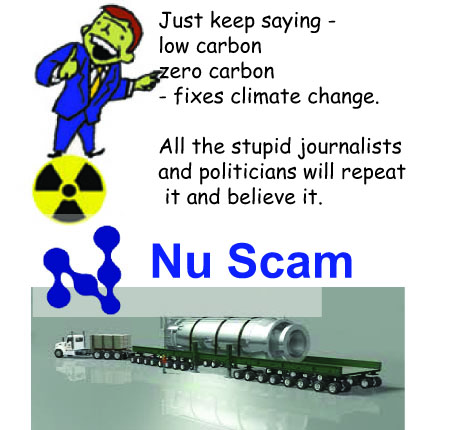
But two cities, Logan and Lehi, Utah have walked away from the project, and a third is now considering dropping its support because of risks and a lack of backers, according to officials.
Allen Johnson, the power department director for Bountiful, Utah, said chances are greater than 50-50 it will withdraw.
“You’ve got to have enough people to support it and some of the players I thought would be interested are not,” he said.
The defections are bad news for U.S. efforts to develop modular nuclear energy …
Combined, cities have so far committed to buying just under 200 megawatts of the plant’s planned 720 megawatts of power.
The U.S. Department of Energy has pumped more the $280 million into the project since 2013, and is expected to commit another $1.4 billion over the next nine years. The department did not respond to requests for comment…….
The consortium earlier this year pushed back the project’s commercial operation date to 2030 from 2026, Webb said, to provide more time for public input and opportunities for cities to reconsider their participation at various phases.
CITIES RETHINK COSTS
NuScale, based in Portland, Oregon, is majority owned by construction and engineering firm Fluor Corp.
The project would include 12 60-megawatt modules at the Energy Department’s Idaho National Laboratory.
The Nuclear Regulatory Commission last week approved NuScale’s design, the first such green light for a modular reactor.
Small modular reactors are meant to be cheaper and quicker to build than traditional reactors because they can be manufactured in factories. But critics say economies of scale are lost with the smaller plants.
The NuScale project’s projected cost of $6.1 billion has risen from $3.6 billion in 2017, Mark Montgomery, head of the municipal utility in Logan told officials there last month ahead of their vote to abandon the project.
Lehi withdrew from the project due to a lack of interest from other entities and increased costs, according to the Aug. 25 resolution approved by its city council.
“These cities should not be acting as venture capital investors,” said Rusty Cannon, vice president of the Utah Taxpayers Association, which has been pushing cities to leave.
Previous cost estimates did not account for financing and decommissioning, as well as higher labor, construction and materials costs over ten years, UAMPS spokesman Webb said, explaining the change.
NuScale said the project delay had been requested by UAMPS. It did not comment specifically on the city defections.
A Wednesday report written by M.V. Ramana a professor of disarmament and human security at the University of British Columbia said Fluor had cut its own investment in the project and excluded NuScale expenses from its financial forecasts because it was expecting additional funding from third party investors.
Financial analyst Jamie Cook of Credit Suisse said last year that Fluor could improve earnings by reducing underperforming assets, including NuScale. ………https://whtc.com/news/articles/2020/sep/02/some-us-cities-turn-against-first-planned-small-scale-nuclear-plant/1054578/
Russia facing huge problem to recover radioactive sunken nuclear reactors, but Putin still plans new ones in the Arctic
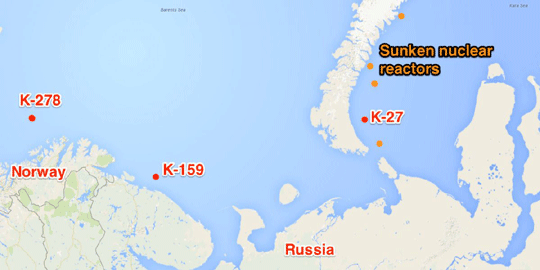
Russia’s ‘slow-motion Chernobyl’ at sea, FUTURE PLANET | OCEANS By Alec Luhn, 2nd September 2020 ……….
Minimising risk
Russia, Norway and other countries whose fishing boats ply the bountiful waters of the Barents Sea have now found themselves with a sword of Damocles hanging over their heads. Although a 2014 Russian-Norwegian expedition to the K-159 wreck that tested the water, seafloor and animals like a sea centipede did not find radiation above background levels, an expert from Moscow’s Kurchatov Institute said at the time that a reactor containment failure “could happen within 30 years of sinking in the best case and within 10 years at the worst”. That would release radioactive caesium-137 and strontium-90, among other isotopes.
While the vast size of the oceans quickly dilutes radiation, even very small levels can become concentrated in animals at the top of the food chain through “bioaccumulation” – and then be ingested by humans. But economic consequences for the Barents Sea fishing industry, which provides the vast majority of cod and haddock at British fish and chip shops, “may perhaps be worse than the environmental consequences”, says Hilde Elise Heldal, a scientist at Norway’s Institute of Marine Research.
According to her studies, if all the radioactive material from the K-159’s reactors were to be released in a single “pulse discharge”, it would increase Cesium-137 levels in the muscles of cod in the eastern Barents Sea at least 100 times. (As would a leak from the Komsomolets, another sunken Soviet submarine near Norway that is not slated for lifting.) That would still be below limits set by the Norwegian government after the Chernobyl accident, but it could be enough to scare off consumers. More than 20 countries continue to ban Japanese seafood, for instance, even though studies have failed to find dangerous concentrations of radioactive isotopes in Pacific predatory fishes following the Fukushima nuclear power plant release in 2011. Any ban on fishing in the Barents and Kara seas could cost the Russian and Norwegian economies €120m ($140m; £110m) a month, according to a European Commission feasibility study about the lifting project.
There is no ship in the world capable of lifting the K-159, so a special salvage vessel would have to be built
But an accident while raising the submarine, on the other hand, could suddenly jar the reactor, potentially mixing fuel elements and starting an uncontrolled chain reaction and explosion. That could boost radiation levels in fish 1,000 times normal or, if it occurred on the surface, irradiate terrestrial animals and humans, another Norwegian study found. Norway would be forced to stop sales of products from the Arctic such as fish and reindeer meat for a year or more. The study estimated that more radiation could be released than in the 1985 Chazhma Bay incident, when an uncontrolled chain reaction during refuelling of a Soviet submarine near Vladivostok killed 10 sailors.
Amundsen argued that the risk of such a criticality excursion with the K-159 or K-27 was low and could be minimised with proper planning, as it was during the removal of high-risk spent fuel from Andreyev Bay.
“In that case we do not leave the problem for future generations to solve, generations where the knowledge of handling such legacy waste may be very limited,” he says.
The safety and transparency of Russia’s nuclear industry has often been questioned, though, most recently when Dutch authorities concluded that radioactive iodine-131 detected over northern Europe in June originated in western Russia. The Mayak reprocessing facility that received the spent fuel from Andreyev Bay by train has a troubled history going back to the world’s then-worst nuclear disaster in 1957. Rosatom continues to deny the findings of international experts that the facility was the source of a radioactive cloud of ruthenium-106 registered over Europe in 2017.
While the K-159 and K-27 need to be raised, Rashid Alimov of Greenpeace Russia has reservations. “We are worried about the monitoring of this work, public participation and the transport [of spent fuel] to Mayak,” he says.
Custom mission
Raising a submarine is a rare feat of engineering. The United States spent $800m (£610m) in an attempt to lift another Soviet submarine, the diesel-powered K-129 that carried several nuclear missiles, from 16,400ft (5,000m) in the Pacific Ocean, under the guise of a seabed mining operation. In the end, they only managed to bring a third of the submarine to the surface, leaving the CIA with little usable intelligence.
That was the deepest raise in history. The heaviest was the Kursk. To bring the latter 17,000-tonne missile submarine up from 350ft (108m) below the Barents Sea, the Dutch companies Mammoet and Smit International installed 26 hydraulically cushioned lifting jacks on a giant barge and cut 26 holes in the submarine’s rubber-coated steel hull with a water jet operated by scuba divers. On 8 October 2001, rushing to beat the winter storm season after four months of nerve-wracking work and delays, steel grippers fitted in the 26 holes lifted the Kursk from the seabed in 14 hours, after which the barge was towed to a dry dock in Murmansk.
At less than 5,000 tonnes, the K-159 is smaller than the Kursk, but even before it sank its outer hull was “as weak as foil”, according to Bellona. It has since been embedded in 17 years’ worth of silt. A hole in the bow would seem to rule out pumping it full of air and raising it with balloons, as has been previously suggested. At a conference of European Bank of Reconstruction and Development donors in December, a Rosatom representative said there was no ship in the world capable of lifting it, so a special salvage vessel would have to be built.
That will increase the estimated cost of €278m ($330m; £250m) to raise the six most radioactive objects. Donors are discussing Russia’s request to help finance the project, said Balthasar Lindauer, director of nuclear safety at EBRD.
“There’s consensus something needs to be done there,” he says. Any such custom-built vessel would likely need a bevy of specialised technologies such as bow and aft thrusters to keep it positioned precisely over the wreck.
But in August, Grigoriev told a Rosatom-funded website that one plan the company was considering would involve a pair of barges fitted with hydraulic cable jacks and secured to deep-sea moorings. Instead of steel grippers like the ones inserted into the holes in the Kursk, giant curved pincers would grab the entire hull and lift it up between the barges. A partially submersible scow would be positioned underneath, then brought to the surface along with the submarine and finally towed to port. The K-27 and K-159 could both be recovered this way, he said.
One of three engineering firms working on proposals for Rosatom is the military design bureau Malachite, which drafted a project to raise the K-159 in 2007 that “was never realised due to a lack of money”, according to its lead designer. This year the bureau has begun updating this plan, an employee tells Future Planet in the lobby of Malachite’s headquarters in St Petersburg. Many questions remain, however.
“What condition is the hull in? How much of force can it handle? How much silt has built up? We need to survey the conditions there,” the employee says, before the head of security arrives to break up our conversation.
Nuclear paradox
Removing the six radioactive objects fits in with an image Putin as crafted as a defender of the fragile Arctic environment. In 2017, he inspected the results of an operation to remove 42,000 tonnes of scrap metal from the Franz Josef Land archipelago as part of a “general clean-up of the Arctic”. He has spoken about environmental preservation at an annual conference for Arctic nations. And on the same day in March 2020 that he issued his draft decree about the sunken objects, he signed an Arctic policy that lists “protecting the Arctic environment and the native lands and traditional livelihood of indigenous peoples” as one of six national interests in the region.
“For Putin, the Arctic is part of his historic legacy. It should be well-protected, bring real benefits and be clean,” said Dmitry Trenin, head of the think tank Carnegie Centre Moscow.
Yet while pursuing a “clean” Arctic, the Kremlin has also been backing Arctic oil and gas development, which accounts for the majority of shipping on the Northern Sea Route. State-owned Gazprom built one of two growing oil and gas clusters on the Yamal peninsula, and this year the government cut taxes on new Arctic liquified natural gas projects to 0% to tap into some of the trillions of dollars of fossil fuel and mineral wealth in the region.
And even as Putin cleans up the Soviet nuclear legacy in the far north, he is building a nuclear legacy of his own. A steady march of new nuclear icebreakers and, in 2019, the world’s only floating nuclear power plant has again made the Arctic the most nuclear waters on the planet.
Meanwhile, the Northern Fleet is building at least eight submarines and has plans to construct several more, as well as eight missile destroyers and an aircraft carrier, all of them nuclear-powered. It has also been testing a nuclear-powered underwater drone and cruise missile. In total, there could be as many as 114 nuclear reactors in operation in the Arctic by 2035, almost twice as many as today, a 2019 Barents Observer study found.
This growth has not gone without incident. In July 2019, a fire on a nuclear deep-sea submersible near Murmansk almost caused a “catastrophe of a global scale,” an officer reportedly said at the funeral of the 14 sailors killed. The next month, a “liquid-fuel reactive propulsion system” exploded during a test on a floating platform in the White Sea, killing two of those involved and briefly spiking radiation levels in the nearby city of Severodvinsk.
“The joint efforts of the international community including Norway and Russia after breakup of the Soviet Union, using taxpayer money to clean up nuclear waste, was a good investment in our fisheries,” says The Barents Observer’s Nilsen. “But today there are more and more politicians in Norway and Europe who think it’s a really big paradox that the international community is giving aid to secure the Cold War legacy while it seems Russia is giving priority to building a new Cold War.”
As long as the civilian agency Rosatom is tasked with clean-up, the Russian military has little incentive to slow down this nuclear spree, Nilsen notes.
“Who is going to pay for the clean-up of those reactors when they are not in use anymore?” he asks. “That is the challenge with today’s Russia, that the military don’t have to think what to do with the very, very expensive decommissioning of all this.”
So while the coming nuclear clean-up is set to be the largest of its kind in history, it may turn out to be just a prelude to what’s needed to deal with the next wave of nuclear power in the Arctic…………….https://www.bbc.com/future/article/20200901-the-radioactive-risk-of-sunken-nuclear-soviet-submarines
Small nuclear reactors – NuScam looking dodgy as parent company Fluor shares sink?
declined by -15.01% in the 3 months of the year. Over the past six months meanwhile, it has lost -19.89% and lost -47.51% year-on date. DBT News 25 August 20
Small nuclear reactor NuScam’s parent company Fluor sued over allegations of insider trading and deception
 Fluor Board Sued Over Insider Trading, Accounting Allegations, Mike Leonard, Legal Reporter, Aug. 14, 2020, COURT: Del. Ch., TRACK DOCKET: No. 2020-0655 (Bloomberg Law Subscription, JUDGE: J. Travis Laster (Bloomberg Law Subscription), COMPANY INFO: Fluor Corp. (Bloomberg Law Subscripti
The board of Fluor Corp., a leading engineering and construction conglomerate that does significant business with the federal government, has been hit with a Delaware lawsuit claiming several of its members sold stock at inflated prices while conspiring to mask the company’s deteriorating finances.
“At the same time,” Fluor’s board and top executives “engaged in a pattern” of having the company “repurchase its own shares at over-inflated prices,” the 98-page Chancery Court complaint says. “This repurchase of inflated stock cost the company over $1.6 billion.”
The heavily redacted derivative suit, made public Wednesday, comes about three months after Fluor……….(subscribers only) https://news.bloomberglaw.com/mergers-and-antitrust/fluor-board-sued-over-insider-trading-accounting-allegations
Small nuclear reactor NuScam’s parent company Fluor – shares tumble afterdisclosure of accounting probe
Fluor Shares Tumble After Disclosure of SEC Accounting Probe, Fluor shares are tumbling after the engineering company disclosed an SEC probe into its past accounting and financial reporting. ROB LENIHAN, FEB 18, 2020
Fluor (FLR) – Get Report shares were tumbling after the engineering and construction company said the Securities and Exchange Commission is looking into the company’s past accounting and financial reporting.
The Irving, Texas, company also said in a statement that the SEC has asked for documents and information related to projects for which the Company recorded charges in the second quarter of 2019……. https://www.thestreet.com/investing/stocks/fluor-shares-tumble-after-engineering-company-discloses-sec-probe
Arctic tragedy: the loss of Russian sailors in nuclear submarine accidents
Russia’s ‘slow-motion Chernobyl’ at sea, FUTURE PLANET | OCEANS By Alec Luhn, 2nd September 2020 By tradition, Russians
always bring an odd number of flowers to a living person and an even number to a grave or memorial. But every other day, 83-year-old Raisa Lappa places three roses or gladiolas by the plaque to her son Sergei in their hometown Rubtsovsk, as if he hadn’t gone down with his submarine during an ill-fated towing operation in the Arctic Ocean in 2003.“I have episodes where I’m not normal, I go crazy, and it seems that he’s alive, so I bring an odd number,” she says. “They should raise the boat, so we mothers could put our sons’ remains in the ground, and I could maybe have a little more peace.”
After 17 years of unfulfilled promises, she may finally get her wish, though not out of any concern for the bones of Captain Sergei Lappa and six of his crew. With a draft decree published in March, President Vladimir Putin set in motion an initiative to lift two Soviet nuclear submarines and four reactor compartments from the silty bottom, reducing the amount of radioactive material in the Arctic Ocean by 90%. First on the list is Lappa’s K-159. ……………..
‘Cursed August’
Sergei Lappa was born in 1962 in Rubtsovsk, a small city in the Altai Mountains near the border with Kazakhstan. Though it was thousands of miles to the nearest ocean, he cultivated an interest in seafaring at a local model shipbuilding club, and after school he was accepted into the higher naval engineering academy in Sevastopol, Crimea. Tall, athletic and a good student, he was assigned to the navy’s most prestigious service: the Northern Submarine Fleet.
With the reactors off, Lappa and his skeleton crew of nine engineers operated the boat by flashlight. As the submarine was towed near Kildin Island at half past midnight, the cables to the bow pontoons broke in heavy seas, and a half-hour later water was discovered trickling into the eighth compartment. But as headquarters struggled with the decision to launch an expensive rescue helicopter, the crew kept trying to keep the submarine afloat. At 02:45am Mikhail Gurov sent one last radio transmission: “We’re flooding, do something!” By the time rescue boats from the tug arrived, the K-159 was on the bottom near Kildin Island. Of the three sailors who made it out, the only survivor was senior lieutenant Maxim Tsibulsky, whose leather jacket had filled with air and kept him afloat.
Yet another nuclear submarine had sunk during the “cursed” month of August, Russian newspapers wrote, but the incident caused little furore compared to the Kursk. The navy promised relatives it would raise the K-159 the next year, then repeatedly delayed the project.
Even after 17 years of scavenging and corrosion, at least the bones of the crew likely remain in the submarine, according to Lynne Bell, a forensic anthropologist at Simon Fraser University. But the families have long since lost hope of recovering them.
“For all the relatives it would bring some relief if their fathers and husbands were buried, not just lying on the bottom in a steel hulk,” Gurov’s son Dmitry says. “It’s just that no one believes this will happen.”
The situation has now changed, however, as Russia’s interest revives in the Arctic and its crumbling Soviet ports and military towns. Since 2013, seven Arctic military bases and two tanker terminals have been built as part of the Northern Sea Route, a shorter route to China that Putin has promised will see 80 million tonnes of traffic by 2025. The K-159 is lying underneath the eastern end of the route………….https://www.bbc.com/future/article/20200901-the-radioactive-risk-of-sunken-nuclear-soviet-submarines
Viruses could be harder to kill after adapting to warm environments
 Viruses could be harder to kill after adapting to warm environments, https://www.eurekalert.org/pub_releases/2020-09/acs-vcb082820.php AMERICAN CHEMICAL SOCIETY 2 Sept 20, Enteroviruses and other pathogenic viruses that make their way into surface waters can be inactivated by heat, sunshine and other microbes, thereby reducing their ability to spread disease. But researchers report in ACS’ Environmental Science & Technology that global warming could cause viruses to evolve, rendering them less susceptible to these and other disinfectants, such as chlorine.
Enteroviruses can cause infections as benign as a cold or as dangerous as polio. Found in feces, they are released into the environment from sewage and other sources. Their subsequent survival depends on their ability to withstand the environmental conditions they encounter. Because globalization and climate change are expected to alter those conditions, Anna Carratalà, Tamar Kohn and colleagues wanted to find out how viruses might adapt to such shifts and how this would affect their disinfection resistance.
The team created four different populations of a human enterovirus by incubating samples in lake water in flasks at 50 F or 86 F, with or without simulated sunlight. The researchers then exposed the viruses to heat, simulated sunlight or microbial “grazing” and found that warm-water-adapted viruses were more resistant to heat inactivation than cold-water-adapted ones. Little or no difference was observed among the four strains in terms of their inactivation when exposed to either more simulated sunlight or other microbes. When transplanted to cool water, warm-water-adapted viruses also remained active longer than the cool-water strains. In addition, they withstood chlorine exposure better. In sum, adaptation to warm conditions decreased viral susceptibility to inactivation, so viruses in the tropics or in regions affected by global warming could become tougher to eliminate by chlorination or heating, the researchers say. They also say that this greater hardiness could increase the length of time heat-adapted viruses would be infectious enough to sicken someone who comes in contact with contaminated water.
3 unplanned shutdowns- Turkey Point nuclear station vulnerable to climate extremes
Critics have pushed Turkey Point and the NRC to take sea rise impacts more seriously, Lyman said.
“We think nuclear plants need to be protected not only against the flood hazards that are reasonably expected today but far into the future, especially plants that have a license renewal like Turkey Point,” he said. “Unfortunately, the NRC today is not interested in increasing regulatory requirements for its current fleet.”
After 3 unplanned shutdowns at Turkey Point nuclear plant, feds launch ‘special inspection’, Miami Herald BY ADRIANA BRASILEIRO AND ALEX HARRIS, SEPTEMBER 01, 2020 After three unplanned nuclear reactor shutdowns over three days this month, federal regulators have launched a “special inspection” at Florida Power & Light’s Turkey Point plant.
In a statement issued Monday, the Nuclear Regulatory Commission said it was inspecting the plant this week to determine why one of the reactors in the two-unit facility “tripped” or shut down three times between Aug. 17 and Aug. 19. Such visits from the federal agency that oversees nuclear power plants aren’t unheard of but are unusual.
The NRC said FPL had supplied different explanations for each event………..
Edwin Lyman, director of nuclear power safety at the Union of Concerned Scientists, called the number of scrams “very unusual,” in a whole year, much less a few days. He said the NRC has a specific set of criteria plants must meet before they need a special investigation.
“These inspections are fairly rare events,” he said. “This could be a sign that they think there is some increase in risk to the public.”
Edwin Lyman, director of nuclear power safety at the Union of Concerned Scientists, called the number of scrams “very unusual,” in a whole year, much less a few days. He said the NRC has a specific set of criteria plants must meet before they need a special investigation.
“These inspections are fairly rare events,” he said. “This could be a sign that they think there is some increase in risk to the public.”………..
Over the past few years FPL has faced criticism and legal challenges over Turkey Point’s aging cooling system, a unique canal network that doesn’t exist anywhere else in the U.S. The problems from the leaking canal water, which created a saltwater plume encroaching into the adjacent freshwater aquifer, have led state and county regulators to cite FPL for polluting the waters in Biscayne Bay.
The plant last year won federal approval to continue to operate through at least 2053 — an unprecedented decision by regulators to extend the operating lifespan of nuclear reactors to 80 years.
The extended approval also brings up concerns of sea level rise and the increased storm surge that comes with it. By the end of this plant’s current license, Miami-Dade is planning for just under two feet of sea-level rise. Turkey Point is planning for between a half foot and a little over a foot by 2050.
Critics have pushed Turkey Point and the NRC to take sea rise impacts more seriously, Lyman said.
“We think nuclear plants need to be protected not only against the flood hazards that are reasonably expected today but far into the future, especially plants that have a license renewal like Turkey Point,” he said. “Unfortunately, the NRC today is not interested in increasing regulatory requirements for its current fleet.” The plant last year won federal approval to continue to operate through at least 2053 — an unprecedented decision by regulators to extend the operating lifespan of nuclear reactors to 80 years.
The extended approval also brings up concerns of sea level rise and the increased storm surge that comes with it. By the end of this plant’s current license, Miami-Dade is planning for just under two feet of sea-level rise. Turkey Point is planning for between a half foot and a little over a foot by 2050.
Critics have pushed Turkey Point and the NRC to take sea rise impacts more seriously, Lyman said.
“We think nuclear plants need to be protected not only against the flood hazards that are reasonably expected today but far into the future, especially plants that have a license renewal like Turkey Point,” he said. “Unfortunately, the NRC today is not interested in increasing regulatory requirements for its current fleet.” https://www.miamiherald.com/news/local/environment/article245384945.html?fbclid=IwAR2h6Kk7IV87lRlc0HWNgR42aIVowxmKXeijJzIwcPyUADkGEUIngnV2xHo
EDF trying to scam UK gvernment to back uneconomic Sizewell C nuclear project
 100% Renewables 1st Sept 2020, EDF are trying to bamboozle ministers to back a scheme that would pay EDF
massive subsidies and premium prices to produce hydrogen that renewable
energy would generate for less than half the cost.
British electricity consumers to fund the proposed Sizewell C plant, on top
of which EDF will also be paid a high guaranteed premium price for all of
their electricity production.
Nuclear corruption in Ohio: HB 6 was never about jobs and communities by keeping nuclear plants open
HB 6 was never about jobs and communities by keeping nuclear plants open. In fact, First Energy Solutions refused to show legislators there was a need for the bailout. Yet, their own numbers posted on the company’s website show subsidies were never needed and, with the subsidy secure, they paid shareholders $800 million! That’s not done by a company in dire straits. Electricity customers should never have been forced to pay for this – especially now when hospitals, households, small businesses, schools and communities are struggling. ...
|
Ohioans should take notice when they hear the word “subsidy” because it refers to your money. That’s why most Ohioans have opposed House Bill 6 – the bailout of power plants owned by First Energy Solutions (now Energy Harbor) that will be tacked onto your electricity bill – from the beginning. And you really have no choice because we all need electricity. HB 6 should have never happened. But because of greed, it was secretly conceived through alleged corruption via the Ohio legislature rather than what should have been settled through a private bankruptcy process. An intimidating monopoly and indicted politician stand accused of perverting the legislative process with some $60 million spent to shift the billion-dollar subsidy from shareholders to Ohioans. That’s why Vistra has vigorously fought against this tainted legislation from the start. First, when HB 6 was before lawmakers and the corruption not yet alleged, we were a member of Ohioans Against Nuke Bailouts. Then, after the legislature passed HB 6 and the governor signed it, we pressed on as a member of Ohioans Against Corporate Bailouts, advocating to let Ohioans vote, as allowed by the state constitution, on whether they’d like their money used to bailout select companies. With the corruption that fueled HB 6 now exposed in a criminal indictment, we continue to fight, demanding the immediate and complete repeal of HB 6 as members of the Coalition to Restore Public Trust. We now know, through the substantial and mounting evidence amassed in the FBI’s investigation, that the real winners of HB 6 were a politician and his cronies, charged with racketeering and bribery, and the Wall Street owners of First Energy and First Energy Solutions. The losers are Ohioans still on the hook today to pay more than a billion dollars – unless Ohio legislators act to immediately repeal HB 6 in its entirety. HB 6 was never about jobs and communities by keeping nuclear plants open. In fact, First Energy Solutions refused to show legislators there was a need for the bailout. Yet, their own numbers posted on the company’s website show subsidies were never needed and, with the subsidy secure, they paid shareholders $800 million! That’s not done by a company in dire straits. Electricity customers should never have been forced to pay for this – especially now when hospitals, households, small businesses, schools and communities are struggling. …….. https://www.cincinnati.com/story/opinion/2020/09/01/opinion-nuclear-bailout-corruption-kills-public-trust-and-competition/3455443001/ |
|

Iran Nuclear Deal Parties ‘United in Resolve’ to Preserve Agreement
 Iran Nuclear Deal Parties ‘United in Resolve’ to Preserve Agreement https://www.voanews.com/middle-east/voa-news-iran/iran-nuclear-deal-parties-united-resolve-preserve-agreement, By VOA News, September 02, 2020 A European Union official leading talks among Iran and a group of five world powers Tuesday said the participants are committed to keeping alive the 2015 nuclear deal that restricted Iran’s nuclear program in exchange for sanctions relief. Iran Nuclear Deal Parties ‘United in Resolve’ to Preserve Agreement https://www.voanews.com/middle-east/voa-news-iran/iran-nuclear-deal-parties-united-resolve-preserve-agreement, By VOA News, September 02, 2020 A European Union official leading talks among Iran and a group of five world powers Tuesday said the participants are committed to keeping alive the 2015 nuclear deal that restricted Iran’s nuclear program in exchange for sanctions relief.
Helga Schmid tweeted after the meeting in Vienna that “participants are united in resolve to preserve the #IranDeal and find a way to ensure full implementation of the agreement despite current challenges.” “All participants reaffirmed the importance of preserving the agreement recalling that it is a key element of the global nuclear non-proliferation architecture, as endorsed by United Nations Security Council Resolution 2231,” Schmid said in a later statement. The deal came under stress last year when Iran announced would take steps to walk away from its commitments, complaining it was not getting the promised economic relief after the United States imposed fresh sanctions. Those sanctions came after the Trump administration withdrew from the agreement in 2018, arguing it did too little to prevent Iran from developing nuclear weapons while giving the country too much in sanctions relief. Iran has denied it worked to build nuclear arms, and says it is able and prepared to reverse the actions it has taken to back away from the deal. Tehran has surpassed limits on the amount of enriched uranium it can hold at one time as well as the level to which it is allowed to enrich the material and has installed more advanced centrifuges. Representatives from Britain, China, France, Russia and Germany all took part in Tuesday’s talks, the latest in their efforts to salvage the agreement. Speaking with reporters after the meeting, Chinese representative Fu Cong called on Iran to return to full compliance with its requirements, but also said “the economic benefit that is due to Iran needs to be provided.” The U.N. Security Council resolution that enshrined the nuclear agreement includes mechanisms for participants to address non-compliance, and last month the United States sought to reinstate U.N. sanctions based on Iran’s violations of its requirements. The other signatories have rejected the U.S. move, something they reaffirmed at Tuesday’s talks. Schmid’s statement said that because the United States announced it was halting its participation in the nuclear deal and had not participated in any related activities since that time in May 2018, all of the remaining signatories agree it “therefore could not be considered as a participant state,” and thus “cannot initiate the process of reinstating U.N. sanctions.” The United States has argued that because it was an original member of the agreement, it retains the right to seek the snapback sanctions. The representatives at Tuesday’s talks also welcomed Iran’s decision last week to allow the U.N. atomic energy agency to inspect two sites where Iran is suspected of having stored or used undeclared nuclear material in the early 2000s. |
1 This Month


Tell the Ukrainian Government to Drop Prosecution of Peace Activist Yurii Sheliazhenko

Petition to revoke the licensing of the Near Surface Nuclear Disposal Facility (NSDF) at Chalk River. https://www.ourcommons.ca/petitions/en/Petition/Details?Petition=e-7247


of the week – STOP SMALL MODULAR REACTORS IN CANADA
To see nuclear-related stories in greater depth and intensity – go to https://nuclearinformation.wordpress.com
-
Archives
- March 2026 (204)
- February 2026 (268)
- January 2026 (308)
- December 2025 (358)
- November 2025 (359)
- October 2025 (376)
- September 2025 (258)
- August 2025 (319)
- July 2025 (230)
- June 2025 (348)
- May 2025 (261)
- April 2025 (305)
-
Categories
- 1
- 1 NUCLEAR ISSUES
- business and costs
- climate change
- culture and arts
- ENERGY
- environment
- health
- history
- indigenous issues
- Legal
- marketing of nuclear
- media
- opposition to nuclear
- PERSONAL STORIES
- politics
- politics international
- Religion and ethics
- safety
- secrets,lies and civil liberties
- spinbuster
- technology
- Uranium
- wastes
- weapons and war
- Women
- 2 WORLD
- ACTION
- AFRICA
- Atrocities
- AUSTRALIA
- Christina's notes
- Christina's themes
- culture and arts
- Events
- Fuk 2022
- Fuk 2023
- Fukushima 2017
- Fukushima 2018
- fukushima 2019
- Fukushima 2020
- Fukushima 2021
- general
- global warming
- Humour (God we need it)
- Nuclear
- RARE EARTHS
- Reference
- resources – print
- Resources -audiovicual
- Weekly Newsletter
- World
- World Nuclear
- YouTube
-
RSS
Entries RSS
Comments RSS
 nuclear-news