Environment ministry: If Estonia gets nuclear power plant, not before 2035, ERR News, 3 July 20, Estonia’s first nuclear power plant would not start operating before 2035, according to a memorandum from the Ministry of the Environment (Keskkonnaministeerium), which the government will discuss later this summer.
The memorandum “Possibilities for the Deployment of Nuclear Energy in Estonia” (“Tuumaenergia kasutuselevõtmise võimalused Eestis”) describes a process of at which would take at least 15 years which would follow the government agreeing to a nuclear power plant. Estonia is starting this process almost from scratch.
The first proposal of the memorandum signed by Minister of the Environment Rene Koka calls for the establishment of an inter-ministerial working group on nuclear energy in order to form publicly agreed positions on the possibility of introducing nuclear energy in Estonia.
…….. The memorandum states it is important to determine society’s support for nuclear energy as soon as possible and to avoid problems caused by poor communication. Holding a referendum on this issue should also be discussed….
The memorandum lists the main risks and describes possibilities to mitigate them. These include problems with the introduction of new technology, the possibility of an emergency, concerns about the production and supply of nuclear fuel, financial and nuclear liability, radioactive waste management, lack of know-how and specialists, public involvement and communication.
……Finally, there are political risks.
If a referendum is held on the construction of a nuclear power plant and if the public vote against it, the ability to initiative nuclear energy projects in Estonia will be ruled out for a very long time, and Estonia’s energy policy may change with the change of government,
But there is also a broader, international view that Estonia’s neighbors, such as Sweden and Lithuania, who have themselves decided to abandon nuclear energy, or Russia, who may not want a nuclear power plant built in Estonia for geopolitical reasons if US technology is introduced…….. https://news.err.ee/1109118/environment-ministry-if-estonia-gets-nuclear-power-plant-not-before-203
July 4, 2020
Posted by Christina Macpherson |
EUROPE, politics |
Leave a comment
 Largs & Millport News 1st July 2020
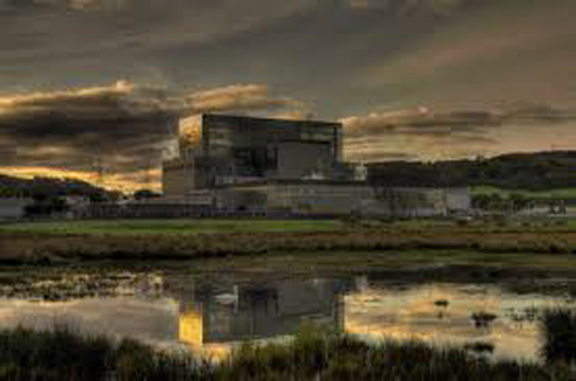
, A CALL has been made to shut down Hunterston B with immediate effect. West Kilbride councillor Todd Ferguson says that Hunterston should not be a
‘guinea pig’ for the UK nuclear industry testing long far power stations can last. Cracks have been appearing in all of the EDF advanced cooling reactors fleet around the United Kingdom – and the Office of Nuclear Regulation (ONR) are currently examining the safety case presented by EDF to switching the reactors back on but the matter has been delayed several times this year.
Councillor Ferguson said: “The cracks at Hunterston keep making news and EDF acknowledge that the cracks have been accelerating quicker than expected. “There comes a time when the reactors should remain offline for good. The North Ayrshire Conservative Group believe the time to look at this is now. …….
I believe that the time is right for the Office of Nuclear Regulation not to grant permissionto restart the reactors at Hunterston B. I’m concerned that Hunterston B is being used as some sort of guinea pig, with the purpose being to supply data on how far you can push EDF’s ageing AGR reactor fleet. The station has exceeded its life cycle and the time is right to start winding down operations safely. The safety of the workforce and local communities are paramount.
…….ONR have a
big decision to make in relation to the safety case which has been presented by EDF.” At the recent Hunterston Site Stakeholders Group meeting, EDF were asked when it became economically prohibitive to re-start the reactors and the response was that the data coming from the testing of
the reactors was important information for the rest of the fleet of reactors around the UK.Councillor Ferguson said: “Hunterston is by far the most heavily cracked. When does it get to the points where the risks outweigh everything else? “I don’t want it to get into a position of a race of what is going to fail first – the graphite or the boilers.”………
https://www.largsandmillportnews.com/news/18533657.dont-turn-hunterston-guinea-pig—call-shut-reactors-now/
July 4, 2020
Posted by Christina Macpherson |
safety, UK |
Leave a comment
Swarm of insects cause nuclear reactor to lose power in Michigan, Fox 23, July 2, 2020 NEWPORT, Mich. — The Enrico Fermi 2 Nuclear Power Plant in Newport lost offsite power Wednesday in what has been described as a “mayfly accumulation.”
In a report released by the Nuclear Regulatory Commission that the outage was “caused by mayfly accumulation” around the facility’s switchyard. Diesel generators started automatically as a backup power supply.
July 4, 2020
Posted by Christina Macpherson |
incidents, USA |
Leave a comment
Boris Johnson pledges to get ‘big nuclear things’ done in message to Copeland mayor
|
|
|
July 4, 2020
Posted by Christina Macpherson |
politics, UK |
Leave a comment
Germany is first major economy to phase out coal and nuclear, Economic Times, 3 July 20
The plan is part of Germany’s ‘energy transition’ – an effort to wean Europe’s biggest economy off planet-warming fossil fuels and generate all of the country’s considerable energy needs from renewable sources…….
Bills approved by both houses of parliament Friday envision shutting down the last coal-fired power plant by 2038 and spending some 40 billion euros ($45 billion) to help affected regions cope with the transition.
The plan is part of Germany’s ‘energy transition’ – an effort to wean Europe’s biggest economy off planet-warming fossil fuels and generate all of the country’s considerable energy needs from renewable sources…….
Bills approved by both houses of parliament Friday envision shutting down the last coal-fired power plant by 2038 and spending some 40 billion euros ($45 billion) to help affected regions cope with the transition.The plan is part of Germany’s ‘energy transition’ – an effort to wean Europe’s biggest economy off planet-warming fossil fuels and generate all of the country’s considerable energy needs from renewable sources.
“The days of coal are numbered in Germany,” Environment Minister Svenja Schulze said. “Germany is the first industrialized country that leaves behind both nuclear energy and coal.”……
Schulze, the environment minister, said there would be regular government reviews to examine whether the end date for coal can be brought forward. She noted that by the end of 2022, eight of the country’s most polluting coal-fired plants will have already been closed………
This week, utility companies in Spain shut down seven of the country’s 15 coal-fired power plants, saying they couldn’t be operated at profit without government subsidies.
But the head of Germany’s main miners’ union, Michael Vassiliadis, welcomed the decision, calling it a “historic milestone.” He urged the government to focus next on an expansion of renewable energy generation and the use of hydrogen as a clean alternativ ..
July 4, 2020
Posted by Christina Macpherson |
climate change, Germany |
Leave a comment

Science and Technology: ¶ “Warming Temperatures Threaten Hundreds Of Fish Species The World Relies On, Study Finds” • As the planet’s oceans and rivers warm, increased heat could pose a grave threat to the fish populations the world depends on by the end of this century. That’s the alarming conclusion of a study published in […]
via July 3 Energy News — geoharvey
July 4, 2020
Posted by Christina Macpherson |
Uncategorized |
Leave a comment
 European Council resists calls for Just Transition Fund cash to be available for gas
  and nuclear generation https://www.pv-magazine.com/2020/07/01/european-council-resists-calls-for-just-transition-fund-cash-to-be-available-for-gas-and-nuclear-generation/
The heads of state of the 27 EU member states agreed to resist calls from a reported eight countries to expand the nature of projects eligible for energy transition support beyond renewables.
JULY 1, 2020 MAX HALL An EU spokesperson has confirmed the heads of the bloc’s 27 member states have announced an intent to block any of the European Commission’s proposed €40 billion energy transition money being spent on gas or nuclear power facilities.
The commission has proposed pulling together a Just Transition Fund (JTF) to be spent helping regions dependent on fossil fuels transition to clean energy as part of its much-vaunted Green Deal for Europe. The fund would comprise €30 billion from the bloc’s coronavirus recovery fund and €10 billion from the EU budget for 2021-27, both of which are yet to be ratified.
Reports late last week suggested the 27 heads of state who make up EU joint legislative body the European Council had agreed to resist calls from eight EU states to permit the proposed JTF to be spent on gas and nuclear facilities, as well as clean energy generation.
An EU spokesperson has told pv magazine the council wants to ensure the cash is spent only on renewables and confirmed the plans will now be negotiated with the other EU legislative body, the European Parliament, with the commission mediating.
“We would hope for an agreement as soon as possible, certainly this autumn,” said the spokesperson, indicating a hoped-for resolution by December 20.
July 2, 2020
Posted by Christina Macpherson |
climate change, EUROPE |
Leave a comment
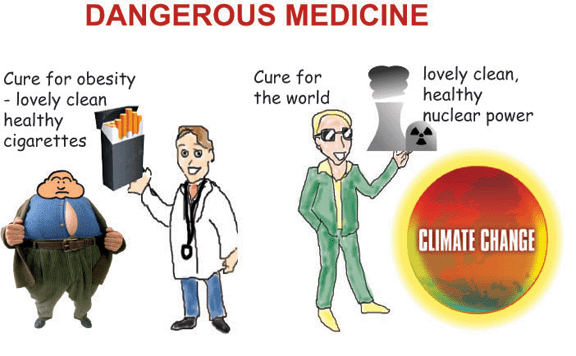
Edmundson & Ramana: Nuclear power doesn’t fit with Green New Deal https://pamplinmedia.com/ttt/90-opinion/472125-380632-edmundson-and-ramana-nuclear-power-doesnt-fit-with-green-new-deal, Schyler Edmundson and M. V. Ramana, 1 July 20,
‘This is as it should be, for GND proposals also emphasize considerations having to do with ethics and equity.’
The COVID-19 pandemic and the resultant economic downturn have led, again, to calls for governments to institute some kind of a Green New Deal (GND) to both create jobs and deal with climate change. Most prominently, climate and environment ministers from 17 European countries have publicly called upon the European Commission to include some such deal as part of the EU recovery plan.
In the United States, too, there have been similar calls from academics, community organizers, and journalists; there are even hints that the presumptive Democratic nominee Joe Biden might embrace parts of this proposal.
There is no single version of a Green New Deal. Yet, all versions share many common features. They universally emphasize major investment in solar and wind energy to meet climate goals and because these sectors create many more jobs than older centralized energy forms. With the rapid declines in the costs of renewable energy and storage technologies, the economic logic for their expansion is impeccable.
Within discussions of the GND, what is fiercely debated is nuclear power. For proponents of nuclear power, the case for inclusion is obvious: it is a low-carbon source of electricity. Some go so far as arguing that it is impossible to meet any serious climate targets without nuclear energy. Conversely, most serious proponents of the GND would simply not countenance an increase in nuclear power.
This is as it should be, for GND proposals also emphasize considerations having to do with ethics and equity. These emphases are what make these Green New Deals rather than just climate change mitigation plans. They explain why the Green New Deal for Europe calls for supporting climate justice around the world and the New Democratic Party’s GND proposal in Canada stresses respect for indigenous rights.
Nuclear power is not compatible with this emphasis. The environmental impacts of the long chain of processes involved in generating electricity from nuclear reactors are unevenly spread out, and the heaviest burdens have been placed on historically marginalized communities, especially indigenous populations.
Consider, for example, uranium mining. Much of the uranium that has been mined around the world has come from areas occupied by indigenous peoples, including in Australia, in Canada, in India, and in the United States. Several examples of proposed uranium mining projects are in areas with large indigenous populations — for example, in Meghalaya in India. Indigenous communities have suffered incalculable health consequences as a result of these activities — for example, the Navajo Nation in the United States.
At the other end of the fuel chain is radioactive waste that is produced by all nuclear power plants. Many of the sites that have been proposed as potential hosting places for nuclear waste have high proportions of indigenous populations. This has been a major concern in Canada, and has been termed nuclear colonialism; earlier in January, the Saugeen Ojibway Nation voted overwhelmingly against one such proposal. The proposed Yucca Mountain repository is strongly resisted by the Western Shoshone people, on whose lands the site is located.
Underlying this resistance is the reality that there is no demonstrated solution to safely managing nuclear waste. The radioactive elements in nuclear waste will remain hazardous to human health for hundreds of thousands of years. This long period poses a challenge to distributive justice; any putative benefits of producing this nuclear waste will accrue to current generations while future generations will face the risks resulting from their production. This mismatch does not fit well with the ethical ideas underlying Green Nuclear Deal proposals.
Another tenet underlying all GND proposals is the need for rapid climate action, the importance of which was reinforced by the 2018 Intergovernmental Panel on Climate Change report outlining the impacts of global warming of 1.5 degrees Celsius above pre-industrial levels. International bodies have warned that we only have a decade to stop irreversible damage from climate change. Urgency is the reason GND proposals set ambitious targets for emission reductions.
Nuclear power is incompatible with this envisioned pace. It takes approximately 10 years to go from start of construction to connecting a new nuclear plant to the electricity grid. It might take another decade before starting construction to prepare the site, deal with the necessary safety and environmental licensing processes, and engage in complex negotiations needed to raise the billions of dollars the reactor costs. Nuclear energy capacity can simply not be scaled up rapidly.
The bottom line is that nuclear power is incompatible with any plan that strives to be a Green New Deal. Add to this the long list of other problems confronting nuclear power, including unfavorable economics, danger of catastrophic accidents, and connections with nuclear weapons proliferation, and the GND for Europe proposal that the world should be planning for the “obsolescence” of nuclear energy makes complete sense.
Schyler Edmundson is a policy professional from Vancouver, British Columbia, whose research explores the intersection between public policy and climate change, and has worked at Environment and Climate Change Canada and as a research assistant for the School of Public Policy and Global Affairs, University of British Columbia. M. V. Ramana is the Simons Chair in Disarmament, Global and Human Security and director of the Liu Institute for Global Issues at the School of Public Policy and Global Affairs, University of British Columbia.
July 2, 2020
Posted by Christina Macpherson |
2 WORLD, climate change |
Leave a comment
 Assange’s father calls extradition process ‘disgrace’ https://telanganatoday.com/assanges-father-calls-extradition-process-disgrace?fbclid=IwAR1a7bQ0W_Xcgc9EIeGaAHVP7Zmm2cM6nNV65ZXtkhCwNUlarqIYTJVw6xo1 July 20, The 80-year-old is organizing public events in Australia despite the ongoing coronavirus pandemic and hopes to travel to London in August to support Assange during his extradition trial.
Sydney: WikiLeaks founder Julian Assange’s father, John Shipton, is fighting tirelessly for the release and return of his son, who is facing an extradition trial in London for publishing classified information, a process he described as abuse.
“We maintain that the extradition request is a fraud in the English court… It’s a fraud in the English legal system, it’s a case of abuse of process, it is a disgrace,” Shipton, who travelled from Melbourne to Sydney to campaign for his son’s release, told Efe news in an interview.
The 80-year-old is organizing public events in Australia despite the ongoing coronavirus pandemic and hopes to travel to London in August to support Assange during his extradition trial which, he says, is being carried out under “dire” circumstances.
In May 2019, the UN Special Rapporteur on Torture, Nils Melzer, said, after visiting Assange in the Belmarsh prison along with two medical experts, that he showed “all symptoms typical for prolonged exposure to psychological torture, including extreme stress, chronic anxiety and intense psychological trauma”.
Assange has spent almost a decade in confinement, first under house arrest in a British town and then at the Ecuadorian embassy in London between 2012 until 2019, when Ecuador withdrew his political asylum status.
Shipton has urged the Australian government to mediate with the UK administration for the release of his son, who is wanted in the US on 18 charges of espionage and computer intrusion, for which he could be sentenced to prison for up to 175 years.
“I believe the government can, if it wishes to, assist us in bringing Julian home. I believe that (it) is very simple for the Prime Minister (Scott Morrison) to pick up the phone and ring (his UK counterpart) Boris Johnson and say Julian Assange is an Australian citizen in dire circumstances.
“This will resolve this immediately and that’s easily possible,” he told Efe news during the interview.
July 2, 2020
Posted by Christina Macpherson |
AUSTRALIA, civil liberties, legal, politics international, UK |
Leave a comment
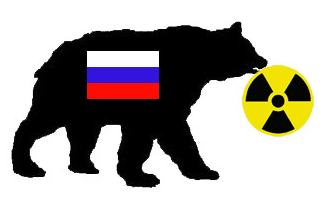
Russia’s nuclear play for power in Africa, DW 2 July 20,
Russia is pushing nuclear technology to African nations to both turn a profit and expand its political might on the continent. Rwanda’s parliament has just approved a plan for Russia’s state-owned Rosatom nuclear conglomerate to build it a nuclear research center and reactor in the capital, Kigali.
The Center of Nuclear Science and Technologies, planned for completion by 2024, will include nuclear research labs as well as a small research reactor with up to 10 MW capacity.
Ethiopia, Nigeria and Zambia have signed similar deals with Rosatom, while countries such as Ghana, Uganda, Sudan and DRC have less expansive cooperation agreements.
Rosatom has been aggressively wooing African nations since the mid-2000s and the nuclear deals are seen as part of Russia’s push turn a profit and also gain influence in Africa.
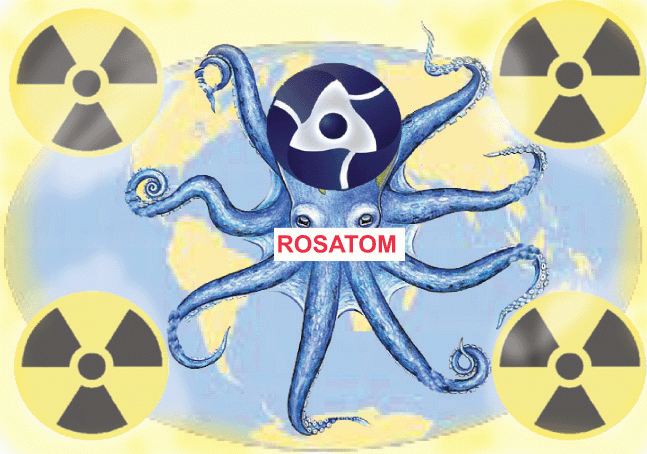
Western sanctions first imposed on Russia in 2014 over its annexation of the Crimea in the Ukraine have forced Russia to seek alternative sources of incomes and also new friends.
Nuclear technology instead of trade
“For Putin to remain relevant in Russia, he really has to ensure that Russia has a big influence,” said Ovigwe Eguegu, a geopolitics analyst with the international affairs platform, Afripolitika. “That’s why he is looking at African markets so he has more parties to partner with when it comes to international issues.”
African nations constitute the largest voting bloc in the United Nations.
While the Soviet Union had a close relationship to various African states during the Cold War, Russia’s trade balance with Africa is one tenth of that of China, meaning it needs to look for other means to get a foothold on the continent.
“Russia is using the tools that they have to expand their influence and right now, Russia has lots of experience in the nuclear energy area,” Eguegu said in a phone interview from Abuja.
Rosatom nuclear leader
Rosatom is the world’s biggest nuclear company by foreign orders. While it has projects in developed countries such as Finland and Hungary, it’s mainly involved in developing regions.
The Rosatom packages are popular because the corporation’s sheer size means it can offer all-in-one deals, from training local workers to developing nuclear science curricula, supplying uranium for the plant’s life time and dealing with nuclear waste — with the added plus of Russian state loans for the projects.
The cost and financing of Rwanda’s nuclear research center is still undisclosed. But Russia is extending a $25 billion (€22.23 billion) loan to Egypt to cover 85% of the cost of the El Dabaa nuclear power plant, which Rosatom is constructing.
Rosatom has come to dominate nuclear exports to developing countries because of their generous financing and worker training,” according to the 2018 Center for Global Development policy paper, Atoms for Africa.
Additionally, Russia is itself a major player in the nuclear market, responsible for some 8% of uranium production worldwide as well as 20% of uranium conversion and 43% of uranium enrichment (conversion and enrichment are stages of processing uranium so it can be used by commercial nuclear power reactors)………….
many experts, including Gatari, believe that nuclear technology doesn’t yet make sense for African countries. They lack the highly skilled local workforce required to run the technological intricacies of such reactors. Plus, nuclear facilities are vastly expensive and take years to build.
Gatari warns of countries becoming locked into costly projects that end up being “white elephants”.
“Such a project can only be driven by strong and educated local human resources,” the nuclear researcher said. “That knowledge isn’t possible by rushing young students through training for a short time.
And the cost of maintaining that kind of installation can cripple the budget of a country for a long, long time.”
Doing the smooth sell
Currently, South Africa is the only country in sub-Saharan Africa with a functioning nuclear power plant, while Nigeria and Ghana have research reactors, which are primarily used for studying and training and to test materials, such as minerals.
In Europe, safety concerns around nuclear technologies have already caused countries such as Germany, Italy, Spain and Switzerland to vote to phase out nuclear power.
These concerns are compounded in Africa, given the the political instability of certain regions and the threat of sabotage or terrorist attacks. This hasn’t stopped Rosatom, and Russia, from doing a soft sell of nuclear technologies on the continent.
Rosatom funds scholarships for students from sub-Saharan Africa to study nuclear sciences and engineering in Russia. As of January 2020, around 300 students from more than 15 African countries were studying nuclear specialties there.
It runs an online video competition, Atoms for Africa, where participants stand a chance to win an all expenses paid trip to Russia for a video dedicated to innovative nuclear technologies.
In 2019, it even held an international fishing competition near the Leningrad nuclear power station, Russia’s largest, to demonstrate the safety of nuclear power for water bodies. (The competition was won by an Egypt team).
“There is good money if you can sell a research reactor,” said nuclear scientist Gatari. “Unfortunately, the convincing capacity of [Rosatom’s] marketing is very high, and the understanding of those who are buying is low.” https://www.dw.com/en/russias-nuclear-play-for-power-in-africa/a-54004039
July 2, 2020
Posted by Christina Macpherson |
AFRICA, marketing, politics international, Russia |
Leave a comment
A global push for racial justice in the climate movement For years, mainstream environmental movements around the globe have excluded people of color, who are disproportionately impacted by climate change. Today’s global Black Lives Matter protests have amplified calls for institutions of all kinds — including environmental groups — to challenge and dismantle chronic systemic racism., The World, June 30, 2020 By Anna Kusmer
Environmental sociologist Dorceta Taylor remembers being the only Black person in her environmental science class at Northeastern Illinois University in the early 1980s. When she asked her white professor why there weren’t more Black students, he quickly told her that it was “because Blacks are not interested in the environment,” she said.
This assumption ran counter to everything she knew. She had grown up in Jamaica, where people from all backgrounds were passionate about the environment and loved nature.
Taylor, until recently a professor of environmental racism at the University of Michigan, found that underrepresentation exists at environmental organizations across the United States. In 2014, just under 16% of people of color were represented in a survey of hundreds of organizations, compared to about 35% of the population, she said. In the early 1990s, only about 2% of the staff of environmental nongovernmental organizations were people of color.
In the UK, the environmental sector is one of the least diverse sectors of the economy.
Yet, people of color are disproportionately impacted by environmental degradation and climate change, and environmental organizations are being called to focus more than ever before on environmental justice.
In the past few weeks, big international green groups including Greenpeace and 350.org have responded with statements, videos and op-eds supporting Black Lives Matter and calling for racial justice.
Related: Black Lives Matter UK says climate change is racist
But environmental activist Suzanne Dhaliwal is skeptical this will translate into real inclusion, particularly in the UK, where she lives and works. Dhaliwal, who identifies as British Indian Canadian Sikh, grew up partly in Canada and spent much of her 20s working alongside big environmental nonprofits in the UK. ………
So, Dhaliwal started her own environmental nonprofit, UK Tar Sands Network, which works alongside Indigenous communities and organizations to campaign against UK companies investing in oil extraction in Alberta, Canada.
“Now, what I call for is direct funding of Black and Brown and Indigenous organizations and leadership training,” said Dhaliwal. “We need research money so that we can research new strategies.”
Other environmentalists are trying to change environmental organizations from within.
Samia Dumbuya just started a job with the European branch of international nonprofit Friends of the Earth, working on climate justice and energy issues. She lives in the UK.
As a Black person whose parents are refugees from Sierre Leone, talking about racial justice issues within the environmental movement is personal for her. She says she sees how climate change is affecting her parents’ home country with increasingly bad flooding and landslides. ………
Across the globe, the urban spaces that are overpoliced and lack public investment also have the worst air quality and contaminated drinking water. The environmental movement will grow stronger with more diverse representation, but also by making these connections, Taylor said.
“Environmentalists all over the country are really taking note that they need to think of the environment now as not just the trees and the birds and the flowers, but the human relationships that are in them — and how these are really threatening some people way more than they’re threatening others.” https://www.pri.org/stories/2020-06-30/global-push-racial-justice-climate-movement
July 2, 2020
Posted by Christina Macpherson |
2 WORLD, climate change, environment, indigenous issues |
Leave a comment

The Nuclear Industry is SUPER KEEN to promote itself as Clean Energy what with the Springfields Nuclear Fuel Manufacturing site (near the Preston New Road frack site) now calling itself a “Clean Energy Technology Park” and the Extinction Rebellion Public Relations guru saying she has “followed the science” and her nuclear mentor George Monbiot along […]
via “Clean Energy” Who are they Kidding? The Moorside Site Again under Threat of New Nuclear Crapola. —
July 2, 2020
Posted by Christina Macpherson |
Uncategorized |
Leave a comment
 We Don’t Have Enough Cash to Build New Nuclear Weapons, Says Air Force https://www.defenseone.com/politics/2020/07/we-dont-have-enough-cash-build-new-nuclear-weapons-says-air-force-chief/166598/ Chief Nukes or conventional weapons, “the current budget does not allow you to do both,” says Gen. Dave Goldfein, suggesting Congress create a separate account.
The Pentagon’s budget is not large enough to buy new nuclear weapons and conventional forces simultaneously, the U.S. Air Force’s top general said Wednesday.
Chief of Staff Gen. Dave Goldfein gave a blunt assessment of the Pentagon’s growing list of bills amid a growing US deficit, on Wednesday, suggesting nuclear expenses have grown so great they may require a separate account of their own.
I think a debate is that this will be the first time that the nation has tried to simultaneously modernize the nuclear enterprise while it’s trying to modernize an aging conventional enterprise,” Goldfein said during a Brookings Institution appearance. “The current budget does not allow you to do both.”
The Trump administration’s $705 billion fiscal 2021 budget request for the Pentagon — which Congress is reviewing — calls for nearly $29 billion in nuclear weapons spending. The money would go toward new stealth bombers, intercontinental ballistic missiles, ballistic missile submarines, a new nuclear cruise missile and upgrades to the global nuclear command, control and communications network. The stealth bomber is the only weapon that could be used for nuclear or conventional strikes. The Energy Department, which oversees nuclear warheads, has requested $15.6 billion in fiscal 2021.
In January 2019, the Congressional Budget Office estimated that the Pentagon’s nuclear weapons spending plan would cost $494 billion between 2019 and 2028, an average of about $50 billion per year.
Pentagon officials today argue they need 3 to 5 percent annual spending increases to fund weapons projects of all kinds, however defense spending is expected to flatten or slightly decline in the coming years regardless who wins November’s presidential election.
“There are either going to be some significant trades made or we’re going to have to find a fund for strategic nuclear deterrence, that we can use to modernize,” Goldfein said.
In recent years, Pentagon officials, including former Defense Secretary Ash Carter, and lawmakers have considered creating a nuclear weapons fund separate from the military services budgets. Todd Harrison, director of defense budget analysis and the Aerospace Security Project at the Center for Strategic and International Studies, questioned the rationale for moving those funds.
“It doesn’t make new money appear,” he said.
During the Obama administration, the Pentagon began the decades-long process of updating its nuclear arsenal with new ICBMs, bombers, submarines and missiles. Some independent estimates say the price tag could reach nearly $1.7 trillion over the next 30 years. How to pay for it is still debated in the Defense Department, but the need for nuclear weapons is not.
“I would just offer that in my mind, I could never advise anybody to unilaterally disarm or give up second strike capability,” Goldfein said. “I do believe we have to have a debate about the way we’re going to fund this essential part of our military going forward.”
July 2, 2020
Posted by Christina Macpherson |
USA, weapons and war |
Leave a comment

 Terrawatch: unearthing snow’s ‘Fukushima layer’ https://www.theguardian.com/science/2020/jun/30/terrawatch-unearthing-snows-fukushima-layer
Chinese glaciologists have found the freeze-thaw process has concentrated discharge from the disaster Kate Ravilious, @katerav Wed 1 Jul 2020 The Fukushima nuclear accident has added a distinctive signature to snow and ice across the northern hemisphere, new research published in Environmental Research Letters shows. Triggered by the Tōhoku earthquake and tsunami off the coast of Japan on 11 March 2011, the disaster resulted in a month-long discharge of radioactive material into the atmosphere, ocean and soil.Feiteng Wang from the Tian Shan glaciological station in Lanzhou, China, and colleagues collected snow samples in 2011 and 2018 from a number of glaciers (spanning a distance of more than 1,200 miles (2,000km) in north-western China. They expected the Fukushima signature to have faded away by 2018, but to their surprise the freeze-thaw processing had made it more concentrated, creating a strong and lasting reference layer in the ice.
Many reference layers from the last 50 years (such as the Chernobyl nuclear disaster) have melted away in recent warming events, making it difficult to date the upper layers of ice cores. “Reference layers are crucial and a prerequisite for telling the story of the ice core,” says co-author Jing Ming. “The Fukushima layer will be useful for dating ice in one or two decades when the snow transforms to ice,” he adds.
July 2, 2020
Posted by Christina Macpherson |
China, environment, radiation |
Leave a comment
Russia’s New Super Weapons May Be Cause Of Radiation Leak https://www.forbes.com/sites/hisutton/2020/07/01/russias-new-super-weapons-may-be-cause-of-radiation-leak/#7acff8725f8c H I Sutton A recent nuclear leak may be related to new nuclear-powered strategic weapons Russia is developing. These are part of a range of new ‘super weapons’
unveiled by President Putin on March 1, 2018. Russia is testing a nuclear-powered mega-torpedo called Poseidon and a nuclear-powered cruise missile called Burevestnik. If either are to blame, then it would not be the first radiation spike caused by testing one of these weapons.On June 23, the Comprehensive Nuclear Test Ban Treaty Organization (CTBTO) revealed that scientists in Sweden had detected higher than usual levels of radiation. Based on analysis of the weather, the origin was projected to be in Northern Russia. Executive Secretary
Lassina Zerbo tweeted that they had detected “3 isotopes; Cs-134, Cs-137 & Ru-103 associated w/Nuclear fission.” He went on to say that “These isotopes are most likely from a civil source.” and that it is “outside the CTBTO’s mandate to identify the exact origin.”
Russia’s nuclear energy body has denied that the radiation originated from its two nuclear power stations in the region. However, it is not only civilian power stations that use nuclear reactors. Tom Moore, a nuclear policy expert and former senior professional staff member of the U.S. Senate Foreign Relations Committee, believes that these military reactors cannot be ruled out:
“CTBTO radionuclide monitoring is intended to discriminate explosive events and to complement seismic monitoring. Not to effectively rule in or rule out a source of radionuclides as being civil or military reactors.”
Possible Cause: Burevestnik Cruise Missile
The first military system under development which comes to mind is the Burevestnik cruise missile. Its name means ‘Storm Bringer’ in Russian, after the Petral sea bird. It is more formally known by the designation 9M730 and NATO code name Skyfall. This is a nuclear-armed cruise missile that is designed to use a nuclear engine to give it virtually unlimited range. Burevestnik is the natural candidate because it is airborne, so any accident would likely release radioactive material into the sky.
This may have previously happened on August 9, 2019. There was a fatal radiation incident at the State Central Navy Testing Range at Nyonoksa. This is near to Severodvinsk in Russia’s arctic north, the same area that the CTBTO has pointed towards this time. Then it was caused by an explosion in a rocket engine. Many analysts believe that this was most likely related to the Burevestnik missile.
Possible Cause: Poseidon Drone-Torpedo
The other weapon in the frame is Poseidon. This is a massive nuclear-powered torpedo that is intended to be launched from specially built submarines. At 60-78 feet long it is about twice the size of a Trident missile. Its designation is believed to be 2m39 and it is known in NATO as Kanyon. Its virtually unlimited range and high autonomy would make it hard to classify. The U.S. government has described it as an intercontinental, nuclear armed, undersea autonomous torpedo. It is a weapon worthy of a Bond villain that would literally go underneath missile defenses. Its threat is slow but inevitable doom to coastal cities such as New York and Los Angeles.
While Poseidon probably doesn’t have very much shielding on its reactor, it is normally underwater, so any radiation leak may not reach the atmosphere. But it would be lifted out of the water after a test launch, so there is room for an incident that could get detected hundreds of miles away in Scandinavia.
Open Source Intelligence On The Suspects
Open source intelligence analysts have been following these weapons. Evgeniy Maksimov noted that flight tests of Burevestnik were probably being conducted. He noted two no-fly zones closed for June 22-27 at a missile test range. But the launch site was far south of where the radiation is believed to originate.
A better candidate may therefore be Poseidon. Vessels believed to be associated with its tests were active in the region at the time. The special support vessel Akademik Aleksandrov was at sea around June 18 to 23, in the area of interest. This ship is suspected of being involved in retrieving Poseidon weapons. Twitter user Frank Bottema found a matching vessel using radar satellite imagery.
We may never know for sure the cause of the heightened radiation levels. But Russia’s denials that it was from a civilian power plant, combined with the ongoing tests, point a finger at the nuclear-powered weapons. This reignites the debate about how safe these projects are, even in peacetime.
July 2, 2020
Posted by Christina Macpherson |
radiation, Russia, weapons and war |
Leave a comment





 nuclear-news