Iran Says Fire At Natanz Nuclear Facility Caused Significant Damage; ME Intel Official Said Israel Planted a Bomb — Mining Awareness +
From https://www.rferl.org/a/iran-now-says-fire-at-natanz-nuclear-facility-caused-significant-damage/30708378.html “Iran Says Fire At Natanz Nuclear Facility Caused Significant Damage July 05, 2020 19:59 GMT By RFE/RL A fire last week at the Natanz nuclear facility in Iran caused significant damage, an Iranian nuclear official said on July 5 in a new assessment of the incident, adding that it could slow down the […]
Rethinking security: Nuclear sharing in Europe in the time of the COVID-19 pandemic — IPPNW peace and health blog

The global COVID-19 pandemic is making it clear that governments must rethink security. Our future challenges lie in establishing a good healthcare system in every country of our planet, in fighting climate change and in achieving the sustainable development goals defined by the United Nations. The time is overdue to transform European public opinion against nuclear weapons into policy steps of nuclear disarmament of our governments.
Can Hunterston nuclear power station restart? Are UK tax-payers to pay billions for new nuclear?
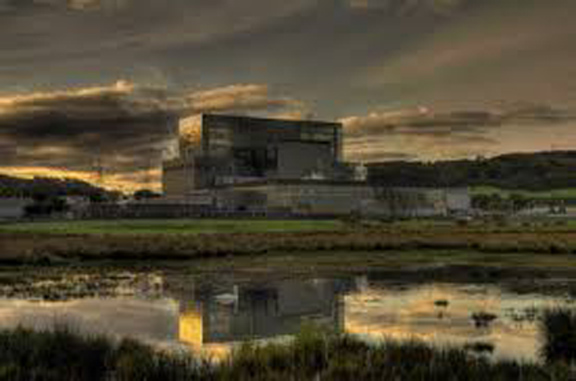
Times 5th July 2020, A high-stakes game of chance is being played at Hunterston B nuclear power
station on the west coast of Scotland. Engineers from the French giant EDF and safety experts from the Office for Nuclear Regulation are trying to work out if and when the plant’s two reactors can be restarted.
Forty-four years of hard use have not been kind to the plant’s graphite core — a vast chunk of carbon riddled with cracks that weighs the same as 110 double-decker buses. While the regulator and EDF insist that, with careful supervision, a cracked graphite core is nothing to worry about, it
is a symptom of its advancing years.
Hunterston, like the rest of EDF’s nuclear power stations around the UK, is on borrowed time. Seven nuclear stations capable of supplying about a sixth of the UK’s power needs will shut during the next decade. Unless ministers leap into action, the country that opened the first industrial-scale nuclear power station in 1956 at Calder Hall, Cumbria, will be left with just one replacement plant, Hinkley Point C on the Somerset coast, which is under construction.
The government faces difficult decisions: what next in its race to eliminate carbon emissions by 2050? A boom in renewable power has offered the beguiling prospect that wind and solar, combined with storage such as big batteries and hydrogen, could fill the void. A report from the National Infrastructure Commission has suggested that commercially unproven technologies, such as hydrogen generation, could negate the need for more nuclear power and be “substantially cheaper”.
With half an eye on this utopian future, successive governments have tried to persuade European
power giants such as Germany’s RWE and Eon, and Japan’s Toshiba and Hitachi, to pump cash into new reactors. However, one by one, those companies have dropped out, leaving just a handful of options remaining.
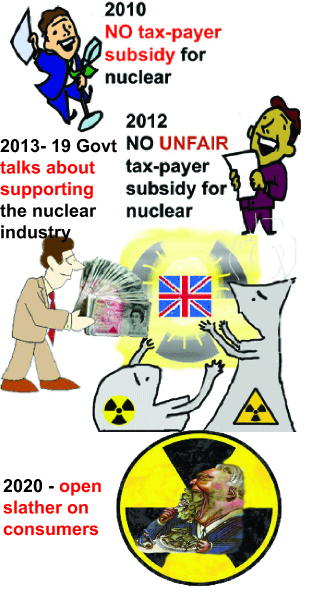
EDF and China General Nuclear (CGN) — both backed by their governments — are building the £22bn Hinkley plant. Without a state support package, EDF will struggle to build the planned Sizewell C in Suffolk. That would leave CGN as the only developer capable of going it alone without UK taxpayer support. ……
The prime minister’s adviser Dominic Cummings is thought to be a fan of small nuclear power stations, and Boris Johnson hinted about a role for nuclear last week………. Taxpayers are about
to find out whether billions of pounds will be pumped into nuclear power……
https://www.thetimes.co.uk/edition/business/atomic-quandary-for-ministers-after-years-of-dallying-over-nuclear-power-dzsc2s25l
Jane Goodall on conservation, climate change and COVID-19
Jane Goodall on conservation, climate change and COVID-19: “If we carry on with business as usual, we’re going to destroy ourselves” BY JEFF BERARDELLI JULY 2, 2020 CBS NEWS While COVID-19 and protests for racial justice command the world’s collective attention, ecological destruction, species extinction and climate change continue unabated. While the world’s been focused on other crises, an alarming study was released warning that species extinction is now progressing so fast that the consequences of “biological annihilation” may soon be “unimaginable.”Dr. Jane Goodall, the world-renowned conservationist, desperately wants the world to pay attention to what she sees as the greatest threat to humanity’s existence.
CBS News recently spoke to Goodall over a video conference call and asked her questions about the state of our planet. Her soft-spoken grace somehow helped cushion what was otherwise extremely sobering news: “I just know that if we carry on with business as usual, we’re going to destroy ourselves. It would be the end of us, as well as life on Earth as we know it,” warned Goodall.
What follows is a lightly edited transcript of our conversation.
Jeff Berardelli: Destruction of nature is causing some really big concerns around the world. One that comes to the forefront right now is emergent diseases like COVID-19. Can you describe how destruction of the environment contributes to this?
Dr. Jane Goodall: Well, the thing is, we brought this on ourselves because the scientists that have been studying these so-called zoonotic diseases that jump from an animal to a human have been predicting something like this for so long. As we chop down at stake tropical rainforest, with its rich biodiversity, we are eating away the habitats of millions of animals, and many of them are being pushed into greater contact with humans. We’re driving deeper and deeper, making roads throughout the habitat, which again brings people and animals in contact with each other. People are hunting the animals and selling the meat, or trafficking the infants, and all of this is creating environments which are perfect for a virus or a bacteria to cross that species barrier and sometimes, like COVID-19, it becomes very contagious and we’re suffering from it.
But we know if we don’t stop destroying the environment and disrespecting animals — we’re hunting them, killing them, eating them; killing and eating chimpanzees in Central Africa led to HIV/AIDS — there will be another one. It’s inevitable.
Do you fear that the next [pandemic] will be a lot worse than this one?
Well, we’ve been lucky with this one because, although it’s incredibly infectious, the percentage of people who die is relatively low. Mostly they recover and hopefully then build up some immunity. But supposing the next one is just as contagious and has a percentage of deaths like Ebola, for example, this would have an even more devastating effect on humanity than this one.
I think people have a hard time connecting these, what may look like chance events, with our interactions and relationship with nature. Can you describe to people why the way that we treat the natural world is so important?
Well, first of all, it’s not just leading to zoonotic diseases, and there are many of them. The destruction of the environment is also contributing to the climate crisis, which tends to be put in second place because of our panic about the pandemic. We will get through the pandemic like we got through World War II, World War I, and the horrors following the World Trade towers being destroyed. But climate change is a very real existential threat to humankind and we don’t have that long to slow it down.
Intensive farming, where we’re destroying the land slowly with the chemical poisons, and the monocultures — which can be wiped out by a disease because there is no variation of crops being grown — is leading to habitat destruction. It’s leading to the creation of more CO2 through fossil fuels, methane gas and other greenhouse gas [released] by digestion from the billions of domestic animals.
It’s pretty grim. We need to realize we’re part of the environment, that we need the natural world. We depend on it. We can’t go on destroying. We’ve got to somehow understand that we’re not separated from it, we are all intertwined. Harm nature, harm ourselves.
If we continue on with business as usual, what do you fear the outcome will be?
Well, if we continue with business as usual, we’re going to come to the point of no return. At a certain point the ecosystems of the world will just give up and collapse and that’s the end of us eventually too.
What about our children? We’re still bringing children into the world — what a grim future is theirs to look forward to. It’s pretty shocking but my hope is, during this pandemic, with people trapped inside, factories closed down temporarily, and people not driving, it has cleared up the atmosphere amazingly. The people in the big cities can look up at the night sky and sea stars are bright, not looking through a layer of pollution. So when people emerge [from the pandemic] they’re not going to want to go back to the old polluted days.
Now, in some countries there’s not much they can do about it. But if enough of them, a groundswell becomes bigger and bigger and bigger [and] people say: “No I don’t want to go down this road. We want to find a different, green economy. We don’t want to always put economic development ahead of protecting the environment. We care about the future. We care about the health of the planet. We need nature,” maybe in the end the big guys will have to listen……….https://www.cbsnews.com/news/jane-goodall-climate-change-coronavirus-environment-interview/?ftag=CNM-00-10aab7e&linkId=92720503
Hard to get action on global heating, with Facebook no help, and oil industry pressure
 What Facebook and the Oil Industry Have in Common, Bill McKibben, New Yorker, 2 July 20,
Why is it so hard to get Facebook to do anything about the hate and deception that fill its pages, even when it’s clear that they are helping to destroy democracy? And why, of all things, did the company recently decide to exempt a climate-denial post from its fact-checking process? The answer is clear: Facebook’s core business is to get as many people as possible to spend as many hours as possible on its site, so that it can sell those people’s attention to advertisers. (A Facebook spokesperson said the company’s policy stipulates that “clear opinion content is not subject to fact-checking on Facebook.”) This notion of core business explains a lot—including why it’s so hard to make rapid gains in the fight against climate change.
For decades, people have asked me why the oil companies don’t just become solar companies. They don’t for the same reason that Facebook doesn’t behave decently: an oil company’s core business is digging stuff up and burning it, just as Facebook’s is to keep people glued to their screens. Digging and burning is all that oil companies know how to do—and why the industry has spent the past thirty years building a disinformation machine to stall action on climate change. It’s why—with the evidence of climate destruction growing by the day—the best that any of them can offer are vague pronouncements about getting to “net zero by 2050”—which is another way of saying, “We’re not going to change much of anything anytime soon.” (The American giants, like ExxonMobil, won’t even do that.)
Total, the French oil company, has made the 2050 pledge, but it is projected to increase fossil-fuel production by twelve percent between 2018 and 2030. These are precisely the years when we must cut emissions in half, according to the Intergovernmental Panel on Climate Change, to have any chance of meeting the vital targets set by the Paris climate agreement, which aim to hold the planet’s temperature increase as close as possible to one and a half degrees Celsius. The next six months will be crucial as nations prepare coronavirus recovery plans. Because effective climate planning at this moment will require keeping most oil, coal, and gas reserves in the ground, the industry will resist fiercely.
So we need power brought to bear from companies whose core business is not directly challenged by climate activism. Consider the example of Facebook again: after organizing by people like Judd Legum and StopHateForProfit.org, companies including Unilever and Coca-Cola agreed to temporarily stop advertising on the social platform. Coke’s core business is selling you fizzy sugar water that can help make you diabetic—when that’s threatened, the company fights back. But when it feared being attacked for helping Facebook’s core business, it simply stopped advertising with the company, which wasn’t essential for Coke’s business.
That’s why it is critical to get third parties to pressure the oil industry. This past month, the growing fossil-fuel divestment campaign got a huge boost when the Vatican, whose core business is saving souls, called for divestment, and the Queen of England, whose core business is unclear but involves hats, divested millions from the industry.
Keith Ellison, the attorney general of Minnesota, announced that he was suing ExxonMobil, as well as the American Petroleum Institute and Koch Industries, for perpetrating a fraud by spreading climate denial for decades. (Ellison’s core business is justice, and his office is pursuing this climate action at the same time that it is prosecuting the killers of George Floyd.) All this, in turn, puts pressure on the financial industry to stop handing over cash to oil companies.
As I pointed out in a piece last summer, JPMorgan Chase may be the biggest fossil-fuel lender on earth, but that’s still only about seven per cent of its business—big, but not core.
Effective progress on climate will require government and the finance industry to enforce the edicts of chemistry and physics: massive action undertaken inside a decade, not gradual, gentle course correction. And that will require the rest of us to press those institutions. Because our core business is survival…….. https://www.newyorker.com/news/annals-of-a-warming-planet/what-facebook-and-the-oil-industry-have-in-common
Update on Legal Case: Toxic, Toxic Culture at Sellafield —

Support Alison McDermott on the 7th July…. Readers may remember Sellafield workers speaking out “about their experience of bullying and sexism at the Sellafield plant….after whistleblower Alison McDermott launched a crowdfunding page to pay for legal fees for her whistleblowing and victimisation case lodged to the Employment Tribunal against Sellafield Ltd. Alison told the local […]
via Update on Legal Case: Toxic, Toxic Culture at Sellafield —
What caused radioactive releases from Russia? — Beyond Nuclear International

Denials persist about nuclear cloud
via What caused radioactive releases from Russia? — Beyond Nuclear International
No economic benefit in nuclear power for India
 NMIMS-FPJ webinar: Nuclear energy not for countries looking at economic development, https://www.freepressjournal.in/fpj-initiatives/nmims-fpj-webinar-nuclear-energy-not-for-countries-looking-at-economic-developmentBy FPJ Web Desk 1 July 20, If India is looking at development by increasing power consumption, it is essential that it opts for cheaper forms of energy, stated nuclear expert M V Ramana, at a webinar ‘The future of nuclear energy’. He stressed that in such a case nuclear is not the right choice. Ramana is Director of the Liu Institute for Global Issues at the School of Public Policy and Global Affairs, University of British Columbia.
Speaking at the third session of a series ‘The future of energy’ organised by NMIMS-FPJ in association with Tata Power, Ramana said, “If you were looking at (economic) development by providing power to hundreds of villages that do not have power, then nuclear energy is a very bad choice. For development, you need cheap energy but you have (nuclear energy which is) an expensive form of energy.”
He revealed today it costs somewhere between USD 10-15 billion to build a nuclear power plant. However, the power produced by this plant is at the cost of USD 100 per MW hour. This is three times higher the cost of solar and wind energy, he added. “Solar and wind energy today are selling at USD 30-35 per megawatt hour (MWh).” After including storage costs and other costs, solar and wind energy continues to be cheaper and will cost over USD 50 per MWh.
He went on to add while nuclear plants are complicated, the fast breeder reactor is a lot more complex. Countries like the United States, Germany, the United Kingdom, others had fast breeder reactors programmes, which they gave up. “For historical and sociological reasons, India has said it is a very important part of our programme and pours in a lot of resources into that. Even if you are supporting nuclear energy, this is not the technology that you should be focussing on,” he advised. https://www.freepressjournal.in/fpj-initiatives/nmims-fpj-webinar-nuclear-energy-not-for-countries-looking-at-economic-development
Following fire at nuclear site, Iran warns it will retaliate if it suffers cyber attacks
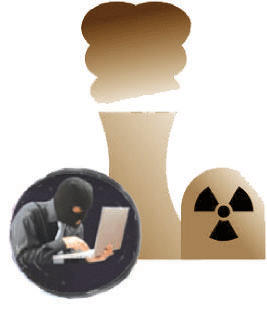 Nuclear site cyber attack possible: Iran, Canberra Times, 4 July 20, Iran will retaliate against any country that carries out cyber attacks on its nuclear sites, the head of civilian defence says, after a fire at its Natanz plant which some Iranian officials say may have been caused by cyber sabotage. Nuclear site cyber attack possible: Iran, Canberra Times, 4 July 20, Iran will retaliate against any country that carries out cyber attacks on its nuclear sites, the head of civilian defence says, after a fire at its Natanz plant which some Iranian officials say may have been caused by cyber sabotage.
The underground Natanz Fuel Enrichment Plant (FEP) is one of several Iranian facilities monitored by inspectors of the International Atomic Energy Agency, the UN nuclear watchdog. Iran’s top security body said on Friday that the cause of the “incident” at the nuclear site had been determined but “due to security considerations” it would be announced at a convenient time……
Three Iranian officials who spoke to Reuters on condition of anonymity said they believed the fire was the result of a cyber attack, but did not cite any evidence. One of the officials said the attack had targeted the centrifuge assembly building, referring to the delicate cylindrical machines that enrich uranium, and said Iran’s enemies had carried out similar acts in the past. Two of the officials said Israel could have been behind the Natanz incident but offered no evidence. Asked on Thursday evening about recent incidents reported at strategic Iranian sites, Israeli Prime Minister Benjamin Netanyahu told reporters: “Clearly we can’t get into that.” In 2010, the Stuxnet computer virus, which is widely believed to have been developed by the United States and Israel, was discovered after it was used to attack the Natanz facility. to have been developed by the United States and Israel, was discovered after it was used to attack the Natanz facility. Australian Associated Press https://www.canberratimes.com.au/story/6818945/nuclear-site-cyber-attack-possible-iran/?cs=14264#gsc.tab=0 |
|
Ruthenium and Caesium radioactive isotopes over Europe due to mismanagement at a nuclear reactor – says IAEA
 Low Levels of Radioisotopes Detected in Europe Likely Linked to a Nuclear Reactor – IAEA, 27/2020 The recent detection of slightly elevated levels of radioisotopes in northern Europe is likely related to a nuclear reactor that is either operating or undergoing maintenance, when very low radioactive releases can occur, the International Atomic Energy Agency (IAEA) said today. The geographical origin of the release has not yet been determined.
Basing its technical assessment on data reported by its Member States, the IAEA reiterated that the observed air concentrations of the particles were very low and posed no risk to human health and the environment.
Estonia, Finland and Sweden last week measured levels of Ruthenium and Caesium isotopes which were higher than usual. They also reported the detection of some other artificial radionuclides. The three countries said there had been no events on their territories that could explain the presence of the radionuclides, as did more than 40 other countries that voluntarily provided information to the IAEA.
Seeking to help identify their possible origin, the IAEA on Saturday contacted its counterparts in the European region and requested information on whether the particles were detected in their countries, and if any event there may have been associated with the atmospheric release.
By Thursday afternoon, 37 Member States in the European region (Albania, Austria, Belgium, Bosnia and Herzegovina, Bulgaria, Republic of Croatia, Cyprus, Czech Republic, Denmark, Estonia, Finland, France, Germany, Greece, Hungary, Iceland, Ireland, Italy, Latvia, Lithuania, Luxembourg, Netherlands, North Macedonia, Norway, Poland, Portugal, Romania, Russian Federation, Republic of Serbia, Slovak Republic, Slovenia, Spain, Sweden, Switzerland, Turkey, Ukraine and United Kingdom) had voluntarily reported to the IAEA that there were no events on their territories that explained the release. They also provided information about their own measurements and results……
Based on the IAEA’s technical analysis of the mix of artificial radionuclides that were reported to it, the release was likely related to a nuclear reactor, either in operation or in maintenance. The IAEA ruled out that the release was related to the improper handling of a radioactive source. It was also unlikely to be linked to a nuclear fuel processing plant, a spent fuel pool or to the use of radiation in industry or medicine.
Based on the data and information reported to the IAEA, no specific event or location for the dispersal of radionuclides into the atmosphere has yet been determined. To do this, the IAEA depends on receiving such information from a country where the release occurred. https://www.iaea.org/newscenter/pressreleases/low-levels-of-radioisotopes-detected-in-europe-likely-linked-to-a-nuclear-reactor-iaea
Fire at Iran’s Natanz uranium enrichment facility
Iran nuclear: ‘Incident’ at Natanz uranium enrichment facility, BBC, 2 July 2020
A fire has reportedly damaged a building at a nuclear facility in Iran.
Atomic Energy Organisation of Iran (AEOI) spokesman Behruz Kamalvandi said there was an incident in “one of the industrial sheds under construction” at the Natanz uranium enrichment plant.
There were no fatalities or concerns about contamination, he added.
The AEOI later published a photo showing a partly burned building, which US-based analysts identified as a new centrifuge assembly workshop. Centrifuges are needed to produce enriched uranium, which can be used to make reactor fuel but also nuclear weapons.
Meanwhile, in a statement sent to BBC Persian journalists before the AEOI’s announcement, an unknown group calling itself “Cheetahs of the Homeland” claimed it had attacked the building. The group said its members were part of “underground opposition with Iran’s security apparatus”.
The claim could not immediately be verified by the BBC.
The International Atomic Energy Agency (IAEA), which monitors Iran’s compliance with a 2015 nuclear deal struck with world powers, said it was aware of the reports from Natanz and currently anticipated no impact on its verification activities.
The incident comes six days after an explosion near the Parchin military complex.
The Iranian authorities said the blast was caused by “leaking gas tanks” at the site, but analysts said satellite photographs showed it happened at a nearby missile production facility…….. https://www.bbc.com/news/world-middle-east-53265023Skip Twitter post by @TheGoodISIS
Even a “limited” nuclear war would bring nuclear winter: could the world survive this?

Project Force: Could the world survive a nuclear winter?
The consequences of a nuclear war would extend far beyond the blast itself, killing millions of people across the globe. Aljazeera, by Alex Gatopoulos, 2 Jul 2020 Firestorms triggered by burning cities create a huge plume of smoke, soot and ash. The plume rises above the clouds, into the upper atmosphere of the planet, where it will stay, encircling the globe, shielding the Earth from the Sun’s light, cooling the planet.
This is the scenario we could expect following a nuclear clash between nations.
The term nuclear winter was coined in the 1980s as scientists began to realise that the horrors of a nuclear war would not be confined to explosive blasts and radiation.
As climate prediction models become more powerful and sophisticated, scientists have been able to examine more closely what would happen in a nuclear conflict between two antagonists. In the past, most scenarios focused on potentially apocalyptic conflicts between Russia and the United States.
But new models now predict that even a very limited nuclear war would have drastic knock-on effects for global agriculture and dire consequences for life on Earth.
As climate prediction models become more powerful and sophisticated, scientists have been able to examine more closely what would happen in a nuclear conflict between two antagonists. In the past, most scenarios focused on potentially apocalyptic conflicts between Russia and the United States.
But new models now predict that even a very limited nuclear war would have drastic knock-on effects for global agriculture and dire consequences for life on Earth.
First, a blinding flash of light and radiation in the form of heat from the initial explosion would produce temperatures as high as that of the Sun. Wood, plastics, fabrics and flammable liquids would all ignite.
This would almost immediately be followed by the blast wave, moving at several times the speed of sound. A wall of compressed superhot air, the wave would gather up rubble and anything moveable, levelling all buildings within the blast zone and killing everyone in its path for several kilometres.
Within 20 to 30 minutes, a shroud of highly radioactive ash would begin to fall, blanketing both the blast site and the surrounding area, tens of kilometres downwind, and very quickly killing anyone caught outdoors who had somehow managed to survive the initial explosion.
For people outside the blast zone, the situation would also be grim. All electronic equipment would cease to function as the electromagnetic pulse fried every electronic circuit. No phones, internet, computers or cars would work.
Hospitals would be quickly overwhelmed, with the vast majority of the population needing some kind of medical care. Food would disappear as logistical supply trains stopped working. What little there was would be contaminated by the radioactive fallout, along with any water.
In the case of a nuclear conflict between India and Pakistan, for example, it is estimated that between 50 million and 125 million people would die.
What comes afterwards?
Those would be the initial, local effects of a nuclear conflict on a population. But the ensuing nuclear winter would take it to a whole new level.
The vast plumes of dark soot entering the upper atmosphere would spread not just regionally but right around the planet within months. The resulting darkening of the sky would severely affect harvests, even in areas nowhere near the conflict zone.
In one recent simulation, global harvests plummeted between 20 percent and 40 percent for at least a decade. Temperatures dropped dramatically as the climate shifted, triggering widespread drought, a worldwide famine and the death of tens of millions more people.
If these scenarios seem far-fetched, consider that the 1815 volcanic eruption of Tambora in Indonesia ruined harvests as far away as the US with 1816 known as the “Year Without Summer” as temperatures dropped sharply around the planet and the resultant failed harvests triggered severe famine across Europe.
The Tambora eruption lowered the global temperature by 0.7 degrees Celsius. The estimated temperature drop from a “limited” nuclear exchange is reckoned to be anywhere between 2 and 5 degrees Celsius.
The Pakistan vs India scenario
The latest studies show that there does not need to be a large-scale nuclear war to have this effect: A possible nuclear conflict between India and Pakistan is the scenario most of these studies have used as their prime example………
If these scenarios seem far-fetched, consider that the 1815 volcanic eruption of Tambora in Indonesia ruined harvests as far away as the US with 1816 known as the “Year Without Summer” as temperatures dropped sharply around the planet and the resultant failed harvests triggered severe famine across Europe.
The Tambora eruption lowered the global temperature by 0.7 degrees Celsius. The estimated temperature drop from a “limited” nuclear exchange is reckoned to be anywhere between 2 and 5 degrees Celsius.
…….. the greatest damage to the environment would be from the vast amount of superheated ash and soot that would rise from these destroyed cities, swept up by a nuclear firestorm into the upper atmosphere.
Darkness and starvation
The impact of even such a “limited” nuclear conflict would be devastating for the Earth as a whole. With global dimming, harvests would fail across the planet…….
In 2016, the United Nations’ Food and Agriculture Organisation estimated that 815 million people were food-insecure. They would all be put at far greater risk as food supplies rapidly dwindled in the aftermath of such a conflict.
Another major, cascading effect of even a partial nuclear winter would be the depletion of the ozone layer, allowing crops to be further damaged by unfiltered hard ultraviolet solar radiation.
Ozone would be destroyed by the heating of the upper atmosphere as the darker soot-laden layer of air absorbed more solar energy. The effect would last for more than five years, with 20 percent of the ozone lost across the planet and, in some places, as much as 70 percent, leading to significant destruction of plant, marine and animal life on Earth, and resulting in skin cancers, DNA mutation and eye damage in humans and animals alike.
This, coupled with the violent competition for shrinking resources, likely civil unrest due to mass starvation, rapidly shifting weather patterns and financial collapse, would disrupt all human life with no part of the planet left unscathed…….. https://www.aljazeera.com/indepth/features/project-force-world-survive-nuclear-winter-200622132211696.html
Safety documents by Canadian Nuclear Safety Commission (CNSC) are vague, inadequate and put Canadians at risk
 Nuclear waste regulations put Canadians at risk https://www.trailtimes.ca/opinion/cannings-nuclear-waste-regulations-put-canadians-at-risk/ Richard Cannings is in his second term as MP for the South Okanagan-West Kootenay riding, Jul. 2, 2020 The Canadian Nuclear Safety Commission (CNSC) should not approve a suite of regulatory documents on radioactive waste at its meeting June 18, 2020 and instead live up to the Liberal government’s commitment to openness and transparency for regulatory development.
Some of these regulations developed by commission staff are at best vague guidelines that leave nuclear waste policy decisions in the hands of private industry, instead of actually prescribing actions that are in the public interest.
These regulatory changes would pave the way for several controversial nuclear waste disposal projects, including a giant mound at Chalk River, Ontario, two entombments of shut-down reactors, and a proposed deep geological repository for the burial of high-level nuclear fuel waste.
For example, the entombment of nuclear reactors is designated as “in-situ decommissioning”, a practice that the International Atomic Energy Agency says should only be used as a last option for facilities damaged in accidents.
Of further concern is the lack of clarity in the proposed regulations.
In many cases the licensee is directed to develop safety requirements with no explicit directions as to what those safety requirements are.
The giant mound at Chalk River is meant to contain up to 1 million cubic metres of low- to intermediate-activity nuclear waste but these activity levels are not defined and the private owner of the facility would get to decide what materials are stored in that mound of nuclear waste.
The Minister of Natural Resources has committed to consulting Canadians on a policy framework and strategy for radioactive waste. Instead we have this backdoor process with limited public input and no parliamentary oversight.
The minister should be conducting a public process to develop a Canadian framework for radioactive waste management that meets or exceeds international best practices, a framework that does not allow the nuclear industry to police itself.
Richard Cannings is NDP Natural Resources Critic and MP for South Okanagan-West Kootenay
European Commission demands that Romania adopt a nation radioactive waste management programme
 Radioactive waste: Commission calls on ROMANIA to enact correctly EU law in this field act, Media Romania News Agency , July 3, 2020
The Commission has decided to send reasoned opinions to Bulgaria, Denmark, Greece, Lithuania, Poland and Romania for failing to adopt a national programme for radioactive waste management compliant with the requirements of the Spent Fuel and Radioactive Waste Directive (Council Directive 2011/70/Euratom), and has also sent another reasoned opinion to Romania for failing to transpose correctly certain requirements of the same Directive. ….
The Directive establishes a Community framework for ensuring the responsible and safe management of spent fuel and radioactive waste to ensure a high level of safety and avoid imposing undue burdens on future generations. In particular, it requires Member States to draw up and implement national programmes for the management of all spent fuel and radioactive waste generated on their territory, from generation to disposal.
The aim is to protect workers and the general public from the dangers arising from ionising radiation. Member States were required to transpose the Directive by 23 August 2013 and to notify their national programmes for the first time to the Commission by 23 August 2015. The Member States concerned have three months to act. Otherwise, the Commission may decide to refer these cases to the Court of Justice of the EU. https://www.actmedia.eu/daily/radioactive-waste-commission-calls-on-romania-to-enact-correctly-eu-law-in-this-field/87391
1 This Month
26 April – Chernobyl: Inside the Meltdown airs on National Geographic on Sunday 26th April from 4pm

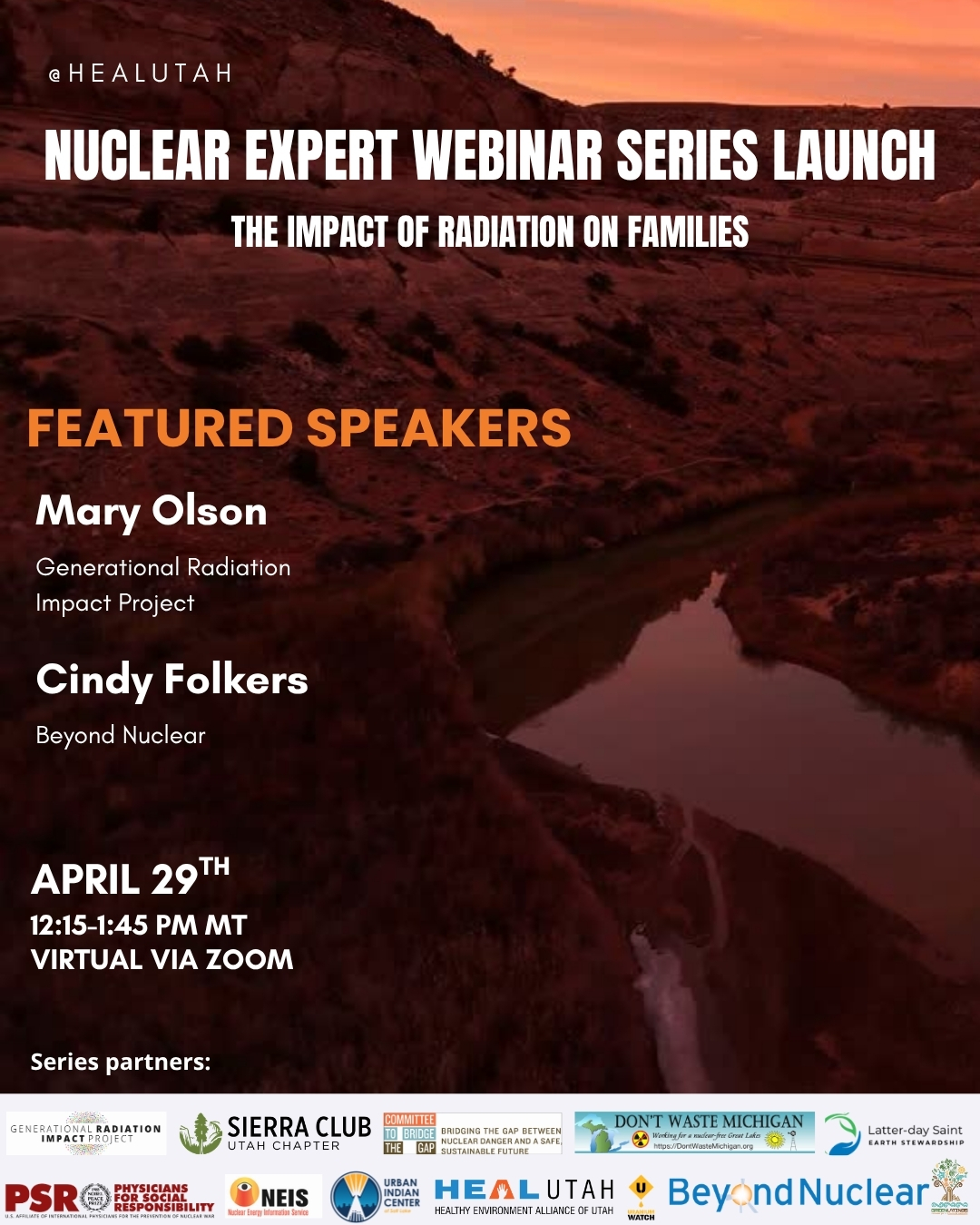
29 April – Nuclear Expert Webinar #1 – Radiation Impacts on Families with Mary Olson and Cindy Folkers
- 12:15 PM MT – 1:45 PM MT
- Location: Virtual – REGISTER TODAY

4 May -West Suburban Peace Coalition to discuss Iran war at May Educational Forum
Monday, May 4, 7:00 – 8:00 PM Central Standard Time
Title: : How Trump’s Narrative Tries to Shape the Reality of the War on Iran.
Contact Walt Zlotow, zlotow@hotmail.com 630 442 3045 for further information
14 May – online event From Bombs to Data Centres: the Face of Nuclear Colonialism

Pine Ridge Uranium is the real threat, not Tehran- Tell Burgum: Stop the Extraction.
Chernobyl: The Lost Tapes – A good documentary on Chernobyl on SBS available On Demand for the next 3 weeks– https://www.sbs.com.au/ondemand/tv-program/chernobyl-the-lost-tapes/2352741955560
To see nuclear-related stories in greater depth and intensity – go to https://nuclearinformation.wordpress.com
-
Archives
- April 2026 (288)
- March 2026 (251)
- February 2026 (268)
- January 2026 (308)
- December 2025 (358)
- November 2025 (359)
- October 2025 (376)
- September 2025 (257)
- August 2025 (319)
- July 2025 (230)
- June 2025 (348)
- May 2025 (261)
-
Categories
- 1
- 1 NUCLEAR ISSUES
- business and costs
- climate change
- culture and arts
- ENERGY
- environment
- health
- history
- indigenous issues
- Legal
- marketing of nuclear
- media
- opposition to nuclear
- PERSONAL STORIES
- politics
- politics international
- Religion and ethics
- safety
- secrets,lies and civil liberties
- spinbuster
- technology
- Uranium
- wastes
- weapons and war
- Women
- 2 WORLD
- ACTION
- AFRICA
- Atrocities
- AUSTRALIA
- Christina's notes
- Christina's themes
- culture and arts
- Events
- Fuk 2022
- Fuk 2023
- Fukushima 2017
- Fukushima 2018
- fukushima 2019
- Fukushima 2020
- Fukushima 2021
- general
- global warming
- Humour (God we need it)
- Nuclear
- RARE EARTHS
- Reference
- resources – print
- Resources -audiovicual
- Weekly Newsletter
- World
- World Nuclear
- YouTube
-
RSS
Entries RSS
Comments RSS
 nuclear-news