Financial institutions funding nuclear weapons – theme for June 20

Nobody except a few erratic multi-billionaires is willing to gamble their money on “peaceful” nuclear power. Still, your taxes are going to so-called “commercial” nuclear power, if you live in a nuclear country.
But banks, pension funds, insurance companies and asset managers are investing in nuclear weapons – and you wouldn’t even know that your money is going there. Don’t Bank on the Bomb has listed institutions around the world with substantial investments in nuclear arms producers. Fo example From 2013 to 2016, United States 226 Financial Institutions made an estimated USD$ 344 billion available to 27 nuclear weapon producing companies .
International Campaign to Abolish Nuclear Weaspons, (ICAN) has identified financial organisations funding nuclear weapons The report Don’t Bank on the Bomb, updated annually by PAX, provides details of financial transactions with companies that are heavily involved in the manufacture, maintenance and modernization of US, British, French and Indian nuclear forces.
ICAN is appealing to financial institutions to stop investing in the nuclear arms industry, as any use of nuclear weapons would violate international law and have catastrophic humanitarian consequences. By investing in nuclear weapons producers, financial institutions are in effect facilitating the build-up of nuclear forces. This undermines efforts to achieve a nuclear-weapon-free world and heightens the risk that one day these ultimate weapons of mass destruction will be used again.
Engaging in dialogues with financial institutions about their investments in nuclear weapons companies can help to raise their understanding of the effects of nuclear weapons and their status under international law. Here are some tips for letter-writing:
- How to begin: Let the financial institution know who you are. Do you hold a bank account with them? Are you a member of their superannuation plan? Do you own shares in their company? Are you writing as a representative of a particular organization? Are you simply a concerned citizen?
- What to include: Inform the financial institution that you are aware of their investments in nuclear weapons companies. Specify which companies and briefly describe the activities these companies are engaged in. Outline why you believe that financing nuclear weapons is illegitimate.
- Ask for information: Inquire as to whether the financial institution has a policy on investing in the arms industry. If you are already aware that such a policy exists, ask the institution to explain how its investments in nuclear weapons companies can be justified under the terms of the policy.
- Call for action: Call on the financial institution to divest from all nuclear weapons companies. Explain that nuclear weapons are illegal to use and have catastrophic humanitarian consequences. End by making it clear that you expect a response. – Don’t Bank on the Bomb
Most UK pension providers are investing in nuclear weapons companies

“The UN Treaty on the Prohibition of Nuclear Weapons (TPNW) was agreed in 2017.
“Once this is ratified by 50 states and comes into effect as a new piece of international law, the implications will be significant for nuclear armed states and financial institutions alike.
“The biggest banking corporations have a global reach and cannot disregard international law.”
|
Concerns raised over pension investments in nuclear weapons,
https://www.pensionsage.com/pa/Most-pension-providers-investing-in-nuclear-weapons.php By Sophie Smith 03/6/20 A report by the UK Nuclear Weapons Financing Research Group has raised concerns about the number of pension providers investing in companies that are producing nuclear weapons.
The report, Banks, Pensions and Nuclear Weapons: Investing in Change, found that among pension providers, policy on restricting investment in nuclear weapons is generally limited to ethical funds. Continue reading |
Nuclear power plants in the path of oncoming Cyclone Nisarga

 Concerns raised over nuclear and chemical plants in Concerns raised over nuclear and chemical plants in  Maharashtra as cyclone Nisarga heads towards the state Opindia, 2 June, 2020, OpIndia Staff As the Cyclone Nisarga is heading towards the coasts of Maharashtra, a huge concern has been expressed regarding the nuclear and chemical plants that may come in its direct path. Expectedly, the cyclone will enter the coasts late Tuesday night or early Wednesday. Maharashtra as cyclone Nisarga heads towards the state Opindia, 2 June, 2020, OpIndia Staff As the Cyclone Nisarga is heading towards the coasts of Maharashtra, a huge concern has been expressed regarding the nuclear and chemical plants that may come in its direct path. Expectedly, the cyclone will enter the coasts late Tuesday night or early Wednesday.
Chief Minister Uddhav Thackeray while updating about the cyclone said, “Care is being taken to prevent power outages. Precautions are being taken at chemical units and nuclear power plants in Palghar and Raigad.” Maharashtra posses a string of chemical and nuclear plants. In Palghar, the oldest Tarapur Atomic Power Plant complex and other power units are present while Mumbai has the BARC set up and Raigad houses power, petroleum, chemicals, and other major industries besides the Mumbai port trust, the Jawaharlal Nehru Post trust and vital installations of the navy. People living in non-pucca houses have been shifted to safer shelters for them and slum dwellers have been asked to vacate for their own safety. As per reports, 50 patients were shifted from the Bandra Kurla complex COVID-19 hospital to the Goregaon NESCO hospital. Rescue operations underway…….. The Indian Meteorological Department announced that depression in the Arabian Sea may develop into a cyclonic storm in the next 12 hours and further intensify into a severe cyclonic storm within 24 hours. The deep depression – ‘Cyclone Nisarga’, which is headed towards the coasts in Maharashtra and Gujarat, is likely to hit the western coast on Wednesday……. https://www.opindia.com/2020/06/cyclone-nisarga-creates-concerns-for-nuclear-and-chemical-plants-maharashtra/ |
|
Climate Experts Predict ‘Grim Future’ For Nuclear Power

Climate Experts Predict ‘Grim Future’ For Nuclear Power
The result of research into black swans – called “Synthesising Unprecedented Coastal Conditions: Extreme Storm Surges” aka SUCCESS – was presented at the meeting. It was important to conduct this research, the academic said, because “the storm surge of 5th December 2013 caused sea levels in many parts of the country that were the highest ever recorded and begs the obvious question – could they have been worse?”
All in all, the presentations and discussions at the meeting would not have been particularly welcome to the ONR, whose job it is to make sure nuclear power stations are built to standards that guarantee public safety. In a statement to VICE, an ONR spokesperson said “ONR requires that nuclear new build sites are able to withstand extreme natural hazards, by designing against a one in 10,000 year event. Sites must identify these external hazards, which include the impact of climate change, and demonstrate that they are adequately protected against them throughout the lifetime of the facility.”
Nuclear Detection Helicopter Flies Mission Around Washington D.C. Amid Unrest
|
Nuclear Detection Helicopter Flies Mission Around Washington D.C. Amid Unrest The Drive 3 June 20, Reports of curious aerial activity over and around Washington, D.C. continue to emerge amid the response in the nation’s capital to protests and riots stemming from the police killing of Minneapolis resident George Floyd last week. E Earlier today, a Department of Energy helicopter equipped with a specialized system to measure and map radiation levels flew a route around the greater D.C. area. It’s unclear if this flight was somehow related to the ongoing protests or if it was just a routine survey………The complete system’s primary job is to figure out the extent and severity of the spread of radiation after some sort of nuclear or radiological incident. This could be something like radiation leaks from a nuclear power plant or waste disposal facility following a natural or man-made disaster. It could also be the spread of radiation from a terrorist attack involving a dirty bomb or an accident involving an actual nuclear weapon. There’s been no such incident in Washington, D.C., but NNSA does send the AMS-equipped helicopters to conduct mapping surveys of background radiation ahead of significant public events, such as presidential visits or Super Bowls. The helicopters then fly additional patrols of the area afterward to monitor for any concerning changes. …….
A dirty bomb could be especially devastating if detonated in the midst of a large public gathering, such as a massive protest. Mass panic from such an attack could also lead to significant casualties simply from people fleeing the epicenter. The appearance of the Department of Energy Bell 412 over Washington, D.C. came after President Donald Trump announced new increased security measures to stem protests and rioting in the capital. This is exactly the kind of decision that could result in a “security bubble” getting established, which might then prompt NNSA to conduct an AMS survey mission as Associated Administrator Tilden had explained. It’s also possible that this flight is unrelated in any way to current events. NNSA does deploy AMS-equipped helicopters and aircraft to conduct routine radiation surveys to collect baseline data in major cities. As with surveys conducted in relation to public events, this provides a picture of what the normal, naturally-occurring radiation levels look like across a certain area to help identify worrisome abnormalities in the future. The Department of Energy has conducted at least one such survey of Washington, D.C., in 2013…….
The NNSA public affairs office has responded to our queries and says that the flight by N411DE around Washington, D.C. yesterday was a routine flight following maintenance on the helicopter. The full statement is provided below: ….. https://www.thedrive.com/the-war-zone/33817/nuke-sniffing-helicopter-flies-around-washington-amid-protests
|
|
Assange too sick to attend the very unjust process of the UK extradition hearings
 Monica Del Mestre 3 June 20
2. In addition to other ongoing health concerns, Assange faces the serious risk of exposure to Covid in Belmarsh prison, and has been advised that even going to the video room to take part in hearings is unsafe. This is another reason he should be immediately released.
3. Assange’s lawyers have long complained they have had insufficient access to him in prison. Under lockdown conditions, they have had no access to him at all. They have repeatedly flagged that this lack of access seriously impacts their ability to prepare his defence.
4. One of the next steps agreed today is that psychiatric reports on Assange from the prosecution and defence will be due to the court on 31 July. Remember that UN Special Rapporteur @NilsMelzer has expressed alarm many times that Assange shows symptoms of psychological torture.
5. It is a welcome step that the continuation of the full extradition hearing was adjourned, as lockdown conditions present clear barriers to open justice – but 7 September may not be late enough to make a meaningful difference. Also the court is still struggling to find a venue.
6. It remains extremely frustrating that the court does not adequately accommodate NGO observers. I have never experienced so much difficulty accessing a trial in any country as at Woolwich Crown Court in February, and the teleconference option we now have is far from sufficient.
7. The press are also facing severe restrictions. Only 6 journalists have been allowed to attend in person the past 2 hearings, with others limited to the awful phone line. This case is of high public interest and a better solution must be found before the full hearing resumes.
8. Assange’s next callover hearing has been scheduled for 29 June at 10 am. We urge the court to find workable solutions to enable his safe attendance and ensure the press and observers are able to properly monitor proceedings. /END
U.S. taxpayers bearing the crushing cost of nuclear waste
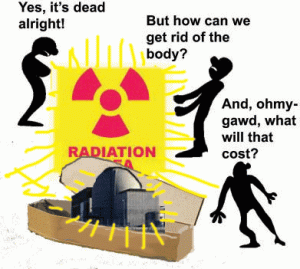
 The Crushing Cost Of Nuclear Waste Is Weighing On Taxpayers, Oil
  Price,
 By Haley Zaremba – Jun 19, 2019 The Maine Yankee nuclear power plant hasn’t produced a single watt of energy in more than two decades, but it cost U.S. taxpayers about $35 million this year.” So begins a powerful report this week about the crushing cost of nuclear waste storage by the Los Angeles Times……..In the United States, where the nuclear industry is ailing, this is particularly bad news. More plants are shutting down than are going online, and many of the nuclear plants that are continuing to function are able to do so in large part thanks to government subsidies at the state level, which is to say, even more taxpayer dollars.
The Trump administration, for its part, has made efforts to combat the rising prices of nuclear waste storage–albeit extremely controversial ones. Just this month, “in a move that will roll back safety standards that have been observed for decades” says not-for-profit news organization Truthout, “the Trump administration reportedly has plans to reclassify nuclear waste previously listed as “high-level” radioactive to a lower level, in the interest of saving money and time when disposing of the material.”
While this may be a quick fix for the massive amounts of money flowing out of taxpayer pockets and into the nuclear energy industry, it’s certainly not a sustainable solution for what could easily become a national health crisis if mismanaged. ……https://oilprice.com/Alternative-Energy/Nuclear-Power/The-Crushing-Cost-Of-Nuclear-Waste-Is-Weighing-On-Taxpayers.html
Time that journalists reported on the threat of global heating to the nuclear industry
 Really? Not a mention of the ill effects that climate change has on nuclear power, nor the fact that it, and the uranium mining that feeds it, are highly water guzzling.
Therefore most nuclear reactors are sited near the sea, or near rivers and estuaries.
They have to cut back or even shut down in very hot weather. They are vulnerable to sea level rise, and extreme events – flooding, hurricanes, wildfires.
Far from nuclear power combatting climate change, it’ds the other way around.
As for Small Modular Nuclear Reactors working against climate change, you would need literally millions of them to be quickly operating around the world, to have any effect on global heating. Time that you journalists told the whole story, not just the nuclear lobby’s version
UK’s Sizewell nuclear plan in doubt, due to cost and China’s involvement?
Plan for new UK nuclear plant under intense scrutiny, Proposal for reactor attracts attention because of Chinese role as well as cost Ft.com Nathalie Thomas in Edinburgh and Jim Pickard in London, JUNE 2 2020
Environmentalists insist cheaper, green technologies such as wind, solar and batteries should take precedence over nuclear. ……….Nuclear just isn’t cost-effective,” said Doug Parr, chief scientist for campaign group Greenpeace.
https://www.ft.com/content/4e3221ef-ac1e-43cc-8d68-e1397ca0637f Against this backdrop, the government last year launched a consultation on a possible new funding model for new nuclear plants. The so-called regulated asset base model is attractive to developers because it would cut the cost of capital for a new nuclear plant, reflecting how consumers would pay upfront for the project through their energy bills. These consumers could be left picking up the tab for cost overruns.
Please use the sharing tools found via the share button at the top or side of articles. Copying articles to share with others is a breach of FT.com T&Cs and Copyright Policy. Email licensing@ft.com to buy additional rights. Subscribers may share up to 10 or 20 articles per month using the gift article service. More information can be found here.
https://www.ft.com/content/4e3221ef-ac1e-43cc-8d68-e1397ca0637f
Loophole in the Nuclear Non-Proliferation Treaty (NPT): small military nuclear reactors lack safeguards
 Small military nuclear reactors: In need of global safeguards, Bulletin of the Atomic ScientistsBy Victor Gilinsky, Henry Sokolski, June 3, 2020 The US Defense Department recently awarded three contracts totaling $40 million to kick off a design competition to build small mobile nuclear reactors that can “be forward deployed with forces outside the continental United States,” including at “remote operating bases.” The notion of small reactors accompanying troops in battle raises all sorts of military, logistical, and international legal issues. But one that has received little attention is that the program shines a light on a growing loophole in the Nuclear Non-Proliferation Treaty (NPT).
It goes without saying that, if the program ever comes to fruition, such reactors on US military bases would not be subject to inspections by the International Atomic Energy Agency (IAEA)—the organization that helps implement the NPT. America’s special agreement with the agency takes account of the United States’ nuclear weapon status, and so excludes it from international inspection activities related to national security.
It may surprise readers unacquainted with the finer points of the NPT, though, that, in principle, non-nuclear weapon states could get a similar deal. The treaty does not prohibit non-nuclear weapon states from engaging in all military applications of nuclear energy, only those that involve nuclear explosives. And each safeguards agreement between a country and the IAEA includes a provision that describes this possibility.
Here is how the loophole arises: Article II of the NPT obligates non-nuclear weapon states to not obtain nuclear weapons. Article III requires IAEA safeguards “for the exclusive purpose of verification” of each country’s NPT obligations—the obligations being to not divert nuclear energy from peaceful uses to nuclear weapons or nuclear explosives.
The obligation does not extend to non-explosive military applications, so neither do IAEA safeguards or inspections. The safeguards agreement that all non-nuclear weapon states adopt with the IAEA contains a paragraph whose title says it all: “Non-Application Of Safeguards To Nuclear Material To Be Used In Non-Peaceful Activities.” The paragraph imposes a number of restrictions on the removal of nuclear materials from IAEA oversight for “non-peaceful” uses, although it still leaves a good deal open to interpretation.
That includes the dividing line between peaceful and non-peaceful. That the NPT has a problem defining “peaceful uses” should be clear from the treaty’s Article V, which speaks of “peaceful applications of nuclear explosions.” Former Brazilian ambassador Sergio Duarte, who speaks with authority as he was president of the 2005 NPT Review Conference and, before that, chairman of the IAEA Board of Governors, recently wrote, “There is no definition of ‘peaceful uses’ in any multilateral treaty on non-proliferation.”
The possibility of non-explosive military use of nuclear energy by non-weapon states is not just an academic matter—the Brazilian Navy is developing a nuclear-powered submarine and expects its reactor to be exempt from inspection while the submarine is operating. This should draw attention to the extent of the non-explosive use exception: Would such an exception apply equally to a land-based military reactor? Could a country just put a military label on a power reactor and thereby curtail international inspection? What about nuclear fuel cycle facilities?……….
The US program will probably go nowhere beyond the initial contracts. The real motivation apparently stems not from military need but from the Energy Department’s desperate attempt to use Defense Department funds to keep a US nuclear reactor manufacturing industry alive. In any case, it’s doubtful that the Defense Department even thought about the implications of the program for the NPT.
The State Department describes the NPT as “the cornerstone of the nuclear nonproliferation regime,” and says, “The United States remains dedicated to preserving and strengthening the nuclear nonproliferation regime, on which the treaty is based.” Whether or not the US small military reactors go forward, or the Brazilian submarines get built, the effect of treating exemptions from the NPT as normal and acceptable undermines the treaty. With the NPT Review Conference slated for early next year, this is the time to clarify these issues with a view to eliminating the IAEA exception to inspections of non-explosive military applications of nuclear energy. https://thebulletin.org/2020/06/small-military-nuclear-reactors-in-need-of-global-safeguards/
Confidential documents stolen, hacked from US nuclear missile contractor
Hackers steal secrets from US nuclear missile contractor
Cyber extortionists have stolen sensitive data from a company which supports the US Minuteman III nuclear deterrent. Sky News, Alexander MartinTechnology reporter @AlexMartin Wednesday 3 June 2020 UK Hackers have stolen confidential documents from a US military contractor which provides critical support for the country’s Minuteman III nuclear deterrent, Sky News has learnt.
After gaining access to Westech International’s computer network, the criminals encrypted the company’s machines and began to leak documents online to pressure the company to pay extortion.
It is unclear if the documents stolen by the criminals include military classified information, but files which have already been leaked online suggest the hackers had access to extremely sensitive data, including payroll and emails.
There are also concerns that Russian-speaking operators behind the attack could attempt to monetise their haul by selling information about the nuclear deterrent on to a hostile state.
Court documents in the US allege that Russian cyber criminals with a financial motivation have collaborated with the intelligence services in order to steal classified government documents.
A spokesperson for Westech confirmed to Sky News that the company had been hacked and its computers encrypted, and that investigations to identify what data the criminals had managed to steal were ongoing.
The company is involved with the nuclear deterrent as a sub-contractor for Northrup Grumman, providing engineering and maintenance support for the Minuteman III intercontinental ballistic missiles.
Minuteman III is the land-based component of the US nuclear deterrent, stored in hundreds of protected underground launch facilities operated by the US Air Force.
Each ICBM is capable of delivering multiple thermonuclear warheads further than 6,000 miles, or the distance between London and Buenos Aires.
Brett Callow, a researcher for Emsisoft which specialises in tackling ransomware incidents, told Sky News: “This is not the first incident in which a contractor has leaked data and, unless action is taken, it will not be the last.
“The information exposed in these incidents could potentially be of interest to other nation states and present a risk to both national security and to the safety of service personnel.
“Even if a company pays the ransom, there is no guarantee that the criminals will destroy the stolen data, especially if it has a high market value.
“They may still sell it to other governments or trade it with other criminal enterprises,” Mr Callow warned, adding that another criminal group operating under the same model is offering interested parties the opportunity to bid for its stolen data…….. https://news.sky.com/story/hackers-steal-secrets-from-us-nuclear-missile-contractor-11999442
France goes back to its restrictive nuclear compensation law affecting Polynesian nuclear test survivors
The new law reintroduces the need for every claimant to prove a minimum exposure to radiation for a compensation claim to be accepted.
It was approved by a joint commission of the National Assembly and the Senate which met after last week’s rejection of the text in the Senate.
The National Assembly had earlier voted for the law, and in a first reading, the Senate had initially also approved it but then acceded to amendments.
The French Polynesian members of the legislature have not been in Paris since the start of the Covid-19 pandemic and couldn’t take part in the discussion of the proposed law.
The compensation law clause defining the minimum exposure had been removed in 2017 because almost all compensation claims kept being rejected.
However, in 2018 the government changed its mind and reintroduced the restrictions as part of a finance act to complement a health act.
This was challenged and in February, the supreme court ruled that compensation claims lodged before the 2018 law change were not subject to the new terms.
With the new law, however, all outstanding claims have to meet the same requirements.
Between 1966 to 1996, France carried out 193 nuclear weapons tests in French Polynesia and until a decade ago, France claimed its tests were clean caused no harm to humans.
The test sites of Moruroa and Fangataufa remain excised from French Polynesia and are French no-go zones.
Latina plant, the last of Italy’s 4 nuclear power stations to be dismantled
 Italy approves dismantling of Latina plant https://www.world-nuclear-news.org/Articles/Dismantling-of-Italys-Latina-plant-to-begin 02 June 2020
The main activities envisaged during this initial phase of decommissioning concern the dismantling of the six boilers, with a total weight of over 3600 tonnes, and the lowering of the reactor building height from 53 to 38 metres. Buildings and auxiliary systems will also be dismantled. These operations are in addition to those already carried out or in progress at the plant.
By the end of this phase, all previous radioactive wastes generated through the operation of the plant or those produced by the dismantling of structures, systems and plant components will be stored safely at the site. These wastes will be stored both in a new temporary storage facility and in some specifically adapted reactor building premises. This initial phase of decommissioning the Latina plant is expected to be completed in 2027 and to cost EUR270 million (USD302 million).
With the availability of a planned national repository, it will be possible to start the second and final phase of the decommissioning of the plant with the dismantling of the graphite gas reactor. Once all the radioactive waste has been transferred to the repository and the temporary storage facilities demolished, the site will be released, without radiological restrictions, and returned to the community for its reuse.
“We are pleased with the issuance of this decree, the fifth after those obtained for the Bosco Marengo [fuel fabrication] plant and the Trino, Garigliano and Caorso [nuclear power] plants,” said Sogin CEO Emanuele Fontani. “This is a crucial step for the closure of the Italian nuclear cycle, which allows us to get to the heart of the decommissioning of the Latina plant. This measure confirms the fruitful collaboration between the various institutional subjects involved in the dismantling of nuclear plants.”
The Latina plant, comprising a single 210 MWe Magnox graphite gas-cooled reactor, began operating in January 1964. It was permanently shut in December 1987 as a result of the Italian referendum on nuclear power that followed the April 1986 Chernobyl disaster. Sogin took over ownership of the site in November 1999.
Anxieties over the risks of spent nuclear fuel storage at San Onofre
|
Used Nuclear Fuel Storage at San Onofre Raises Concerns Over Plant’s Vulnerability, Voice of OC By HOSAM ELATTAR 3 June 20 The Orange County Board of Supervisors Tuesday approved a memorandum of understanding with Southern California Edison to provide the county over $10 million in financial support for emergency preparedness at the San Onofre Nuclear Generating station.Supervisor Lisa Bartlett, who made the motion in support of approving the memorandum, said if there is an incident at the plant it could cost the county a lot of money to address the emergency and the sum agreed to would only cover notifying communities of an incident.
Donna Boston, Orange County director of emergency management, said there is a provision in the agreement that would allow the county to bill Southern California Edison for any excess spending if an emergency response is needed. “We’re not getting but a pittance when you consider what it’s going to take on an emergency preparedness basis, whether it’s evacuation of cities, or if we’ve got nuclear fuel that’s leaking out into the atmosphere or the communities,” Bartlett said. The supervisors’ action comes on the heels of a virtual meeting held last week by the San Onofre Community Engagement Panel about the plant’s vulnerability. The panel made up of local officials and community members advises the plant’s operators on the dismantling of the plant and meets at least four times a year. The plant at San Onofre was retired in June 2013 after uproar from the public and local officials over a radiation leak in 2012. Since then the used nuclear fuel that’s been cooling in wet pools is being converted to dried storage and is kept at the plant. About nine of the 73 canisters of used fuel have yet to be transferred to dry storage but the process is expected to be completed by mid-summer. “We’re moving the spent fuel rods out of the cooling pools and into the dry cask storage, which is safer, but you’re still going to have all of those spent fuel rods in the dry cask storage that are above ground, which concerns me,” said Bartlett……… Some members of the public felt the virtual meeting had an inadequate discussion of the worst case scenario at San Onofre. “There is no plan for when one of these canisters does fail,” said Kalene Walker during the public comment portion of the presentation at last week’s virtual meeting. “There’s so many issues regarding this system. I’m into prevention. Emergency response is super important and appreciated. But I don’t want to be anywhere near when one of these canisters goes off.” Bartlett said Tuesday that canisters have cracked before. “If we have a terrorist attack or something else occurs, we could be in a world of hurt until we get those canisters completely moved off site somewhere else,” Bartlett said…….. https://voiceofoc.org/2020/06/used-nuclear-fuel-storage-at-san-onofre-raises-concerns-over-plants-vulnerability/ |
|
|
Choosing nuclear narrows future energy choices
1 This Month


Tell the Ukrainian Government to Drop Prosecution of Peace Activist Yurii Sheliazhenko

Petition to revoke the licensing of the Near Surface Nuclear Disposal Facility (NSDF) at Chalk River. https://www.ourcommons.ca/petitions/en/Petition/Details?Petition=e-7247


of the week – STOP SMALL MODULAR REACTORS IN CANADA
To see nuclear-related stories in greater depth and intensity – go to https://nuclearinformation.wordpress.com
-
Archives
- March 2026 (204)
- February 2026 (268)
- January 2026 (308)
- December 2025 (358)
- November 2025 (359)
- October 2025 (376)
- September 2025 (258)
- August 2025 (319)
- July 2025 (230)
- June 2025 (348)
- May 2025 (261)
- April 2025 (305)
-
Categories
- 1
- 1 NUCLEAR ISSUES
- business and costs
- climate change
- culture and arts
- ENERGY
- environment
- health
- history
- indigenous issues
- Legal
- marketing of nuclear
- media
- opposition to nuclear
- PERSONAL STORIES
- politics
- politics international
- Religion and ethics
- safety
- secrets,lies and civil liberties
- spinbuster
- technology
- Uranium
- wastes
- weapons and war
- Women
- 2 WORLD
- ACTION
- AFRICA
- Atrocities
- AUSTRALIA
- Christina's notes
- Christina's themes
- culture and arts
- Events
- Fuk 2022
- Fuk 2023
- Fukushima 2017
- Fukushima 2018
- fukushima 2019
- Fukushima 2020
- Fukushima 2021
- general
- global warming
- Humour (God we need it)
- Nuclear
- RARE EARTHS
- Reference
- resources – print
- Resources -audiovicual
- Weekly Newsletter
- World
- World Nuclear
- YouTube
-
RSS
Entries RSS
Comments RSS
 nuclear-news