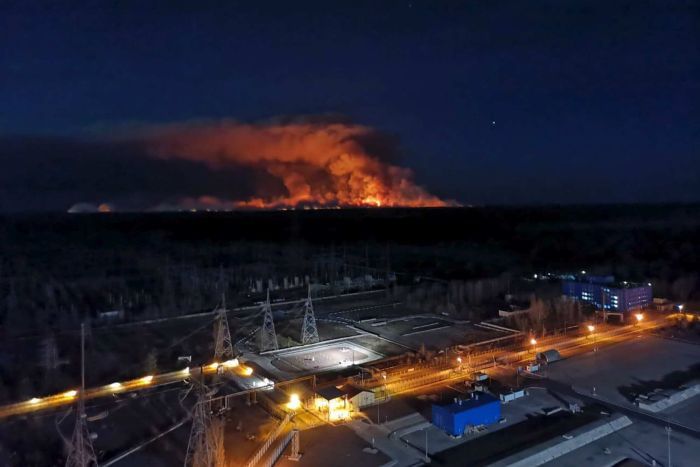
(CNN)Wildfires near the Chernobyl power plant are now under control, Ukrainian authorities said Tuesday.
Will nuclear refuelling workers at Limerick nuclear station spread Coronavirus to each other, and to the wider community?
Coronavirus cases at Limerick nuclear station raised concern. Pa. plants say they’re working to prevent outbreaks during refueling outages, State Impact 15 Apr 20,
Pennsylvania’s nuclear operators said they are taking extra steps to safeguard the health of workers involved in springtime shutdowns for refueling, following the positive testing of two workers for COVID-19 at Exelon’s Limerick plant in Montgomery County.
The cases of the two workers – who Exelon said Monday were resting at home – raised concerns that the hundreds of contractors who are needed to refuel the plants every 18-24 months would be unable to effectively practice social distancing, and would end up infecting each other and the wider community…….. https://stateimpact.npr.org/pennsylvania/2020/04/15/coronavirus-cases-at-limerick-nuclear-station-raised-concern-pa-plants-say-theyre-working-to-prevent-outbreaks-during-refueling-outages/ |
|
Coronavirus cases at Hanford nuclear waste site and at Nuclear Fuel Services
Hanford Employee Being Tested for COVID-19; Cases Confirmed at Nuclear Fuel Services BY EXCHANGEMONITOR, 15 Apr, 20, An employee at the Hanford Site in Washington state is being tested for COVID-19, the Department of Energy said in an overnight post. …….
Hanford, like most other DOE nuclear cleanup sites, has drawn down to minimal operations during the federal public health emergency. Probably no more than 20% of its usual workforce remains on-site. To date, Hanford has not reported any positive COVID-19 results among its workforce of about 11,000 federal and contractor employees. Meanwhile, BWX Technologies subsidiary Nuclear Fuel Services on Tuesday reported multiple cases of COVID-19 among its workforce. The Erwin, Tenn., defense-uranium contractor did not say how many employees were infected, or how many potentially exposed employees were in quarantine following contact with the sick workers……
It was not clear whether the COVID-19 emergency response might delay any Nuclear Fuel Services contract milestones. Among other things, the company is producing low-enriched uranium to produce tritium in civilian nuclear reactors for National Nuclear Security Administration (NNSA) nuclear weapons programs. Nuclear Fuel Services also could wind up purifying defense uranium for the weapons program around 2023. The NNSA is negotiating with the company to act as a backstop for the Y-12 National Security Complex in Oak Ridge, Tenn., in a few years.
As of late last week, there were more than 50 confirmed cases across the NNSA’s nuclear weapons sites. There are currently at least nine confirmed cases at nuclear-cleanup programs overseen by the DOE Office of Environmental Management. https://www.exchangemonitor.com/nuclear-fuel-services-reports-covid-19-cases/?printmode=1
|
|
America’s eternal nuclear waste problem
After burning at 550 degrees Fahrenheit for several years, the fuel in the cores of nuclear reactors (uranium, in most cases) will experience diminishing returns of energy output. The 700-pound, 14.5’-tall uranium fuel assemblies must be replaced, but what to do with the street lamp-sized chunk of (very) heavy metal that will leak radiation for the next 100,000 years?
For nearly 40 years, federal officials have grappled with the question of nuclear waste disposal. There’s no easy answer.
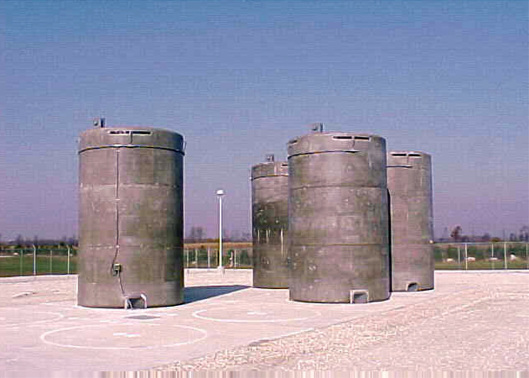
All the uranium ever burned and extracted from reactors at Exelon’s Nine Mile Point and James A. FitzPatrick nuclear facilities remains at the sites, within sight of the Lake Ontario shoreline in Scriba. After several years in a cooling pool adjacent to the reactor itself, the depleted uranium is entombed in steel and concrete silos (known as dry cask storage) at a separate part of the plants’ campuses.
Dry cask storage is “designed to contain radiation, manage heat and prevent nuclear fission. They must resist earthquakes, projectiles, tornadoes, floods, temperature extremes and other scenarios,” according to the Nuclear Regulatory Commission (NRC), which oversees all nuclear plants in the United States. While licensed on a 20-year basis and in most cases built to be effective for more than 100 years, dry cask installations are nevertheless not designed to last forever — unlike the radiation emanating from the uranium.
There’s a lot of science involved in using uranium to power our homes and businesses, but the solution to its waste problem is undeniably a political one.
The federal Nuclear Waste Policy Act of 1982 mandated the Department of Energy to find a solution to the problem of how to collect, transport and store American nuclear waste in a central location. Four decades later, the spent uranium from FitzPatrick and Nine Mile Point’s reactors still sits in Scriba, enjoying its lakeside view.
In 1987, Yucca Mountain, Nevada, was selected from a pool of eight potential sites to host the nation’s geological repository for high-level nuclear waste.
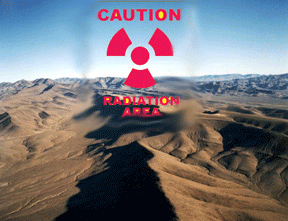
According to the NRC, the Yucca Mountain facility would look basically as follows:
1. Canisters of waste, sealed in special casks, are shipped to the site by truck or train.
2. Shipping casks are removed, and the inner tubes with the waste are placed in steel, multilayered storage containers.
3. An automated system sends storage containers underground to the tunnels.
4. Containers are stored along the tunnels, on their sides.
Unsurprisingly, this was not a universally popular decision with the people of Nye County, Nevada, where Yucca Mountain is located.
NRC documents describe the scenes at the first public hearings in Nye County about the project in 1999 and 2000, after more than a decade of geological studies and environmental impact research.
“The citizens expressed concern about why they felt they couldn’t trust the government and were afraid of being lied to,” read one section of a report prepared by the Center for Nuclear Waste Regulatory Analyses.
In addition to the scientific challenges of building a facility capable of withstanding one million years of natural disasters (an actual court-ordered requirement), the NRC found they had to deal with unexpected human hurdles
“At one of the meetings a local politician attended the meeting with his own television reporter and used the meeting as a venue for grandstanding,” the report said. “His comments off camera to the NRC staff were very complimentary, but on camera he took a much harsher stance.”
U.S. Sen. Kirsten Gillibrand, D-NY, has indicated that while she believes a federal repository is the best solution to spent uranium storage, she would not demand the construction of one without the consent of its local communities.
“Senator Gillibrand believes we must find a permanent solution for spent fuel storage and the Department of Energy should work with the states and with Congress to find an acceptable site,” said Gillibrand spokesperson Miriam Cash. “There should be a federal repository for permanently storing civilian nuclear waste and communities in New York should not have to be required to store it on-site for decades.”
Funds for the Yucca Mountain licensing review process finally ran out in 2011 and no meaningful progress has been made since that point, according to federal nuclear officials.
Secretary of Energy Stephen Chu, a member of President Barack Obama’s administration, dubbed Yucca Mountain “off the table” in 2009, but clearly, the table still has room to accommodate its return.
Yucca Mountain sits in the middle of the Nevada desert roughly 100 miles northwest of Las Vegas. Since the site’s selection in 1987 as the national spent fuel repository from a pool of eight other locations, the Department of Energy has run into roadblocks from local and environmental interests and, perhaps most importantly, opposition from Nevada Democrat Harry Reid. Reid represented Nevada in the U.S. Senate for 30 years beginning in 1987 and deftly wielded his influence, including as Senate majority leader, to stifle Yucca Mountain progress until his 2017 retirement. That was the same year President Donald Trump’s first executive budget contained funds to restart the research into a feasible transition from individual reactor site dry cask storage to a national repository system.
Executive budgets are not law, however, and while Trump’s public support for more than $100 million in funding symbolized yet another component in his industry-friendly administration’s larger platform, Congress has yet to approve any of the dollars.
“The political debate rages on,” Rod McCullum of the Nuclear Energy Institute, an industry advocacy group based in Washington, D.C., told The Palladium-Times in a recent interview. “The scientific and technical basis is as strong as ever, but the political will to move forward is as weak as ever.”
Any meaningful change in funding for the Yucca Mountain licensing review would would need to come from Congress, but in a legislative body where in the best of times progress is measured in subatomic increments, the current health crisis has brought all non-COVID-19 discussion to an indefinate halt.
In a statement on the topic of dry cask storage versus a federal repository, U.S. Rep. Anthony Brindisi, D-Utica, expressed support for a “bipartisan solution that identifies and funds a permanent storage solution” and removing the spent uranium from its sites. Brindisi is also a co-sponsor on H.R. 2314, the Nuclear Powers America Act, which provides investment tax credits for nuclear power plants.
The course reversal (and back again) by the federal government isn’t helping matters. As recently as 2018, legislation was proposed funding Yucca Mountain’s review process. For many, the term “nuclear waste” evokes images of leaking barrels of glowing, toxic goo; the boring truth is that spent fuel’s true danger lies more in the quantity than its lack-of-quality. As long as nuclear plants continue to operate in the United States, they will continue to produce waste uranium that must be carefully stored on site in dry cask facilities.
Yucca Mountain’s license application is for a term of 10,000 years. It is unclear if that is a long enough span of time for officials to come to a final decision.
Seth Wallace is the managing editor of The Palladium-Times and a nuclear energy policy enthusiast.

For UK’s new Labour leader, climate action and Green New Deal will be key goals
Business Green 14th April 2020, Newly appointed Labour leader Sir Keir Starmer completed his front bench
team late last week, handing key green positions to a raft of experienced
MPs. Starmer is widely expected to make climate action and Labour’s Green
New Deal a key plank in the Opposition’s offer to the public – a fact
underlined by the handing of specific green briefs to senior MPs. But it
remains to be seen if he retains the unprecedented levels of low carbon
infrastructure funding pledges and nationalisation programmes proposed
under Corbyn’s leadership.
https://www.businessgreen.com/news/4013864/labour-completes-green-shadow-ministerial-lin
President Trump ‘talked about nuclear weapons’ with Vladimir Putin in a call to the Kremlin over the weekend as START Treaty’s expiration looms
- resident Trump told reporters Monday that he discussed nuclear arms control during his latest conversation with Russian President Vladimir Putin
- The president shared phone call with Putin on Sunday just hours after he helped broker a historic deal with the OPEC+ to shore up plummeting oil prices
- Trump revealed the contents of the call during the White House’s daily coronavirus press briefing on Monday evening
- ‘We did talk about the arms. Yes, we did,’ Trump told reporters from the podium. ‘It was a very important part of the call actually’
- Though Trump failed to divulge specifics the Russian president’s press secretary said Putin and Trump spoke of the START Treaty, which is set to expire next year……….. https://www.dailymail.co.uk/news/article-8216245/President-Trump-talked-nuclear-weapons-Vladimir-Putin-call-weekend.html
Multiple COVID-19 cases confirmed among Nuclear Fuel Services employees in Erwin
by WCYB, Wednesday, April 15th 2020 ERWIN, Tenn. — Multiple COVID-19 cases have been confirmed among Nuclear Fuel Services employees in Erwin.
The exact number of employees was not given.
EDF cutting back on its nuclear energy goals
EDF pulls financial targets in response to pandemic, WNN, 15 April 2020 EDF said on 23 March it would lower its 2020 nuclear power production target of 375-390 TWh, but did not say by how much. On 8 April French transmission system operator RTE said that electricity demand in the country had fallen between15% and 20% since the lockdown.
“The economic turmoil that follows from the current health crisis is causing a drop in power demand and is significantly impacting many of the group’s businesses, namely nuclear generation (which EDF indicates is currently under review and will be adjusted significantly below the initial assumption), new-build projects and services,” EDF said. “Consequently, the EDF Group withdraws all its financial targets for 2020, including the lower end of the EBITDA range of EUR17.5 billion, as well as for 2021.”…….
A new decree – published in the Official Journal on 27 March – postponed the deadline for loading of first fuel at EDF’s EPR unit at its Flamanville site in Normandy by four years, to April 2024. Under the currect schedule, the loading of fuel is planned by the end of 2022. …… https://www.world-nuclear-news.org/Articles/EDF-pulls-financial-targets-in-response-to-pandemi
U.S. Energy Dept awards for nuclear students (not for renewable energy ones)
U.S. Department of Energy Announces Education Awards for the Next Generation of Nuclear Scientists and Engineers, APRIL 14, 2020 WASHINGTON, D.C. – The U.S. Department of Energy (DOE) today announced more than $5 million in awards through the Office of Nuclear Energy’s Integrated University Program. The program offers undergraduate scholarships and graduate fellowships to students pursuing nuclear engineering degrees and other nuclear science and engineering programs relevant to nuclear energy. The awards include 42 scholarships and 34 fellowships for students at 32 U.S. colleges and universities.
“The Integrated University Program is focused on attracting the best and the brightest to nuclear energy professions,” ….https://www.energy.gov/ne/articles/us-department-energy-announces-education-awards-next-generation-nuclear-scientists-and-0
April 15 Energy News — geoharvey
Science and Technology: ¶ “Stronger Action On Climate Change Would Benefit The Economy, Study Finds” • One main argument against taking action on climate change has always been that it’s too expensive. But research published in the journal Nature finds the opposite is true. The net global economic benefit would range between $127 trillion and […]
Coronavirus doubters follow climate denial playbook — RenewEconomy
Observing the US political leaders’ responses to the coronavirus pandemic has been like watching the climate crisis unfold on fast-forward. The post Coronavirus doubters follow climate denial playbook appeared first on RenewEconomy.
via Coronavirus doubters follow climate denial playbook — RenewEconomy
Criirad final report on Chernobyl Fires – Recommendations and findings
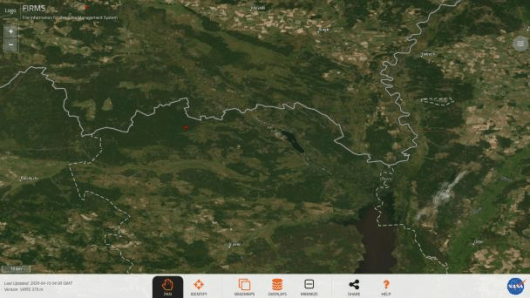
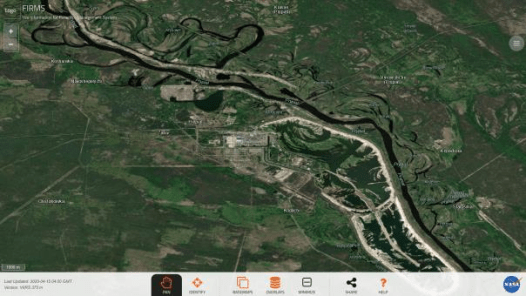
Images satellites NASA / FIRMS /Période du 14 au 15 avril 2020 (4H GMT)


NASA 1 satellite images updated April 15, 2020 at 4:00 GMT (see illustrations) confirm what Ukrainian authorities announced yesterday that the recent rains and the action of firefighters have led to the arrest of the fires which were a few hundred meters from the nuclear power plant in Chernobyl. As the satellite image of the region shows, most of the fires that affected the contaminated areas are resolved but some limited foci persist. CRIIRAD will maintain its surveillance.
These fires resulted in a one-time increase of more than 700 times 2 in the concentration of cesium 137 in the air of the city of Kiev located more than 100 kilometers south of the Chernobyl power plant. Of many questions remain about the radiological impact of these fires for firefighters, local residents as well as the safety of nuclear installations and waste storage in the exclusion zone. The recurrence of fires in contaminated areas also raises questions about the means of prevention and management implemented to limit these repeated releases of radioactivity, just like on the absence of air radioactivity control beacons in the most exposed inhabited areas.
See all CRIIRAD press releases on the dedicated page:
http://balises.criirad.org/actuTchernobyl2020.html
Impact on France
With regard to the impact on French territory, as indicated in our press release of April 8, the modeling suggests that air masses from the Chernobyl area may have reached
French territory at the start of last week, but with very low and difficult levels of contamination to measure.
As indicated in our press release of April 14, the analysis of the filter for the radioactivity monitoring beacon atmosphere operated by CRIIRAD in Montélimar (Drôme, Rhône valley) confirmed that over the period from 3 as of April 10, the volume activity of cesium 137 in ambient air remained very low, below the limits of detection (<6 μBq / m 3).
The same observations are made for the Romans-sur-Isère tag (Drôme): the analysis of the aerosol filter that night for the period from April 5 to April 14 (morning) does not show cesium 137 above the limit of detection (<13 μBq / m 3).
This means that the traces of cesium 137 necessarily present in the atmosphere are lower than detection capabilities of the measurement means implemented by CRIIRAD. These detection limits are different for these two analyzes because the Montélimar filter counted the entire weekend, 300,000 seconds, which is not the case for the pre-counting of the Romans filter.
Editing: Bruno Chareyron, nuclear physics engineer, director of the CRIIRAD laboratory, with the participation of Jérémie Motte, head of the beacons service and Stéphane Patrigeon, metrologist technician.
Document source https://balises.criirad.org/pdf/200415_CPCRIIRAD_Radioactivite_incendies_Tchernobyl.pdf
Ukrainian authorities declare wildfires near Chernobyl nuclear power plant.
Wildfires near Chernobyl under control, Ukrainian authorities say, April 14, 2020 The fires reportedly came within two kilometers of the Chernobyl nuclear power plant.
Abandoned Chernobyl nuclear plant is threatened by approaching wildfires
Blaze rages near Chernobyl, endangering abandoned nuclear plant https://www.mercurynews.com/2020/04/13/blaze-rages-near-chernobyl-endangering-abandoned-nuclear-plant/
“A fire approaching a nuclear or hazardous radiation facility is always a risk” By Margaryta Chornokondratenko and Alexander Marrow | Reuters
KIEV – A huge forest fire in Ukraine that has been raging for more than a week is now just one kilometer from the defunct Chernobyl nuclear power plant and poses a radiation risk, Greenpeace Russia warned on Monday, citing satellite images.
Ukraine’s Emergency Situations Service said it was still fighting the fires, but that the situation was under control.
Video footage shot by Reuters on Sunday showed plumes of black smoke billowing into the sky and trees still
ablaze, with firefighters in helicopters trying to put out the fires.
Aerial images of the 19 mile exclusion zone around the plant, site of the world’s worst nuclear accident in 1986, showed scorched, blackened earth and the charred stumps of still smoldering trees.
The Emergency Situations Service said radiation levels in the exclusion zone had not changed and those in nearby Kiev, the Ukrainian capital, “did not exceed natural background levels.”
Greenpeace Russia said the situation is much worse than Ukrainian authorities believe, and that the fires cover an area one thousand times bigger than they claim.
On April 4 Ukrainian authorities said the blaze covered an area of 20 hectares, but Greenpeace cited satellite images showing it was around 12,000 hectares in size at that time.
“According to satellite images taken on Monday, the area of the largest fire has reached 34,400 hectares,” it said, adding that a second fire, stretching across 12,600 hectares, was just one kilometer away from the defunct plant.
Ukrainian officials did not immediately respond to a request for comment on those claims.
Rashid Alimov, head of energy projects at Greenpeace Russia, said the fires, fanned by the wind, could disperse radionuclides, atoms that emit radiation.
“A fire approaching a nuclear or hazardous radiation facility is always a risk,” Alimov said. “In this case we’re hoping for rain tomorrow.”
Chernobyl tour operator Yaroslav Yemelianenko, writing on Facebook, described the situation as critical.
He said the fire was rapidly expanding and had reached the abandoned city of Pripyat, two kilometers from where “the most highly active radiation waste of the whole Chernobyl zone is located.” He called on officials to warn people of the danger.
Satellite images taken by NASA Worldview and seen by Reuters showed the two fires had extended far into the exclusion zone.
The fires, which follow unusually dry weather, began on April 3 in the western part of the exclusion zone and spread to nearby forests. Police say they have identified a 27-year old local resident who they accuse of deliberately starting the blaze.
It remains unclear if the person, who has reportedly confessed to starting a number of fires “for fun,” is partly or fully responsible.
Changes for a low carbon economy are possible: we must advocate for this
The major impact of coronavirus on the trajectory of climate change must not be a temporary reduction in emissions from cars, trucks and airplanes. It must be a collective recognition that rapid and significant voluntary changes in our behavior are possible. For individual climate action to be sustained, people must find honor and joy in it. And that action must also be supported by government leadership and coordination. We must advocate now, as vocally as we can, for immediate and significant investments in green infrastructure. To avert disaster, we must change how we live.
The Coronavirus and Climate Action https://blogs.scientificamerican.com/observations/the-coronavirus-and-climate-action/ Confronting global warming will take a completely different approach from confronting the pandemic, By Laura J. Martin on April 10, 2020
In recent weeks, many Americans have voluntarily and radically altered their behavior in order to protect others from the novel coronavirus. Those who are less vulnerable are making sacrifices in order to protect those who are more vulnerable: the elderly, the immunocompromised, and—in our country, with its broken social safety net—the uninsured and the poor.
Climate scientists have been quick to draw parallels between the need to “flatten the curve” of coronavirus spread and the need to flatten the carbon emissions curve. The Intergovernmental Panel on Climate Change states that we must reduce emissions by about 45 percent from 2010 levels by 2030 in order to lessen the severity of future emergency; to reduce, but not eliminate, the probability of catastrophic changes in sea level, ocean acidity, extreme weather, food security and biodiversity.
But confronting climate change will require a completely different generational politics than confronting coronavirus. Rather than young people changing their lifestyles to protect the elderly, the large and growing proportion of older citizens in industrialized countries will have to change their lifestyles in order to protect children and those not yet born. Those with power and resources today will have to change their lifestyles dramatically in order to protect the world’s poorest and most marginalized, those who will not be able to move away from climate hazards. This is the message that youth activists like Zero Hour, Isra Hirsi and Greta Thunberg implore us to heed. It is also the premise of DearTomorrow, a storytelling project where people write climate messages to loved ones living in the future.
Who is right? Continue reading
The planet needs a green recovery. But are governments up for this?
|
The Guardian view on the climate and coronavirus: global warnings, https://www.theguardian.com/commentisfree/2020/apr/12/the-guardian-view-on-the-climate-and-coronavirus-global-warnings 13 Apr 20, Editorial Steep falls in emissions have been the pandemic’s immediate effect. But what’s needed is a green recovery. So far, discussions of a coronavirus exit strategy have mainly focused on the steps that could bring an end to the lockdown. In the short term, both in the UK and elsewhere, there is nothing more desirable than letting people resume their lives, once it is safe to do so.
But the speed of the “return to normal” is not the only thing that matters. The manner in which the world’s leaders manage the colossal economic and political shocks caused by the virus is also of the utmost importance. And at the top of their list of priorities, alongside human welfare, must be the biosphere and its future. It’s too soon to say with any confidence what impact coronavirus will have on the climate emergency. The brakes placed on economic activities of many kinds, worldwide, have led to carbon emission cuts that would previously have been unthinkable: 18% in China between February and March; between 40% and 60% over recent weeks in Europe. Habits and behaviours once regarded as sacrosanct have been turned on their heads: road traffic in the UK has fallen by 70%. Global air traffic has halved. Meanwhile, a much-needed spotlight has been thrown on humans’ troubling relationship to wildlife, with some experts arguing that the degradation of the natural world and exploitation of other species is among the pandemic’s causes. In human terms, the economic contraction precipitated by the virus – and predicted by the World Bank to lead to a severe depression – is sure to be brutal. No one, and least of all an elected government, would have chosen to limit emissions in this way. But if further savage waves of destruction to people’s livelihoods are to be avoided, rather than simply stored up or ignored until they become unignorable, just as coronavirus was, every possible effort must now be made to ensure that the recovery, when it comes, is as green as possible; that any and every stimulus package is directed towards renewable energy and zero- or low-carbon infrastructure and transport. The urgency and desperation surrounding all such efforts are likely to militate against progressive measures. Already, governments are coming under huge pressure to bail out oil and gas companies (in the US and Canada this has already begun). But while in the short term the low oil price, which is also the result of a price war being waged by Saudi Arabia and Russia, could have the damaging effect of making oil more competitive against renewables, plunging demand and turmoil in the industry provide an opportunity that must be seized by all who oppose the continued dominance of fossil fuels. There are other questions besides the future of oil that the crisis has opened up in unexpected ways. Huge political shifts are under way, with fiscally conservative governments such as Boris Johnson’s intervening in economies to an unprecedented extent. What was once impossible (socialist, reckless) now turns out not to be, at all. Could the renewed shock of human vulnerability in the face of Covid-19 make way for an increased willingness to face other perils, climate chaos among them? Impossible to say at this stage, perhaps. Certainly not without a fight against all those who will promote a return to business (and emissions) as usual. But with the postponement of crucial UN biodiversity and climate conferences, it has never been more important to keep up the pressure. There is no exit strategy from our planet. |
|
-
Archives
- February 2026 (228)
- January 2026 (308)
- December 2025 (358)
- November 2025 (359)
- October 2025 (376)
- September 2025 (258)
- August 2025 (319)
- July 2025 (230)
- June 2025 (348)
- May 2025 (261)
- April 2025 (305)
- March 2025 (319)
-
Categories
- 1
- 1 NUCLEAR ISSUES
- business and costs
- climate change
- culture and arts
- ENERGY
- environment
- health
- history
- indigenous issues
- Legal
- marketing of nuclear
- media
- opposition to nuclear
- PERSONAL STORIES
- politics
- politics international
- Religion and ethics
- safety
- secrets,lies and civil liberties
- spinbuster
- technology
- Uranium
- wastes
- weapons and war
- Women
- 2 WORLD
- ACTION
- AFRICA
- Atrocities
- AUSTRALIA
- Christina's notes
- Christina's themes
- culture and arts
- Events
- Fuk 2022
- Fuk 2023
- Fukushima 2017
- Fukushima 2018
- fukushima 2019
- Fukushima 2020
- Fukushima 2021
- general
- global warming
- Humour (God we need it)
- Nuclear
- RARE EARTHS
- Reference
- resources – print
- Resources -audiovicual
- Weekly Newsletter
- World
- World Nuclear
- YouTube
-
RSS
Entries RSS
Comments RSS