Nuclear waste dumping for the beautiful landscape of the Northwoods?
 Nuclear Waste In The Northwoods https://www.wxpr.org/post/nuclear-waste-northwoods#stream/0 Nuclear Waste In The Northwoods https://www.wxpr.org/post/nuclear-waste-northwoods#stream/0
By GARY ENTZ 18 Mar 20, The issue of nuclear waste generated by power plants in the United States always seems to be somebody else’s problem. In this week’s Northwoods Moment in History, Gary Entz reminds us how it wasn’t so long ago that it could have been a problem for the Northwoods and could be again in the future.
The beautiful landscape of the Northwoods along with its pristine lakes and streams is something that most people would not associate with a nuclear waste dump. Yet not so long ago that is exactly what the United States Department of Energy had in mind for the region. What was once known as Atomic Power grew out of the atomic weapons research programs of World War II and the Cold War. The first fission reactor capable of generating electricity came online in 1951 and the first commercial reactor to generate electricity for the public market came online in 1957. By March of 1979, when the accident at Three Mile Island occurred, there were over eighty nuclear reactors that either were or had been in operation in the U.S. with nearly sixty more under construction. Wisconsin had three of those reactors, located at Point Beach, Kewaunee, and La Crosse. Nuclear power is touted as being clean energy because it has zero emissions; that is, the steam rising from a nuclear cooling tower is just that, water steam. However, fuel rods are usually swapped out every 18 to 24 months. Spent fuel rods remain dangerously radioactive for 10,000 years or longer and must be safely stored. Unused nuclear fuel rods typically spend 7 to 10 years in a pool of water to cool down and are then stored in dry casks either at the power plant site or in a spent fuel storage installation. Today there eighty sites across dozens of states where nearly 80,000 metric tons of nuclear waste from America’s power plants and military installations is stored. This is where the Northwoods comes in. By the late 1970s, the Department of Energy wanted a centralized location where all the nation’s nuclear waste could be stored and monitored. In the 1980s, the DOE ranked Wisconsin’s Wolf River Batholith as number two of the top three options for a high-level nuclear waste repository. The Batholith is a 1,000 square mile watershed that extends over seven counties, including Langlade, Shawano, Waupaca, Menominee, Portage, Marathon and Oconto counties, and the land of three tribes, the Stockbridge-Munsee, Menominee and Ho-Chunk. This area was selected due to its stable granite geology and lack of earthquakes. The proposed sixteen square mile facility was dangerously close to popular waterways. If the radioactive materials leaked, then contaminated water could flow into the Wolf River, the Fox River, and on to Lake Winnebago and Lake Michigan. The people of the Northwoods and all of Wisconsin were overwhelmingly opposed to becoming a nuclear dump for the DOE. In a 1983 statewide referendum, 89 percent voted for a moratorium on nuclear power and a waste disposal site in Wisconsin. Because of the licensing issues at Yucca Mountain, Nevada, the DOE has been looking for different options, and in 2008 the Wolf River Batholith was again listed as a leading alternative. In 2015, when the state legislature voted to overturn the 1983 moratorium on nuclear power, it also inadvertently lifted to moratorium on a nuclear waste dump. |
|
EDF reassures UK that during coronavirus epidemic, nuclear operations will continue
|
EDF Energy says plans in place to maintain operations at UK nuclear plants https://uk.finance.yahoo.com/news/edf-energy-says-plans-place-144424093.html?guccounter=1&guce_referrer=aHR0cHM6Ly9uZXdzLmdvb2dsZS5jb20v&guce_referrer_sig=AQAAABq2naeyyQ9ohtcPQW2Ho9e2-qDfI6XSbDwfZUneTxi4VhdT3GWx-zWbqg0MCFS2ArOO-cBI7xrEXbGJxc_Z4MEQGCMb8xZYz9GdF6dLu3azUPUvN5EB4x2GgyUSjwZkX1E93xGECuqxS4HnxqOETaVwytGf9KBTZIzT3QuaBP-R Reuters18 March 2020 By Nina ChestneyLONDON (Reuters) – EDF Energy has plans in place to maintain operations at its nuclear power plants in Britain during the coronavirus outbreak, it told Reuters on Tuesday.
The company operates all 15 nuclear reactors in Britain. Currently eight of those, with a combined capacity of around 4.2 gigawatts – almost half of the country’s total nuclear power capacity – are offline for planned or unplanned outages. “We have comprehensive plans in place to maintain operations at all of our power stations and planned generation is not affected at any of our sites,” said a spokeswoman, declining to specify what the measures were. On Monday, EDF Energy’s parent company EDF <EDF.PA> said it would reduce staff at its Flamanville nuclear power plant in northern France due to coronavirus infections in the Cotentin region. The plant has been offline for maintenance. Britain’s Office for Nuclear Regulation (ONR) said all UK sites have minimum staffing levels, and contingency plans should they fall below these levels, to enable them to stay in control of activities that could affect nuclear safety under all foreseeable circumstances. The ONR, which is in charge of overseeing nuclear safety, said its staff have been directed to work at home. “A number of inspectors will continue to travel to sites where required, but we will endeavour to carry out as much of our business as possible via phone, email and Skype,” it said. “These measures will not have a severe impact on our regulation of the nuclear industry.” (Reporting by Nina Chestney; Editing by Pravin Char and Jan Harvey) |
|
Democrats may not support Trump’s new W93 nuclear weapons program
|
Political Battle Brewing Over New Nuclear Program, National Defense
3/17/2020, By Jon Harper The Trump administration’s proposal to begin work on a new nuclear warhead program to modernize the nation’s aging stockpile is expected to be hotly contested.For fiscal year 2021, President Donald Trump requested $28.9 billion for the Pentagon’s nuclear enterprise. He requested an additional $15.6 billion for efforts by the National Nuclear Security Administration, which manages the stockpile, including $53 million for NNSA work on a new warhead, dubbed the W93.
The Pentagon’s budget blueprint includes $480 million for work on the weapon system over the future years defense program, with $32 million slated for 2021. The W93 is intended for the Navy’s submarine-launched ballistic missiles, according to senior defense officials. There are currently two families of warheads for the sea-based leg of the triad: the W76 and the W88. “Both of these systems are growing old, and so now we must start thinking about a warhead that will replace one of those two when it’s time for those systems to retire,” a senior defense official told reporters during a background briefing. “These things take a long time. There’s a seven-stage process by which we start to develop a warhead.”…….. The Department of Energy has estimated that the program will cost about $10.9 billion in 2019 dollars. Hans Kristensen, director of the Nuclear Information Project at the Federation of American Scientists, said the $10.9 billion estimate is “low-balling it.” A new fuze is also needed, he noted in an email. “New fuzes are expensive.” Other components could increase the price tag. “The W88 uses the Mk5 [reentry body] but the W93 will likely use a new Mk7, which will add to the cost projection,” Kristensen said. “A W93 using Mk7 obviously will be more expensive than the standard life-extension programs.”….. Nuclear modernization programs, especially those related to warheads, have put Republicans and Democrats at loggerheads in the past. “This will be, I predict, the probably most contentious issue in this year’s defense authorization bill about modernizing the stockpile,” House Armed Services Committee Ranking Member Rep. Mac Thornberry, R-Texas, said during recent remarks at the Brookings Institution. “There is a temptation to say, ‘Oh, it’s worked pretty well so far. Why do we need to mess with it and spend all this money?’” Thornberry said the nuclear arsenal needs to be modernized. However, Democrats may not go along with the W93 plans. “Congressional leadership has yet to receive the military requirement or justification for another new nuclear warhead,” a spokesperson for HASC Democrats said in an email. “As recently as July 2019, the Department of Energy projected it would begin work on this warhead in 2023. Work on this new warhead will add billions of dollars to an already strained nuclear modernization plan.”…… https://www.nationaldefensemagazine.org/articles/2020/3/17/political-battle-brewing-over-new-nuclear-program |
|
Cancel The Tokyo Olympic Games! — limitless life
The Tokyo Olympic Games Dear Friends, The conscientious Japanese citizens are shocked by the queer attachment to holding the Tokyo Olympic Games as planned in spite of the declared Corona virus pandemic. The rumored alternative of postponement confirms the lamentable level of understanding as to the purposely ignored Fukushima radioactive dangers which are […]
How dangerous is a coronavirus infection?

Gene Leonard MDCorona 30 Morbitity Mers 18 Mar 20
Do not listen to conspiracy theories or factoids. It is serious. 86 percent of the people, who already heve the virus in the USA, do not know they have it. It can kill babies and toddlers as well. If you value your loved ones hunker down, and help slow down the deadly virus’s transmission.
How dangerous is a coronavirus infection?
Usually coronavirus illnesses are fairly mild, affecting just the upper airway. But the new virus, as well as both SARS and MERS, are different.
Those three types of betacoronaviruses can latch onto proteins studding the outside of lung cells, and penetrate much deeper into the airway than cold-causing coronaviruses, says Anthony Fauci, director of the U.S. National Institute of Allergy and Infectious Diseases in Bethesda, M.D. The 2019 version is “a disease that causes more lung disease than sniffles,” Fauci says.
Damage to the lungs can make the viruses deadly. In 2003 and 2004, SARS killed nearly 10 percent of the 8,096 people in 29 countries who fell ill. A total of 774 people died, according to the World Health Organization.
MERS is even more deadly, claiming about 30 percent of people it infects. Unlike SARS, outbreaks of that virus are still simmering, Fauci says. Since 2012, MERS has caused 2,494 confirmed cases in 27 countries and killed 858 people.
MERS can spread from person to person, and some “superspreaders” have passed the virus on to many others. Most famously, 186 people contracted MERS after one businessman unwittingly brought the virus to South Korea in 2015 and spread it to others. Another superspreader who caught MERS from that man passed the virus to 82 people over just two days while being treated in a hospital
Nuclear-powered submarines – fraught with legal and political problems

|
The Complex Policy Questions Raised by Nuclear Energy’s Role in the Future of Warfare, Just Security by Alex Gilbert, Morgan Bazilian and Julia Nesheiwat, March 16, 2020 The United States military, as well as other militaries around the world, are racing to develop high-energy weapons—lasers, high-powered microwaves, and electromagnetic rail guns—in order to compete with near-peer competitors on the next generation of military technologies. But the electricity to power these systems will need to derive from somewhere, and so military planners are eyeing a new generation of energy-dense nuclear reactors, despite potential policy and legal challenges to doing so…….. The Army is considering mobile nuclear power plants, in part to drive high-energy weapons, an idea one retired three-star hailed as a potential logistics revolution. And should the U.S. build space-based lasers for missile defense, nuclear energy may be the only way to provide the needed megawatts. All this raises key policy concerns in relation to international law, rules of engagement, and the laws of warfare. Basing, or even deploying, nuclear reactors in the territorial waters or land of an overseas ally requires the permission of the host government, which may be averse to expanding nuclear power as in the case of major bases like Yokosuka, Japan. Diego Garcia, an island in the Indian Ocean, provides another challenging case as the ongoing territorial dispute between the United Kingdom and Mauritius threatens the U.S. base there, and a nuclear plant would only complicate the existing dispute. The U.S. Navy already faces constraints on where their nuclear-powered ships can visit. Floating nuclear power plants, like those developed by Russia and China, face similar concerns if they transit foreign waters or, in the case of the South China Sea, are stationed in disputed territories. Similarly, mobile reactors, like those considered by the U.S. Army, would likely be transported by air, requiring permission of all overflight countries. Beyond basing, a critical question is whether the U.S. military would own and operate these new reactors, as the Navy currently does, or whether they would pursue commercial alternatives, as the Army is considering. The U.S. Army report on mobile reactors noted that, with either government or commercial ownership, there are concerns about international rules and licensing that present potential barriers to deployment. In some cases, potential host countries do not even have nuclear regulatory agencies. Further, commercial ownership raises liability concerns, both in the case of a military incident or an accident. International nuclear liability treaties are not well harmonized between the U.S. and most of its allies, especially when it comes to the unique concerns of transportable reactors. Using nuclear power for high-energy weapons also creates targeting dilemmas for the U.S. and foreign militaries. High-energy weapons and their support infrastructure, including reactors, may be initial targets in a conflict. The social, environmental, and reputational impacts of damaging a nuclear reactor, particularly on a country’s home territory, or with effects on a third country, could lead to conflict escalation and international condemnation……. Nuclear-powered laser satellites could aggravate concerns about nuclear arms controls as such systems could be used for anti-ballistic missile or anti-satellite applications. While the Outer Space Treaty prohibits weapons of mass destruction in orbit, it does not prohibit other types of weaponry. During the Cold War, Soviet military space reactors raised calls for bans on space nuclear power, particularly after one accidentally crashed in Canada. Recent calls for space arms control have been unsuccessful. As with terrestrial nuclear-powered lasers, the unique role of laser satellites would make them early targets in any major power conflict, leading to risks of collateral damage from radioactive and dangerous space debris, as occurred after the accidental 2009 collision involving a decommissioned Soviet nuclear satellite.. The article below is not about Australia, but it is about small nuclear reactors. Everybody knows, (just quietly) that Australia won’t be getting small nuclear reactors for providing electricity. The real aim is for nuclear-powered submarines. So this article, about the legal and political problems of nuclear reactors for Defence is applicable to Australia, too
The Complex Policy Questions Raised by Nuclear Energy’s Role in the Future of Warfare, Just Security by Alex Gilbert, Morgan Bazilian and Julia Nesheiwat, March 16, 2020 The United States military, as well as other militaries around the world, are racing to develop high-energy weapons—lasers, high-powered microwaves, and electromagnetic rail guns—in order to compete with near-peer competitors on the next generation of military technologies. But the electricity to power these systems will need to derive from somewhere, and so military planners are eyeing a new generation of energy-dense nuclear reactors, despite potential policy and legal challenges to doing so…….. The Army is considering mobile nuclear power plants, in part to drive high-energy weapons, an idea one retired three-star hailed as a potential logistics revolution. And should the U.S. build space-based lasers for missile defense, nuclear energy may be the only way to provide the needed megawatts.
All this raises key policy concerns in relation to international law, rules of engagement, and the laws of warfare.
Basing, or even deploying, nuclear reactors in the territorial waters or land of an overseas ally requires the permission of the host government, which may be averse to expanding nuclear power as in the case of major bases like Yokosuka, Japan. Diego Garcia, an island in the Indian Ocean, provides another challenging case as the ongoing territorial dispute between the United Kingdom and Mauritius threatens the U.S. base there, and a nuclear plant would only complicate the existing dispute.
The U.S. Navy already faces constraints on where their nuclear-powered ships can visit. Floating nuclear power plants, like those developed by Russia and China, face similar concerns if they transit foreign waters or, in the case of the South China Sea, are stationed in disputed territories. Similarly, mobile reactors, like those considered by the U.S. Army, would likely be transported by air, requiring permission of all overflight countries.
Beyond basing, a critical question is whether the U.S. military would own and operate these new reactors, as the Navy currently does, or whether they would pursue commercial alternatives, as the Army is considering. The U.S. Army report on mobile reactors noted that, with either government or commercial ownership, there are concerns about international rules and licensing that present potential barriers to deployment. In some cases, potential host countries do not even have nuclear regulatory agencies. Further, commercial ownership raises liability concerns, both in the case of a military incident or an accident. International nuclear liability treaties are not well harmonized between the U.S. and most of its allies, especially when it comes to the unique concerns of transportable reactors.
Using nuclear power for high-energy weapons also creates targeting dilemmas for the U.S. and foreign militaries. High-energy weapons and their support infrastructure, including reactors, may be initial targets in a conflict. The social, environmental, and reputational impacts of damaging a nuclear reactor, particularly on a country’s home territory, or with effects on a third country, could lead to conflict escalation and international condemnation…….
Nuclear-powered laser satellites could aggravate concerns about nuclear arms controls as such systems could be used for anti-ballistic missile or anti-satellite applications. While the Outer Space Treaty prohibits weapons of mass destruction in orbit, it does not prohibit other types of weaponry. During the Cold War, Soviet military space reactors raised calls for bans on space nuclear power, particularly after one accidentally crashed in Canada. Recent calls for space arms control have been unsuccessful. As with terrestrial nuclear-powered lasers, the unique role of laser satellites would make them early targets in any major power conflict, leading to risks of collateral damage from radioactive and dangerous space debris, as occurred after the accidental 2009 collision involving a decommissioned Soviet nuclear satellite…. …… https://www.justsecurity.org/69056/the-complex-policy-questions-raised-by-nuclear-energys-role-in-the-future-of-warfare/
|
|
“Military Intelligence?” 30,000 U.S. soldiers to Corona-infested Europe for “war games”

|
U.S. Army invades virus plagued Europe, http://space4peace.blogspot.com/2020/03/us-army-invades-virus-plagued-europe.html BRUCE K. GAGNON BRUNSWICK, MAINE, UNITED STATES
In the midst of a staggering virus epidemic that has shut much of Europe down, the insane and arrogant United States is presently sending 30,000 Army troops throughout Europe for war games.As the soldiers emerged from their transport planes they shook the hands of US and European military officials welcoming them to the hot bed of corona-virus.
|
|
The clean-up of the Fukushima nuclear mess is not going to schedule – continual decommissioning delays
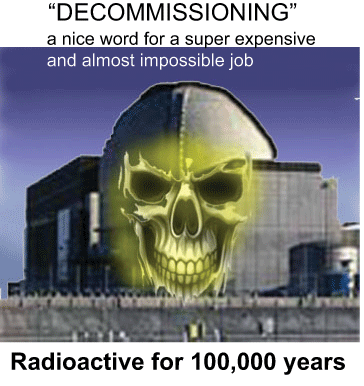 Japan’s 3/11 Recovery Stalled by Fukushima Japan’s 3/11 Recovery Stalled by Fukushima  Decommissioning Delays Decommissioning DelaysDelays in dismantling the disaster-stricken nuclear power complex cast doubt on whether recovery goals will move forward according to schedule. The Diplomat By Thisanka Siripala, March 13, 2020 Nine years after a quake-triggered tsunami sparked a triple meltdown at Fukushima Daiichi nuclear power plant, decontamination and decommissioning continues in northeastern Japan. The ultimate goal of removing all debris is expected to take anywhere between 30 to 40 years, but progress has been slower than originally planned. So far just one-fourth of decommission work has been completed, drawing attention to work that has not yet begun. The Fukushima decommissioning and decontamination draft has been amended five times. While changes published in December offered a specific time frame for the first time, the latest timetable for debris removal has been pushed back five years, citing the need for additional safety precautions. Previously, the process of removing spent fuel was scheduled from 2021 to 2024. But work on reactor two looks more likely to start in 2025 and last until 2027, followed by reactor one work commencing sometime between March 2028 and March 2029. ……..
The next decommissioning stage sets out the removal of 4,471 spent fuel rods inside the cooling pools of reactors one to six. But the biggest obstacle is finding a way to locate and remove the molten nuclear fuel. With frequent delays, evacuees face a constant sense of uncertainty,
tangled in a waiting game to see whether decommissioning work can be completed in 30 years.
Reactor two is seen as the safest and easiest option to start full-scale debris removal since it suffered the least structural damage with only “some fuel” melting through the pressure vessel and accumulating at the bottom of the containment vessel. But with no established method for debris retrieval, attempts to survey the location and distribution of molten nuclear fuel among the rubble requires a lengthy trial and error process. In mid-February 2019 an attempt to probe and collect samples from reactor two failed to find and lift the main nuclear fuel debris, instead lifting portions of pebble-like sediment with the lowest radiation readings from the surface. At this stage there is no way for TEPCO, the company that owns the Fukushima Daiichi plant, to determine where fuel debris lies among the rest of the metal debris. It’s estimated that reactor two alone contains 237 metric tons of debris while reactors one and three contain a combined 880 tons. The complexity of debris removal requires developing specialized technology that does not yet exist.
Also plaguing decommissioning efforts is the battle over how to safely dispose of 1 million tons of contaminated water that were used to cool nuclear fuel. Currently, huge tanks on the premises store the polluted runoff, which could fill 400 Olympic swimming pools, but space is expected to run out by mid-2022. On average 170 tons of contaminated water is produced to cool fuel in nuclear reactors. Without constant cooling, nuclear fuel risks melting from its own heat in a process called decay heat. With two years needed to prepare a disposal method, time is running out for a final decision. Government proposals to slowly release contaminated water into the ocean has sparked fierce backlash from locals and the agriculture and fishing industries, who argue traces of radioactive materials such as tritium still found in “treated” water could further harm a region still struggling to restore its international reputation……..
To make matters worse, decommissioning operations have been temporarily suspended due to the spread of coronavirus. Tepco was forced to cancel on-site inspections of reactor one scheduled during March, which would have brought together some 1,800 experts and members of parliament, as well as local residents and student groups. https://thediplomat.com/2020/03/japans-3-11-recovery-stalled-by-fukushima-decommissioning-delays/
|
|
|
Coronavirus cluster in the area – construction stalled at France’s Flamanville nuclear reactor
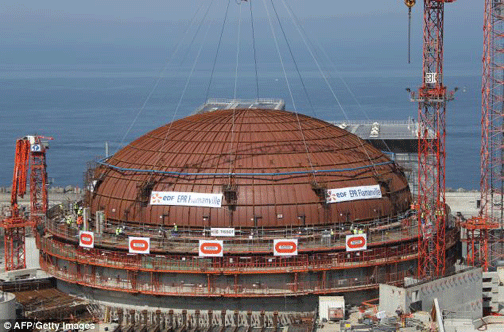
France’s EDF to reduce Flamanville nuclear plant staffing over virus, PARIS, March 16 (Reuters) – EDF will reduce staff to around 100 from 800 at its Flamanville nuclear power plant in northern France due to coronavirus infections in the Cotentin region, a spokesman for the French utility said on Monday.
Only people in charge of safety and security will remain on-site.
The decision was made because of a cluster of COVID-19 infections in region, the spokesman said adding that some staff displayed signs of the virus.
“But today, it is no longer possible to carry out tests. There are too many cases,” he said. “As a preventive measure and because it is no longer possible to carry out tests to confirm cases, we have decided to only keep those in charge of safety and security,” the spokesman said.
While the two reactors have been offline for maintenance since January and September, respectively, major maintenance work was under way.
EDF also said construction work on a long-delayed third reactor on the site would be reduced.
The French government is preparing an order that would put its inhabitants under partial lockdown to combat the coronavirus epidemic, sources aware of the planning said on Sunday, a move that would tighten further restrictions on public life. (Reporting by Bate Felix; writing by Geert De Clercq; editing by Jason Neely and Louise Heavens) AT TOP https://uk.reuters.com/article/health-coronavirus-france-nuclear/update-1-frances-edf-to-reduce-flamanville-nuclear-plant-staffing-over-virus-idUKL8N2B962I
World food supplies would be severely disrupted by even a “limited” nuclear war
RUTGERS UNIVERSITY A WAR BETWEEN INDIA AND PAKISTAN USING LESS THAN 1 PERCENT OF NUCLEAR WEAPONS WORLDWIDE COULD LEAD TO THE WORST GLOBAL FOOD LOSSES IN MODERN HISTORY, ACCORDING TO A RUTGERS CO-AUTHORED STUDY THAT IS THE FIRST OF ITS KIND.
Sudden global cooling from a limited nuclear war along with less precipitation and sunlight “could disrupt food production and trade worldwide for about a decade – more than the impact from anthropogenic climate change by late (21st) century,” the study says.
While the impacts of global warming on agricultural productivity have been studied extensively, the implications of sudden cooling for global crop growth are little understood, notes the study in the journal Proceedings of the National Academy of Sciences.
“Our results add to the reasons that nuclear weapons must be eliminated because if they exist, they can be used with tragic consequences for the world,” said co-author Alan Robock, a Distinguished Professor in the Department of Environmental Sciences in the School of Environmental and Biological Sciences at Rutgers University-New Brunswick. “As horrible as the direct effects of nuclear weapons would be, more people could die outside the target areas due to famine.”
Robock co-authored a recent study in the journal Science Advances estimating that more than 100 million people could die immediately if India and Pakistan wage a nuclear war, followed by global mass starvation. The study focused on a war scenario that could occur between the neighboring nations in 2025, when they could have a combined 400 to 500 nuclear weapons.
For the new study, scientists used a scenario of 5 million tons of black smoke (soot) from massive fires injected into the upper atmosphere that could result from using only 100 nuclear weapons. That would cool the Earth by 1.8 degrees Celsius (3.2 degrees Fahrenheit) and lead to 8 percent lower precipitation and less sunlight for at least five years.
Scientists included those climate changes in computer simulations by six different crop models for four major crops that account for 90 percent of global cereal production in terms of calories. The scientists found that corn calorie production would fall by 13 percent, wheat by 11 percent, rice by 3 percent and soybeans by 17 percent over five years. Total first-year losses of 12 percent would be four times larger than any food shortage in history, such as those caused by historic droughts and volcanic eruptions.
Analyses of food trade networks show that domestic reserves and global trade can largely buffer the loss of food production in the first year. But multiyear losses would reduce domestic food availability, especially in food-insecure countries.
By year five, corn and wheat availability would decrease by 13 percent globally and by more than 20 percent in 71 countries with a total of 1.3 billion people. Corn production in the United States and Canada – representing more than 40 percent of global production – would drop by 17.5 percent.
Robock said the scenario with 5 million tons of smoke was developed more than a decade ago. Scientists now think that 16 million tons of smoke could arise from a nuclear war between India and Pakistan since they now have more and bigger weapons and their potential targets are larger. This means the impacts could be three-fold larger.
Next steps include analyzing the impacts of more scenarios, including those generating more smoke. Scientists also want to study the economic impacts in greater detail, including food hoarding by countries and refusals to trade it. They will also look into other impacts of nuclear war, using more models and studying more crops, extreme cold snaps and greater fluctuations in ultraviolet light.
Japan’s Sendai nuclear reactor 1 offline because not meeting safety requirements
|
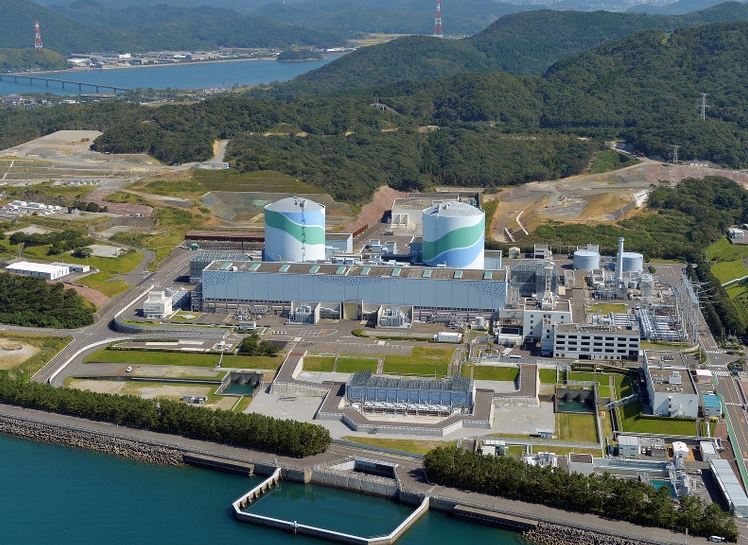
Nuclear reactor in southwestern Japan goes offline, https://www3.nhk.or.jp/nhkworld/en/news/20200316_35/ The operator of a nuclear power plant in southwestern Japan has suspended one of its reactors as it cannot meet the deadline for building mandatory facilities to deal with emergencies.Kyushu Electric Power Company began work to reduce output at the No.1 reactor at the Sendai plant in Kagoshima Prefecture at 2:30 a.m. on Monday. The reactor went offline at 1:01 p.m.
Kyushu Electric will start regular inspections on the reactor earlier than scheduled. This is the first time for a reactor to go offline because of its failure to meet the government’s new regulations. The regulations were drawn up in 2013 after the nuclear accident at the Fukushima Daiichi plant two years earlier. They require nuclear plant operators to construct facilities to ensure the safety of reactors in the event of emergencies such as acts of terror and aircraft crashes. The Nuclear Regulation Authority, or NRA, obliges the operators to erect such facilities within five years of construction plans being approved. Kyushu Electric says it aims to put the reactor back online after completing the necessary facilities by December and gaining approval from the NRA. The utility also plans to shut down the No.2 reactor at the Sendai plant in May for failing to meet the deadline. Kansai Electric Power Company is also expected to suspend the No.3 and No.4 reactors at the Takahama nuclear plant in Fukui Prefecture in August and October respectively for the same reason. |
|
Wake up world -to the climate emergency – Naomi Klein’s new book “On Fire”
 To avoid climate catastrophe, it’s going to take a revolution of the mind,
As we approach a turning point in our civilization’s journey, author Naomi Klein has been sounding the alarm about how to shift the current paradigm and loosen our deadly chokehold on the living world. Fast Company, BY ANNA LENZER, 15 Mar 20,
Antarctica just hit 65 degrees, the highest temperature it’s ever recorded, and a sea in Siberia is “boiling” with methane. Major parts of the U.S. drinking water supply are contaminated with “forever chemicals”—so called because they virtually never degrade—that are linked to cancers and liver damage, among other health problems. Climate models used to forecast warming are running red-hot and giving us far less time than we thought to turn things around. And last July was the hottest month in the 140 years that records have been kept, the 415th consecutive month with temperatures above the 20th-century average.
There’s a growing sense that we’re approaching a turning point in our civilization’s journey, in which the path diverges between two extremes—a re-flourishing garden planet and a bleak, burning wasteland of increasingly rationed resources. We’re pushing on dominoes that could fall into a runaway series of irreversible tipping points and feedback loops that will leave us to do emergency triage and run rescue-salvage missions on a dying and incinerated planet for the rest of our days. Peak Life is in sight, possibly already behind us, and our current trajectory is about to fling us off the cliff.
The UN is raising the alarm that the mass extinction of plant and animal species—which has already decimated large swaths of the planet—risks collapsing into a catastrophic point of no return, and that halting this destruction of the web of life (along with our food and water security) requires an unprecedented transformation of civilization beginning immediately.
A series of global summits through the end of this year is intended to kick off  this paradigmatic shift and to loosen our deadly chokehold on the living world.
A few days before the UN’s Climate Action Summit in New York last fall, author Naomi Klein launched her latest broadside against the forces of inertia with the now best-selling On Fire: The (Burning) Case for a Green New Deal, a book designed to inspire a blueprint for the United States’ reemergence as a global climate leader………https://www.fastcompany.com/90475368/to-avoid-climate-catastrophe-its-going-to-take-a-revolution-of-the-mind
Coronavirus Covid-19 Testing Per Capita By Country; The US Near The Bottom; India Worse — Mining Awareness +

Below is a screenshot from the Covid-19 Coronavirus tests article. It is sorted by tests per million people with the most tests per million on top. Unfortunately, it is already dated because the Coronavirus-19 pandemic is evolving so rapidly, but it gives a sense of how little testing is happening in the United States – […]
Out from under the uranium shadow — Beyond Nuclear International

How a community in Mali fought back and won
via Out from under the uranium shadow — Beyond Nuclear International
Nuclear, climate, coronavirus news
Awareness about infectious diseases seems to have faded, up until suddenly just lately. It really is a long time between epidemics, and now we have a pandemic. The quickly spreading Coronavirus disease is being handled differently, according to each country. Climate scientist Paul Beckwith explains this, and warns on the necessity of urgent action. http://www.youtube.com/watch?v=p_udREjTrBo&t=59s Another excellent resource is Corona Virus – With Dr. John Campbell. There is also the inhumane theory of “herd immunity”, being recommended by some as a strategy for Britain.
Climate scientists are bemoaning the slowness to take action on the coronavirus, but, even more so, the continuing slowness to act on global heating.
A bit of good news – One Million ‘Wonder Plant’ Seedlings Are Planted in Wales to Fight Climate Crisis—and Create Healthy Seas
Polar ice melting at an accelerating rate. The planet’s largest ecosystems could collapse faster than we thought.
Global response to Covid-19 is rapid. Response to climate change is too damn slow. Coronavirus poses threat to climate action.
Bulletin of the Atomic Scientists warns on doomsday. Hypocrisy: new commitments to Non-Proliferation of Nuclear Weapons (NPT) include push for nuclear power.
Nuclear modernisation, cyber operations, raise a dilemma for nuclear deterrence.
Investigative journalism – Fukushima, and the ocean’s history of nuclear waste dumping.
Tritium – more hazardous than gamma rays and most X-rays.
JAPAN.
- Japan’s Olympic Games propaganda really tops the lies that cover up the Fukushima nuclear catastrophe. Japan may have to cancel the Olympics, Will coronavirus cancel the Tokyo 2020 Olympics? Fukushima’s huge accumulation of radioactive water – a pressing problem as Olympics approach.
- Nine years after the Fukushima nuclear disaster: back to normal towards a bright future? Fukushima – Invisible Fallout documentary from CRIIRAD March 2020. Map of Soil Radioactivity in 17 Prefectures in Eastern Japan. Starting the Olympic torch relay in Fukushima should remind us of. The price of staying. The half lives of the abandoned. Soil from decontamination work kept in communities. What ‘Fukushima 50’ can teach us about crises. 9 Years On: Fukushima N-Plant Lawsuits Await High Court Rulings. Reporters Without Borders urges Japan to stop pressuring the media on Fukushima-related topics.
USA.
- Steps to nowhere on nuclear disarmament – USA’s “Creating an Environment for Nuclear Disarmament” (CEND). In southern Nevada, some form of advanced B61-12 testing is underway.
- Joe Biden to encourage nuclear power, and Bernie Sanders is not all that anti nuclear.
- A ruse to save the nuclear industry? Dangerous, expensive portable mini-reactors. Pentagon’s latest scam for tax-payers’ money; dangerous, costly portable nuclear reactors.
- They’ve licensed Exelon’s Peach Bottom Nuclear Plant for 80 Years – but it mightn’t last.
- Canisters for high level nuclear wastes likely to corrode faster than expected. U.S. Department of Energy’s plans could mean delay in Hanford nuclear waste clean-up. Angst in Nevada over law designating Yucca Mt for a national repository.
- Renewables surpass coal and nuclear says USA’s Federal Energy Regulatory Commission (FERC).
UK. UK’s nuclear regulated asset base (RAB) financing passes all financial risks to electricity customers. Nuclear waste transport disrupted by measures to stall coronavirus. Bradwell B Nuclear power plant consultations cancelled amid coronavirus fears. Groups question the viability of the three coastal sites for UK’s new nuclear plants. The lies about nuclear waste dumping in Scotland – from U.S. nuclear submarines.
UNITED ARAB EMIRATES. Nuclear power, then nuclear weapons? for United Arab Emirates.
SOUTH AFRICA. Murky links between the nuclear and coal lobbies in South Africa. Eskom nuclear troubles – the outcome of years of corruption.
INDONESIA. Nuclear Agency employee accused of illegally storing radioactive waste at his home. Indonesia warned on dangers of nuclear power, advantages of renewable energy.
GERMANY. German grid and nuclear plant operators step up coronavirus precautions.
IRAN. Iran continues to provide international inspectors access to its nuclear facilities.
AUSTRALIA. Australian govt rejects a report that recommends nuclear submarines. Small Nuclear Reactors, like large ones, are out of the question for Australia, due to staggering costs. Small nuclear reactors, (just like large) can survive only with massive subsidies. This week’s uranium report- prices fall again, Australia’s “nuclear future” going nowhere.
-
Archives
- February 2026 (228)
- January 2026 (308)
- December 2025 (358)
- November 2025 (359)
- October 2025 (376)
- September 2025 (258)
- August 2025 (319)
- July 2025 (230)
- June 2025 (348)
- May 2025 (261)
- April 2025 (305)
- March 2025 (319)
-
Categories
- 1
- 1 NUCLEAR ISSUES
- business and costs
- climate change
- culture and arts
- ENERGY
- environment
- health
- history
- indigenous issues
- Legal
- marketing of nuclear
- media
- opposition to nuclear
- PERSONAL STORIES
- politics
- politics international
- Religion and ethics
- safety
- secrets,lies and civil liberties
- spinbuster
- technology
- Uranium
- wastes
- weapons and war
- Women
- 2 WORLD
- ACTION
- AFRICA
- Atrocities
- AUSTRALIA
- Christina's notes
- Christina's themes
- culture and arts
- Events
- Fuk 2022
- Fuk 2023
- Fukushima 2017
- Fukushima 2018
- fukushima 2019
- Fukushima 2020
- Fukushima 2021
- general
- global warming
- Humour (God we need it)
- Nuclear
- RARE EARTHS
- Reference
- resources – print
- Resources -audiovicual
- Weekly Newsletter
- World
- World Nuclear
- YouTube
-
RSS
Entries RSS
Comments RSS
 nuclear-news