Nuclear, climate, coronavirus news
Awareness about infectious diseases seems to have faded, up until suddenly just lately. It really is a long time between epidemics, and now we have a pandemic. The quickly spreading Coronavirus disease is being handled differently, according to each country. Climate scientist Paul Beckwith explains this, and warns on the necessity of urgent action. http://www.youtube.com/watch?v=p_udREjTrBo&t=59s Another excellent resource is Corona Virus – With Dr. John Campbell. There is also the inhumane theory of “herd immunity”, being recommended by some as a strategy for Britain.
Climate scientists are bemoaning the slowness to take action on the coronavirus, but, even more so, the continuing slowness to act on global heating.
A bit of good news – One Million ‘Wonder Plant’ Seedlings Are Planted in Wales to Fight Climate Crisis—and Create Healthy Seas
Polar ice melting at an accelerating rate. The planet’s largest ecosystems could collapse faster than we thought.
Global response to Covid-19 is rapid. Response to climate change is too damn slow. Coronavirus poses threat to climate action.
Bulletin of the Atomic Scientists warns on doomsday. Hypocrisy: new commitments to Non-Proliferation of Nuclear Weapons (NPT) include push for nuclear power.
Nuclear modernisation, cyber operations, raise a dilemma for nuclear deterrence.
Investigative journalism – Fukushima, and the ocean’s history of nuclear waste dumping.
Tritium – more hazardous than gamma rays and most X-rays.
JAPAN.
- Japan’s Olympic Games propaganda really tops the lies that cover up the Fukushima nuclear catastrophe. Japan may have to cancel the Olympics, Will coronavirus cancel the Tokyo 2020 Olympics? Fukushima’s huge accumulation of radioactive water – a pressing problem as Olympics approach.
- Nine years after the Fukushima nuclear disaster: back to normal towards a bright future? Fukushima – Invisible Fallout documentary from CRIIRAD March 2020. Map of Soil Radioactivity in 17 Prefectures in Eastern Japan. Starting the Olympic torch relay in Fukushima should remind us of. The price of staying. The half lives of the abandoned. Soil from decontamination work kept in communities. What ‘Fukushima 50’ can teach us about crises. 9 Years On: Fukushima N-Plant Lawsuits Await High Court Rulings. Reporters Without Borders urges Japan to stop pressuring the media on Fukushima-related topics.
USA.
- Steps to nowhere on nuclear disarmament – USA’s “Creating an Environment for Nuclear Disarmament” (CEND). In southern Nevada, some form of advanced B61-12 testing is underway.
- Joe Biden to encourage nuclear power, and Bernie Sanders is not all that anti nuclear.
- A ruse to save the nuclear industry? Dangerous, expensive portable mini-reactors. Pentagon’s latest scam for tax-payers’ money; dangerous, costly portable nuclear reactors.
- They’ve licensed Exelon’s Peach Bottom Nuclear Plant for 80 Years – but it mightn’t last.
- Canisters for high level nuclear wastes likely to corrode faster than expected. U.S. Department of Energy’s plans could mean delay in Hanford nuclear waste clean-up. Angst in Nevada over law designating Yucca Mt for a national repository.
- Renewables surpass coal and nuclear says USA’s Federal Energy Regulatory Commission (FERC).
UK. UK’s nuclear regulated asset base (RAB) financing passes all financial risks to electricity customers. Nuclear waste transport disrupted by measures to stall coronavirus. Bradwell B Nuclear power plant consultations cancelled amid coronavirus fears. Groups question the viability of the three coastal sites for UK’s new nuclear plants. The lies about nuclear waste dumping in Scotland – from U.S. nuclear submarines.
UNITED ARAB EMIRATES. Nuclear power, then nuclear weapons? for United Arab Emirates.
SOUTH AFRICA. Murky links between the nuclear and coal lobbies in South Africa. Eskom nuclear troubles – the outcome of years of corruption.
INDONESIA. Nuclear Agency employee accused of illegally storing radioactive waste at his home. Indonesia warned on dangers of nuclear power, advantages of renewable energy.
GERMANY. German grid and nuclear plant operators step up coronavirus precautions.
IRAN. Iran continues to provide international inspectors access to its nuclear facilities.
AUSTRALIA. Australian govt rejects a report that recommends nuclear submarines. Small Nuclear Reactors, like large ones, are out of the question for Australia, due to staggering costs. Small nuclear reactors, (just like large) can survive only with massive subsidies. This week’s uranium report- prices fall again, Australia’s “nuclear future” going nowhere.
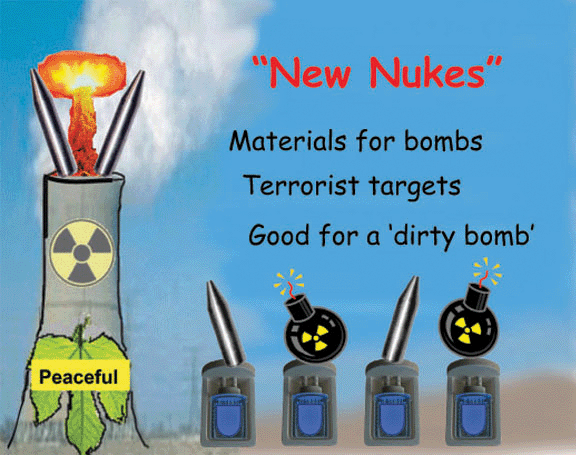
A ruse to save the nuclear industry? Dangerous, expensive portable mini-reactors
|
Pentagon invented the internet: This time portable Micro Nuclear reactors, https://www.globalvillagespace.com/pentagon-invented-the-internet-this-time-portable-micro-nuclear-reactors/ 12 Mar 20, There’s no shortage of hefty defense deals awarded by the US Department of Defense, but the $40 million contract for micro-reactors definitely stands out, as it hides safety risks and raises doubts over its economic efficiency.The nuclear device that the DoD strategists want must have the capability to be safely and rapidly transported by road, rail, sea or air (sic!) as well as swiftly set up and shut down. The project split between three companies — BWX Technologies, Westinghouse Government Services and X-energy — calls for a “safe, mobile and advanced nuclear micro-reactor.” The safety part sounds particularly soothing, but how would it look on the ground? What if those miniature reactors, when moved by land, become targets of high-profile terrorist attacks? And will it prove to be a real alternative (which means cheaper price, of course) to conventional energy sources? The more reactors — the greater the danger“Any nuclear reactor attracts terrorists,” Andrey Ozharovsky, nuclear scientist, program expert at the Russian Social Ecological Union, told RT. “It doesn’t matter if it’s located at a nuclear power plant [or inside a portable device]… if you remember, the terrorists planned directing one of the planes at a nuclear plant during 9/11.” The logic here is simple, he pointed out: “the more reactors are out there — the greater the danger.” If the US builds hundreds, or even dozens of such devices, it’ll be really hard for them to properly defend them all. Another vital safety issue is the reliability of the nuclear micro-reactors. Interestingly enough, the US military had already experimented with them back in the 1950s and 1960s — and it ended in a tragedy. Several portable reactors were built and setup in Greenland and Panama, but one of them blew up in 1961, killing three operators. The Army Nuclear Power Program was shut down shortly after that. “There were eight US micro-reactors and one of them exploded. That’s how safe they are,” Ozharovsky said, adding that the Pentagon’s idea of bringing them back will “likely create more risks instead of solving any problems.” Micro-reactors yet to prove their economic efficiencyBut even if the portable reactors will be shielded from the perils of the battlefield and operate without failure, what’s the Pentagon’s rationale behind bringing the radioactive fuel to their military bases? For decades, the army had been successfully running on gasoline, diesel and fuel oil; when going off-grid, it would switch to generators and high-power accumulators. “The main problem has nothing related to safety,” Anton Khlopkov, director of Energy and Security Center and member of Russian Security Council’s Scientific Council argued. Micro-reactors must prove their viability from the economic point of view since such plants always have alternatives It is yet to be proven that micro-reactors won’t be “many times more” expensive than other conventional sources of energy. Electricity produced by such devices should be at least comparable in cost to the one produced by diesel generators, he said. Some kind of a soap bubbleIf micro-reactors are such a questionable solution, why is the Pentagon pushing for their development? The answer isn’t lying on the surface, but it isn’t buried too deep. “They work against the trends,” Ozharovsky suggested. And those trends are that the world is giving up on the use of civilian nuclear energy due to being too expensive. Washington may be trying to “support the US the nuclear industry that’s dying out with the use of the military budget; sponsor their research and development — which is an expensive thing.” RT with additional input by GVS News Desk At last – someone recognises the bleeding obvious – thank you! To keep the nuclear industry alive there MUST be new nuclear reactors built. With no willing private investment available, then it must be the tax-payer who coughs up. Especially in USA, it seems that the only respectable use of tax-payer money is in that most sacred of cows – defence. |
|
Canisters for high level nuclear wastes likely to corrode faster than expected
 Corrosion poses risk in nuclear waste storage https://frontline.thehindu.com/science-and-technology/article30913130.ece March 13, 2020 The materials the United States and other countries plan to use to store high-level nuclear waste are likely to degrade faster than previously thought because of the way those materials interact, new research from Ohio State University shows.
The findings, published in a recent issue of “Nature Materials”, show that corrosion of nuclear waste storage materials accelerates because of changes in the chemistry of the nuclear waste solution and the way the materials interact with one another. “This indicates that the current models may not be sufficient to keep this waste safely stored,” Xiaolei Guo, lead author of the study was quoted in the news release issued by the university.
The team’s research focussed on storage materials for high-level nuclear waste that is highly radioactive. While some types of the waste have half-lives of about 30 years, others like plutonium have a half-life that can be tens of thousands of years.
With no long-term viable nuclear waste disposal mechanism yet in operation, in most sites nuclear waste is stored near the plants where it is produced. While countries around the world have debated the best way to deal with nuclear waste, only Finland has started construction of a long-term repository for high-level nuclear waste.
In general, proposals involve mixing nuclear waste with other materials to form glass or ceramics and then encasing those pieces of glass or ceramics, now radioactive, inside metallic canisters. The canisters are buried deep underground in a repository to isolate it.
Researchers found that when exposed to an aqueous environment, glass and ceramics interact with stainless steel to accelerate corrosion, especially of the glass and ceramic materials holding nuclear waste. The study measured the difference between accelerated corrosion and natural corrosion of the storage materials. “In the real-life scenario, the glass or ceramic waste forms would be in close contact with stainless steel canisters. Under specific conditions, the corrosion of stainless steel will go crazy,” he said. “It creates a super-aggressive environment that can corrode surrounding materials.”
To analyse corrosion, the research team pressed glass or ceramic “waste forms” (the shapes into which nuclear waste is encapsulated) against stainless steel and immersed them in solutions for up to 30 days, under conditions that simulate those under Yucca Mountain, the proposed nuclear waste repository in the U.S.
Those experiments showed that when glass and stainless steel were pressed against one another, stainless steel corrosion was “severe” and “localised”. The researchers also noted cracks and enhanced corrosion on the parts of the glass that had been in contact with stainless steel.
Part of the problem lies in the Periodic Table. Stainless steel is made primarily of iron mixed with other elements, including nickel and chromium. Iron has a chemical affinity for silicon, which is a key element of glass.
The experiments also showed that when ceramics, another potential holder for nuclear waste, were pressed against stainless steel under conditions that mimicked those beneath Yucca Mountain, the ceramics and stainless steel corroded in a “severe localised” way.
Tritium – more hazardous than gamma rays and most X-rays
 Ian Fairlie 13th March 2020, The Nuclear facilities emit very large amounts of tritium, 3H, the radioactive isotope of hydrogen. Much evidence from cell/animal studies and radiation biology theory indicates that tritium is more hazardous than gamma rays and most X-rays.
However the International Commission on Radiological Protection (ICRP) continues to underestimate tritium’s hazard by recommending a radiation weighting factor (wR) of unity for
tritium’s beta particle emissions. Tritium’s exceptionally high molecular exchange rate with hydrogen atoms on adjacent molecules makes it extremely mobile in the environment.
This plus the fact that the most common form of tritium is water, i.e. radioactive water, means that, when tritium is emitted from nuclear facilities, it rapidly contaminates all biota in adjacent areas. Tritium binds with organic matter to form organically bound tritium (OBT) with long residence times in tissues and organs making it more radiotoxic than tritiated water (HTO).
Epidemiology studies indicate increases in cancers and congenital malformations near
nuclear facilities. It is recommended that nuclear operators and scientists should be properly informed about tritium’s hazards; that tritium’s safety factors should be strengthened; and that a hazard scheme for common radionuclides be established.
Murky links between the nuclear and coal lobbies in South Africa
 Anatomy of a lobby: How, and why, coal and nuclear interests are converging https://www.news24.com/SouthAfrica/News/anatomy-of-a-lobby-how-and-why-coal-and-nuclear-interests-are-converging-20200315, Sarah Evans
While in South Africa, there is little proof of such an organised, funded campaign being conducted by the coal industry itself, a motley crew of intersecting interests has coalesced around common policy goals: Attempting to stop government’s policy of introducing renewable energy onto the national grid by purchasing power from Independent Power Producers (IPPs), and pushing a narrative that says that Eskom needs to keep buying coal, and that the life of its ageing power stations needs to be extended.
The narrative is also centred around the idea that government must once again pursue a large nuclear building programme, once favoured by former president Jacob Zuma, but since shelved by the Cyril Ramaphosa administration.
Many of the anti-IPP lobbyists are strongly sympathetic to the former president.
The is despite the release of the Integrated Resource Plan last year – the country’s energy roadmap – which seeks to phase out coal, gradually, over the coming decades, increase the use of renewable energy onto the grid, with a reduced role for nuclear energy.
Lobbying efforts by the industry itself have cropped up all over the world as governments are pressured to radically reduce their reliance on burning fossil fuels.
The Guardian reported last year that such a campaign had been launched on a global scale by mining giant Glencore.
But in South Africa, the campaign has taken on the face of a coalition of forces, more than an organised and well-funded propaganda effort, as far as we know.
To the one side of the anti-IPP coalition are some unions, some obscure pro-Zuma lobby groups, coal truckers and disgruntled individuals such as former acting Eskom CEO Matshela Koko.
This campaign has played out in the mainstream media, but seems to have the most traction on social media.
The campaign reached Eskom’s physical doors last week when the EFF entered the fray on the side of the lobbyists. The party took its message to the power utility in the form of a protest, flanked by nuclear energy industry lobbyists like Adil Nchabaleng of pro-Zuma lobby group Transform RSA.
On the other side of the campaign is the coal industry itself, which appears to be in the initial stages of an advocacy campaign.
Transform RSA teamed up with Numsa and the Coal Truckers Association in 2018 in a failed court bid to stop the signing of IPP agreements – a case that Nchabaleng tried to link to a break-in at his home where his housekeeper was tied up and held at gunpoint.
He is also a Member of Parliament, representing the African People’s Convention.
Transform RSA’s politics were made clear when, also in early 2018, it threatened to take legal action against the ANC’s leadership if they moved against former president Jacob Zuma by discussing his recall at a meeting.
On the social media front, the South African Energy Forum (SAEF_ZA) has been actively opposing IPPs, and has advocated for more nuclear energy in South Africa’s energy mix in a “People’s IRP” released on behalf of itself and sister organisations last year.
Another vocal advocate of nuclear energy, and of abandoning the IPP project, is Khandani Msibi, who heads up Numsa’s investment arm.
The SAEF’s members are all APC party members, with the exception of one Ronald Mumyai. His social media accounts show that he is a former EFF member, supporter of Zuma, and homophobe, although the homophobic tweet in question has since been deleted.
Another obscure entity that appears only to exist online is the Anti-Poverty Forum, which, when it is not laying complaints with the Public Protector over IPPs, spends its days campaigning against Zuma’s nemesis, Public Enterprises Minister Pravin Gordhan.
The forum is fronted by ANC Brian Bunting branch member Phapano Phasha, also formerly associated with the Gupta’s failed television station ANN7, who laid a complaint against Public Enterprises Minister Pravin Gordhan with the ANC’s integrity commission last year.
Coal industry advocacy
As for the industry itself, it seems clear that many players feel coal is unfairly under attack, in the face of overwhelming scientific evidence of its contribution to climate change.
At a gathering of coal industry leaders in Cape Town in February, Minerals Council South Africa (MCSA) senior economist Bongani Motsa said there was a need for a “strong coal advocacy group” to lobby for the industry, against what it views as an onslaught from the “renewables lobby”.
Motsa likened the Integrated Resource Plan (IRP) to an abusive spouse that was unkind to the industry, in spite of its willingness to invest in “clean coal” technologies.
Motsa did not provide any details as to what this would look like.
In February 2018, when heated talks over the IRP were ongoing behind closed doors at Nedlac, the MSCA released a document titled “Coal Strategy 2018” in which it outlined plans to counter the narrative around coal.
The plan’s executive summary states: “The Chamber of Mines Coal Leadership Forum, consisting of coal executives, commissioned a report to determine what needs to be done to increase the profile of the coal mining industry in the face of seemingly ineluctable negative public opinion around the use of coal in industrial processes. Negative views on coal and its impact on the environment have resulted in a precipitous decline in the use of coal by the major economies of the world…”
The plan decried the introduction of strict laws to protect the environment that would stifle the coal industry, and implied that the industry’s contribution to the economy and jobs needed to be punted in public.
For now, the links between the pro-coal, anti-IPP actors are murky. But what is clear is that their interests align around policy and political goals, and it remains to be seen whether they carry enough weight to have real impact on either front.
UK’s nuclear regulated asset base (RAB) financing passes all financial risks to electricity customers
 Times 15th March 2020 David Lowry: I read with incredulity the claims of Horizon nuclear chief Duncan Hawthorne that his company, which is really a Japanese shell company with no products, could build nuclear plants offering power at half the currently projected cost from the Hinkley Point C plant being built.
Fukushima Daiichi reactors in Japan on March 11, 2011 — costs $250bn
(£200bn) and rising — suggests Horizon has not learnt the full lessons
of that. The regulated asset base (RAB) financing mechanism Horizon
advocates transfers all financial investment risk to electricity customers
before a single unit is delivered to a home, allowing the foreign nuclear
company to build plants without having to pay attention to keeping costs
under control. This is an extraordinarily one-sided proposal. Surely even
this nuclear-friendly government cannot fall for it.
Nuclear waste transport disrupted by measures to stall coronavirus
 GNS 13th March 2020, The return transport of vitrified waste from the reprocessing plant in Sellafield to the interim storage facility in Biblis planned for this spring is suspended. As the police authorities responsible for accompanying and carrying out the transport have stated, the police operation is currently not responsible with regard to the current “spread of corona” and therefore cannot be carried out in spring as planned. The companies and institutions involved in the repatriation will agree on a new deadline for the repatriation in due course.
South Africa’s Eskom nuclear troubles – the outcome of years of corruption
 Eskom’s ailing Koeberg nuclear plant a result of years of corruption https://www.thesouthafrican.com/news/eskom-koeberg-nuclear-plant-corruption/ What Eskom continues to do to this country should be viewed as a human rights violation, says Safcei. by Andrea Chothia, 2020-03-12 Eskom’s ailing Koeberg nuclear plant a result of years of corruption https://www.thesouthafrican.com/news/eskom-koeberg-nuclear-plant-corruption/ What Eskom continues to do to this country should be viewed as a human rights violation, says Safcei. by Andrea Chothia, 2020-03-12
The Southern African Faith Communities’ Environment Institute (Safcei) said that Eskom needs to be more realistic about the country’s precarious energy situation and consider whether pushing the Koeberg Nuclear Power Station past its sell-by date is worth risking an energy catastrophe.
Koeberg’s electricity unit 1 has only been up and running for a matter of weeks after it was closed for essential repairs. But after coming back into service in January, it has only returned to cause more problems. About 930 MW of power has been taken off the national grid because of its breakdown.
|
|
Nuclear Agency employee accused of illegally storing radioactive waste at his home
Jakarta. An employee of the National Nuclear Energy Agency, or Batan, was named suspect for illegally storing radioactive waste at his home in Batan Indah housing complex in South Tangerang, Banten, police have said.
The news came a month after nuclear authorities launched decontamination operation at the housing complex, followed by criminal investigation by the National Police.
The cleanup, that took weeks to complete, was called after the Batan and the Nuclear Energy Regulatory Agency (Bapeten) detected radiation in the area. Around 100 drums of soil and grass containing radioactive substance have been removed from the area.
The suspect, identified by initials S.M., is accused of storing radioactive substance called Cesium-137 and dumping toxic waste at the housing complex, National Police’s special crimes director Brig. Gen. Agung Budijono said on Friday.
“We named S.M. as suspect after we conducted the crime scene investigation,” Agung told Jakarta Globe’s sister publication Beritasatu.com.
“At least 26 witnesses, including Batan and Bapeten officials, have been questioned by the police and it was learned that S.M. has no license for storing and processing radioactive waste,” he said.
The suspect is alleged to have run illegal decontamination services for money at his home. He is charged under the 1997 law on nuclear energy, which carries a sentence of up to two years’ imprisonment.
His position at Batan was not disclosed.
A joint investigation involving Batan, Bapeten and police was formed last month after radiation was detected and nine resident had to undergo medical examination for fear of exposure to Cesium-137, which may pose serious risks to human health including cancer and death.
Nuclear agencies ban companies who hold license to use Cesium-137 from storing or managing radioactive waste themselves. They must send it to Batan’s Center for Radioactive Waste Technology in South Tangerang.
The Batan facility is located around 45 kilometers from the housing complex.
Global response to Covid-19 is rapid. Response to climate change is too damn slow
Climate Policy Times 15th March 2020
The deadly threat posed by the rapid spread of Covid-19 has resulted in
unprecedented action from governments around the world. There’s a lesson
here for climate change: it’s too damn slow. What would happen, for
example, if we learnt that the polar icecaps had reduced by almost half
overnight, rather than since the 1980s? What if some of the world’s
largest lakes mysteriously dried up over January, not over the past decade?
What sort of panic would ensue if a quarter of the world’s population
found their homes under water tomorrow, instead of being told it would
happen in 80 years?
German grid and nuclear plant operators step up coronavirus precautions
Background German operators of key energy infrastructure including power stations, gas and electricity grids have stepped up their precautions against a coronavirus pandemic, reports Jakob Schlandt in Tagesspiegel Background. “The primary goal is to protect employees from infection – especially employees in the system control room,” a spokesperson from power grid operator 50Hertz told the energy newsletter. Employees are no longer allowed to travel to areas classified as risky – even private trips are banned – and all other business trips are being kept to a minimum. The operator also said it had reduced visits by foreign delegations “practically to zero”. Like other transmission grid operators, 50Hertz also operates a reserve control centre as a back-up.
The company said it is prepared for worst-case scenarios. In case of emergency, the system control room and other key technical divisions can operate “self-sufficiently and largely isolated from the environment for weeks. To this end, we have staff, a lounge and a bedroom, as well as food supplies,” the spokesperson said, adding key spare parts for the grid are also available. Germany’s other transmission grid operators Tennet, Amprion and TransnetBW have similar policies, according to the article. Gas grid operator Open Grid Europe (OGE) has also put additional precautions in place to make sure gas can continue to flow to consumers, including cancelling all internal and external events that are not strictly necessary. Germany’s eleven gas grid operators also have reserve control rooms as a back-up at their disposal.
Nuclear power plant operators have also put new rules in place. RWE, for example, is disinfecting radiation meters that are regularly used by employees more often. The company has also closed visitor centres, and cancelled scheduled group visits to lower the risk of infections, a spokesperson told the publication.
Angst in Nevada over law designating Yucca Mt for a national repository.
 CORTEZ MASTO PRESSES DOE SECRETARY ON PLAN TO SEEK YUCCA ALTERNATIVES Lincoln County Central | Mar 13, 2020 By Humberto Sanchez, The Nevada Independent
Energy Secretary Dan Brouillette sought to reassure Sen. Catherine Cortez Masto on Tuesday that the Department of Energy plans to seek alternatives to storing nuclear waste at Yucca Mountain, but he stopped short of backing an effort to change the law designating the site for a national repository.
At a Senate Energy and Natural Resources Committee hearing Tuesday on the DOE budget, Cortez Masto, who opposes the project, asked Brouillette what DOE would do if Congress provided funds for the Yucca project in the current fiscal year.
‘We will follow the law, obviously, but it’s our intent to look for alternatives to Yucca Mountain,” Brouillette said. “It’s our intent to begin a process, and that’s why we’ve requested $27.5 million in the budget, to do a few things.” ……
Cortez Masto also pressed Brouillette about whether he would support a repeal of the 1987 law that designated the Yucca the spot for the nation to bury its nuclear waste. …..
At a House hearing last week, Brouillette said the administration currently has no plans to change the law even though it would be needed to implement storing waste at temporary sites, which is something DOE has said it could explore……
After seeking funds for the project in his first three budgets, President Donald Trump reversed course in the fiscal 2021 budget blueprint and in a tweet last month said he heard Nevadans on the issue of Yucca. Most Nevada lawmakers and business interest groups oppose the project’s proposed site, which is located about 90 miles from Las Vegas.
Following the release of the budget, Gov. Steve Sisolak, who was in Washington for the annual National Governors Association winter meeting, hand-delivered a letter to the White House calling on Trump to pledge to veto legislation that would advance the Yucca project and “undermine the State’s legal standing or consent requirements.”
The White House has not yet responded according to Sisolak’s office……..
Trump’s decision on Yucca also comes as he looks to win Nevada in his 2020 re-election bid. He lost the state to Hillary Clinton in 2016 by two points.
After the hearing, Murkowski said she welcomed the president’s budget request dropping funds for Yucca because it would allow Congress to focus on advancing legislation to authorize temporary nuclear waste storage rather than expending energy on the Gordian knot that is Yucca.
“We think we have an opportunity to move on our interim waste bill,” Murkowski said. “I always thought that was a path that we needed to pursue as well. And so I think this gives us an opportunity and an opening.”
The energy secretary also said that DOE remains on track for removing the half metric-ton of weapons-grade plutonium the agency secretly shipped to the Nevada National Security Site (NNSS) from the Savannah River site in South Carolina.
In April, Cortez Masto struck a deal with then-Energy Secretary Rick Perry to remove the plutonium beginning in 2021 and getting all of it out by 2026. The DOE disclosed in January 2019 as part of a lawsuit filed by the state to prevent any plutonium shipment—after talks with DOE yielded no resolution—that it had already shipped the plutonium. ……. https://lccentral.com/2020/03/13/cortez-masto-presses-doe-secretary-on-plan-to-seek-yucca-alternatives/
In southern Nevada, some form of advanced B61-12 testing is underway
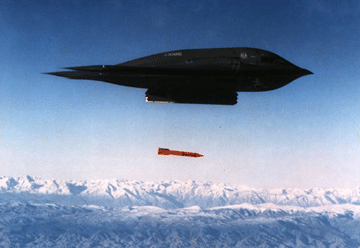 F-15E Strike Eagle Spotted Flying With An Inert B61-12 Nuclear Bomb Out Of Nellis AFB https://www.thedrive.com/the-war-zone/32585/f-15e-strike-eagle-spotted-flying-with-an-inert-b61-12-nuclear-bomb-out-of-nellis-afb
The precision-guided upgrade of the B61 tactical nuclear bomb has had a troubled and very expensive past. BY TYLER ROGOWAYMARCH 14, 2020, Exercise Red Flag is underway with the U.S. and some of its tightest allies fighting a mock air war over the Nevada Test and Training Range (NTTR)
In southern Nevada. Either in conjunction with the exercise or independent of it, there is a lot of testing currently going on over the same area. Case in point, this test F-15E Strike Eagle assigned to Eglin Air Force Base carrying an inert version of America’s newest variant of its long-running B61 series of nuclear bombs, the precision-guided B61-12.
The jet was snapped by aviation photographer Kris Trajano on Tuesday, March 10th, 2020. The F-15E was followed by a pair of F-16s that were landing just before the first Red Flag launch of the day. It isn’t uncommon for various test, training, and tactics development missions to be executed in the space between the two daily Red Flag mass launches and recoveries. Still, it is interesting to see the B61-12 hanging on an F-15E coming into Nellis. Much of the test and evaluation work for the USAF’s nuclear weapons delivery systems occurs on the Tonopah Test Range in the northern reaches of the NTTR. Nearby Tonopah Test Range Airport also supports those activities under certain circumstances.
It isn’t clear why the F-15E is carrying the weapon into Nellis. It appears to be a full-up guided round, but an inert one that lacks a nuclear warhead for testing purposes. The aircraft could be set to run another drop test on the Tonopah Test Range, or it’s possible, but less likely, that deployment of the weapon could be folded into an upcoming Red Flag mission. America’s NATO allies Germany, Italy, and Spain are the only foreign players taking part in this Red Flag, so an operational test of the weapon that will be the lynchpin of the Alliance’s nuclear deterrent in Europe would make some sense, especially this late in its development. It’s not unheard of for B61 deployment tactics development and training to occur out of Nellis, either.
As for the B61-12 program, which is seen as an essential upgrade to the Air Force’s only tactical nuclear gravity bomb, it has been mired in cost overruns and other issues. All said, the bombs will be worth over twice their weight in gold, literally, once they are operational. The F-15E, along with the F-16 and B-2, are the Air Force’s delivery systems for this weapon.
The Air Force’s F-35As will acquire this capability in the future, as well. The 412th Test Wing at Edwards noted that it “advanced strategic capabilities [for the F-35] like Dual-Capable Aircraft” in a round-up of its accomplishments during 2019. “Dual-capable” in this context refers to the ability to carry both conventional and nuclear weapons. In 2017, Military.com had reported that the B61-12 might be integrated into the F-35A as early as 2020, but when The War Zone reached out to the 412th Test Wing for an update earlier this year, the unit’s public affairs office said it could not “provide a response at this time due to operational security reasons.”
The updated B61-12’s ability to make precision strikes greatly increases its versatility, regardless of the plane carrying it, and the ways in which it could be employed during an actual nuclear strike. You can read all about the weapon and its developmental state here and here. Once the B61-12 is fully operational, it will be forward-deployed, including to Europe, where some of America’s NATO partners could be tasked with delivering a portion of the weapons during an all-out conflict.
The unit’s public affairs office said it could not “provide a response at this time due to operational security reasons.”
Clearly, some form of advanced B61-12 testing is underway out of Nellis. Hopefully, this will involve ironing out some of the weapon’s kinks so that it can be made operational. Regardless, it’s always interesting seeing a tactical fighter carrying a weapon type that is intended to be far more destructive than anything else in the jet’s air-to-ground arsenal.
It’s fascinating just how much destructive power can be packed inside the B61’s svelte, 700-pound frame. The B61-12 has a so-called “dial-a-yield” warhead with various settings, the highest of which is a 50 kiloton yield. This is a little over twice the power of the Fat Man bomb, a substantially larger weapon overall, which the United States dropped on Nagasaki at the end of World War II.
Top 10 Reasons the U.S. Government Is Blowing This — limitless life
Top 10 Reasons the U.S. Government Is Blowing This By David Swanson https://davidswanson.org/top-10-reasons-the-u-s-government-is-blowing-this/ 10. Recognizing that a problem that has grown severe in other countries could grow severe in the United States would require thinking of the United States as existing in the same world, susceptible to the same forces, as everyone else. A willingness […]
via Top 10 Reasons the U.S. Government Is Blowing This — limitless life
1 This Month

of the week – Shut Down Drone Warfare!


Tell the Ukrainian Government to Drop Prosecution of Peace Activist Yurii Sheliazhenko

Petition to revoke the licensing of the Near Surface Nuclear Disposal Facility (NSDF) at Chalk River. https://www.ourcommons.ca/petitions/en/Petition/Details?Petition=e-7247
To see nuclear-related stories in greater depth and intensity – go to https://nuclearinformation.wordpress.com
-
Archives
- April 2026 (79)
- March 2026 (251)
- February 2026 (268)
- January 2026 (308)
- December 2025 (358)
- November 2025 (359)
- October 2025 (376)
- September 2025 (257)
- August 2025 (319)
- July 2025 (230)
- June 2025 (348)
- May 2025 (261)
-
Categories
- 1
- 1 NUCLEAR ISSUES
- business and costs
- climate change
- culture and arts
- ENERGY
- environment
- health
- history
- indigenous issues
- Legal
- marketing of nuclear
- media
- opposition to nuclear
- PERSONAL STORIES
- politics
- politics international
- Religion and ethics
- safety
- secrets,lies and civil liberties
- spinbuster
- technology
- Uranium
- wastes
- weapons and war
- Women
- 2 WORLD
- ACTION
- AFRICA
- Atrocities
- AUSTRALIA
- Christina's notes
- Christina's themes
- culture and arts
- Events
- Fuk 2022
- Fuk 2023
- Fukushima 2017
- Fukushima 2018
- fukushima 2019
- Fukushima 2020
- Fukushima 2021
- general
- global warming
- Humour (God we need it)
- Nuclear
- RARE EARTHS
- Reference
- resources – print
- Resources -audiovicual
- Weekly Newsletter
- World
- World Nuclear
- YouTube
-
RSS
Entries RSS
Comments RSS
 nuclear-news