Climate and Nuclear news for the past week
When their finances are affected by climate change, the guys at the top at last start to pay attention. G20 finance ministers and central bank governors met in Saudi Arabia, and sounded the alarm over the climate emergency, despite U.S. objections. Leaked report for world’s major fossil fuel financier says Earth is on unsustainable trajectory.
Of course, nuclear weapons tensions are always there, particularly as regards USA and Iran. However, when it comes to the so-called “peaceful nukes”, things are very quiet. All that continues is an endless stream of “journalism” promoting Small Modular Reactors (they leave out that unpopular word ‘Nuclear’). This hype resembles the early 2000s hype about the “nuclear renaissance’ and is sounding more and more hollow.
A bit of good news – All Australian Bushfires in NSW Have Officially Been Contained Thanks to Week of Heavy Rain. Australian Soldiers Are Using Their Time Off to Care for Koalas Displaced by the Fires.
Immoral and illegal spying on Julian Assange and his lawyers Investigative journalism – How will Julian Assange’s extradition case proceed in court?
All the world is betraying the world’s children, the World Health Organisation has found.
A war correspondent turns to today’s war on climate change, as he studies Antarctica.
Scientists warn on the seriousness of the collapse of many insect species.
Climate denialists using bots on Twitter to get their message across.
Reprocessing is NOT a solution to the nuclear waste problem. Small nuclear reactors are no better than large ones.
UK. Britain buying new nuclear warheads from USA: Pentagon knew about it. Nuclear Energy Agency’s “pretend transparency“. UK Parliament did not. Chinese-led nuclear company pretending that Sizewell project is a ‘fait accompli’ – no, it is far from it. Huge rise predicted for Britain’s seas and tidal rivers.
JAPAN. Survey finds most Japanese do not want to attend live Olympic or Paralympic events. Replace Tokyo by London as Host of 2020 Olympics. Time running out on Tokyo Olympics. South Korean activists and professors sign petition against Japan’s push to dump radioactive water into the ocean. Japan’s paralysis over what to do with the nuclear industry’s plutonium wastes.
USA.
- Trump jumping into Nevada’s nuclear waste dilemma. Confusion and contradiction in Trump’s policy on nuclear waste and Yucca Mountain. New Energy Deputy Secretary nominee (?unwisely) contradicts Trump on Yucca Mountain and nuclear wastes.
- USA’s Energy Dept’s failure to monitor Hanford nuclear site, parts not inspected for 50 years.
- Karen Silk remembered – nuclear unsafety whistleblower.
- Danger of nuclear catastrophe in USA’s New “Low-Yield” Nuclear Warhead. Pentagon wary about morale of staff at nuclear bases.
- Desperate nuclear industry hypes up unlikely new gimmick, HALEU nuclear fuel.
- Secret research by U.S. Navy revealed effects of nuclear radiation on animals.
- Al Gore’s goal to beat climate change – get Trump out of office!
FRANCE. Anti Nuclear activists break into France’s Tricastin nuclear station. France starts out on the path to withdraw from nuclear energy. France shuts down Fessenheim reactor in first phase of retreat from nuclear power.
INDIA. Trump to visit India as salesman for Westinghouse nuclear reactors.– Large U.S. nuclear delegation to India to con Indians into buying Small Modular Nuclear Reactors. Why India is not defined as a “Nuclear Power”, though it has nuclear bombs.
INDONESIA. Indonesian authorities investigate suspected nuclear waste dumping at housing estate. Positive tests for Caesium-137 in some South Tangerang residents. Indonesia eases import limits on processed foods from Japan imposed after Fukushima nuclear disaster.
BAVARIA (GERMANY). Bavaria’s renewable capacity growing as nuclear plant shutdown boosts power imports.
CANADA. Bruce County, Ontario, protest against nuclear waste dump plan.
ALGERIA. Algeria and French Polynesia suffer from France’s 30 years of nuclear bomb testing.
TAIWAN. Taiwan searches for a solution to its nuclear waste problem.
AUSTRALIA. Australia the ‘poster child’ for climate change inaction.
Unjustified hype over non existent Small Nuclear Reactors
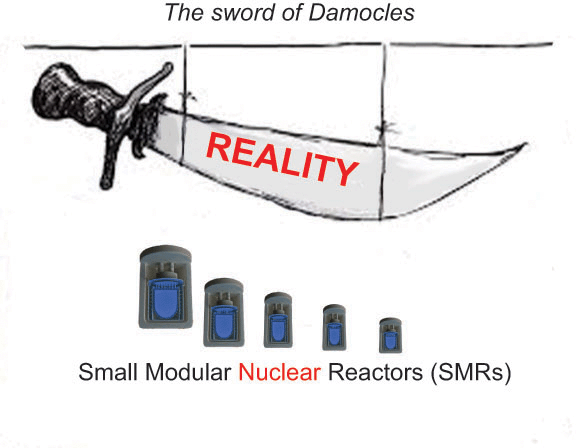 Let’s call SMRs what they are, Leaving out “nuclear” doesn’t minimize the danger, or the cost https://beyondnuclearinternational.org/2020/02/23/lets-call-smrs-what-they-are/By Gordon Edwards, Michel
  Duguay and Pierre Jasmin, February 23, 2020, On Friday the 13th, September 2019, the St John Telegraph-Journal’s front page was dominated by what many gullible readers hoped will be a good luck story for New Brunswick – making the province a booming and prosperous Nuclear Energy powerhouse for the entire world.
After many months of behind-the-scenes meetings throughout New Brunswick with utility company executives, provincial politicians, federal government representatives, township mayors and First Nations, two nuclear entrepreneurial companies laid out a dazzling dream promising thousands of jobs – nay, tens of thousands! – in New Brunswick, achieved by mass-producing and selling components for hitherto untested nuclear reactors called SMNRs (Small Modular Nuclear Reactors) which, it is hoped, will be installed around the world by the hundreds or thousands!
On December 1, the Saskatchewan and Ontario premiers hitched their hopes to the same nuclear dream machine through a dramatic tripartite Sunday press conference in Ottawa featuring the premiers of the provinces. The three amigos announced their desire to promote and deploy some version of Small Modular Nuclear Reactors in their respective provinces. All three claimed it as a strategy to fight climate change, and they want the federal government to pledge federal tax money to pay for the R&D. Perhaps it is a way of paying lip service to the climate crisis without actually achieving anything substantial; prior to the recent election, all three men were opposed to even putting a price on carbon emissions.
Motives other than climate protection may apply. Saskatchewan’s uranium is in desperate need of new markets, as some of the province’s most productive mines have been mothballed and over a thousand uranium workers have been laid off, due to the global decline in nuclear power. Meanwhile, Ontario has cancelled all investments in over 800 renewable energy projects – at a financial penalty of over 200 million dollars – while investing tens of billions of dollars to rebuild many of its geriatric nuclear reactors. This, instead of purchasing surplus water-based hydropower from Quebec at less than half the cost.
Three previous “small reactor” failures in Canada so far
These new nuclear reactors are so far perfectly safe, because they exist only on paper and are cooled only by ink. But declaring them a success before they are even built is quite a leap of faith, especially in light of the three previous Canadian failures in this field of “small reactors”. Two 10-megawatt MAPLE reactors were built at Chalk River and never operated because of insuperable safety concerns, and the 10-megawatt “Mega-Slowpoke” district heating reactor never earned a licence to operate, again because of safety concerns. The Mega-Slowpoke was offered free of charge to two universities – Sherbrooke and Saskatchewan – and several communities, all of whom refused the gift. And a good thing too, as the only Mega-Slowpoke ever built (at Pinawa, in Manitoba) is now being dismantled without ever producing a single useful megawatt of heat.
This current media hype about modular reactors is very reminiscent of the drumbeat of grandiose expectations that began around 2000, announcing the advent of a Nuclear Renaissance that envisaged thousands of new reactors — huge ones! — being built all over the planet. That initiative turned out to be a complete flop. Only a few large reactors were launched under this banner, and they were plagued with enormous cost-over-runs and extraordinarily long delays, resulting in the bankruptcy or near bankruptcy of some of the largest nuclear companies in the world – such as Areva and Westinghouse – and causing other companies to retire from the nuclear field altogether – such as Siemens.
 Speculation about that promised Nuclear Renaissance also led to a massive (and totally unrealistic) spike in uranium prices, spurring uranium exploration activities on an unprecedented scale. It ended in a near-catastrophic collapse of uranium prices when the bubble burst. Cameco was forced to close down several mines. They are still closed. The price of uranium has still not recovered from the plunge.
Large nuclear reactors have essentially priced themselves out of the market. Only Russia, China and India have managed to defy those market forces with their monopoly state involvements. Nevertheless, the nuclear contribution to world electricity production has plummeted from 17 percent in 1997 to about 10 percent in 2018. In North America and Western Europe, the prospects for new large reactor projects are virtually nil, and many of the older reactors are shutting down permanently without being replaced.
During long construction times nuclear makes the climate problem worse
Many people concerned about climate change want to know more about the moral and ethical choices regarding low-carbon technologies: “Don’t we have a responsibility to use nuclear?” The short reply is: nuclear is too slow and too expensive. The ranking of options should be based on what is cheapest and fastest — beginning with energy efficiency, then on to off-the-shelf renewables like wind and solar energy.
As a case in point, Germany installed over 30,000 megawatts of wind energy capacity in only 8 years, after deciding to close down all of its nuclear reactors by 2022. That is an impressive achievement – more than twice the total installed nuclear capacity of Canada. It would be impossible to build 30,000 megawatts of nuclear in only 8 years.
By building wind generators, Germany obtained some carbon relief in the very first year of construction, then got more benefit in the second year, even more benefit in the third, and so on, building up to a cumulative capacity of 30,000 MWe after 8 years. With nuclear, even if you could manage to build 30,000 megawatts in 8 years, you would get absolutely no benefit during that entire 8-year construction period.
In fact you would be making the problem worse by mining uranium, fabricating fuel, pouring concrete and building the reactor core and components, all adding to greenhouse gas emissions – earning no benefit until (and IF) everything is finally ready to function.
In the meantime (10 to 20 years), you will have starved the efficiency and renewable alternatives of the funds and political will needed to implement technologies that can really make an immediate and substantial difference.
In Saskatchewan, professor Jim Harding, who was director for Prairie Justice Research at University of Regina where he headed up the Uranium Inquiries Project, has offered his own reflection. Here is the conclusion of his December 2, 2019 comment:
“In short, small reactors are another distraction from Saskatchewan having the highest levels of GHGs on the planet – nearly 70 metric tonnes per capita. While the rest of Canada has been lowering emissions, those here, along with Alberta with its high-carbon tar sands, have continued to rise. Saskatchewan and Alberta’s emissions are now almost equal to all the rest of Canada. Shame on us!”
In the USA, engineers and even CEO’s of some of the leading nuclear companies are admitting that the age of nuclear energy is virtually over in North America. This negative judgment is not coming from people who are opposed to nuclear power, quite the opposite — from people lamenting the decline. See, for example, one major report from the Engineering faculty at Carnegie-Mellon University.
The SMR order book is filled with blank pages; there are no customers
That Carnegie-Mellon report includes Small Modular Nuclear Reactors in its analysis, without being any more hopeful for a nuclear revival on that account. The reason? It is mainly because a new generation of smaller reactors, such as those promised for New Brunswick, will necessarily be more expensive per unit of energy produced, if manufactured individually. The sharply increased price can be partially offset by mass production of prefabricated components; hence the need for selling hundreds or even thousands of these smaller units in order to break even and make a profit. However, the order book is filled with blank pages — there are no customers. This being the case, finding investors is not easy. So entrepreneurs are courting governments to pony up with taxpayers’ money, in the hopes that this second attempt at a Nuclear Renaissance will not be the total debacle that the first one turned out to be.
Over 150 designs and none built, tested, licensed or deployed
Chances are very slim however. There are over 150 different designs of “Small Modular Reactors”. None of them have been built, tested, licensed or deployed. At Chalk River, Ontario, a consortium of private multinational corporations, comprised of SNC-Lavalin and two corporate partners, operating under the name “Canadian Nuclear Laboratories” (CNL), is prepared to host six or seven different designs of Small Modular Nuclear Reactors — none of them being identical to the two proposed for New Brunswick – and all of these designs will be in competition with each other. The Project Description of the first Chalk River prototype Small Modular Reactor has already received over 40 responses that are posted on the CNSC web site, and virtually all of them are negative comments.
The chances that any one design will corner enough of the market to become financially viable in the long run is unlikely. So the second Nuclear Renaissance may carry the seeds of its own destruction right from the outset. Unfortunately, governments are not well equipped to do a serious independent investigation of the validity of the intoxicating claims made by the promoters, who of course conveniently overlook the persistent problem of long-lived nuclear waste and of decommissioning the radioactive structures. These wastes pose a huge ecological and human health problem for countless generations to come.
Finally, in the list of projects being investigated, one finds a scaled-down “breeder reactor” fuelled with plutonium and cooled by liquid sodium metal, a material that reacts violently or explodes on contact with air or water. The breeder reactor is an old project abandoned by Jimmy Carter and discredited by the failure of the ill-fated French SuperPhénix because of its extremely dangerous nature. In the event of a nuclear accident, the Tennessee Clinch River Breeder Reactor was judged capable of poisoning twelve American states and the SuperPhénix half of France.
One suspects that our three premiers are only willing to revisit these bygone reactor designs in order to obtain funding from the federal government while avoiding responsibility for their inaction on more sensible strategies for combatting climate changes – cheaper, faster and safer alternatives, based on investments in energy efficiency and renewable sources.
Gordon Edwards PhD, is President of the Canadian Coalition for Nuclear Responsibility. Michel Duguay, PhD, is a professor at Laval University. Pierre Jasmin, UQAM, is with Quebec Movement for Peace and Artiste pour la Paix.
Extradition case for Julian Assange – how it will proceed
 Julian Assange’s extradition case is finally heading to
  court – here’s what to expect more https://www.sbs.com.au/news/julian-assange-s-extradition-case-is-finally-heading-to-court-here-s-what-to-expe
February 24, 2020 Holly Cullen, Adjunct professor, University of Western AustraliaThe extradition hearing to decide whether to send Julian Assange to the United States to be tried for publishing classified military documents on Wikileaks is expected to finally begin today in London.Assange is charged with 17 counts under the Espionage Act, involving receipt, obtaining and disclosing national security information. He has also been charged with one count of conspiracy to assist Chelsea Manning to crack a US Department of Defense password to enable her to access classified information.
Assange has been in Belmarsh prison since his arrest in April 2019. He had been in solitary confinement in a prison medical unit, but was recently moved into a less isolated section of the prison due to concerns about his mental health.
From May to September of last year, Assange served a sentence for bail absconding, but since then has been waiting for the extradition hearing.
How will the process play out? Continue reading
Britain buying new nuclear warheads from USA: Pentagon knew about it, UK Parliament did not
|
The revelation has dismayed MPs and experts who question why they have learned of the move – which will cost the UK billions of pounds – only after the decision has apparently been made. It has also raised questions about the UK’s commitment to staunching nuclear proliferation and the country’s reliance on the US for a central plank of its defence strategy. Earlier this month, Pentagon officials confirmed that its proposed W93 sea-launched warhead, the nuclear tip of the next generation of submarine-launched ballistic missiles, would share technology with the UK’s next nuclear weapon, implying that a decision had been taken between the two countries to work on the programme. In public, the UK has not confirmed whether it intends to commission a new nuclear warhead. The Ministry of Defence’s annual update to parliament, published just before Christmas, says only: “Work also continues to develop the evidence to support a government decision when replacing the warhead.” But last week Admiral Charles Richard, commander of the US strategic command, told the Senate defence committee that there was a requirement for a new warhead, which would be called the W93 or Mk7. Richard said: “This effort will also support a parallel replacement warhead programme in the United Kingdom, whose nuclear deterrent plays an absolutely vital role in Nato’s overall defence posture.” Ed Davey, acting leader of the Liberal Democrats, said: “It is totally unacceptable that the government seems to have given the green light to the development of new nuclear weapon technologies with zero consultation and zero scrutiny. Britain under Johnson increasingly looks like putty in Trump’s hands. That Britain’s major defence decisions are being debated in the United States, but not in the UK, is a scandal. Under Johnson, it seems that where Trump leads, we must follow.” ………. https://www.theguardian.com/uk-news/2020/feb/22/pentagon-gaffe-reveals-uk-deal-replace-trident-nuclear-weapon |
|


Scientists warn on the seriousness of the collapse of many insect species
|
Experts call for solutions to be enforced immediately to halt global population collapses, Guardian Damian Carrington Environment editor @dpcarrington, Thu 20 Feb 2020 .The “fates of humans and insects are intertwined”, scientists have said, with the huge declines reported in some places only the “tip of the iceberg”.The warning has been issued by 25 experts from around the world, who acknowledge that little is known about most of the estimated 5.5 million insect species. However, enough was understood to warrant immediate action, they said, because waiting for better data would risk irreversible damage. The researchers said solutions were available and must be implemented immediately. These range from bigger nature reserves and a crackdown on harmful pesticides to individual action such as not mowing the lawn and leaving dead wood in gardens. They also said invertebrates must no longer be neglected by conservation efforts, which tend to focus on mammals and birds…….https://www.theguardian.com/environment/2020/feb/20/fates-humans-insects-intertwined-scientists-population-collapse |
|

Nuclear power for Australia a fantasy – Australian Labor Party
  Labor’s Chris Bowen: Renewables make much more sense than ‘nuclear fantasy’, The New Daily, Colin Brinsden 23 Feb 20, Labor’s Chris Bowen: Renewables make much more sense than ‘nuclear fantasy’, The New Daily, Colin Brinsden 23 Feb 20,
Federal Labor frontbencher Chris Bowen has criticised the Morrison government for even considering nuclear power as an option in the future energy mix, calling it a “fantasy and a furphy”……… Mr Bowen, the former shadow treasurer and now the opposition’s health spokesman, told reporters in Sydney that billions of dollars will be “unleashed” by renewable energy investment that will create jobs. Asked by a journalist if he would be open to nuclear power, Mr Bowen said: “No”. “The economics of nuclear power don’t stack up. You could start building a nuclear power station today and it wouldn’t be ready for decades,” Mr Bowen said. “The idea that this is part of the mix to Australia’s response to global warming is a fantasy and a furphy.”……. https://thenewdaily.com.au/news/national/2020/02/22/labors-bowen-rejects-going-nuclear/ |
|
|
Trump jumping into Nevada’s nuclear waste dilemma
|
President Donald Trump is seeking to woo Nevada voters by abandoning the GOP’s decades of support for storing the nation’s nuclear waste under a mountain northwest of Las Vegas — a move that could drag the White House into an unsolvable political stalemate. Trump, who is targeting a state that he narrowly lost to Hillary Clinton in 2016, announced the turnabout in a tweet this month, writing: “Nevada, I hear you on Yucca Mountain and my Administration will RESPECT you!” He also pledged to find “innovative approaches” to find a new place to store the 90,000 metric tons of nuclear plant leftovers stranded at 120 temporary storage sites — an impasse that is on course to cost taxpayers tens of billions of dollars. The statement surprised people involved in the debate because developing a permanent nuclear repository at Yucca has long been a priority of Republicans, and even Trump’s own budget proposals in previous years had sought money to keep it alive. Taxpayers spent $15 billion developing the nuclear site after Congress selected the location during the Reagan era, only to see the Obama administration freeze the plan amid opposition from the state’s political leaders. Trump’s Yucca reversal echoed his previous efforts to untangle a political food fight involving the federal ethanol mandate, an attempt that left both gasoline refiners and Iowa’s corn growers furious. Once again, Trump could face political risks by intervening in a politically charged, no-win energy quagmire.
Some lawmakers also fear that Trump is undermining their efforts to work out a compromise in which some states agree to host a small number of interim waste storage sites while the search for a long-term solution continues. “Not working on a permanent repository is going to make it harder to do consent-based interim storage, ’cause all of a sudden those communities are going to be going, ‘s—, we’re going to become permanent storage,’” Rep. Mike Simpson (R-Idaho), a senior House appropriator who has long-championed the Yucca project, told POLITICO. “It’s a no-win situation for anybody, that doesn’t seem to change,” said Edwin Lyman, director of nuclear power safety for the Union of Concerned Scientists, which is neutral on Yucca but supports building a repository somewhere. Further complicating the problem, he said, was a 1982 law that prohibits the Energy Department from spending money building interim nuclear storage unless it has a construction license for Yucca Mountain. Like Iowa, where Trump championed the ethanol program while running in the 2016 Republican caucus, Nevada is a key state on the electoral map. Hillary Clinton carried the state four years ago by just 27,000 votes. ……… https://www.politico.com/news/2020/02/22/trump-nevada-nuclear-waste-yucca-mountain-116663 |
|

Climate denialists using bots on Twitter to get their message across
|
Draft of Brown study says findings suggest ‘substantial impact of mechanized bots in amplifying denialist messages’ Guardian, Oliver Milman in New York @olliemilman, Fri 21 Feb 2020 The social media conversation over the climate crisis is being reshaped by an army of automated Twitter bots, with a new analysis finding that a quarter of all tweets about climate on an average day are produced by bots, the Guardian can reveal.The stunning levels of Twitter bot activity on topics related to global heating and the climate crisis is distorting the online discourse to include far more climate science denialism than it would otherwise. An analysis of millions of tweets from around the period when Donald Trump announced the US would withdraw from the Paris climate agreement found that bots tended to applaud the president for his actions and spread misinformation about the science. The study of Twitter bots and climate was undertaken by Brown University and has yet to be published. Bots are a type of software that can be directed to autonomously tweet, retweet, like or direct message on Twitter, under the guise of a human-fronted account…….. An analysis of millions of tweets from around the period when Donald Trump announced the US would withdraw from the Paris climate agreement found that bots tended to applaud the president for his actions and spread misinformation about the science. The study of Twitter bots and climate was undertaken by Brown University and has yet to be published. Bots are a type of software that can be directed to autonomously tweet, retweet, like or direct message on Twitter, under the guise of a human-fronted account…….. Trump has consistently spread misinformation about the climate crisis, most famously calling it “bullshit” and a “hoax”, although more recently the US president has said he accepts the science that the world is heating up. Nevertheless, his administration has dismantled any major policy aimed at cutting planet-warming gases, including car emissions standards and restrictions on coal-fired power plants……. number of suspected bots that have consistently disparaged climate science and activists have large numbers of followers on Twitter. One that ranks highly on the Botometer score, @sh_irredeemable, wrote “Get lost Greta!” in December, in reference to the Swedish climate activist Greta Thunberg……. ohn Cook, an Australian cognitive scientist and co-author with Lewandowsky, said that bots are “dangerous and potentially influential”, with evidence showing that when people are exposed to facts and misinformation they are often left misled. “This is one of the most insidious and dangerous elements of misinformation spread by bots – not just that misinformation is convincing to people but that just the mere existence of misinformation in social networks can cause people to trust accurate information less or disengage from the facts,” Cook said. .. https://www.theguardian.com/technology/2020/feb/21/climate-tweets-twitter-bots-analysis The stunning levels of Twitter bot activity on topics related to global heating and the climate crisis is distorting the online discourse to include far more climate science denialism than it would otherwise.ast |
|

Huge rise predicted for Britain’s seas and tidal rivers
 Times 23rd Feb 2020, Britain should be preparing for its seas and tidal rivers to rise by up to 6½ ft in the next 80 years, according to the scientist in charge of protecting Holland against flooding and sea level change. Peter Glas, head of Holland’s Delta Programme, which oversees long-term flood risk management, will tell a UK conference that the rise in the level of the Times 23rd Feb 2020, Britain should be preparing for its seas and tidal rivers to rise by up to 6½ ft in the next 80 years, according to the scientist in charge of protecting Holland against flooding and sea level change. Peter Glas, head of Holland’s Delta Programme, which oversees long-term flood risk management, will tell a UK conference that the rise in the level of theNorth Sea may accelerate sharply from 2050, potentially reaching 2 metres (6½ ft) by 2100. That is nearly double the Met Office’s worst-case
predictions. It follows research at Holland’s Deltares centre, commissioned by the Delta Programme, into the impact of rising sea levels on northern Europe. “The rise could potentially accelerate with effect from 2050, entailing far-reaching consequences,” said Glas’s latest report to the Dutch government, which he will cite at this week’s Floodex conference in Peterborough. The Delta report added that effects of “the more rapid melting of Antarctic ice sheets” had not yet been incorporated into the programme’s predictions. |
|
|
USA’s Energy Dept’s failure to monitor Hanford nuclear site, parts not inspected for 50 years

Parts of Hanford nuclear waste site have not been inspected in 50 years, government auditors say, The former defense site in Washington state has a troubled past. The latest lapse involves the Energy Department’s failure to analyze the cause of a tunnel collapse.WP, By Aaron Gregg Feb. 22, 2020
Companies responsible for cleaning up a decommissioned plutonium plant in rural Washington state failed to conduct comprehensive safety checks at facilities containing nuclear waste, even after a 2017 tunnel collapse put surrounding communities on lockdown, government auditors reported Thursday.
The report about the Hanford nuclear waste site raises new concerns about environmental and safety risks posed by one of the United States’ worst toxic waste sites.
The Government Accountability Office found that the Energy Department waived a “root cause analysis” of the tunnel collapse because it was asked to do so by the contractor handling inspections, a subsidiary of Dallas-based Jacobs Engineering. The department did conduct a separate review to determine weaknesses and risks related to contaminated facilities, but that evaluation “was based largely on old data” and “did not include any physical or non-physical inspection” to flag facilities for cleanup, the office reported.
Sitting in a rural area of southwestern Washington, the Hanford site was once the U.S. military’s primary source of enriched plutonium used in nuclear warheads, including one of the weapons dropped on Japan at the end of World War II. Hanford’s workforce once numbered more than 50,000 people. Plutonium production ended in 1987.
Parts of the site have not been entered or inspected in more than 50 years, the Government Accountability Office reported, suggesting there could be additional safety risks of which the Energy Department is not aware. And the inspections that were carried out found structural problems severe enough that they “could lead to the potential release of hazardous or nuclear materials” at five of 18 facilities there, the office reported……..
The project has been fraught with waste, with milestones continually pushed back as contractors experienced difficulties. Earlier reports found that the department spent more than $19 billion over 25 years on “treatment and disposition of 56 million gallons of hazardous waste” without actually treating any hazardous waste. The project was originally scheduled to be completed in 2011 at a cost of $4.3 billion.
Besides the cost overruns, the haphazard way in which some waste was stored has made cleanup a hazardous task for the thousands of workers…….
U.S. Sen. Ron Wyden (D-Ore.) scolded the Energy Department for its handling of the nuclear waste cleanup effort in a letter to Energy Secretary Dan Brouillette. The letter notes that the department has accepted all of the office’s recommendations but says those changes are not sufficient to protect the lives of workers and citizens throughout the region.
Wyden blamed the 2017 tunnel collapse on the Energy Department’s failure to conduct comprehensive inspections.
The tunnel collapse “seems largely due to a failure of [the Energy Department] and its contractors to independently verify the tunnel’s physical condition ― a state of affairs replicated over many years across the site’s facilities,” Wyden wrote. https://www.washingtonpost.com/business/2020/02/21/parts-hanford-nuclear-waste-site-have-not-been-inspected-50-years-government-auditors-say/
Australian MP calls on #ScottyFromMarketing (Australia’s Prime Minister) to help save Julian Assange from extradition to U.S.
|
A Spanish private security company is under investigation over allegations it spied on Mr Assange while he was living at the Ecuadorian embassy, passing on hundreds of hours of recordings and other surveillance to American intelligence, according to former workers at the Spanish company. The ABC reported on Sunday that Mr Assange’s Australian lawyers, including prominent QC Geoffrey Robertson, were also among those spied on in “Operation Hotel”. Mr Wilkie, who met with Mr Assange as part of Australian parliamentary delegation in London last week, told The Sydney Morning Herald and The Age the actions were “immoral and illegal”. “It alone should be the basis for the extradition to be dropped this week,” Mr Wilkie said. “If the court doesn’t drop the proceedings in light of these allegations, a question mark hangs over the court’s neutrality. It just adds to the injustice that’s being experienced by Julian”. The ABC reported the covert surveillance was uncovered through a public investigation into the Spanish company, UC Global, contracted by the Ecuadorian government to provide security at the embassy. WikiLeaks Spanish lawyer, Aitor Martinez, told the ABC it came to light after Mr Assange was arrested, when former UC Global employees provided a large file of material.
Hundreds of supporters of Julian Assange marched through London on Saturday to pressure the British government into refusing to extradite the WikiLeaks founder to the United States to face spying charges. Famous backers, including Pink Floyd’s Roger Waters, Pretenders singer Chrissie Hynde and fashion designer Vivienne Westwood joined the crowd protesting the US espionage charges against the founder of the secret-spilling website. He will again face an extradition hearing on Monday night (Australian time) relating to US criminal charges against him for his role in the WikiLeaks releases of classified US government material. WikiLeaks adviser Jennifer Robinson, one of the Australian lawyers caught in the spying operation, said the federal government had not done enough to protect Mr Assange. “His Australian lawyers — all of us Australian citizens — have [also] had our rights as lawyers and our ability to give him a proper defence superseded by the US and potentially the UK government,” she told the ABC. “This is something that the Australian government ought to be taking very seriously and ought to be raising, both with the UK and with the United States. It is time the Australian government stands up for this Australian citizen and stops his extradition.” A spokesman for the Department of Foreign Affairs and Trade said the Australian government had discussed Julian Assange’s circumstances with partners, including as recently as during the UK Foreign Secretary Dominic Raab’s visit. “In the past 12 months, we have sought relevant assurances on multiple occasions from the UK,” the spokesman said. |
|

Secretary of State Mike Pompeo explains Trump’s plan to kill off the Iran nuclear agreement
|
Pompeo Reveals Trump Admin’s Wide-Ranging Plan to Combat Iran, Deal Death Blow to Nuclear Deal, Washington Free Beacon,
In discussion with Free Beacon, secretary of state explains how he is galvanizing the globe against the Islamic Republic Republic, Adam Kredo – FEBRUARY 23, 2020, RIYADH, Saudi Arabia—The Trump administration is waging a multi-pronged effort to thwart Iran’s expansion across the Middle East, including efforts at the United Nations to ensure global sanctions come back into effect in what would mark a final death blow for the landmark nuclear deal, Secretary of State Mike Pompeo told the Washington Free Beacon in an exclusive and wide-ranging interview. In a one-on-one talk with the Free Beacon on Friday following high-level meetings with the Saudi royal family in Riyadh, Pompeo pulled the curtain back on the Trump administration’s years-long effort to combat Iran militarily and diplomatically…….. In the coming months, Pompeo said, he and the president will make a major decision about whether to petition the U.N. to invoke what is known as “snapback” on a set of international sanctions on Iran that were lifted as part of the Obama administration’s nuclear accord. Iran hawks in Congress have been pressing Pompeo and the administration to pursue this course of action for months, a message the secretary says he has received and is digging into. Such a move would deal a deathblow to the nuclear deal. …….. In the coming months, Pompeo said, he and the president will make a major decision about whether to petition the U.N. to invoke what is known as “snapback” on a set of international sanctions on Iran that were lifted as part of the Obama administration’s nuclear accord. Iran hawks in Congress have been pressing Pompeo and the administration to pursue this course of action for months, a message the secretary says he has received and is digging into. Such a move would deal a deathblow to the nuclear deal……… When asked about that “special” relationship—a term typically applied to the U.S.-Israel alliance—Pompeo acknowledged that the two countries are on better footing than ever, particularly when it comes to Iran……… https://freebeacon.com/national-security/exclusive-pompeo-reveals-trump-admins-wide-ranging-plan-to-combat-iran-deal-death-blow-to-nuclear-deal/ |
|
Karen Silk remembered – nuclear unsafety whistleblower
Observer 23rd Feb 2020, Life is never easy for whistleblowers – see Mordechai Vanunu, Chelsea Manning and Edward Snowden among many others. But in 1974 Karen Silkwood, a lab technician who had doubts about the safety of the nuclear plant she worked at in Oklahoma, died – in extremely mysterious circumstances – before she could reveal the information.
It was her death itself that led
investigations into safety practices at the plant. Joyce Eddinton
interviewed Meryl Streep, who played Silkwood in Mike Nichols’s eponymous
film, for the Observer Magazine of 8 April 1984 (‘The Karen Silkwood
File’).https://www.theguardian.com/lifeandstyle/2020/feb/23/from-the-archive-meryl-streep-as-muclear-whistleblower-karen-silkwood-1984-mike-nichols-film
Positive tests for Caesium-137 in some South Tangerang residents
1 This Month


Tell the Ukrainian Government to Drop Prosecution of Peace Activist Yurii Sheliazhenko

Petition to revoke the licensing of the Near Surface Nuclear Disposal Facility (NSDF) at Chalk River. https://www.ourcommons.ca/petitions/en/Petition/Details?Petition=e-7247


of the week – STOP SMALL MODULAR REACTORS IN CANADA
To see nuclear-related stories in greater depth and intensity – go to https://nuclearinformation.wordpress.com
-
Archives
- March 2026 (204)
- February 2026 (268)
- January 2026 (308)
- December 2025 (358)
- November 2025 (359)
- October 2025 (376)
- September 2025 (258)
- August 2025 (319)
- July 2025 (230)
- June 2025 (348)
- May 2025 (261)
- April 2025 (305)
-
Categories
- 1
- 1 NUCLEAR ISSUES
- business and costs
- climate change
- culture and arts
- ENERGY
- environment
- health
- history
- indigenous issues
- Legal
- marketing of nuclear
- media
- opposition to nuclear
- PERSONAL STORIES
- politics
- politics international
- Religion and ethics
- safety
- secrets,lies and civil liberties
- spinbuster
- technology
- Uranium
- wastes
- weapons and war
- Women
- 2 WORLD
- ACTION
- AFRICA
- Atrocities
- AUSTRALIA
- Christina's notes
- Christina's themes
- culture and arts
- Events
- Fuk 2022
- Fuk 2023
- Fukushima 2017
- Fukushima 2018
- fukushima 2019
- Fukushima 2020
- Fukushima 2021
- general
- global warming
- Humour (God we need it)
- Nuclear
- RARE EARTHS
- Reference
- resources – print
- Resources -audiovicual
- Weekly Newsletter
- World
- World Nuclear
- YouTube
-
RSS
Entries RSS
Comments RSS
 nuclear-news