Young woman leads revival of Fukushima’s fishing industry
When economic considerations take precedence over radioactive contamination and people’s health…
February 9, 2020
FUKUSHIMA: A courageous young graduate recently crowdfunded 3 million yen to help revive Fukushima’s sagging fishing industry.
The fishermen at the Iwaki market can put their money on Hiromi Sakaki, whom they can rely on as the manager of the Osakana Hiroba Hamasui (Fish Plaza Hamasui) shop, which she now jointly operates with them at Hisanohama.
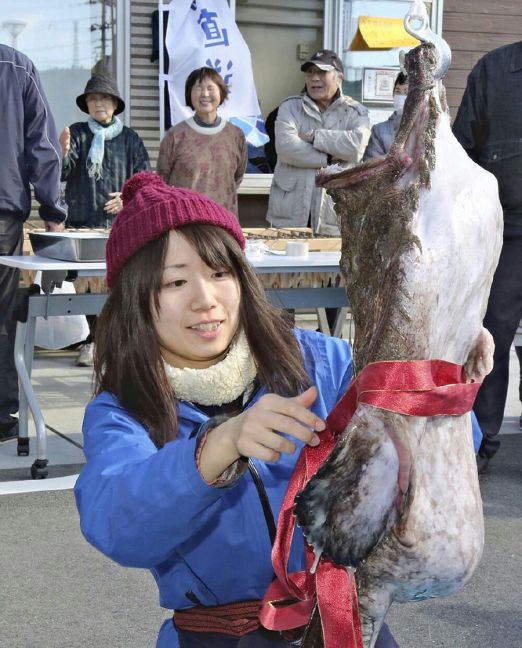
The Japan News by Yomiuri Shimbun reported that Hiromi was given the honour of launching the shop, where she tied a ribbon around a monkfish.
Fukushima’s fishing industry was dealt a severe blow following a nuclear plant leak nine years ago.
Hiromi, 27, had moved to Iwaki from Aomori Prefecture in 2017, after the Great East Japan Earthquake on March 11, 2011, that caused a radioactive contamination leak from the Fukushima Daiichi nuclear plants.
Hiromi Sakaki tying a ribbon around d a monkfish at the opening of an outlet jointly operated by her and local fishermen at the Iwaki market in Fukushima, Japan.
The radiation also affected farmers who are still reeling from huge losses.
“I want to sell delicious fish that people can buy only here, Although this is a port town, fishing here has been on the decline. So I started thinking about creating a place where children would aspire to become fishermen in the future,” said Hiromi, who had graduated from Saitama University, and whose shop sells fish like sea bass and flounder.
Hiromi first became familiar with the Fukushima fishermen after she became a volunteer to send used bicycles to Iwaki.
Her shop has a window where customers can see fish being processed.
“This is intended to help children get an idea about who caught the fish and what happens to bring them to the dining table.
“I intend to offer breakfast featuring fresh fish at the shop under the name “Ryoshi shokudo” (Fisherman’s diner) in the near future,” she said.
The city’s fisheries cooperative association revealed that there were seven fish markets and four fishery processing companies in Hisanohama before the disaster.
Now, there is only one fish retailer, which is a traveling market.
Fukushima’s fishing industry continues to face restrictions, but fishermen in the prefecture are allowed to operate on a trial basis under which they face limitations on the species the catch, fishing areas, and the number of days they can catch.
No comments yet.
1 This Month
10 March A LIVE WEBINAR THE REAL EFFECTS OF NUCLEAR POWER
What the Industry Isn’t Telling Us
1:00 PM Mountain, 2 pm Central, 3 pm Eastern. Live on the Keepers of the Water Facebook page


18 March Webinar @ 1 PM EST: An Assessment of SMR Projects: The Case of Canada
register for the zoom:
https://us02web.zoom.us/webinar/register/WN_o8BIIOUvQ2ONJR1nta65DQ#/registration


of the week – STOP SMALL MODULAR REACTORS IN CANADA
To see nuclear-related stories in greater depth and intensity – go to https://nuclearinformation.wordpress.com
-
Archives
- February 2026 (256)
- January 2026 (308)
- December 2025 (358)
- November 2025 (359)
- October 2025 (376)
- September 2025 (258)
- August 2025 (319)
- July 2025 (230)
- June 2025 (348)
- May 2025 (261)
- April 2025 (305)
- March 2025 (319)
-
Categories
- 1
- 1 NUCLEAR ISSUES
- business and costs
- climate change
- culture and arts
- ENERGY
- environment
- health
- history
- indigenous issues
- Legal
- marketing of nuclear
- media
- opposition to nuclear
- PERSONAL STORIES
- politics
- politics international
- Religion and ethics
- safety
- secrets,lies and civil liberties
- spinbuster
- technology
- Uranium
- wastes
- weapons and war
- Women
- 2 WORLD
- ACTION
- AFRICA
- Atrocities
- AUSTRALIA
- Christina's notes
- Christina's themes
- culture and arts
- Events
- Fuk 2022
- Fuk 2023
- Fukushima 2017
- Fukushima 2018
- fukushima 2019
- Fukushima 2020
- Fukushima 2021
- general
- global warming
- Humour (God we need it)
- Nuclear
- RARE EARTHS
- Reference
- resources – print
- Resources -audiovicual
- Weekly Newsletter
- World
- World Nuclear
- YouTube
-
RSS
Entries RSS
Comments RSS
 nuclear-news
Leave a comment