To 27 January – climate and nuclear news
Australia’s bushfires still dominate the climate news. Despite helpful rain, as of last Tuesday, 107 fires were still burning.-More extreme heat, and more fires, are predicted. Indeed, as I write, a new bushfire is reported, in Australian Capital Territory.
Still, Australia is far from the only climate story this week. Climate change could unlock new microbes and increase heat-related deaths. Deadly flooding and landslides are striking Brazil. Extreme weather is causing falling iguanas, rise of deadly spiders and swarms of locusts. And, no doubt of prime importance to “sensible” and “corporate” humans, Climate Change could blow up the economy and the banks aren’t ready.
The Bulletin of the Atomic Scientists has moved the “Doomsday Clock” to 100 minutes to midnight, its closest to doomsday since it began ticking, due to nuclear proliferation, failure to tackle climate change and “cyber-based disinformation”.
Six legal arguments against the extradition of Julian Assange to America.
New interactive flood-risk map shows that global vulnerability to sea level rise is worse than previously understood. Davos conference – an expensive exercise in corporate spin. Greta Thunberg says climate demands ‘completely ignored’ at Davos.
The global danger as insect species disappear
Nuclear recycling is a bad idea. The nuclear nations push the fantasy of Small Modular Nuclear Reactors.
World’s first public database of mine tailings dams aims to prevent deadly disasters.
Solar, storage, and wind tipped as top energy job generators.
EUROPE. Wildfires – drastic climate effects in Australia, but Europe cops it, too.
USA.
- Donald Trump tweets that US will not lift sanctions to secure nuclear deal with Iran. Despite years of negotiations, we came once again to the brink of conflict with Iran. Democratic presidential candidates not well informed on nuclear weapons. Ask presidential candidates about nuclear and climate issues, says former energy secretary Moniz.
- USA’s National Nuclear Security Administration (NNSA) spurns environmental assessment for plutonium cores. No clear explanation of USA’s rush to produce more plutonium cores for nuclear weapons. ”Plutonium pits” not only unnecessary, but also very dangerous for the environment.
- History of U.S. missiles testing atomic, bacterial and viral weapons in Utah.
- USA Politicians on both sides sucked in by propaganda for fantasy new nuclear reactors. Republicans try to get nuclear power accepted as “renewable” in California.
- Lawmakers seek safeguards on decommissioning of Pilgrim Nuclear Power Station. Class action lawsuit about failed V.C. Summer nuclear plant goes back to state court.
- Donald Trump threatens to get rid of National Public Radio.
IRAN. Understanding Iran. Iran will never seek nuclear weapons – P.M Rouhani.
NORTH KOREA. North Korea abandoning talks with “hostile” USA.
JAPAN.
- Irresponsible tactics are being used to bury Fukushima’s social and environmental problems .
- Japan faces decision over contaminated Fukushima water. Japan might decide on fate of radioactive waste water before the Olympics in July. S. Korea, U.S, discuss Fukushima Wastewater, Marine Issues. Fukushima Daiichi Frozen Wall Leaks.
- 2020 Olympic events worryingly close to radioactive areas.
- $123 billion the cost of safety measures for Japan’s nuclear stations.
- Tepco estimates 44 years to decommission its Fukushima No. 2 nuclear plant.
- Hiroshima High Court orders Ikata nuclear reactor to be halted.
- No long-term prospects in Japan for reusing, storing spent MOX fuel.
- Mayor in Kyushu admits to ‘bribe’ from company in nuclear business.
UK. Significant item – In UK deep disposal is planned for the mounting, costly and forever problem of nuclear wastes. Rolls Royce’s fantasy plan for so-called ‘mini’ nuclear reactors. In UK “big” nuclear power versus “small” (both unaffordable) at Wylfa
FRANCE. Sloppy safety and waste management at Electricite de France’s nuclear sites.
CANADA, Ontario landowners sign deal with agency looking to store used nuclear fuel.
INDIA. India – a case study in regulatory capture by the nuclear industry. India joins the panic to sell costly, impractical, nuclear power to Africa and Middle East. India installed 7.5GW of solar and 2.4GW of wind in 2019.
SWEDEN. Swedish Parliament Rejects Proposal to Halt Nuclear Shutdown.
ROMANIA. Romania quits deal with China for new nuclear reactors.
RUSSIA. Unsafety of Russia’s November-class submarines.
Nuclear recycling is a bad idea
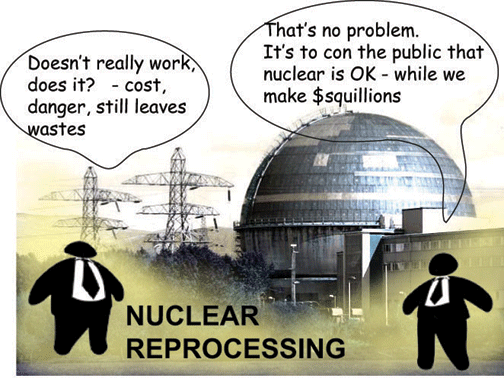

 claiming that nuclear power is safe and finding a solution for its toxic waste is easy. If it’s so easy, why don’t they have a workable solution? Is it really just peoples’ unreasonable fears that obstruct the industry and the federal government from creating a final solution?
Originally we were told that there was no waste problem because the waste would be reprocessed and used again in bombs and new “breeder” reactors. That idea failed! Miserably! The only reprocessing facility for commercial nuclear waste that ever existed was West Valley in upstate New York and it shuttered after only five years because it contaminated the land and water around it with radiation. It remains a Superfund site to this day. Without the technology to safely reprocess it, nuclear fuel waste remains in fuel pools and dry storage at reactor sites all over the country.
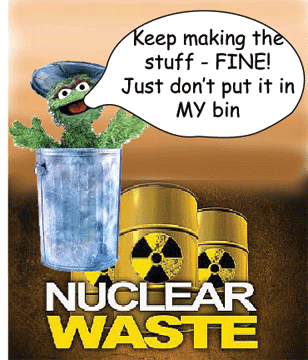 All this was codified under the 1982 Nuclear Waste Policy Act (NWPA). Once established, investigations began to determine the best dump site/s. But every state that was identified as a potential site for a repository threatened to sue. Instituting the NWPA was in crisis. The NWPA was amended and Congress targeted Yucca Mountain because
 failed to meet the necessary criteria for safe isolation of the deadly material. With the failure of the federal government and the nuclear industry to establish Yucca Mountain as the national repository for nuclear waste, nuclear corporations were forced to establish onsite storage at their operating and shuttered reactor sites. Six out of nine reactors in New England have shuttered due to significant public opposition and their inability to compete with gas and renewables. These six sites are in varying degrees of cleanup. Without a “solution” as to dealing with the nuclear waste, these sites have devolved into ad hoc nuclear waste dumps. All have created onsite storage for their high level waste. It costs a lot to store the waste onsite — at least $5 million out of pocket for each year. This waste could remain onsite for decades if not centuries. So costs could really add up for corporations without any revenue. Naivety, arrogance, and thoughtlessness add up to a lot of money!
With waste piling up at shuttered reactor sites throughout the country, the industry has a perception problem. This is not a favorable image for an  industry trying to reinvent itself as the answer to global warming. So what’s the industry’s answer? It wants to create “interim storage” dump sites in west Texas and New Mexico in working poor, Hispanic communities to make this problem disappear. These sites don’t have to meet the strict environmental standards that sunk Yucca Mountain— i.e., isolation from the environment for 1,000 years and isolation from groundwater for 10,000 years.
This “interim storage” initiative is a statement of the failure of the nuclear industry and the federal government to address the most toxic waste we have ever created. We don’t need more nukes; we don’t need half baked “solutions”. We need a commitment to put our best minds to solve this thorny problem. What is needed is a scientifically sound and environmentally just solution, not more magic or wish fulfillment. A qualified “panel” must be established and funded to create the standards required to meet the health and safety of the public and the planet, not the profit-driven, short-sighted monetary bottom line of a moribund industry.
Deb Katz is the executive director of the Citizens Awareness Network, which was founded locally in 1991 and has offices in Shelburne Falls and Rowe. Here’s a link to our website www.nukebusters.org.
Six legal arguments against the extradition of Julian Assange to America
 Six legal arguments show why the US extradition of Julian Assange should be denied https://www.thecanary.co/uk/analysis/2020/01/25/six-legal-arguments-show-why-the-us-extradition-of-julian-assange-should-be-denied/ Tom Coburg 25th January 2020 The first of two articles examining Julian Assange’s upcoming extradition trial.
There are at least six legal reasons why the extradition request by the US against WikiLeaks founder Julian Assange should be dismissed by the UK courts. The main extradition hearing is scheduled to commence 24 February 2020, with district judge Vanessa Baraitser presiding. The evidence to support Assange is compelling.
1. Client-lawyer confidentiality breached
2. The initial charge is flawed
1. Client-lawyer confidentiality breached
3. Initial charge relies on co-operation from Manning
4. Additional charges raised by the US are political
5. US legal precedent argues that Assange’s work is protected by the US Constitution
6. Threats of violence against Assange mean he’s unable to receive a fair trial
1. Client-lawyer confidentiality breached Continue reading
New interactive flood-risk map shows that global vulnerability to sea level rise is worse than previously understood.

Eastern Daily Press 23rd Jan 2020, Huge swathes of the Broads, the Fens and even parts of Great Yarmouth and Norwich could be under water in 30 years unless drastic action is taken to halt global warming.
That is the shocking conclusion drawn from a new
interactive flood-risk map built by US-based researchers who claim that
global vulnerability to sea level rise is worse than previously understood.
Democratic presidential candidates not well informed on nuclear weapons
 2020 Dems Need To Get Up To Speed on Nuclear Weapons. Fast. https://www.defenseone.com/ideas/2020/01/democratic-presidential-candidates-need-get-speed-nuclear-weapons-fast/162577/ Last week, U.S. voters had two opportunities to inspect the leading Democratic presidential candidate’s national security credentials. In both the Democratic debate in Iowa and the New York Times editorial board’s interview series, candidates were asked to explain their views on key aspects of nuclear weapons policy. Unfortunately, all three of the leading candidates flubbed some of their responses. For the existential sake of the country, the candidates need to get up to speed on nuclear weapons policy. Fast.
- Despite being a leader on a number of nuclear weapons issues, including a promise to commit the United States to a No First Use doctrine, Sen. Elizabeth Warren seemed unaware of the controversial existence of U.S. nuclear weapons in Turkey. Even though the issue made headlines as recently as October.
- Despite giving an answer that spoke eloquently of his long abhorrence of nuclear weapons, Sen. Bernie Sanders did not seem to know how many countries have nuclear weapons. The number is nine, not the eleven or twelve the senator claimed.
- Despite his compelling recent defense of the 2015 Iran nuclear deal he helped obtain, Vice President Joe Biden seemed to mischaracterize President Trump’s North Korea policy. Speaking of the North Koreans at the Democratic debate, he said the President “weakened the sanctions we have against them.” CNN’s fact-checkers soon rebuked the Vice President. As they put it, “Trump has not weakened the sanctions his administration has placed on North Korea to date, and has in fact ratcheted them up from the Obama administration.”No one is perfect, but these mistakes matter for several reasons. Nuclear weapons are the most acute national security threat we face. From Iran to North Korea, South Asia to Russia, they are still drivers of major international dangers. Any lack of clarity on such a grave topic should be alarming. But there are also more specific implications of each of the candidate’s misstatements. With tensions between the U.S. and Turkey increasing on a number of fronts, the question of whether to keep basing U.S. nuclear weapons at Incirlik is a serious one, especially when one considers that Turkey might attempt to steal them.
- With the 2020 Nonproliferation Treaty Review Conference looming, the question of how many countries have nuclear weapons is a crucial barometer for judging the success of that agreement. And by criticizing nonexistent sanctions relief, Vice President Biden ignores the real failure of the Trump administration’s North Korea policy, which has been its inability to translate summitry into productive diplomacy.Clearly, the country should expect better on this important issue from the leading Democratic candidates. Moreover, it is also to the candidates’ electoral benefit to get up to speed on nuclear weapons policy.
- First, the candidates should remember that the emerging consensus within the Democratic Party on nuclear weapons issues is politically popular. All three aforementioned candidates support a No First Use policy, as do 57 percent of voters in Iowa and 73 percent of voters in New Hampshire. All three support extending key arms control agreements with Russia, like New START. They are in the company of eight in ten registered voters, including over 75 percent of Republicans. And all three prefer the diplomacy of the Iran nuclear deal to starting another endless war in the Middle East – as do the American people.
- Second, nuclear policy issues are frequently used as ‘gotcha’ questions by the media. The media will keep asking questions on nuclear policy and it’s important for candidates to be ready. For instance, during the 2016 primaries the media infamously tripped candidate Trump up with a ‘gotcha’ question on the nuclear triad. Trump took the hit but recovered in the general election, by which time he had learned his way to a more coherent responseThird, nuclear issues simply aren’t going away. With tensions high from South Asia to the Korean Peninsula and Iran, the candidates will likely need to address a nuclear-related foreign policy crisis soon. Such moments can be politically decisive – there’s no faster way to solidify support than by handling a crisis well; it was only in the heat of the financial collapse of 2008 that Sen. Obama’s lead over Sen. McCain solidified. Candidates should do their homework in advance of such a moment.The three front-runners have each made important contributions to preventing the use and spread of nuclear weapons, although voters could use more policy specifics. Unlike some of their competitors, they have also had the courage to answer pressing questions about nuclear weapons. But with the Iowa caucus just days away, they need to do more.
Akshai Vikram is the Roger L. Hale Fellow at the Ploughshares Fund, a global security foundation. Before coming to Ploughshares, he worked as an opposition researcher for the Democratic National Committee and a campaign staffer for the Kentucky Democratic Party
Should women run the world? — Beyond Nuclear International

Would nuclear weapons go away if men leave power?
via Should women run the world? — Beyond Nuclear International
Donald Trump tweets that US will not lift sanctions to secure nuclear deal with Iran
 US will not lift sanctions to secure nuclear deal with Iran , https://www.sbs.com.au/news/us-will-not-lift-sanctions-to-secure-nuclear-deal-with-iran 26 Jan 2020, Donald Trump has tweeted that the US will not lift sanctions on Iran in order to negotiate a new nuclear deal.
The United States will not lift sanctions on Iran in order to negotiate, US President Donald Trump has tweeted, seemingly in response to a Der Spiegel interview with Iran’s foreign minister.
“Iranian Foreign Minister says Iran wants to negotiate with The United States, but wants sanctions removed. @FoxNews @OANN No Thanks!” Trump tweeted in English on Saturday and later in Farsi.
Iran’s Foreign Minister Mohammad Javad Zarif responded on Sunday by tweeting an excerpt from the interview with Der Spiegel published on Friday, where he said Iran is still open to negotiations with America if sanctions are lifted.
“@realdonaldtrump is better advised to base his foreign policy comments & decisions on facts, rather than @FoxNews headlines or his Farsi translators,” Zarif said in the tweet with the interview excerpt.
Tensions between Iran and the United States have reached the highest levels in decades after the US killed top Iranian General Qassem Soleimani in a drone strike in Baghdad on January 3, prompting Iran to fire missiles days later at bases in Iraq where US troops are stationed.
Tensions between the two have been increasing steadily since Trump pulled the United States out of Iran’s nuclear pact with world powers in 2018 and reimposed sanctions that have driven down Iran’s oil exports and hammered its economy.
World’s first public database of mine tailings dams aims to prevent deadly disasters

World’s first public database of mine tailings dams aims to prevent deadly disasters https://www.eurekalert.org/pub_releases/2020-01/g-wfp012320.php
Previously unreleased data offer unprecedented view into mining industry’s waste storage practices
GRID-ARENDAL 24 JAN 2020 ENVIRONMENTAL ORGANIZATION GRID-ARENDAL HAS LAUNCHED THE WORLD’S FIRST PUBLICLY ACCESSIBLE GLOBAL DATABASE OF MINE TAILINGS STORAGE FACILITIES. THE DATABASE, THE GLOBAL TAILINGS PORTAL, WAS BUILT BY NORWAY-BASED GRID-ARENDAL AS PART OF THE INVESTOR MINING AND TAILINGS SAFETY INITIATIVE, WHICH IS LED BY THE CHURCH OF ENGLAND PENSIONS BOARD AND THE SWEDISH NATIONAL PENSION FUNDS’ COUNCIL ON ETHICS, WITH SUPPORT FROM THE UN ENVIRONMENT PROGRAMME. THE INITIATIVE IS BACKED BY FUNDS WITH MORE THAN US$13 TRILLION UNDER MANAGEMENT.
Until now, there has been no central database detailing the location and quantity of the mining industry’s liquid and solid waste, known as tailings. The waste is typically stored in embankments called tailings dams, which have periodically failed with devastating consequences for communities, wildlife and ecosystems.
“This portal could save lives”, says Elaine Baker, senior expert at GRID-Arendal and a geosciences professor with the University of Sydney in Australia. “Dams are getting bigger and bigger. Mining companies have found most of the highest-grade ores and are now mining lower-grade ones, which create more waste. With this information, the entire industry can work towards reducing dam failures in the future.”
The database allows users to view detailed information on more than 1,700 tailings dams around the world, categorized by location, company, dam type, height, volume, and risk, among other factors.
“Most of this information has never before been publicly available”, says Kristina Thygesen, GRID-Arendal’s programme leader for geological resources and a member of the team that worked on the portal. When GRID-Arendal began in-depth research on mine tailings dams in 2016, very little data was accessible. In a 2017 report on tailings dams, co-published by GRID and the UN Environment Programme, one of the key recommendations was to establish an accessible public-interest database of tailings storage facilities.
“This database brings a new level of transparency to the mining industry, which will benefit regulators, institutional investors, scientific researchers, local communities, the media, and the industry itself”, says Thygesen.
The release of the Global Tailings Portal coincides with the one-year anniversary of the tailings dam collapse in Brumadinho, Brazil, that killed 270 people. After that disaster, a group of institutional investors led by the Church of England Pensions Board asked 726 of the world’s largest mining companies to disclose details about their tailings dams. Many of the companies complied, and the information they released has been incorporated into the database.
For more information on tailings dams, see the 2017 report “Mine Tailings Storage: Safety Is No Accident” and the related collection of graphics, which are available for media use.
About GRID-Arendal
GRID-Arendal supports environmentally sustainable development by working with the UN Environment Programme and other partners. We communicate environmental knowledge that motivates decision-makers and strengthens management capacity. We transform environmental data into credible, science-based information products, delivered through innovative communication tools and capacity-building services.

Ask presidential candidates about nuclear and climate issues, says former energy secretary Moniz
|
Former energy secretary urges voters to ask about nuclear issues
– 26 Jan 2020 Conversations at town halls around New Hampshire have been focused on domestic policy, like the job market and health insurance. At a forum Monday, Ernst Moniz, who served as energy secretary under former President Barack Obama and is now CEO of the Nuclear Threat Initiative, will try to convince New Hampshire voters to look beyond those kitchen table issues, and ask presidential primary candidates about nuclear weapons “The bread-and-butter issues if you like—the economy, health care, education—are typically a major focus at this time of the political season, Moniz said Saturday. Voters are typically less worried about foreign policy and security issues like nuclear weapons. “Unfortunately, catastrophic risks for our society and future gens are very, very considerable.”
Moniz said he hoped Monday’s forum would spur voters to think about nuclear proliferation when they talk to candidates, as much as kitchen table issuse. New Hampshire voters can shape candidates, he said. With the history of the political tradition in New Hampshire, where I think priorities for candidates can be shaped, we are hoping to bring those issues to the attention of the New Hampshire voters. In an interview Saturday, Moniz spoke about what he saw as a growing potential for accidents and miscalculations to be made with nuclear weapons. “Especially in the context of the current international geopolitical situation,” Moniz said, citing tensions with Russia and uncertainty in the Middle East. International treaties have a strong role to play in arms control, Moniz said, and he hopes whoever wins the 2020 election will take those treaties seriously. A treaty with Russia known as New START is due to be renewed in the next president’s term, Moniz said. “If we do not, we will have upended the entire hierarchy of nuclear arms control,” he said. If New Hampshire voters want to ask about these issues, Moniz said, it could impact how much attention is paid to nuclear weapons during the 2020 election. He recalled the 2004 election, when Nuclear Threat Initiative activists raised the specter of nuclear weapons falling into the hands of terrorist groups. He said that issue became critical in the 2004 election.
Moniz said this year, he would ask candidates what they would you do to re-starting dialogue between the Russia and the United States nuclear weapons, what they would do to stabilize North Korea, how they would protect against cyber attacks that could affect the United States’ early warning systems “If the New Hampshire voters are asking these questions, if the media are putting these questions out in front and getting responses from the candidates, that raises those issues in the priorities of these candidates,” he said. “This is the right time in places like Iowa and New Hampshire, where the people the voters are so much closer to the candidates. They do in fact have influence in how these issues can be talked about now and addressed over the next several years. Moniz will speak at 6:30 p.m. Monday at Southern New Hampshire University, in the Hospitality Center Salon Rooms. Register online at https://wacnh.org/event-3673124. |
|
Japan could decide on fate of radioactive waste water before the Olympics in July

|
Fukushima Water Waste Decision Could Come Before Tokyo Olympics, VOA, 26 Jan 2020, Japanese officials say a decision on how to deal with radioactive water from the Fukushima nuclear plant could come before the Tokyo Olympics begin in July……
TEPCO officials recently guided a Reuters reporter around the plant, which covers about 3.5 million square meters in northeast Japan. The reporter described large cranes being used to break up major parts of the plant’s structure. The reporter also described operations aimed at removing spent fuel from a reactor. Overall, about 4,000 people are taking part in the cleanup effort, Reuters reported. Some Olympic events are set to take place within 60 kilometers of the destroyed plant, Reuters said. One major part of the cleanup has involved treating and storing contaminated water from the area. TEPCO has predicted that Fukushima will run out of all its storage space for water by 2022. A government group studying future storage solutions said last month that it had decided on two main possible solutions. One solution is to treat the water and then control its release into the Pacific Ocean. The other would be to let the water evaporate. Japanese experts say the government may decide on a solution within the next few months. Either process is expected to take years to complete. Joji Hara is a Tokyo-based spokesman for the power company. He told Reuters that TEPCO has already been making preparations to inform the public about any developments related to Fukushima. “The Olympics are coming, so we have to prepare for that, and TEPCO has to disclose all the information – not only to local communities but also to foreign countries and especially to those people coming from abroad,” Hara said….. oji Hara is a Tokyo-based spokesman for the power company. He told Reuters that TEPCO has already been making preparations to inform the public about any developments related to Fukushima. “The Olympics are coming, so we have to prepare for that, and TEPCO has to disclose all the information – not only to local communities but also to foreign countries and especially to those people coming from abroad,” Hara said. The Olympic torch will be carried through a sports center called J-Village. The center served as an operations base for the Fukushima nuclear plant during the first years after the disaster. The torch will then pass through areas near the destroyed power station on its way to Tokyo. Last month, the environmental group Greenpeace said it found radiation “hotspots” at J-Village, about 18 kilometers south of the plant. When Tokyo was chosen for the 2020 Summer Olympics, Prime Minister Shinzo Abe declared that Fukushima was “under control” and would not affect activities related to the Games. https://learningenglish.voanews.com/a/fukushima-water-waste-decision-could-come-before-tokyo-olympics/5254594.html |
|
Lawmakers seek safeguards on decommissioning of Pilgrim Nuclear Power Station
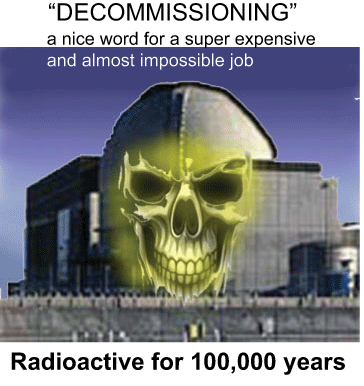 Lawmakers seek safeguards on nuclear plant decommissioning, 22 WWLP.com by: Chris Lisinski: Jan 25, 2020 BOSTON (SHNS) – Lawmakers are seeking additional influence over the decommissioning of the recently shuttered Pilgrim Nuclear Power Station, but a representative for the company conducting the work argued Wednesday that those attempts may be unconstitutional. Lawmakers seek safeguards on nuclear plant decommissioning, 22 WWLP.com by: Chris Lisinski: Jan 25, 2020 BOSTON (SHNS) – Lawmakers are seeking additional influence over the decommissioning of the recently shuttered Pilgrim Nuclear Power Station, but a representative for the company conducting the work argued Wednesday that those attempts may be unconstitutional.
Tom Joyce, a lobbyist for Holtec Decommissioning International, said that bills imposing higher clean-up standards (H 2904 / S 1949) or reforming how decommissioning is funded (S 1948, S 1992) would exceed the state’s authority and infringe on the jurisdiction of the federal Nuclear Regulatory Commission. Joyce told the Joint Committee on Telecommunications, Utilities and Energy that passage of the bills would likely prompt a lawsuit from Holtec, delaying the decommissioning process that the company has said will take seven years…….. Backers of the legislation, though, see the proposals as important steps to protect local stakeholders amid a process that has drawn criticism and a lawsuit from the attorney general. Plymouth Republican Rep. Mathew Muratore, who filed one of the bills that would require decommissioning to meet stricter environmental standards, said his goal is to ensure the land is clean enough to appeal to potential businesses and avoid remaining vacant…… The Pilgrim facility officially ended operations on May 31 after decades of generating power. In August, the NRC approved the transfer of Pilgrim’s license from Entergy to Holtec International to handle its decommissioning. Attorney General Maura Healey, with the backing of the Baker administration, filed a lawsuit seeking to block the transfer until the NRC holds a hearing on concerns about Holtec’s ability to decommission the plant safely, its financial stability and the company’s alleged involvement in a kickback scheme. Speakers at Wednesday’s committee hearing said the case, which also features the Pilgrim Watch group as a party, is still pending. Other bills before the committee (S 1948, S 1992) would charge the owners of any nuclear power station in the state $25 million per year and stash the money into a fund managed by the state treasurer only to be used for postclosure activities. Pilgrim Watch chair Mary Lampert said that money would serve as an “insurance policy” – if decommissioning concluded using the existing trust fund set aside for those purposes, the owners would get back the additional funding plus interest, she said. If not, the state would have a reserve ready to cover any shortfall. Without a safety net backing up the more than $1 billion trust fund, Lampert said taxpayers would be on the hook. “Who’s going to pay the difference? We’re going to pay the difference,” she told the committee. “Holtec cannot be required to do so. Why can it not be required to do so? Because it is a limited liability company and you cannot get blood out of this stone.” Rep. Sarah Peake, a cosponsor of the bill, said Connecticut found itself footing a $480 million bill to complete decommissioning of the former Connecticut Yankee Nuclear Power Plant. Like the legislation concerning cleanup standards, Joyce argued the funding proposals would unconstitutionally circumvent NRC authority…. Muratore and Lampert said they did not agree with that argument, with the latter arguing that the bills in question are all “money bills” and therefore grant the state authority to take additional action. “States have the authority to enact a more conservative (environmental) standard if it applies after NRC has released the site because once the NRC has released the site, it no longer has authority, so there is not a question of preemption,” Lampert said. In his fiscal year 2021 budget unveiled Wednesday, Gov. Charlie Baker proposed language that would allow the Department of Public Health to assess operators of nuclear reactors in the process of being decommissioned — such as Holtec — for the costs of radiation monitoring and emergency planning associated with the project. https://www.wwlp.com/news/state-politics/lawmakers-seek-safeguards-on-nuclear-plant-decommissioning/ |
|
Tepco estimates 44 years to decommission its Fukushima No. 2 nuclear plant.
Japan Times 23rd Jan 2020, Tokyo Electric Power Company Holdings Inc. has estimated that it will take 44 years to decommission its Fukushima No. 2 nuclear plant. Tepco presented the outline of decommissioning plans to the municipal assembly of Tomioka, one of the two host towns of the nuclear plant, on Wednesday.
The Fukushima No. 2 plant is located south of the No. 1 plant, which suffered a triple meltdown accident in the wake of the March 2011 massive earthquake and tsunami.
According to the outline, the decommissioning process for the No.
2 plant will have four stages, taking 10 years for the first stage, 12
years for the second stage and 11 years each for the third and fourth
stages.
Tepco will survey radioactive contamination at the nuclear plant in
the first stage, clear equipment around nuclear reactors in the second,
remove the reactors in the third and demolish the reactor buildings in the
fourth. Meanwhile, the plant operator will transfer a total of 9,532 spent
nuclear fuel units at the plant to a fuel reprocessing company by the end
of the decommissioning process, and 544 unused fuel units to a processing
firm by the start of the third stage.
https://www.japantimes.co.jp/news/2020/01/23/national/tepco-fukushima-decommissioning/#.Xi1KBmj7RPb
Republicans try to get nuclear power accepted as “renewable” in California
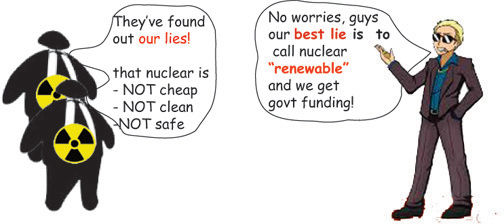
- California Republicans on Tuesday introduced legislation to temporarily halt the requirements of the state’s Renewables Portfolio Standard (RPS) program and redirect funds to ensure utilities improve their infrastructure and vegetation management programs.
- The proposed bill would also, if and when the program is reinstated, include nuclear generation and all hydroelectric facilities operating as of January 1, 2021 in the program’s definition of an “eligible renewable energy resource.”
- The bill, along with a second piece of legislation introduced by state Assemblyman James Gallagher, R, and Sen. Jim Nielsen, R, “will help prevent future wildfires and utility power shutoff events,” according to a press release. But environmental advocates say that the move to extend RPS eligibility to hydro and nuclear facilities might not go far in California’s current political landscape.
Dive Insight:
California established its RPS program in 2002, requiring at the time that renewable resources make up 20% of electricity retail sales by 2017. However, the program’s targets have changed over the years; the state passed Senate Bill 100 in 2018, accelerating RPS requirements to 60% by 2030, as well as requiring that carbon-free resources supply all of the state’s electricity by 2045.
Large hydropower and nuclear generation don’t currently count toward the RPS standard requirements, but the state is still defining the zero-carbon requirement passed in SB 100, Alex Jackson, senior attorney at the Natural Resources Defense Council, told Utility Dive.
In the last three years, California utilities have also been wrestling with the increased threat of wildfires posed by their infrastructure. Devastating fires in 2017, 2018 and 2019 have caused billions of dollars in damage across the state, pushing Pacific Gas & Electric to declare bankruptcy in early 2019.
To reduce this risk, the utility adopted a public safety power shut-off (PSPS) program, proactively de-energizing areas that are particularly prone to fires during windy or dry weather conditions. The shut-offs have drawn widespread criticism from regulators, lawmakers and customers in Northern California……..
Environmental advocates pushed back against the proposal to include both large hydropower and nuclear generation as eligible resources under the RPS program.
The RPS is part of a deliberate state move away from fossil fuels, and utilities already get a lot of their power from hydro, so counting it in the RPS requirements would discourage investments in wind, solar, and other renewables, Kathryn Phillips, director of Sierra Club California, told Utility Dive…..
On the nuclear energy front, “there’s no way you can call nuclear renewable,” she said. “It doesn’t emit carbon, but it has lots of other very intense environmental impacts.”
“Nuclear is being phased out not because of its ineligibility for RPS requirements, but because these large inflexible baseload plants are increasingly incompatible with a system that’s predominantly run on intermittent clean energy resources,” according to Jackson.
Flexibility is key going forward and the high operating costs of nuclear plants is what led PG&E to propose the retirement of the Diablo Canyon plant in the first place, he added. …….https://www.utilitydive.com/news/proposed-bill-include-large-hydro-nuclear-power-californias-rps/570919/
Class action lawsuit about failed V.C. Summer nuclear plant goes back to state court

|
Federal judge kicks Santee Cooper nuclear fiasco lawsuit back to state court, https://www.thestate.com/news/local/crime/article239614263.html
BY JOHN MONK, JANUARY 26, 2020 A class action lawsuit resulting from the failed V.C. Summer nuclear plant and involving South Carolina-owned power company Santee Cooper is back in state court. That’s the latest turn of the legal screw in a lawsuit involving more than 2 million of Santee Cooper’s customers. A key issue is whether Santee Cooper’s customers will be stuck with paying several billion dollars that the power company is said to owe due to the nuclear project’s failure in mid-construction in July 2017. Another affected matter is whether the historic state-owned utility, which began as a rural electrification project in the 1930s, will eventually be sold to a big out-of-state energy company or remain under state control. Last year, Santee Cooper’s partner in the doomed V.C. Summer nuclear venture — SCANA, a publicly traded company suffering financial woes because of the project — was sold to Dominion Energy, one of the nation’s largest power companies. The state’s 170 lawmakers will be mulling the possible sale of Santee Cooper in this legislative session. Last week, U.S. Judge Terry Wooten ordered that the Santee Cooper case — which had temporarily been transferred to federal court — be sent back to state court to be tried before special Judge Jean Toal, a former S.C. Supreme Court chief justice. It is unclear when a trial will begin. Toal had originally set Feb. 24 as the trial start date in the case. But Judge Wooten’s order could be appealed to the federal 4th Circuit Court of Appeals, delaying the trial. The lawsuit was initially filed in August 2017 by Santee Cooper customers seeking to avoid having to pay for the failed nuclear plant. Costs for the project — estimated at $9 billion before it failed — had for years been added to their monthly bills and continue to be added, according to a complaint in the case. Over the next two years, the parties “vigorously litigated in state court, engaging in significant discovery — including dozens of depositions and the exchange of millions of pages of documents — and arguing numerous substantive motions,” according to a memorandum in the case. Defendants in the case included Santee Cooper, SCANA and various electric cooperatives to which Santee Cooper provides power to be sold to customers around the state. As joint partners in the nuclear venture, Santee Cooper contributed 45% of the cost, while SCANA took responsibility for project oversight and shouldered 55% of the cost. In November, SCANA suddenly moved to transfer the case from Toal’s court to federal court, where it wound up before Judge Wooten. In the month before the case was transferred, Toal had certified the case as a class action, rejected a move by SCANA to send the case to an arbitrator and set a three-week trial to begin on Feb. 24, according to records in the case. Although numerous lawsuits have been filed in state and federal court against SCANA, this lawsuit is the major legal action against Santee Cooper on behalf of ratepayers. According to plaintiffs in the case, Santee Cooper increased its electricity rates five times over the years to pay for construction and other costs associated with the doomed nuclear project. Santee Cooper spent some $4.7 billion on the failed project, and its customers continue to pay extra on their monthly bills for the failure, according to plaintiffs. Santee Cooper is a main defendant in the case, along with SCANA and SCE&G. Plaintiffs are asking the court to refund hundreds of millions of dollars in costs associated with the failed nuclear project they say they have already paid in increased monthly bills. Plaintiffs also also asking the court to rule that Santee Cooper cannot keep passing costs for the failed project on to them — a future amount estimated at more than $4 billion. After the case was transferred to Wooten, the Santee Cooper customers, along with Santee Cooper, urged Wooten to send the the case back to state court, arguing there was no need for federal courts to take up the case. “The central issues involve South Carolina actors, agreements made in South Carolina, governed by South Carolina law, affecting a South Carolina power project and costing South Carolina customers billions of dollars,” they argued. Wooten agreed. “The court finds it would not be appropriate to exercise federal jurisdiction here,” he wrote in his order last week. @ChristinaMac1
|
|

1 This Month

of the week – Shut Down Drone Warfare!


Tell the Ukrainian Government to Drop Prosecution of Peace Activist Yurii Sheliazhenko

Petition to revoke the licensing of the Near Surface Nuclear Disposal Facility (NSDF) at Chalk River. https://www.ourcommons.ca/petitions/en/Petition/Details?Petition=e-7247
To see nuclear-related stories in greater depth and intensity – go to https://nuclearinformation.wordpress.com
-
Archives
- April 2026 (103)
- March 2026 (251)
- February 2026 (268)
- January 2026 (308)
- December 2025 (358)
- November 2025 (359)
- October 2025 (376)
- September 2025 (257)
- August 2025 (319)
- July 2025 (230)
- June 2025 (348)
- May 2025 (261)
-
Categories
- 1
- 1 NUCLEAR ISSUES
- business and costs
- climate change
- culture and arts
- ENERGY
- environment
- health
- history
- indigenous issues
- Legal
- marketing of nuclear
- media
- opposition to nuclear
- PERSONAL STORIES
- politics
- politics international
- Religion and ethics
- safety
- secrets,lies and civil liberties
- spinbuster
- technology
- Uranium
- wastes
- weapons and war
- Women
- 2 WORLD
- ACTION
- AFRICA
- Atrocities
- AUSTRALIA
- Christina's notes
- Christina's themes
- culture and arts
- Events
- Fuk 2022
- Fuk 2023
- Fukushima 2017
- Fukushima 2018
- fukushima 2019
- Fukushima 2020
- Fukushima 2021
- general
- global warming
- Humour (God we need it)
- Nuclear
- RARE EARTHS
- Reference
- resources – print
- Resources -audiovicual
- Weekly Newsletter
- World
- World Nuclear
- YouTube
-
RSS
Entries RSS
Comments RSS
 nuclear-news