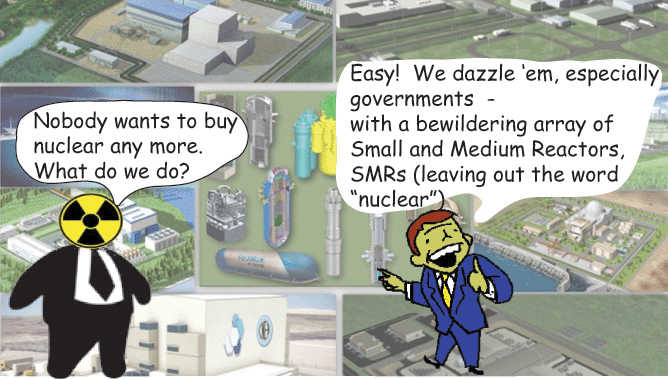
Yesterday the nuclear nations pushed the fantasy of Small Modular Nuclear Reactors
William Sanford. 25 January 2020
Faux News “The Five” tried to push the Safe SMR Narrative just yesterday. Complete nonsense on the Climate Crisis shows how doubling down on stupid (and old) technology is a last resort effort to preserve their doomed industry.
Sweden, Switzerland, and Germany all announced increased rates of decommissioning. Add Spain, Italy, as USA continues to hide, censor, and deflect the TRUTH. The IAEA playbook directly from Vienna …and the worst part is many “climate activists” actually buy into the false narrative that nuclear energy is “carbon free.”
The ‘Nuclear Cycle’ uses huge amounts of gas/diesel. From pulling uranium out of the ground to enrichment, use, removal, dry cask ops, and delivery to a repository, LOTS of petroleum. And NO, nuke plants DO NOT RUN on their own power. 1.7 !illion cancers annually worldwide AS A direct result of nuclear power plants directly from the IAEA/NRC.
In UK “deep disposal” is planned for the mounting, costly and forever problem of nuclear wastes
 How To Solve Nuclear Energy’s Biggest Problem https://oilprice.com/Alternative-Energy/Nuclear-
 Power/How-To-Solve-Nuclear-Energys-Biggest-Problem.html By Haley Zaremba – Jan 22, 2020, Nuclear waste is a huge issue and it’s not going away any time soon–in fact, it’s not going away for millions of years. While most types of nuclear waste remain radioactive for mere tens of thousands of years, the half-life of Chlorine-36 is 300,000 years and neptunium-237 boasts a half-life of a whopping 2 million years.
All this radioactivity amounts to a huge amount of maintenance to ensure that our radioactive waste is being properly managed throughout its extraordinarily long shelf life and isn’t endangering anyone. And, it almost goes without saying, all this maintenance comes at a cost. In the United States, nuclear waste carries a particularly hefty cost.
Last year, in a hard-hitting expose on the nuclear industry’s toll on U.S. taxpayers, the Los Angeles Times reported that “almost 40 years after Congress decided the United States, and not private companies, would be responsible for storing radioactive waste, the cost of that effort has grown to $7.5 billion, and it’s about to get even pricier.”
How much pricier? A lot. “With no place of its own to keep the waste, the government now says it expects to pay $35.5 billion to private companies as more and more nuclear plants shut down, unable to compete with cheaper natural gas and renewable energy sources. Storing spent fuel at an operating plant with staff and technology on hand can cost $300,000 a year. The price for a closed facility: more than $8 million, according to the Nuclear Energy Institute.”
With the United States as a poster child of what not to do with your nuclear waste, the United Kingdom is taking a much different tack. The UK is currently undertaking what the country’s Radioactive Waste Management (RWM) department says “will be one of the UK’s largest ever environmental projects.” This nuclear waste storage solution comes in the form of a geological disposal facility (GDF), a waste disposal method that involves burying nuclear waste deep, deep underground in a cocoon of backfill, most commonly comprised of bentonite-based cement. This type of cement is able to absorb shocks and is ideal for containing radioactive particles in case of any failure. The GDF system would also be at such a depth that it would be under the water table, minimizing any risk of contaminating the groundwater.
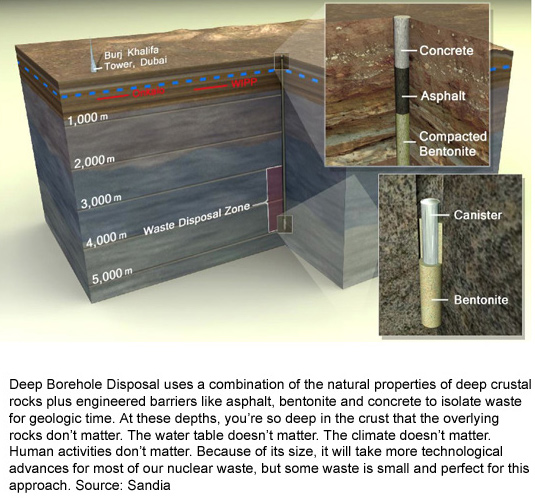
According to reporting from Engineering & Technology, nuclear waste is a mounting issue in Europe and in the UK in particular. “Under European law, all countries that create radioactive waste are obliged to find their own disposal solutions – shipping nuclear waste is not generally permitted except in some legacy agreements. However, when the first countries charged into nuclear energy generation (or nuclear weapons research), disposal of the radioactive waste was not a major consideration. For several of those countries, like the UK, that is now around 70 years ago, and the waste has been ‘stored’ rather than disposed of. It remains a problem.”
In fact, not only does it remain a problem, it is a mounting problem. As nuclear waste has been improperly or shortsightedly managed in the past, the current administration can no longer avoid dealing with the issue. In the past the UK used its Drigg Low-Level Waste Repository on the Cumbrian Coast to treat low and intermediate level waste, but now, thanks to coastal erosion, the facility will soon begin leeching radioactive materials into the sea, although that might not be quite as scary as it sounds.
Back in 2014, the Environment Agency raised concerns that coastal erosion could result in leakage from the site within 100 to 1,000 years, although it was counter-claimed that the levels of radioactivity after such a time would be low enough to be harmless,” Engineering & Technology writes. “This would definitely not be the case for high-level wastes, where radioactivity could remain a hazard into and beyond the next ice age, hence the need for longer-term disposal.”
Where exactly will that longer-term disposal be based? That’s up for debate. And it won’t be an easy thing to decide, as the RWM says that they will need a community to volunteer to be involved in such a costly, lengthy, and potentially unpopular project. And it’s not just an issue for the current inhabitants of potential locations in the UK, but for many generations to come over the next tens of thousands of years of radioactivity
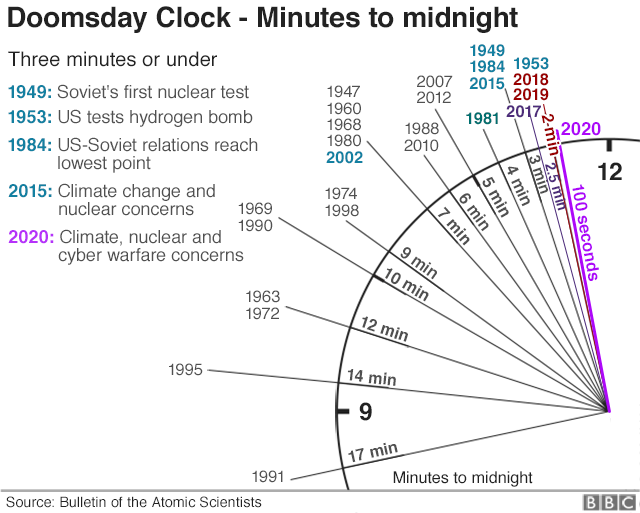
Doomsday clock now closest ever to midnight, due to climate and nuclear dangers
|
Doomsday Clock nears apocalypse over climate and nuclear fears, BBC, 23 Jan 2020, The symbolic Doomsday Clock, which indicates how close our planet is to complete annihilation, is now only 100 seconds away from midnight.The Bulletin of the Atomic Scientists (BAS) said on Thursday that the change was made due to nuclear proliferation, failure to tackle climate change and “cyber-based disinformation”.
The clock now stands at its closest to doomsday since it began ticking. Last year the clock was set at two minutes to midnight – midnight symbolises the end of the world – the same place it was wound to in 2018…….. The idea began in 1947 to warn humanity of the dangers of nuclear war……….. https://www.bbc.com/news/world-us-canada-51213185 |
|
USA’s National Nuclear Security Administration (NNSA) spurns environmental assessment for plutonium cores
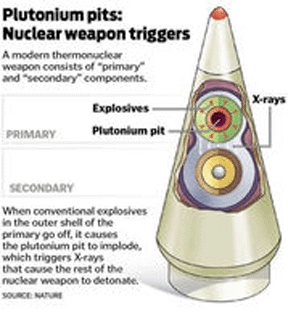
 NNSA Says No EIS Needed to Expand LANL Pit Production, http://nuclearactive.org/ January 24th, 2020 The Department of Energy’s semi-autonomous agency, the National Nuclear Security Administration (NNSA), has determined that a full environmental impact statement is not needed to increase the number of triggers for nuclear weapons manufactured at Los Alamos National Laboratory (LANL) by 50 percent – from 20 to 30. Since 1997, DOE has limited production to 20 triggers, or plutonium pits, per year. Nevertheless, since that time, LANL has not produced anything near 20 pits per year – the most in one year was six. Safety and seismic issues have shut down production for years. Even so, LANL is the only U.S. location for such work. Critics oppose the decision and have stated that litigation may result. NNSA Says No EIS Needed to Expand LANL Pit Production, http://nuclearactive.org/ January 24th, 2020 The Department of Energy’s semi-autonomous agency, the National Nuclear Security Administration (NNSA), has determined that a full environmental impact statement is not needed to increase the number of triggers for nuclear weapons manufactured at Los Alamos National Laboratory (LANL) by 50 percent – from 20 to 30. Since 1997, DOE has limited production to 20 triggers, or plutonium pits, per year. Nevertheless, since that time, LANL has not produced anything near 20 pits per year – the most in one year was six. Safety and seismic issues have shut down production for years. Even so, LANL is the only U.S. location for such work. Critics oppose the decision and have stated that litigation may result.
In 2018, the current administration determined that the U.S. would increase pit production at LANL and begin production at the Savannah River Site, located in South Carolina. Savannah River has never produced plutonium pits, let alone the planned 50 per year. For Savannah River, NNSA has determined that it would follow the National Environmental Policy Act (NEPA) and issue a full environmental impact statement for public review and comment. The federal agencies have refused to conduct a programmatic environmental impact statement for operations at both facilities, including the transportation of nuclear materials between them. For LANL, NNSA said it would produce a supplemental analysis to the 2008 environmental impact statement. A supplemental analysis may not address the impacts of the 2011 Las Conchas fire, increased hexavalent chromium in the regional aquifer, and increased seismic danger on the Pajarito Plateau, which LANL occupies. The 1997 decision to limit the number of pits to 20 is the result of citizen litigation. The Natural Resources Defense Council (NRDC), based in Washington, DC, represented 39 citizens groups from around the country against DOE. CCNS was one of the citizen plaintiffs, along with Tri-Valley Communities Against a Radioactive Environment, or Tri-Valley CARES, located in Livermore, California, where the Lawrence Livermore National Laboratory, LANL’s “sister” nuclear weapons laboratory, is located. Marylia Kelley, Executive Director of Tri-Valley CAREs, said, “NNSA’s refusal to complete programmatic environmental review before plunging ahead with plans to more than quadruple the production authorization for plutonium bomb cores flies in the face of our country’s foundational environmental law, the [NEPA], and a standing federal court order mandating that the government conduct such a review. The order was obtained in prior litigation by [NRDC] on behalf of itself, Tri-Valley CAREs, and additional plaintiffs. Today, I find myself shocked but not surprised that NNSA would so flagrantly flout the law. [] My group stands ready to uphold NEPA and the specific court order.” http://www.trivalleycares.org/ For more information, please see the following documents [links provided by Nuclear Watch New Mexico]: NNSA’s Federal Register Notice of Availability for the final Supplement Analysis is available at https://www.govinfo.gov/content/pkg/FR-2020-01-08/pdf/2020-00102.pdf It provides succinct background. NNSA’s final Supplement Analysis is available at https://www.energy.gov/sites/prod/files/2020/01/f70/final-supplement-analysis-eis-0236-s4-sa-02-complex-transformation-12-2019.pdf The 1998 court order that requires DOE to prepare a supplemental PEIS when it plans to produce more than 80 pits per year is available as Natural Resources Defense Council v. Pena, 20 F.Supp.2d 45, 50 (D.D.C. 1998), https://law.justia.com/cases/federal/district-courts/FSupp2/20/45/2423390/ |
|
Greta Thunberg says climate demands ‘completely ignored’ at Davos
|
Greta Thunberg says climate demands ‘completely ignored’ at Davos, https://www.sbs.com.au/news/greta-thunberg-says-climate-demands-completely-ignored-at-davos 24 Jan 2020, Greta Thunberg says she isn’t surprised that calls to disinvest in fossil fuels have fallen on deaf ears at the World Economic Forum in Davos. Teenage climate activist Greta Thunberg said calls to the corporate elite meeting in Davos to immediately disinvest in fossil fuels had been ignored. “We had a few demands (coming into the World Economic Forum). Of course these demands have been completely ignored. We expected nothing less,” Thunberg told reporters in the Swiss ski resort on the last day of the conference. Thunberg was a highlight of the 50th edition of the conference, drawing massive attention including barbs by US Secretary Steven Mnuchin who on Thursday told the teen to go “study economics”. Asked about Mnuchin’s comments, the Swede said: “Of course it has no effect. We are being criticised like that all the time.” “If we cared about that, we would not be able to do what we do. We put ourselves in the spotlight.” The spat between Mnuchin and Thunberg underlined the tensions over climate change at the World Economic Forum (WEF) in Davos, where governments and major firms have come under pressure to act now on global warming. Asked about the 17-year-old’s demand for an immediate halt to investment in fossil fuels, Mnuchin said on Thursday: “Is she the chief economist? Who is she? I’m confused,” adding after a pause that it was “a joke”. “After she goes and studies economics in college, she can come back and explain that to us.” In a speech on Tuesday, US President Donald Trump castigated the “prophets of doom” that predict a climate “apocalypse”, in comments widely seen as an attack on Thunberg who sat in the audience. But either by accident or design, there was no meeting between Trump and Thunberg at the forum. |
|
2020 Olympic events worryingly close to radioactive areas

In an Olympic year, Japan faces decision over contaminated Fukushima water Aaron Sheldrick OKUMA, Japan (Reuters)24 Jan 2020, – At the wrecked Fukushima nuclear plant north of Tokyo, workers in protective suits are still removing radioactive material from reactors that melted down after an earthquake and tsunami knocked out its power and cooling nearly nine years ago.
On an exclusive tour of the plant, spread over 3.5 million square meters (865 acres), Reuters witnessed giant remote-controlled cranes dismantling an exhaust tower and other structures in a highly radioactive zone while spent fuel was removed from a reactor.
Officials from Tokyo Electric, which owns the plant, also showed new tanks to hold increasing amounts of contaminated water.
About 4,000 workers are tackling the cleanup, many wearing protective gear, although more than 90% of the plant is deemed to have so little radioactivity that no extra precautions are needed. Photography was highly restricted and no conversations were allowed with the workers.
Work to dismantle the plant has taken nearly a decade so far, but with Tokyo due to host the Olympics this summer – including some events less than 60 km (38 miles) from the power station – there has been renewed focus on safeguarding the venues…….
The buildup of contaminated water has been a sticking point in the cleanup, which is likely to last decades, and has alarmed neighboring countries. In 2018, Tepco said it had not been able to remove all dangerous material from the water – and the site is running out of room for storage tanks.
Officials overseeing a panel of experts looking into the contaminated water issue said in December choices on disposal should be narrowed to two: either dilute the water and dump it in the Pacific Ocean, or allow it to evaporate. The Japanese government may decide within months, and either process would take years to complete, experts say……..
Athletes from at least one country, South Korea, are planning to bring their own radiation detectors and food this summer.
Baseball and softball will be played in Fukushima City, about 60 km (38 miles) from the destroyed nuclear plant. The torch relay will begin at a sports facility called J-Village, an operations base for Fukushima Daiichi in the first few years of the disaster, then pass through areas near the damaged station on its way to Tokyo.
In December, Greenpeace said it found radiation “hotspots” at J-Village, about 18km south of the plant.
When Tokyo won the bid to host the 2020 Summer Olympics Prime Minister Shinzo Abe declared that Fukushima was “under control” in his final pitch to the International Olympic Committee.
In 2016, the Japanese government estimated that the total cost of plant dismantlement, decontamination of affected areas, and compensation would be 21.5 trillion yen ($195 billion) – roughly a fifth of the country’s annual budget at the time.
(Reporting by Aaron Sheldrick: Editing by Gerry Doyle) https://mobile.reuters.com/article/amp/idUSKBN1ZK0CV?__twitter_impression=true
Rolls Royce’s fantasy plan for so-called ‘mini’ nuclear reactors

|
Rolls-Royce plans mini nuclear reactors by 2029 https://www.bbc.com/news/business-51233444 By Roger Harrabin & Katie Prescott, BBC environment analyst and business reporter, 24 January 2020
Mini nuclear reactors could be generating power in the UK by the end of the decade. Manufacturer Rolls-Royce has told the BBC’s Today programme that it plans to install and operate factory-built power stations by 2029. Mini nuclear stations can be mass manufactured and delivered in chunks on the back of a lorry, which makes costs more predictable. But opponents say the UK should quit nuclear power altogether. They say the country should concentrate on cheaper renewable energy instead. Environmentalists are divided over nuclear power, with some maintaining it is dangerous and expensive, while others say that to achieve net zero emissions by 2050 all technologies are needed. However, the industry is confident that mini reactors can compete on price with low-cost renewables such as offshore wind. Rolls-Royce is leading a consortium to build small modular reactors (SMRs) and install them in former nuclear sites in Cumbria or in Wales. Ultimately, the company thinks it will build between 10 and 15 of the stations in the UK. They are about 1.5 acres in size – sitting in a 10-acre space. That is a 16th of the size of a major power station such as Hinkley Point. SMRs are so small that theoretically every town could have its own reactor – but using existing sites avoids the huge problem of how to secure them against terrorist attacks. It is a rare positive note from the nuclear industry, which has struggled as the cost of renewables has plummeted. In the past few years, major nuclear projects have been abandoned as Japanese companies Toshiba and Hitachi pulled out because they could not get the required funding. And the construction of Hinkley Point in Somerset could cost £3bn more than was expected, in an echo of the row over the rail mega-project HS2. “The trick is to have prefabricated parts where we use advanced digital welding methods and robotic assembly and then parts are shipped to site and bolted together,” said Paul Stein, the chief technology officer at Rolls-Royce.
He said the approach would dramatically reduce the cost of building nuclear power sites, which would lead to cheaper electricity. But Paul Dorfman from University College London said: “The potential cost benefits of assembly line module construction relative to custom-build on-site construction may prove overstated. “Production line mistakes may lead to generic defects that propagate throughout an entire fleet of reactors and are costly to fix,” he warned. “It’s far more economic to build one 1.2 GW unit than a dozen 100 MW units.” Rolls-Royce is hoping to overcome the cost barrier by selling SMRs abroad to achieve economies of scale. Its critics have warned that SMRs will not be ready in substantial numbers until the mid 2030s, by which time electricity needs to be carbon-free in the UK already to meet climate change targets. |
|

Sloppy safety and waste management at Electricite de France’s nuclear sites
 Improve Nuclear Plant Maintenance Works, Watchdog Says, Francois de Beaupuy, Bloomberg News (Bloomberg) 24 Jan 2020 — Electricite de France SA and its suppliers must improve maintenance operations at nuclear reactors and waste management because they have lost skills and become sloppy in recent years, the French nuclear safety authority said.
The warning reflects a string of incidents related to substandard manufacturing or installation of equipment at EDF and its suppliers. It underscores the difficulties the French nuclear giant faces in extending the lifetime of aging reactors and building new ones, prompting it to announce an action plan to revamp the industry’s skills.
“There’s a need to reinforce skills and some carelessness among some players in the industry,” Bernard Doroszczuk, chairman of Autorite de Surete Nucleaire, said at a press conference near Paris on Thursday. “There’s a lack of rigor in the oversight of safety by operators,” from manufacturing to welding to equipment tests “which must be corrected.”
Discussions are still going on with EDF regarding safety improvements, including ways to prevent or mitigate the impact outside its plants in case of a severe accident such as the meltdown of the radioactive fuel and its vessel, said Sylvie Cadet-Mercier, a commissioner of the regulator. A spokesman for the utility declined to comment…… https://www.bnnbloomberg.ca/edf-must-improve-nuclear-plant-maintenance-works-watchdog-says-1.1378571
USA Politicians on both sides sucked in by propaganda for fantasy new nuclear reactors


|
Reporter’s notebook: Nuclear reactors prove tough tech, despite
bipartisan push, https://www.houstonchronicle.com/business/energy/article/Reporter-s-notebook-Nuclear-reactors-prove-15000083.php
James Osborne Jan. 24, 2020 WASHINGTON – If there’s any clear area of agreement between Republicans and Democrats on climate change, it’s on the need to develop a new generation of nuclear power plants as quickly as possible. More precisely, it’s the need to bring down the multi-billion dollars costs of existing plants and create a meltdown-proof reactor that can run on recycled uranium and plutonium rods, which power companies and environmentalist alike can get behind. But getting bipartisan agreement on the need for those reactors has proven far easier than developing them, as companies look to overhaul a nuclear reactor design that has changed little since they first began operation in the United States in the 1950s. One year after the Senate passed a law requiring the government’s leading nuclear authority, the Nuclear Regulatory Commission, to overhaul its processes for approving nuclear power plants to account for the new reactors, senators are already beginning to exhibit impatience. At a hearing earlier this month, Sen. Sheldon Whitehouse, a Rhode Island Democrat, quizzed NRC officials about why they thought the Senate passed the law. When one of them said, “You really want me to guess,” he responded: “I would hope you would know, that it would be so clear why we gave you this power.” Two-fer The point, Whitehouse said, is to create a new carbon-free energy source that could also be fueled by the growing stockpiles of spent nuclear rods at reactors around the country, ending a decades-long debate about where to dispose of them. “I don’t know if that’s going to pan out, but people who are very smart and have invested millions of dollars tell me that is their intention,” Whitehouse said. “We want to see that focus on turning that waste into something positive.” With backers like billionaire Bill Gates, a wave of startups is trying to develop a reactor that uses materials such as molten salt or liquid metal to cool itself — instead of water — allowing a reactor that loses power to cool down on its own. But so far only one company, California-based Oklo, is ready to submit plans for its reactor to the NRC for review, said Scott Burnell, a spokesman for the agency. |
|
|
Mayor in Kyushu admits to ‘bribe’ from company in nuclear business
 Mayor in Kyushu admits to ‘bribe’ from company in nuclear business, THE ASAHI SHIMBUN, January 24, 2020 GENKAI, Saga Prefecture–The mayor here said Jan. 23 that he received–but returned–what he suspected was a bribe from a contractor tied to an individual known to have lavished gifts on nuclear power company executives.Shintaro Wakiyama, 63, said at a news conference at the Genkai town office that he received “about 1 million yen ($9,140)” from Shiohama Industry Corp. in July 2018, immediately after he was elected mayor for the first time. Mayor in Kyushu admits to ‘bribe’ from company in nuclear business, THE ASAHI SHIMBUN, January 24, 2020 GENKAI, Saga Prefecture–The mayor here said Jan. 23 that he received–but returned–what he suspected was a bribe from a contractor tied to an individual known to have lavished gifts on nuclear power company executives.Shintaro Wakiyama, 63, said at a news conference at the Genkai town office that he received “about 1 million yen ($9,140)” from Shiohama Industry Corp. in July 2018, immediately after he was elected mayor for the first time.
He said he returned the money to the company, which is based in Tsuruga, Fukui Prefecture, through an acquaintance in December 2019. Wakiyama also said he recently learned that the acquaintance had died soon after the money was returned, but he did not provide any details about the intermediary……… Several executives related to nuclear power operations at Kansai Electric Power Co. have resigned for receiving cash and other presents from Moriyama. They said he had demanded contracts from the utility for his company…… http://www.asahi.com/ajw/articles/AJ202001240040.html |
|
January 24 Energy News — geoharvey

Opinion: ¶ “What The Minimum Offer Price Rule (MOPR) Means For Clean Energy In PJM” • PJM, which coordinates the movement of wholesale electricity in all or parts of 13 states and DC, submitted proposed MOPR values in its last filing as required by the Federal Energy Regulatory Commission. They will support fossil fuels and […]
Visualizing U.S. wars, coups, and interventions — limitless life
Visualizing U.S. wars, coups, and interventions Here are some lists of U.S. wars, proxy wars, coups, and interventions. I can add them to the interactive visualization of US military bases http://waliberals.org/bases/ . Perhaps clicking on a country on the globe could bring up a list of wars, and clicking on a war in said list could open […]
via Visualizing U.S. wars, coups, and interventions — limitless life
Australian bushfires drive up global emissions as economic costs mount — RenewEconomy

Australian bushfires to drive global greenhouse gas concentrations to new records, as more than half of Australians report experiencing bushfire impacts. The post Australian bushfires drive up global emissions as economic costs mount appeared first on RenewEconomy.
via Australian bushfires drive up global emissions as economic costs mount — RenewEconomy
Australia singled out for climate denial as “Doomsday Clock” ticks closer to midnight — RenewEconomy

“Doomsday Clock” moved to 100 seconds to midnight as Morrison government is slammed for “mendacious” climate denial. The post Australia singled out for climate denial as “Doomsday Clock” ticks closer to midnight appeared first on RenewEconomy.
via Australia singled out for climate denial as “Doomsday Clock” ticks closer to midnight — RenewEconomy
Solar, storage, and wind tipped as top energy job generators — RenewEconomy

A new study has shown that the global solar PV, battery storage, and wind power sectors will serve as the major job creating technologies by 2050. The post Solar, storage, and wind tipped as top energy job generators appeared first on RenewEconomy.
via Solar, storage, and wind tipped as top energy job generators — RenewEconomy
1 This Month

of the week – Shut Down Drone Warfare!


Tell the Ukrainian Government to Drop Prosecution of Peace Activist Yurii Sheliazhenko

Petition to revoke the licensing of the Near Surface Nuclear Disposal Facility (NSDF) at Chalk River. https://www.ourcommons.ca/petitions/en/Petition/Details?Petition=e-7247
To see nuclear-related stories in greater depth and intensity – go to https://nuclearinformation.wordpress.com
-
Archives
- April 2026 (91)
- March 2026 (251)
- February 2026 (268)
- January 2026 (308)
- December 2025 (358)
- November 2025 (359)
- October 2025 (376)
- September 2025 (257)
- August 2025 (319)
- July 2025 (230)
- June 2025 (348)
- May 2025 (261)
-
Categories
- 1
- 1 NUCLEAR ISSUES
- business and costs
- climate change
- culture and arts
- ENERGY
- environment
- health
- history
- indigenous issues
- Legal
- marketing of nuclear
- media
- opposition to nuclear
- PERSONAL STORIES
- politics
- politics international
- Religion and ethics
- safety
- secrets,lies and civil liberties
- spinbuster
- technology
- Uranium
- wastes
- weapons and war
- Women
- 2 WORLD
- ACTION
- AFRICA
- Atrocities
- AUSTRALIA
- Christina's notes
- Christina's themes
- culture and arts
- Events
- Fuk 2022
- Fuk 2023
- Fukushima 2017
- Fukushima 2018
- fukushima 2019
- Fukushima 2020
- Fukushima 2021
- general
- global warming
- Humour (God we need it)
- Nuclear
- RARE EARTHS
- Reference
- resources – print
- Resources -audiovicual
- Weekly Newsletter
- World
- World Nuclear
- YouTube
-
RSS
Entries RSS
Comments RSS
 nuclear-news