Debunking James Hansen’s claims in favour of nuclear power
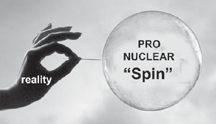 John Wayne squares off against Jim Hansen, Medium, Albert Bates, 11 Jan 2020 “……. I greatly admire James Hansen ……. What annoys me, however, about Hansen, then and now, is his insistence, in utter disregard of best science, that nuclear energy can somehow save humanity from climate change because it is clean, safe, too cheap to meter and besides all that, is carbon-free. I watched with pity more than scorn when he took his time to repeat this nonsense at the recent UN climate conference in Madrid. He mounted fallacy upon fallacy in a pyramid of lies that had been heard since the 1940s coming from the Atomic Energy Commission, Nuclear Regulatory Commission, International Atomic Energy Agency and others in thrall to the atomic devil.
“. . . the genetic effect has no threshold and exposure is not only cumulative in the individual, but in succeeding generations. On this basis, there would be no tolerance dose, but rather an acceptable injury-limit.”[Parker, H.M., Instrument ation and Radiation Protection (March, 1947), Health Physics, 38:957,970, June 1980]
and:
“Even sub-tolerance radiations produce certain biological changes (cosmic rays are supposed to have some biological effects), so tolerance radiation is not what one strives to get but the maximum permissible dose.”[Morgan, K.Z., The Responsibilities of Health Physics, The Scientific Monthly, 93 (August 1946); reprinted in Health Physics 38:949–952, June 1980.]
The question of what percentage of the population can be acceptably damaged came first to the attention of the AEC at a meeting of the Advisory Committee on Biology and Medicine on January 16–19,1957. At this meeting the AEC advisors determined that a 20 percent increase in the rate of bone cancers and birth defects nationwide would be an “acceptable” effect of U.S. nuclear weapons testing activities. These scientists also acknowledged at this time that the long-term genetic effects were totally unknown.
The historical record indicates that prominent radiologists, health physicists, and geneticists of the time recognized even at the outset of America’s atomic power program that any large population exposure to even very minute amounts of ionizing radiation could create lingering public health problems and genetic damage, and these scientists went to some lengths, including sacrificing their own illustrious careers, to express their views publicly. [ long list of references given here]
[ discusses Fukushima]
….. atmospheric physicists should not opine on health physics. There is no dose of radiation below which there is not a negative biological effect. Indeed, there is a “superlinear” ratio of dose to effect at low doses, because doses that do not kill a cell cause genetic damage that is a larger health threat than dead cells, so humans and animals exposed to low doses are at greater health risk than those exposed to higher doses.
While there are hundreds of different radioactive isotopes within a nuclear reactor, the isotope Cesium-137 is easily measured and has become a standard by which to calculate impacts. During the two-day accident, 18 quadrillion becquerels of cesium were released into the Pacific (18 with 15 zeros). A typical abdominal or pelvic CT scan (the most often performed) is 14–18 thousandths of a becquerel, so during the accident the cesium dose to the environment was the same as about 1 quintillion (1 with 18 zeros) CT scans (repeated every second, continuously, for the next 300 to 600 years). Depending on the type of scan and the age and sex of the patient, a single CT scan will produce 1 cancer for 150 to 3300 exposures, or a median risk of 10 cancers per becquerel (or seivert). [table here on original]
By that calculation, the cesium released during the Fukushima accident was capable of causing roughly 10 quadrillion cancers, but with one important difference.
When you receive radiation treatment like a CT-scan it is sudden and one-off. One second. The technician presses the button and it is on and then off. There is no danger from the machine when it is off. When radioactive elements like cesium-137 (and remember that is just one of hundreds of elements in a nuclear reactor) are released to the environment, there is no off-switch. Thus, the cesium released during the Fukushima accident is capable of roughly 10 quadrillion cancers per second. Inhaling or ingesting it can kill a person, a dolphin or a seagull, but then as the individual’s body decomposes after death — as bacteria, worms and fungi eat away the flesh and bone — the isotope goes back into the food chain to strike another individual, and another, and so on. The danger is limited only by the isotope’s half-life — the time it takes to decay to a harmless element, which for cesium-137 is 30.17 years. Scientists generally use 10 or 20 half-lives to bracket safety concerns, so for cesium 137, “safe” levels arrive in 302 to 604 years (around year 2322 to year 2624), admittedly an imperfect measurement since any residue, no matter how microscopic, may still be lethal, as we have known since before the Manhattan Project. Cesium is one of 256 radionuclides released during Fukushima, so we would need to calculate quantities, biological effectiveness, and the decay time of each of those to get the full health picture. Other isotopes in the Fukushima fuel include Uranium-235, with a half-life of 704 million years, and Uranium-238, with a half-life of 4.47 billion years, or longer than the age of the Earth.
At Fukushima, the end of the accident was not the end of the story. In 2013, 30 billion becquerels of cesium-137 were still flowing into the ocean every day from the damaged and leaking reactor cores. That is 300 billion cancer doses per second of man-made cesium added every day, or 109.5 trillion cancer doses per second added every year. To stop this assault on ocean life, and our own, over the next 5 years the owner of the plant constructed more than 1000 tanks to hold contaminated water away from the ocean. In September 2019, the Japanese government announced that more than one million tons were in storage but that space would run out by the summer of 2022 so it planned to begin releasing those billions of bequerels to the ocean again.Swimmers and sailors who plan to compete in open water events at the 2020 Tokyo Olympics might want to think about that, as might any who fish those waters or consume the catch.
What happens to ocean creatures who ingest radionuclides from leaking nuclear power plants is not very different from what happened to John Wayne, his sons and his co-stars. As the isotopes decay within the body of a dolphin or a coral polyp they send microscopic bullets hurling through DNA chains, causing tumors, sicknesses, defective offspring and death for untold generations. The chance that a single mutation will produce a beneficial result are less than one in a million. Radioactivity is, for practical purposes, forever, as we can see just by looking up at our Sun, a benevolent nuclear reactor providing us energy from the relatively safe distance of 93 million miles.
Even that radiation will kill a number of us, but far fewer than would die if, by some devilish plan or panic response, we follow Dr. Hansen’s advice. https://medium.com/@albertbates/john-wayne-squares-off-against-jim-hansen-42a258b2260d
Climate change afflicting the health of the world’s children
 Warning: Climate change will bring major new health risks for kids https://thebulletin.org/2020/01/warning-climate-change-will-bring-major-new-health-risks-for-kids/?utm_source=Newsletter&utm_medium=Email&utm_campaign=MondayNewsletter01202020&utm_content=ClimateChange_HealthRisks_01172020#
By Kathleen E. Bachynski, January 17, 2020 As we enter a new decade, headlines from across the world make all too clear that the effects of climate change are not just looming. They’re here, they’re now, and they’re devastating communities on every continent. For example, in Australia, unprecedented fires have emitted roughly 400 million tons of carbon, killed at least 25 people, and destroyed 2,000 homes. In Indonesia, terrible flooding has killed at least 67 people and caused 400,000 to abandon their homes. The loss of sea ice in the Arctic is shrinking access to food resources that numerous indigenous communities have depended on for generations.
But the health effects of climate change go beyond even the most immediate and obvious consequences of fires, floods, and melting ice. In November 2019, the medical journal The Lancet published a detailed report examining the effects that climate change will have on human health under two scenarios: one in which the world reins in emissions according to commitments laid out in the Paris agreement, and one in which the world does not. In both cases, children will be most vulnerable to the numerous health harms resulting from decisions made by their parents and grandparents. Children are particularly likely to suffer the effects of climate change for numerous reasons: Their immune and organ systems are still developing, they drink relatively more water and breathe in more air than do adults relative to their body weight, and they tend to spend more time outdoors. Understanding the full scope of the public health consequences of a changing climate, then, involves examining how the risks will affect the bodies of the youngest people.
According to the Lancet report, air pollution—specifically, exposure to fine particulate matter known as PM 2.5—represents the largest environmental risk factor for premature deaths across the globe. When people think of the public health effects of air pollution, they often imagine the worst-case scenarios. For example, the smoke from the fires in Australia is currently so severe that a day spent inhaling the air in east Sydney represents the equivalent of smoking 19 cigarettes.
But air pollution need not reach such extreme levels to cause serious harm. Far more commonly, people are unaware of the daily pollution that they are breathing in due to the burning of fossil fuels, such as coal and gas. In fact, more than 90 percent of children are exposed to concentrations of PM 2.5 higher than the World Health Organization’s guidelines on outdoor air pollution. Over a lifetime, unhealthy air damages lungs and increases risks for a host of diseases, from asthma to pneumonia. And due to their small body size and the factors cited above, children absorb more of this pollution than do adults.
Similarly, The Lancet report notes that children are particularly vulnerable to the effects of heat. Specifically, young children are at greater risk for experiencing electrolyte imbalance, fever, respiratory disease, and kidney disease during periods of extreme heat. Rates of heat-related deaths are four times higher among children younger than one year old as compared to people aged 1-to-44. Changing temperature and precipitation patterns are also influencing the transmission of disease from insects to humans. In particular, malaria and dengue are spread by mosquitoes, and climate suitability for transmission of these diseases is increasing in numerous parts of the world. Because children tend to spend more time outdoors, they are more likely to contract these diseases. In 2017, children accounted for 61 percent of all malaria deaths worldwide, and climate change is putting more children at even greater risk.
Changing climate patterns, droughts, and fires also threaten to reduce crop yields and increase food insecurity. Moreover, rising carbon dioxide appears to diminish the nutrient quality of crucial staple foods such as wheat and rice. Combined, these trends are likely to exacerbate the already serious global health problem of malnutrition, which currently accounts for nearly one-fifth of premature deaths and poor health globally. The consequences of malnutrition are particularly severe among children. In 2018, 22 percent of children under five years of age were stunted, meaning they experienced impaired growth and development. Stunting is largely irreversible and includes serious consequences, from poorer cognition to increased risk of nutrition-related chronic diseases later in life.
Finally, The Lancet report observes that climate change has other health implications that are more challenging to quantify but crucial to address, such as mental health effects. Researchers have found that children are at high risk of mental health problems following the types of natural disasters that are likely to increase due to climate change. For example, one study found that 31 percent of a group of children who were evacuated during Hurricane Katrina reported clinically significant symptoms associated with depression and Post Traumatic Stress Disorder. According to the Centers for Disease Control, children are at particular risk for stress after a disaster because they often understand less about what is occurring, feel less able to control events, and have less experience coping with difficult situations.
Protecting children from air pollution, heat-related deaths, infectious diseases, malnutrition, and mental health effects associated with climate change will involve the mobilization of all sectors of society to drastically reduce emissions and invest in health systems and infrastructure. The Lancet report notes a few promising signs, such as increased public and political engagement, and increasing health adaptation spending to improve communities’ resilience to a changing climate. Unfortunately, however, current efforts are falling far short of what is needed to meaningfully reduce carbon emissions on the scale needed to address the threat posed to human health. According to a 2019 United Nations report, greenhouse gas emissions must begin falling by 7.6 percent this year in order to meet the most ambitious goals laid out in the 2015 Paris climate accord. But the world is nowhere near this goal, and many countries are heading in the opposite direction. Notably, in 2018, energy-related carbon dioxide emissions rose by 2.7 percent in the United States. The United Nations has warned that every year of delay “brings a need for faster cuts, which become increasingly expensive, unlikely, and impractical.”
Waiting until action becomes more difficult, or perhaps even impossible, has appalling moral consequences. The longer we fail to act to address the risks of climate change, the more human lives we place on the line. And the majority of those lives will belong to the most vulnerable among us. It is no wonder, then, that children across the world have taken the lead in advocating for urgent, necessary action. The public health stakes for them—and for all people—grow higher with each passing year. Our health is fundamentally tied to our planet’s health. We must all consider, then, what actions we need to take to protect our planet—and thereby our communities, our children, and our selves.
Watch the 2020 Doomsday Clock Announcement on January 23
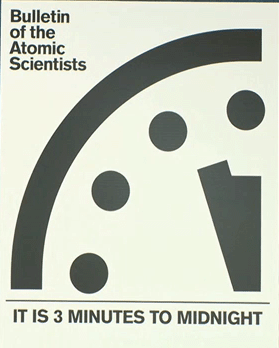 Watch the 2020 Doomsday Clock Announcement on January 23By Gayle Spinazze, January 8, 2020 The Bulletin of the Atomic Scientists will host a live international news conference at 10 a.m. EST/1500 GMT on Thursday, January 23, 2020, to announce the 2020 time of the Doomsday Clock. The news conference will take place at the National Press Club in Washington, D.C. Watch the announcement live on our website or on our Facebook page………. https://thebulletin.org/2020/01/watch-the-2020-doomsday-clock-announcement/?utm_source=Newsletter&utm_medium=Email&utm_campaign=ThursdayNewsletter01092020&utm_content=DoomsdayClock_ClockEvent_01082020
Report shows that most young adults fear a nuclear attack this decade
 More than half the world’s millennials fear a nuclear attack this decade More than half the world’s millennials fear a nuclear attack this decadeThe International Committee of the Red Cross released an astounding report. Vox, By Alex Ward@AlexWardVoxalex.ward@vox.com Jan 20, 2020 A majority of millennials around the world believe it’s more likely than not that a nuclear attack will happen sometime in the next 10 years — a sign that younger adults’ views on global affairs is exceedingly bleak. The International Committee of the Red Cross, a worldwide humanitarian organization, surveyed 16,000 millennials — adults between the ages of 20 and 35 — in 16 countries and territories last year: Afghanistan, Colombia, France, Indonesia, Israel, Malaysia, Mexico, Nigeria, Palestinian Territories, Russia, South Africa, Syria, Switzerland, the United Kingdom, Ukraine, and the United States. Half of those nations are experiencing conflict right now, while the other half are fortunately in peace. Based on the results released last week, this demographic is worried about what the future holds. “More than half of millennials — 54 percent — believe it is likely that a nuclear attack will occur in the next decade,” reads the report. Those questioned in Malaysia are the most likely to fear a nuclear device going off soon, while Syrians are the least likely to worry about that. However, respondents said that nuclear weapons were the least concerning of the 12 different issues they were asked to rank, with corruption topping the list followed by unemployment and increasing poverty. Still, the fear of a nuclear attack seems to be a trend. A January 2018 World Economic Forum survey of 1,000 leaders from government, business, and other industries, for example, identified nuclear war as a top threat. The worldwide shudder is understandable. The chance of a nuclear conflict between the US and North Korea isn’t entirely gone. India and Pakistan, two nuclear-armed enemies, could rekindle their decades-long squabble at any time. And the US and Russia — the world’s foremost nuclear powers — have had warheads pointed at each other since the earliest days of the Cold War……… https://www.vox.com/2020/1/20/21070621/millennials-survey-nuclear-world-war-3-red-cross |
|
In Turkey, renewable energy rising, as nuclear partnership with Japan is scrapped
|
Turkey, Japan scrap partnership in Sinop nuclear plant in Turkey’s north, Hurriyet Daily News, 20 Jan 2020, Turkey is reassessing its major partner for the country’s second nuclear plant in the Black Sea province of Sinop, Energy Minister Fatih Dönmez said on Jan. 19.In an interview with state-run Anadolu Agency, Dönmez said that the time schedule and pricing of the nuclear power plant in Sinop fell short of the ministry’s expectations after the results of feasibility studies, carried out by Japanese Mitsubishi Heavy Industries, Ltd., came out.
“We agreed with the Japanese side to not continue our cooperation regarding this matter,” Dönmez said…….. An intergovernmental agreement was signed between Turkey and Russia in May 2010 for Akkuyu NPP, the first nuclear plant of Turkey that will have four VVER-1200 power reactors with a total installed capacity of 4,800 megawatts. …… Share of local and renewable energy increases to 62 pct Dönmez also said Turkey saw an increase in the share of local and renewable resources for the country’s electricity production. Electricity production from local and renewables sources in 2019 amounted to 62 percent compared to 49 percent in 2018, a 13 percent increase, he further elaborated……… http://www.hurriyetdailynews.com/turkey-japan-scrap-partnership-in-sinop-nuclear-plant-in-turkeys-north-151212 |
|
Vast swarm of locusts ruining the livelihood of 1000s in East Africa
Locust swarm 37 miles long and 25 miles wide threatens crops across swathes of east Africa, ITV News, 17 Jan 2020, A swarm of locusts measured at 37 miles long and 25 miles wide has been tracked in Kenya – and the insects are now threatening to decimate crops across swatches of east Africa.
The most serious outbreak of desert locusts in 25 years is posing an unprecedented threat to food security in some of the world’s most vulnerable countries, authorities say.
Unusual climate conditions are partly to blame.
Kenya’s Intergovernmental Authority on Development said: “A typical desert locust swarm can contain up to 150 million locusts per square kilometre.
“Swarms migrate with the wind and can cover 100 to 150 kilometres in a day. An average swarm can destroy as much food crops in a day as is sufficient to feed 2,500 people.”
Roughly the length of a finger, the insects fly together by the millions and are devouring crops and forcing people in some areas to bodily wade through them.
The outbreak of desert locusts, considered the most dangerous locust species, also has affected parts of Somalia, Ethiopia, Sudan, Djibouti and Eritrea and IGAD warns that parts of South Sudan and Uganda could be next.
The “extremely dangerous” outbreak is making the region’s bad food security situation worse, the United Nations’ Food and Agriculture Organisation has warned.
Hundreds of thousands of acres of crops have been destroyed……. https://www.itv.com/news/2020-01-17/locust-swarm-37-miles-long-and-25-miles-wide-threatens-crops-across-swathes-of-east-africa/?fbclid=IwAR1cn3AzYPruUHLGk_0dgXtQvDvh9bjrehBk7AeCTXeru2AjLKdlmmrYz_g
New report: China soon to join countries where renewables are cheaper than coal
Oil Price 19th Jan 2020, In September of last year Oilprice reported an incredible milestone for renewable energy when solar and wind power became cheaper than coal in most of the world. Now, a new report released this week by Wood Mackenzie Power and Renewables has heralded another milestone: China will soon be added to that list of countries in which coal is no longer more economical than renewable energy.
The “Power of the Purse” Belongs to the US Congress According to the Constitution – Not with the President

“Congress—and in particular, the House of Representatives—is invested with the “power of the purse,” the ability to tax and spend public money for the national government. Massachusetts’ Elbridge Gerry said at the Federal Constitutional Convention that the House “was more immediately the representatives of the people, and it was a maxim that the people ought to hold the purse-strings.””
For this reason, it has been argued that the Speaker of the US House is the most powerful person in the government, because that person wields so much control over the “power of the purse”. This not only is rooted in the US Constitution, but is rooted in British tradition.
“Power of the Purse
Historical Highlight
July 24, 1789
“All Bills for raising Revenue shall originate in the House of Representatives; but the Senate may propose or concur with amendments as on other Bills.”
— U.S. Constitution, Article…
View original post 974 more words
Trump’s Unprecedented Attack on Iran and the Rule of Law — limitless life

Trump’s Unprecedented Attack on Iran and the Rule of Law FacebookTwitterPinterestRedditShare The assassination of Iranian major general Qassem Soleimani on Jan. 3 in Baghdad is what happens when the steady erosion of congressional war-making powers intersects with the tenancy of a madman in the Oval Office. I know. Soleimani was, to invoke the parlance of another grossly […]
via Trump’s Unprecedented Attack on Iran and the Rule of Law — limitless life
January 20 Energy News — geoharvey

Science and Technology: ¶ “Fires Set Stage For Irreversible Forest Losses In Australia” • Before the wildfires, ecologists divided up Australia’s native vegetation into two categories: fire-adapted landscapes that burn periodically, and those that don’t burn. Now, that distinction lost meaning. Even rainforests and peat swamps caught fire, likely changing them forever. [The Denver Post] […]
President Trump made 16,241 false or misleading claims in his first three years — limitless life
President Trump made 16,241 false or misleading claims in his first three years Add to list President Trump has made more than 16,200 false or misleading claims | Fact Checker The Fact Checker is keeping a running list of the false or misleading claims Trump says most regularly. Here’s what you need to know. (Meg […]
via President Trump made 16,241 false or misleading claims in his first three years — limitless life
The age of the individual must end – our world depends on it
Marie Curie’s illness and death caused by ionising radiation
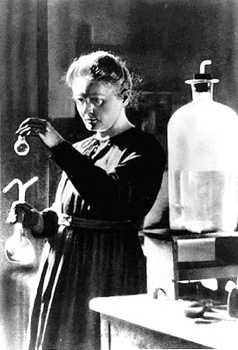 John Wayne squares off against Jim Hansen, Medium, Albert Bates, 11 Jan 2020 “…….. In 1896, Henri Becquerel discovered that uranium emitted rays that resembled X-rays. Marie Curie suspected that the radiation was not the outcome of some interaction but came from the atom itself. Her work with uranium disproved the conventional wisdom going back to ancient Greece that atoms were indivisible and set up the later discovery of subatomic particles. Curie discovered that thorium, radium, polonium and radioactive bismuth occurred naturally with uranium. Radium was known to glow in the dark, which made it useful for painting the hour and minute hands on watches and clocks. It was later discovered that radium “radiated” more than just neutrons, but also protons and electrons, becoming another unstable element, radon, and that element radiated its subatomic particles to become others, polonium and bismuth, until those eventually became a stable element, lead. Indeed, the radium Curie discovered was the progeny of another unstable element, thorium, which was the progeny of yet another unstable element, uranium.
Madame Curie was a physicist, not a medical doctor, so she did not recognize the health effects of handling uranium, thorium, radium and the other radionuclides. Indeed, she suspected the effects would be beneficial. One of the papers she and her husband published in the late 19th century announced that, when exposed to radium, diseased, tumor-forming cells were destroyed faster than healthy cells (the basis for today’s radio-chemotherapy). She carried test tubes containing radioactive isotopes in her pockets and stored them in her desk drawer. Although her many decades of exposure to radiation caused chronic illnesses (including near-blindness due to cataracts) and ultimately her death, she never acknowledged the inherent health risks. She likely did not recognize the symptoms when she began to feel weak and lose her hair. She died in 1934 from aplastic anemia without ever knowing that she fought the same mortal enemy as those who had painted the hands on watches and clocks, or those who had mined and processed the uranium on which she worked. After her death, and to this day, her papers and effects are too radioactive to be handled and her laboratory is unsafe to enter.also……..https://medium.com/@albertbates/john-wayne-squares-off-against-jim-hansen-42a258b2260d
1 This Month



Tell the Ukrainian Government to Drop Prosecution of Peace Activist Yurii Sheliazhenko

Petition to revoke the licensing of the Near Surface Nuclear Disposal Facility (NSDF) at Chalk River. https://www.ourcommons.ca/petitions/en/Petition/Details?Petition=e-7247


of the week – STOP SMALL MODULAR REACTORS IN CANADA
To see nuclear-related stories in greater depth and intensity – go to https://nuclearinformation.wordpress.com
-
Archives
- March 2026 (222)
- February 2026 (268)
- January 2026 (308)
- December 2025 (358)
- November 2025 (359)
- October 2025 (376)
- September 2025 (258)
- August 2025 (319)
- July 2025 (230)
- June 2025 (348)
- May 2025 (261)
- April 2025 (305)
-
Categories
- 1
- 1 NUCLEAR ISSUES
- business and costs
- climate change
- culture and arts
- ENERGY
- environment
- health
- history
- indigenous issues
- Legal
- marketing of nuclear
- media
- opposition to nuclear
- PERSONAL STORIES
- politics
- politics international
- Religion and ethics
- safety
- secrets,lies and civil liberties
- spinbuster
- technology
- Uranium
- wastes
- weapons and war
- Women
- 2 WORLD
- ACTION
- AFRICA
- Atrocities
- AUSTRALIA
- Christina's notes
- Christina's themes
- culture and arts
- Events
- Fuk 2022
- Fuk 2023
- Fukushima 2017
- Fukushima 2018
- fukushima 2019
- Fukushima 2020
- Fukushima 2021
- general
- global warming
- Humour (God we need it)
- Nuclear
- RARE EARTHS
- Reference
- resources – print
- Resources -audiovicual
- Weekly Newsletter
- World
- World Nuclear
- YouTube
-
RSS
Entries RSS
Comments RSS
 nuclear-news