Hazards of Russia’s nuclear colonialism- example South Africa
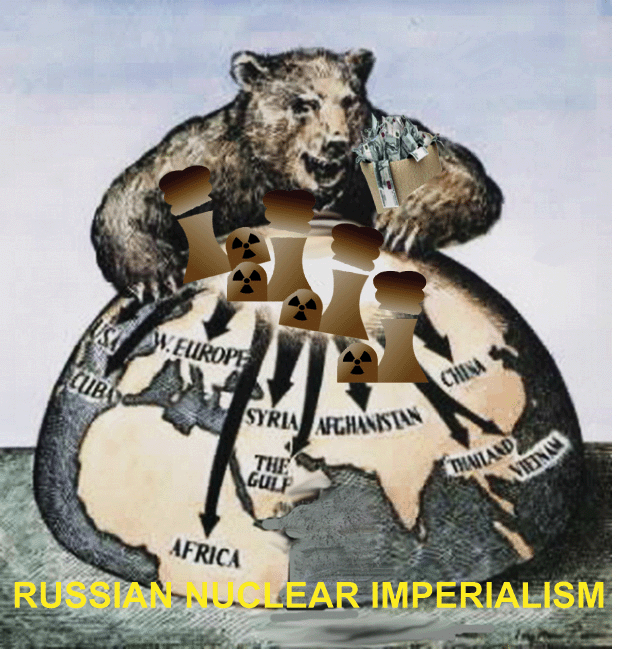
 Africa, Russia squandered close ties with the South African government by overplaying its hand and getting caught up in a corrupt nuclear energy pact. Carnegie Endowment For International Peace (thoroughly researched and referenced) 16 Dec 19,
 SUMMARY
 Amid the widespread attention the Kremlin’s recent inroads in Africa have attracted, there has been surprisingly little discussion of South Africa, a country which, for nearly a decade, unquestionably represented Russia’s biggest foreign policy success story on the continent. As relations soared during the ill-starred presidency of Jacob Zuma (2009–2018), the Kremlin sought to wrest a geopolitically significant state out of the West’s orbit and to create a partnership that could serve as a springboard for expanded influence elsewhere in Africa. Continue reading
 Male dominated climate talks falter, while women’s perspective is excluded
|
The first step to achieving this aim would be gender parity at international climate conferences such as the Madrid COP. While we don’t yet know how many of the 13,000 registered governmental delegates were women, based on past numbers they are unlikely to make up more than a quarter. This is not the only forum where the experiences of women are ignored. Our research, spanning Kenya, Cambodia and Vanuatu, has found women are working collectively to strengthen their communities in the face of climate change. But their knowledge about climate risk is dismissed by scientists and political leaders. Bridging climate awareness When women are excluded from local and national-level governance, the absence of their voices at regional and global levels, such as COP meetings, is virtually assured. Our work across Africa, Asia and the Pacific found scientists – generally male – lack awareness of the knowledge women hold about the local consequences of climate change. At the same time, those women had little access to scientific research. In places where the labour is divided by gender, women and men learn different things about the environment. Though the women in our research generally did not know about government policies or programs on climate change and disaster risk reduction, they were very aware of environmental change. In Kenya, the pastoralist women we spoke to are acutely aware of the link between their physical insecurity and extreme drought. Continue reading |

European Union’s “taxonomy” of sustainable activities includes nuclear
 Green-Finance Deal Reached by EU States on Nuclear Compromise https://www.bloomberg.com/news/articles/2019-12-16/green-finance-deal-reached-by-eu-states-on-nuclear-compromise
By Alexander Weber, December 16, 2019, Green-Finance Deal Reached by EU States on Nuclear Compromise https://www.bloomberg.com/news/articles/2019-12-16/green-finance-deal-reached-by-eu-states-on-nuclear-compromise
By Alexander Weber, December 16, 2019,
Diplomats from the European Union’s 28 countries agreed to advance with key legislation for green financial products, bringing the bloc a step closer to embedding environmental goals in standards for banks, money managers and insurers. Envoys signed off on a deal on the EU’s list of sustainable activities after more lenient wording on the inclusion of nuclear energy won the backing of countries including France and the U.K., according to an official involved in the talks, who asked not to be named, in line with policy. A first attempt to strike a deal last week failed amid divisions over the role that nuclear energy should play in the framework. The EU’s list of sustainable activities for investment purposes, dubbed “taxonomy,” is the centerpiece of its push to regulate the fast growing market of green finance, in the hope of directing trillions of euros to fund a radical revision of the region’s economy. It’s meant to define what’s green and what’s not, an effort that could find a range of uses and serve as an example for governments around the world. The difficulty of agreeing on the rules shows what kind of obstacles the EU has to overcome to meet its ambitious climate targets. Leaders last week agreed that the bloc should achieve zero net emissions in 2050, paving the way for a flurry of legislation that’s needed for the unprecedented clean-up of the economy. The member states now have to present their compromise to the European Parliament, which has been critical of allowing fossil fuels and nuclear power to be classified as sustainable and thus eligible to be financed with green bonds and similar financial products. |
|
European Union’s sustainable finance debate bogged down in question of including nuclear power
|
Nuclear power toxifies EU sustainable finance debate EU28 ambassadors meet on Monday morning to see if they can come up with a compromise that can keep all sides happy Mehreen Khan 15 Dec 19 https://www.ft.com/content/f4ee6bfc-1fb2-11ea-b8a1-584213ee7b2b Nuclear power toxifies EU sustainable finance debate EU28 ambassadors meet on Monday morning to see if they can come up with a compromise that can keep all sides happy Share on Twitter (opens new window) Share on Facebook (opens new window) Share on LinkedIn (opens new window) Save Mehreen Khan YESTERDAY Agreeing on international climate deals is harder than it looks. Despite rising public pressure for policymakers to grapple with the challenge, marathon talks at the UN’s COP25 summit ended this weekend in failure. In what was the world’s longest ever climate negotiation (14 consecutive days), international delegates in Madrid failed to agree rules for how rich and poorer countries should construct a new global carbon trading market. The FT’s Leslie Hook dissects how the summit came to an inconclusive end and why the EU and environmental NGOs are lamenting the outcome.
The EU, which was part of the negotiations in Madrid, will be discouraged by the rancour over carbon trading permits — especially as Brussels is drawing up contentious plans to force third countries to pay a price for carbon it exports to the bloc.
Away from the UN talks, EU governments will have to face down their own green divisions on Monday when they meet to discuss much-anticipated market rules on sustainable finance products. Despite hopes for a deal before the end of the year, France and eastern European capitals last week demanded the rules make explicit to investors that nuclear energy is part of the EU’s journey towards carbon neutrality.
EU28 ambassadors meet on Monday morning to see if they can come up with a compromise that can keep all sides happy. Austria and Luxembourg have led the charge against giving a green-stamp to nuclear, with Germany also resisting over concerns about the environmental impact of nuclear waste.
While the EU has championed itself as a global leader in climate policy, Brussels has yet to prove whether it can “walk the talk” on green policy. The debate over the classification system (known as the “taxonomy”) is the new European Commission’s first real test.
Energy policy is a fiercely protected part of governments’ national powers. Divisions were laid bare in a tense leaders’ summit last week where member states ultimately failed to convince Poland to sign up to the bloc’s 2050 net zero carbon target. But in a triumph for France and its eastern allies, the summit conclusions gave an explicit nod to nuclear as “part of the energy mix” in some countries.
Diplomats think the summit agreement on nuclear should pave the way for pro-nuclear countries to win the argument over the taxonomy. Even if they do, another battle with MEPs lies ahead. Should ambassadors get a compromise on Monday, it still has to be agreed by the European Parliament, which has insisted on its “no” to nuclear.
Pascal Canfin, head of the EP’s environment committee and member of Emmanuel Macron’s En Marche, also held firm on the issue. He told the Brussels Briefing that EU governments should not “modify the balanced political compromise” agreed with MEPs earlier this month. “All parties know that it is the only deal that could have been reached. That’s why I’m confident we will get a formal endorsement this week,” said Mr Canfin.
|
|
Pentagon goes ahead with ballistic missile test, bringing on deadly arms race
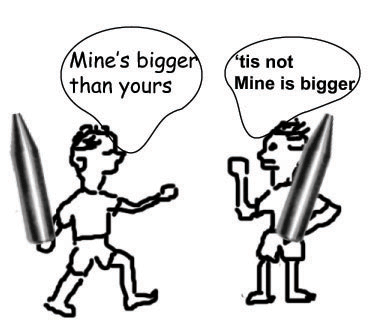 US shuns treaty, sends chilling nuclear message In the second test since the US pulled out of the INF treaty, the prototype ballistic missile flew more than 500km before crashing into the ocean, Asia Times, By DAVE MAKICHUK 16 Dec 19, In a sobering doomsday signal to Moscow, Beijing, and Pyongyang, the Pentagon again showed it plans to leave the INF treaty behind and boldly risk sparking a new arms race by launching a prototype ballistic missile that blew past the old pact’s range limits, Breaking Defense reported.
In the second test of its kind since the US pulled out of the Intermediate-Range Nuclear Forces treaty in August, the prototype ballistic missile flew more than 500 km before crashing into the ocean, as planned, while “data collected and lessons learned from this test will inform the Department of Defense’s development of future intermediate-range capabilities,” Pentagon spokesman Lt. Col. Robert Carver said in a statement.
In a previous test conducted just two weeks after withdrawing from the treaty, the Navy launched a Tomahawk Land Attack Cruise Missile from an island off the California coast, marking the first time a missile breached the 500-5,000km range barred by the treaty, putting competitors on notice that the US was ready to push ahead quickly, the report said.
That does not bar prototypes or other research and development work. The Pentagon can keep working on them for the next year, but must submit a report to Congress with an Analysis of Alternatives for a future INF-busting missile.
Lawmakers also want more information on potential basing options in Europe and a rundown of what conversations the Pentagon has had with allies about plans for basing and deployment locations in the future…… https://www.asiatimes.com/2019/12/article/us-shuns-treaty-sends-deadly-nuclear-message/
TEPCO delays Fukushima chimney demolition

December 16, 2019
The operator of the crippled Fukushima Daiichi nuclear plant says it is having difficulties reducing the height of a damaged exhaust chimney and will extend the deadline to finish the work.
The 120-meter tall exhaust stack shared by the No.1 and No.2 reactors was heavily contaminated by radioactive substances in the 2011 accident. Its steel framework was damaged by the accident.
Tokyo Electric Power Company has been working since August to halve the chimney’s height to around 60 meters to reduce the risk of collapse, but has so far only cut about nine meters.
The company says a cutter developed for the project has run into a series of problems. It says the blade of the remotely-controlled device has worn down faster than expected and become stuck.
TEPCO has suspended the demolition, and is reviewing its cutting methods and procedures. The utility says it will submit an improved plan to the Nuclear Regulation Authority.
The firm says it hopes to restart the work by the end of this month and will reschedule completion of the project from the end of March next year to mid-May.
Idaho nuclear waste processing project to close – not commercially viable
Federal officials will shut down an Idaho nuclear waste treatment project after determining it would not be economically feasible to bring in radioactive waste from other states.
The U.S. Department of Energy in documents made public this week said the Advanced Mixed Waste Treatment Project that employs 650 workers will end next year.
A $500 million treatment plant handles transuranic waste that includes work clothing, rags, machine parts and tools that have been contaminated with plutonium and other radioactive elements. The U.S. Nuclear Regulatory Commission says transuranic wastes take much longer to decay and are the most radioactive hazard in high-level waste after 1,000 years.
The Energy Department said that before the cleanup began, Idaho had the largest stockpile of transuranic waste of any of the agency‘s facilities. Court battles between Idaho and the federal government culminated with a 1995 agreement requiring the Energy Department to clean up the Idaho site.
The Idaho treatment plant compacts the transuranic waste, making it easier to ship and put into long-term storage at the Waste Isolation Pilot Plant in New Mexico.
Federal officials earlier this year floated the idea of keeping the $500 million treatment plant running in Idaho with waste from other states. The bulk of that would have been 8,000 cubic meters (6,100 cubic meters) of radioactive waste from a former nuclear weapons production area in Hanford in eastern Washington.
Local officials and politicians generally supported the idea because of the good-paying jobs. The Snake River Alliance, an Idaho-based nuclear watchdog group, said it had concerns the nuclear waste brought to Idaho would never leave.
A 38-page economic analysis the Department of Energy completed in August and released this week found “it does not appear to be cost effective due to packaging and transportation challenges in shipping waste” to Idaho.
“As work at the facility will continue into 2019, no immediate workforce impacts are anticipated,” the agency said in an email to The Associated Press on Friday. The Energy Department “recognizes the contribution of this facility and its employees to DOE‘s cleanup mission and looks forward to applying the knowledge gained and experience of the workforce to other key activities at the Idaho site.”
The agency said it would also consider voluntary separation incentives for workers.
With the Idaho treatment plant scheduled to shut down, it‘s not clear how the transuranic waste at Hanford and other sites will be dealt with.
The Energy Department “will continue to work to ensure a path forward for packaging and certification of TRU (transuranic) waste at Hanford and other sites,” the agency said in the email to the AP.
The Post Register first reported the closure.
Japan ponders recycling Fukushima soil for public parks & green areas

December 15, 2019
Japan ponders recycling Fukushima soil for public parks & green areas Soil from the Fukushima prefecture may be used as landfill for the creation of “green areas” in Japan, a government panel has proposed, facing potential public backlash over fears of exposure to residual radiation from the decontaminated earth. Trends
The advisory panel of the Environment Ministry on Monday proposed reusing soil that was contaminated during the Fukushima nuclear meltdown of 2011 as part of future landfills designated for public use, Kyodo news .
In its proposal, the environmental panel avoided openly using the word “park” and instead said “green space,” apparently to avoid a premature public outcry, Mainichi Shimbun reported.
Following an from the news outlet, the Ministry of the Environment clarified that “parks are included in the green space.”
In addition to decontaminating and recycling the tainted earth for new parks, the ministry also stressed the need to create a new organization that will be tasked with gaining public trust about the prospects of such modes of recycling.
To calm immediate public concerns, the panel said the decontaminated soil will be used away from residential areas and will be covered with a separate level of vegetation to meet government guidelines approved last year.
In June last year, the Ministry of the Environment decided to reuse contaminated soil with radioactive cesium concentration between 5,000 to 8,000 becquerels per kilogram for public works such as nationwide roads and tidal banks.
Under these guidelines, which can now be extended to be used for the parks, the tainted soil shall be covered with clean earth, concrete or other materials.
Such a landfill, the government said at the time, will not cause harm to nearby residents as they will suffer exposure less than 0.01 mSv a year after the construction is completed.
The Fukushima Daiichi nuclear power plant suffered a blackout and subsequent failure of its cooling systems in March 2011, when it was hit by an earthquake and a killer tsunami that knocked out the facility, spewing radiation and forcing 160,000 people to flee their homes. Three of the plant‘s six reactors were hit by meltdowns, making the Fukushima nuclear disaster the worst since the Chernobyl catastrophe in 1986.
https://stockdailydish.com/japan-ponders-recycling-fukushima-soil-for-public-parks-green-areas/

Maryland’s Back From the Brink” resolution to support the U.N. Nuclear Ban Treaty
 The Montgomery County Council has joined Baltimore and Washington, D.C. with its own “Back From the Brink” resolution to support the U.N. Nuclear Ban Treaty, alongside the U.S. Conference of Mayors and 40 municipalities and state legislatures from California to Maine calling on the Trump Administration and Congress to exercise global leadership in preventing nuclear war by:
- Renouncing the option of using nuclear weapons first;
- Ending the President’s sole, unchecked authority to launch a nuclear attack;
- Taking U.S. nuclear weapons off hair-trigger alert;
- Canceling the the $1.7 trillion dollar plan to replace the entire U.S. nuclear arsenal with enhanced weapons;
- Supporting the U.S. entry into the Treaty on the Prohibition of Nuclear Weapons; and
- Requiring the U.S. to pursue a verifiable agreement among nuclear-armed states to eliminate their nuclear arsenals.
The U.N. treaty is two-thirds of the way toward the 50 ratifying nations needed to make it operational, whereupon nuclear weapons will be prohibited, stigmatized and eventually eliminated.
Maryland jurisidictions join “back from the brink” nuclear war movement Baltimore Sun, By DAVID GROSSO, BILL HENRY and TOM HUCKER, BALTIMORE SUN |, DEC 16, 2019 “A nuclear war cannot be won and must never be fought.”
— President Ronald Reagan in his 1984 State of the Union address
U.S. presidents have always understood the calamitous power of nuclear weapons. They held the fate of our planet and human civilization in their hands with sole authority to launch a nuclear warhead that could not be recalled.
Under President Donald Trump, the danger of putting planetary fate of the world in the hands of one person has never been clearer. He refuses to listen to, or abide by, the advice of our career military and diplomatic experts. His ill-advised and impetuous withdrawal of U.S. forces from Syria is only the most recent example. Since taking office, President Trump has abandoned the multilateral agreement that constrained Iran’s nuclear program. He also announced plans to withdraw from the Intermediate-Range Nuclear Forces Treaty, which for more than 30 years banned intermediate range missiles and has contributed to stability in Europe.
According to the Bulletin of Atomic Scientists: “The INF treaty’s potential death foreshadows a new competition to deploy weapons long banned. Continue reading
Olympics no relief for devastated city
 Weeds grow in an abandoned apartment complex Tuesday in Futaba, Japan. Government officials say it’s the “recovery Olympics” for the disaster-hit areas and residents. But the town of Futaba, home to the tsunami-wrecked nuclear plant, is still largely frozen in time for nearly nine years since the disaster, with thousands of its former residents still unable to return.
December 14, 2019
FUTABA, Japan — The torch relay for the Tokyo Olympics will kick off in Fukushima, the northern prefecture devastated almost nine years ago by an earthquake, tsunami and the subsequent meltdown of three nuclear reactors.
They’ll also play Olympic baseball and softball next year in one part of Fukushima, allowing Tokyo organizers and the Japanese government to label these games the “Recovery Olympics.” The symbolism recalls the 1964 Tokyo Olympics, which showcased Japan’s reemergence just 19 years after World War II.
But tens of thousands still haven’t recovered in Fukushima, displaced by nuclear radiation and unable to return to deserted places like Futaba.
Time stopped in the town of 7,100 when disaster struck on March 11, 2011.
Laundry still hangs from the second floor of one house. Vermin gnaw away at once intimate family spaces, exposed through shattered windows and mangled doors. The desolation is deepened by Japanese tidiness with shoes waiting in doorways for absent owners.
“This recovery Olympics is in name only,” Toshihide Yoshida told The Associated Press. He was forced to abandon Futaba and ended up living near Tokyo. “The amount of money spent on the Olympics should have been used for real reconstruction.”
Olympic organizers say they are spending $12.6 billion on the Olympics, about 60% public money. However, an audit report by the national governments said overall spending is about twice that much.
The Olympic torch relay will start in March in J-Village, a soccer stadium used as an emergency response hub for Fukushima plant workers. The relay goes to 11 towns hit by the disaster, but bypasses Futaba, a part of Fukushima that Olympic visitors will never see.
“I would like the Olympic torch to pass Futaba to show the rest of the world the reality of our hometown,” Yoshida said. “Futaba is far from recovery.”
The radiation that spewed from the plant at one point displaced more than 160,000 people. Futaba is the only one of 12 radiation-hit towns that remains a virtual no-go zone. Only daytime visits are allowed for decontamination and reconstruction work, or for former residents to check their abandoned homes.
The town has been largely decontaminated and visitors can go almost anywhere without putting on hazmat suits, though they must carry personal dosimeters — which measure radiation absorbed by the body — and surgical masks are recommended. The main train station is set to reopen in March, but residents won’t be allowed to return until 2022.
A main-street shopping arcade in Futaba is lined by collapsing store fronts and sits about 4 kilometers (2.5 miles) from the nuclear plant, and 250 kilometers (150 miles) north of Tokyo. One shop missing its front doors advertises Shiseido beauty products with price tags still hanging on merchandise. Gift packages litter the ground.
“Let us know if you start feeling unwell,” Muneshige Osumi, a former town spokesman told visitors, apologizing for the musty smell and the presence of rats.
About 20,000 people in Japan’s northern coastal prefectures died in the magnitude 9.0 earthquake and resulting tsunami. Waves that reached 16 meters (50 feet) killed 21 people around Futaba, shredding a seaside pine forest popular for picnics and bracing swims.
A clock is frozen at 3:37 p.m. atop a white beach house that survived.
Nobody perished from the immediate impact of radiation in Fukushima, but more than 40 elderly patients died after they were forced to travel long hours on buses to out-of-town evacuation centers. Their representatives filed criminal complaints and eventually sent former Tokyo Electric Power Company executives to court. They were acquitted.
When Tokyo was awarded the Olympics in 2013, Prime Minister Shinzo Abe assured International Olympic Committee members that the nuclear disaster was “under control.” However, critics say the government’s approach to recovery has divided and silenced many people in the disaster-hit zones.
Under a development plan, Futaba hopes to have 2,000 people — including former residents and newcomers such as construction workers and researchers — eventually living in a 550-hectare (1,360-acre) site.
Standing outside the Futaba station, Mayor Shirou Izawa described plans to rebuild a new town. It will be friendly to the elderly, and a place that might become a major hub for research in decommissioning and renewable energy. The hope is that those who come to help in Fukushima’s reconstruction may stay and be part of a new Futaba.
“The word Fukushima has become globally known, but regrettably the situation in Futaba or (neighboring) Okuma is hardly known,” Izawa said, noting Futaba’s recovery won’t be ready by the Olympics.
To showcase the recovery, government officials say J-Village — where the torch relays begins — and the Azuma baseball stadium were decontaminated and cleaned. However, problems keeping popping up at J-Village with radiation “hot spots” being reported, raising questions about safety heading into the Olympics.
The baseball stadium is located about 70 kilometers (45 miles) west of Futaba, J-Village is closer, about 20 kilometers (12 miles) away along the coastal area.
The radioactive waste from decontamination surrounding the plant, and from across Fukushima, is kept in thousands of storage bags stacked up in temporary areas in Futaba and Okuma.
“Who wants to come to live in a place like that? Would senior officials in Kasumigaseki government headquarters go and live there?” Yoshida asked, referring to the high-end area in Tokyo that houses many government ministries.
“I don’t think they would,” Yoshida said. “But we have ancestral graves, and we love Futaba, and we don’t want Futaba to be lost. The good old Futaba that we remember will be lost forever, but we’ll cope.”
https://www.nwaonline.com/news/2019/dec/14/olympics-no-relief-for-devastated-city-/
USA rejects North Korea’s ‘hostile’ deadline over nuclear talks
|
Top US diplomat rejects North Korea’s ‘hostile’ deadline over nuclear talks and says Washington will not bow to Pyongyang’s ominous threat of a ‘Christmas Gift’ provocation,
By ROSS IBBETSON FOR MAILONLINE and AFP 17 Dec 19, A senior US diplomat has today slammed North Korea for making ‘hostile demands’ over nuclear talks and warned Kim Jong-un against his planned ‘Christmas Gift’ provocation. US special representative Stephen Biegun told reporters in Seoul that Washington would not bow to Pyongyang’s increasingly strident demands for concessions by 2020. ‘Let me be absolutely clear: The United States does not have a deadline. We are fully aware of the strong potential for North Korea to conduct a major provocation in the days ahead,’ Biegun said. ‘To say the least, such an action will be most unhelpful in achieving lasting peace on the Korean Peninsula.’….. Pyongyang has said that if Washington fails to make it an acceptable offer, it will adopt a so far unspecified ‘new way’. It has carried out a series of static tests at its Sohae rocket facility this month, after a number of weapons launches in recent weeks, some of them described as ballistic missiles by Japan and others – which Pyongyang is banned from testing under UN sanctions……Pyongyang has said that if Washington fails to make it an acceptable offer, it will adopt a so far unspecified ‘new way’. It has carried out a series of static tests at its Sohae rocket facility this month, after a number of weapons launches in recent weeks, some of them described as ballistic missiles by Japan and others – which Pyongyang is banned from testing under UN sanctions…https://www.dailymail.co.uk/news/article-7797205/Top-diplomat-rejects-North-Koreas-deadline-says-Washington-not-bow-threats.html |
|
|
In France, over the next decade renewable energy is ‘on track to overtake nuclear’
 Renewables ‘on track to overtake nuclear’ in France https://www.powerengineeringint.com/2019/12/16/renewables-on-track-to-overtake-nuclear-in-france/ Kelvin Ross A new study claims that renewables are on track to overtake nuclear power as the dominant energy source in France in the next decade.The share of renewables in France will hit 42.9 per cent of the country’s power mix by 2023, up from 19.9 per cent in 2018, according to analytics company GlobalData. Renewables ‘on track to overtake nuclear’ in France https://www.powerengineeringint.com/2019/12/16/renewables-on-track-to-overtake-nuclear-in-france/ Kelvin Ross A new study claims that renewables are on track to overtake nuclear power as the dominant energy source in France in the next decade.The share of renewables in France will hit 42.9 per cent of the country’s power mix by 2023, up from 19.9 per cent in 2018, according to analytics company GlobalData.
And the research suggests that renewables will continue to rise as nuclear reactors come offline. The report examining France’s power outlook to 2030 reveals that in 2018 nuclear power dominated the capacity mix by 47.2 per cent, followed by renewables, hydropower and thermal power. In the non-hydro renewable energy mix, wind contributed 56.7 per cent followed by solar PV with 35.6. GlobalData analyst Piyali Das said that France “is aiming to boost the renewable energy sources through tender mechanism. Renewable power sources are expected to increase at a compound annual growth rate of 8.9 per cent between 2019 and 2030 with a net capacity addition of around 50 GW. “Installed capacity for onshore wind will double from its current levels of 15.1 GW by 2026, and to support the expansion the government has announced doubling of the renewable energy budget. Solar PV is not behind by much in terms of growth and will witness an addition of more than 24 GW during the same period.” Das said that in the long-term, the French government has decided to cut down its fossil fuel dependency and is replacing coal and oil power stations with gas-fired plants. The government also has wants to reduce nuclear generation to 50 per cent of net generation by 2035, with a plan to decommission around 14 reactors by 2035 and fill the gap with renewable sources. “To date the development of renewable energy is largely supported by public support mechanisms,” explained Das. “These mechanisms finance the difference between the remuneration of their production on the wholesale market and the purchasing price guaranteed by the state to the renewable producer. |
|
Turkey may shut US nuclear weapons base over sanctions threat
|
Turkey may shut US nuclear weapons base over sanctions threat
The Turkey-US row is partly over Ankara’s military offensive in Syria targeting American-backed Kurdish forces. Sky News Sunday 15 December 2019 Turkey’s leader says his country could close two military installations where American troops are stationed “if necessary”. One of the sites, called the Incirlik air base, is where some US nuclear warheads are kept. The other is the Kurecik radar station.
President Recep Tayyip Erdogan spoke in response to a threat of American sanctions over Ankara’s military offensive in Syria targeting US-backed Kurdish forces. His comments also followed a US senate resolution over Armenian claims about mass killings a century ago – a move which has further increased tensions between Ankara and Washington……. The Incirlik air base, located about 100 miles from Turkey’s border with Syria, is often referred to as one of the major strategically located US military bases. The Kurecik radar station hosts NATO’s early-warning radar systems against ballistic missile attacks. https://news.sky.com/story/turkey-may-shut-us-nuclear-weapons-base-over-sanctions-threat-11887811 |
|
Fukushima: Japan court finds government liable for nuclear disaster

December 13, 2019
A Japanese court has ruled for the first time that the government bears partial responsibility for the 2011 Fukushima nuclear disaster.
The court was responding to a case brought by a group of evacuees who had been forced to flee their homes.
It ruled that the disaster could have been averted if government regulators had ordered plant operator Tepco to take preventive safety measures.
The government and Tepco were both ordered to compensate the evacuees.
Around 80,000 people were forced to flee their homes when three reactors failed at the plant after a tsunami that struck six years ago.
It was the world‘s most serious nuclear accident since Chernobyl in 1986.
The district court in Maebashi, north of Tokyo, ruled in favour of 137 evacuees seeking damages for the emotional distress of fleeing their homes.
The parties were told to pay a total 38.6m yen ($341,000, £275,000) in compensation, far below the 1.5bn yen the group had sought.
A number of legal cases have already been filed against Tepco (Tokyo Electric Power) relating to the disaster, but this is the first time a court has recognised that the government was liable for negligence.
Chief Cabinet Secretary Yoshihide Suga, the government‘s top spokesman, declined to comment but said the ruling would have no impact on the country‘s nuclear power policies.
Anti-nuclear sentiment runs high in Japan, but the government has been resolute in restarting reactors that were closed in the aftermath of the disaster.
https://stockdailydish.com/fukushima-japan-court-finds-government-liable-for-nuclear-disaster/
Tohoku reactor restart: What is the state of Japan’s nuclear policy?
Their contempt for the Japanese’ public’s will and the health and well being of people, animals, plants, oceans, rivers, lakes, genetic pools and the economies of the northern hemisphere is appalling. Abe, LDP, nuke industry, anyone that’s pro-nuke.’
 Members of the government’s expert panel inspect Tohoku Electric Power Co.’s Onagawa nuclear power plant in Miyagi Prefecture in April.
Dec 9, 2019
OSAKA – In late November, the Nuclear Regulation Authority (NRA) gave the green light for restarting the No. 2 reactor at Tohoku Electric Power Co.’s Onagawa plant in Miyagi Prefecture, which had been damaged in the March 11, 2011, earthquake and tsunami. The announcement once again put the spotlight on the country’s nuclear power policy, not only in Tohoku but nationwide.
Why did the Onagawa restart attract so much attention?
While the Onagawa plant is actually the second damaged on 3/11, after the Tokai No. 2 power station in Ibaraki Prefecture, to pass the NRA’s new safety regulations for nuclear power plants prepared after the disaster, it happens to be the nuclear plant closest to the epicenter of the magnitude 9 quake that struck off the Tohoku coast that day.
The Onagawa facility is located near Ishinomaki, which received extensive damage and much domestic and international media attention after the tsunami claimed the lives of 74 Okawa Elementary School students.
In addition, the Onagawa reactor, which was flooded on 3/11, is the first boiling water reactor to have its restart application approved by the NRA.
There are three kinds of nuclear reactors in operation in Japan: 14 pressured water reactors (PWRs), four advanced boiling water reactors (ABWRs) and 13 boiling water reactors (BWRs), which are the same kind as those at the Fukushima No. 1 plant destroyed by the 3/11 quake and tsunami. The PWRs are considered more technologically stable than the other kinds, and have a better ability to contain radiation.
Now that the NRA has greenlighted Onagawa’s restart, does that mean it will happen anytime soon?
That depends on a number of factors. The Onagawa plant is not ready to be fired up tomorrow. It must first complete the installation of various anti-disaster measures, including a 29-meter-high, 800-meter-long seawall along the Pacific coast to guard against tsunami as high as 23.1 meters. That will not be completed until sometime in fiscal 2020, which begins April 1.
Furthermore, various local governments, including Ishinomaki and Miyagi Prefecture, will have to give their consent to the restart. That could involve long, drawn out negotiations between the utility and local residents and politicians. It’s also probable that lawyers and local citizens opposed to a restart will seek a court injunction to halt the move based on safety concerns. If a court approves an injunction, that will create further delays.
How many other nuclear power plants are there and what are their statuses?
As of this month, there are nine reactors officially in operation. Four belong to Kansai Electric Power Co. (Kepco), which provides electricity mainly to Kyoto, Osaka, Nara, Hyogo, Shiga and Wakayama prefectures. Another four belong to Kyushu Electric Power Co. One of Shikoku Electric Power Co.’s reactors at its Ikata plant is also operating.
Another six reactors have made improvements to meet the new, post-3/11 quake safety standards and have received NRA approval to restart. These include two reactors at Tokyo Electric Power Company Holdings’ Kashiwazaki-Kariwa plant in Niigata Prefecture, two of the four reactors at Kepco’s Takahama plant (the other two are in operation) in Fukui Prefecture, one reactor at Kepco’s Mihama plant (the other two have been decommissioned), also in Fukui Prefecture, and one reactor at Japan Atomic Power Co.’s Tokai No. 2 plant in Ibaraki Prefecture. The other reactor at the facility has been decommissioned.
Nearly a dozen reactors are now in the process of undergoing safety reviews and will have to upgrade their facilities to meet tougher NRA standards for disaster preparedness, and then, if they receive approval to restart, will go through the process of obtaining local consent.
These include reactors in Hokkaido, Aomori, Shizuoka, Ishikawa, Fukui and Shimane prefectures.
Finally, another nine reactors have not applied to be restarted under the new regulations, and 24 reactors, including all six Fukushima No. 1 plant reactors and all four Fukushima No. 2 plant reactors, as well as four of Kepco’s 11 reactors in Fukui Prefecture, are being decommissioned.
How much electricity does nuclear power provide?
Figures vary, sometimes greatly, depending on how many plants in operation were shut down for inspection during a particular year. The latest figures from the Ministry of Economy, Trade and Industry’s Agency for Natural Resources show that in 2017, nuclear power provided 3.1 percent of Japan’s electricity. The Institute for Sustainable Energy Policies, a nonprofit research institute, estimates that based on its own surveys of utilities, nuclear provided 4.7 percent of Japan’s electricity last year.
What about the future for nuclear power in Japan?
The government’s long-term energy policy for 2030 calls for nuclear power to make up around 20 to 22 percent of the nation’s energy mix, and it is pushing hard for the restart of as many idled reactors as possible. By then, the plan calls for renewable energy to account for 22 to 24 percent of the mix, LNG to make up 27 percent, coal 26 percent and oil 3 percent.
But the obstacles to restarting, or continuing to operate, nuclear plants in the coming years are vast. In addition to local opposition that could delay restarts for months or years, costing the utilities money, they include such issues as the economics of running reactors past 40 years, for which the utilities must first spend money to upgrade their facilities in order to meet new NRA standards regarding reactors older than four decades.
While Kepco has secured permission to operate three reactors already over 40 years old for another two decades at the most, other utilities with reactors currently more than 30 years old — such as Tepco’s Kashiwazaki-Kariwa No. 1 reactor (34 years old) — will have to decide within a few years whether it’s worth the investment of money and time to apply for a two-decade extension or whether it’s cheaper to decommission.
A second problem has to do with spent nuclear fuel generated by the restarted reactors.
Tokyo is making efforts to find local governments able and willing to have a midterm spent fuel storage facility built in their backyard, and has agreed to offer financial incentives for anyone willing to accept a facility. No luck so far. Meanwhile, in Fukui Prefecture, which has the largest concentration of reactors (13 commercial reactors plus the Monju experimental fast-breeder reactor) in the nation, Gov. Tatsuji Sugimoto is insisting that such storage facilities be built outside the prefecture. His position could lead to other prefectures hosting nuclear power plants to take a firmer stance with utilities and the central government over what to do with spent nuclear fuel when they come seeking local consent for their own restart plans.
1 This Month

of the week – Shut Down Drone Warfare!


Tell the Ukrainian Government to Drop Prosecution of Peace Activist Yurii Sheliazhenko

Petition to revoke the licensing of the Near Surface Nuclear Disposal Facility (NSDF) at Chalk River. https://www.ourcommons.ca/petitions/en/Petition/Details?Petition=e-7247
To see nuclear-related stories in greater depth and intensity – go to https://nuclearinformation.wordpress.com
-
Archives
- March 2026 (251)
- February 2026 (268)
- January 2026 (308)
- December 2025 (358)
- November 2025 (359)
- October 2025 (376)
- September 2025 (257)
- August 2025 (319)
- July 2025 (230)
- June 2025 (348)
- May 2025 (261)
- April 2025 (305)
-
Categories
- 1
- 1 NUCLEAR ISSUES
- business and costs
- climate change
- culture and arts
- ENERGY
- environment
- health
- history
- indigenous issues
- Legal
- marketing of nuclear
- media
- opposition to nuclear
- PERSONAL STORIES
- politics
- politics international
- Religion and ethics
- safety
- secrets,lies and civil liberties
- spinbuster
- technology
- Uranium
- wastes
- weapons and war
- Women
- 2 WORLD
- ACTION
- AFRICA
- Atrocities
- AUSTRALIA
- Christina's notes
- Christina's themes
- culture and arts
- Events
- Fuk 2022
- Fuk 2023
- Fukushima 2017
- Fukushima 2018
- fukushima 2019
- Fukushima 2020
- Fukushima 2021
- general
- global warming
- Humour (God we need it)
- Nuclear
- RARE EARTHS
- Reference
- resources – print
- Resources -audiovicual
- Weekly Newsletter
- World
- World Nuclear
- YouTube
-
RSS
Entries RSS
Comments RSS
 nuclear-news