Fukushima: Japan’s government has not solved its many technical, economic, and socio-political problems

|
An update from Fukushima, and the challenges that remain there, https://thebulletin.org/2019/11/an-update-from-fukushima-and-the-challenges-that-remain-there/ By Tatsujiro Suzuki, November 11, 2019 After more than eight years, Japan is still struggling with aftermath of the 2011 Fukushima nuclear disaster. The Japanese government and nuclear industry have not solved the many technical, economic, and socio-political challenges brought on by the accident. More worrying, they continue to put special interests ahead of the public interest, exacerbating the challenges and squandering public trust. The longer these issues remain unsolved, the more difficult it will be to restore this trust.
Technical challenges. The most difficult challenge is, of course, the decommissioning of the Fukushima Daiichi reactors. It would take too long to describe all of the technical challenges of the decommissioning operations, but two recent events are instructive of the overall difficulties. The first is the dismantlement of the joint exhaust stack for units one and two. This stack stands 120 meters tall and is at risk of collapse because of fractures in its pillars. It was also heavily contaminated by the venting of radioactive gases during the accident. So the stack must come down, and the operation to deconstruct it must be done remotely from the stack itself to avoid exposing workers to dangerous radiation. According to the Tokyo Electric Power Company (TEPCO), the operation was supposed to be simple: cut down the top of the tower using special remote-controlled equipment, slicing pieces from the top of the chimney one by one and guiding them down by crane. Originally, the operation was supposed to start in March 2019, but TEPCO deployed an operation tower that was about three meters too short for the task, meaning it needed to rebuild the tower before starting. The cutting operation began on August 1, but the project has already faced numerous additional delays because of technical difficulties that include malfunctions of the crane, the camera on the cutting machine (which is needed to monitor the operation), the saws of the cutting machine, and both the main generator and sub-generators. The operation was supposed to finish by the end of 2019 but will now drag on until at least March 2020. The second technical problem, which is much more serious than the first, is the management of contaminated water. The water is continuously injected into the reactors to cool the fuel debris, and then treated to remove most—though not all—of the radioactive materials. The so-called “treated water” is being stored on site and amounts to about 1.1 million tons, with several hundred tons being added every day. According to TEPCO, the total tank capacity to store treated water will be approximately 1.37 million tons by the end of 2020, but the volume of treated water will exceed storage capacity by 2022. A subcommittee of the Ministry of Economy, Trade, and Industry recommended that the treated water, which still contains tritium, should be released into the sea once the radioactive concentration is below the standard agreed beforehand. The agreed standard between TEPCO and the local fishing industry association is 1,500 becquerels per liter (Bq/l), which is far below the drinking water standard for tritium water of 10,000 Bq/l set by the World Health Organization. An additional condition of release, however, is that all other radioactive substances besides tritium must be removed below a detectable limit or in line with regulatory standards. Unfortunately, in August 2019 news outlets reported that some radioactive materials such as iodine 129 were not completely removed and that their concentration levels were above the regulatory standards. Most recently, the super typhoon Hagibis hit the eastern part of Japan, which includes Fukushima prefecture and the area affected by the nuclear accident. TEPCO reported irregular readings from sensors monitoring water at the Fukushima Daiichi plant but did not confirm whether any radioactive water leaked into the sea. In addition, according to the Tamura city government, some bulk bags filled with soil collected from decontamination operations were swept into a river during the typhoon on October 12. The bags were among 2,667 that have been temporarily stored at a site in the city. The Ministry of the Environment later confirmed that total of 11 bags were swept away and found downstream. Thankfully, there was no evidence that any of the contaminated soil leaked out. But this wasn’t the first time an incident like this has happened. In September 2015, several hundred bags were swept downstream during flooding caused by tropical storm Etau. The recurring close calls reveal the ongoing vulnerabilities of the Fukushima and associated sites. The contaminated soil will need to be stored for at least 30 years, and the risk of possible leakage remains if a larger and stronger typhoon, or a tsunami, hits the region again. Economic challenges. In December 2016, the Ministry of Trade, Economy, and Industry’s committee for reforming TEPCO published its latest estimate for total accident costs, including decommissioning the reactors, compensation, and decontamination of the land. The total cost was estimated at almost 22 trillion yen ($188 billion), which was twice as much as the previous estimate of 11 trillion yen ($96 billion). More recent estimates have put the figure even higher—up to 80 trillion yen ($736 billion) over 40 years. According to the legal scheme established by the ministry, TEPCO and other nuclear utilities will pay about 20 trillion yen of the total accident costs. But now the rest (2 trillion yen) will be footed by Japanese taxpayers. The 2016 report was the first time that the Japanese government admitted that tax money would be spent for the Fukushima accident costs. The government’s lack of transparency in agreeing to this scheme is a source of ongoing concern, not least because the taxpayer burden could balloon if total costs go up, or if the nuclear utilities cannot pay off the debt. The government has given no clear explanation why and how much tax money will be spent to cover the total accident costs. To make matters worse, the power utilities are passing on part of the accident cleanup costs to customers by increasing their electricity rates, but without disclosing the amount. This exceptionally high cost may have influenced the future economic competitiveness of nuclear power. At present, no utility has announced plans to build new reactors or to replace existing reactors. Socio-political challenges. On September 19, 2019, three former top executives of TEPCO were found not guilty of criminal negligence for their roles in the disaster, which resulted in the death of 44 and the injury of 13 others. The Tokyo district court ruled that it was not realistic for the former executives to have prevented the triple core meltdown because they were not able to predict all possible tsunami scenarios. This was the only criminal case so far involving TEPCO officials and, although they were found not guilty, the case revealed new facts regarding the tsunami predictions.A 2008 TEPCO internal study, based on a 2002 report by a government panel, concluded that a wave of up to 15.7 meters could hit the plant after a magnitude 8.3 earthquake, overwhelming the Fukushima site, which sits 10 meters above sea level. The findings were reported to the TEPCO executives, but they did not act to take measures against such high-tsunami scenarios. The court decision was totally unsatisfactory to the public, especially for the victims in Fukushima who were forced to leave their homes. For them, it is now clear that the accident was preventable and that no one at TEPCO will be held accountable for their lack of action to prevent it. Although the criminal case was highly symbolic, it is not the only legal one involving TEPCO and Fukushima. More than 100,000 evacuees have filed about 30 different civil lawsuits seeking compensation from TEPCO and the government. Several district courts have ruled that TEPCO could have predicted and prevented the nuclear crisis and have awarded millions of dollars in damages to the evacuees. TEPCO isn’t the only utility with a public relations problem. On September 27, 2019, the Kansai Electric Power Company held a press conference to disclose that 20 of its employees, including top executives, received inappropriate payments and gifts worth a total of $2.9 million from a senior local government official in Takahama, a town that hosts one of the company’s four nuclear power plants. This has become the biggest scandal since the 2011 Fukushima accident and has exposed the collusive relationship between the utility companies and local public officials as well as the connection between the utilities and local construction companies, which may have benefited from favorable contracts for necessary safety upgrades at the nuclear plants. In October, the chairman, executive vice president, and three executive directors resigned, while the president of the company stepped down from his position as the head of the powerful Federation of Electric Power Companies of Japan. Although Kansai Electric Power Company planned to restart units one and two of its Takahama nuclear plant earlier this year, that plan is now on hold indefinitely. These two recent events show that social and political problems persist even eight years after the Fukushima accident. According to the latest public polling conducted in 2018 by Japan Atomic Energy Relations Organization, a utility-sponsored pro-nuclear organization, only 6.7 percent of the public think nuclear industry organizations are trustworthy or somewhat trustworthy (a decline from 7 percent in 2017), and only 7.9 percent of the public think the government is trustworthy or somewhat trustworthy (a decline from 9.2 percent in 2017). Lessons not learned. The ongoing technical, economic, and socio-political problems demonstrate that the nuclear power industry and the Japanese government haven’t learned their lesson from the Fukushima accident, which is that transparency is the key to public trust. It is true that the quantity of information about cleanup has increased substantially over the years. But transparency means that the utilities and the government need to disclose information that the public needs, even when it is not favorable to them. One solution, which they have so far been unwilling to accept, would be to establish a truly independent third party to oversee their activities. Lack of such an independent oversight organization is one of the main causes for not taking alternative and possibly better, more appropriate measures over the last eight years. |
|
|
S and P Global Ratings has made it plain: nuclear power can survive only with massive tax-payer support
 Nuclear power ‘dead and alive’, S&P proclaims, EURACTIV, 13 Nov 19, Growing competition from cheap renewable electricity, safety concerns, and rising costs of new plants are slowly driving nuclear power over the edge – except in Russia and China where the industry continues to enjoy extensive state support, S&P said in a note to investors.It’s probably one of the worst kept secrets in the energy world: nuclear power wouldn’t be able to stand on its own feet without massive government support.
Now, S&P Global Ratings has made it plain and clear to investors.
“The global nuclear industry is facing challenges to do with safety concerns, tightening regulations post-Fukushima, phase-out policies in several countries, aging asset bases, increasingly volatile energy markets, and competition with renewables,” the rating agency wrote in the note, released on Monday (11 November).
“We see little economic rationale for new nuclear builds in the US or Western Europe, owing to massive cost escalations and renewables cost-competitiveness, which should lead to a material decline in nuclear generation by 2040,” S&P said.
But despite those challenges, it would be too soon to pronounce nuclear power dead, S&P adds. China and Russia, for instance, continue to build new nuclear capacities, supported by energy policies and significantly lower construction costs, the rating agency remarked.
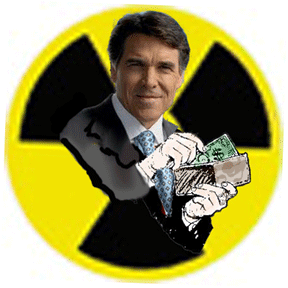 In the US, Energy Secretary Rick Perry has touted small modular reactors (SMRs) as key to the industry’s future, saying small reactors could provide access to electricity in areas of the globe which are currently “shrouded in darkness”. ……..
In Europe, a battle has been raging below the radar on whether to include or reject nuclear power from an upcoming sustainable finance classification scheme aimed at driving private investments into the green economy.
While France supports the inclusion of nuclear in the EU’s draft green finance taxonomy, Germany and Austria argue nuclear isn’t sustainable and shouldn’t be eligible for any kind of EU support. A final decision on the EU’s sustainable finance taxonomy is expected in December. https://www.euractiv.com/section/electricity/news/nuclear-power-dead-and-alive-sp-proclaims/
Messianic Rick Perry preaches nuclear to sceptical Europeans
Messianic Perry preaches nuclear to sceptical Europeans, By Frédéric Simon | EURACTIV.com Oct 26, 2019 Small nuclear reactors can help “vulnerable nations take control of their destinies,” the US energy secretary said in Brussels today (21 October), claiming that small off-grid nuclear plants can bring electricity to poor nations and “disperse the darkness” around the globe…….
Today’s remarks, made in Brussels at the first EU-US high-level forum on small modular reactors, were again chiefly aimed at Eastern European countries, which have repeatedly complained about Russian interference in national politics, using gas as a lever.
Nuclear is a divise topic in Europe. While countries like France opted for it decades ago, others like Germany and Austria are strongly opposed.
“Nuclear energy is neither safe and sustainable nor cost-effective,” said German State Secretary for Energy, Andreas Feicht, during a recent meeting of EU energy ministers, firmly rejecting suggestions that EU money might be used to extend the lifetime of existing nuclear plants.
Today’s remarks, made in Brussels at the first EU-US high-level forum on small modular reactors, were again chiefly aimed at Eastern European countries, which have repeatedly complained about Russian interference in national politics, using gas as a lever.
Nuclear is a divise topic in Europe. While countries like France opted for it decades ago, others like Germany and Austria are strongly opposed.
“Nuclear energy is neither safe and sustainable nor cost-effective,” said German State Secretary for Energy, Andreas Feicht, during a recent meeting of EU energy ministers, firmly rejecting suggestions that EU money might be used to extend the lifetime of existing nuclear plants……
USA universities in the money as they help develop nuclear weapons

UNIVERSITIES ACROSS AMERICA PROFIT FROM DEVELOPING NUCLEAR WEAPONS. IT’S UNCONSCIONABLE, https://www.newsweek.com/universities-funding-nuclear-weapons-research-1471572 BEATRICE FIHN ON 11/13/19 Americans like a good comeback story, but the recent revitalization of the nuclear arms race is not one to be cheered. President Trump plans to charge the American taxpayer nearly $100,000 a minute to expand the nation’s nuclear weapons capabilities.Other nuclear-armed countries are doing the same.
A new generation of nuclear weapons requires a new generation of workers to develop and maintain these weapons of mass destruction. The National Nuclear Security Administration reported to Congress that 40 percent of its workforce will be eligible to retire in the next five years.The U.S. government and its contractors have turned to the nation’s universities to provide this human capital. A new report documents formal ties between nearly 50 college campuses and the nuclear weapons complex.
The extent to which universities have joined this endeavor is surprising. Supporting weapons of mass destruction does not show up in any university mission statements. In fact, it’s often the opposite: universities like to talk about bringing the benefits of knowledge to a global community.
The dangers posed by nuclear weapons are clear. Yet universities still choose to support them anyway. Students and faculty now face a choice. They can become the next generation of weapons scientists. Or they can refuse to be complicit in this scheme, denying research partnerships or internships at nuclear weapons labs.Currently, universities across the country receive millions and in some cases billions of dollars to support nuclear weapons development. Universities directly manage nuclear weapons labs, form institutional agreements with these labs and related production sites, pursue research partnerships with nuclear weapons scientists, and provide targeted workforce development for these facilities.
Many of the universities with more extensive connections to nuclear weapons are household names: the University of California, Texas A&M University, Johns Hopkins University, and the University of New Mexico. Others, such as local technical and vocational schools, are less well-known.
Nuclear weapons are weapons of mass destruction, just like chemical and biological weapons. They carry devastating humanitarian and environmental consequences that do not stop at national borders. Thousands still suffer from the bombs dropped on Hiroshima and Nagasaki. Thousands more suffer from the effects of nuclear weapons testing in the 20th century, including in the U.S.
One Centers for Disease Control and Prevention study estimated that radioactive fallout from nuclear tests would kill an additional 11,000 Americans due to an increase in fatal cancers. The United States has paid more than $2.3 billion in compensation to individuals affected by nuclear test fallout. Those most affected by tests around the world have been the already marginalized: indigenous and colonized peoples, women and children.
Some see value in the nuclear weapons complex because it supplies thousands of jobs. These boosters fail to acknowledge the studies that demonstrate how defense spending produces fewer jobs per dollar than investment in other areas, like education, health care or infrastructure. The business of nuclear weapons does not provide jobs; it takes them away.
Our choice today is between a future without nuclear weapons or no future at all. Seventy-nine nations (and counting) have signed the 2017 United Nations Treaty on the Prohibition of Nuclear Weapons; American states and cities are voting to urge the US to join them. Universities that support nuclear weapons make the wrong choice and their communities should refuse to be complicit.
Students, faculty, alumni, and community members — who often fund these schools through their tax dollars — can also take concrete action to help their universities join the right side of history.
They can push for transparency around any ties to the nuclear weapons complex, install ethical review processes for basic or dual-purpose research funded by the complex, and prohibit classified research. They can ask University administrations to stop direct management of nuclear weapons production sites and dissolve research contracts solely related to nuclear weapons production.
University communities and administrations together can lobby the federal government to flip its funding priorities, so that nonproliferation and disarmament verification research receive more funding than weapons activities.
A society can—and should—actively debate the extent to which universities are to serve explicitly national interests. But there should be no debate when it comes to supporting weapons of mass destruction. American academia must stop enabling mass murder.
Beatrice Fihn is the Executive Director of the International Campaign to Abolish Nuclear Weapons (ICAN), the 2017 Nobel Peace Prize-winners.
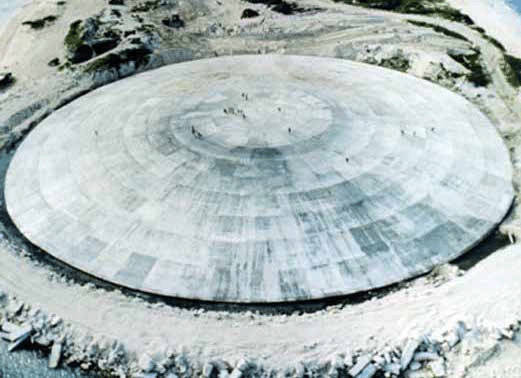
Nuclear tomb: The Runit Dome is chipping and cracking
|
Radioactive ‘Tomb’ in Pacific Filled With Nuclear Waste Is Starting to Crack, Science Alert ARIA BENDIX, BUSINESS INSIDER, 12 NOV 2019
In the Marshall Islands, locals have a nickname for the Runit Dome nuclear-waste site: They call it ‘The Tomb’. The sealed pit contains more than 3.1 million cubic feet (87,800 cubic meters) of radioactive waste, which workers buried there as part of efforts to clean hazardous debris left behind after the US military detonated nuclear bombs on the land. From 1977 to 1980, around 4,000 US servicemen were tasked with cleaning up the former nuclear testing site of Enewetak Atoll. They scooped up the contaminated soil, along with other radioactive waste materials such as military equipment, concrete, and scrap metal. It all went into the Runit Dome, which the servicemen then covered with concrete. In total, the crater holds enough radioactive waste to fill 35 Olympic-sized swimming pools. Most of that is irradiated soil carrying plutonium, an isotope that can cause lung cancer if inhaled. But as seas have gotten higher in the area – the water has risen about 7 millimetres per year since 1993 – water has begun to seep into the soil beneath the dome. Unlike the sealed dome on top, the bottom of the pit was never lined with concrete. So now, rising tides threaten to submerge the tomb – or crack it open. The Runit Dome is chipping and crackingPrior to the nuclear tests in the 1940s and 1950s, residents of Enewetak Atoll were exiled from their homes and relocated to nearby islands. Today, only three of the atoll’s 40 islands have been dubbed safe for human habitation. They are currently home to around 650 residents. The island that hosts Runit Dome remains unoccupied. In 2013, the US Department of Energy reported that radioactive materials could be leaking from the dome into the marine environment, but said such an occurrence would “not necessarily lead to any significant change in the radiation dose delivered to the local resident population.” But sea levels around the Marshall Islands are rising. By 2030, they could be between 1.2 and 6.3 inches (3 cm to 16 cm) higher than they are now, resulting in more storm surges and coastal flooding. By 2100, the dome could be submerged in water. Locals fear that mounting damage to the structure could present a new set of health risks. The dome recently began to crack and chip, increasing the odds that strong waves could force the structure open. A disaster like that would send even more radioactive waste into the nearby ocean or lagoon, which could even force locals to leave the island once again. “If it does [crack] open, most of the people here will be no more,” Christina Aningi, a teacher on Enewetak Atoll, told the Australian Broadcasting Corporation. “This is like a graveyard for us, waiting for it to happen.”…….https://www.sciencealert.com/a-tomb-in-the-marshall-islands-contains-a-huge-amount-of-radioactive-waste |
|
Boris nukes — daryanenergyblog

via Boris nukes — daryanenergyblog, A few weeks back Boris Johnson made reference to how the UK would shortly be building mini fusion reactors, courtesy of a generous grant of UK government funding (and thus brexit wasn’t going to be the disaster to UK science everyone is predicting). Of course, the actual nuclear scientists were quick to point out that […
that this is about as accurate as pretty much any other Boris Johnson statement. Such as his claim there will be no border checks between Ireland and the UK post-brexit (which would result in the UK facing sanctions from the WTO, the EU, and the US, plus he’d be unable to prevent counterfeit goods or smugglers flooding the UK market and why would anyone give the UK a trade deal if you can smuggle stuff across the UK border via NI tariff free?).In truth the UK leaving the EU also means the UK will be leaving Euroatom (The European agency that handles regulation and sale of nuclear materials). And given that the Tories plans for a UK regulator to replace them are in various states of chaos, the UK leaving the EU will probably mean an end to any significant nuclear research within the UK. While the UK will technically be still part of the ITER and JET fusion programs, its inevitable there will be some blowback as a result of brexit (e.g. scientists or their sick grandmother can’t get visas and walks off the job). About the only thing fortunate is that given the long time lines before we have a working commercial fusion reactor, its likely the UK will have rejoined the EU by the time this becomes a problem.
As with most Johnson lies the reality is a little different. Rolls Royce has a program to develop a mini nuclear power plant (fission based obviously, in the range of a few hundred megawatts), which the government has committed £18 million worth of matching funds too (i.e. the bulk of the funding will still have to come from Rolls Royce). To put this in prospective, funding for ITER is closer to 200 million euro’s per year (out of a total project cost estimated at 15 billion euro) with the EU contributing just under half of this (so Boris is promising the UK will spend about 25% the amount the EU spends on ITER every year).
By contrast Hinkley C (which is being built by the French) is likely to cost £22 billion, which works out as a cast burn rate of £5 million per day (so that £18 million won’t keep the Hinkley C site going for a week). And many Tories are nuclear supporters who are going to vote for this clown!
As for the prospects of mini-nukes rolling out across the country, polls show little public support with very few willing to live close to such a reactor. And as I’ve mentioned before, the downside of mini-nukes is their lower economies of scale, something even nuclear industry sources are quick to acknowledge, while talking up the benefits of them as a niche energy source. Given the fact that the two main obstacles to nuclear power right now are the high costs and the low level of public support, why in blue blazes would you pursue a form of nuclear that is more expensive and creates more flash points for public opposition. In fact it probably explains why RR have been in talks with the French about selling off some of their nuclear business.
The reality of nuclear energy is that it tends to favour large reactors, build by the larger nations, or transnational organisations, particularly when it comes to the regulation of such a safety critical industry. And this is even more true for nuclear fusion, given the enormous levels of research that will need to be applied to get the technology to work. Leaving the EU will inevitably diminish the UK’s ability to build, develop and service its nuclear industry. As in some many other areas the UK will be worse off out than in.
400,000 insect species face extinction

‘Insect apocalypse’ poses risk to all life on Earth, conservationists warn
Report claims 400,000 insect species face extinction amid heavy use of pesticides, Guardian, Damian Carrington Environment editor
A new report suggested half of all insects may have been lost since 1970 as a result of the destruction of nature and heavy use of pesticides. The report said 40% of the 1million known species of insect are facing extinction.
The analysis, written by one of the UK’s leading ecologists, has a particular focus on the UK, whose insects are the most studied in the world. It said 23 bee and wasp species have become extinct in the last century, while the number of pesticide applications has approximately doubled in the last 25 years.
UK butterflies that specialise in particular habitats have fallen 77% since the mid-1970s and generalists have declined 46%, the report said. There are also knock-on effects on other animals, such as the spotted flycatcher which only eats flying insects. Its populations have dropped by 93% since 1967.
But conservationists said that insect populations can be rescued, by introducing firm targets to cut pesticide use and making urban parks and gardens more wildlife friendly. Scientists said insects are essential for all ecosystems, as pollinators, food for other creatures, and recyclers of nutrients.
“We can’t be sure, but in terms of numbers, we may have lost 50% or more of our insects since 1970 – it could be much more,” said Prof Dave Goulson, at the University of Sussex, UK, who wrote the report for the Wildlife Trusts. “We just don’t know, which is scary. If we don’t stop the decline of our insects there will be profound consequences for all life on earth [and] for human wellbeing.”……
The planet is at the start of a sixth mass extinction in its history, with huge losses already reported in larger animals that are easier to study. But insects are by far the most varied and abundant animals, outweighing humanity by 17 times.
Insect population collapses have been reported in Germany and Puerto Rico, and the first global scientific review, published in February, said widespread declines threaten a “catastrophic collapse of nature’s ecosystems”.
Insects can be helped to recover by “rewilding” urban gardens and parks, Goulson said. “There is potential for a huge network of insect-friendly habitats right across the country. Already a lot of people are buying into the idea that they can make their gardens more wildlife friendly by letting go of control a bit. There are also quite a lot of councils going pesticide free.”
But he said: “The bigger challenge is farming – 70% of Britain is farmland. No matter how many gardens we make wildlife friendly, if 70% of the countryside remains largely hostile to life, then we are not going to turn around insect decline.”……. https://www.theguardian.com/environment/2019/nov/13/insect-apocalypse-poses-risk-to-all-life-on-earth-conservationists-warn
The push for nuclear power in Africa, but what happens to the wastes?

|
What happens to nuclear waste from power plants? DW, 14 Nov 19African countries looking to invest in nuclear energy as a source of clean electricity should consider Europe’s struggles with disposing of radioactive waste. Seventy years after the nuclear age began, no country has built a place to safely store its waste, a report published this week warns, raising concerns for governments mulling nuclear power as an alternative to fossil fuels.More than 60,000 tons of highly radioactive waste in the form of spent nuclear fuel rods are stored in interim sites across Europe, according to the World Nuclear Waste Report, some in old facilities that are running out of capacity and are expected to be used for decades longer than planned. Finland is the only country building a permanent repository underground for nuclear waste that emits large amounts of radiation for tens of thousands of years, according to the report published by the Heinrich Böll Foundation — which is affiliated with the German Green party.
“We are talking about time frames that are beyond the human scale of what we can think of,” said Arne Jungjohann, political scientist and lead editor of the report. “We still don’t know where to put the waste safely in a way that nobody will get harmed, that it is not vulnerable to terrorist attacks, that it is not being stolen to build nuclear bombs.” At the dawn of the nuclear age, radioactive material was diluted and dumped in the environment, before governments moved towards containing it securely underground. But projects from the 1960s onwards only met high safety expectations “to a very limited extent, if at all,” according to the report. That raises difficult questions for developing countries looking to get into nuclear. Nuclear Power in Africa Africa’s urban population is set to double in the next three decades, massively boosting demand for infrastructure and energy. Just half of Africans had access to electricity in 2017, compared to a global average of 88%, World Bank data shows. Eager to connect citizens with electricity grids, but anxious to avoid high-emissions of Western countries, some governments are exploring nuclear as a way to supply cheap and stable energy. South Africa is the only country on the continent that currently operates a nuclear plant, but about a dozen others are considering, planning or building them, according to the World Nuclear Association. Several countries — Algeria, Egypt, Ghana, Kenya, Namibia, Nigeria, Tanzania, Uganda and Zambia — have signed partnership agreements with Russian nuclear energy company Rosatom, a paper published in the journal Issues in Science and Technology found earlier this year, and others have contracts with China…….. attempts to deal with nuclear waste have so far faltered. Excluding Russia and Slovakia due to poor data, the report found that just four countries — France, the UK, Ukraine and Germany — are responsible for more than half of Europe’s nuclear waste, and none have yet found a deep underground store to hold it over centuries. The Heinrich Böll Foundation report found many governments underestimate the cost of storing waste and decommissioning reactors, with inconsistent rules shifting the financial burden from plant operators onto future generations of taxpayers. Unsolved nuclear waste is the “defeating argument against entering into the nuclear age,” said Rebecca Harms, a former Member of the European Parliament who was behind the report. “African countries should consider the nuclear legacies which have been created during the last 50, 60 years and for which we have no solutions.” Demand for energy in Sub-Saharan Africa is set to rise by 60% in the next two decades, but nuclear sources are projected to meet only a small fraction of this, according to the Africa Energy Outlook 2019, a report from the International Energy Agency (IEA) published on Thursday. “What we see in the future economic development of sub-Saharan Africa will be powered by a mix of renewables and natural gas,” said Kieran McNamara, senior energy analyst at the IEA and co-author of the report. “Nuclear just doesn’t feature.” https://www.dw.com/en/what-happens-to-nuclear-waste-from-power-plants/a-51216359 |
|
Australia’s bushfires could stay out of control for months
 Australia fires could be out of control for months, says fire chief, Concern grows over wind changes and high temperatures forecast for later this week, Guardian, Ben Doherty in Sydney @bendohertycorro
Wed 13 Nov 2019 It could be months before eastern Australia has more than a million hectares of bushfires under control, the New South Wales fire chief has warned, as the country faces one of its worst bushfire outbreaks.After relief that no further lives were lost on Tuesday, concern was growing over unpredictable winds worsening fires in the neighbouring state of Queensland on Wednesday, with much hotter temperatures also predicted for the Sydney area in the coming days.
Gusty winds changing direction are predicted to fan flames in new directions and widen “catastrophic” fire fronts in Queensland and northern NSW, where more than 100 fires – one more than 150,000 hectares (370,000 acres) in size – are burning.
Forecasters warned that “dry lightning” strikes could ignite new blazes, with fires worsening when hotter temperatures arrive over the weekend. Temperatures in Queensland are currently up to 8C higher than average.
Shane Fitzsimmons, the commissioner of the NSW rural fire services, said: “The real challenge is we have an enormous amount of country that is still alight. They won’t have this out for days, weeks, months. Unfortunately the forecast is nothing but above-average temperatures and below-average rainfall over the next few months and we’ve still got summer around the corner.”
The current fires in NSW cover four times the land area that burned during the whole of 2018, according to Fitzsimmons. There are also fires in Western Australia, South Australia and the Northern Territory.
While the extent of the bushfires is less than those in New South Wales in 1974-75 , which destroyed 4.5m hectares (11m acres), forecasters and fire chiefs are concerned that so many fires are already under way before high summer………
Bushfires are a regular occurrence during Australian summers, but the intensity of this year’s fires, and how early in the season they have arrived, have unleashed an acute political debate over the impact of climate change in exacerbating Australia’s fire vulnerability.
The prime minister, Scott Morrison, whose conservative coalition government has been consistently criticised over its support for coal-mining and power plants, inaction on climate change, and Australia’s rising carbon emissions, has refused to answers questions on climate change worsening fires………
In one of the largest peacetime mobilisations of Australian forces, the defence minister, Linda Reynolds, is preparing to send army, navy and air force reserve forces – the equivalent of the UK’s Army Reserve – into the fire zone to assist with evacuations and logistics.
The military intervention might even include an unprecedented compulsory call-up of reserve forces, such is the scale of the fire damage. https://www.theguardian.com/australia-news/2019/nov/12/australia-fires-rage-out-of-control-catastrophic-day
France extends nuclear reactors outage after earthquake
France extends nuclear reactors outage after earthquake, France 24 13 Nov 19, French utility EDF on Tuesday extended outages at three nuclear reactors at its Cruas plant until Nov. 15 following a 5.1 magnitude earthquake in southeast France that forced it to temporarily suspend electricity generation at the site.A sensor at the plant was activated during the earthquake in the region on Monday, requiring the state-controlled utility to carry out further checks for potential damage.
A spokesman for EDF said the outage extension would allow enough time for thorough visual and advanced checks across the plant, including in the nuclear buildings to ascertain that the units could function properly when they restarted.
France’s ASN nuclear safety agency on Monday said it was monitoring the situation and would decide when the reactors could restart.
The outage at the three reactors reduced French power generation by 2,700 megawatts (MW)……https://www.france24.com/en/20191112-france-extends-nuclear-reactors-outage-after-earthquake
A long-term continuing resolution -damaging to America’s nuclear weapons development
|
Here’s how a CR could hurt America’s nuclear weapons modernization. https://www.defensenews.com/smr/nuclear-arsenal/2019/11/12/heres-how-a-cr-could-hurt-americas-nuclear-weapons-modernization/
By: Aaron Mehta WASHINGTON — A long-term continuing resolution will result in delays for modernizing America’s nuclear warheads, while putting at risk an already challenging plan to build plutonium pits needed for the next generation of U.S. intercontinental ballistic missiles, nuclear officials are warning.
The National Nuclear Security Administration is a semiautonomous agency under the Department of Energy that handles the manufacturing and maintenance of America’s nuclear warheads. Like other government agencies, NNSA would be limited to fiscal 2019 funding limits under a continuing resolution, and it would be unable to start new contracts. The current continuing resolution, or CR, is set to end Nov. 21, but there is little expectation that regular budgeting will then resume. Congress is debating the merits of pushing the CR through December, but analysts are concerned the CR could extend into next year. “We are in a situation right now where we have single-point failures throughout our enterprise,” Lisa Gordon-Hagerty, the NNSA administrator, said during a Defense Writers Group breakfast earlier this month. “It’s necessary for us, for the NNSA and for the nuclear security enterprise to receive consistent and robust funding to modernize our infrastructure as well as continue ongoing operations.” “We’re looking at where we can move funding insofar as CRs will allow us to do so,” she added. “We’re working very closely with OMB and the administration to see what we can do to continue our important programs to modernize the infrastructure as well as the stockpile and our workforce initiatives and our endeavors.” Gordon-Hagerty did not go into detail about specific CR-related worries, but according to an NNSA source, the agency has identified three main areas of concern under a longer CR. The first is, broadly, keeping the warhead modernization efforts on schedule. Two of those modernization programs — the B61-12 gravity bomb and W88 submarine-launched ballistic missile warhead — already face program delays thanks to an issue with a commercial part that has to be redesigned. Gordon-Hagerty said a CR should not impact that particular issue, as the funding for a solution is coming from a realignment of other warhead modernization programs. But a delay to one program caused by a CR “does affect all of the other modernization programs and all of the other work that we have ongoing throughout our nuclear security enterprise,” she said. The second major area of concern is the surplus plutonium disposition program, which is supposed to dispose of 34 metric tons of excess plutonium at a South Carolina facility. That program emerged as the successor to the controversial MOX program, and has faced opposition from South Carolina Sen. Lindsey Graham. Construction on that facility could be delayed under a CR. The NNSA source said that the agency requested extra funding for the surplus plutonium disposition program through the budget anomaly process, but was not given the resources it requested. The third area of concern is a 10-year plan to develop a native plutonium pit in the United States. The NNSA has been charged with producing 80 plutonium pits a year by 2030, a target that Gordon-Hagerty acknowledged is a tight window for the agency to hit, even with stable funding. “We are again rebalancing, looking at our budget across the entire enterprise to see what it is we need to do to meet the scope and schedule of that 2030,” she said. “Am I confident we can get there? Yes. Is it fraught with — probably a bad way of saying it — land mines? It is.” Construction costs Construction featuring prominently on this list should not be a huge surprise; NNSA officials are quick to point out in public events that they are still using some buildings that date back to the Manhattan Project. According to Gordon-Hagerty, more than 50 percent of NNSA facilities are more than 40 years old, and over a third of those are about 70 years of age. The looming CR extension comes as the agency launches a number of construction projects, and a CR could lead to major delays in standing up those facilities. While that’s an issue for every agency under a CR, the NNSA is concerned that the specialty construction talent needed to build those facilities may not available if a contract is frozen and then picked up again later. There could also be high-dollar costs. Responding to a lawsuit by environmental groups trying to halt the construction of the Y-12 facility in Tennessee, NNSA said a six- to 12-month delay in construction at that location could result in almost $1 billion in extra costs for taxpayers and the agency may have to lay off 1,000 construction personnel. Those numbers, first reported by the Exchange Monitor, likely have resonance with other potential delays at construction sites caused by a CR — meaning construction delays at one or more sites could quickly become costly for an agency whose facilities and construction needs have traditionally been underfunded. “It’s been on schedule and on budget for the last six years. It will be finished in 2025 for approximately $6.5 billion,” Gordon-Hagerty said of the Y-12 facility. “If that funding somehow fails to materialize, then we’ve got over 1,000 crafts [personnel] working at the site right now. Crafts personnel are hard to come by, especially those that are qualified. So if they see a question about funding or funding gets pulled back, they’re going to find positions elsewhere.”
|
|

As Fukushima food export barriers fall, Japan aims to persuade China
Five markets still prohibit crops and seafood from nuclear disaster zone
The United States’ Nuclear and Non-Nuclear Weapons Are Dangerously Entangled
|
New evidence from the Yom Kippur War shows how such knots can lead to nuclear annihilation.
BY JAMES M. ACTON, NICK BLANCHETTE
NOVEMBER 12, 2019, In October 1973, an unreliable radiation detector could have caused the end of the world. The setting was the Yom Kippur War between Israel and a coalition of Arab states, and the superpowers found themselves being sucked into the conflict. In the war’s febrile final days, the United States detected what appeared to be radiation from a Soviet freighter headed for Egypt and concluded—almost certainly incorrectly—that Moscow was transferring nuclear warheads to Cairo. Partly in response, on Oct. 24, Washington placed its nuclear forces on a global alert for only the fourth time in history—a step it has taken only twice since. The U.S. alert prompted the Soviet Union to reportedly issue a preliminary order to begin the alerting of its own nuclear forces. This chain of events, which could have culminated in a nuclear war, provides a timely warning. The United States’ ability to detect and track nuclear warheads has improved immeasurably over the last 46 years, making an exact replay of 1973 unlikely. However, growing entanglement between nuclear and nonnuclear weapons is exacerbating closely related dangers. In particular, nuclear-armed states are relying ever more heavily on dual-use weapons, which can accommodate nuclear or nonnuclear warheads, thus exacerbating the risk that one side might wrongly conclude that another had deployed nuclear weapons. In a crisis or conflict, the result could be an escalation spiral that, unlike in 1973, spins all the way to nuclear devastation. ……(subscribers only) https://foreignpolicy.com/2019/11/12/the-united-states-nuclear-and-non-nuclear-weapons-are-dangerously-entangled/
|
|
Africa has fourfold growth potential with energy plan — G9IJA

By G9ija Africa has the potential to expand the continental economy fourfold, with energy demands expanding by only 50 per cent, the International Energy Agency (IEA), has said. In its new report unveiled on the sidelines of African Investment Forum in Johannesburg, South Africa, an analyst at IEA, Kieran McNamara, noted that these will have […]
via Africa has fourfold growth potential with energy plan — G9IJA
1 This Month

of the week – Shut Down Drone Warfare!


Tell the Ukrainian Government to Drop Prosecution of Peace Activist Yurii Sheliazhenko

Petition to revoke the licensing of the Near Surface Nuclear Disposal Facility (NSDF) at Chalk River. https://www.ourcommons.ca/petitions/en/Petition/Details?Petition=e-7247
To see nuclear-related stories in greater depth and intensity – go to https://nuclearinformation.wordpress.com
-
Archives
- April 2026 (114)
- March 2026 (251)
- February 2026 (268)
- January 2026 (308)
- December 2025 (358)
- November 2025 (359)
- October 2025 (376)
- September 2025 (257)
- August 2025 (319)
- July 2025 (230)
- June 2025 (348)
- May 2025 (261)
-
Categories
- 1
- 1 NUCLEAR ISSUES
- business and costs
- climate change
- culture and arts
- ENERGY
- environment
- health
- history
- indigenous issues
- Legal
- marketing of nuclear
- media
- opposition to nuclear
- PERSONAL STORIES
- politics
- politics international
- Religion and ethics
- safety
- secrets,lies and civil liberties
- spinbuster
- technology
- Uranium
- wastes
- weapons and war
- Women
- 2 WORLD
- ACTION
- AFRICA
- Atrocities
- AUSTRALIA
- Christina's notes
- Christina's themes
- culture and arts
- Events
- Fuk 2022
- Fuk 2023
- Fukushima 2017
- Fukushima 2018
- fukushima 2019
- Fukushima 2020
- Fukushima 2021
- general
- global warming
- Humour (God we need it)
- Nuclear
- RARE EARTHS
- Reference
- resources – print
- Resources -audiovicual
- Weekly Newsletter
- World
- World Nuclear
- YouTube
-
RSS
Entries RSS
Comments RSS
 nuclear-news