As Trump trashed nuclear weapons treaty, Putin promises ‘symmetrical response’ to US missile test
 Putin promises ‘symmetrical response’ to US missile test after end of nuclear treaty Telegraph UK 23 AUGUST 2019
Vladimir Putin has promised a “symmetrical response” to the US test of a missile banned under a nuclear weapons treaty rubbished this month by the Trump administration amid fears of a new arms race.A new land-based version of the navy’s Tomahawk cruise missile fired from an island in California struck a target more than 310 miles away on Sunday, according to the Pentagon. The recently defunct 1987 US-Russian intermediate-range nuclear forces treaty banned land-based missiles with ranges between 310 and 3,410 miles.
On Friday, Mr Putin told his security council that the test just 16 days after the treaty’s demise proved that the United States had long been developing weapons in violation of the agreement, while accusing Russia of the same as part of a “propaganda campaign”……
“For a symmetrical response, it would be enough to take Kalibr and put it on land and conduct a launch,” defence analyst Alexander Golts told The Telegraph. “That wouldn’t take a huge effort.”
South Korea might make own food arrangements for Fukushima Olympic events
 South Korea concerned over food safety at Olympics with events slated for Fukushima
Talks to take place over food provision at Tokyo Games
Fukushima to host baseball and softball games next year, Guardian Justin McCurry in Tokyo, Thu 22 Aug 2019 South Korea is considering making its own arrangements to feed its athletes at next year’s Tokyo Olympics, citing concerns over the safety of food from Fukushima, media reports said.
Radioactive patients – a concern following Russian nuclear accident
 Russian nuclear accident: Medics fear ‘radioactive patients’, https://www.bbc.com/news/world-europe-49432681 23 Aug 19, Russian medics who treated radiation victims after a military explosion in the Arctic had no protection and now fear they were irradiated themselves.
Two of the medics in Arkhangelsk spoke to BBC Russian about the victims’ evacuation, on condition of anonymity.
Five nuclear engineers died on 8 August when an “isotope-fuel” engine blew up at the Nyonoksa test range, officials said. Two military personnel also died.
President Vladimir Putin said the test involved a new weapon system.
Six people were injured in the accident, but officials gave few details about it.
On 14 August Russia’s weather service Rosgidromet revealed that radiation levels had spiked 16 times above normal, in Severodvinsk, a city 47km (29 miles) east of Nyonoksa.
According to the official data, the radiation that reached Severodvinsk was not heavy enough to cause radiation sickness.
Experts in Russia and the West say the test was most likely linked to the new 9M730 Burevestnik nuclear-powered cruise missile, called “Skyfall” by Nato. Last year Mr Putin said the technology would give the missile “unlimited” range.
The Arkhangelsk medics, who spoke to the BBC’s Pavel Aksenov, said at least 90 people came into contact with the casualties, but the military did not warn them of any nuclear contamination risk.
Contamination fears
The medics were at the civilian Arkhangelsk regional hospital, which treated three of the injured, while three other casualties were taken to an Arkhangelsk hospital called Semashko, which is equipped for radiation emergencies.
The medics said they were speaking out now because they feared for their own health and did not want any similar “[safety] violations” to recur.
“We don’t want them to bring us next time not three, but ten people, God forbid, and hide the information from us again,” said one.
The degree of secrecy surrounding the explosion has drawn comparisons with the 1986 Chernobyl disaster, when Soviet officials were slow to admit the truth.
The Arkhangelsk medics said it was clear that the three brought to their regional hospital were very sick. Doctors examined them in the emergency room, then sent them to an operating theatre.
But the emergency room continued to admit other patients for about an hour, the medics said, until the doctors realised that the three “had received a very high radiation dose”. The hospital handles pregnancy complications and other difficult medical conditions.
“The radiation picture was developing by the hour. Blood tests were being done, and every hour you could see that this or that cell count was plunging. That signified a very high radiation dose,” they said.
The hospital staff kept treating the victims despite knowing about the radiation dose. The staff had to improvise some self-protection – for example, they took face masks from the helicopter crews’ emergency kit.
The next day the three victims were transferred to a hospital in Moscow which has radiation specialists. Their condition now is unknown.
Nuclear decontamination
A military team later carried out decontamination work in the Arkhangelsk hospital.
The medics said the casualties’ clothing was removed, along with stretchers and a “highly radioactive bath”.
“Our cleaners should have been advised, they’re just simple country folk, they were just picking up sacks and bundles and carrying them out,” said one.
The other medic said hospital staff were now mentally stressed, knowing that radiation safety information had been withheld from them during the emergency.
Two weeks after the explosion the Russian health ministry said none of the medics at the Arkhangelsk hospitals had received a hazardous radiation dose. Its conclusion was based on medical examination of 91 staff.
Incomplete data
On Monday an international nuclear agency reported that the two Russian radiation monitoring stations nearest to Nyonoksa had gone offline soon after the explosion. The revelation fuelled suspicions that the radiation could have been heavier than officially reported.
The Comprehensive Nuclear Test-Ban Treaty Organization (CTBTO) said the technical failure at those sites was then followed by a failure at two more. It tweeted an animation showing the potential radiation plume from the explosion.
Russia said the weapons test was none of the CTBTO’s business, and added that handing over radiation data was voluntary. Two of the monitoring stations have since started working again.
Massive wildfires are burning across the world- July was hottest month ever
|
July was the hottest month ever on Earth. Now massive wildfires are burning across the globe. https://www.usatoday.com/story/news/nation/2019/08/21/wildfires-july-hottest-month-ever-fires-rage-across-globe/2070418001/ DENVER – Wildfires are burning across the globe, clogging the sky with smoke from Alaska to the Amazon, and scientists say it’s no coincidence that July was the warmest-ever month recorded on Earth.… |
|
“ZATO” Russia’s many closed cities, – some site of nuclear accidents

|
Russia’s closed cities hold the secrets to global nuclear disasters you’ve never heard of https://www.abc.net.au/news/2019-08-24/russia-closed-cities-hold-secrets-to-global-nuclear-disasters/11437734
Key points:
But it makes sense why Russia might be vague on the detail. Both the city near the accident site, Severodvinsk, and the one where the victims were buried, Sarov, are “closed cities” — highly controlled areas that house the country’s most important weapons sites. The Government does not want outsiders knowing what goes on there, especially when accidents happen. And when accidents do happen in closed cities, like a radioactive explosion or an outbreak of anthrax, Russia has a long history of covering them up. Russia is far from the only country to have closed cities, but it does have a lot of them. It’s thought there are about 40 closed cities in Russia, though it’s suspected there are others whose very existence is highly classified. First established in the 1940s, closed cities — officially known by the acronym ZATO in Russian — are most often associated with either military installations or major research centres and are used to house employees and their families. For example, Sarov, where the five scientists killed in the explosion were buried, is the site of a nuclear weapons design facility. It’s been a closed city since 1946, when it was renamed Arzamas-16 and its location was removed from all unclassified maps. The movement of people and information in and out of these cities is highly restricted, and residents are often not allowed to disclose where they live to outsiders.
“And when you have those it is easy to gloss over problems, perhaps cover up accidents, there’s not a lot of ways for information to get out.” The nuclear disaster you probably haven’t heard ofWhile Chernobyl and Fukushima might be synonymous with nuclear disasters, that might not be the case for Kyshtym. It was the third most-serious nuclear accident ever recorded, and it happened at the Mayak facility in the closed city of Ozyorsk, in Russia’s Ural Mountains, in 1957. A cooling system in a radioactive waste tank broke down and the rise in temperature resulted in an explosion that released an estimated 20 million curies of radioactivity into the environment. During the Chernobyl explosion, about 50–200 million curies of radioactivity was estimated to have been released. The Kyshtym disaster contaminated an area up to 20,000 square kilometres, known as the East-Ural Radioactive Trace, and thousands of people near the plant were evacuated. But the Soviet government didn’t publicly acknowledge the accident until 1989. The incident was happening at the time of the Cold War so it was also an attempt by the Soviet authorities to prevent the news from reaching the outside world,” Alexey Muraviev, a specialist in Russian strategic and defence policy at Curtin University, told the ABC. But the area had been contaminated even before the Kyshtym disaster, when high-level radioactive waste from the production of plutonium at Mayak had been intentionally dumped into the nearby Techa river. “They put about 3.2 million curies into that small river, and the people who lived downstream drank from it, swam in it, ate from it, fished in it, watered their crops in it,” Professor Brown said. Twenty-eight communities live down that river, several tens of thousands of people, and they didn’t tell anybody that they were putting high-level waste [in the river].” Mayak now serves as a reprocessing plant for spent radioactive fuel. In October 2017, a network of monitoring sites picked up a cloud of radioactive material, Ruthenium-106, above Europe. In a report published just last month, a team of scientists say the most likely source was a fire or explosion at Mayak that occurred during the reprocessing of spent fuel to create enriched caesium for an Italian laboratory. Russia’s nuclear energy agency continues to deny anything happened at Mayak in 2017, but at the time, the Russian Meteorological Service admitted there was “extremely high contamination” in the air around the Ural mountains. And it’s not just nuclear accidents that happen at closed cities. In 1979, spores of anthrax leaked from a biological weapons facility in the closed city of Sverdlovsk and killed at least 68 people, many of whom were civilians from a nearby ceramics plant. The Soviet government blamed the deaths on the consumption of contaminated meat, and it was only in 1992 that then-president Boris Yeltsin publicly linked the anthrax outbreak with the military facility. While some have a bad safety reputation, there’s a big reason why Russians might want to move to a closed city: they’ve historically gotten the best of everything. As part of the privileges of working on important, secret and dangerous processes, residents are promised a higher standard of living and better resources. During the Soviet era, those who lived in closed cities were spared the austerity of other parts of the country.
“They also provided better living conditions, so people who would work at closed cities would be guaranteed state funding accommodation and so on.” The reputation of the living standards and privileges of those cities meant the jobs that would allow you to move to one were highly sought after. “This is an important element, otherwise it sounds like [closed cities] are like a giant concentration camp,” Dr Muraviev said. And according to Dr Muraviev, Russian President Vladimir Putin has been actively trying to restore the glamour of the country’s remaining closed cities. “Back in the 1990s those privileges kind of really lapsed, so there were no incentives anymore, but now they’re sort of back on the agenda and the Government is really pumping funds into these cities,” he said. “That’s part of [Mr Putin’s] strategy to rebuild Russia’s national security as well as rebuild Russia’s national defence capability.” And as far as the risks go of moving to a secretive town next to a nuclear facility or a military installation? Dr Muraviev said the people who chose to move to closed cities knew what came with the job. “They understand risks associated with it and they’re not just doing it for money; they’re also doing it for the idea of making Russia safe,” he said. |
|
Iran working productively with France, to save nuclear deal
 Iran’s Zarif: Nuclear talks with Macron were ‘productive’ Iran’s Zarif: Nuclear talks with Macron were ‘productive’Mohammad Javad Zarif says they could work with new French proposals, to save nuclear deal. https://www.aljazeera.com/news/2019/08/irans-zarif-nuclear-talks-macron-productive-190823161529602.html Iran’s foreign minister has hailed “positive” talks with French President Emmanuel Macron, on salvaging the 2015 nuclear deal.Mohammad Javad Zarif says they could work with new French proposals, to save the nuclear deal. Speaking to reporters after meeting Macron, Zarif says both countries have made suggestions on how to move forward after the United States pulled out of the nuclear deal last year. Macron has previously said he will either try to soften the effect of the US sanctions or come up with a way to compensate the Iranian people. |
|
Trumped Up: Wiki cables show Australia thinks Iran is not the aggressor,
Trumped Up: Wiki cables show Australia thinks Iran is not the aggressor, Michael West, by Prof. Clinton Fernandes — 23 August 2019 Wikileaks cables reveal Iran presents no threat to Australia and little threat to the US. Instead, clear intelligence from the US, Australia and Iran confirms Iran, although portrayed as aggressive, has pursued a defensive military strategy. Clinton Fernandez reports.
UK Office of Nuclear Regulation seems to have increased the number of cracks permitted in Hunterston nuclear reactor.
|
Scottish CND 21st Aug 2019 Scottish CND condemn Office of Nuclear Regulation’s decision to restart
Hunterston nuclear reactor 4. The meeting between ONR, Dr Ian Fairlie and NFLA (notes available) stated that while the cracking in Reactor 4 is not as extensive as Reactor 3 there is an issue of some cracks openings that are greater than 1.2cm wide (i.e. 1/2 inch). Scottish CND chair Arthur West: “This news about the Hunterston reactor is very disappointing. It is
very worrying that the Office of Nuclear Regulation seems to have increased the number of cracks permitted in the reactor. This move seems to be a clear case of moving the goalposts to allow the closed reactor to reopen. It really is time to think about a future beyond nuclear energy. The best response to the current situation at Hunterston is to continue the development of safer and cleaner forms of renewable energy.” |
|
Massachusetts Attorney General objects to transfer of the Pilgrim Nuclear Power Station license to Holtec
 Regulators approve nuclear transfer over governor, AG protests, MASS LIVE, By Colin A. Young / STATE HOUSE NEWS SERVICESTATE HOUSE, BOSTON, AUG. 23, 2019…..Despite the objections of Attorney General Maura Healey, the Baker administration and local advocacy groups, federal regulators approved the transfer of the Pilgrim Nuclear Power Station license to a company that plans to decommission the plant on an “accelerated basis.” Regulators approve nuclear transfer over governor, AG protests, MASS LIVE, By Colin A. Young / STATE HOUSE NEWS SERVICESTATE HOUSE, BOSTON, AUG. 23, 2019…..Despite the objections of Attorney General Maura Healey, the Baker administration and local advocacy groups, federal regulators approved the transfer of the Pilgrim Nuclear Power Station license to a company that plans to decommission the plant on an “accelerated basis.”
Entergy, which bought the Plymouth plant from Boston Edison in 1999, is selling it to Holtec International, and the Nuclear Regulatory Commission has been reviewing the requested license transfer since last year. The NRC approved the transfer Friday, announcing that Holtec International will be the owner of the plant and that its subsidary Holtec Decommissioning International will serve as the decommissioning operator. The NRC said its order approving the license transfer is effective immediately but that the transfer will not actually take place until the sale of the plant is finalized. The transfer includes the dry cask spent fuel storage installation at Pilgrim.
……… The approval comes as Attorney General Maura Healey, Gov. Charlie Baker’s energy and environment secretariat and members of the state’s Congressional delegation mounted an effort to block the transfer until the NRC held a full hearing on concerns over Holtec’s ability to safely decommission the nuclear plant, the company’s financial stability and its alleged involvement in a kickback scheme.
“The Commonwealth does not believe that Holtec has met the NRC’s financial and technical qualification requirements for license transfer approval,” Healey’s office wrote to the NRC this week. “Indeed, the Commonwealth has serious concerns about Holtec’s financial and technical capacity to complete the work at Pilgrm. At a minimum, this history requires a heightened degree of scrutiny by the NRC and its Staff.” ……..
On Friday, Healey’s office said it will review the options it still has to rectify what it called a “misguided decision” by the federal regulators. “We are deeply disappointed in the NRC’s misguided decision to approve the license transfer and trust fund exemption requests, and its failure to meaningfully consult with our state prior to doing so. We continue to have serious concerns about Holtec’s financial capacity, technical qualifications, and judgment to safely and properly clean up the site, and store and manage Pilgrim’s spent nuclear fuel,” Healey spokeswoman Chloe Gotsis said. “We are reviewing all of our available options to ensure the health, safety and interests of our residents and the environment are protected.” U.S. Sen. Edward Markey, who sits on a Congressional committee with jurisdiction over the NRC, said the agency “is abdicating any responsibility for protecting public health and safety with its rushed and uninformed license transfer for the Pilgrim nuclear power plant.” “The opaque process that disregarded local resident and state input reflects the Commission’s choice to prioritize industry timelines over due diligence and transparency. Holtec’s math on how it will pay for decommissioning does not add up. Holtec’s unwillingness to even negotiate an agreement with local stakeholders — the ones who will be living next door to nuclear waste for years to come — is unacceptable,” Markey said. “I have repeatedly called on Holtec to be a good neighbor and for the Commission to be a good regulator, but those calls of concern were ignored.”
The Baker administration said it “believes the Nuclear Regulatory Commission staff should not have made the decision to approve the license transfer prior to the Commission ruling on the concerns raised by the administration and Attorney General.” “Both offices remain deeply committed to ensuring the Pilgrim Nuclear Power station is decommissioned in a manner that protects the safety of the public and environment,” Energy and Environmental Affairs spokeswoman Katie Gronendyke said. Late Thursday, four state senators and six state representatives — Sens. Viriato deMacedo, Julian Cyr, John Keenan and Patrick O’Connor along with Reps. William Crocker, Josh Cutler, Dylan Fernandes, Sarah Peake, Kathleen LaNatra and Tim Whelan — issued a statement in support of Healey and the administration. They asked the NRC to give the issue a full hearing before acting on the license transfer application……… https://www.masslive.com/news/2019/08/regulators-approve-nuclear-transfer-over-governor-ag-protests.html |
|
White House new system guidelines for nuclear power in space includes weapons grade materials
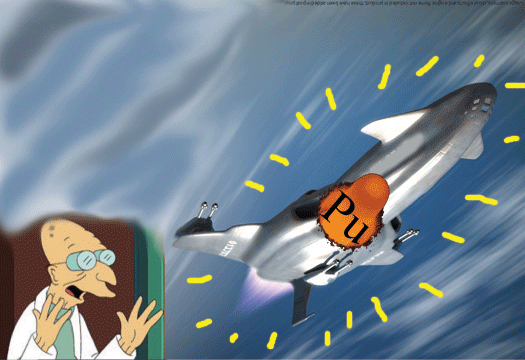 White House Overhauls Launch Approval Process for Nuclear Spacecraft, AIP, 23 Aug 19, The White House has announced a new launch authorization process for spacecraft that use nuclear-powered systems, instituting a tiered framework that delegates decision-making for less risky missions and provides explicit guidance on acceptable risk levels……
The least risky missions fall in Tier 1, where the director of the sponsoring agency can approve the launch. In Tier 2, an interagency review process is triggered, though the sponsoring agency director maintains authority over the launch decision. The memo directs NASA to establish a standing Interagency Nuclear Safety Review Board to perform this function, which formerly was handled by an ad hoc committee empaneled on a mission-by-mission basis.
Spacecraft that use fission reactors automatically fall in at least Tier 2, and the memo requires NASA to identify additional safety guidelines for “safe non-terrestrial operation of nuclear fission reactors, including orbital and planetary surface activities.”
Tier 3 missions require presidential authorization, which for non-defense missions is delegated to the OSTP director, who may opt to forward the decision to the president. Due to nuclear nonproliferation considerations, missions that use highly enriched uranium automatically fall in Tier 3.
The memo also establishes a set of safety guidelines that apply to spacecraft across all tiers. It specifies that the probability a launch accident would result in any individual receiving a total effective dose between 0.025 rem and five rem should be no greater than 1 in 100. The probability for exposures between five rem and 25 rem should not exceed 1 in 10,000, and above 25 rem the probability should not exceed 1 in 100,000. For comparison, the average effective doseindividuals receive from natural background radiation in the U.S. is about 0.3 rem per year, and the Nuclear Regulatory Commission’s dose limit for radiation workers is five rem per year…….
According to a 2015 study, the U.S. has launched 47 nuclear power systems and hundreds of heater units on 31 missions since 1961. The most recent scientific missions to employ an RPS were New Horizons, a Pluto fly-by mission launched in 2006, and the Mars Curiosity Rover, launched in 2011. The follow-on Mars 2020 Rover and the recently selected Dragonfly rotorcraft mission to Saturn’s moon Titan are currently the only two approved NASA spacecraft in development that will use an RPS.
The relatively infrequent use of nuclear systems on spacecraft is in part attributed to the complexity and cost of the safety review process, which generally has limited them to flagship-class missions. Low availability of plutonium for civilian uses has also constrained the mission cadence…….
NASA has recently emphasized the potential value of fission reactors for human deep space exploration missions. At the National Space Council meeting this week, NASA Administrator Jim Bridenstine said nuclear thermal propulsion technologies could significantly reduce transit time to Mars. He also pointed to other potential applications, such as using fission to power a space-based laser that could deflect asteroids and deorbit space debris.
NASA is also exploring how nuclear reactors could meet the power demands of planetary bases. One such concept, called Kilopower, could provide up to 10 kilowatts per reactor using highly enriched uranium. Bridenstine visited members of the Kilopower team this week at NASA’s Glenn Research Center.
The concept is not without critics. Rep. Bill Foster (D-IL), a former Fermilab physicist who advocates using alternatives to highly enriched uranium, pressedBridenstine on the subject at a hearing this year.
“A future where every space-faring nation has a big inventory of weapons-grade material to service the reactors that they are using all over the Moon and all over Mars is not a very safe space environment,” Foster said. “There will be some small performance compromises in going with low enriched non-weapons grade material, but I really urge you to look hard at keeping alive the prospect of having an international collaboration to develop workable non weapons grade-based materials that the whole world will use.” …….https://www.aip.org/fyi/2019/white-house-overhauls-launch-approval-process-nuclear-spacecraft
1 This Month


Tell the Ukrainian Government to Drop Prosecution of Peace Activist Yurii Sheliazhenko

Petition to revoke the licensing of the Near Surface Nuclear Disposal Facility (NSDF) at Chalk River. https://www.ourcommons.ca/petitions/en/Petition/Details?Petition=e-7247


of the week – STOP SMALL MODULAR REACTORS IN CANADA
To see nuclear-related stories in greater depth and intensity – go to https://nuclearinformation.wordpress.com
-
Archives
- March 2026 (204)
- February 2026 (268)
- January 2026 (308)
- December 2025 (358)
- November 2025 (359)
- October 2025 (376)
- September 2025 (258)
- August 2025 (319)
- July 2025 (230)
- June 2025 (348)
- May 2025 (261)
- April 2025 (305)
-
Categories
- 1
- 1 NUCLEAR ISSUES
- business and costs
- climate change
- culture and arts
- ENERGY
- environment
- health
- history
- indigenous issues
- Legal
- marketing of nuclear
- media
- opposition to nuclear
- PERSONAL STORIES
- politics
- politics international
- Religion and ethics
- safety
- secrets,lies and civil liberties
- spinbuster
- technology
- Uranium
- wastes
- weapons and war
- Women
- 2 WORLD
- ACTION
- AFRICA
- Atrocities
- AUSTRALIA
- Christina's notes
- Christina's themes
- culture and arts
- Events
- Fuk 2022
- Fuk 2023
- Fukushima 2017
- Fukushima 2018
- fukushima 2019
- Fukushima 2020
- Fukushima 2021
- general
- global warming
- Humour (God we need it)
- Nuclear
- RARE EARTHS
- Reference
- resources – print
- Resources -audiovicual
- Weekly Newsletter
- World
- World Nuclear
- YouTube
-
RSS
Entries RSS
Comments RSS
 nuclear-news