Ranking Member of US Senate Armed Services Committee Reed: Trump should be Restricted from going to War with Iran — Mining Awareness +

“Reed Votes to Block President Trump from Authorizing a Military Strike on Iran Without Congressional Approval Ranking Member of Armed Services Committee says White House should be restricted from going to war with Iran 6/28/2019 — WASHINGTON, DC – Today, despite the fact that he is a member of the minority party, U.S. Senator Jack Reed […]
US Senator Kaine Says War With Iran Would Be A “Colossal Mistake”; Kaine-Udall Plan to Work with House to Assert Congress’ War Powers to Prevent War with Iran — Mining Awareness +

40 voted to abdicate their responsibility as US Senators. 10 abdicated their responsibility as US Senators by not even voting! https://miningawareness.wordpress.com/2019/06/28/us-senate-roll-call-to-prohibit-unauthorized-military-operations-in-or-against-iran-50-yeas-40-nays-10-awol-60-yeas-required/ US Senator Kaine is right, except in his concern that “Trump was blundering toward war with Iran“. Trump is doing it on purpose. Trump’s not blundering his way because it’s intentional. “In Lead Up […]
Nuclear power limited by climate change: France’s nuclear reactors can’t cope with the heat
 EDF to curb Bugey nuclear reactor output as Rhone river flow slows https://www.reuters.com/article/us-france-weather-nuclearpower/edf-to-curb-bugey-nuclear-reactor-output-as-rhone-river-flow-slows-id Reporting by Bate Felix; Editing by Geert De Clercq, PARIS (Reuters) 29 June 19 – French utility EDF said on Friday that power generation at its 3,600 megawatt (MW) Bugey nuclear power plant in eastern France could be curbed from Tuesday July 2 due to a lower flow rate of the Rhone river.The plant near the Swiss border has four 900 MW reactors and uses water from the river for cooling.
EDF’s use of water from rivers as coolant is regulated by law to protect plant and animal life. It is obliged to reduce output during hot weather when water temperatures rise, or when river levels and the flow rate are low.
France saw new all-time record temperatures about 45 degrees Celsius in the south of the country on Friday afternoon as a sweltering heatwave engulfed much of southern and central Europe.
Climate change’s new normal? Heat waves, wildfires, in Europe
 ‘Worst is still to come’: Sizzling Europe battles wildfires, health risks, New records are being set as Europe swelters, sparking forest fires – and debates over public nudity. SBS News, 28 June 19 Wildfires raged across Catalonia and French authorities stepped up restrictions on water use and driving in cities as swathes of western Europe remained in the grip of an intense heatwave.
Temperatures climbed towards 44 degrees Celsius (111 degrees Fahrenheit) in parts of northern Spain and southern France, driving many people to seek relief in the sea, rivers, lakes, fountains and swimming pools.
Grid operator RTE said French electricity demand on Thursday was close to a summer record seen two years ago, as people turned on fans and coolers to full blast for relief from the scorching temperatures……….
The stifling heat has elsewhere prompted traffic restrictions in France and fanned debate in Germany over public nudity as sweltering residents stripped off. …….
Exceptional for arriving so early in summer, the heatwave will on Thursday and Friday likely send thermometers above 40 degrees in France, Spain and Greece.
In Spain, hundreds of firefighters and soldiers, backed by water-dropping aircraft, battled on Wednesday to put out a wind-fuelled forest fire that erupted in Torre del Espanol in the northeastern region of Catalonia…….
Scientists warn that global warming linked to human fossil fuel use could make such scorchers more frequent.
“Global temperatures are increasing due to climate change,” said Len Shaffrey, professor of climate science at the University of Reading.
“The global rise in temperatures means the probability that an extreme heatwave will occur is also increasing.”……… European heatwave could be the norm in a climate change affected world…….. https://www.sbs.com.au/news/worst-is-still-to-come-sizzling-europe-battles-wildfires-health-risks
Progress in diplomatic talks with Iran, but might not save the nuclear deal
 Nuclear talks progress ‘not enough’ for Iran to change course, INSTEX payment system now operational, but Iran says needs to be used for oil purchases to be useful. Aljazeera, 29 June 19
Diplomats meeting in Vienna in a bid to save a 2015 nuclear deal between Iran and world powers made progress but it was “not enough” to stop Tehran scaling back compliance with the accord, according to the Iranian deputy foreign minister.
Officials from the deal’s remaining signatories – China, Russia, the United Kingdom, France, Germany and Iran – as well as the European Union, held talks in the Austrian capital on Friday after Tehran warned that it would soon breach a limit on the amount of enriched uranium set out in the agreement.
“It was a step forward, but it is still not enough and not meeting Iran’s expectations,” Iran’s Deputy Foreign Minister Abbas Araqchi told reporters. “I don’t think the progress made today will be enough to stop our process but the decision will be made in Tehran.”…….https://www.aljazeera.com/news/2019/06/nuclear-talks-progress-iran-change-190628160308104.html
G-20: Trump Deeply Disgraces and Damages the USA with his Fawning Bromance with Putin; Trump Again Refuses to Reveal Discussions with Putin — Mining Awareness +

“Trump deeply disgraces & damages our nation in his fawning bromance with Putin—an engraved invitation to Russian military agents reving up their 2020 machine for hacking, disinformation, deceptive social media & newer weapons of sabotage” (US Senator Blumenthal, 28 June 2019) From US Senator Reed: “Reed: Instead of Joking About Russian Interference in U.S. Elections, […]
No climate change leadership at G20 summit, and Trump is a disruptive disaster
|
The Guardian view of the Osaka G20 summit: bad as he is, Trump is not the only problem, Editorial, Guardian 268 June 19 The climate crisis underlines the need for effective global economic leadership. The US president makes this harder, but so do China and several others.Ever since the G20 of leading global economies was founded, its summits have mostly been convergent occasions, marked by attempts to find common ground and remembered for nothing more unseemly than a bit of jostling among the heads of government to be on the front row of the group photograph. Japan’s prime minister Shinzō Abe clearly takes this traditional view about the G20 summi twhich he will host in Osaka on Friday and Saturday. “We want to make it a meeting that focuses on where we can agree and cooperate rather than highlighting differences,” he said recently.
But there is a balloon-puncturing problem with Mr Abe’s approach, and it answers to the name of Donald Trump. If there is one issue on which this year’s summit clearly ought to be showing global leadership, it is the climate crisis. The subject is indeed on the Osaka agenda but, in spite of efforts by countries including France, there is no prospect of serious or effective action. That is no surprise from a group of nations which almost tripled the subsidies they gave to coal-fired power plants between 2013 and 2017, with China, India and Japan itself leading the way. But it is Mr Trump’s decision to walk away from climate accords and to back fossil fuels that creates the wider permission for these other terrible derelictions. Mr Trump’s disruptions do not end there. The US president uses these gatherings not to build alliances to solve common problems but to knock his adversaries – and sometimes his supposed allies – off their stride. He is not looking for general agreement, which he thinks is for wimps. He is looking for American advantage over friend and foe. That’s the reason why the summit is already overshadowed by the increasingly serious trade war between the United States and China (Mr Trump will have an all-smiles bilateral with Xi Jinping on Saturday). And it is certainly the reason why Mr Trump has used the run-up to Osaka to have a pop at his hosts, whom he claimed would respond to an attack on the US by watching it “on a Sony television”, attacking India for raising tariffs and then, inventing false figures, berating Germany as a “security freeloader”. Since Mr Trump’s Friday schedule involves one-on-ones with Mr Abe, India’s Narendra Modi and Germany’s Angela Merkel, it seems these mind games are part of a deliberate strategy of disruption. This is not a novel conclusion. Mr Trump used the same approach before his recent visit to Britain, when he praised Boris Johnson and attacked Sadiq Khan and the Duchess of Sussex. If Mr Johnson becomes prime minister and Britain were to back off from supporting European opposition to the White House’s Iran strategy, Mr Trump would count this a job well done. Mr Trump’s bullying is also selective. Among the world leaders whom Mr Trump has not attacked in advance – but with whom he will also be meeting in Osaka bilaterals – are Vladimir Putin of Russia, whose country systematically interfered in the 2016 US election, and Mohammed bin Salman of Saudi Arabia, who has just been accused by the United Nations of orchestrating the murder and dismemberment of the opposition journalist Jamal Khashoggi……… https://www.theguardian.com/commentisfree/2019/jun/27/the-guardian-view-of-the-osaka-g20-summit-bad-as-he-is-trump-is-not-the-only-problem |
|
|
A film that reminded the world of the nuclear danger
The China Syndrome (1979) ORIGINAL TRAILER [HD 1080p]
How THE CHINA SYNDROME Brought Down The Nuclear Power Industry, The film that predicted Three Mile Island and affected the response to Chernobyl. Birth, Movies, Death. By ANDREW TODD Jun. 28, 2019 When we think about nuclear power, we tend to think about disasters. Real life has given us plenty of reason to do so: between Three Mile Island, Chernobyl, and Fukushima, three major global powers have each seen their nuclear industries fall subject to catastrophe. People died; economies crashed; whole sections of Earth were rendered uninhabitable. Hell, Chernobyl arguably ended the entire Soviet Union.
Entertainment, too, has played a significant role in creating this image of nuclear power. Dozens of movies, TV miniseries, and documentaries over the years have played off and magnified real-life fears, often drawing a direct connection between the “peaceful atom” and its destructive wartime counterpart. One of the first, and most influential, was James Bridges’ 1979 atomic energy thriller The China Syndrome.
“The China Syndrome” is a colloquial term for a very real threat in the event of a nuclear accident. It refers to a reactor accident wherein reactivity becomes so supercritical that operators cannot control it. The fuel gets so hot, it melts its mounting channels, control rods, and even exterior housing, burning through concrete and steel to seep unstoppably downwards – in fanciful terms, all the way to China (hence the name). This actually happened, to a degree, at Chernobyl: the reactor transformed into hundreds of tons of corium lava, eating through multiple basement levels and nearly breaching the building’s foundations before it cooled sufficiently to stop melting concrete. The danger, as with any China Syndrome situation, was that the fuel would reach groundwater, poisoning the land or creating a steam explosion that would blast radioactive material across an enormous area.
Curiously, there is no China Syndrome in The China Syndrome. Based primarily on a 1970 accident at the Dresden Nuclear Power Station in Illinois, the film follows reporter Kimberly Wells (Jane Fonda) and cameraman Richard Adams (Michael Douglas) after they witness an accident while reporting at a California nuclear power plant. ………….
Predictably, the nuclear industry had a fiery reaction. Westinghouse executive John Taylor described the film as “an overall character assassination of an entire industry.” Nuclear experts generally agreed that the film’s specific events were highly improbable (if not entirely impossible), but also that an inherent clash exists between earning corporate profits and spending the money required to keep reactors safe. The industry may have been correct to debate the film’s finer technical points or melodramatic ending, but it’s hard to argue that unchecked capitalism doesn’t encourage corner-cutting.
On that note, it’s worth noting, that The China Syndrome’s institutional failure is near-identical to that which contributed to the Chernobyl disaster. Both saw powerful organisations covering up disastrous mistakes made in the name of cost-efficiency, but they come from opposite ends of the ideological spectrum. One comes from American capitalism, where making money and gaining power comes first and safety regulations are a costly hassle. The other comes from Soviet communism, where saving money and maintaining power came first and safety regulations were a costly hassle. Personal and institutional selfishness knows no political boundaries, and both all-powerful states and all-powerful corporations are prone to malfeasance.
All the industry’s rebuttal ultimately proved ill-advised, of course, as less than two weeks after the film’s release, a reactor underwent a partial meltdown at the Three Mile Island Nuclear Generating Station. Still the most serious nuclear accident in US history, the accident caused no immediate deaths, but the radiation leakage may have contributed to cancers, and the fourteen years of cleanup cost a billion dollars. More importantly, it caused opinion to solidify around the The China Syndrome’s thesis: that the nuclear energy industry could not be trusted with nuclear energy……… https://birthmoviesdeath.com/2019/06/28/how-the-china-syndrome-brought-down-the-nuclear-power-industry
Trump Praises Saudi Crown Prince at G-20 Meeting — Mining Awareness +

From VOA News: “Trump Praises Saudi Crown Prince at G-20 Meeting By VOA News June 28, 2019 09:23 PM VOA’s White House Bureau Chief Steve Herman in Osaka, Japan, and Dorian Jones in Istanbul contributed to this report. U.S. President Donald Trump praised Saudi Arabia’s Crown Prince Mohammed bin Salman as the two met on […]
via Trump Praises Saudi Crown Prince at G-20 Meeting — Mining Awareness +
U.S. senators agonise over nuclear waste debacle, (but with no thought of stopping producing radioactive trash)
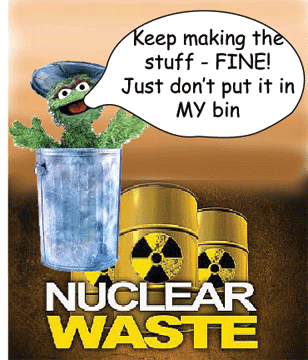 SENATORS TRY—AGAIN—TO SOLVE THE NUCLEAR WASTE DEBACLE, WIRED, RIC NIILER, 28 June 19
The place that the government picked to store all the nuclear waste back in 1987, a repository in Yucca Mountain, Nevada, was canceled in 2009 by the Obama administration. Since then, the project has been in a bureaucratic limbo. The Trump administration moved to take another look at Yucca Mountain and restart the licensing process, but Congress removed funds to do that from last year’s budget.
“It is long, long past time to figure this out, and the sooner we find a path the better,” said Senator Lisa Murkowski (R–Alaska) as she opened a hearing on the issue Thursday in the Senate’s Energy and Natural Resources Committee. Murkowski is sponsoring a bill that would both create a new agency in charge of handling nuclear waste and develop a way for local consent to become part of the decision-making process, although insulated from pressure by members of Congress. That means that the local residents living near a selected site—either temporary or permanent—would get some say in the matter, although perhaps not a veto.
Murkowski’s bill would set up a new agency outside of Congress to pick a place for a new temporary nuclear waste site to take the spent fuel right away (well, within 10 years). The big holdup is “consent.” While some local communities or native tribes might want the money or jobs that go along with hosting a nuclear waste site, state politicians have blocked such attempts in Nevada, Utah, and Tennessee.
Some noteworthy comments on the diseconomics of nuclear power
 Nuclear Power’s Economic Crisis, Friends of the Earth, Australia, 29 June 19
- Letter to Australian Politicians (FoE has sent this to all federal MPs and Senators)
- Nuclear Power’s Economic Crisis
‒ An Escalating Crisis
‒ Recent Experience in North America and Western Europe: New Reactors Cost A$14‒24 Billion Each
‒ Small Modular Reactors and ‘Generation IV’ Nuclear Power Concepts
———————-
Here are some fun quotes from the paper:
- “I don’t think we’re building any more nuclear plants in the United States. I don’t think it’s ever going to happen. They are too expensive to construct.” ‒ William Von Hoene, Senior Vice-President of Exelon, 2018.
- Nuclear power “just isn’t economic, and it’s not economic within a foreseeable time frame.” ‒ John Rowe, recently-retired CEO of Exelon, 2012.
- “It’s just hard to justify nuclear, really hard.” ‒ Jeffrey Immelt, General Electric’s CEO, 2012.
- “I don’t think anybody’s pretending you can take forward a new nuclear power station without some form of government underwriting or support.” ‒ Sir John Armitt, chair of the UK National Infrastructure Commission, 2018.
- France’s nuclear industry is in its “worst situation ever”, a former EDF director said in November 2016 ‒ and the situation has worsened since then.
- Nuclear power is “ridiculously expensive” and “uncompetitive” with solar. ‒ Nobuo Tanaka, former executive director of the International Energy Agency, and former executive board member of the Japan Atomic Industrial Forum, 2018.
- Compounding problems facing nuclear developers “add up to something of a crisis for the UK’s nuclear new-build programme.” ‒ Tim Yeo, former Conservative parliamentarian and now a nuclear industry lobbyist, 2017.
- “It sometimes seems like U.S. and European nuclear companies are in competition to see which can heap greater embarrassment on their industry.” ‒Financial Times, 2017, ‘Red faces become the norm at nuclear power groups’.
- “I don’t think a CEO of a utility could in good conscience propose a nuclear-power reactor to his or her board of directors.” ‒ Alan Schriesheim, director emeritus of Argonne National Laboratory, 2014.
- “New-build nuclear in the West is dead” due to “enormous costs, political and popular opposition, and regulatory uncertainty” ‒ Morningstar market analysts Mark Barnett and Travis Miller, 2013
- “Nuclear construction on-time and on-budget? It’s essentially never happened.” ‒ Andrew J. Wittmann, financial analyst with Robert W. Baird & Co., 2017.
- “The mooted nuclear renaissance has clearly stalled.” ‒ Steve Kidd, former World Nuclear Association executive, 2014.
- “Nuclear power and solar photovoltaics both had their first recorded prices in 1956. Since then, the cost of nuclear power has gone up by a factor of three, and the cost of PV has dropped by a factor of 2,500.” ‒ J. Doyne Farmer, Oxford University economics professor, 2016. more https://nuclear.foe.org.au/wp-content/uploads/Nuclear-power-economic-crisis-June-2019-FoE-Aust.pdf
Belgium needs to speed up renewable energy investment, to phase out nuclear power by 2025
That is higher than its previous forecast of 3.6 GW, made in a similar study in 2017.
Neighboring countries, including Germany, are accelerating an exit from coal while others are cutting back on nuclear power generation, reducing Belgium’s ability to import electricity.
The Belgian parliament passed legislation in April aimed at spurring investment in gas-fired power generation and building 4,000 megawatt of new offshore wind farm capacity by 2030. The study, co-sponsored by Elia and energy agencies, said more efforts are needed.
While some action has been taken over the past year, “we are not yet ready for any scenario. It is still five minutes to midnight,” Elia said.
The threat of nuclear weapons – a survival issue, but ignored in the U.S. Presidential debates
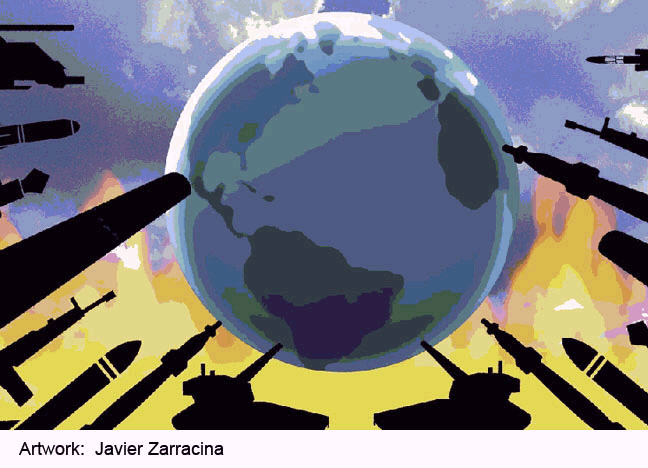

At a time when the Bulletin of Atomic Scientists calculates that we are closer to nuclear war either by intent, cyberattack or accident than at any time since the height of the cold war, we would be well advised to take note so as to take appropriate action and educate our citizenry to eliminate these risks. In keeping their 2019 Doomsday Clock at 2 Minutes to Midnight, the Bulletin’s advisory board noted the close interplay of climate crises with growing international conflict, and the risk of nuclear war.
Our nation and the world need a virtual IQ test to understand the risk we face from these weapons. Each of us and every presidential candidate should be required to take this test and respond to these questions so we can have a greater understanding of the devastating risks we face.
Such an IQ assessment might go as follows:…….
The risk of nuclear war remains with us as long as these weapons exist. The only way to eliminate this risk is by the complete abolition of these weapons. The non-nuclear nations of the world, refusing to be held hostage by the nuclear states, are moving forward in the process of making these weapons illegal by international law and norms in the same way every other weapon of mass destruction has been dealt with before.
Ultimately, nuclear weapons are not a political issue but rather a survival issue. The understanding of this fact by our next president may very well determine our future. https://www.commondreams.org/views/2019/06/28/nuclear-iq-presidential-debates-and-our-future
World War 3: The secret underground nuclear bunkers hiding below forest revealed
The Secret Soviet Nuclear Bunker
World War 3: The secret underground nuclear bunkers hiding below forest revealed
TWO bunkers leading to a secret underground city were discovered in the former Soviet state of Moldova, which were built for high ranking officers to pull the strings from should World War 3 break out, an explorer revealed. Express UK By CALLUM HOARE, Jun 28, Known to the British and US spies as “Object 1180” these two structures were built in 1985 – at the height of the Cold War. As the threat of a nuclear strike from either side seemed more than likely, high-ranking officers needed somewhere to orchestrate their retaliation and prepare for a second strike. As a result, the cylinders were built with thick walls to withstand a direct nuclear hit and an entire city was concealed below with shops, hospitals and a vast amount of supplies to provide the generals with everything they needed.They were only discovered when spy planes and satellites noticed increased activity heading towards the forests of Moldova and were soon abandoned following the fall of the Soviet Union in 1991.
However, YouTube star Benjamin Rich, the man behind popular exploration channel “Bald and Bankrupt” treated fans to a history lesson when he visited earlier this month. He explained: “In 1985, western satellites picked up some strange activity in the rural countryside of what was then the Moldavia Soviet Socialist Republic.
“They didn’t know what it was at the time and they named them Object 1180.
“It was only years later, with the fall of the Soviet Union, that they discovered that it was an underground nuclear bunker.”
Mr Rich, who treats his 800,000 subscribers to visits all over the former Soviet Union, explained why leaders in Moscow thought the construction was necessary.
He added: “The Eighties were quite a scary time for people in England and in the Soviet Union.
“It seemed at one point there was a real possibility of a nuclear war between the Soviet Union and the West.
“So the Soviet Union built about four of these giant nuclear bunkers dotted around the former nation for the high command to hide in and command the forces should, what seemed like the inevitable, happen.
“They started construction in 1985, but as the Soviet Empire came to an end, there was no need for [them] anymore.
“The West and East were friends so these monoliths were just left as reminders of how close we came to a war between our nations. ”
Finally, taking a look inside the dark abandoned remains, Mr Rich then revealed how things would have looked more than 30 years ago.
He continued: “These things were designed for the bigwigs, the apparatchiks, the nomenclature of the Soviet Communist Party in the military High Command. ……… https://www.express.co.uk/news/world/1146430/world-war-3-soviet-union-underground-bunker-moldova-forest-object-1189-spt
Belarus nuclear physicist warns on the unsafety of new nuclear plant
Nuclear physicist about Chernobyl / ENG subs
Professor Heorhi F. Lepin, a physicist, co-chairman of the public association ‘Scientists For A Nuclear-Free Belarus’, who took part in the rectification of the consequences of the Chernobyl disaster, warns the Belarusians against launching the nuclear power plant in Astravets. https://belsat.eu/en/?p=1108658
According to him, the site chosen is no good and even dangerous – once an earthquake happened on the spot; there is an intersection of crust fractures. However, President Alyaksandr Lukashenka called the scientists who are critical of nuclear-power engineering and particularly the Astravets NPP ‘undercover bandits’ and ‘enemies of the people’, Lepin stressed. The Belarusian NPP with two VVER-1200 reactors with a total capacity of 2,400 MW is being built according to the Russian project near Astravets in the Hrodna region. The first power unit is scheduled to be commissioned in 2019, the second one — in 2020. Subscribe to our channels:
1 This Month



Tell the Ukrainian Government to Drop Prosecution of Peace Activist Yurii Sheliazhenko

Petition to revoke the licensing of the Near Surface Nuclear Disposal Facility (NSDF) at Chalk River. https://www.ourcommons.ca/petitions/en/Petition/Details?Petition=e-7247


of the week – STOP SMALL MODULAR REACTORS IN CANADA
To see nuclear-related stories in greater depth and intensity – go to https://nuclearinformation.wordpress.com
-
Archives
- March 2026 (222)
- February 2026 (268)
- January 2026 (308)
- December 2025 (358)
- November 2025 (359)
- October 2025 (376)
- September 2025 (258)
- August 2025 (319)
- July 2025 (230)
- June 2025 (348)
- May 2025 (261)
- April 2025 (305)
-
Categories
- 1
- 1 NUCLEAR ISSUES
- business and costs
- climate change
- culture and arts
- ENERGY
- environment
- health
- history
- indigenous issues
- Legal
- marketing of nuclear
- media
- opposition to nuclear
- PERSONAL STORIES
- politics
- politics international
- Religion and ethics
- safety
- secrets,lies and civil liberties
- spinbuster
- technology
- Uranium
- wastes
- weapons and war
- Women
- 2 WORLD
- ACTION
- AFRICA
- Atrocities
- AUSTRALIA
- Christina's notes
- Christina's themes
- culture and arts
- Events
- Fuk 2022
- Fuk 2023
- Fukushima 2017
- Fukushima 2018
- fukushima 2019
- Fukushima 2020
- Fukushima 2021
- general
- global warming
- Humour (God we need it)
- Nuclear
- RARE EARTHS
- Reference
- resources – print
- Resources -audiovicual
- Weekly Newsletter
- World
- World Nuclear
- YouTube
-
RSS
Entries RSS
Comments RSS
 nuclear-news