The long-lasting unsolved problem of Three Mile Island’s radioactive trash
 Where will the nuclear waste go after Three Mile Island shuts down? The Inquirer, by Andrew Maykuth, After the infamous Three Mile Island nuclear accident 40 years ago, most of the reactor’s partially melted uranium fuel was hauled away to the Idaho National Lab, where the radioactive waste now slowly decays in steel and concrete containers, awaiting long-term disposal.
But the formal decommissioning of the damaged Unit 2 reactor near Harrisburg, site of America’s worst commercial nuclear disaster, has not yet really begun. Its owner, FirstEnergy Corp., has said that the plant would remain dormant until the surviving reactor, owned by a different company, shuts down.
FirstEnergy, in a 2013 filing with the U.S. Nuclear Regulatory Commission, said that both reactors would be decommissioned simultaneously “to achieve economies of scale, by sharing costs between the units, and coordinating the sequence of work activities.”
The timing of the final dismantlement and interment of Three Mile Island plant was thrown into uncertainty last week when the owner of the operating reactor, Exelon Generation, announced that it would take nearly 60 years to decommission its unit if it prematurely shut down operations in September. Exelon says it is losing money on the plant and has no option but to shut it down without a state rescue.
The prolonged decommissioning of the operational reactor — and by implication, the damaged reactor — could push back the final cleanup and remediation of Three Mile Island to 2079, a century after the meltdown.
“We’ve been living with this for 40 years,” said Eric Epstein, chairman of Three Mile Island Alert, a Harrisburg nuclear watchdog group. “Out of a sense of fairness, we need to have this cleaned up.”
The fate of the damaged reactor is further complicated because FirstEnergy Solutions, an Akron company that operates FirstEnergy Corp.’s power generation plants, including the Beaver Valley Power Station in Pennsylvania, last year filed for bankruptcy.
The Unit 2 decommissioning costs, which FirstEnergy last year estimated at $1.26 billion, would be paid out of a trust fund. (Exelon estimates its reactor, TMI Unit 1, would need an additional $1.2 billion to decommission, paid from a separate trust fund.)………
FirstEnergy has until 2053 to decommission the site, 60 years after operations ceased. It contracts Exelon to maintain the dormant reactor, and provide security.
FirstEnergy can request an exemption to push back its decommissioning date if it appeared the task could not be completed within 60 years, said Neil Sheehan, an NRC spokesman.
FirstEnergy, in its 2013 filing, anticipated that Exelon would run its reactor through to the expiration of its license in 2034, and then the companies would jointly complete decontamination and dismantlement of both reactors in less than 20 years.
By decommissioning both reactors simultaneously, FirstEnergy said, it can use Exelon’s fuel storage equipment to contain the “small quantities of core debris and fission products” that still remain from Unit 2′s partial meltdown, which occurred after a series of mechanical and human errors led to a loss of coolant, allowing the uranium fuel to overheat.
Any spent fuel from the operating reactor, or any remaining radioactive debris collected during decontamination of the damaged unit, could be stored in dry casks on the reactor site, at federal expense, until the federal government builds a long-term underground disposal facility. ……..
Until the issue is sorted out, most decommissioned U.S. reactors will be forced to keep their spent fuel in canisters on the former reactor sites.
But 99 percent of the fuel from Three Mile Island’s damaged reactor was already packed up and shipped to the Idaho National Laboratory after the TMI accident.
The U.S. Department of Energy stores 2,750 tons of nuclear waste at four sites in South Carolina, Washington, Colorado and Idaho from an assortment of commercial, naval, and weapons-related reactors.
The site in eastern Idaho, which holds 358 tons of spent fuel, is kind of a mausoleum of nuclear detritus. It contains 46.9 tons of waste from the Shippingport Atomic Power Station in Beaver County, Pa., the nation’s first commercial reactor. It’s also home to 1.8 tons of thorium‐uranium carbide fuel from Philadelphia Electric Co.’s Peach Bottom Unit 1, an experimental reactor in Delta, Pa., that shut down in 1974.
The 90.8 tons of ruined nuclear fuel from Three Mile Island’s damaged reactor is the biggest contributor of waste to the Idaho site. It is contained in 29 steel canisters encased in concrete containers.
But it is an unwelcome long-term resident in Idaho.
The agreement specifically includes Three Mile Island’s waste. https://www.philly.com/business/what-happened-to-three-mile-island-nuclear-waste-after-the-accident-20190414.html
1 Comment »
Leave a reply to Martin Kral Cancel reply
1 This Month
26 April – Chernobyl: Inside the Meltdown airs on National Geographic on Sunday 26th April from 4pm

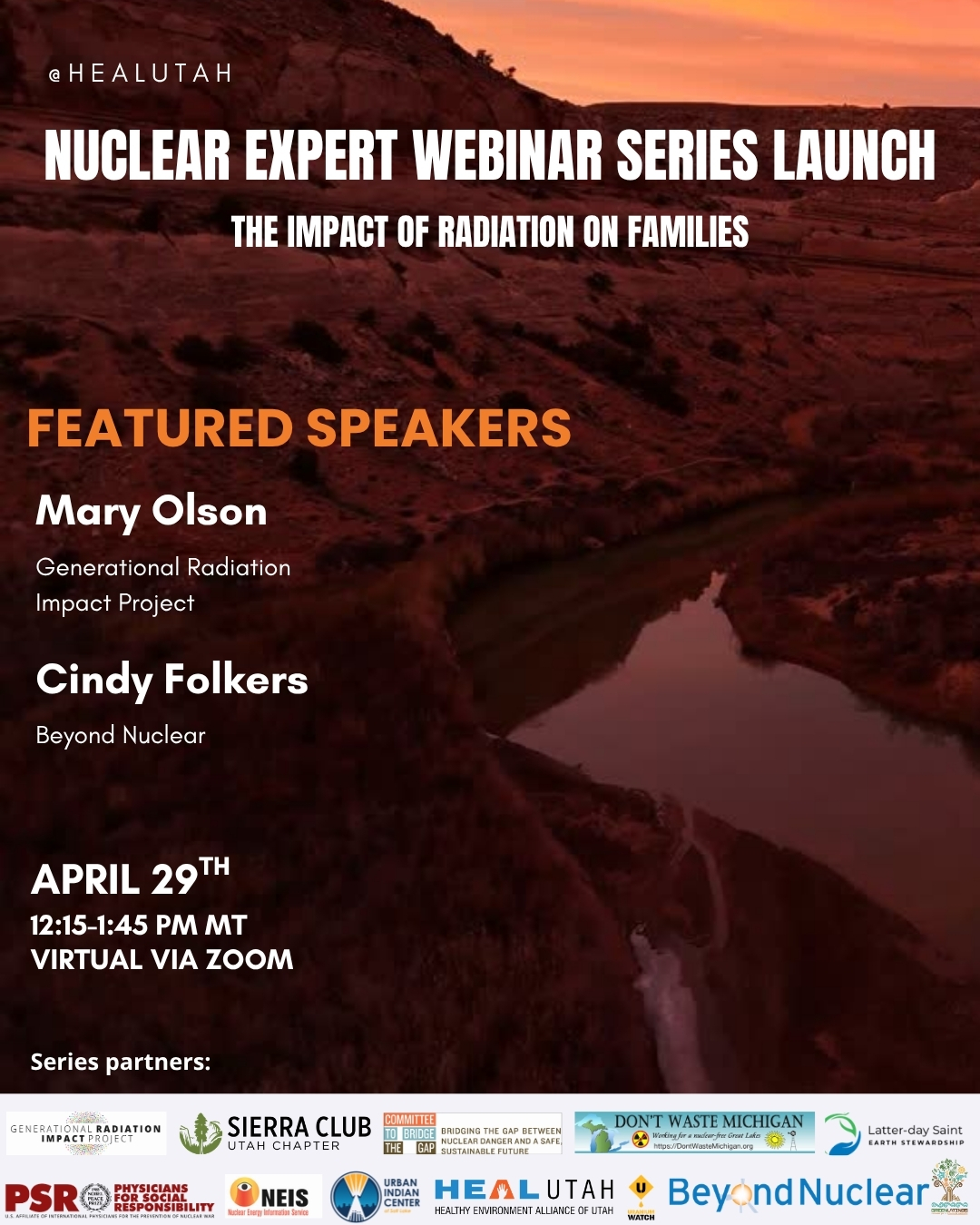
29 April – Nuclear Expert Webinar #1 – Radiation Impacts on Families with Mary Olson and Cindy Folkers
- 12:15 PM MT – 1:45 PM MT
- Location: Virtual – REGISTER TODAY

4 May -West Suburban Peace Coalition to discuss Iran war at May Educational Forum
Monday, May 4, 7:00 – 8:00 PM Central Standard Time
Title: : How Trump’s Narrative Tries to Shape the Reality of the War on Iran.
Contact Walt Zlotow, zlotow@hotmail.com 630 442 3045 for further information
14 May – online event From Bombs to Data Centres: the Face of Nuclear Colonialism

Pine Ridge Uranium is the real threat, not Tehran- Tell Burgum: Stop the Extraction.
Chernobyl: The Lost Tapes – A good documentary on Chernobyl on SBS available On Demand for the next 3 weeks– https://www.sbs.com.au/ondemand/tv-program/chernobyl-the-lost-tapes/2352741955560
To see nuclear-related stories in greater depth and intensity – go to https://nuclearinformation.wordpress.com
-
Archives
- April 2026 (338)
- March 2026 (251)
- February 2026 (268)
- January 2026 (308)
- December 2025 (358)
- November 2025 (359)
- October 2025 (376)
- September 2025 (257)
- August 2025 (319)
- July 2025 (230)
- June 2025 (348)
- May 2025 (261)
-
Categories
- 1
- 1 NUCLEAR ISSUES
- business and costs
- climate change
- culture and arts
- ENERGY
- environment
- health
- history
- indigenous issues
- Legal
- marketing of nuclear
- media
- opposition to nuclear
- PERSONAL STORIES
- politics
- politics international
- Religion and ethics
- safety
- secrets,lies and civil liberties
- spinbuster
- technology
- Uranium
- wastes
- weapons and war
- Women
- 2 WORLD
- ACTION
- AFRICA
- Atrocities
- AUSTRALIA
- Christina's notes
- Christina's themes
- culture and arts
- Events
- Fuk 2022
- Fuk 2023
- Fukushima 2017
- Fukushima 2018
- fukushima 2019
- Fukushima 2020
- Fukushima 2021
- general
- global warming
- Humour (God we need it)
- Nuclear
- RARE EARTHS
- Reference
- resources – print
- Resources -audiovicual
- Weekly Newsletter
- World
- World Nuclear
- YouTube
-
RSS
Entries RSS
Comments RSS
 nuclear-news
Holtec International will probably acquire the decommissioning license from Exelon and transfer the unused (spent) nuclear fuel rods to their future storage site in Carlsbad, New Mexico. The low level radioactive building materials will probably end up in Andrews, Texas. This is a billion dollar project paid for by the rate payers of nuclear produced electricity the last few decades.