|
Grand Gulf nuclear power plant troubles ‘happening far too often,’ Mississippi official says, Clarion Ledger
Jeff Amy, Associated Press Dec. 19, 2018 JACKSON, Miss. — Another unplanned outage at Mississippi’s Grand Gulf nuclear power plant outside Port Gibson is adding to regulators’ concerns over reliability problems at the largest single-unit nuclear power plant in the United States. The move is also heightening scrutiny over whether problems at Entergy Corp.’s plant may be affecting power markets.
Operators took the southwest Mississippi plant offline last week, citing problems with a turbine bypass valve. Last Wednesday’s outage came to light Tuesday when the federal Nuclear Regulatory Commission announced a special inspection.
“The reactor was safely shut down but some equipment issues occurred that the agency wants to better understand,” the agency said in a statement.
It’s at least the sixth unplanned decrease in output at the plant in the last 15 months, according to NRC documents. The plant has been running at reduced or zero power output for much of the time since 2016, according to an analysis published earlier this month by E&E News …….
The plant’s troubles come as President Donald Trump continues to support plans to subsidize nuclear power generation for reliability purposes. …….
Beyond questions of safety, the absence of Grand Gulf’s 1,443-megawatt capacity can stress power supplies and may cause higher prices across Mississippi, Arkansas, Louisiana and southeastern Texas, a region that includes not only New Orleans-based Entergy’s utilities, but cooperatives and private utility Cleco of Pineville, Louisiana…….
Entergy spent hundreds of millions to increase the plant’s generating capacity in 2012, setting it up to be a cornerstone of low-cost generation in the region for decades, especially after winning a 20-year extension of the plant’s license from the NRC through 2044. But when it’s down, utilities have to buy power from other plants in the MISO region……..https://www.clarionledger.com/story/news/2018/12/19/grand-gulf-nuclear-power-plant-outage-safety-reliability-ms-entergy/2361876002/
|
|
December 20, 2018
Posted by Christina Macpherson |
business and costs, safety |
Leave a comment
|
 US to offer ‘black box’ nuclear waste tech to other nations ChannelNews Asia 20 Dec 18 US to offer ‘black box’ nuclear waste tech to other nations ChannelNews Asia 20 Dec 18
“…………MOUNTING U.S. STOCKPILES
The United States is also struggling to support its own nuclear industry at home, with aging reactors shuttering, new projects elusive due to soaring costs, and an ongoing political stalemate over a permanent solution for mounting nuclear waste stockpiles.
The United States produces some 2,000 metric tons of nuclear waste each year, which is currently stored in pools or in steel casks at the nation’s roughly 60 commercial nuclear power plants across 30 states.
The federal government designated Nevada’s Yucca Mountain as the sole permanent U.S. nuclear waste repository decades ago to solve the problem, spending about US$13 billion on the project, but it has never opened due to local opposition.
Thomas Countryman, the State Department’s top arms control officer during the Obama administration, said the government should make headway on the domestic problem before helping other countries.
“The primary issue on this front … is not that the U.S. can’t offer a low-volume option to potential buyers; rather it’s that the U.S. still has no option for disposing of its own spent fuel,” he said.
Edwin Lyman, a nuclear expert at the Union of Concerned Scientists, said NNSA should be less concerned about volume of waste and more concerned about the dangers that make it hard to store.
“It’s not the volume of the nuclear waste that’s the issue, but the radioactivity and heat it gives off as well as the fact that it remains dangerous for hundreds of thousands of years,” he said.
(Reporting by Timothy Gardner; Editing by Richard Valdmanis and Brian Thevenot)
Source: Reuters https://www.channelnewsasia.com/news/technology/exclusive–us-to-offer–black-box–nuclear-waste-tech-to-other-nations-11046762
|
|
December 20, 2018
Posted by Christina Macpherson |
USA, wastes |
Leave a comment
Daily Mail 18th Dec 2018 : Eerie photos show how the nuclear
disaster exclusion zone lies untouched more than 30 years later. Haunting
images show the nuclear wasteland which stands largely untouched since the
catastrophe in 1986. Communist stars and pictures of Lenin adorn buildings
which were abandoned after the nuclear disaster. An eerie children’s
hospital is still filled with rusted cribs and shops are stacked with
ageing cans of food. Two Scotsmen made the 4,000 mile road-trip to take a
tour of Pripyat on the Ukraine Belarus border.
https://www.dailymail.co.uk/news/article-6507131/Chernobyl-wasteland-frozen-time-Eerie-photos-nuclear-disaster-exclusion-zone-30-years-on.html
December 20, 2018
Posted by Christina Macpherson |
general |
Leave a comment
|
|
Nuclear negations yield renewable energy leverage https://pv-magazine-usa.com/2018/12/18/nuclear-negations-yield-renewable-energy-leverage/
As part of the recently approved settlement negotiations associated with the failed VC Summer Nuclear Plant expansion in South Carolina, renewable energy has gained greater PPA and IRP access, and greater market continuity.
DECEMBER 18, 2018 JOHN WEAVER The VC Summer Nuclear Power plant expansion failed at a cost of $9 billion to South Carolina electricity customers. The follow ups have led to court cases in which ex-employee testimony suggested firings for whistleblowing, and that the company running the construction – SCANA – had committed fraud, and mismanaged the project.
Utility customers on the hook for the project had received nine unique electricity bill increases, equal to about $27/month, a factor in South Carolina to having the highest average monthly bills in the United States. As part of the fallout, the parties involved are being pushed hard by politicians and voters to change their ways.
On November 30th, general council of the South Carolina Electric & Gas Company (SCANA), also representing Dominion Energy, notified the Public Service Commission of South Carolina, that it supports a certain set of renewable energy supporting policies as part of the ongoing negotiations.
The policies are focused on renewables and energy storage gaining consistent access to the market. The regulations mainly aim to create a consistent set of variables – avoided costs, ten year PPAs, hourly pricing, consistent interconnection standards – that will allow developers of solar power projects to better model probability of successful projects.
This is not the first time that failed nuclear power plants have been followed by solar. The above images [on original] are of the 1 MW solar power plant that is running at the Chernobyl Nuclear Power plant in Ukraine. The large structure in the background is the $1.5 billion 31,000 ton concrete sarcophagus to cover the still burning nuclear melt down.
The Phipps Bend Nuclear Power Plant in Surgoinsville, Tennessee sat abandoned since it was cancelled in 1981, 36 years ago. As of July 5, 2017 it began generating solar electricity as United Renewable Energy completed a 1 MW solar power plant (main article image)
When Duke Energy Florida cancelled the Levy Nuclear Plant at a cost of $800 million in already collected fees from consumers, the electric utility announced plans to satiate the public with 700 MWac of solar power, plus at least 50 MW of grid-tied batteries, grid modernization projects, and 500 electric vehicle charging areas.
|
|
in South Carolina, renewable energy has gained greater PPA and IRP access, and greater market continuity.
DECEMBER 18, 2018 JOHN WEAVER The VC Summer Nuclear Power plant expansion failed at a cost of $9 billion to South Carolina electricity customers. The follow ups have led to court cases in which ex-employee testimony suggested firings for whistleblowing, and that the company running the construction – SCANA – had committed fraud, and mismanaged the project.
Utility customers on the hook for the project had received nine unique electricity bill increases, equal to about $27/month, a factor in South Carolina to having the highest average monthly bills in the United States. As part of the fallout, the parties involved are being pushed hard by politicians and voters to change their ways.
On November 30th, general council of the South Carolina Electric & Gas Company (SCANA), also representing Dominion Energy, notified the Public Service Commission of South Carolina, that it supports a certain set of renewable energy supporting policies as part of the ongoing negotiations.
The policies are focused on renewables and energy storage gaining consistent access to the market. The regulations mainly aim to create a consistent set of variables – avoided costs, ten year PPAs, hourly pricing, consistent interconnection standards – that will allow developers of solar power projects to better model probability of successful projects.
This is not the first time that failed nuclear power plants have been followed by solar. The above images [on original] are of the 1 MW solar power plant that is running at the Chernobyl Nuclear Power plant in Ukraine. The large structure in the background is the $1.5 billion 31,000 ton concrete sarcophagus to cover the still burning nuclear melt down.
The Phipps Bend Nuclear Power Plant in Surgoinsville, Tennessee sat abandoned since it was cancelled in 1981, 36 years ago. As of July 5, 2017 it began generating solar electricity as United Renewable Energy completed a 1 MW solar power plant (main article image)
When Duke Energy Florida cancelled the Levy Nuclear Plant at a cost of $800 million in already collected fees from consumers, the electric utility announced plans to satiate the public with 700 MWac of solar power, plus at least 50 MW of grid-tied batteries, grid modernization projects, and 500 electric vehicle charging areas.
|
|
December 20, 2018
Posted by Christina Macpherson |
renewable, USA |
Leave a comment
 Birmingham joins China’s nuclear regulator for safe and clean energy research
https://www.birmingham.ac.uk/news/latest/2018/12/safe-and-clean-energy-research.aspx19 Dec 2018 University of Birmingham experts are partnering with Chinese nuclear regulators in helping develop cleaner, safer and more sustainable civil atomic energy.
The University has signed an agreement with the Nuclear and Radiation Safety Centre (NSC), Ministry of Ecology and Environment to work on collaborative education and research in nuclear policy, safety and regulation, as well as the environmental impact and assessment of nuclear radiation.
Following an earlier visit of a University of Birmingham team to NSC headquarters in Beijing, a senior delegation headed by Deputy-Director General CHAI Guohang visited Birmingham to further develop the collaboration and sign the agreement. The visit was attended by a representative from the Chinese Embassy in London.
Signing the agreement on behalf of the University of Birmingham, Pro-Vice-Chancellor Professor Andy Schofield commented: “The University of Birmingham is delighted to partner with NSC, to work together in the research and education of civil nuclear safety, policy and regulation. This is such an important area for both our countries as we develop civil nuclear power as a key part of clean and sustainable energy production.
“We are very proud of the University’s accomplishments in having the largest and longest continually-running civil nuclear education programmes in the UK, matched by a diverse research capability, and with influence on the development of UK nuclear energy policy. We look forward to working with NSC to continue the development of safe and efficient civil nuclear system in UK and China.”
As the nuclear regulator of China, NSC affiliates directly to the Chinese Ministry of Ecology and Environment, and provides all-round support and assurance in safety regulation and administration of China’s civil nuclear facilities and radiation protection.
In the development of civil nuclear power in China to meet its increasing energy demand, NSC is actively forming a wide range of collaborations with high level domestic and internal partners, including with IAEA and the UKs ONR.
The NSC Deputy-Director General Mr CHAI Guohang said: “As one of the top 100 world universities, the University of Birmingham strength in nuclear science and engineering, its work in nuclear policy and its long standing achievements in civil nuclear education and research are well-known. For these reasons we chose Birmingham as our first international university partner. We believe our collaboration will deliver successful and mutually beneficial results.”
December 20, 2018
Posted by Christina Macpherson |
Education, UK |
Leave a comment
The global nuclear framework still faces many challenges. Often, bleak predictions motivate the international community to collectively ensure that such predictions do not come true. This essay attempts to gauge the future of the global nuclear framework based on current trends. ……….With repeated tests of nuclear devices and missile systems, it is North Korea that today no doubt presents the gravest challenge to the framework. The international community appears to be divided on the solution to the North Korean problem, and whether complete denuclearisation should be the end goal of a prospective deal with Pyongyang. Considering the efforts that Kim Jong-un’s regime has made to acquire an operational, costly nuclear weapons programme, it is unlikely that Pyongyang will agree to complete denuclearisation without significant concessions, including a possible reunification of the Korean peninsula under Kim Jong-un’s leadership. This, of course, will have significant geopolitical ramifications. A deal without denuclearisation as its last stage, on the other hand, will leave the global nuclear framework dented forever. While speculations of consequential horizontal proliferation of nuclear weapons have been labelled “far-fetched,” there are hints that Japan could consider nuclearising.
As the global nuclear framework continues to grapple with the daunting North Korean challenge, it is equally important to consider other challenges, e.g. the threat to the Joint Comprehensive Plan of Action (JCPOA), which Iran and the P5+1 countries negotiated in 2015; the failing US–Russia arms control pacts; the aggressive nuclear posturing with deployment of tactical nuclear weapons for warfighting; the technological advancements in delivery systems, such as the hypersonic vehicles that could lead to a fresh wave of arms race in the world; and the long-ignored agenda of global nuclear disarmament.
Challenges to the future of the JCPOA is a significant threat to the framework’s agenda of nuclear non-proliferation. US President Donald Trump seeks an additional agreement that broadens the mandate of the deal to include Iran’s long-range missile programme, tightens the verification measures of the JCPOA further, and extends the terms of the deal indefinitely, removing the “sunset” clauses. Even with this additional deal — chances of which materialising are feeble — the case of Iran, in principle, will allow states to possess enrichment technology and be on the nuclear “threshold.” This is another challenge for nuclear non-proliferation.
Meanwhile, the arms-control agenda of the framework has suffered severe setbacks in the last decade. The existing mechanisms, primarily negotiated by the US with the Soviet Union during the Cold War — and with Russia since — are now breaking down. There is a new wave of nuclear warhead modernisation across the board, led primarily by the US. Coupled with the ongoing and rapid development of various modern weapons delivery systems, this makes the possibility of negotiating new arms control mechanisms negligible. ………https://www.orfonline.org/expert-speak/nuclear-unpredictability-managing-the-global-nuclear-framework-46338/
December 20, 2018
Posted by Christina Macpherson |
politics international |
Leave a comment
NB – Russia Annexed Crimea: February 20 – March 19 2014 https://en.wikipedia.org/wiki/Annexation_of_Crimea_by_the_Russian_Federation This article was published by the Center for American Progress Action Fund at The MoscowProject.org https://themoscowproject.org: “APRIL 2014 FLYNN FIRED FROM DIA INVOLVING MICHAEL FLYNN Flynn was reportedly bitter and angry when he was pushed out [1] of the D.I.A.; he subsequently became a contributor to […]
via General Michael Flynn Fired From The DIA – Summary — Mining Awareness +
December 20, 2018
Posted by Christina Macpherson |
Uncategorized |
Leave a comment
 Climate has to dominate this week’s news. It seems that it takes a 15 year-old schoolgirl, Greta Thunberg to best spread the message, the reality of the planet’s situation. . Radio Ecoshock introduced some hard questions that have been ignored:
What social disruptions are being caused by global heating – increased levels of malnutrition, starvation, disease, civil conflict and war – and not ecluding affluent nations?
Should we tell young people what we’ve done to the climate? (Too late: they are telling us.)
Far from perfect, but still, nearly 200 nations reached an agreement on climate action rules.
Some good news in the climate battle – over 1000 institutions to divest from fossil fuels. Makoma Lekalakala: ‘There should be no nuclear in climate financing’. Nuclear power is no answer to global heating – even if only because nuclear power is unaffordable. Global nuclear industry aggressively lobbying climate negotiators.
The drying of soils due to climate change is shrinking the world’s water supply.
Numerous nuclear accidents at sea (doesn’t inspire confidence for nuclear-powered space travel). No restraints on nuclear weapons use, if USA abandons Intermediate-Range Nuclear Forces Treaty.
ARCTIC. Degrading permafrost puts Arctic infrastructure at risk by mid-century.
JAPAN. Japan’s nuclear export industry about to get the fatal blow. High Iodine distribution, low intake among children after Fukushima nuclear accident.
UK.
USA.
AUSTRALIA. Australian government’s hypocritical performance at UN Climate Summit.
FRANCE. How France multiplies hazardous nuclear waste. Replacing nuclear with renewables would save France $44.5 billion.
RUSSIA. Russia claims US ignoring outreach on nuclear treaty dispute. Russia woos China to join nuclear framework with US. Russia marketing nuclear technology to Saudi Arabia.– White House fury as Russian nuclear planes visit Venezuela .
TAIWAN. Comprehensive and Progressive Agreement for Trans-Pacific Partnership (CFTPP) held over Taiwan , because of its referendum rejecting food from Fukushima.
GERMANY. Explosion and fire at German Advanced Nuclear Fuels plant. Residential batteries ready to compete with fossil fuels and nuclear in Germany.
FINLAND. Radioactive reindeer in Finland and Norway.
IRAN. Iranian hackers take aim at foreign nuclear experts and US official.
INDIA. India has 140 Nuclear Warheads – And More Are Coming.
BULGARIA. Bulgaria’s planned nuclear power station unlikely to ever be built.
BELGIUM. Call for Belgium’s unsafe Tihange nuclear reactor to be shut down.
CHINA. Chinese military is building a test facility to simulate thermonuclear explosions.
December 19, 2018
Posted by Christina Macpherson |
Christina's notes |
1 Comment
 Sun setting on Japan’s nuclear export sector http://www.atimes.com/article/sun-
 setting-on-japans-nuclear-export-sector/
Post-Fukushima cost overruns may kill a giant power project in Turkey, and there are few other deals to replace it
By TODD CROWELL DECEMBER 16, 2018 Japan’s nuclear export industry could be dealt a fatal blow if Mitsubishi Heavy Industries pulls out of a massive project to build four large power plants on Turkey’s Black Sea coast, as reports have suggested.
The Sinop plant project in Turkey was seen as Japan’s best chance for an industry – battered and bruised after the 2011 tsunami and triple meltdown at Fukushima – to put together a workable export strategy that did not break the bank of potential international customers.
Aside from Sinop, the Japanese industry has only one viable export project still upcoming: Hitachi’s bid to build two reactors on the island of Anglesey in Britain. And even that deal is looking shaky.
Mitsubishi Heavy Industries (MHI) has not pulled the plug yet on its stake in the four-reactor project on Turkey’s Black Sea coast, but a slew of domestic media reports and talk in Tokyo, suggests that, in the face of seemingly ever-rising construction costs to meet new safety standards that have been put in place since the 2011 Fukushima disaster, the company will bail.
Fukushima legacy
When the deal was signed with Ankara in 2013, the ownership profile was: 65% awarded to a consortium made up of MHI, Itochu, France’s Areva, and GDF Suez. The other 35% was covered by Turkey’s electric power utility, Elektrik Uretim.
However, in April, Itochu pulled out of the consortium, citing cost overruns. That left the consortium with 51%, and the remaining 49% owned by the Turkish utility.
Without Mitsubishi the viability of the project is in question, sources say, unless Turkey can find a new partner or is willing to take on the project without its largest foreign partner. The Russians, who are building a nuclear complex on Turkey’s southern Mediterranean coast, might be interested.
According to Kyodo, a thorough cost evaluation was to be completed by the end of this year. Itochu waited for the report to be released before bailing out of the deal. MHI is apparently waiting for the study to be completed before deciding its next move.
When the deal with Mitsubishi was signed in 2013, the estimated cost was $18 billion for four 1,100-megawatt nuclear power plants. But overall costs have soared, passing $42 billion in April – when Itochu withdrew, and is now put at about $44 billion.
Cost increases are nothing new in the nuclear power industry, but have been exacerbated in recent years by expensive adjustments phased in to meet more stringent safety concerns following the earthquake and tsunami that destroyed four units of the Fukushima Daiichi plant. The Sinop cost rises, however, also encompass other problems encountered in construction.
Fukushima, one of the most serious nuclear accidents in history, turned most of Japan against nuclear power. Before March 11, 2011, Japan had 54 nuclear plants. All were shut down after the accident and some are slowly returning to service having passed scrutiny by the regulator. Five are expected to restart within the next five years, and eight will likely be decommissioned. But prospects for the remaining plants are unclear.
Aware that no new nuclear plant may ever be built at home amid the anti-atomic public mood, Japan’s nuclear vendors have turned to overseas exports as the Fukushima accident does not appear to have destroyed the Japanese industry brand in other countries.
Endgame for nuclear exports?
If Mitsubishi does pull out of the huge project in Turkey it will be a blow to Prime Minister Shinzo Abe, who sees international exports of nuclear technology as an important way to boost the economy. On his many trips abroad, he often acts as a salesman for nuclear exports. For example, it was a topic of discussion with Turkish President Recep Erdogan on the sidelines of the G-20 meeting in Argentina.
Details of the conversation were not revealed, but it would be a good bet that they discussed the Sinop project with the threat of Mitsubishi hanging over them, and that Abe sought ways to keep the project viable.
Meanwhile, it is not just MHI that may have doubts about the sector. Japan’s nuclear export industry has suffered plenty of setbacks in the seven years since Fukushima. Questions about the future of the sector hang over all three main players in the sector.
Toshiba, one of Japan’s big-three nuclear constructors, recently pulled out of the nuclear power business overseas after incurring huge losses in the United States.
Toshiba has also suffered something of an administrative meltdown in its quest to win construction contracts in the US. In February it finally unloaded it money-losing American subsidiary, Westinghouse, for $1 billion less than it paid to acquire the company 10 years ago.
If the export program is to remain viable, it may be in Wales, where the British government is seeking to build a two-reactor nuclear power plant on the island of Anglesey. Among those bidding for the project is Japan’s third nuclear constructor, Hitachi, through a subsidiary called Horizon Nuclear.
In the nuclear world, there are constructors – like MHI, Toshiba and Hitachi – and operators, who run the plant after it is completed, and they are not always the same. Japan learned from Korea’s successful bid to build six nuclear plants in the United Arab Emirates that offering to build and also run them – a one-stop service – is key to making sales.
Hitachi is teaming up with the Japan Atomic Power Company, which operates two plants in Japan (although both are currently shut down pending the review by regulators). The plan is to present the British with a package deal.
Now, there are worries that Hitachi might pull out of the British project. Chairman Hiroaka Nakanishi was quoted in the Times of London saying his company was “facing an extreme situation,” and that a final decision on whether to stay with the project or leave it will be made next year.
If Mitsubishi does, as is widely expected, pull out of the huge project in Turkey, the only egg left in Japan’s overseas nuclear export basket will be Wales.
December 18, 2018
Posted by Christina Macpherson |
business and costs, Japan, politics |
Leave a comment

Lawmakers Want a Greater Say as U.S. Seeks a Saudi Nuclear Deal, Members of Congress from both parties demand that an agreement to sell Riyadh civilian nuclear technology be based on stringent controls, WSJ . By Michael R. Gordon, Dec. 16, 2018
The Trump administration’s push to sell civilian nuclear technology to Saudi Arabia is emerging as the next battleground in the struggle between the White House and Congress over U.S. policy toward Riyadh following the killing of journalist Jamal Khashoggi.
The debate over Riyadh’s nuclear ambitions intensified last week after Energy Secretary Rick Perry brushed aside congressional appeals that nuclear talks be suspended because of Mr. Khashoggi’s killing and traveled to Saudi Arabia, where he accentuated the role American companies could play in helping the country establish a nuclear energy program.
…….But the CIA assessment that Saudi Crown Prince Mohammed bin Salman likely ordered Mr. Khashoggi’s killing has fueled concerns in Congress that the Saudi leader is too ruthless to be entrusted with nuclear technology. Saudi Arabia has repeatedly said the crown prince had no knowledge of the operation.
Lawmakers of both parties are demanding a deal be based on the most stringent nonproliferation controls. And some are now pushing legislation that would give Congress more of a say by requiring that a nuclear accord with Saudi Arabia be approved by the Senate and the House of Representatives.
“Before Khashoggi, I would say our chances were quite modest,” said Rep. Brad Sherman, a California Democrat, referring to prospects of House legislation he is drafting. “Now I would have to say our chances are better than 50-50.”
An identical measure is being prepared in the Senate by Sens. Ed Markey (D., Mass.) and Marco Rubio (R., Fla.), though the prospects for winning approval are likely to be more challenging.
The prospective nuclear deal comes amid a broader debate over Saudi policy, including a Senate vote last week to halt U.S. support for the Saudi-led coalition that is fighting in Yemen.
Even since the Trump administration signaled its interest in a nuclear agreement with Saudi Arabia last year, there has been debate about proliferation controls that should be imposed under an accord authorizing the transfer of U.S. nuclear technology, known as a 123 agreement.
……..Nuclear experts have also said that it would be important for Saudi Arabia to agree to the “Additional Protocol,” a formal arrangement with the International Atomic Energy Agency that provides for far-reaching inspections. The Saudis have been resisting that step, former officials who have been tracking the talks say. A spokeswoman for the Saudi embassy didn’t respond to a request for comment..
……..Under current law, a nuclear cooperation agreement with Saudi Arabia would go forward unless congressional opponents backed a joint resolution against it. That means that two-thirds of the lawmakers would need to oppose the accord so Congress could overcome a potential veto.
Mr. Sherman’s new bill aims to put nuclear accord skeptics in a more favorable position by requiring the administration to win approval from both the Senate and the House. That means a simple majority in one legislative chamber would be enough to block the agreement…….https://www.wsj.com/articles/lawmakers-want-a-greater-say-as-u-s-seeks-a-saudi-nuclear-deal-11544990606
December 18, 2018
Posted by Christina Macpherson |
politics, Saudi Arabia, USA |
Leave a comment
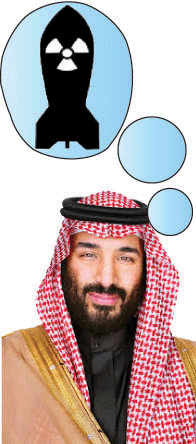 US Nuclear Energy Policy & Khashoggi Murder: Appeasement Or Threat? Clean Technica, December 12th, 2018 by Tina Casey
The horrific murder of journalist Jamal Khashoggi last October continues to fester, and some of the blowback has been falling on the shoulders of the US tech sector. Rightfully so, considering the connection between Saudi wealth, Japan-based SoftBank, and Silicon Valley A-listers. Meanwhile, US President* Donald Trump has dismissed evidence that Saudi Crown Prince Mohammed bin Salman was directly responsible for the crime, but a recent nuclear energy announcement could indicate that someone in Trump’s cabinet is stirring the pot.
Khashoggi Or Not, Trump Administration Still Sharing Nuclear Energy Love With Saudi Arabia…
There is also a nuclear weapons angle to the story, but for now lets focus on the nuclear energy angle.
Despite its vast solar and wind resources, Saudi Arabia has expressed a growing interest in building a fleet of power plants fueled by nuclear energy.
CleanTechnica has been among those taking note, though not in any particular depth — until earlier this week, when the US Department of Energy released a readout of Energy Secretary Rick Perry’s recent visit with the Saudi Minister of Energy, as well as the CEO of Saudi Aramco and other officials.
The readout hit the Intertubes just about the time word leaked out that there is now a written transcript of the audiotape that recorded the last minutes of Khashoggi’s life.
Anyone — even those who do not speak Arabic — can now read and understand the last words that Khashoggi screamed out in the course of his murder.
So, was the readout yet another example of Secretary Perry tone deafness? Or was it yet another one of his curiously timed missives that undercut White House policy even while seeming to affirm it.
Here, you do the math. This is where the readout deals with the visit to Saudi Arabia (Perry also went to Qatar on the same trip):
…the Secretary expressed that the United States continues to view Saudi Arabia as an important ally, particularly in the energy space. Perry and Al-Falih spoke about last week’s OPEC announcement of production cuts and Perry reiterated the need for stable supply and market values. They also discussed the 2018 increase in Saudi oil production and the impact it has had on world markets in the wake of the Iran sanctions.
And, here’s the summary message (emphasis added):
Secretary Perry underscored the message that he carries all over the world: any nation seeking to develop a truly safe, clean, and secure nuclear energy program should turn to American companies who have the ability to provide the technology, knowledge, and experience that are essential to achieving that goal.
The US nuclear energy industry is in a state of near collapse, domestically speaking. As with coal power, the only hope for growth is to export the technology elsewhere…but the readout makes it clear there are standards to be met.
Or Not
The readout is not particularly startling in and of itself, though there is a lot to chew on between the lines.
What really sticks out is the summary message. It could be read in two different ways.
Number one, Secretary Perry was blithely pitching the US nuclear energy industry to the Saudi government, ignoring — as per White House policy — the latest revelations about the Khashoggi murder.
That would be consistent with the Rick Perry, who toes the Trump line on a whole host of other issues, inside and outside of the energy space.
Number two relates to the other Rick Perry — the one who has consistently pushed for the Department of Energy’s scientific and renewable energy missions, even when (or perhaps especially when) those missions clash with Trump’s anti-science, pro-coal rhetoric.
In this scenario, the nuclear message is not a pitch. It’s practically the opposite: a reminder that the US holds the nuclear energy cards.
To be clear, the US doesn’t hold all the nuclear energy cards, but it does hold enough of them to make trouble. Earlier this fall, for example, the Trump administration announced new restrictions on nuclear technology exports to China. Though some have downplayed the impact, that’s gotta hurt.
As applied to the Saudi government, Perry could wield the authority of his agency under its nonproliferation mission as a stick, not a carrot.
Or, maybe not. If you apply Occam’s razor to the readout, it is just what it is: a message that, Khashoggi or not, it’s business as usual between Saudi Arabia and the US.
What do you think? Drop us a note in the comment thread! ………… https://cleantechnica.com/2018/12/12/us-nuclear-energy-policy-khashoggi-murder-appeasement-or-threat/
December 18, 2018
Posted by Christina Macpherson |
politics international, Saudi Arabia, USA |
Leave a comment

Opinion from a concerned reader, 18 Dec 18 I think the nuclear problem is more serious than climate change.
I do not know if anything can be done, to shut down enough reactors in time, in the world, to stem the dangerous massive creation of hi level waste, and prevent more fukushimas. That is, before it goes beyond the point of no return, where there is so much radionuclides poison , in the environment, that life on earth is doomed and cannot come back. It maybe too late already.
Too much radionuclides waste in the environment.
I feel like hot-button issues like nuclear, are used by propagandists as propgens, to insidiously pawn-off their polarizing propaganda memes or just throw-out rightwing propaganda- blurbs going at opportune moments.
As far as ideological memes go, we are constantly presented, with smoke screens and false dichotomies.
There is the soros meme. He is like the evil enemy of the state in Orwells1984.
do not know what he really is. I do not think he is a radical leftist. Are globalists, radical leftists? No they are part of the neoliberal and neoconservative elites.
More rightwing groups, that have elements of the same neoliberal, neoconservative, corporatist elements, with strong racist-authoritarian inclinatibons are not really populist and do little for common people.
They border on fascism, or are fascist.
What is very scary is the fact that the Paris demonstrations are laying the groundwork for another election in France.
The demonstrations are setting up the groundwork for the fascist Marine La Pen to take power. Very topsey-turkey to me.
If the French go with La Pen as Macron loses it, the Frences, and worlds, troubles have only begun. They will be like The USA, Japan, The Ukraine, Brazil, eastern Europe. More appeasement of the rich and corporations.
Hate and racism will grow more pitched.
Superficially, it will look like things are better because they will appease corporations, and make it appear to be cutting taxes for all classes . There maybe some extra low wage jobs created. They will keep reactors open, to appease nuclear workers and privatize the nuclear industry, more. There will be less security for pensioners, not more, as trump has done . There will be more cuts to commons and loss of civil liberties in favor of corporations.
There will be greater risk of nuclear accidents, of war, of civil unrest . Nuclear will again be highly favored in France, like it is in the rash of eastern European authoritarian regimes. More dangerous reactors will be kept open or maybe all of them, with attempts to build new ones. The nationalist scree, will call for greater resource exploitation in their old colonies in Africa. They will probably jump on board with new the new calls from mics and the emboldened neoconservatives in America for new arms race plans.
So crazy
December 18, 2018
Posted by Christina Macpherson |
general |
Leave a comment
 Explosive Accidents: The Lost Nuclear Arsenal at the Bottom of the Sea https://www.thevintagenews.com/2018/09/03/nuclear-arsenal/?fbclid=IwAR1dPU13kVGGrYK–PFmFciWyMO28xaa1nU7OFMlC7UfuQwjMFh4
Sep 3, 2018 Ian Harvey In July of 2018, Andrew Thaler wrote for Southern Fried Science that there were at least two nuclear capsules, four unarmed weapons, and one armed nuclear weapon sitting on the ocean floor, that he was aware of.
His information was based on declassified U.S. Department of Defense narrative summaries of accidents involving U.S. nuclear weapons.
He noted that the documents he had access to only covered the period of time between 1950 and 1980. Any more recent data would still be classified. There is reason to believe that his estimated numbers for nuclear material in the oceans are far too low.
Business Insider in 2013 wrote that since 1950 there have been 32 nuclear weapon accidents, known as Broken Arrows, where an unexpected event involving nuclear weapons resulted in the firing, launching, theft, or loss of said weapon.
BI reported in this piece that there were six nuclear weapons that have been lost and never recovered. The time frames for the BI list continued into the 2000’s, but this is also a lowball number.
According to a 1989 article in the New York Times, however, there have been at least 50 nuclear warheads and nine reactors scattered on the ocean floors since 1956.
These were the result of various accidents on the part of U.S. and Soviet bombers, ships, and rockets, according to a study of naval accidents that was published by Greenpeace and the Institute for Policy Studies.
The study outlines 1,276 accidents, both nuclear and non-nuclear, on the part of the world’s navies, and has some, more limited, information on another 1,000 accidents. The study points out that the total number of incidents amounts to one major peacetime accident a week
Information for the study was gathered mostly through the Freedom of Information Act, which included American intelligence assessments of Soviet naval accidents.
Eighty days after it fell into the ocean following the January 1966 midair collision between a nuclear-armed B-52G bomber and a KC-135 refueling tanker over Palomares, Spain, this B28RI nuclear bomb was recovered from 2,850 feet (869 meters) of water and lifted aboard the USS Petrel (note the missing tail fins and badly dented “false nose”).
The authors also received information from the governments of other nations. The report said that the worst accident occurred in 1986, when a Soviet submarine sank 600 miles northeast of the Bermuda coast, depositing two nuclear reactors and 32 nuclear warheads on the bottom of the ocean.
That one accident left more nuclear material under the sea than the authors of the first two pieces posited, combined. The study also notes that it doesn’t reflect data on any of the “many hundreds” of Soviet accidents about which little is known, and suggested that the Soviet Navy has far more accidents than those of America.
The accidents are, for the most part, due to human factors, ranging from issues of faulty navigation to outright sabotage.
So far, the U.S. has admitted to knowing of one hydrogen bomb that is leaking radioactive material. That bomb was accidentally dropped into the sea south of Japan in 1965 by an aircraft carrier.
Read another story from us: The Missing Nuclear Weapons Lost Off The Coast Of Bermuda
There is some likelihood that other bombs may have also begun to leak radiation into the water, and are just unknown as yet. Even if it hasn’t happened yet, the chances of such leaks will increase over time as the weapons degrade, having the potential to cause untold harm to the oceans and our planet as a whole.
December 18, 2018
Posted by Christina Macpherson |
incidents, oceans, Reference |
1 Comment
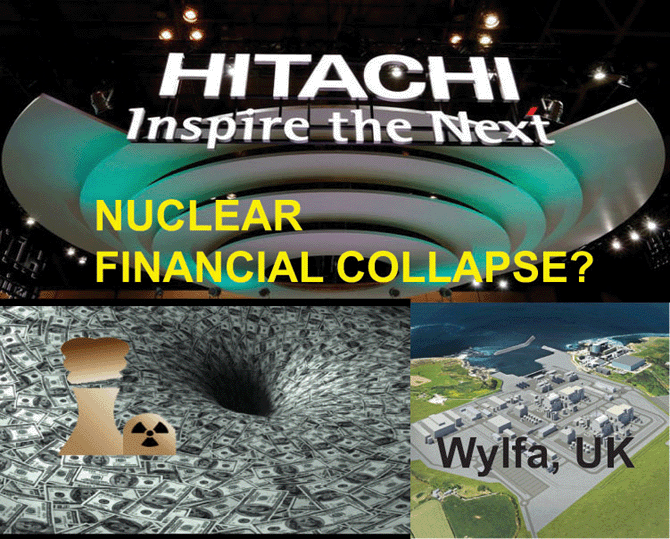
Hitachi may freeze British nuclear project due to swelling costs, https://www.japantimes.co.jp/news/2018/12/16/business/corporate-business/hitachi-may-freeze-british-nuclear-project-due-swelling-costs/#.XBawLdIzbGg
KYODO 17 Dec 18, Hitachi Ltd. is considering freezing its plan to build nuclear reactors in Wales after facing difficulties in finding investors to finance the project’s ballooning costs, sources close to the matter said Sunday.
If the Japanese conglomerate freezes the ¥3 trillion Wylfa Newydd plant construction, all of the overseas nuclear projects promoted by the government of Prime Minister Shinzo Abe as part of his growth strategy would have faltered.
Mitsubishi Heavy Industries Ltd. is mulling withdrawing from a nuclear project in Turkey amid swelling safety-related costs following the 2011 Fukushima nuclear accident, while Toshiba Corp. has decided to exit from the nuclear plant business outside Japan after incurring huge losses in the United States.
Hitachi has said it wants to lower its stake in Horizon Nuclear Power Ltd., a wholly owned unit it acquired in 2012 from two German electric utilities to take over the nuclear project, to below 50 percent to limit the impact on the Hitachi group of the construction of two advanced boiling water reactors on the Isle of Anglesey in Wales.
Hitachi is likely to have told the British and Japanese governments of its plan to freeze the project, the sources said. The issue will likely be discussed at the planned meeting between Abe and British Prime Minister Theresa May in January, they said.
The company has been contacting prospective investors in the project, including Japanese utilities, but little progress has been made amid concerns that costs will further swell, they said.
Hitachi also remains at odds with the British government over the purchase price of electricity to be generated by the plant, a key factor in determining the project’s profitability for the company and potential investors.
Given the current turmoil in British politics over May’s proposed deal with the European Union on the United Kingdom’s departure from the bloc, price-setting talks are at a “deadlock,” a senior Hitachi official said.
December 18, 2018
Posted by Christina Macpherson |
business and costs, Japan, UK |
1 Comment








 nuclear-news