Janine Jackson interviewed Karl Grossman about the the weaponization of space for the August 24, 2018, episode of CounterSpin. This is a lightly edited transcript.
CounterSpin Karl Grossman Interview
LA Times: Pence says Pentagon Should Create ‘Space Force’
LA Times story (8/9/18) goes from “would” to “will” on Space Force.
Janine Jackson: While the internet treated it largely as a kind of painful joke, corporate news media reported the Trump White House’s plans to establish a “Space Force” as the sixth branch of the US military as almost an inevitability: A Los Angeles Times story slips from saying the force “would be” responsible for training military personnel to saying the space command “will centralize planning for space war-fighting.” The pushback reported is from those concerned about “bureaucracy,” or changes in the “roles and budgets” of existing military branches. There are details to be worked out—even such “basic” ones, says a Washington Post front-pager, as “what uniforms” the space force would use. But coverage presents potential opposition to the plan, from congressmembers, for example, more as a “hurdle” than a cause for deeper investigation.
Karl Grossman is a preeminent resource on the weaponization of space. He’s professor of journalism at State University of New York/College at Old Westbury, and author of the books Weapons in Space and The Wrong Stuff: The Space Program’s Nuclear Threat to Our Planet, among others. He’s also a longtime associate of FAIR, the media watch group that brings you this show. Welcome back to CounterSpin, Karl Grossman.
Karl Grossman: A pleasure to be with you, Janine.
JJ: We can ask how media can report the statement, from the bipartisan leaders of the Armed Services Committee Panel on Strategic Forces, that “beefing up” military capabilities in space “will result in a safer, stronger America,” with no thought to whether terrestrial war-making has made America safer or stronger, but we know that elite media takes place in this sort of la-la land where those presumptions are premises.
But I want to ask you about the more specific claim being made, and simply recited in the press, about the nature of this plan: USA Today says it “would develop forces to defend satellites from attack and perform other space-related tasks.” It says the Pentagon’s plan “identifies”—doesn’t allege, but identifies—Russia and China as “explicitly pursuing space war-fighting capabilities to neutralize US space capabilities in a time of conflict.” What are we to make, Karl Grossman, of the idea that creating a space force is a defensive measure?
KG: What we would be doing is opening the heavens to war, making space a war zone, and that flies in the face of the Outer Space Treaty of 1967, which sets space aside for peaceful purposes, and precludes the deployment in space, by any nation, of weapons of mass destruction. And there’s been efforts—I’ve covered them for years now; mainstream media has not covered these efforts—to broaden the Outer Space Treaty to preclude not just weapons of mass destruction, but any weaponry in space, and in that way ensure that it would be space for peace.
And the two countries that have been leaders in this effort have been Russia and China. In fact, I have here a piece from Chinese media, this was just a couple of weeks ago, “China Envoy Calls for Strengthening Outer Space Covenants and Cooperation.” What Russia and China—and let me mention, too, our neighbor Canada—have been promoting, pushing, has been a treaty titled Prevention of an Arms Race in Outer Space, the PAROS treaty.
And I’ve been actually to the United Nations for votes on the PAROS treaty. And one country after another country votes for it—again, with Russia, China and our neighbor Canada in the lead. And the one nation, in all the countries of the world, voting against the PAROS treaty? The United States. And because there’s a consensus process for a disarmament treaty, the PAROS treaty has gotten nowhere. So what we’d be doing by creating this Space Force, and seeking, as Trump put it, “American dominance” in space, is just really asking for Russia and China and other countries—there will be India and Pakistan, the list will go on—to go up into space and weaponize space.
JJ: So it’s really turned on its head; it’s being presented, in the words, largely, of Mike Pence and other officials, that it’s “our adversaries,” as it’s put, that have already transformed space into a war-fighting domain—those are their words—and so, therefore, the US has to get up there to respond.
KG: I must say, China did a real stupid thing in the year 2007. It used one of its missiles to destroy an obsolete Chinese satellite. And the next year, we did the same thing to one of our satellites, with a missile. And this is being used by the US as an example of China being keen on anti-satellite weaponry. In fact, what is was was a very dumb way to eliminate a satellite, because you’re left with all kind of debris—dumb on the Chinese part, and dumb for the United States to do the same thing the year after.
But up to now, China and Russia—and I’ve spoken to officials of both countries, and I’ve been to both countries; I’ve been on the story for a long time—and they’re very, very reluctant to violate the intent of the Outer Space Treaty. Also, and they’ve gone on and on with me about this, they don’t want to waste their national treasuries; they don’t want to expend—I mean, to put weaponry up in space is an expensive proposition; it isn’t like acquiring a tank or even a jet fighter; billions and billions of dollars would be the cost—and they’ve told me that they just don’t want to waste their money on placing weapons in space. However, if the US moves up into space with weapons, with this mission to dominate the Earth below from space, despite the cost, they’ll be up there.
JJ: I’ve read a lot about satellites, Karl, but a word that I haven’t seen much of in this current round of coverage is nuclear. But that’s got to be in the story, right?
Karl Grossman: “Consider the consequences of a shooting war: Battle platforms are hit, and radioactivity from these nuclear reactors rains down on Earth.”
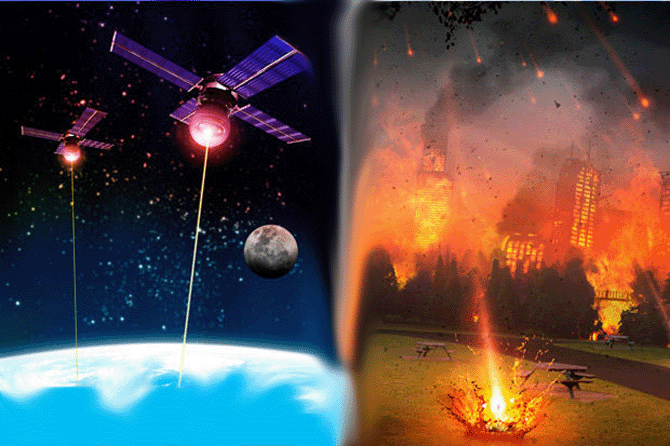
KG: Absolutely. In moving up into space, with the Space Force, no doubt the United States will be placing nuclear power systems in space. That was the architecture of Reagan’s Star Wars, orbiting battle platforms with nuclear reactors on them providing the power for hypervelocity guns, particle beams and laser weapons; as Star Wars head general James Abrahamson said, without reactors in orbit, there would need to be a long, long extension cord that goes down to the surface of the Earth, bringing up power. Consider the consequences of a shooting war: Battle platforms are hit, and radioactivity from these nuclear reactors rains down on Earth.
JJ: You really are not getting the picture of, not just things going wrong, but things going as they might be anticipated to go, being, really, a horrific calamity for human beings. It’s a very tidy image that we’re getting about what war in space would be like.
KG: This lethal threat would be above our heads. I did a documentary a number of years ago, entitled, advisedly, Nukes in Space: The Nuclearization and Weaponization of the Heavens. And nukes and weapons in space, they go together.
JJ: And I wanted to ask you about that question of priorities, finally. The Washington Post had an article headlined “Potential Winners if a Space Force Flies,” which delivered the no doubt shocking news that “a group of government contractors sees a chance to profit.” Hold onto your hat! An analyst tells the Post, “Lockheed Martin, Northrop Grumman and Harris Corporation may be particularly well positioned to benefit from Trump’s Space Force.” I found it odd to present military contractors as sort of savvily responding to policy, as opposed to driving it, but then, to your point, there was vanishingly little reference in media coverage to who would not benefit from this allocation of funds, to what would be lost, to what would be harmed, and so I wanted to underscore that point that you made, just to say, media didn’t talk about it either.
And then, finally, what do you see as the role for the public in this, where can people focus in terms of speaking out on this issue?
“Space Force” looks to be a coup for the military industrial complex (LA Times, 8/18/18).
KG: Just a quick mention of a very important piece, in regards to mainstream media, I was so happy to see it, in the Los Angeles Times, this is just a couple of days ago, the headline, “Trump Backed ‘Space Force’”—in quotes—“After Months of Lobbying by Officials With Ties to the Aerospace Industry.” And listeners can Google that; it’s very, very detailed, talks about
a small group of current and former government officials, some with deep financial ties to the aerospace industry, who see creation of the sixth military service as a surefire way to hike Pentagon spending on satellite and other space systems.
So on this issue, we can at this point, there’s been enough documentation, to include the “follow the money” precept.
As to what people can do, we have to rise from the grassroots. An excellent organization, that I would recommend that people connect with, is the Global Network Against Weapons and Nuclear Power in Space. Its website is Space4Peace.org, and among other things, the Global Network will be doing, October 6–13 this year, they’re going to—all over the world, this is going to be happening—protests and other actions in a Space for Peace week. So from the grassroots, people—certainly in this country, and all over the world—need to stand up and to stop this madness, to keep space for peace.
JJ: We’ve been speaking with Karl Grossman, professor of journalism at State University of New York/College at Old Westbury. You can find his recent article, “Turning Space Into a War Zone,” on CounterPunch. Karl Grossman, thank you so much for joining us this week on CounterSpin.
KG: A pleasure, Janine.
September 3, 2018
Posted by Christina Macpherson |
2 WORLD, weapons and war |
Leave a comment
 Reporterre 1st Sept 2018 [Machine Translation] Since the morning of Saturday, September 1, several anti-nuclear Franco-German militants block a uranium transport.
They climbed a bridge 140 m high near Koblenz, Germany, blocking the railway on the Moselle, informs us the group Contratom Deutschland. The blocked train carries ” Yellow Cake ” from Namibia ; it left Hamburg on Thursday for the Orano uranium conversion plant in Narbonne Malvesi, in the south of France.
In Narbonne, uranium is transformed into UF4 and then used, after several transformations and enrichment, in nuclear power plants around the world. According to Orano, the Narbonne plant processes 25% of the world’s uranium.
“If we want to get out of the nuclear industry, ” says Cécile, a French climber living in Germany who takes part in the action, ” we must stop these transports and prevent them from reaching the Orano factory in
Narbonne Malvési, the gateway to European nuclear energy.
Germany, a net exporter of electricity, unlike political discourse, does not come out quite nuclear. The transports supplying the nuclear facilities continue and the Framatome Nuclear Fuel Plant in Lingen (Lower Saxony) and Urenco’s uranium enrichment plant in Gronau (North Westphalia) continue to operate. That’s why we want to stop nuclear transport. ”
https://reporterre.net/Un-train-d-uranium-a-destination-de-Narbonne-bloque-en-Allemagne
September 3, 2018
Posted by Christina Macpherson |
Germany, opposition to nuclear |
Leave a comment

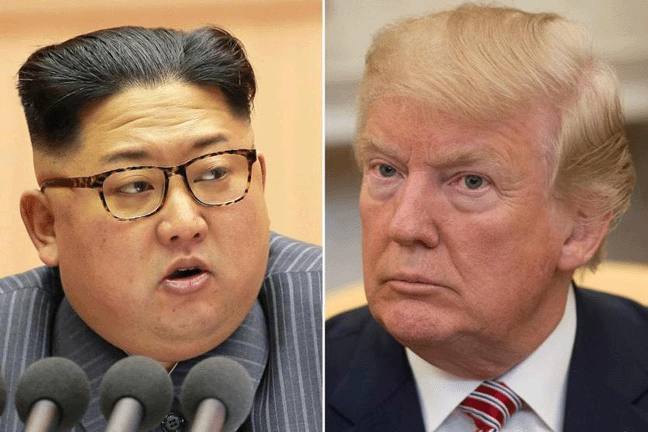
 The current US negotiating strategy with North Korea is doomed, Bulletin of the Atomic Scientists, By Perry World House, August 30, 2018 US negotiations with North Korea over the latter’s nuclear weapons program appear to have hit a major roadblock. While North Korea has temporarily suspended nuclear and missile testing and partially destroyed its nuclear test site, both steps are reversible, and North Korea has largely balked at US President Donald Trump’s demand for “complete, verifiable, and irreversible denuclearization.” Consequently, negotiations with Pyongyang may be on the verge of breakdown. Trump recently cancelled his secretary of state’s planned trip to the country, and the administration has gone back and forth in the last few days about whether Washington will continue to suspend joint military exercises with South Korea, a concession Trump made to North Korean leader Kim Jong-un during their historic summit in June. Given this critical juncture in negotiations, it is time to reevaluate what talks can actually achieve. It would be great if Kim agreed to hand over all of his nuclear weapons, but the reality is that North Korea will not be completely, verifiably, or irreversibly denuclearizing anytime soon. Therefore, if the Trump Administration wants to salvage the negotiations, it needs a new strategy.
Why North Korea won’t denuclearize. The first step to a successful negotiating strategy is understanding how your opponent thinks. So why does North Korea want nuclear weapons in the first place? For the same reason Israel, France, India, and others wanted them—security. Specifically, security against the United States.
North Korea’s murderous dictator has good reason to worry about an American intervention to overthrow his regime. First of all, the United States is much more powerful than North Korea. While the size of North Korea’s entire economy is about $40 billion at most, America spends over $700 billion on its military alone. Second, this fact, combined with Washington’s long history of military interventions, is enough to make any despot shake in his shoes. Finally, the specific history between the United States and North Korea is not reassuring to Kim. The two countries fought against each other in the Korean War, President George W. Bush branded North Korea part of the “axis of evil,” and Trump threatened Pyongyang with “fire and fury like the world has never seen.”
Like many relatively weak countries facing a threat, North Korea turned towards nuclear weapons not because its leader is crazy, but to deter a stronger power. By threatening to punish the United States and its allies with a nuclear response if it is attacked, North Korea is able to effectively dissuade Washington from such attempts. Since Kim’s top priority, like most autocrats, is regime security, he will only give up the protection of his nuclear weapons if he is very confident that he can retain his power without them. Though Trump committed to guaranteeing North Korea’s security in the Singapore Declaration, a number of recent historical episodes will make it difficult to convince Kim he can remain safe if he surrenders all his nuclear weapons.
One example involves Libya. In 2003, Libyan dictator Muammar Gaddafi agreed to give up his nascent nuclear weapons program and permit international inspections. In return, US President George W. Bush promised that Libya could “regain a secure and respected place” among nations. However, just eight years later, in 2011, the United States led a NATO military intervention in Libya that resulted in the brutal killing of Gaddafi. In recent months John Bolton, Trump’s national security advisor, has repeatedly said that Washington has the “Libya model” in mind for North Korea, probably the least reassuring example that could be communicated to Kim.
A second leader who did not do well after suspending his nuclear weapons program was Iraq’s Saddam Hussein. While states that possess nuclear weapons can almost always effectively deter military intervention, states that do not, like Iraq in 2003, are vulnerable. In a fate not much better than Gaddafi’s, Saddam was removed from power by an American military intervention in 2003 and ultimately hung in 2006…….
Trump personally undermined American negotiating credibility in two ways; one indirect and one direct. Indirectly, he hurt Washington’s credibility by withdrawing from the Iran nuclear deal, even though, according to the International Atomic Energy Agency, Iran was complying with its terms. The Trump Administration has now moved to severely punish Iran for its compliance by instituting tough sanctions………..
Given this record, North Korea is very unlikely to agree to fully denuclearize in the short or medium-term, and demanding that it do so is only likely to lead to negotiation failure. To make real progress on this issue, the White House will need to take a different tack.
What Washington’s strategy should be. The Prussian statesman Otto von Bismarck said, “politics is the art of the possible, the attainable.” If North Korea will not be handing over its entire nuclear stockpile anytime soon, what possible, attainable options might curtail the threat? The most extreme option, of course, would be to launch a massive military attack against North Korea in an effort to destroy all of its nuclear weapons and infrastructure—the “fire and fury” Trump threatened. However, such an operation would be reckless to the point of insanity. North Korea has the ability to deliver nuclear missiles to South Korea, Japan, and American military bases in the Pacific. If even one or a handful of nuclear missiles survived an American first strike, hundreds of thousands could die beyond those killed in the initial US attack. Furthermore, even if the United States could reliably locate and destroy all of North Korea’s nuclear weapons in a first strike, Pyongyang would still be able to inflict tens of thousands of casualties daily using conventional and chemical weapons. Given that there is no imminent threat from North Korea’s nuclear program, a preventive war of this type would be nonsensical.
The most sensible option to address the nuclear threat from North Korea would be to pursue an approach dubbed “less for less” by nuclear scholar James Acton. Rather than demanding total denuclearization, the United States should seek a smaller-scale deal that puts significant restrictions on North Korea’s nuclear program in return for moderate sanctions relief and other limited concessions. ……….
Though the prospect of living with a nuclear-armed North Korea for the foreseeable future may seem unacceptable, the world has survived with a nuclear-armed Russia for the last 69 years, China for the last 54 years, Pakistan for the last 20 years, and, yes, North Korea for the last 12 years. Just as North Korea’s nuclear weapons have effectively deterred the United States from a major military intervention, America’s vastly superior nuclear arsenal and conventional capabilities will almost certainly deter North Korea.
This column was written by Joshua A. Schwartz, a PhD candidate in political science at the University of Pennsylvania. https://thebulletin.org/2018/08/the-current-us-negotiating-strategy-with-north-korea-is-doomed/?utm_source=Bulletin%20Newsletter&utm_medium=iContact%20email&utm_campaign=August31
September 3, 2018
Posted by Christina Macpherson |
North Korea, politics international, USA |
Leave a comment
Ken Raskin, 3 Sept 18, I see at enenews the code (code and the other trolls) continue to keep the health physics and  background radiation, harbingers and lies going.
It is all such nonsense. If you breathe or ingest any radionuclides, you might be screwed. If a nuclear- radiation, detector is going off, there is too much radionuclides in the soil and it is getting in the air.
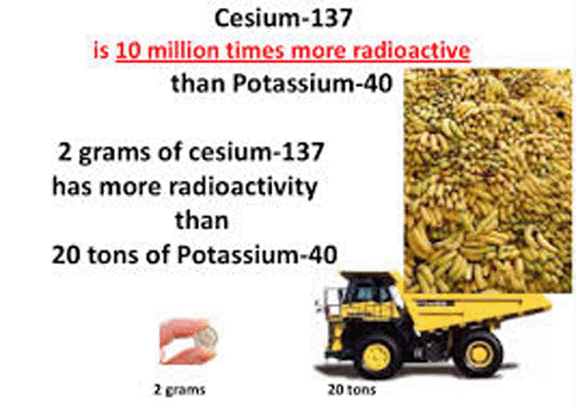
It only takes 100 billionths of a gram of cesium 137 or radioactive iodine to biocummulate and kill u. They are teratogenic.
Fukushima spewed hundreds of tons of uranium, plutonium, and radioactice isotopes like cesium 137 into the environment. A fuel pool caught fire too. Cobalt 60, cesium134/137, strontium 90, plutonium and many more of the worst radionuclides are omnipresent in northern Japanese soil, water, food air. Typical health physics nonsense. It is used as misinformation, lies, propaganda to distract from the real problem: any radionuclides in the environment.

The k40 obsession is misdirection too. It shows the psyops nature of the arguments and meme generating propaganda. Inet has a lot of manipulative mind-games.
September 3, 2018
Posted by Christina Macpherson |
Uncategorized |
Leave a comment











 nuclear-news