 The Ass Clown Epoch, Counter Punch, JENNIFER MATSUI , 28 Aug 18 How do we define “dumb” in the Age of Stupid? Whether you call it the Anthropocene, or the more scientific ‘Ass Clown Epoch’, stupid is the defining feature of our “smart” everything society: From our phones to the lampshades and corkscrews that increasingly depend on them to function. When the greatest minds of your generation came up with the idea of enriching themselves to the extent that no one else can survive – financially or even physically – it’s time to acknowledge that we are in the throes of irreversible human cognitive collapse. Some would point to the Supreme Dotard at its apex as symptomatic of its underlying causes rather than the cause itself. After all, stupid is the fertile foundation from which both “intelligent life” and Donald Trump evolved. ……
For these people, “asshole” is less an insult than a badge of honor since it denotes a rugged and “alpha” disposition. Science has confirmed that the smell of sulfur has its own aphrodisiac underpinnings if it’s emanating from someone dressed as a banker or a tech bro. ……
There’s always the risk of unfairly maligning those with actual disabilities who bear the brunt by association with those who use their intellects to devise ways of driving species essential to the continuation of life to extinction, and then talk about moving to Mars and nuking it for their own survival. We can’t call the latter “retards”, since the word still has unpleasant associations with hate speech directed at vulnerable people, yet not calling them out on their intellect-driven choices misses a valuable opportunity to reassess what it means to be “smart” and how this designation puts us all at risk as in . . . “The decision by educated and well-informed bureaucrats and corporate executives to build nuclear power plants close to the coastline of a seismically active island prone to tsunamis was monumentally . . . misguided”. As was the decision to invade Iraq, Afghanistan, Libya . . . The list is as long as our capacity to unlearn history is boundless……..
Understatements like “misguided” only serve to insulate evil-doers from their evil, and even evoke sympathy and admiration for their “plight” as remorseful serial killers with the benefit of hindsight. Even “psychopaths” enjoy a sort of cult status, and considered role models in tech and banking circles. …..
Understatements like “misguided” only serve to insulate evil-doers from their evil, and even evoke sympathy and admiration for their “plight” as remorseful serial killers with the benefit of hindsight. Even “psychopaths” enjoy a sort of cult status, and considered role models in tech and banking circles. …….
The people we deem “genius”, blessed, gifted, or even capable, are too often committed to the destruction of everything or anything that sustains balance, harmony and joy for short-term, ego-driven gains that have endlessly cascading consequences for organized life on earth. Very bad ideas, once monetized, become “innovation”, while the criminal masterminds behind them them are dubbed “visionaries”. It takes a genius to devise ways to integrate banking systems, airlines, hospital equipment and vending machines so that they all crash simultaneously in some foreseeable future without running water or electricity…….
If a person is somehow able to mathematically chart a course for himself to a distant, freezing planet, having helped mastermind the destruction of his own, we somehow consider this development an achievement milestone ……..Jennifer Matsui is a writer living in Tokyo. https://www.counterpunch.org/2018/08/28/the-ass-clown-epoch/
August 29, 2018
Posted by Christina Macpherson |
general |
1 Comment
 HOW A NUCLEAR STALEMATE LEFT RADIOACTIVE WASTE STRANDED ON A CALIFORNIA BEACH, Nuclear waste is all dressed up with nowhere to go, The Verge By Rachel Becker@RA_Becks Aug 28, 2018 W
hen I got to the
San Onofre State Beach about
60 miles north of San Diego, the red sun of fire season was sandwiched on the horizon between a layer of fog and the sea. Surfers floated in a line off the shore. It looked like any other California beach — except for the row of signs that warned “Nuclear Power Plant Exclusion Area,” and the twin reactor domes rising above the bluffs.
I was there to see the
San Onofre Nuclear Generating Station, a shuttered nuclear power plant right next to the Pacific Ocean. It once supplied electricity to Southern California, but was
permanently shut down in 2013. It’s now scheduled to be dismantled, but even when that happens, more than 1,700 tons of spent nuclear fuel will remain — interred in enormous concrete casks behind a seawall. There’s nowhere else to put it.
On the beach, perspectives on the plant ranged from resignation to frustration. “It’s part of the landscape now,” said one man walking his dog. A woman who was roasting marshmallows in the sand with her family said it’s eerie to see the plant when she’s out surfing: “You turn around and take a wave, and you just see these nuclear boobs staring out at you.” Her husband wondered what will happen with the spent nuclear fuel now that the plant is no longer operating. “No citizen wants it here permanently, but nobody wants to take it,” he said. “So we’re just in a really hard spot. What are you supposed to do with it?”
All those containers of fuel left behind mean that no one can use the land for anything else. And the problem is widespread: spent fuel from commercial reactors is scattered across roughly 80 sites in 35 different states, according to the Government Accountability Office. It wasn’t supposed to be like this: for decades, the plan has been to bury highly radioactive nuclear waste underground. (There were also proposals to bury the waste in the ocean or shoot it into the sun — but those weren’t as practical, according to a report by the Blue Ribbon Commission on America’s Nuclear Future.)
The idea is that a geologic repository would keep the waste away from people as the radioactivity decays — which can take
hundreds of thousands of years, depending on the material. In the 1980s, the government settled on Yucca Mountain in Nevada as the most likely spot and planned to start taking shipments of spent nuclear fuel in 1998. In return, the deal was that utilities — really, their customers —
would start paying ahead into a fund that would cover the costs. But Nevada politicians like Senator Harry Reid (D-NV)
hated what became known as the “screw Nevada bill,” and the project has hit delay after delay ever since.
Now, utilities like Southern California Edison, which operated San Onofre, are stuck in a holding pattern: guarding the waste, and suing the government
for billions of taxpayer dollars to pay for it. “The federal government has not fulfilled their obligation to come take the fuel from this plant site, or any commercial plant site,”
Ron Pontes, team manager of decommissioning environmental strategy at San Onofre, told me. “So, until they do so, the fuel is here and we are charged with taking care of it.”
Verge Science’s video team and I went on a tour of the plant to see what it means to take care of that fuel. ……….
There are a few possible fixes. Two different private companies have applied to the Nuclear Regulatory Commission for licenses to construct interim storage facilities
in Texas and
New Mexico. But the key word there is
interim: these sites would be temporary holding areas for fuel that will eventually move to a permanent repository — like
Yucca Mountain, the controversial site in Nevada that’s about
100 miles northwest of Las Vegas, and across the state line from Death Valley in California.
At first, the list of possible long-term repositories for highly radioactive waste was longer than just Yucca Mountain. Hanford in Washington state and Deaf Smith County in Texas also rose to the top, according to a report by the Blue Ribbon Commission on America’s Nuclear Future. Plus, there were supposed to be two repositories, so that one state wouldn’t be stuck with an entire nation’s nuclear waste. “And then the idea was you couldn’t do this quick and dirty, you’d spend several years and a billion dollars at each of those three sites,” says Robert Halstead, executive director of Nevada’s Agency for Nuclear Projects……….
Now, a bill introduced by John Shimkus (R-IL) that passed the House in May proposes to clear the way for the licensing to proceed and would authorize interim storage facilities. It would let Nevada negotiate compensation in return for hosting the repository, ensure the DOE has the land rights it needs for the site, and increase the amount of waste that could be stored in the Yucca Mountain repository.
The bill probably won’t get anywhere. “Historically, the Senate’s not going to move,” Shimkus said in an interview with The Verge. Senator Dean Heller (R-NV) called the bill“dead on arrival” in the Senate. But Shimkus says the bill shows the House’s collective support for funding Yucca Mountain. That’s key as the House and the Senate haggle over the budget for fiscal year 2019. “We’re waiting to see how this final dance happens,” Shimkus says.
Halstead, over at Nevada’s Agency for Nuclear Projects, said, “The bill is a declaration of war on the state of Nevada.” There are two big things wrong with it, according to Halstead: “They think that they can force this down Nevada’s throat, and they’re not going to be able to — and secondly, they think the Department Of Energy can carry out the program,” he says, adding that the state of Nevada can “whup the Department of Energy. So bring it on.”………https://www.theverge.com/2018/8/28/17765538/san-onofre-nuclear-generating-station-radioactive-spent-fuel-waste-yucca-mountain
August 29, 2018
Posted by Christina Macpherson |
USA, wastes |
Leave a comment
Russia Kicks Off Work on Engine for Nuclear-Powered Supercarrier, A Russian Navy research institute has reportedly commenced work on engine designs for a nuclear-powered aircraft carrier.The Diplomat , By Franz-Stefan Gady, August 28, 2018 The Russian Navy has commenced research on engine designs for Russia’s planned nuclear-powered supercarrier, dubbed Project 23000E Shtorm (Storm), the chief of the Russian Navy’s shipbuilding department, Rear Admiral Vladimir Tryapichnikov, said in a television interview on August 24……….
As I
reported previously, a supercarrier would take up to 10 years to build and cost as much as $9 billion excluding operational costs. A design for a Russian supercarrier was first revealed in May 2015 by the Krylovsky State Research Center (KRSC), a Russian shipbuilding research and development institute. Based on information supplied by KRSC, the flattop would displace 90,000-100,000 tons, will be 330 meters long, 40 meters wide, and will have a draft of 11 meters. The ship would be able to carry 80-90 deck-based aircraft. …..
Chances that the program will move beyond the design stage remain slim. First, Russia has never built a nuclear-powered aircraft carrier and lacks expertise. All Soviet carriers were constructed in Ukraine. Second, given current budgetary realities, it appears unlikely that the Russian Ministry of Defense will allocate billions of dollars to a project that only vicariously supports the core mission of the Russian Navy — nuclear deterrence. Third, even if Russia were to eventually float out a carrier, it would still lack crucial other assets to successfully field a carrier strike group including carrier-capable next-generation fighter, tactical airborne early warning, and electronic warfare aircraft, as well as support vessels.
https://thediplomat.com/2018/08/russia-kicks-off-work-on-engine-for-nuclear-powered-supercarrier/
August 29, 2018
Posted by Christina Macpherson |
weapons and war |
Leave a comment
Nuclear fuel removal to start at Monju reactor NHK, 28 Aug 18 The operator of Japan’s Monju prototype fast-breeder reactor plans to soon start removing its nuclear fuel from a storage container as part of the plant’s decommissioning.
The Japan Atomic Energy Agency plans to scrap the reactor in Tsuruga City in Fukui Prefecture, central Japan, over 30 years.
Work to move the fuel to a detached storage pool was to start in late July. But it was postponed due to equipment trouble including fogging up of monitoring camera lenses during trials.
The work is now to start on Thursday……..https://www3.nhk.or.jp/nhkworld/en/news/20180828_33/
August 29, 2018
Posted by Christina Macpherson |
decommission reactor, Japan |
Leave a comment
Diplomacy In The Nuclear Age, Kashmir Observer, HAIDER NIZAMANI • Aug 28, 2018, How India & Pakistan Deal With The Bomb
India and Pakistan ‘gatecrashed’ the nuclear club in May 1998. Children who were born right after the nuclear tests, carried out by the two countries in that year, are now able to vote — a generation, particularly in Pakistan, that has grown up on a steady diet of nuclear nationalism that portrays weapons of mass destruction as guarantors of national security and sources of collective pride. In times when the country can showcase little by way of achievements, we always console ourselves by saying that we have nuclear weapons.
Nuclear weapons and their delivery systems are made by experts trained in science and engineering but there is also another ‘nuclear expert’ whose bread and butter is linked to writing about these. There was only a small group of such experts two decades ago but nuclear tests by India and Pakistan have opened up many new spots for them. They are camped mainly in think tanks in New Delhi, Islamabad and Washington DC.
An overwhelming majority of them use the lens of political realism that sees states as key actors who pursue their national interests in competition with each other. Moeed Yusuf also belongs to this tribe of nuclear experts. He defines the crises explored in his book as “exercises in coercion through adversaries seek to enhance their relative bargaining strength vis-à-vis their opponents”………..
limitations of Yusuf’s book Brokering Peace in Nuclear Environments are, in fact, the limitation of realist theory that focuses on state actors and their actions and does not delve into the social, economic, political and strategic factors that cause those actions and determine their direction and outcome. Additionally, many Indian and Pakistan security experts consciously or unwittingly end up echoing official versions as the true versions of history. In many parts, Brokering Peace in Nuclear Environments also follows the same path which makes its analysisa bit lopsided and its prescriptions a little too Pakistan-centric.
Its strength, however, is the large number of interviews that Yusuf has conducted with policymakers, especially from the United States and Pakistan, who played key roles during the three crises mentioned above. For this reason alone, if for nothing else, his book should be seen as a good addition to the academic literature available on war and peace between India and Pakistan. https://kashmirobserver.net/2018/feature/diplomacy-nuclear-age-35464
August 29, 2018
Posted by Christina Macpherson |
India, Pakistan, weapons and war |
Leave a comment
Students submit nuclear abolition petition to UN https://www3.nhk.or.jp/nhkworld/en/news/20180829_06/ A group of Japanese high school students has visited the United Nations European headquarters in Geneva to submit a petition calling for the abolition of nuclear weapons.
The 20 “peace messengers” met Anja Kaspersen, the director of the UN Office for Disarmament Affairs, on Tuesday. Some of the students are from the atomic-bombed cities of Hiroshima and Nagasaki. The students showed Kaspersen photos taken immediately after the 1945 bombings. They told her the bombs not only killed many people but also forced survivors to live with burns and aftereffects.
They submitted about 100,000 signatures they had collected over the past year and urged the UN to do more to create a world with no nuclear weapons.
Kaspersen said the students’ campaign is not just about hope, but it is also helping young people in many countries to promote generosity and understanding.
The UN adopted the Treaty on the Prohibition of Nuclear Weapons last year, but nations possessing nuclear weapons and Japan have not joined it. Riko Shitakubo from Hiroshima said she renewed her resolve to keep trying to change the situation surrounding nuclear weapons.
August 29, 2018
Posted by Christina Macpherson |
Japan, weapons and war |
Leave a comment
|
Unfinished nuclear fuel plant had water leak NHK, 28 Aug 18The operator of a nuclear fuel reprocessing plant under construction in northern Japan says it found a water leak earlier this month at one of its facilities.
Japan Nuclear Fuel says an employee spotted the leak in the pipes of a storage pool at the plant in Rokkasho Village, Aomori Prefecture.
The operator found that the pipes were corroded in 20 places and one of them had a hole. They are located outdoors and used for inspections.
The operator believes that rainwater seeped through gaps in insulation materials wrapped around the pipes………https://www3.nhk.or.jp/nhkworld/en/news/20180829_02/
|
|
August 29, 2018
Posted by Christina Macpherson |
incidents, Japan |
Leave a comment
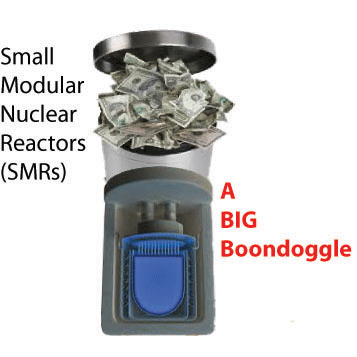
 US regulators agree smaller SMR emergency zones http://www.world-nuclear-news.org/Articles/US-regulators-agree-smaller-SMR-emergency-zones, 28 August 2018
The US Nuclear Regulatory Commission (NRC) has agreed that emergency planning zones (EPZ) around small modular reactors can be scaled to be reflect their reduced risks rather than the mandatory ten-mile EPZ required for the USA’s current light-water reactor fleet.
The NRC’s preliminary finding is part of a safety evaluation of a 2016 Early Site Permit application from the Tennessee Valley Authority (TVA) for the potential use of a site at Clinch River for two or more SMR modules of up to 800 MWe. This is the first SMR-related application of any type to be received by the NRC.
The US Nuclear Energy Institute (NEI) described the decision as a “potential regulatory breakthrough” that could accelerate future deployment of SMRs and advanced reactors. “The industry believes that this recognition of the enhanced safety features of small and advanced reactors could greatly simplify the licensing of these technologies and increase their cost competitiveness,” it said.
TVA’s application uses information from four SMR designs – BWXT’s mPower, Holtec International’s SMR-160, NuScale Power’s SMR, and Westinghouse’s SMR – to provide the technical basis for a requested exemption to the ten-mile EPZ requirement currently in use. The most detailed information was provided on the NuScale SMR, for which a design certification application was submitted to the NRC in January 2017. According to the application, the enhanced safety characteristics of those designs, such as smaller reactor cores, simpler systems, and built-in passive safety features, mean that off-site emergency planning requirements and plans can be scaled down to be proportionate with those reduced risks.
NRC staff found TVA’s proposed dose-based, consequence-oriented methodology to be a “reasonable technical basis” for determining EPZ size, consistent with the basis used to determine that for large light water reactors, NEI said.
The NRC also granted TVA its exemption from a ten-mile EPZ for future combined construction and operating licence applications for which the radioactive source term is bounded by the conditions established by the NRC. An SMR plant at the Clinch River site based on the NuScale SMR design would meet the conditions for a so-called site boundary-sized EPZ.
NEI Technical Advisor for Nuclear Generation David Young said current emergency planning requirements would impose an unnecessary regulatory burden on applicants and licensees, which would diminish the cost competitiveness of advanced reactors and hinder their development.
NEI Technical Advisor for Nuclear Generation David Young said current emergency planning requirements would impose an unnecessary regulatory burden on applicants and licensees, which would diminish the cost competitiveness of advanced reactors and hinder their development.
August 29, 2018
Posted by Christina Macpherson |
Small Modular Nuclear Reactors |
Leave a comment
China stands by its commitment not using nuclear weapons, Pakistan Observer , August 28, 2018 BEIJING : China on Tuesday reiterated that it will not use nuclear weapons first and foremost at any time and under any circumstances.
August 29, 2018
Posted by Christina Macpherson |
China, politics international, weapons and war |
Leave a comment
Hundreds protest against nuclear power station mud dump, BBC News 27 August 2018
August 29, 2018
Posted by Christina Macpherson |
opposition to nuclear, UK |
Leave a comment
During nuclear audit, Santee Cooper executives faced a question: ‘Disclose or not’
 By Thad Moore tmoore@postandcourier.com
- Two years before their nuclear ambitions foundered, Santee Cooper’s top executives and lawyers got on the phone to talk about a top-to-bottom study of their $9 billion plant project, one that would later cast serious doubts about its viability.
- They hadn’t gotten results yet, but the utility wasn’t expecting a positive review: They had demanded an audit by the engineering and construction giant Bechtel Corp. to show just how far off track the V.C. Summer nuclear plant project had gone. They wanted to use it as leverage to get their partner, South Carolina Electric & Gas, to hire professional help.
- But while they waited for the audit’s findings, someone asked a pivotal question, one that would come to define the fallout from the project’s failure:
- Do we need to tell our investors about this?
- Their conversation is just one piece of evidence that federal investigators will consider as they sift through tens of thousands of subpoenaed records, probing South Carolina’s nuclear debacle for potential criminal wrongdoing. Through a Freedom of Information Act request, The Post and Courier obtained the trove of documents that Santee Cooper handed over to the U.S. Securities and Exchange Commission, including handwritten notes about the phone call………. https://www.postandcourier.com/business/during-nuclear-audit-santee-cooper-executives-faced-a-question-disclose/article_ee13b992-a7de-11e8-87d7-2ba1c923965f.html
August 29, 2018
Posted by Christina Macpherson |
Legal, USA |
Leave a comment
Nuclear waste briefings in coastal areas https://www3.nhk.or.jp/nhkworld/en/news/20180827_27/ Japanese energy agency officials say they will continue to hold public briefing sessions on the disposal of highly radioactive nuclear waste.
The government last year released a map showing which parts of the country may be scientifically suited to hosting an underground disposal site.
The Agency for Natural Resources and Energy has so far invited residents to 55 briefing sessions. Most have taken place in prefectural capitals.
On Monday, the agency held a meeting in Tokyo to explain the sessions to regional officials.
Agency officials said participants tend to question whether highly contaminated nuclear waste can safely be stored in earthquake-prone Japan. They also express concerns over how local people’s opinions may be reflected.
The agency plans to hold further briefings, mainly in coastal areas that are considered to be relatively suitable for underground waste storage.
The districts cover about 900 municipalities.
The officials say they will decide on where to hold the briefing sessions after discussions with the municipalities.
August 29, 2018
Posted by Christina Macpherson |
Japan, wastes |
Leave a comment
New earthquake probability scale https://www3.nhk.or.jp/nhkworld/en/news/20180828_18/ Japanese government officials have revised the chances for earthquakes linked to marine trenches in order to avoid misleading the public. The government’s task force for earthquake research released its assessment of quakes that may hit Japan, along with their probabilities of occurring within 30 years.
Currently, the chances of quakes linked to marine trenches are given in percentages.
But experts fear that such descriptions could cause misunderstandings. People might feel safe living in an area with a small quake possibility figure, such as 0.1 percent or less.
The task force said it has introduced a new 4-rank scale to describe quake probabilities.
The highest rank of 3 means having the biggest chance of a large-scale quake within 30 years– a chance of 26 percent or more. Rank 2 is for areas with the chance of a quake between 3 and 26 percent. The rank of 1 suggests quake probabilities of less than 3 percent. Another rank of X suggests the chances of a quake cannot be calculated due to a lack of data, but an imminent quake cannot be ruled out.
Under the new classification system, possible mega quakes, including along the Nankai Trough off the Pacific coast from central through western Japan, are ranked 3.
August 29, 2018
Posted by Christina Macpherson |
Japan, safety |
Leave a comment

ATOM Project Calls For August 29 Moment Of Silence To Honor Nuclear Weapons-Testing Victims https://www.indiatimes.com/news/india/atom-project-calls-for-august-29-moment-of-silence-to-honor-nuclear-weapons-testing-victims-351997.html Ashok Dixit August 28, 2018
The ATOM Project is urging the international community to observe a moment of silence on the occasion of UN International Day against Nuclear Tests on August 29 in memory of all nuclear weapons-testing victims.
The ATOM Project and its Honorary Ambassador, Karipbek Kuyukov, wants people around the world to observe 11.05 a.m. their local time as a moment of silence. The exact 11:05 a.m.time was chosen because, at that time, analogue clock hands form a “V,” symbolizing victory.
The moment of silence and the representation of victory honour those who have suffered and urges the international community to continue to seek victory over the nuclear weapons threat. “The effort continues to bring the Comprehensive Nuclear Test Ban Treaty into force and to permanently end the weapons testing. Still today, there are many living victims of nuclear weapons testing struggling with the emotional and physical scars of decades of nuclear weapons tests,” said Kuyukov.
Kuyukov, himself, was born without arms as a result of his parents’ exposure to nuclear weapons testing. He has overcome that challenge to become a renowned artist and globally recognized non-proliferation activist.
He has devoted his art to capturing the images of nuclear weapons testing victims and his life to the elimination of the nuclear threat. He is one of more than 1.5 million Kazakhs negatively impacted by exposure to nuclear-weapons testing.
On Dec. 2, 2009, the 64th session the United Nations General assembly established by unanimous vote the United Nations International Day against Nuclear Tests.
The vote was initiated by Kazakhstan to commemorate the date in 1991 – August 29 – when Kazakh President Nursultan Nazarbayev made the historic decision to close the infamous Semipalatinsk nuclear test site in East Kazakhstan, where 456 nuclear tests were conducted. August 29 in 1949 was the date of the first Soviet nuclear weapon test there.
The ATOM Project, an acronym for “Abolish Testing. Our Mission,” is an international effort launched in 2012 to permanently end nuclear weapons testing and seek elimination of all nuclear weapons. The moment of silence on August 29 has been observed globally at The ATOM Project’s initiative since 2013.
The ATOM Project seeks to unify support for the entry into force of the Comprehensive Nuclear Test Ban Treaty (CTBT). The treaty was open for signature in 1996 and has been signed by 183 nations.
It has been ratified by 166 countries, however, it has not entered into force because it has not been signed or ratified by eight specific states listed in CTBT Annex II – China, Egypt, India, Israel, North Korea, Pakistan and the United States.
With the observance of the International Day against Nuclear Tests and the accompanying moment of silence, Kuyukov and The ATOM Project urge people around the world to remain vigilant in the effort to achieve a nuclear weapons-free world.
August 28, 2018
Posted by Christina Macpherson |
Uncategorized |
1 Comment
Senior officials of the Kuomintang, Taiwan’s largest opposition party, hold a press conference on Aug. 27, 2018 at their headquarters in Taipei to state their opposition to lifting a ban on food imports from Fukushima and four other Japanese prefectures. The banners read “oppose nuclear food.”
TAIPEI — Taiwan’s largest opposition party Kuomintang has announced that it has collected some 470,000 signatures supporting a referendum on whether to lift a ban on the import of food products from five Japanese prefectures, including Fukushima, imposed after the 2011 Fukushima No. 1 nuclear plant disaster.
The number is far more than the 280,000 legally required to hold a referendum, and it is most likely that one will be held on Nov. 24 in tandem with general local elections.
Taiwan has banned foodstuff from the prefectures of Fukushima, Ibaraki, Tochigi, Chiba and Gunma in the northern and eastern parts of Japan, and the Kuomintang supports the ban.
A national referendum must have a turnout rate of at least 25 percent for the result to be valid, but this hurdle is likely to be cleared if the voting is done alongside the local elections. If voters back the ban, it would be extremely difficult for the administration of Tsai Ing-wen to ignore the outcome and Japan-Taiwan relations would suffer substantially as a result.
Behind the referendum move is a political rivalry between the Kuomintang and the ruling Democratic Progressive Party (DPP) headed by Tsai. The opposition is stepping up attacks on the ruling party in a bid to win the local elections and build political momentum toward the 2020 presidential election.
The Kuomintang has launched a negative PR campaign against food items from Fukushima and the other prefectures because the Tsai administration is positive about lifting the import ban. The opposition called the Japanese products “nuclear food,” meaning contaminated by the nuclear accident, and accused the government of ignoring people’s food safety concerns. A person linked to the DPP lamented that the issue is “being used in a political fight.”
The government of Japan has repeatedly urged Taiwan to lift the import ban, saying the safety of its food items is scientifically proven. However, the Tsai administration is hesitant about rushing a decision on resuming imports as it faces faltering approval rates and the issue could trigger explosive opposition from some voters.

August 28, 2018
Posted by dunrenard |
Taiwan | Ban Lifting, Fukushima Food Ban, Referendum |
Leave a comment



 nuclear-news