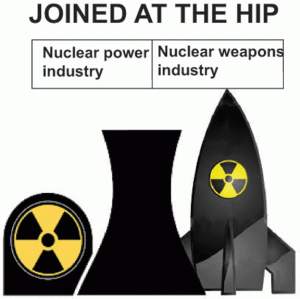
 NNSA, TVA agree to ‘down-blend’ uranium to produce tritium for weapons, Oak Ridge Today AUGUST 29, 2018, BY JOHN HUOTARI
 The National Nuclear Security Administration and the Tennessee Valley Authority announced last week that they intend to enter into an agreement to “down-blend” highly enriched uranium to low-enriched uranium in order to help produce tritium, a key “boosting” component in nuclear weapons.The highly enriched uranium used for the “down-blending” is processed, packaged, and shipped from the Y-12 National Security Complex in Oak Ridge, according to the NNSA. Y-12 is the main storage facility for certain categories of highly enriched uranium, which can be used in nuclear weapons and in naval reactors.
Low-enriched uranium, or LEU fuel, is used in a commercial power reactor run by TVA at the Watts Bar Nuclear Plant Unit 1 near Spring City in Rhea County, southwest of Oak Ridge. Tritium is produced there by irradiating lithium-aluminate pellets with neutrons in rods known as tritium-producing burnable absorber rods, or TPBARs.
The irradiated rods are then shipped to the Savannah River Site, an NNSA production facility near Aiken, South Carolina. The Savannah River Site extracts the tritium from the irradiated rods, purifies it, and adds it to the existing inventory, according to the NNSA’s Fiscal Year 2018 Stockpile Stewardship and Management Plan.
Tritium is a radioactive isotope of hydrogen that has two neutrons and one proton. It has been described as an essential component in every nuclear weapon in the U.S. stockpile. It occurs naturally in small quantities but must be manufactured to obtain useful quantities. It enables weapons to produce a larger yield while reducing the overall size and weight of the warhead in a process known as “boosting,” the U.S. Department of Energy said in an environmental impact statement about 20 years ago.
But unlike other nuclear materials used in nuclear weapons, tritium decays at a rate of 5.5 percent per year—its half-life is about 12 years—and it must be replenished periodically…….
The new agreement follows a determination by U.S. Energy Secretary Rick Perry on August 21 that allows the NNSA to continue transfers of enriched uranium from DOE’s inventories in support of national security, the NNSA said in a press release.
The rest of this story, which you will find only on Oak Ridge Today, is available if you are a member: a subscriber, advertiser, or recent contributor to Oak Ridge Today. https://oakridgetoday.com/tag/tritium-production/
August 31, 2018
Posted by Christina Macpherson |
business and costs, USA, weapons and war |
Leave a comment
https://www.militarytimes.com/veterans/2018/08/29/lawmaker-presses-for-quicker-action-to-help-clean-up-crews-of-a-deadly-military-nuclear-accident/, By: Leo Shane III WASHINGTON — Veterans exposed to radioactive debris more than five decades ago haven’t made much progress in the courts to have their illnesses recognized by the Department of Veterans Affairs, so now they’re hoping Congress can intervene.
“These veterans were exposed to nuclear materials without any warning or protection that today would be considered routine,” Blumenthal said. “The quickest way to get them what they deserve now is for Congress to act.”
Veterans involved in the accident have been unsuccessfully petitioning VA on their case since the mid-1970s, after a host of strange cancers and other illnesses began appearing among individuals involved in the Palomares incident.
In January 1966, seven airmen were killed and four more injured when a B-52 crashed into a KC-135 during a refueling mission off the coast of Spain. The B-52 was carrying four nuclear weapons at the time of the accident, and two of them exploded near the town of Palomares, spreading radioactive plutonium over hundreds of acres.
U.S. officials quickly ordered military personnel into the area to collect contaminated debris, crops and soil in an effort to repair the damage.
But veterans involved in that clean up say they were given no protective clothing or respiratory devices, and told very little about the potential long-term health effects about exposure to the nuclear material.
John Garman, one of the first airmen on the scene, said he remembers loading thousands of 55-gallon drums with contaminated top soil that was sent back to the United States for safe disposal.
“The civilians who buried those barrels in South Carolina were covered under federal law, but not us,” said Garaman, who developed bladder cancer at age 35 and multiple respiratory problems in later years. “Since I first filed in 1981, the VA has denied all of my claims.”
Department officials have long insisted that not enough scientific evidence exists to classify all of the health problems as service-related illnesses, and spotty Air Force records of the work and contamination levels have added to the problem.
Last December, the Veterans Legal Services Clinic at Yale Law School filed suit against VA to force recognition of the illnesses and benefits payouts, but that case has yet to move forward. Officials from Vietnam Veterans of America said many of the affected troops are elderly or deceased, meaning further delays could prove tragic.
Blumenthal called VA’s refusal to address the Palomares issue the latest in a long line of controversial decisions related to wartime exposure.
Recently, VA has come under criticism for its opposition to grant presumptive benefits status to so-called “blue water veterans” who served in ships off the coast of Vietnam and claim extensive Agent Orange contamination in their daily work. Several veterans groups have also accused the department of not doing enough to document illnesses connected to the use of burn pits in Iraq and Afghanistan.
VA officials have warned that deivating from long-held scientific standards for benefits awards could create financial problems for the department, by opening up support payments to tens of thousands of additional veterans.
Blumenthal said he does not believe this group presents a significant new financial burden for the department. But, he also called the cost issue irrelevant.
“This is about the principle of helping these veterans,” he said.
August 31, 2018
Posted by Christina Macpherson |
health, USA, weapons and war |
Leave a comment
 Ken Raskin 31 Aug 18 They detonated 5 nuclear bombs under parachute Colorado and Rangley. Not so far from Aspen Colorado. The radionuclides have been pouring into the headwaters of the Colorado river and Colorado for years. Rangely and Parachute have 15 times normal average for cancer.

Following the Project Gasbuggy test, two subsequent nuclear explosion fracturing experiments, 5 nuclear bombs total, were conducted in western Colorado in an effort to refine the technique. They were Project Rulison in 1969 and Project Rio Blanco in 1973. In both cases the gas radioactivity was still seen as too high and in the last case the triple-blast rubble chimney structures disappointed the design engineers. Soon after that test the ~ 15-year Project Plowshare program funding dried up. The underground aquifer and gas still radioactive
These early fracturing tests were later superseded by hydraulic fracturing technologies.
August 31, 2018
Posted by Christina Macpherson |
environment, USA |
Leave a comment
 Global warming is intensifying El Niño weather https://www.skepticalscience.com/gw-intensifying-el-nino-weather.html 29 August 2018 by John Abraham,
As humans put more and more heat-trapping gases into the atmosphere, the Earth warms. And the warming is causing changes that might surprise us. Not only is the warming causing long-term trends in heat, sea level rise, ice loss, etc.; it’s also making our weather more variable. It’s making otherwise natural cycles of weather more powerful.
Perhaps the most important natural fluctuation in the Earth’s climate is the El Niño process. El Niño refers to a short-term period of warm ocean surface temperatures in the tropical Pacific, basically stretching from South America towards Australia. When an El Niño happens, that region is warmer than usual. If the counterpart La Niña occurs, the region is colder than usual. Often times, neither an El Niño or La Niña is present and the waters are a normal temperature. This would be called a “neutral” state.
The ocean waters switch back and forth between El Niño and La Niña every few years. Not regularly, like a pendulum, but there is a pattern of oscillation. And regardless of which part of the cycle we are in (El Niño or La Niña), there are consequences for weather around the world. For instance, during an El Niño, we typically see cooler and wetter weather in the southern United States while it is hotter and drier in South America and Australia.
It’s really important to be able to predict El Niño/La Niña cycles in advance. It’s also important to be able to understand how these cycles will change in a warming planet. Fortunately, a study just published in Geophysical Research Letters helps answer that question. The authors include Dr. John Fasullo from the National Center for Atmospheric Research and his colleagues.
El Niño cycles have been known for a long time. Their influence around the world has also been known for almost 100 years. It was in the 1920s that the impact of El Niño on places as far away as the Indian Ocean were identified. Having observed the effects of El Niño for a century, scientists had the perspective to understand something might be changing.
For example, in 2009–2010, intense drought and heat waves gripped the Amazon region – far greater than expected based on the moderate El Niño at the time. In addition, from 2010 to 2011, severe drought and heat waves hit the southern USA, coinciding with a La Niñaevent. Other extreme weather in the US, Australia, Central and Southern America, and Asia stronger than would be expected from El Niño’s historical behavior have raised concerns that our El Niño weather may be becoming “supercharged.”
To see if something new was happening, the authors of this paper looked at the relationship between regional climate and the El Niño/La Niña status in climate model simulations of the past and future. They found an intensification of El Niño/La Niña impacts in a warmer climate, especially for land regions in North America and Australia. Changes between El Niño/La Niña in other areas, like South America, were less clear. The intensification of weather was more prevalent over land regions.
So, what does this mean? It means if you live in an area that is affected by an El Niño or La Niña, the effect is likely becoming magnified by climate change. For instance, consider California. There, El Niño brings cool temperatures with rains; La Niña brings heat and dry weather. Future El Niños will make flooding more likely while future La Niñas will bring more drought and intensified wildfire seasons.
Unsurprisingly, we’re already seeing these effects, with record wildfires in California fueled by hot and dry weather. We are now emerging from a weak La Niña, so we would expect only a modest increase in heat and dryness in California. But the supercharging of the La Niña connection is likely making things worse. We would have California wildfires without human-caused global warming, but they wouldn’t be this bad.
Dr. Fasullo nicely summarized the findings of the paper:
Click here to read the rest
August 31, 2018
Posted by Christina Macpherson |
2 WORLD, climate change |
Leave a comment
 Archived’ heat has reached deep into the Arctic interior, researchers say https://www.sciencedaily.com/releases/2018/08/180829143836.htm August 29, 2018
- Source:
- Yale University
- Summary:
- Arctic sea ice isn’t just threatened by the melting of ice around its edges, a new study has found: Warmer water that originated hundreds of miles away has penetrated deep into the interior of the Arctic.
-
Arctic sea ice isn’t just threatened by the melting of ice around its edges, a new study has found: Warmer water that originated hundreds of miles away has penetrated deep into the interior of the Arctic.
That “archived” heat, currently trapped below the surface, has the potential to melt the region’s entire sea-ice pack if it reaches the surface, researchers say.
The study appears online Aug. 29 in the journal Science Advances.
“We document a striking ocean warming in one of the main basins of the interior Arctic Ocean, the Canadian Basin,” said lead author Mary-Louise Timmermans, a professor of geology and geophysics at Yale University.
The upper ocean in the Canadian Basin has seen a two-fold increase in heat content over the past 30 years, the researchers said. They traced the source to waters hundreds of miles to the south, where reduced sea ice has left the surface ocean more exposed to summer solar warming. In turn, Arctic winds are driving the warmer water north, but below the surface waters.
“This means the effects of sea-ice loss are not limited to the ice-free regions themselves, but also lead to increased heat accumulation in the interior of the Arctic Ocean that can have climate effects well beyond the summer season,” Timmermans said. “Presently this heat is trapped below the surface layer. Should it be mixed up to the surface, there is enough heat to entirely melt the sea-ice pack that covers this region for most of the year.”
The co-authors of the study are John Toole and Richard Krishfield of the Woods Hole Oceanographic Institution.
The National Science Foundation Division of Polar Programs provided support for the research.
August 31, 2018
Posted by Christina Macpherson |
ARCTIC, climate change |
Leave a comment
Samoan Prime Minister Tuilaepa Sailele hits out at climate change sceptics during fiery speech, ABC News 31 Aug 18
By Pacific affairs reporter
Stephen Dziedzic Samoan Prime Minister Tuilaepa Sailele has lashed out at climate sceptics and urged Australia to make deeper cuts to carbon emissions to help save Pacific Island nations from the “disaster” of climate change.
Key points:
- Mr Sailele says “greater ambition” is needed to stop impact of climate change
- He warns geostrategic competition is creating uncertainty for small Pacific countries
- Australia, New Zealand and the US have been scrambling to reassert influence in the Pacific
Mr Sailele told the Lowy Institute in Sydney that climate change posed an “existential challenge” to low lying islands in the Pacific, and developed countries needed to reduce pollution in order to curb rising temperatures and sea levels.
“We all know the problem, we all know the solutions, and all that is left would be some political courage, some political guts, to tell people of your country there is a certainty of disaster,” Mr Sailele said.
The Prime Minister’s intervention came as some Coalition MPs press the new Prime Minister Scott Morrison to abandon Australia’s promise to cut carbon emissions under the Paris agreement.
New Foreign Minister Marise Payne is also expected to face questions about Australia’s climate change policies at the Pacific Islands Forum leader’s meeting in Nauru next week.
Senator Payne and Pacific leaders are set to sign the “Biketawa Plus” security agreement, which declares that climate change remains the “single greatest threat to the livelihoods, security and wellbeing of the peoples of the Pacific”.
Several other leaders — including Fiji’s Prime Minster Frank Bainimarama and the Marshall Island’s President Hilda Heine — have also called on Australia to do more to cut emissions.
Mr Sailele told the audience that “greater ambition” was needed to stop the destructive impact of climate change.
“While climate change may be considered a slow onset threat by some in the region, its adverse impacts are already being felt by Island communities,” he said……… http://www.abc.net.au/news/2018-08-31/samoan-prime-minister-hits-out-at-climate-change-sceptics/10185142
August 31, 2018
Posted by Christina Macpherson |
AUSTRALIA, climate change, OCEANIA |
Leave a comment
 Second Hanford radioactive tunnel collapse expected. And it could be more severe, BY ANNETTE CARY, acary@tricityherald.com, August 28, 2018 RICHLAND, WA
The possible collapse of a second Hanford tunnel storing radioactive waste is both more likely than thought a year ago and the effects potentially more severe, according to Hanford officials.
The risk of failure, based on Department of Energy nuclear safety standards, has increased from “unlikely” to “anticipated,” and the potential severity has been increased from “low” to “moderate,” according to the ranking.
The severity of the possible collapse is still not ranked as “high,” but it would be a significant event with the potential for the airborne release of radioactive particles, said Dan Wood, chief operating officer of the CH2M Hill Plateau Remediation Co., a Hanford contractor.
After the partial collapse in May 2017 of the older of two tunnels storing radioactive waste at Hanford’s PUREX processing plant, an initial structural analysis of the second and longer tunnel was conducted.
The analysis concluded that the second tunnel, built in 1964, needed to be stabilized.
But concerns increased after a video inspection of the interior of the tunnel was done this spring, Wood said. At a hearing Monday night, he explained the risks posed by the nuclear reservation’s second tunnel……..
The first tunnel, which is 360 feet long and stores eight railcars loaded with contaminated equipment, was filled with grout by November 2017. Ecology allowed the grouting under emergency conditions without a public hearing.
A second public hearing is planned at 6:30 p.m. Sept. 5 at the University of Washington Center for Urban Horticulture, 3501 NE 41st St., Seattle. https://www.tri-cityherald.com/news/local/hanford/article217470425.html
August 31, 2018
Posted by Christina Macpherson |
safety, USA |
Leave a comment
Nucnet 28th Aug 2018 , BGE, Germany’s state-owned radioactive waste disposal company, is to
cooperate with the Federal Institute for Geosciences and Natural Resources
(BGR) on the selection process for a national deep geologic repository
site, BGE said. According to a statement, BGE and BGR, which provides
scientific advice to the government, will also cooperate on the management
of existing waste repositories, including the Asse, Konrad and Morsleben
sites. The agreement will remain valid until the final repository site
selection process is complete, BGE said.
Under the agreement BGR will carry
out R&D on behalf of BGE, the statement said. The Gorleben salt mine in
Lower Saxony, northern Germany, has been under investigation as a potential
final repository site.
A moratorium on the evaluation of Gorleben was
introduced in 2000 by a former Social Democrat and Green Party
administration, but ended in 2010 and exploration at the site was
restarted. However, work was discontinued again at the end of 2012 to allow
for a political compromise on site selection and then ended in July 2013.
August 31, 2018
Posted by Christina Macpherson |
Germany, wastes |
Leave a comment
 Pregnant Flight Crewmembers Face Unique Hazard: Cosmic Radiation https://ehsdailyadvisor.blr.com/2018/08/pregnant-flight-crewmembers-face-unique-hazard-cosmic-radiation/
Working as a flight crewmember can put a pregnancy at risk, particularly during the first trimester, notes the National Institute for Occupational Safety and Health (NIOSH). NIOSH points to three hazards that could imperil a pregnancy—circadian rhythm disruption (jet lag) or shiftwork, physical job demands, and cosmic ionizing radiation.
While pregnant workers in many occupations do shiftwork and heavy lifting, exposure to high levels of cosmic ionizing radiation is probably an occupational hazard that is unique to flight crews. The problem for pregnant flight attendants is that it cannot be avoided while flying.
What Is It?
Cosmic ionizing radiation comes from outer space with a very small amount reaching the earth. At flight altitudes, passengers and crewmembers are exposed to higher levels on every flight. The World Health Organization says that ionizing radiation causes cancer as well as reproductive problems, but NIOSH believes the issue warrants additional study.
“We don’t know what causes most health problems that could be linked to radiation, including some forms of cancer and reproductive health issues like miscarriage and birth defects,” states NIOSH. “If you are exposed to cosmic ionizing radiation and have these health problems, we can’t tell if it was caused by your work conditions or something else. We don’t know what levels of cosmic radiation are safe for every person.”
Unsafe Levels
Despite these reservations, NIOSH does not dismiss the risk. For example, one NIOSH study found that exposure to 0.36 millisievert (mSv) or more of cosmic radiation in the first trimester may be linked to an increased risk of miscarriage. If this estimated is accurate, the risk to flight crewmembers is high. The National Council on Radiation Protection and Measurements report that aircrew have the largest average annual effective dose (3.07 mSv) of all U.S. radiation-exposed workers. Other estimates of annual aircrew cosmic radiation exposure range from 0.2 to 5 mSv per year.
There are no official radiation dose limits for aircrew in the United States; however, there are national and international guidelines. For example, the International Commission on Radiological Protection (ICRP) recommends a dose limit of 20 mSv/year averaged over 5 years for radiation workers and 1 mSv/year for the public. For pregnant radiation workers, the ICRP recommends a dose limit of 1 mSv throughout pregnancy. The National Council on Radiation Protection and Measurements has a 0.5 mSv recommended monthly radiation limit during pregnancy.
Solar Particle Events
Flying through a solar particle event doesn’t happen often; pilots fly through about 6 solar particle events in an average 28-year career. Still, a pregnant crewmember who flies through a solar particle event can receive more radiation than is recommended during pregnancy by national and international agencies. Also, avoiding exposure to solar particle events is difficult because they often happen with little warning. One helpful resource is the National Aeronautics and Space Administration’s (NASA) Nowcast of Atmospheric Ionizing Radiation System ((NAIRAS), which was developed to report potentially harmful flight radiation levels to flight crews and passengers.
Recommendations
NIOSH says it recognizes that controlling one’s flight crew responsibilities to reduce exposure to high-altitude radiation is not a simple solution and one that can be constrained by job seniority, lifestyle, and personal issues. However, there are several actions pregnant crewmembers can consider:
- Try to reduce time working on very long flights, flights at high latitudes, or flights over the poles. Calculate usual cosmic radiation exposures. The Federal Aviation Administration has developed a tool to estimate the effective dose from galactic cosmic radiation (not solar particle events) for a flight (https://www.faa.gov/data_research/research/med_humanfacs/aeromedical/radiobiology/cari6).
- If pregnant or planning a pregnancy, consider work exposures, including cosmic radiation. If pregnant and aware of an ongoing solar particle event when scheduled to fly, consider trip-trading or other rescheduling actions if possible.
More information on the risks of cosmic ionizing radiation to pregnant flight crewmembers is at https://www.cdc.gov/niosh/topics/aircrew/reproductivehealth.html.
August 31, 2018
Posted by Christina Macpherson |
2 WORLD, radiation, women |
Leave a comment
 Assemblies make moves to reject playing host to nuclear waste http://www.asahi.com/ajw/articles/AJ201808280029.html By CHIAKI OGIHARA/ Staff WriterAugust 28, 2018 More local assemblies are taking measures to send a strong message to the central government not to bother asking them to host storage facilities for nuclear waste.The moves, in the form of ordinances, were accelerated after the Ministry of Economy, Trade and Industry in July 2017 released its Nationwide Map of Scientific Features for Geological Disposal that classified areas around Japan into four colors denoting their suitability as storage sites for nuclear waste.
Electric power companies are looking for land plots to construct an interim storage facility for spent nuclear fuel. The central government is planning a final storage facility where high-level radioactive waste would be mixed with glass and vitrified before being buried more than 300 meters underground.
Twenty-two municipal assemblies now have ordinances that limit the entry of highly radioactive waste into their communities.
About half of the ordinances were adopted by 2005, followed by an extended period when concerns decreased about being chosen as a site for nuclear waste storage facilities.
But the release of the geological disposal map prompted five municipal assemblies to quickly adopt ordinances limiting the introduction of nuclear waste to their communities.
Dark green areas on the map show places deemed appropriate for hosting the final storage facility. They are all within 20 kilometers from the coast, have favorable geological features and are considered adequate for the transportation of waste.
About 900 municipalities fall into the dark green areas.
Light green areas on the map have favorable geological features but face problems in transporting the waste.
Orange areas are considered inappropriate from a geological standpoint, while silver areas are also deemed inappropriate because they have reserves of natural resources that could be mined in the future.
Between autumn 2017 and spring 2018, the village of Yamato and the towns of Higashi-Kushira and Kimotsuki–all in dark green areas in Kagoshima Prefecture–adopted ordinances to reject the acceptance of nuclear waste.
Two towns in Hokkaido passed similar ordinances. Biei, located in a light green area, took the action in April, while Urakawa, which lies mostly in a dark green area, adopted the ordinance in June.
Kagoshima Prefecture has the most municipalities–11–with such ordinances. In 2000 and 2001, six municipalities adopted the ordinances amid rising concerns that an interim spent fuel storage facility would be brought in. Between 2005 and 2015, four other municipalities followed suit.
The town of Yaku was among the first group, but its ordinance became invalid after it merged with Kami-Yaku to form the new town of Yakushima.
The Yakushima town assembly is now planning to submit an ordinance in its September session to reiterate its opposition to serving as a site for nuclear waste storage.
However, the law for nuclear waste storage would take legal precedence over any municipal ordinance, meaning that the local governments could still be asked to accept the nuclear waste.
The Nuclear Waste Management Organization of Japan (NUMO) is in charge of the final nuclear waste storage project, and it has held explanatory meetings around Japan about the geological disposal map.
At those meetings, NUMO officials have stressed that it would not force a locality to accept nuclear waste if the prefectural governor or municipal mayor was opposed.
Still, Kohei Katsuyama, chairman of the Yamato village assembly in Kagoshima Prefecture, said the ordinance serves as a strong sign of the municipality’s stance of rejecting any idea of serving as host of a nuclear waste storage facility.
August 29, 2018
Posted by Christina Macpherson |
Japan, politics, wastes |
Leave a comment
Popular French environment minister quits in blow to Macron, Laurence Frost, Geert De Clercq, PARIS (Reuters) 28 Aug 18 – French Environment Minister Nicolas Hulot resigned on Tuesday in frustration over sluggish progress on climate goals and nuclear energy policy, dealing a major blow to President Emmanuel Macron’s already tarnished green credentials.
Hulot, a former TV presenter and green activist who consistently scored high in opinion polls, quit during a live radio interview following what he called an “accumulation of disappointments”.
“I don’t want to lie to myself any more, or create the illusion that we’re facing up to these challenges,” Hulot said on France Inter. “I have therefore decided to leave the government.”
Hulot was among Macron’s first ministerial appointments following his May 2017 election victory. His inclusion helped to sustain a green image France had earned 18 months earlier by brokering the Paris Agreement to combat global greenhouse emissions.
But the centrist president has watered down a series of campaign pledges on the environment, including a commitment to cut the share of nuclear power in French electricity to 50 percent by 2025 and boost renewable energy.
Those policy shifts have been a repeated source of frustration for Hulot. Since a post-election honeymoon period, they have been accompanied by a sharp slide in Macron’s ratings, which touched new lows after his bodyguard was filmed assaulting demonstrators last month.
……. Greenpeace France director Jean-Francois Julliard said that while Macron had “made some fine speeches” and stood up to U.S. President Donald Trump on climate change, he had “never turned these words to concrete action” at home……..https://www.reuters.com/article/us-france-politics/popular-french-environment-minister-quits-in-blow-to-macron-idUSKCN1LD0K0
August 29, 2018
Posted by Christina Macpherson |
France, politics |
1 Comment
 Kepco in last-ditch attempt to save Moorside nuclear plant project https://www.ft.com/content/50389e18-a6df-11e8-926a-7342fe5e173fSouth Korean utility group looks at potential lenders to finance construction Sylvia Pfeifer in London, Song Jung-a in Seoul and Leo Lewis in Tokyo, 28 Aug 18
Korea Electric Power Corp is meeting lenders to finance the construction of a new nuclear power plant in west Cumbria, as it makes a last-ditch attempt to save the project. Kepco said it was “exchanging opinion with potential lenders” but noted that the Korean government, which owns a majority stake in the company, had said it was “too early” to enter financing negotiations. The South Korean group was named last December as the preferred bidder for Toshiba’s NuGen unit, which was to build the plant at Moorside. But the deal ran into problems after the UK announced in June that it was considering how the funding for new nuclear power plants should be structured. One model under review is for private investors to secure a return on a nuclear plant’s so-called regulated asset base (RAB). The following month, Toshiba said it was exploring alternative options for the business and had terminated Kepco’s preferred bidder status.
Toshiba has set a deadline to secure a deal by the end of September, according to people close to the negotiations. The company declined to comment. The persistent delays have prompted NuGen to review its operations. It started a 30-day consultation period at the start of August raising the prospect of about 100 job losses. Toshiba is believed to have spent hundreds of millions of pounds on developing the site so far. It was forced to pay close to $139m to buy a 40 per cent stake held by France’s Engie last year. The failure of the Moorside plant would deal a blow to the UK government’s plans to encourage the construction of new reactors to replace its ageing fleet.
A government spokesperson in Seoul confirmed the company had launched a joint study to ascertain whether the RAB model was “workable”. The Korean government is understood to remain keen to progress with the investment because it would give it a foothold in one of the few western nations backing the construction of new reactors. But it has said the investment must pass a “national audit” test before it can proceed.
Kepco wants to deploy two of its APR-1400 reactors at Moorside to generate a combined electricity of about 3GW — close to 7 per cent of Britain’s electricity needs. Kepco said it was “too early” to say whether it would be able to meet the criteria for the audit. A spokesperson for the Department for Business, Energy and Industrial Strategy said the government had “repeatedly engaged with Kepco and the government of the Republic of Korea both in Korea and the UK in support of ongoing Moorside negotiations”. “Ultimately, this remains a commercial matter between Toshiba and Kepco,” he added.
August 29, 2018
Posted by Christina Macpherson |
business and costs, South Korea, UK |
Leave a comment
 Here’s how Donald Trump could start a nuclear war, Quartz, By Tim Fernholz, August 28, 2018
 The more you know about nuclear weapons, the more worried you might be.
Jeffrey Lewis is an arms control expert and analyst of the high-stakes diplomacy conducted around North Korea’s nuclear program. He is also so worried about the future that he wrote a book explaining how easily Donald Trump could stumble into nuclear war.
The 2020 Commission Report on the North Korean Nuclear Attacks Against the United States, published by HMH on Aug. 7, is a work of speculative fiction that draws on deep factual knowledge. It is framed as the report of future government commission investigating a nuclear conflict that has left 1.4 million Americans dead, with Lewis acting as its rapporteur.
While Trump’s well-documented impulsiveness and shoddy policymaking process weigh heavily, Lewis does not depict the president’s character recklessly launching nuclear missiles at rivals. Instead, the reality depicted in The 2020 Commission demonstrates how the assumptions of all parties—the South Korean government, Kim Jong Un’s totalitarian state, and the US government—leave perilously little room for error.
Far more readable than your average government report, the story is centered on an all-too-believable scenario and I will avoid spoilers. By and large, the public—and perhaps many lawmakers—believe that North Korea cannot yet attack the US with a nuclear weapon, that US air defenses could stop it, and that clear, timely communication between all parties is possible. But three key factors at the heart of the story are also likely to be true in real life:
- North Korea likely has nuclear weapons capable of striking not just South Korea and Japan, but also the US, contrary to claims by government officials that the country does not yet have a “reliable” way to launch its weapons.
- The US missile defense system is unlikely to stop any nuclear missiles launched at the US, and the US military has little ability to prevent the launch of missiles from North Korea ahead of time.
- The lack of clarity around each country’s motivation, particularly the psychology of Kim Jong Un, leaves a grey area ripe for nuclear actors to mis-interpret each other’s signals of deterrence.
- Nor, perhaps, do many Americans understand the nature of the nuclear threat against them, which Lewis depicts by drawing on graphic eye-witness testimony from the Hiroshima attacks.
- Earlier in 2018, Trump said North Korea was no longer a nuclear threat after he held a summit with Kim. The summit produced no lasting agreement. Before and since, Lewis predicted that Trump would use any positive signals to declare that he had solved the problem of North Korea’s nuclear threat, and that North Korea would not give up its nuclear weapons. When these two realities collide, Lewis warned, Trump will have to lose face, or blame the North Koreans—a recipe for increasing tension. ……..https://qz.com/1370887/a-book-predicts-trumps-nuclear-war-with-north-korea/
August 29, 2018
Posted by Christina Macpherson |
USA, weapons and war |
1 Comment
 Radioactive waste stranded as U.S. shifts from nuclear energy, Lack of a long-term repository leaves communities as de facto storage sites, Chemical and Engineering News, by Jeff Johnson, special to C&EN, AUGUST 28, 2018
The U.S. appears to be witnessing the slow death of nuclear power. Plants are aging out and retiring, and their place in the electricity marketplace is being captured by cheaper, simpler, and less controversial sources—particularly natural gas plants and renewable energy sources such as wind and solar.
But even as reactors shut down and communities eye former nuclear sites for redevelopment, a big problem remains: Despite more than 50 years of laws, regulations, lawsuits, and debates, the U.S. has no long-term repository for nuclear waste—nor even much of a plan for one.
A decade ago, more than 120 reactors generated electricity in the U.S., and the nuclear power industry and federal regulators were heralding a nuclear power renaissance. Today, however, operating reactors have dropped to 98. Twelve more reactors have committed to shutting down by 2024, according to Nuclear Regulatory Commission (NRC), which regulates nuclear power generators.
The rest of the current reactors will also likely close over the next two decades as they reach their expected lifetimes. Two power plants remain under some level of construction, half of the number planned a year ago.
As reactors shut down, radioactive spent fuel from decades of electricity production remains in pools and casks on the plant sites, much to the chagrin of nearby residents and civic leaders. They want the waste gone and the land put to productive use.
Al Hill is the mayor of Zion, Ill., a 25,000-resident community on the shore of Lake Michigan, 45 miles north of Chicago. In 1973, two reactors at Zion Nuclear Power Station began generating power for the region and operated until 1998. Since then, the plant has been successfully decommissioned, and by the end of this year, most concrete structures and the reactor cores will be hauled to low-level radioactive disposal sites, Hill says. However, 64 5-meter-tall, 150-metric-ton waste canisters will remain, lined up like giant bowling pins on a concrete slab 90 m from the lakeshore……….
It wasn’t supposed to be this way. Under the 1982 Nuclear Waste Policy Act, a U.S. geologic repository was to be operating by 1998. That act called for the creation of two waste repositories, one each in the eastern and western parts of the U.S. It also laid out a process to examine and select potential waste sites from several candidates. In 1987, however, Congress amended the law, modifying it in such a way that only Yucca Mountain in Nevada could qualify as a geological waste repository. The law was nicknamed the “screw Nevada bill.”
The state has opposed hosting a radioactive waste repository at Yucca Mountain from the start, notes geologist Allison Macfarlane, who served as NRC head from 2012–14 and before that was a member of a special blue-ribbon committee that examined the site-selection process. Some geologists, Native American tribes, and environmental organizations have also opposed a Yucca Mountain repository. Nevertheless, geologic site studies, pilot plant construction, and policy planning slowly advanced.
But while campaigning for president in Nevada in 2008, Barack Obama promised to cancel the site. When elected, he followed through and killed Yucca, then created the 15-member commission that included Macfarlane. The commission did not reconsider the geological suitability of Yucca Mountain as a waste repository. Rather, it spent two years examining the site selection process. It ultimately recommended a total overhaul of the site assessment and selection process, including having the process led by a “single-purpose federal corporation” instead of the Department of Energy. The commission also recommended a “consent-based” process with incentives offered to encourage communities and states to accept the waste.
Commission members pointedly said the Yucca Mountain approach had been a “top-down, federally mandated solution” that was forced onto a community and eventually would fail. …….
“I don’t get the sense that nuclear waste is a high priority for the Trump administration,” former NRC head Macfarlane says. “There is no real group to put pressure to resolve the waste issue, except the people living near the shutdown sites. The nuclear industry is struggling right now, and they aren’t likely to pour money into this, and Congress appears willing to let it be.” Macfarlane still supports a consent-based approach for repository selection and would not comment on the suitability of Yucca Mountain as a repository
Meanwhile, NRC spokesperson McIntyre notes that two companies, Holtec International and Interim Storage Partners, are pursuing consolidated interim storage facilities and have applied for NRC licenses. The two sites are near one another in the southwest on both sides of the border between Texas and New Mexico.
Operations would be years away, McIntyre adds, and would require a complex—and also controversial—transportation plan to move the huge casks of radioactive material through much of the U.S.
Also, NRC is nearly ready to publicly release a proposed regulation to speed the decommissioning process. The regulation is needed, McIntyre says, because decommissioning is likely to become much more common and does not hold the same risks as an operating plant. Communities are watching closely for changes that might threaten safety, Hill says.
The regulation will have far-reaching impact, McIntyre notes, since the decommissioning process can legally take up to 60 years and will affect some 80 communities. But spent fuel removal will remain on hold, stored in casks or pools, until transportation and long-term repository issues are addressed. https://cen.acs.org/energy/nuclear-power/Radioactive-waste-stranded-US-shifts/96/web/2018/08
August 29, 2018
Posted by Christina Macpherson |
USA, wastes |
1 Comment
 Fighting for life in the “place of death”https://beyondnuclearinternational.org/2018/08/27/fighting-for-life-in-the-place-of-death/ August 27, 2018 by beyondnuclearinternationa
Traditional owners won’t give up 40-year opposition to Yeelirrie uranium mine, By Linda Pentz Gunter
In the local Aboriginal language, the name Yeelirrie means to weep or mourn. It is referred to as a “place of death.” Yeelirrie is on Tjiwarl Native Title lands in Western Australia, where it has long been faithfully protected by Aboriginal traditional owners. The Seven Sisters Dreaming songline is there. It is home to many important cultural sites. And for 40 years, due to resolute indigenous opposition, and thousands of community submissions of protest, it had been spared plans by the Canadian mining company, Cameco, to plunder it for uranium.
The earth guardians know that such a desecration would cause the extinction of multiple species of subterranean fauna. It would release death. It would destroy Yeelirrie.
Now the fate of those tiny creatures hangs in the balance, their future in the hands of three brave women, backed by environmental organizations, after the outgoing Western Australian government decided to allow the Yeelirrie uranium mine project to go forward.
That decision was made in January 2017, despite the fact that, in August 2016, the Western Australia Environmental Protection Agency (WAEPA) had recommended that the Yeelirrie project be rejected.
The Conservation Council of Western Australia (CCWA), which is engaged in contesting the uranium mining permit for Yeelirrie, said the WAEPA had rejected the Yeelirrie mine plan “on the grounds that the project is inconsistent with three of the objectives of the Environmental Protection Act — the Precautionary Principle, the Principle of conservation of biological diversity, and the Principle of intergenerational equity. The EPA decision was based on the overwhelming evidence that the project would make several species of subterranean fauna extinct.”
But former Minister for Environment, Albert Jacob, threw all that aside to approve the Yeelirrie mine in the waning days of Western Australia’s Liberal government, now replaced by Labor, which came in on a mandate to end uranium mining that it now may not be able to enforce.
In February 2018, CCWA and three members of the Tjiwarl community initiated proceedings in the Western Australia Supreme Court in an attempt to invalidate the approval decision made by Jacob. The case was dismissed by the court, a decision said CCWA executive director, Piers Verstegen, that shows that “our environmental laws are deeply inadequate,” and “confines species to extinction with the stroke of a pen.”
However, while the decision was a set-back, Verstegen said, “it’s absolutely not the end of the road for Yeelirrie or the other uranium mines that are being strongly contested here in Western Australia.”
Accordingly, CCWA and the three Tjiwarl women — Shirley Wonyabong, Elizabeth Wonyabong, and Vicky Abdullah (pictured left to right above the headline) vow to fight on, and have begun proceedings in the WA Court of Appeal to review the Supreme Court decision.
“I grew up here, my ancestors were Traditional Owners of country, and I don’t want a toxic legacy here for my grandchildren,” Abdullah told Western Australia Today in an August 2017 article.
“We have no choice but to defend our country, our culture, and the environment from the threat of uranium mining — not just for us but for everyone.”
Yeelirrie is one of four uranium mines proposed for Western Australia. The other three are Vimy’s Mulga Rock project, Toro Energy’s Wiluna project, and Cameco’s and Mitsubishi’s Kintyre project. Each of them is home to precious species, but Yeelirrie got special attention from the WAEPA because the proposed mine there would cause actual extinctions of 11 species, mostly tiny underground creatures that few people ever see.
According to a new animated short film, produced by the Western Australia Nuclear-Free Alliance, all four of these proposed mines could irreparably damage wildlife, habitat and the health of the landscape and the people and animals who depend on it. The film highlights Yeelirrie, but also describes the other three proposed uranium mines and the threats they pose.
At Mulga Rock, in the Queen Victoria Desert, the site is home to the Sandhill Dunnart, the Marsupial Mole, the Mulgara and the Rainbow Bee Eater, according to the film.
Wiluna, a unique desert lake system, could see uranium mining across two salt lakes that would leave 50 million tonnes of radioactive mine waste on the shores of Lake Way, which is prone to flooding.
The Kintyre uranium deposit was excluded from the protection of the Karlamilyi National Park within which it sits so that uranium could be mined there. It is a fragile desert ecosystem where 28 threatened species would be put at risk, including the Northern Quoll, Greater Bilby, Crest Tailed Mulgara, Marsupial Mole and Rock Wallaby.
At Yeelirrie, says the CCWA, “Cameco plans to construct a 9km open mine pit and uranium processing plant. The project would destroy 2,421 hectares of native vegetation and generate 36 million tonnes of radioactive mine waste to be stored in open pits.”
The mine would likely operate for 22 years and use 8.7 million litres of water a day.
Under Australian laws, ‘nuclear actions’ like the Yeelirrie proposal also require approval by the Federal Environment Minister. CCWA and Nuclear-Free Western Australia, have launched a campaign directed at Federal Environment Minister, Josh Frydenberg, calling for a halt to the Yeelirrie mine, given the immense risk it poses to “unique subterranean fauna that have been found nowhere else on the planet.” They point out that the Minister has the opportunity to “protect these unique species from becoming extinct.
“Species have a right to life no matter how great or small,” they wrote. “One extinction can massively disrupt an entire ecosystem. No one should have the right to knowingly eliminate an entire species from our planet forever.”
August 29, 2018
Posted by Christina Macpherson |
AUSTRALIA, indigenous issues, opposition to nuclear, Uranium |
Leave a comment






 nuclear-news