Holtec-US NRC Pushing for More Safety Related Exemptions for Nuclear Dry Cask Storage. 2nd Month in a Row! Holtec wants to Avoid Quality Testing! Comment Deadline July 30 11.59 pm — Mining Awareness +
Originally posted on Mining Awareness + : Some will recall that March 9th 2015 was the comment deadline for another of Holtec’s attempts to decrease safety by asking for exemptions re dry cask storage of damaged spent nuclear fuel rods, and other safety related exemptions. Well, they are at it again this month, trying to avoid material…
Holtec Safety-Quality Related Exemption Request(s) – Amendment 10: Brittle Mangalloy Metal Composition – Holtec Comment Deadline July 30th, 11:59 pm — Mining Awareness +

Originally posted on Mining Awareness + : Holtec Spent Fuel Casks at Diablo Canyon Comment Deadline April 13th 11.59 PM US Eastern Time (i.e. all day on the 13th minus one minute). ID: NRC-2015-0270-0002 “List of Approved Spent Fuel Storage Casks: Holtec International HI-STORM 100 Cask System; Certificate of Compliance No. 1014, Amendment No. 10” https://www.regulations.gov/#!documentDetail;D=NRC-2015-0270-0002 As…
Bradwell Nuclear Power Station closed 16 years ago, now ready for decades of “interim” wastes

 Maldon & Burnham Standard 23rd July 2018 , BRADWELL Power Station has finished treating radioactive waste as it makes another big step towards being decommissioned. Site operator Magnox is now
preparing the site for the 80 year care and maintenance process. The power
station stopped generating electricity in March 2002, after running for 40
years. In a programme spanning seven years, hundreds of thousands of litres
of radioactive resin and sludge has been made ready for interim storage.
The radioactive sludge was collected from the ponds which stored the
site’s spent nuclear fuel during operation. The resins helped with
removing the radioactive content from site’s discharges – making sure
they were kept within safe and permitted levels. Once it had been
retrieved, the waste was treated and packaged in self-shielding ductile
cast iron containers known as yellow boxes, making it suitable for interim
storage in the site’s purpose-built facility.
http://www.maldonandburnhamstandard.co.uk/news/16371458.bradwell-power-station-finishes-treating-radioactive-waste/
Solar power plant operating within the Chernobyl Exclusion Zone
Positive News 24th July 2018 , A solar power plant has started producing electricity within the Chernobyl
Exclusion Zone, marking a new epoch for the notorious nuclear facility in
Ukraine. The €1m (£870,441), one-megawatt solar farm went live in May
and generates enough electricity to power a medium-sized village.
https://www.positive.news/2018/environment/33949/nuclear-wasteland-is-home-to-worlds-unlikeliest-green-energy-experiment/
Nuclear power is “ridiculously expensive” utterly “uncompetitive” – former IEA executive director,
Asahi Shimbun 24th July 2018 , Nuclear power is “ridiculously expensive” compared with solar power and
cannot compete from a financial standpoint, said the former head of the
International Energy Agency.
During a lecture at a symposium in Tokyo on
July 23, Nobuo Tanaka, former IEA executive director, said nuclear power is
utterly “uncompetitive” with solar power generation in terms of costs for
building or expanding nuclear plants….
http://www.asahi.com/ajw/articles/AJ201807240045.html
Why Vietnam dumped its plans for commercial nuclear power
Beyond Nuclear 23rd July 2018 , A convincing list of arguments persuaded Vietnam to change its mind.
Vietnam had been planning to build 14 nuclear reactors, with the first
provided by Russia. But on November 22, 2016 the country abruptly canceled
its nuclear energy plans.
This occurred shortly after an international
delegation visited officials and presented them with the “road map”
below. Originally titled, Nuclear Power in Vietnam: challenges and
alternatives, this article was based on scientific information, experiences
from Germany, Japan and South Africa, and two workshops on “Nuclear power
development in Vietnam and worldwide”, organized in Hanoi in early
October 2016.
This is a deterrence road map that every country considering
a nuclear power program should read. The full list of authors can be found
at the end of the article. Although Vietnam has now signed a “framework
agreement” with India that includes nuclear energy, this appears to be
for a “research reactor.” Commercial nuclear power for electricity
remains unlikely.
https://beyondnuclearinternational.org/2018/07/23/international-delegation-convinces-vietnam-to-reject-nuclear/
South Africa can’t afford nuclear power expansion, but still open to nuclear deals with Russia
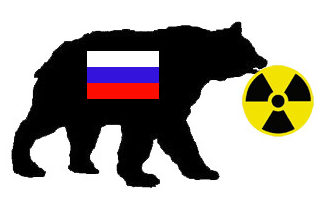
 South Africa Opens Door to Future Russian Nuclear Power Deal, US News, July 26, 2018 , BY ALEXANDER WINNING, JOHANNESBURG (Reuters) – South Africa cannot afford large-scale expansion of its nuclear power capacity but would still be open to future deals with Russia, a senior ruling party official said on Thursday, shortly before the arrival of President Vladimir Putin for a summit.
Russian state firm Rosatom was one of the front runners for a project to increase South Africa’s nuclear power-generating capacity championed by former president Jacob Zuma.
South African President Cyril Ramaphosa has put nuclear expansion on the back burner since taking office in February, saying it is too expensive, and has focused instead on pledges to revive the economy and crack down on corruption.
African National Congress Treasurer General Paul Mashatile, one of the six most powerful members of the ruling party, said Pretoria would not rush into major nuclear investments but that it was still open to deals. ………
Russia wants to turn nuclear energy into a major export industry. It has signed agreements with African countries with no nuclear tradition, including Rwanda and Zambia, and is set to build a large nuclear plant in Egypt.
Rosatom signed a separate agreement with South Africa’s state nuclear firm on Thursday to explore joint production of nuclear medicines and other ways of harnessing nuclear technology, a statement from the two firms showed.
The agreement, which is non-binding and is not related to large-scale power generation, is a further sign that Rosatom is keen to cement its position on the African continent.
The deal will involve the construction of two small reactors and a commercial cyclotron to produce medical isotopes and radiopharmaceuticals at a facility near Pretoria. https://www.usnews.com/news/world/articles/2018-07-26/south-africa-cannot-afford-major-nuclear-expansion-top-anc-official
St. Lucie nuclear power plant is protected against flooding—unless a flood happens
Leaked video of post-Fukushima flooding risk at American nuclear power plant
Flooding at a Florida Nuclear Plant, UCS, DAVE LOCHBAUM, DIRECTOR, NUCLEAR SAFETY PROJECT | JULY 26, 2018, Role of Regulation in Nuclear Plant Safety #5
St. Lucie Unit 1 began operating in 1976. From the beginning, it was required by federal regulations to be protected against flooding from external hazards. After flooding in 2011 led to the meltdown of three reactors at Fukushima Dai-ichi in Japan, the NRC ordered owners to walk down their plants in 2012 to verify conformance with flood protection requirements and remedy all shortcomings. The owner of St. Lucie Unit 1 told the NRC that only one minor deficiency had been identified and it was fixed.
But heavy rainfall in January 2014 flooded the Unit 1 reactor auxiliary building with 50,000 gallons through flood barriers that had been missing since at least 1982. Unit 1 became as wet as the owner’s damp assurances and the NRC’s soggy oversight efforts.
Parade of Flood Protection Promises
Operators achieved the first criticality, or sustained nuclear chain reaction, of the Unit 1 reactor core at the St. Lucie nuclear plant located about miles southeast of Ft. Pierce, Florida at 8:30 am on April 22, 1976. Federal regulations adopted more than five years earlier required the plant to be protected against natural phenomena. The Atomic Energy Commission (AEC), forerunner to today’s Nuclear Regulatory Commission (NRC), issued guidance in August 1973 that explicitly informed nuclear plant owners and applicants that the natural phenomena to be protected against included heavy local precipitation.
En route to the AEC issuing an operating license for Unit 1 on March 1, 1976, the owner submitted a Preliminary Safety Analysis Report and later a Final Safety Analysis Report, now called the Updated Final Safety Analysis Report (UFSAR), describing the design features and operational procedures that demonstrated conformance with all applicable regulatory requirements such as flood protection. The design bases external flood was a Probable Maximum Hurricane (PMH) while the design bases internal flood was the postulated rupture of a 14-inch diameter low pressure safety injection system pipe. The analyses summarized in the UFSAR reported the flooding rates, flooding depths needed to submerge and disable safety components, alarms alerting workers to the flooding situation, and response actions and associated times for workers to intervene and successfully mitigate a flooding event.
…………The owner reported to the NRC on December 27, 2012, the results of its evaluation of the missing and degraded conduit seals. The NRC was told that the electrical manholes have 4-inch and 1.5-inch diameter drain lines to the storm water system. In the event of site flooding due to a storm, water could flow through these drain lines into the electrical manholes. When the water filled the manholes to a certain depth, water would flow through the missing and degraded conduit seals into the reactor auxiliary building and disable components needed for safe shutdown of the reactor. The owner reported that the conduit seals had been missing since original construction in the 1970s. This potential hazard no longer existed because the missing and degraded conduit seals had been corrected.
The NRC evaluated the missing and degraded conduit seals reported by the owner via its November 27 and December 27 submittals. On April 25, 2013, the NRC issued its report for its evaluation. The NRC noted:
The licensee’s design basis does not allow for any external leakage into safety-related buildings during a PMH. Unit 1 UFSAR section 3.4.4, states in part, that “All external building penetrations are waterproofed and/or flood protected to preclude the failure of safety related system or component due to external flooding.”
Even though the flood protection deficiency existed for over three decades before being found and fixed, the NRC elected to impose no sanction for violating federal safety regulations.
The NRC reported on July 30, 2013, about additional walkdowns its inspectors made of the Unit 1 and 2 reactor auxiliary buildings. The NRC inspectors also reviewed documents in the owner’s corrective action and work order databases for weather-related problems that could result in site flooding. No problems were found.
Raining on the Promise Parade
On January 9, 2014, it rained on St. Lucie. A culvert in the storm water drain system obstructed by debris caused rain water to pool around the reactor auxiliary building instead of being carried away. Rain water leaked into the reactor auxiliary building via two electrical conduits that lacked the proper flood barriers. A video obtained by UCS via the Freedom of Information Act (FOIA) shows water pouring from an electrical junction box mounted on the inside wall of the Unit 1 reactor auxiliary building. (We don’t have a video of this location before the flood, but we know that it wasn’t nearly as wet and noisy.)
An estimated 50,000 gallons of water flooded Unit 1. Workers periodically manipulated valves to allow flood water to drain into the emergency core cooling system (ECCS) pump room sumps where it was transferred to an outdoor collection tank. Their efforts successfully prevented any safety components from being disabled and Unit 1 continuing operating through the rainfall.
When the dust dried, workers found four other electrical conduits that lacked proper flood barriers. The six conduits passed through the reactor auxiliary building wall below the design bases flood elevation. Consequently, they should have been equipped with flood barriers, but the required barriers had not been provided. These six conduits were not part of the plant’s original design, but had been installed via modifications implemented in 1978 and 1982.
The NRC issued a White finding, the second least serious among its Green, White, Yellow and Red classification scheme, on November 19, 2014, for two violations of regulatory requirements:
……..the owner violated federal regulations in 1978 and 1982 by not providing flood barriers with the installed conduit and re-violated federal regulations in 2012 by not finding the flood barriers missing when commanded by NRC to do so after Fukushima.
UCS Perspective
In the letter transmitting the White finding to the plant’s owner, NRC noted that the severity of the two violations of federal regulations would normally have also resulted in a $70,000 fine, but explained:
Because your facility has not been the subject of escalated enforcement actions within the last two years, the NRC considered whether credit was warranted for Corrective Action in accordance with the civil penalty assessment process in Section 2.3.4 of the Enforcement Policy. … Therefore, to encourage prompt identification and comprehensive correction of violations, and in recognition of the absence of previous escalated enforcement action, I have been authorized, after consultation with the Director, Office of Enforcement, not to propose a civil penalty in this case.
What?
“Because your facility has not been the subject of escalated enforcement actions within the last two years” is largely because the owner violated federal regulations by not finding, fixing, and reporting the missing flood barriers on the six electrical conduits that factored in the January 9, 2014, flooding event. So, the reason the owner has a clean slate over the past two years is because the owner violated federal regulations two years ago that would otherwise have uncleaned that slate. Who says crime doesn’t pay?
……… Is the White finding without the usual (and entirely appropriate) $70,000 fine a slap on the wrist of this owner?I don’t know. But I do know that it is a slap in the face of the many plant owners who took the NRC’s order seriously by doing a thorough job of walking down their plants for flooding and earthquake vulnerabilities and remedying all deficiencies (not just a token one or two).
By “encouraging” owners who perform badly, the NRC is discouraging owners who perform well. ……..
For over 30 years, St. Lucie operated without flood barriers it was required by federal regulations to have. ………
St. Lucie is adequately protected against flooding—unless a flood happens. That flood might reveal still more deficiencies for the NRC to “encourage” the owner to promptly find and comprehensively fix (assuming the reactor still hasn’t melted down.)
The only reason this event goes into the “under-regulation” bin is that there are no lower bins for it. https://allthingsnuclear.org/dlochbaum/flooding-at-a-florida-nuclear-plant
Citizens group: Radiation from Grumman plume needs to be addressed
A citizens group called Long Island Pure Water held its first public meeting to share with residents what it’s learned about the area under the former Grumman site in Bethpage.
James Rigano, an attorney representing the 70-member group, says radiation from the toxic plume is in the groundwater and must be addressed.
The group has filed a lawsuit against the Navy and the state Department of Environmental Conservation in an effort to have the radiation investigated.
“The Navy and the DEC have refused to investigate it. They have no plans, they have no intentions to investigate it and they would just let it go and be silent about it,” said Rigano.
The Navy has said that the radium found in the plume occurred naturally and that they are continuing to monitor it. Environmentalists have argued that the levels of radium found are far from natural.
Geologist Nick Valkenberg says that the Navy based it’s conclusion on 1,270 samples – but he says none of them were collected on Long Island.
Among those in attendance was Pat Stuart of Bethpage, who says six of eight of her family members have cancer. She says she doesn’t know whether the former Grumman site is to blame.
“I think the amount of time that they’ve known about this, they could be doing better,” Stuart says. “They’re dragging their heels, and there’s a lot of people’s lives at risk here.”
Scandal of radioactive particles on Britain’s beaches
Radiation Free Lakeland 24th July 2018 , An urgent request has been sent to Sellafield to monitor and retrieve
radioactive particles from St bees beach ahead of Cumbria Wildlife
Trust”s ‘Beached Art’ day. Sellafield have treated this
straightforward request under Freedom of Information rules which means that
there will not be a reply for at least a month and then we may have to pay
for the request to be answered.
The request has been sparked by a citizen
science project carried out by Radiation Free Lakeland volunteers in
collaboration with nuclear science undergraduates at Worcester Polytechnic
Institute in the US. The accuracy of the independent report has been
confirmed by the Environment Agency (letter from EA below on original ) . Marianne
Birkby of RaFL says “the EA recognise the accuracy of our citizen science
project and the accuracy of the students work, but they fail to acknowledge
that our samples were taken without the use of expensive detecting (or any)
equipment,
Also plutonium was not tested for, so this report while accurate
does not reveal the full picture. This means that the volume and
viciousness of radioactive particles being washed onto our beaches is far
greater than is being admitted to. It also means the likelihood of
inhalation and ingestion of particles by beach users is far greater than
“low.” Cumbria Wildlife Trust and other beach users have faith in the
authorities when they say the beaches are safe. This faith is misplaced.
The nuclear waste scandal has been going on for decades polluting our
beautiful beaches with insidious radioactive particles and it will continue
unabated unless people square up to the nuclear industry and say enough is
enough”
https://mariannewildart.wordpress.com/2018/07/24/radioactive-sand-sculptures-by-cumbria-wildlife-trust/
NHK’s new documentary, Meltdown: Cooling Water Crisis
 Fukuleaks 27th May 2018 , NHK’s new documentary, Meltdown: Cooling Water Crisis provides new
insight into a series of less known events in the Fukushima disaster.
Between March 18 – 21 of the 2011 disaster, white and black smoke was
seen leaving the unit 3 reactor well in significant quantities. At the time
TEPCO claimed they didn’t know a reason. At the time a few radiation
readings outside the plant caused concern that the two things were related.
All of this was mostly ignored by TEPCO and the press. New investigative
research supported by NHK TV found a series of significant events that shed
light on what happened during these later days of the disaster
http://www.fukuleaks.org/web/?p=16683
Britain’s nuclear regulator concerned for Hinkley project, as Flamanville nuclear project’s delays and safety problems continue
Times 26th July 2018 , Doubts about the Hinkley Point nuclear plant being built on time
intensified yesterday when its developer announced fresh delays to a prototype in France caused by defective welding. EDF, the French state-controlled energy company, is building Britain’s first new nuclear plant in a generation in Somerset and aims to start generating electricity from the £20 billion project in 2025.
The company is building the same
reactor type at Flamanville, Normandy, but has repeatedly had to put back
the start-up date, originally 2012, because of construction problems. EDF
said yesterday that first power generation at Flamanville would now slip by
a year to early 2020 because it needed to repair “quality deficiencies”
in the welding in part of the plant that carries steam to the turbines. The
cost of the plant has increased by a further €400 million to €10.9
billion, more than three times its original budget.
City analysts at RBC
Capital Markets said the announcement would “add to concerns about
whether EDF’s other projects . . . can be delivered on time and
budget”. Hinkley Point is due to generate 3.2 gigawatts of power, seven
per cent of Britain’s power needs, and is meant to help keep the lights
on when coal and older nuclear plants close. EDF insists it has learnt the
lessons from the EPRs being built elsewhere, ensuring that the British
project will proceed more smoothly.
However, Britain’s nuclear safety
regulator has raised concerns about substandard quality control checks on
EDF’s supply chain. A source insisted that Hinkley should not suffer the
same problems as Flamanville because the project uses a different
contractor and testing method, both of which had already been deployed
successfully in Finland. Kate Blagojevic, head of energy at Greenpeace UK,
said: “EDF’s nuclear design just doesn’t work very well. The nuclear
power plant in Finland is a decade late and because of yet more technical
problems, the Flamanville plant has gone from late to later. This bodes ill
for Hinkley Point C.” A spokesman for EDF said: “The construction of
Hinkley Point C remains on track. The project has already benefited, and
will continue to learn from the experience of other projects.
https://www.thetimes.co.uk/edition/news/reactor-fault-raises-spectre-of-delays-at-20bn-hinkley-point-xflrcbg2j
France’s Flamanville nuclear reactor: swelling costs, and more delays
New Economy 25th July 2018 The cost of EDF’s new Flamanville nuclear reactor has swelled to more
than three times the French state-owned utility’s original budget after
further issues were revealed in the construction process. EDF said target
construction costs had risen by €400m ($468m) to €10.9bn ($12.7bn).
Already seven years behind schedule, the project will now be delayed by
another year, with the loading of nuclear fuel not expected until the
fourth quarter of 2019. In April, EDF revealed that problems with the
weldings at its flagship nuclear site could impact the project’s costs
and timetable following an assessment by the French Nuclear Safety
Authority.
On July 25, EDF said 33 of 148 inspected welds were found to
have “quality deficiencies” and would be repaired: “EDF teams and
their industrial partners are fully mobilised and are continuing all other
assembly and testing activities at the Flamanville [European Pressurised
Reactor (EPR)], including the system performance tests.” France’s
Flamanville project is one of three EPRs currently being built across
Europe.
The third-generation technology has taken decades to develop and
aims to improve safety, as well as reduce costs. EDF is also building the
Olkiluoto 3 project in Finland and Hinkley Point C in the UK, both of which
are also behind schedule.
https://www.theneweconomy.com/energy/edf-reveals-further-cost-overruns-and-delays-to-its-flamanville-nuclear-reactor
1 This Month

Petition to revoke the licensing of the Near Surface Nuclear Disposal Facility (NSDF) at Chalk River. https://www.ourcommons.ca/petitions/en/Petition/Details?Petition=e-7247


of the week – STOP SMALL MODULAR REACTORS IN CANADA
To see nuclear-related stories in greater depth and intensity – go to https://nuclearinformation.wordpress.com
-
Archives
- March 2026 (152)
- February 2026 (268)
- January 2026 (308)
- December 2025 (358)
- November 2025 (359)
- October 2025 (376)
- September 2025 (258)
- August 2025 (319)
- July 2025 (230)
- June 2025 (348)
- May 2025 (261)
- April 2025 (305)
-
Categories
- 1
- 1 NUCLEAR ISSUES
- business and costs
- climate change
- culture and arts
- ENERGY
- environment
- health
- history
- indigenous issues
- Legal
- marketing of nuclear
- media
- opposition to nuclear
- PERSONAL STORIES
- politics
- politics international
- Religion and ethics
- safety
- secrets,lies and civil liberties
- spinbuster
- technology
- Uranium
- wastes
- weapons and war
- Women
- 2 WORLD
- ACTION
- AFRICA
- Atrocities
- AUSTRALIA
- Christina's notes
- Christina's themes
- culture and arts
- Events
- Fuk 2022
- Fuk 2023
- Fukushima 2017
- Fukushima 2018
- fukushima 2019
- Fukushima 2020
- Fukushima 2021
- general
- global warming
- Humour (God we need it)
- Nuclear
- RARE EARTHS
- Reference
- resources – print
- Resources -audiovicual
- Weekly Newsletter
- World
- World Nuclear
- YouTube
-
RSS
Entries RSS
Comments RSS
 nuclear-news