Cracking Letter in the Westmorland Gazette …still no word from Mainstream Environmental Journos! —

Originally posted on Keep Cumbrian Coal in the Hole: Another Cracking Letter from Anita in the Westmorland Gazette. In a long running exchange this is a reply to Kent Brook’s letter about the “need” for coking coal to provide steel for WMD etc. Whether or not you want nuclear WMD …there are other ways to…
via Cracking Letter in the Westmorland Gazette …still no word from Mainstream Environmental Journos! —
Solar start-ups are plugging Africa’s energy gap — Beyond Nuclear International

600 million in Africa still live without electricity
via Solar start-ups are plugging Africa’s energy gap — Beyond Nuclear International
The (nearly) 90-year old man who climbed out the window and got a nuclear weapons ban — Beyond Nuclear International

ICAN founder sprints to the finish line
Fallout from Fukushima exaggerated? But Still….
What was the fallout from Fukushima? Guardian, Fred Pearce 3 June 18 When a tsunami hit the nuclear plant, thousands fled. Many never returned – but has the radiation risk been exaggerated?
“……..Seven years on, many people in Japan say they will never listen to nuclear experts again, including radiation doctors. Some of those experts call this “radiophobia”, but that is to blame the victims when the real problems lie elsewhere. So what harm was done?
In most nuclear accidents, the biggest concern is the risk of getting thyroid cancer from the release of radioactive iodine-131. Iodine-131 is nasty. It has a half-life of only eight days, so it doesn’t stick around. But if breathed in or ingested, for instance, in milk from cows grazing on contaminated pastures, it concentrates in thyroid glands and can cause thyroid cancer that emerges within a few years. Children are especially at risk. The only prophylactic is to give exposed people tablets of non-radioactive iodine to flood their thyroid glands and prevent uptake of the radioactive version.
There was an epidemic of thyroid cancer after Chernobyl. Radioactive iodine was also released during the Fukushima accident, though only about a tenth as much as at Chernobyl. Doctors I spoke to all agreed that the actual uptake by people near the plant was tiny. This is because most of the fallout initially headed out to sea, because the authorities quickly removed potentially contaminated foodstuffs from sale and because iodine tablets were issued………..
A quarter of young girls surveyed feel they might not be able to have a baby because of the accident. Many parents fear their children will get thyroid cancer. Masaharu Maeda, the head of disaster psychiatry at the FMU, calls it “the Godzilla effect”, after the film about a mutant monster created by atomic tests.
Some call this “radiophobia”, suggesting that this absolves the nuclear industry of responsibility. But these are real psychological and social consequences of the accident – and are surely just as much the responsibility of the operators of the plant as any radiological consequences. And they mean that the prospects for repopulating the region, including four ghost towns where 150,000 people once lived, remain small.
The stricken reactors still contain terrifying amounts of radiation. Cleaning up the mess will take decades and tens of billions of dollars. But outside, away from a few hotspot zones in the mountains, most of the radioactive isotopes that fell in the evacuated zone have now decayed away and huge amounts of contaminated soil and vegetation have been bagged up and removed. ……https://www.theguardian.com/environment/2018/jun/03/was-fallout-from-fukushima-exaggerated
Nuclear news at the beginning of June
 With the world still teetering about North Korea etc, and the famous Kim-Trump summit still supposed to be happening, the nuclear weapons industry continues to thrive.
The impacts of climate change will not affect all regions equally – they will be worse in places with already fragile social and ecological systems. The nuclear waste time bomb will keep ticking – America’s 60 years of radioactive trash. And, as if the facts were not enough to worry about, Margaret Attwood (of ‘The Handmaid’s Tale”), suggests a future dystopian world, as the result of climate change.
Nuclear power plant construction even more costly than we thought – new analysis shows.
Energy politics – why renewables are winning over nuclear power. International Renewable Energy Agency reports on companies across 75 nations sourcing renewable energy.
Further research on how ionising radiation causes cancer.
NORTH KOREA. North Korea likely to follow Pakistan’s nuclear path, not Libya’s. Kim Jong-un knows what he wants from the summit. Does President Trump? Yes, there are concerns, but North Korea’s dismantling of the nuclear weapons site is a positive step.
USA.
- Donald Trump – the worst USA presidential negotiator in modern history? Donald Trump managing to isolate USA’s allies, by his failures in negotiation. Trump administration could so easily blow the chance of a diplomatic solution for the Korean Peninsula. U.S. Senator Ed Markey points out the absurdity of John Bolton’s suggesting the “Libya model” for negotiating with North Korea.
- USA government to use Emergency Measures to prop up coal and nuclear industries.
- President Trump’s Washington swamp – the nuclear lobby/politics revolving door.
- “Nuclear is N.I.C.E” – the latest spin from the desperate nuclear industry.
- Congress has the power to stop squandering the public purse on new nuclear weapons.
- Toshiba walks away from involvement in USA nuclear energy project.
- The Federal Energy Regulatory Commission and Department of Justice support Illinois nuclear subsidies.
- Tennessee Valley Authority was overcharged nearly $4.4 million by contractor at Watts Bar Nuclear Power Plant.
- Logan city in Idaho ponders joining in costly and risky Small Modular Nuclear Reactor (SMR) development.
- Measures to compensate Arizona “Downwinders” approved by USA Congress. Nevada fights back – resentment against becoming America’s nuclear waste dump. Don’t overturn the 1995 Batt agreement – stop toxic nuclear waste being imported into Idaho. Albuquerque city councilors oppose shipping radioactive waste through city. Rocky Flats Wildlife Refuge – the cover-up – the cleanup – but radioactive trash is still there.
INDIA. Nuclear politics between India and Pakistan need attention and understanding. India, a Key U.S. Ally, Plans to Ignore Trump’s Iran Sanctions .
FRANCE. Macron’s France signs up to join nuclear power partnership with Putin’s Russia. France scaling back nuclear reprocessing – fears of financial disaster as with Japan’s Monju project. Persisting with the European Pressurized Reactor (EPR) has brought France to a costly nuclear crisis. The trials and tribulations of France’s Flamanville EPR nuclear reactor.
UK.
- British scientists distressed at loss of funding as Britain leaves the nuclear safety agency Euratom.
- Hitachi ‘won’t pay’ for nuclear accidents at proposed Wylfa plant on Anglesey. As long as UK tax-payer coughs up, £20bn Hitachi nuclear plant looks set to be built in Wales. Britain’s “nuclear renaissance” in the balance as Hitachi ponders Wylfa nuclear project. Hitachi board of management wavers over costs of Wylfa nuclear power plan. Wylfa Newydd nuclear plant protesters go to Japan.
- Licence exists for dumping mud at North Cardiff – but they don’t need Hinkley’s suspect “mud”. UK is not correctly testing Hinkley Point dumped mud for radioactivity.
- British government used pilots like ‘GUINEA PIGS’ during Cold War nuclear experiments .
JAPAN. Fukushima mothers at UN tell their story. Japan is poised to FLOOD the Pacific with one million tons of radioactive water contaminated by the Fukushima nuclear plant Japanese Buddhist priest joins movement to divest from fossil fuels and nuclear power. Japan’s state-affiliated bank is reluctant to fund Hitachi’s Wylfa nuclear project in UK. Japanese atomic bomb survivor pays tribute to U.S. POWs killed in A-bombing.
CANADA. Tough times for uranium company Cameco – and no improvement in sight. Ontario could save $1.2B by closing Pickering plant, buying power from Quebec – Greens.
ISRAEL. Israel selling nuclear information and expertise to Saudi Arabia. Israel’s PM Netanyahu planned a military strike on Iran in 201l.
GERMANY. Germany is ready to support Iran in restoring its economy as long as Iran adheres to the Joint Comprehensive Plan of Action (JCPOA).
RUSSIA. In a drill, fake terrorists take over Russia’s Arctic radioactive waste storage site.
SAUDI ARABIA. Thousands Held Arbitrarily – increasing numbers in Detention Without Trial in Saudi Arabia.
AUSTRALIA. Federal Government National Nuclear Waste Dump Selection Process – a B-grade horror movie plot. Sydney’s Opal nuclear reactor’s High Level Wastes off to France, later to return to planned Federal Nuclear waste Dump
USA government to use Emergency Measures to prop up coal and nuclear industries
Trump orders Energy Secretary Perry to halt shutdown of coal and nuclear plants, https://www.washingtonpost.com/business/economy/trump-officials-preparing-to-use-cold-war-emergency-powers-to-protect-coal-and-nuclear-plants/2018/06/01/230f0778-65a9-11e8-a69c-b944de66d9e7_story.html?utm_term=.5abb572447d6, By Steven Mufson Email the author 1 June 18, President Trump on Friday ordered Energy Secretary Rick Perry to halt the shutdown of ailing coal and nuclear power plants that he said were needed to maintain the nation’s energy mix, grid resilience and national security.
“Unfortunately, impending retirements of fuel-secure power facilities are leading to a rapid depletion of a critical part of our nation’s energy mix, and impacting the resilience of our power grid,” the White House said in a statement.
The Trump administration has been preparing to invoke emergency powers granted under Cold War-era legislation to order regional grid operators to buy electricity from ailing coal and nuclear power plants. There have been meetings this week at the Cabinet deputies’ level and at the National Security Council.
One likely plan, laid out in a 41-page draft memorandum posted online by Bloomberg News and Utility Dive, would favor certain power plants in the name of national security. Those plants are owned by some of the president’s political allies in the coal industry.
According to the draft memo, the Energy Department would exercise its emergency authority to order grid operators to give preference to plants “that have a secure on-site fuel supply” and that “are essential to support the Nation’s defense facilities, critical energy infrastructure, and other critical infrastructure.” Only coal and nuclear plants regularly keep fuel on site.
The Energy Department would also establish a “Strategic Electric Generation Reserve.” The memo added that “federal action is necessary to stop the further premature retirements of fuel-secure generation capacity.” The emergency rules would be a “prudent stopgap measure” that would last two years while the Energy Department did further study.
“President Trump believes in total energy independence and dominance, and that keeping America’s energy grid and infrastructure strong and secure protects our national security, public safety and economy from intentional attacks and natural disasters,” the White House said.
The idea of declaring an emergency under the Defense Production Act of 1950 (used by President Harry S. Truman for the steel industry) and Section 202 of the Federal Power Act has been promoted by the chief executives of the coal-mining firm Murray Energy and the Ohio utility FirstEnergy, both of whom have contributed heavily to Trump’s political activities.
Robert Murray presented a proposal to Energy Secretary Rick Perry in March 2017, the month Perry took office. And on April 2 of this year, FirstEnergy appealed for emergency help after a subsidiary operating ailing power plants filed for bankruptcy protection.
The Federal Energy Regulatory Commission, an independent agency, unanimously rejected an earlier proposal by the Energy Department that would have favored coal and nuclear plants.
In a recent appearance at a Washington Post Live event, FERC Chairman Kevin McIntyre said that using the emergency powers was “perhaps not the most obvious fit.”
He said using that section of the Federal Power Act “tees off the concept of continuance of a war in which the United States is involved as being kind of the baseline circumstance that would justify a DOE order to certain types of facilities to either begin operating or continue operation.”
Environmental groups, natural-gas producers, and Republicans and Democrats who have pushed for greater competition in electricity markets all condemned the latest signal that the administration might be moving closer to imposing the Energy Department’s plan.
They noted that the coal and nuclear power plants that would benefit have failed to compete against natural gas, solar and wind. Many of the plants have operated far longer than anticipated when they were built.
“Uneconomic, dirty coal plants retiring does not represent a national security risk,” Michael Panfil, director of federal energy policy and senior attorney with the Environmental Defense Fund, wrote on his blog. “If Trump chooses to bail out these failing coal plants, he’ll be forcing Americans to pay for dirty energy that pollutes our environment and makes people sick.”
Katie Bays of Height Capital Markets, an investment research firm, wrote in a commentary: “If DOE proceeds as the memo suggests, a selection of coal and nuclear plants, ostensibly those at risk of retirement, would receive subsidized payments . . . under a stitched-together ‘Frankenstein’s monster’ of federal authorities. Above all, the subsidy would be a major victory for FirstEnergy as it negotiates with bondholders over the value of coal and nuclear plants owned by its bankrupt FirstEnergy Solutions subsidiary.”
FirstEnergy’s top lobbyist last year was Jeff Miller, who was campaign manager for the presidential campaign of Perry, now energy secretary. Trump attended a private dinner with Miller and a handful of political advisers in early April.
Trump about to massively bail out polluting industries owned by his special donors
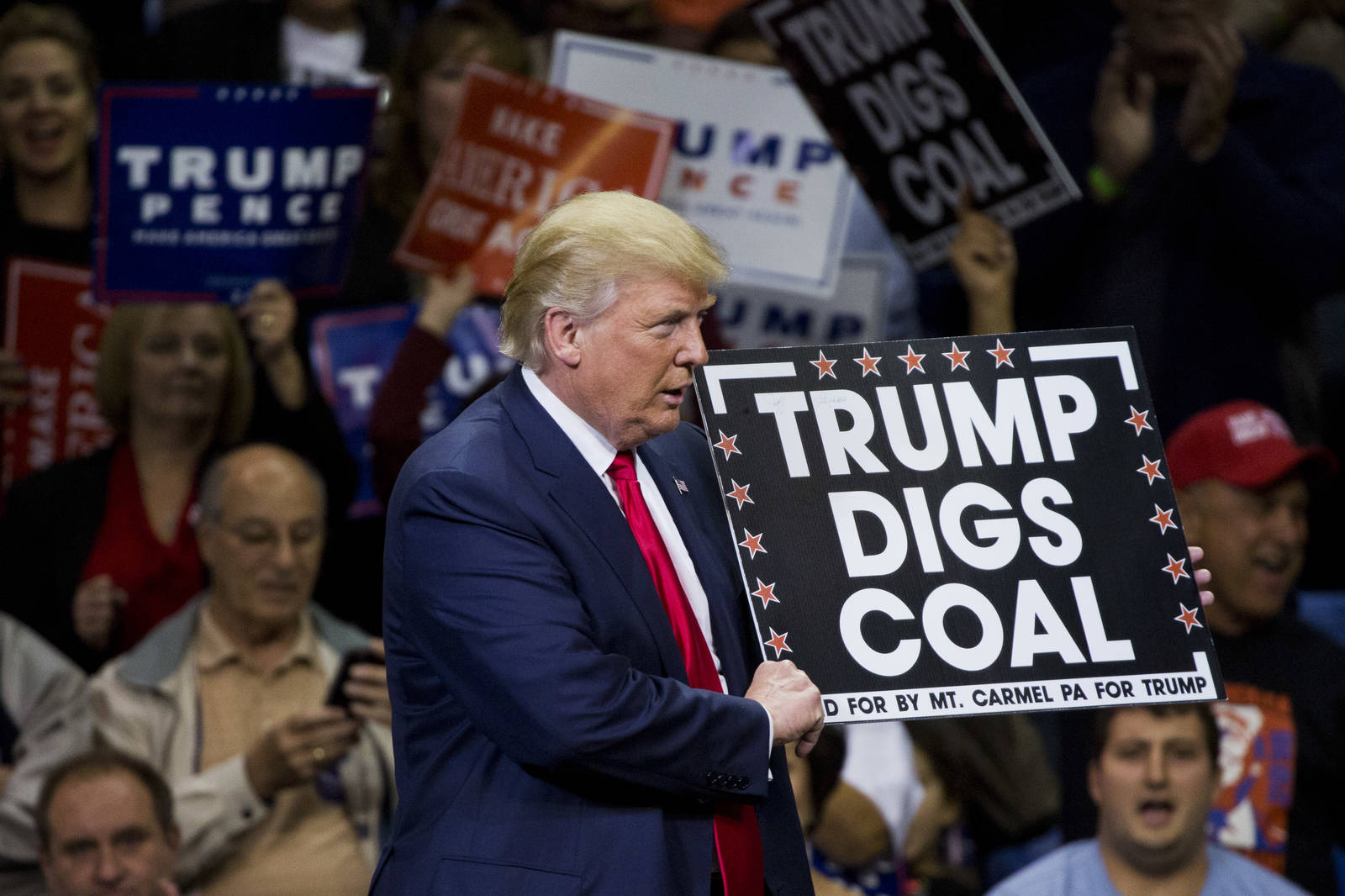 Trump wants taxpayers to bail out his polluter donors https://shareblue.com/trump-coal-energy-rick-perry-robert-murray-taxpayer-bailout/ By Oliver Willis June 1, 2018
The trials and tribulations of France’s Flamanville EPR nuclear reactor

Montel 31st May 2018 French utility EDF will reveal “in the next few days” whether
sub-standard welding identified at France’s first European pressurised
reactor (EPR) in Flamanville will lead to further start-up delays, a
spokeswoman said on Thursday. However, she refused to comment on Montel’s
interview with a senior official of the ASN watchdog’s technical arm –
the IRSN – who said the commissioning of the unit faced further delays
“of at leastseveral months”.
https://www.montel.no/en/story/edf-to-reveal-possible-epr-start-up-delay-in-days/905717
Jeremy Leggett 31st May 2018 French nuclear regulator fears “epidemic” safety-culture collapse at
Flamanville: disaster looms for EDF. Almost 150 more weld failures (beyond
those discovered earlier, as reviewed in the article) mean the nuclear
plant scheduled online in 2012 at a cost of €3.5bn is now delayed to
2020, probably, at a cost of €10.5bn, and counting.
Thierry Charles, deputy director general, Institute for Radiation Protection and Nuclear
Safety (IRSN), the technical arm of the Nuclear Safety Authority (ASN):
“The expected high level of quality was not specified (Editor’s note:
by EDF), the conformity of supplies to the specification could not be
attested”, plus “the qualification of the welding procedures […] ]
does not respect all the rules of art. Charles cites concerns over “other
categories of mechanical equipment” than the pipes of the secondary
circuit. He flags “human and organizational failures” and “lack of
rigor of suppliers”.
He ascribes all this to the “inadequacies of the
monitoring system put in place by EDF” to check the conformity of the
work of its subcontractors and he fears “dysfunction potentially damaging
to safety”. He has invited the ASN to summon EDF to thoroughly review its
organization “to improve the quality of realization of welds and make its
monitoring system more effective”. In a final, potentially lethal, blow
to EDF he argues that “additional controls will be requested on other
circuits of the reactor to verify that there is no epidemic.”
https://jeremyleggett.net/2018/05/31/french-nuclear-regulator-fears-safety-culture-collapse-at-flamanville-disaster-looms-for-edf/
Liberation 31st May 2018 [Machine Translation] The Flamanville EPR is likely to see its start
postponed to 2020. The weld quality problem detected on the EPR reactor
could differ by almost a year from its commissioning. The nuclear policeman
should demand that the work be redone.
A blow for EDF. A month and a half
after the discovery of new quality defects on 150 welds of the main
secondary circuit of the EPR reactor of the Flamanville power station, in
the Channel , EDF is preparing to post a further delay of several months in
the commissioning of what was to be the new flagship of the atom made in
France.
The EPR was due to start no later than early 2019. But according to
a source very familiar with the file questioned by Libération, the start
of the EPR Flamanville could outright “suffer a year late and be postponed
to the end of 2019 or early 2020” ! Severely taxed by the gendarme of the
atom, EDF would indeed be forced to resume one by one “Almost all 150
welds” whose quality is not up to what was expected by the nuclear
policeman for this type of equipment under nuclear pressure.
http://www.liberation.fr/france/2018/05/31/l-epr-de-flamanville-risque-de-voir-son-demarrage-reporte-a-2020_1655448
Divisive discussions on the future of Florida’s Turkey Point nuclear plant
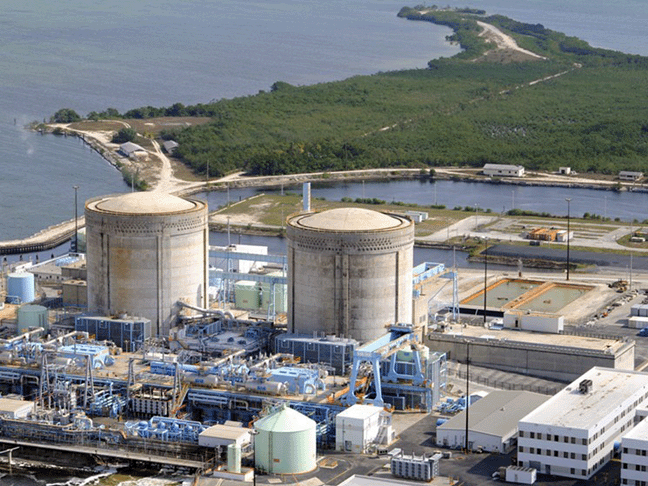 FPL, speakers clash on plan to run Turkey Point nuclear plant to 2053, Palm Beach Post By Charles Elmore – Palm Beach Post Staff Writer 1 June 18
The unequal impacts of climate change on regions and peoples
 Climate change won’t heat the planet equally, Bulletin of the Atomic Scientists, By Thomas Gaulkin, 1 June 18
“…..In places closer to the equator that usually see only slight variations in temperature, the consequences of global warming are likely to be far more extreme. The outsize vulnerability of the world’s poorest people to damaging effects of climate change like droughts and floods is well established. It’s harder for people to overcome disasters in regions without the resources and infrastructure that are plentiful in wealthier parts of the world.
Now, a new study published in Geophysical Research Letters adds insult to injury. By mapping economic and social development to climate models’ “signal-to-noise ratio”—which compares normal local temperature fluctuation (noise) to overall increases to average local temperatures (signal)—the authors determined that the poorest populations on the planet will experience more perceptible climate change than the richest. In other words, in places with already fragile social and ecological systems, climate change won’t just be harder to deal with, it will actually be more noticeable, and worse.
Not to be outdone, climate researchers at Oxford University offered their own insults this week. Analyzing vehicle use in Scotland, they concluded that top-down efforts to transition society to electric vehicles and phase out vehicle emissions aren’t enough. Without radical changes to lifestyles and increased demand for less harmful transportation systems, the authors say, there’s no chance of hitting the targets set in the Paris climate agreement. …https://thebulletin.org/climate-change-wont-heat-planet-equally11865
The secret transportation of nuclear weapons, materials and wastes across America
Major challenges remain for nuclear transportation in America
Perhaps the most pressing issue is nuclear waste and in particular, excess plutonium, most of which remains at Amarillo’s Pantex plant and will need to be moved to secure disposal facilities in the years to come.
public fears endure about whether moving such materials can ever truly be “safe.”
The Secret ‘White Trains’ That Carried Nuclear Weapons Around the U.S. History, BRIANNA NOFIL 31 May 18 At first glance, the job posting looks like a standard help-wanted ad for a cross-country trucker. Up to three weeks a month on the road in an 18-wheel tractor-trailer, traveling through the contiguous 48 states. Risks include inclement weather, around-the-clock travel, and potentially adverse environmental conditions. But then the fine print: Candidates should have “experience in performing high-risk armed tactical security work…and maneuvering against a hostile adversary.”
Artificial intelligence could increase nuclear war threat
How artificial intelligence could increase nuclear war threat, according to RAND by Joe Douglass, KATU News 1 June 18 “…..KATU talked with Andrew Lohn, an engineer for the RAND corporation recently bout a new study he co-authored.
“This study is: How might artificial intelligence affect the risk of nuclear war?” said Lohn. “We’re trying to look at it not from the way that pop fiction has looked at it over the decades where artificial intelligence gets control of the nuclear weapons and can launch them at will. But more about how, how could technologies that are a little bit more feasible in the near-ish term affect the way that humans perceive the risks or balances and cause them to make dangerous or improper decisions.”
For input, Lohn said RAND talked with top experts in the nuclear weapons and AI industries on the condition of anonymity.
…….Lohn said over the next couple of decades experts could see a path where AI might also be competitive in war gaming scenarios.
“And in that case generals or presidents would have to think, ‘Well, what do our main advisers say, what does the secretary of defense say?'” he said. “And then ask, ‘What does the computer say?’ And they might be influenced to making decisions that the computer suggests even without the computer being directly connected to any of the launchers.”
The other risk factor: Information overload from technology that may be able to take in and analyze a huge amount of data about an enemy’s arsenal.
“It can potentially be destabilizing if you know where all of your enemy’s launchers are,” Lohn said. “Or even if you don’t know where they are but they think that you know where all of their launchers are they might be pressured into a scenario where they think they’re in a use-it-or-lose-it situation.”
Or, Lohn said, if they think there’s an imminent attack, they could be pressured to “fire now” instead of waiting for confirmation…….http://katu.com/news/nation-world/how-artificial-intelligence-could-increase-nuclear-war-threat-according-to-rand
Minnesota process protect ratepayers from being ripped off by the nuclear industry
Now That Xcel Won’t Get Its Nuclear Bill, What’s Next? Bulletin of the Atomic Scientists JESSICA COLLINGSWORTH, POLICY ANALYST, CLEAN ENERGY | JUNE 1, 2018 Earlier this month the Xcel Nuclear Plant Costs Bill (SF3504/HF3708) passed the Senate but failed to pass through the Minnesota House. The bill created a system of approving nuclear plant repair costs for Xcel Energy that would have circumvented the normal process of the Minnesota Public Utilities Commission (MN PUC) and left ratepayers to shoulder potentially excessive costs of keeping Xcel’s nuclear plants running.
Trying to keep Xcel’s nuclear fleet in the blackXcel’s nuclear fleet is struggling to stay profitable in the face of cheaper alternatives (like renewable energy and natural gas) and looming upkeep costs. Xcel estimates it will need at least $1.4 billion dollars in repairs over the next 17 years for its Monticello and Prairie Island nuclear plants. To provide certainty that Xcel would be able to recover those costs from ratepayers, they introduced legislation that would have allowed the company to get upfront approval from the PUC for its future nuclear expenses instead of approval after those investments have been made (how it works currently). The legislation would have provided certainty for Xcel that they would be able to recover these maintenance costs from ratepayers.
This is a bad deal for ratepayers because the legislation dilutes the PUC’s authority, and attempts to bypass the PUC’s current process for reviewing costs to determine if they’re prudent. That’s why UCS opposed the bill: it was an attempt to avoid the existing regulatory review process and shift financial risk from Xcel’s shareholders to ratepayers. This is not the first legislative attempt to dilute the power of the MN PUC.
Maintaining the current process for approving costs is important
Xcel is due to file their next Integrated Resource Plan (IRP), also known as their 15-year business plan, in February 2019. The IRP process allows for a comparison of electricity options to make sure consumers are getting the most bang for their ratepayer bucks. The IRP process is where Xcel will detail how they plan to generate and supply power to their customers over the next 15 years, including any expected expenses to keep its nuclear plants up and running.
A successful IRP includes evaluation of existing resources, a robust economic analysis of different supply-side and demand-side options under a range of scenarios and assumptions, including future environmental costs and fuel prices, opportunities for stakeholder engagement, adequate reporting requirements, and a robust set of criteria of which to base approval or denial of utility plans to spend ratepayer dollars.
It’s important to keep the current process because it protects ratepayers from excessive charges. By separating out the nuclear plant upkeep costs, we’re not comparing them to other options that would maintain a reliable and affordable energy supply for less cost to ratepayers. The legislation would have pre-approved these costs, meaning any cost overruns due to mismanagement by Xcel would have been automatically passed on to ratepayers. To protect Minnesota consumers, it’s important to keep the robust IRP process and maintain the PUC’s authority to scrutinize Xcel’s expenditures……..https://blog.ucsusa.org/jessica-collingsworth/xcel-nuclear-bill-whats-next
UK Environment Agency (EA) will let Atomic Weapons Establishment’s (AWE) release more radioactive isotopes into the air
 NIS 31st May 2018 The Environment Agency (EA) have announced that they are planning to
approve the Atomic Weapons Establishment’s (AWE) application to to
increase the quantity of volatile beta emitters that AWE Aldermaston is
permitted to release into the environment.
Beta emitters are radioactive elements that produce beta radiation. Volatile is a chemistry term which
refers to a substance that tends to vaporise and become a gas. AWE’s
application for the increase to the limit was announced in late January,
and there was a consultation on the application which ended in February.
The Environment Agency have now released a draft decision which approves
the proposed increase to the limit. Under their current license AWE are
allowed to release 4.4 megabecquerels (MBq) of volatile beta emitters into
the air as gas every year. The draft decision allows them to increase the
limit to 100 MBq a year, an increase of 22 times, or 2200%. A becquerel is
a measure of the quantity of radioactive material. One bequerel is the
quantity of material where radioactive decay will occur once every second.
A megabecquerel means one million becquerels of material. The EA is running
a consultation on the draft decision, which closes on the 6th June.
https://www.nuclearinfo.org/article/awe-aldermaston/environment-agency-plans-approve-2000-increase-awe-discharge-limit
UK wind power – much cheaper than planned Wylfa nuclear power plant
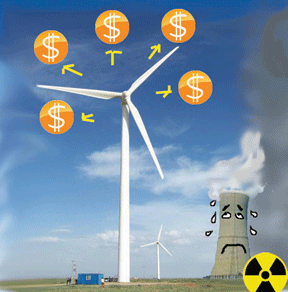
 ‘Cheap’ power at Wylfa nuclear plant blown away by wind, The Times, Emily Gosden, Energy Editor, 2 June 18 The electricity generated by the Wylfa nuclear plant could be about a fifth
cheaper than Hinkley Point’s but is likely to be much more expensive than
power from the latest offshore wind farms. It is understood that a figure
of close to £75 per megawatt-hour is under discussion as the “strike
price” that Hitachi, the Japanese conglomerate developing the Anglesey
plant, would be guaranteed by the government for the electricity it
produces. The difference between the guaranteed price and the wholesale
price — currently £50 per MWh — would be paid for by consumers through
levies on their energy bills.
Ministers are preparing to announce next week
the outline of a deal to fund the proposed Wylfa plant, which could cost in
excess of £15 billion. The twin-reactor plant could generate 2.9 gigawatts
of electricity, enough to power five million homes. It is due to start
generating in the mid 2020s. The government plans to invest directly in
Wylfa, as well as to offer extensive guarantee loans for the project. These
measures are designed to cut the cost of the project and so lower the price
that consumers will have to cover.
Critics of nuclear power are likely to
draw unfavourable comparisons with offshore wind. Two projects in UK waters
were awarded guarantees prices of £57.50 per MWh last year. Some onshore
wind and solar projects are being built without any subsidy.
https://www.thetimes.co.uk/article/cheap-power-at-nuclear-plant-blown-away-by-wind-3bzc2h5qm
1 This Month
Chernobyl: The Lost Tapes – A good documentary on Chernobyl on SBS available On Demand for the next 3 weeks– https://www.sbs.com.au/ondemand/tv-program/chernobyl-the-lost-tapes/2352741955560

of the week–London Campaign for Nuclear Disarmament

Tell the Ukrainian Government to Drop Prosecution of Peace Activist Yurii Sheliazhenko
To see nuclear-related stories in greater depth and intensity – go to https://nuclearinformation.wordpress.com
-
Archives
- April 2026 (139)
- March 2026 (251)
- February 2026 (268)
- January 2026 (308)
- December 2025 (358)
- November 2025 (359)
- October 2025 (376)
- September 2025 (257)
- August 2025 (319)
- July 2025 (230)
- June 2025 (348)
- May 2025 (261)
-
Categories
- 1
- 1 NUCLEAR ISSUES
- business and costs
- climate change
- culture and arts
- ENERGY
- environment
- health
- history
- indigenous issues
- Legal
- marketing of nuclear
- media
- opposition to nuclear
- PERSONAL STORIES
- politics
- politics international
- Religion and ethics
- safety
- secrets,lies and civil liberties
- spinbuster
- technology
- Uranium
- wastes
- weapons and war
- Women
- 2 WORLD
- ACTION
- AFRICA
- Atrocities
- AUSTRALIA
- Christina's notes
- Christina's themes
- culture and arts
- Events
- Fuk 2022
- Fuk 2023
- Fukushima 2017
- Fukushima 2018
- fukushima 2019
- Fukushima 2020
- Fukushima 2021
- general
- global warming
- Humour (God we need it)
- Nuclear
- RARE EARTHS
- Reference
- resources – print
- Resources -audiovicual
- Weekly Newsletter
- World
- World Nuclear
- YouTube
-
RSS
Entries RSS
Comments RSS
 nuclear-news