On May 31, the Tokyo Electric Power Co. (TEPCO) released a progress report on the decommissioning at the Fukushima Daiichi Nuclear Power Plants.
Four days earlier, on May 27, the power company began transferring some of the spent fuel currently stored in a common pool to a temporary facility at the site, for storage in dry casks, to create enough space in the pool to store spent fuel taken from the Unit 3 spent fuel pool when that is eventually removed.
At the temporary storage facility, TEPCO will pack the spent fuel in dry casks providing shielding and heat removal (with natural air circulation outside the casks) and store it under stable conditions.
By August, 483 spent fuel assemblies from the common pool will have been transferred to the facility using seven transport and storage casks, in anticipation of the arrival of 566 fuel assemblies (including unused 52 assemblies) from Unit 3.
On May 11, a problem was found at Unit 3—where a fuel handling machine has been in trial operation since March—inside a control panel for a crane used for moving fuel transportation containers to the ground. TEPCO nevertheless aims to begin removing fuel from the spent fuel pool around mid-FY18, as initially planned.
TEPCO will determine a method for removing fuel debris from the first unit by FY19 (April 2019 to March 2020), and the status of that effort was also included in the status report on May 31. The approach is to proceed after heightened understanding is made of internal conditions, the nature of the debris, and the effects when removed.
As that has not yet been fully completed, though, the effort will proceed gradually and incrementally, as follows: first investigating the interiors of the primary containment vessels (PCVs) through sampling, then carrying out small-scale removal of debris, followed by large-scale removal.
As for small-scale fuel removal, one promising method seems to be using a “X-6 penetration” rail to access the interiors of the PCVs (found in all the units) from the side, in order to exchange the control rod drive mechanism (CRDM). That method is already being used for inserting investigation devices into PCVs.
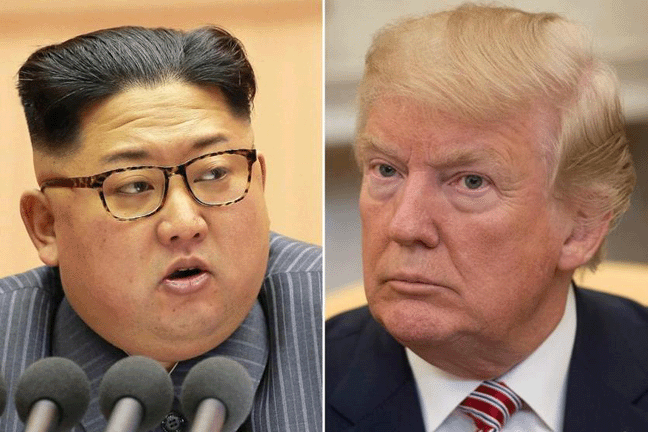
How Kim Jong Un and Trump Differ on Denuclearization. Bloomberg , By David Tweed and Kanga Kong
Donald Trump and Kim Jong Un are preparing to meet face-to-face in Singapore on June 12, a prospect that seemed unthinkable just a year ago when the leaders of the U.S. and North Korea were exchanging insults and threats. The main topic will be denuclearization, but they appear to have different ideas of what that means and how long it might take. Overcoming those differences will be key to reaching a historic outcome.
1. What is the U.S. stance on denuclearization?
The U.S. wants to see “complete, verifiable and irreversible denuclearization” of the Korean Peninsula. Known in the arms-control world as “CVID,” this would involve dismantling North Korea’s nuclear program and stripping Kim of the ability to make nuclear bombs in the future.
2. What does denuclearization mean for North Korea?
North Korea in April committed to work toward “complete denuclearization,” without elaborating on what that meant. In 2016, a government spokesman called for “the denuclearization of the whole Korean peninsula and this includes the dismantlement of nukes in South Korea and its vicinity.” More recently, North Korea has framed its willingness to get rid of nuclear weapons in more of a global context, implying that it will do so in concert with established nuclear powers like the U.S., China and Russia.
3. Does the U.S. have nuclear weapons on the peninsula?
The U.S. hasn’t stationed them in South Korea since 1992, but it does provide a so-called nuclear umbrella that guarantees the safety of allies South Korea and Japan. Kim may ask the U.S. to remove the nuclear bombers it has stationed in Guam and cease patrols by its nuclear-armed submarines. The U.S. would be unlikely to agree to any measures that would leave its allies vulnerable.
4. What about the time frame for removing nuclear weapons?
Speed is crucial for the U.S. to avoid a lengthy process that provides sanctions relief for North Korea as well as time to advance its nuclear program even further. Even so, North Korea has made it clear it will not accept the so-called Libya model proposed by U.S. National Security Adviser John Bolton under which the regime ships its nuclear arsenal out of the country in return for security guarantees and sanctions relief. ……….https://www.bloomberg.com/news/articles/2018-06-04/how-kim-jong-un-and-trump-differ-on-denuclearization-quicktake
Iran informs UN of increase in nuclear enrichment capacity, Iran’s Ayatollah had ordered the increase in capacity in a speech Monday, CBC ,The Associated Press
Iran has informed the UN nuclear watchdog that it will increase its nuclear enrichment capacity within the limits set by the 2015 agreement with world powers.
The modest steps announced Tuesday appeared to be mainly aimed at signalling that Iran could resume its drive toward industrial-scale enrichment if the nuclear accord comes unraveled.
Behrouz Kamalvandi, the spokesman for Iran’s nuclear agency, was quoted by state TV as saying a letter was submitted to the International Atomic Energy Agency detailing the move.
Kamalvandi said Iran is “providing infrastructure and arrangements for high-speed and capacity in production of UF4 and UF6 gases as well as rotor of centrifuges.”
Spinning centrifuges convert the gases into enriched uranium that can be used for reactor fuel and medical isotopes. If enriched to higher levels, the material can be used for weapons.
“The Agency received a letter from Iran on 4 June informing the Agency that there is a tentative schedule to start production of UF6,” a spokesperson for the IAEE confirmed on Tuesday, referring to uranium hexafluoride, the feedstock for centrifuges.
JCPOA set enrichment levels
The head of Iran’s nuclear agency, Ali Akbar Salehi, said Iran is prepared to resume work on advanced centrifuges that would dramatically increase its capacity for enrichment. But he said that so far the work is limited to building a new facility for assembling the centrifuges.
Supreme Leader Ayatollah Ali Khamenei had ordered the increase in capacity in a speech Monday, in which he vowed that Iran would preserve its nuclear program despite the U.S. withdrawal from the landmark 2015 accord, known as the Joint Comprehensive Plan of Action and also signed by France, Germany, the United Kingdom, the European Union, Russia and China.
Stake in nuclear plant would be dramatic change of policy for UK, Government has not revealed terms of sensitive deal with Hitachi over Wylfa, Ft.com, 5 June 18, NICK BUTLER
Last Monday, the board of Hitachi met in Tokyo to consider the future of their proposed new nuclear power plant at Wylfa in north Wales. The Japanese company decided neither to approve nor to drop the plan but to continue the negotiations with the UK government.
As Toshiaki Higashihara, Hitachi’s chief executive, said after the meeting: “No decision has been taken.”
They were right to pause because the deal on the table was weak and inadequate as protection against the risks involved in a project of such scale. Wylfa is set to cost at least £20bn — and, given the record of new nuclear construction, that figure can only rise.
As reported by the Japanese press, at that stage the deal appeared to involve simply a UK government “guarantee” to cover the construction phase of the project, which is when the risks are highest.
But, within days, authoritative reports in the FT and elsewhere indicated that Britain had gone further and decided to make a direct investment of public money into the project.
This would be a dramatic change of policy with many implications.
First, it would mark the reversal of 40 years of a privatisation of the energy sector begun by Margaret Thatcher and Nigel Lawson. Suddenly, the state is back in business and the arguments against other proposed nationalisations, for instance of the railways or energy retailers, are undermined.
Second, taking a direct stake in one energy supplier opens up issues of competition policy. Will the government take shareholdings in other new nuclear projects including Hinkley Point C ? If nuclear, why not offshore wind or gas-fired power stations?
Then there is the question of the use of resources. There appears to be almost no extra money for anything from the National Health Service to defence and security. But suddenly several billion pounds have been found for a single nuclear power station……..
A direct shareholding will almost certainly be challenged in the courts on the grounds of competition policy and European state-aid rules. Britain is likely to be subject to EU rules at least until the end of the Brexit transition period.
And it must face scrutiny in parliament, where it will be weighed against other potential uses of the money.
Examination of this deal is likely to force a strategic review of energy policy, which would include just how much nuclear power is really needed — a question that has not been answered since 2013. In those five years, much has changed and there is a good case for a fundamental and open reappraisal.
Another nuclear crisis in the making? Great power competition and the risk of war in South Asia, BAS, Moeed Yusuf 5 June 18, In May 1998, India and, later, Pakistan conducted multiple nuclear tests to become the first pair to go nuclear in the post-Cold War era. Two decades on, these South Asian rivals remain locked in a deeply antagonistic relationship that constantly threatens to boil over.
The US-North Korea showdown, the upcoming summit, and the fate of the Iranian nuclear deal have consumed the global nuclear debate over the past year. During this time, India and Pakistan have slipped into an active low-level confrontation largely unnoticed.Violence on the Line of Control (LoC) that divides the Indian and Pakistani controlled parts of the disputed territory of Kashmir has been at its highest level since the two sides agreed to a ceasefire in 2003. In 2017, the bloodiest year since, there were nearly 3,000 ceasefire violations. Persistent tit-for-tat military shelling across the LoC has caused significant casualties and damage. Civilians have been targeted and killed at an unprecedented rate, as well.
Previous wars and major crises between the two sides were triggered by miscalculated military maneuvers in Kashmir or, in more recent years, by terrorist attacks. Neither can be ruled out in the current context; either could unleash a deadly escalatory spiral.
The risks involved in such a scenario would quickly remind the world why US President Bill Clinton dubbed the LoC as “the most dangerous place” on Earth at the turn of the century. India and Pakistan lack robust bilateral escalation control mechanisms. In the past, they have depended heavily on the United States and other strong third-party states with influence in the region to mediate crisis outcomes. These third parties have responded eagerly and acted with remarkable coordination in pursuit of de-escalation.
The next crisis may demand the same—but the global powers may be found wanting. The antecedent conditions that previously drove their positive engagement have already eroded. Never since South Asia’s nuclearization has global politics been so uncertain, great power relations so fraught, and competing global priorities so distracting. This reality combined with the continued absence of alternative tested crisis management experiences in South Asia may force a break from the successful crisis management patterns of the past.
A look at the past. South Asia’s nuclearization in 1998 not only ushered in a new era of regional nuclear competition but it also forced a rethink of the established norms of nuclear crisis management. The Cold War was dominated by the two superpowers. No stronger third parties able to readily influence their crisis behavior existed. Virtually all examination of nuclear contests therefore assumed bilateral contexts. While the United States and Soviet Union regularly intervened in regional crises in support of their allies, they used these moments primarily to compete and advance their global interests vis-à-vis the other.
The advent of regional nuclear dyads fundamentally altered the incentives for the United States and other strong powers to compete through regional proxies. The worry of second-age nuclear powers like India and Pakistan stumbling into nuclear war on their own proved overbearing. Crisis moments were now marked by the urge to ensure the absence of catastrophic escalation—above all prior policy preferences, no matter how important or urgent.
India and Pakistan are no strangers to crises. Since 1998, they have experienced at least three major and several modest bouts of high tension. ……
A future different from the past? The importance of third party crisis management in South Asia has only grown over time. India and Pakistan have been unable to agree on dependable risk reduction and escalation control mechanisms with a direct bearing on crisis moments. Simulation exercises continue to point to their likely inability to terminate escalated crises. In fact, as reluctant as India and Pakistan are to admit this, they have learned from previous crisis iterations and internalized third-party roles as part of their crisis planning. Worryingly, some of their doctrines and crisis strategies assume the option of third-party bailouts.
These South Asian rivals have not ruled out conflict under the nuclear umbrella. India now boasts an operational limited war doctrine, Cold Start, that envisions swift military action against Pakistan—before international actors can pressure India to forego aggression
……….. The aura of unpredictability that presently surrounds US foreign policy has brought America’s willingness to act as that leader into question. Simultaneously, the precipitous decline in US relations with surging competitors like China and Russia and increasing difficulties in transatlantic relations has tempered global confidence in the ability of the great powers to operate collectively as agents of peace. ……..https://thebulletin.org/another-nuclear-crisis-making-great-power-competition-and-risk-war-south-asia11876
Clapper says Kim’s regime doesn’t feel like a ‘supplicant’ now
Ex-DNI chief says he backs Trump’s decision to attend summit
North Korean leader Kim Jong Un’s decision to sit down with the U.S. was fueled by his regime’s view that it made significant achievements in its nuclear weapons program and would no longer be a “supplicant” in talks, former Director of National Intelligence James Clapper said.
Clapper said it may not matter whether North Korea actually has the technology to launch an intercontinental ballistic missile with a nuclear warhead that can successfully hit a U.S. target. That’s less important to the regime than the psychological boost it received from demonstrating its prowess in testing ICBMs and more powerful nuclear bombs.
The bankrupt business has spent hundreds of thousands of dollars on lobbying so far this year., EMMA FOEHRINGER MERCHANTJUNE 05, 2018
In the month following its declaration of bankruptcy and its request for an emergency orderto support coal and nuclear plants, FirstEnergy Solutions spent hundreds of thousands of dollars on lobbying, documents show.
Lobbying filings show a bill of $230,000 for FirstEnergy Solutions with top lobbying firm Akin Gump Strauss Hauer & Feld so far in 2018. In total, FirstEnergy spent about $750,000 on activities with the firm, billed under work on “energy regulation” as well as federal and state government affairs. FirstEnergy did not work with Akin Gump in 2017.
Akin Gump’s invoice for May 30 through April 30, which it filed as part of FirstEnergy Solutions’ bankruptcy proceeding, shows that the firm billed for time spent in communication with members of Congress and in calls with the Department of Energy and the White House regarding FirstEnergy’s Section 202(c) request.
The lawmakers Akin Gump contacted hail from coal states including Pennsylvania, Ohio and West Virginia. Among those lobbying for FirstEnergy on behalf of the firm Sam Olswanger, a former staff member for Republican Representative Daniel Webster of Florida, who has roots in West Virginia.
The Energy and Policy Institute, a renewable energy advocacy organization, annotated the recent filing and argued it showed the “high-priced campaign” FirstEnergy has waged to secure emergency assistance for coal and nuclear. It’s a market intervention that many in the energy industry, particularly the clean energy space, vehemently oppose.
The White House, the Department of Energy and FirstEnergy did not respond to request for comment regarding the filing.
Between 2008 and 2017, FirstEnergy Corp. spent an annual average of about $2.05 million on lobbying. Its spending hasn’t dipped below $1.8 million since 2011.
This year, Akin Gump seems to have found an audience with the administration. On Thursday, Bloomberg reported that the administration is preparing to use Section 202 of the Federal Power Act and the Defense Production Act to “stop the further premature retirements of fuel-secure generation capacity” from coal and nuclear.
And Akin Gump isn’t the only one working on the coal and nuclear bailout. Jeff Miller, a former adviser to Rick Perry who maintains close ties to the Trump administration, has signed clients including FirstEnergy Solutions parent company FirstEnergy Corp. since moving to Washington and founding his lobbying firm Miller Strategies last year.
In a Q1 2018 filing, Miller noted that his firm was lobbying the Energy Department, the Executive Office of the President and the U.S. House of Representatives on “issues related to grid resilience” for FirstEnergy.
In addition to the $330,000 FirstEnergy paid Miller in 2017 and so far in 2018, according to filings, the firm has also received $60,000 each from the Nuclear Energy Institute and Southern Company. A $110,000 lobbying filing for Pacific Electric & Gas mentions issues such as “climate resilience” that Miller’s firm brought before the Department of Energy, Executive Office of the President, and the U.S. House of Representatives.
While it’s not unusual for a company to hire lobbyists to pursue its interests in the halls of influence, Miller’s previous ties to the Trump administration are worth noting. As the Associated Press has reported, Miller ran Perry’s presidential campaign just two years ago and helped him through his confirmation process as Energy Secretary.
He has also contributed to the campaign coffers of Greg Pence, Mike Pence’s brother, who just won a congressional primary in Indiana. The president of America First Action, a pro-Trump super PAC (political action committee), also confirmed to the AP that Miller works with the group as a volunteer.
On Friday, after Bloomberg broke the news that the administration was planning to move forward with plans to prop up coal and nuclear, President Trump asked Perry to draw up recommendations to do so.
During a Tuesday conference in Washington, D.C. hosted by the Energy Information Administration, the Department of Energy spoke for the first time since the memo release. Comments from Undersecretary of Energy Mark Menezes indicate DOE is sticking to the administration’s script.
“The president rightly views grid resilience as a national security issue,” he said, adding that closing nuclear and coal plants means “we’re losing more than grid resiliency; we’re losing energy security.”
How many billions-with-a-“b” of your tax dollars is the federal government willing to waste on bad nuclear decisions? It’s in the tens of billions already, with the meter in overdrive.
There’s the $15 billion already plowed into the Yucca Mountain storage site, about 100 miles northwest of Las Vegas, Nev., since 1987. The project has yet to take a thimble of nuclear waste, having been abandoned since 2010. There’s the $4 billion Mixed-Oxide Fuel Fabrication Facility, or MOX, at the Department of Energy’s Savannah River Site. MOX was designed to transform weapons-grade plutonium into commercial reactor fuel as part of a disarmament deal with the Russians. It’s more than a decade old, was supposed to open in 2016, is barely 70 percent complete and is over budget – cost estimates have skyrocketed from $1.4 billion to $17 billion.
And now there’s the multibillion plan to split the job of making plutonium pits between Los Alamos National Laboratory and a re-purposed MOX facility. As the National Nuclear Security Administration unveiled the pit production plan, U.S. Secretary of Energy Rick Perry executed a waiver to terminate MOX construction. MOX would now have to be revamped to churn out 50 pits by 2030, even though a nuclear pit has never been produced in South Carolina and there are questions of whether the complex work is even possible in the Palmetto State’s humidity. LANL would get an estimated $3 billion makeover to expand its production line, even though it has never made more than 11 pits a year and has made exactly zero since 2011; it has to crank out 30 under the new deal.
And that nuclear waste that was destined for MOX? It would end up headed to – wait for it – the Waste Isolation Pilot Plant near Carlsbad in a “dilute and dispose” operation. New Mexico never signed up for this level of waste. South Carolina lawmakers, who want MOX and its 2,000 jobs to remain, say “DOE says it now wants to pursue ‘dilute and dispose,’ but that plan was already considered and rejected…. this could lead to the permanent orphaning of at least 34 metric tons of weapons grade plutonium, enough for thousands of warheads.”
Yes, on one hand, it makes sense to find another mission for MOX – in 10 years, a utility has yet to come forward and say it wants to buy what MOX was ultimately supposed to be selling. And it is certainly politically expedient to throw a multibillion-dollar nuclear job-creator bone to South Carolina – after all, that’s where the head of the U.S. Senate resides.
But on the other, there are real questions about whether the U.S. really needs 80 new pits for an estimated $1.4 trillion-with-a-“t.” The magic 80 number comes from an Obama-era vast weapons modernization make-work plan, and Trump is expected to up that ante. Yet, the United States already has 12,000 spare pits and in storage those “have credible minimum lifetimes in excess of 100 years,” according to an independent advisory panel cited in The Economist. Making pits also produces a lot of waste, and as mentioned above, the nation can’t dispose of the metric tons it already has – more than 70,000 metric tons of used reactor fuel is in temporary facilities in 39 states and 55 metric tons of surplus weapons-grade plutonium is in bunkers at the Energy Department’s Pantex warhead assembly-disassembly plant outside Amarillo and in an old reactor building at the Savannah River Site.
N.M. Democratic Sens. Tom Udall and Martin Heinrich, and Reps. Michelle Lujan Grisham and Ben Ray Luján are saying “instead of wasting billions of dollars exploring the construction of a new facility that will likely never be completed somewhere else, the Department of Energy should immediately move forward with the new, modular plutonium facilities at Los Alamos – as originally endorsed by both Congress and the Nuclear Weapons Council.” And LANL director Terry Wallace says “this commitment by the government to expand our plutonium mission reiterates the critical role we play in ensuring the nation’s security.”
There’s something to be said for going with what you know, and the nation knows LANL can build pits. But there are also billions of reasons to take a hard, unbiased look at what the nation truly needs to keep its nuclear deterrence vibrant.
And what is just expensive and dangerous busy work.
Trump Plan to Prop Up Coal, Nuclear Won’t Protect the Electric Grid The Trump administration says it needs to support struggling coal and nuclear plants to safeguard the grid. Experts say it’ll do the opposite. U.S. News, By Alan Neuhauser, Staff WriterJune 4, 2018 PRESIDENT DONALD TRUMP and Republican political leaders spent close to eight years accusing the Obama administration of picking winners and losers in the energy sector, but Trump’s order to the Energy Department last week to prop up failing coal and nuclear power plants does exactly what he vilified – and proposes the opposite of what’s needed to best safeguard the nation’s vulnerable electric grid, experts say.
Citing national security and defense concerns caused by the “rapid depletion of a critical part of our nation’s energy mix,” Trump on Friday directed Energy Secretary Rick Perry “to prepare immediate steps to stop the loss of these resources.”
The administration referred to coal and nuclear plants as “fuel-secure,” because they can house their fuel supplies on site, rather than relying on pipelines like natural gas plants.
Much remains unclear about the proposal, including how it will be implemented and how many plants it will seek to prop up. However, it encountered swift opposition from a broad range of energy experts, industry executives and advocates from across the spectrum. It’s also expected to face legal challenges in federal court, particularly from natural gas and renewables companies, which compete with coal and nuclear plants for market share.
Notably, a dispersed electric grid – one that relies on a diverse array of wind and solar power, in addition to natural gas, hydropower and, perhaps one day, advanced nuclear – is widely seen as far more resilient to attack or accident than one that depends on large, centralized power resources such as coal or large-scale nuclear.
The Defense Department, for example, isexpected to spend as much as $1.4 billion by 2026 on developing decentralized electric systems known as micro-grids, and the Energy Department in 2015partnered with private firms to research and develop distributed energy systems to boost the resilience for the civilian grid.
“If you really want security, you get away from all that and you decentralize the grid,” says David Bookbinder, chief counsel at the Niskanen Center, a libertarian-leaning think tank in the nation’s capital.
In particular, he continues, “residential solar is the single most secure form of power we have in the United States: It’s secure both from a fuel supply side – no one’s blocking the sun – and a distribution side: it goes from roof into your house, so there’s no problem with the transmission. That is a secure energy supply.”
Trump last year introduced a 30 percent tariff on imported solar panels, which is expected to crimp the solar industry’s growth in the coming years.
The biggest threat to the nation’s electric grid, meanwhile, isn’t believed to be an attack or accident that would take down a power plant but instead a disruption of the distribution network: the transmission lines, transformers and substations that carry electrons from the nation’s power plants to its homes and businesses.
……….”Most of the outages occur on the distribution system, which has nothing to do with the power plants connected to the system,” says John Larsen, director in the energy and climate practice at Rhodium Group, a research firm. “That’s not to say the loss of power from a particular plant doesn’t cause a loss of power here and there. But the vast majority of power outages occur elsewhere in the system.”
The Federal Energy Regulatory Commission, which oversees electricity markets,reached a similar conclusion in January, after the Trump administration made what was then its first attempt to subsidize struggling coal and nuclear plants.
FERC Commissioner Richard Glick, a Trump appointee, wrote in an opinion concurring with the agency’s decision to reject the administration’s proposal that “if a threat to grid resilience exists, the threat lies mostly with the transmission and distribution systems, where virtually all significant disruptions occur.”
The administration’s latest attempt to prop up coal and nuclear plants is expected to face similar challenges. The White House, in a memo made public last week, cited Section 202(c) of the Federal Power Act, as well as the Defense Production Act, which authorizes the Energy Department to nationalize parts of the nation’s electric sector during wartime……….
On Monday, 4 June 2018, comments from the public on the draft Integrated Planning Framework Bill are due to the Department of Performance Monitoring and Evaluation (DPME) in the Presidency.
The call for comments makes the draft bill sound fairly benign, in that the DPME says the bill will provide for the functions of the department and establish an institutional framework for “a new predictable planning paradigm and discipline within and across all spheres of government”.
However, upon analysis, the bill could be the latest worrying development in the relentless bid to push the new-nuclear build programme forward.
On 17 May 2018, Loyiso Tyabashe, senior manager of nuclear new build at Eskom, said at African Utility Week that Eskom is continuing with front-end planning for a nuclear build programme. This despite Cyril Ramaphosa sending clear signals at the World Economic Forum in Davos in January that South Africa does not have money to pursue a major nuclear plant build.
Within this context, consider the following lines contained in the draft integrated planning framework bill, which says that the Minister in the Presidency must:
(c) annually in consultation with the Minister of Finance develop a budget prioritisation framework in order to guide the allocation of resources to organs of state in the national sphere of government;
(d) annually give input to the Minister of Finance in the preparation of the budget on—
the status of the economy and the possible macro-economic interventions;
its alignment with the National Development Plan; and
the proposed capital and development projects and programmes and related expenditure;
Nkosazana Dlamini Zuma is Minister in The Presidency responsible for Planning, Monitoring and Evaluation. This bill would give the minister the ability to develop a budget prioritisation framework that outlines which capital programmes to prioritise and to propose the related expenditure. Capital projects could include such contentious projects as the nuclear build, the Moloto Rail and the Mzimvubu dam.
In February 2018, which is after Cyril Ramaphosa signalled at the World Economic Forum that South Africa has no money for major nuclear expansion, the DPME launched a discussion paper on energy. The DPME’s website notes that enquiries related to this discussion paper could be directed to Tshediso Matona.
Tshediso Matona is the Secretary for National Planning at the DPME and is also the fired former Eskom boss to whom former President Jacob Zuma apologised about the way he was treated when he was fired.
The discussion paper reiterates that “the promulgated IRP 2010-2030 included 9.6 GW of nuclear power generation capacity, which has been confirmed as existing policy on numerous occasions. The Draft IRP 2016 that is in the public domain for consultation following a significant time-lapse since the promulgation of the IRP 2010-2030 in 2011 has a Base Case that requires nuclear power by 2037 (earliest) while a Carbon Budget scenario requires it by 2026.”
The discussion paper does acknowledge that the court case in which the Inter-Governmental Agreements (IGAs) with the United States of America, the Republic of Korea and the Russian Federation were legally challenged, determined the IGAs to be irrational, unlawful and unconstitutional. The court ruled that they should be set aside.
However, the paper then continues to say that the opportunity for small modular reactors to be included in the integrated energy planning framework should be considered. While it says that appropriate realistic costs should be considered, the paper outlines in the line immediately before that small modular reactors have typically been considered prohibitively expensive. With regards to the small modular reactors, the paper refers to revived research and previous research in preparation for the shelved Pebble Bed Modular Reactor which cost about R10-billion before it was shut down.
So, if a smaller nuclear build at an appropriate realistic cost could be possible, should taxpayers be worried? According to two recently released reports by the World Wide Fund for Nature (WWF), there is cause for concern. The WWF reports look at the players’ potential strategies for pushing the nuclear new-build programme as well as the domestic procurement and public finance implications. WWF cautions that suggestions for smaller amounts of installed nuclear capacity appear to be an attempt to gain support for smaller amounts of nuclear energy and use these as a stepping stone towards building the full 9.6 GW.
How might the Integrated Planning Framework Bill play a role in the continued push for nuclear? If the bill is legislated it would give the Minister in the Presidency responsible for Planning, Monitoring and Evaluation the ability to give input to the Minister of Finance on proposed capital and development projects and programmes and related expenditure. The financing would need to come from somewhere.
WWF notes that finance for electricity generating plants typically comes from “corporate finance, government equity, government guarantees, loans from development finance institutions, a long-term loan from an export credit agency, and extra cash generated from regulated tariffs”.
However, says the WWF, it is unlikely that corporate finance would be used; government-to-government loans or financing from state banks or development finance institutions of the vendor’s home country are more likely to be used, with sovereign wealth funds another possibility. In order to enable a loan, National Treasury may need to put up a loan guarantee. Given the alarming trend of State-owned Entities including Eskom needing bailouts, the possibility of the loan being called in would be a risk. The ratings downgrade that Eskom received would also mean that a loan, if it were granted to Eskom, would attract a higher interest rate than previously.
The draft Integrated Planning Framework bill is currently in white paper form. When it comes before Parliament, there is a strong rationale for civil society to study it closely and make submissions to ensure that it is not used as a tool to push corrupt capital projects through the system. DM
Data from the CSIRO’s Global Carbon Project indicates greenhouse gas emissions in China accelerated to 1.5 per cent growth last year. China is now responsible for about a third of the world’s carbon emissions.
“That was quite significant growth for China because we had seen almost three years of little or no increase,” the project’s director, Pep Canadell, told Fairfax Media.
Early indications are that 2018 could see an even larger rise, with China’s carbon emissions in the first quarter jumping 4 per cent alone, according to a Greenpeace analysis.
2017’s increase was partly caused by a revival of China’s reliance on heavy industrial growth to prop up the economy, and a drop in hydro electric generation amid poor rainfall, Dr Canadell said. This year’s growth, though, is also being spurred by a pick-up in the global economy.
Given China’s emissions are roughly double the next largest polluter – the US – and triple the European Union’s, its acceleration means there is a fast-diminishing chance that the rise in global average temperatures can be restricted to the range of 1.5 to 2 degrees, as agreed at the 2015 Paris climate conference.
“Most climate scientists think 2 degrees [compared with pre-industrial levels] to be aspirational,” said Andy Pitman, director of the ARC Centre of Excellence for Climate Extremes.
Even if emissions ceased globally, it is probable warming would still reach at least 1.5 degrees given the longevity of carbon-dioxide and other heat-trapping gases in the atmosphere, he said.
With increasing evidence of extreme weather events even at the roughly 1 degree of warming so far – including compounding risks of bushfires, heatwaves and droughts – societies can expect impacts to worsen, Professor Pitman said: “The notion that 1.5 degrees is somehow safe is totally incompatible with the evidence.”
‘Not a pretty picture’
News in recent days that the Trump administration plans to bolster the ailing US coal-fired power industry by intervening in markets would worsen the global emissions picture.
The CSIRO’s Dr Canadell said while US carbon emissions had fallen for a decade, last year’s decline will likely be much smaller because of quickening economic growth at home and abroad.
The European Union, too, was likely to register a slower emissions drop. Australia, meanwhile, is on course to increase its carbon pollution for a fourth year in a row, a “remarkable” result for a rich nation, he said.
Bruce Nilles, a former head of the Sierra Club’s “Beyond Coal” campaign, who is visiting Australia, said President Trump’s “brazen efforts” to help coal in US would likely be stymied by a flurry of lawsuits from other energy suppliers.
The US had seen 266 coal-fired power plants shut or set closure dates since 2010, and these “were continuing at the same rate as during the last few years of the Obama administration”, he said.
Filling the gap were more than 10,000 megawatts of new wind and solar capacity each year, a process likely to continue as their technology becomes even cheaper, Mr Nilles said.
UK takes £5bn stake in Welsh nuclear power station in policy U-turn, Ministers reach initial agreement with Japanese firm Hitachi over new Wylfa plant, Guardian, Adam Vaughan, 3 June 18,
The UK will take a £5bn-plus stake in a new nuclear power station in Wales in a striking reversal of decades-long government policy ruling out direct investment in nuclear projects.
Ministers said they had reached an initial agreement with the Japanese conglomerate Hitachi to back the Wylfa plant but emphasised that no final decision had yet been made and negotiations were just beginning.
The business secretary, Greg Clark, announcing the Wylfa agreement in the Commons, said: “For this project the government will be considering direct investment alongside Hitachi and Japanese government agencies.”…..
Caroline Lucas, the co-leader of the Green party, said: “Taking a stake in this nuclear monstrosity would see taxpayers locked into the project and paying out for a form of electricity generation that’s not fit for the future.”
Greenpeace attacked what it called a “bailout” of the project and accused Clark of being coy about what Hitachi had been offered.
Justice Action Bulletin: Opposition to pipeline project, nuclear weapons, NCR , Jun 5, 2018., by Maria Benevento
MINNESOTA — Hundreds of faith leaders led by Minnesota Interfaith Power & Light and the Minnesota Poor People’s Campaign oppose Enbridge Energy’s proposed Line 3 pipeline project in northern Minnesota, warning that the project threatens the local environment and the Anishinaabe indigenous people, Twin Cities Pioneer Press via AP reported June 2.
This week, the group will deliver a letter to the state Public Utilities Commission and to Gov. Mark Dayton expressing their concerns, including the risks continued dependence on fossil fuels poses to the global climate.
Local indigenous people and other groups have opposed the project for months; a gathering of Midwest Catholic Workers held a retreat in Duluth during early April focusing on the issue which culminated in nonviolent civil disobedience at a pipeline storage yard.
MINNESOTA — Hundreds of faith leaders led by Minnesota Interfaith Power & Light and the Minnesota Poor People’s Campaign oppose Enbridge Energy’s proposed Line 3 pipeline project in northern Minnesota, warning that the project threatens the local environment and the Anishinaabe indigenous people, Twin Cities Pioneer Press via AP reported June 2.
This week, the group will deliver a letter to the state Public Utilities Commission and to Gov. Mark Dayton expressing their concerns, including the risks continued dependence on fossil fuels poses to the global climate.
Local indigenous people and other groups have opposed the project for months; a gathering of Midwest Catholic Workers held a retreat in Duluth during early April focusing on the issue which culminated in nonviolent civil disobedience at a pipeline storage yard.
LINCOLN, MASSACHUSETTS — Faith-based activists were among about 40 people who participated in a May 27 protest against nuclear weapons at the gate of Hanscom Air Force Base in Lincoln, Massachusetts, which resulted in six arrests, the Nuclear Resister reported May 28 from Massachusetts Peace Action.
The Program Executive Office for a program known as Nuclear Command, Control and Communications (NC3) is located at Hanscom. The program works on improving the communications system that would be used by the U.S. in case of nuclear war.
Massachusetts Peace Action organized the event, which included a flash mob where participants froze for two minutes in front of a Minuteman Statue and a march from Lexington Battle Green to Hanscom.
As they attempted to deliver an anti-nuclear weapons letter to the base commander, John Bach of Arlington and Cambridge Friends Meeting, John Schuchardt of the House of Peace in Ipswich, Pat Ferrone of St. Susanna Parish in Dedham, Laura Evans of Unitarian Universalist Society of Rockport, Jerald Ross of Chelmsford, First Parish Bedford, and Dan McLaughlin of Cambridge were arrested for trespassing.
WASHINGTON — Art Laffin, Mike Walli, and Dominican Srs. Ardeth Platte and Carol Gilbert — all part of the Dorothy Day Catholic Worker in Washington, D.C. — were among hundreds of people nationwide to be arrested May 29, the day after Memorial Day, as part of a Poor People’s Campaign day of action focused on gun violence and militarism.
According to an email report from Laffin May 20, at the action in Washington, about 150 people processed to the Russell Senate Office Building and went to Sen. Mitch McConnell’s office with a folded American flag “in remembrance of the U.S. war dead and the countless victims of U.S warmaking and violence worldwide.” The group also left carnations and offered reflections and information about U.S. war and gun violence.
Other faith leaders that were arrested for “Crowding, Obstructing, or Incommoding” after refusing to disperse include the Rev. Nelson Johnson, Joyce Johnson, Poor People’s Campaign co-chair the Rev. Liz Theoharis, the Rev. William Lamar IV, the Rev. Chuck Booker, Shane Claiborne, Jean Stokan, Bob Cooke, Mary Liepold, Paki Wieland and members of the group “About Face —Veterans Against the War.”
The protesters could choose to pay a fine of $50 or request a court day to be arraigned. Walli, Platte, Gilbert and Laffin will be arraigned in D.C. Superior Court June 27.
Trump keeps up US nuclear hypocrisy by leaving the Iran deal, SCMP, Tuesday, 05 June, 2018“……. it would behove the Trump administration to remember that America is the first and only nation to use a nuclear weapon on other humans.
As a political strategy, it is no mystery why President Donald Trump ultimately abandoned the Iran nuclear deal: he wanted to assuage Israel, punish Iran, exert power in the Middle East, send a message to North Korea, Russia and Syria, embarrass Barack Obama (for whom it was a major policy achievement), fulfil a campaign promise, renegotiate a deal that favours American interests and so on.
But, despite these justifications, Trump cannot erase the hypocrisy of history. Whereas Iran was at least willing to limit its nuclear programme in return for a lifting of economic sanctions, the US has more nuclear weapons than any other nation in the world, the US has tested more nuclear weapons than any other nation, and the US has actually used them on another country.
U.K. Reaches Draft Deal to Ensure Nuclear Supply After Brexit, Bloomberg , By Jonathan Tirone,
The U.K. reached an accord with international inspectors that will help keep the flow of nuclear materials going after the country leaves the European Union.
The International Atomic Energy Agency’s board of governors could approve the U.K.’s draft safeguards this week in Vienna, according to a statement. The IAEA deal will “replace existing agreements” between the U.K. and European Atomic Energy Community, or Euratom, that are needed for the import and export of fuel used in nuclear power plants.








 nuclear-news