This is a pivotal time for the lab. Los Alamos is expected to take on new nuclear work, building up to 30 plutonium pits per year. Producing the softball-sized plutonium metal cores, which trigger a reaction inside a nuclear weapon, is dangerous work, and Los Alamos has struggled to safely build even a single stockpile-ready pit in recent years.
Consumers will pay up to $17 billion each year for Trump’s nuclear bailout
Trump’s nuclear bailout could cost consumers up to $17 billion each year https://inhabitat.com/trumps-nuclear-bailout-could-cost-consumers-up-to-17-billion-each-year/ The Trump Administration is taking unprecedented steps to bail out failing nuclear and coal power plants, effectively nationalizing the American energy market with potentially drastic consequences for the renewable energy industry and the American consumer. According to an updated report from the Nuclear Information and Resource Service (NIRS), the Trump Administration’s plan could result in artificially high electricity prices. The planned subsidies for nuclear power plants alone could increase the overall cost of electricity in the U.S. by up to $17 billion each year; the subsidies for coal plants would add even more. This skewing of the American energy market, which has recently seen significant progress made by wind and solar energy, could also result in the decline of renewable energy in the U.S.
The administration claims that it must act to save failing coal and nuclear plants in the interest of national security. Not everyone is buying that excuse. “The Administration’s warnings of dire effects from power shortages caused by shortages of reliable and resilient generation are contradicted by all of the bodies with actual responsibility for assuring adequate supplies,” said former member of the U.S. Nuclear Regulatory Commission Peter A. Bradford. “There are no state or federal energy regulators petitioning DOE for these measures. Indeed, those who have spoken clearly have said that such steps are unnecessary. … As was said in the run-up to the 2003 invasion of Iraq, the facts are being fixed around the desired end result.”
In order to enact its bailout policies, the Trump Administration has three options: Congressional action, review and approval by the Federal Energy Regulatory Commission or a formal National Security Council assessment. While the bailouts are likely to be delayed for the foreseeable future, if they even occur, the Trump Administration’s decision to subsidize failing power plants at the expense of American industry and consumer well-being makes its priorities quite cle
ALL the nuclear weapons countries pose a peril, not just North Korea
The big picture: The world’s other nuclear weapons hot spots https://www.axios.com/north-korea-countries-nuclear-weapons-programs-f09c202a-e776-4f89-8588-b035af517eb7.html
For all the attention North Korea is getting, there’s a web of nuclear threats around the world that risk setting off an arms race all on their own — even if the North Korean threat goes away.
The big picture: It’s worth taking the time to focus on the other standoffs. Heightened risk is not a certainty that nuclear conflict breaks out, but the web is tangled enough that a spark of conflict could have wide-ranging global consequences.
Iran
Iran began increasing its uranium enrichment following the U.S. withdrawal from the nuclear deal, and it may not remain in the deal with other countries much longer. Most of the incentive to remain in the deal came from economic benefits of doing business with the United States — and Europe alone will have trouble enticing Iran to stay in the deal.
Saudi Arabia
The Saudis have said they would consider making nuclear weapons if Iran restarts its nuclear weapons program. And Saudi Arabia has been seeking U.S. help in starting a nuclear program, even though Riyadh hasn’t accepted terms of uranium enrichment that would prevent the program from escalating beyond peaceful aims. Israel has gotten involved in the conversation in an attempt to prevent a potential arms race in the region.
China
Its nuclear policy states that it would only use nuclear weapons in response to an attack — but analysts close to the Chinese government fear that the U.S. National Security Strategy and Nuclear Posture Review frame China as a potential target for the U.S. as a primary rival on the world stage. And China has been working to catch up to the U.S. in the meantime.
India, Israel, and Pakistan
These three countries never signed the nuclear Nonproliferation Treaty (NPT), which was drawn up as a way to stop the spread of nuclear weapons. And they each have nuclear arsenals.
- Pakistan and India’s nuclear tension and arms race goes all the way back to the signing of the NPT in 1968‚ and their rivalry goes back even farther, to the partition of British India in 1947. According to the Brookings Institution, the cascade of geopolitical influence is dizzying in this case, too: Pakistan responds to India’s moves in the nuclear realm, and India responds to both Pakistan and China. And China in turn, responds to India and the U.S. This circle of tension has kept the region nearly on the brink of nuclear conflict since the 1960s.
- Israel has maintained its nuclear weapons arsenal to keep up with the possibility that Saudi Arabia and Iran could become nuclear states, although it has kept a “strategic ambiguity” about it, neither confirming nor denying its existence. It’s believed that Israel began its program in the 1950s and that its weapons can reach Libya, Iran, and Russia, creating potential flash points there.
A few other powers…
- Russia has a nuclear stockpile, too, and it’s the largest in the world. However, Russia, like China, is still working to catch up to the U.S. in terms of nuclear capability.
- France‘s nuclear arsenal relies on the nuclear deterrence doctrine as a way to assert its sovereignty.
- The U.K. is viewed as adept at building a nuclear weapons state while using a minimal deterrent — although it does not rule out using nuclear weapons in a first strike, per the Nuclear Threat Initiative.
Countries that had nuclear weapons/programs
- Libya gave up its nuclear weapons in 2003. Many analysts believe Libya’s experience giving up nuclear weapons and Muammar Gadhafi’s downfall following the abandonment is scaring North Korea’s Kim Jong-un away from denuclearization.
- Belarus, Kazakhstan, and Ukraine had nuclear weapons at one time following the collapse of the Soviet Union, but returned them to Russia.
- Argentina, Brazil, South Korea, and Taiwan all also abandoned nuclear weapons programs.
- South Africa developed nuclear warheads but dismantled them before joining the NPT in the 1990s.
- Iraq dismantled its nuclear weapons program for UN inspectors after the Persian Gulf War.
For energy security, flexibility trumps baseload – the German experience
‘Baseload Is Poison’ And 5 Other Lessons From Germany’s Energy Transition https://www.forbes.com/sites/jeffmcmahon/2018/06/10/baseload-is-poison-and-5-other-lessons-from-germanys-energy-transition/#59113a2d6f88https://www.forbes.com/sites/jeffmcmahon/2018/06/10/baseload-is-poison-and-5-other-lessons-from-germanys-energy-transition/#59113a2d6f88 Jun 10, 2018
Baseload power is not the answer to the variability of renewable energy, a German energy official said Friday, and energy storage may not be the answer either.
Germany has achieved moments in its Energiewende, or Energy Transition, in which renewables met 100 percent of demand without the aid of baseload power or batteries, said Thorsten Herdan, a director general for energy policy at the German Federal Ministry for Economic Affairs and Energy. Germany was able to do that, he argued, because of its system’s flexibility.
1. Flexibility Trumps Baseload
“What we need for this fluctuating renewable energy in the electricity mix is not baseload. Baseload is poison for our electricity transition in Germany,” Herdan said in a briefing at the Dirksen Senate Office Building in Washington, D.C. “What you need is flexibility, because the sun is shining and then you have PV production, wind is blowing and you have wind production. So it’s not according to demand, it’s according to weather conditions, which means they are there in any case and then you need to have flexibility to fill the gap.”
Baseload power was traditionally supplied by coal and nuclear plants, with peaks in demand met by natural-gas plants.
But flexibility can displace the old notion of baseload and peak, Herdan said, and flexibility can take many forms, including gas peaker plants, batteries, demand management or regional exchanges. It’s most important to keep in mind, he argued, that flexiblity is the goal, not any one of the forms it takes.
2. Flexibility Trumps Storage
Herdan appeared in a briefing on Germany’s Energy Transition hosted by the Environmental and Energy Study Institute. Asked whether an energy transition like Germany’s will increase the demand for energy storage, Herdan said, “I don’t know whether the demand for storage will increase. What I know is the demand for flexibility will increase, will increase dramatically… and if storage proves to be the cheapest flexibility, and the market chooses storage, then of course storage will increase.
“It’s always coming down to flexibility. That’s what we need and storage is one sort of that.”
But other sorts may prove cheaper:
3. Flexibility Can Be Geographic
Energy storage is not necessarily the cheapest form of flexibility. Germany is building transmission lines into Norway so the two countries can exchange electricity between Germany’s northern wind farms and Norway’s 937 hydropower stations.
“That’s the cheapest flexibility you can think of. We don’t need to build, for that, storage facilities which are much more expensive,” he said. “If you integrate yourself the various states in the U.S. you can see that you can help each other.”
4. Markets Should Be Transparent
To manage flexibility, electricity providers need real-time information about electricity production and demand, Herdan said, and that information should also include the price for the various forms of flexibility.
“All you have to do is create a market, an electricity market, where prices tell the truth,” he said.
“I’m talking to everyone in the world about transparency, I tell them, try to get your data on electricity production real-time. We didn’t have that for a long time, and all the various lobby groups told us a lot of interesting stories. So we decided we needed to have in real time the electricity produced in every second from every source so that we know what’s going on.”
5. Flexibility Provides Reliability
Germany moved from almost no renewable energy in the 1990s to 37 percent today—its single largest block of power, almost all of it generated from wind and solar photovoltaic. Anxieties about a loss of grid reliability have not materialized, Herdan said:
“The grid is extremely stable. We have grid disruption in a year of about 12 minutes. So, 12 minutes a year is effectively nothing,” he said, citing Germany’s average duration of electric supply disruption. The comparable number in the U.S., where power producers boast of their reliability, is 114 minutes.
“So we could cope with the question of whether we can adopt a high share of renewables, the volatile ones in our grid, and we would like to talk with you about how we achieved that, what we did right, what we did wrong, and how can we perhaps achieve that in the States.”
6. Powerful Price Signals Help
Germany has more than 100 Gigawatts of renewable capacity, more than enough to meet a demand that fluctuates between 40 and 85GW. One day in May, renewables were meeting 100 percent of demand, Herdan said, and the price of electricity dropped below zero.
“At the time the renewables were at 100 percent, the price went down and it was negative, so we had a negative price, and what we say is, fine, there is nothing bad in negative prices because that very clearly tells the other generators how to behave,” he said. “That forced the generators, specifically the coal generators, to change their behavior, shut them down or reduce them or whatever is possible.”
Market transparency and real-time data allow prices to send such immediate signals to power producers.
“That is something that we established last year and that we heavily use in order to not be told by lobby groups that offshore wind power is the best one, or coal generators are the most flexible ones, we can see what happens, and we can tell them how they should behave or the market tells them how they should behave.”
Herdan cautioned that Germany’s example is not a model for every country. Germany has decided not to use nuclear power, for example, and few countries share that commitment. But he contends that Germany’s example reveals an underlying principle about the importance of flexiblity.
“Of course as I said in the beginning it’s different in the various countries around the world and also in the U.S., but this principle—that if you create renewable energy you need to have flexibility and no baseload—that is valid for each and every country in the world.”
New contractor hired to run Los Alamos National Laboratory includes same manager that was effectively fired
, 10 June 18,
Despite a lengthy record of safety violations, the University of California will continue its 75-year legacy of running Los Alamos National Laboratory, the U.S. Department of Energy and National Nuclear Security Administration announced Friday.
A management partnership that includes the university, research and development nonprofit Battelle Memorial Institute and Texas A&M University, the alma mater of Energy Secretary Rick Perry, will be paid $2.5 billion annually to run Los Alamos, the birthplace of the atomic bomb. They’re calling their partnership Triad National Security LLC.
The contract could be worth upward of $25 billion over the next decade, with hundreds of millions of dollars more in performance-based bonus fees. Six other corporations will join the team in support roles……..
This is the second time the University of California has effectively maintained control over the laboratory despite concerns about serious mismanagement. In 2003, and again in 2015, the National Nuclear Security Administration said it would seek a new management contractor for the New Mexico lab following significant security breaches, costly accidents and injured employees.
The current management team, which also includes defense contractor Bechtel, amassed more than $110 million in fines and withheld bonuses because of health and safety issues. An electrical accident in 2015 left a worker hospitalized for over a month, and waste packaging errors led to a drum burst in 2014 at the Waste Isolation Pilot Plant in Carlsbad, exposing workers to radiation. The accident caused the storage facility to shut down for nearly three years…….
Nuclear warning over Brexit as advisers fear for Scottish sites’ safety
John Boothman, June 10 2018, The Sunday Times Scotland’s ability to safeguard nuclear sites will be compromised by Brexit, say government advisers who are concerned that EU oversight of inspections and monitoring of atomic facilities will be lost.
An expert group led by Professor Anne Glover, president of the Royal Society of Edinburgh, said Westminster will need to establish a system of policing the country’s nuclear power plants, which include Torness in East Lothian and Hunterston B in North Ayrshire, when the UK is forced to leave Euratom, the European nuclear regulator.
The UK’s Office for Nuclear Regulation (ONR) must take on extra duties after the UK leaves the EU, including the “safeguards” regime required under international rules to prevent misuse of fissile materials, the panel said.
The group believes the move could…(subscribers only) https://www.thetimes.co.uk/article/nuclear-warning-over-brexit-as-advisers-fear-for-scottish-sites-safety-fxskdprdp
Conservative Iranian lawmakers opposes Iran joining Financial Action Task Force (FATF)
Parliamentary group opposes Iran joining FATF as fate of nuclear deal is in disarray http://www.tehrantimes.com/news/424284/Parliamentary-group-opposes-Iran-joining-FATF-as-fate-of-nuclear, June 9, 2018 TEHRAN – A number of conservative Iranian lawmakers, who are members of the Velayat (Jurisprudence) faction, issued a statement on Saturday calling on other fellow parliamentarians not to approve the legislation on joining the Financial Action Task Force (FATF) as the U.S. pullout from the nuclear agreement has put the fate of the accord in disarray.
The statement said since the U.S. intends to impose “crippling” sanctions on Iran an approval of the FATF will pave the way for the U.S. to get access to all the economic and banking transactions by Iran.
“Now that the future of the JCPOA [the 2015 nuclear deal] has become vague after the withdrawal of the U.S. and the order to return the sanctions, it is illogical to join the FATF,” the statement said.
On May 8, U.S. President Donald Trump withdrew from the UN-endorsed nuclear agreement and ordered a return of sanctions on Iran.
U.S. Secretary of State Mike Pompeo announced on May 21 that the U.S. will apply economic and military pressure against Iran and will impose “the strongest sanctions in history” on the Islamic Republic.
The FATF is a set of measures designed to make financial affairs transparent and verifiable.
NA/PA
Trump’s bailout of coal and nulc ear industries – a breathtaking abuse of authority
Breathtaking Power Grab: Trump Orders Uneconomical Coal and Nuclear Plants Not to Close, Lays Plans for Taxpayers to Bail Out Coal and Nuclear Industry https://www.citizen.org/media/press-releases/breathtaking-power-grab-trump-orders-uneconomical-coal-and-nuclear-plants-not
Statement of Tyson Slocum, Director, Public Citizen’s Energy Program
Note: President Donald Trump today directed U.S. Secretary of Energy Rick Perry to stop the closure of coal and nuclear plants, which are closing because renewable energy has become cheaper. In addition, a draft White House memo outlines a plan to bail out coal and nuclear plants using the U.S. Department of Energy’s emergency powers and a Cold War-era law that permits it to nationalize parts of the power sector.
President Donald Trump’s actions are a breathtaking abuse of authority and another indication that the president – whose daily knee-jerk actions show neither thought nor policy knowledge – is heavily influenced by extremist corporations and industries. Trump is imagining a crisis that doesn’t exist. This is a power grab, literally.
Ordering the National Security Council to “prepare immediate steps” to assist Energy Secretary Rick Perry in crafting a bailout for uneconomic coal and nuclear power plants is an outrageous attack on hardworking Americans, the environment and the climate.
The 41-page White House memo outlines a strategy to force consumers and taxpayers to pay for direct purchases of electric power from failing coal and nuclear power plants through the establishment of a “Strategic Electric Generation Reserve.”
Last month, Public Citizen submitted a letter [PDF] to Perry opposing any effort to bail out these power plants and demanding transparency in the federal government’s consideration of such a bailout.
America’s coal and nuclear power plants have been rendered uneconomic because of the combination of cheaper renewables and gas, and flat power demand. There is no national security or reliability crisis stemming from the retirement of such facilities. Public Citizen will fight this outrageous bailout through all legal, legislative and regulatory means available.
Japanese anti nuclear group No Nukes Wakayama flexes their muscles

26,000 tons of radioactive waste sits at the bottom of Lake Powell
https://inhabitat.com/26000-tons-of-radioactive-waste-sits-at-the-bottom-of-lake-powell/ Located on the Arizona–Utah border, Lake Powell serves the drinking water needs of 40 million people in the Southwest while welcoming over 3 million recreational visitors every year. However, what lies beneath may give pause to those who depend on the lake. OZY reports that silt on the lake bed covers 26,000 tons of radioactive waste. A remnant from the mid-century uranium boom in the American West, the radioactive stockpile is not thought to be particularly dangerous. Still, even trace amounts can increase the risk of anemia, fractured teeth, cataracts and cancer – dangers which can become more threatening if Lake Powell suffers an extended drought.
Navy cites concerns with nuclear work at Newport News shipyard
Hugh Lessig Contact Reporter Daily Press 10 June 18 The Navy has cited a developing shortage of skilled employees that handle nuclear-related work at Newport News Shipbuilding as an important concern that affects current operations and could delay future work if not addressed.
A draft report from Naval Sea Systems Command issued last fall — reviewed by the Daily Press earlier this year — lists problems stemming from a lack of radiological control technicians (RCTs), shift-test engineers and other nuclear trades workers who perform tasks on nuclear-powered aircraft carriers and submarines.
The Newport News yard, a division of Huntington Ingalls Industries, is the sole builder of carriers and one of two yards that builds subs for the Navy. It faces a coming boom in shipbuilding as the Trump administration seeks to expand the Navy’s fleet of warships, including a possible bulk purchase of aircraft carriers.
“The potential shortfall in critical nuclear resources is a significant problem that impacts the shipyard’s ability to complete nuclear work today, and could impact successful delivery of ships to the Navy if not adequately addressed,” the draft states……..http://www.dailypress.com/business/newport-news-shipyard/dp-nws-navy-nuclear-shipyard-20180403-story.html
Nuclear news this week, and a look towards next week
In the coming week the “nuclear summit” meeting between USA President Donald Trump and North Korean dictator Kim Jong Un will be a diplomatic conference like no other has ever been. It is remarkable because, between these two dominating national leaders, trading threats and insults, the world has been brought so close to the brink of nuclear war. It is remarkable for being a meeting between two exceptionally narcissistic, sociopathic personalities.
And, behind the scenes, one, Kim Jong Un, risks the loss of his domestic support, even his life endangered, if he should be seen to be weak, or to give up North Korea’s proud achievement of becoming a nuclear weapons State. The other, Donald Trump, proudly ignorant of co-operative negotiating processes, is being advised by a number of belligerent personalities in his closest associates. The world should be relieved if this meeting even comes about, and relieved if there is no outcome, other than pleasant waffle.
A new study suggests several future scenarios – outcomes for the world because of climate change. Most predict collapse of civilisation. One, more optimistically, predicts sustainability in both population and global temperatures rise – but only if populations switch to “low-impact” resource use. It’s now”Aspiration” rather than a genuine plan for limiting global warming to 2 degrees. Read Climate and Ecological Delusions and Contradictions That Will Rapidly End Humanity. And listen to Radio Ecoshock.
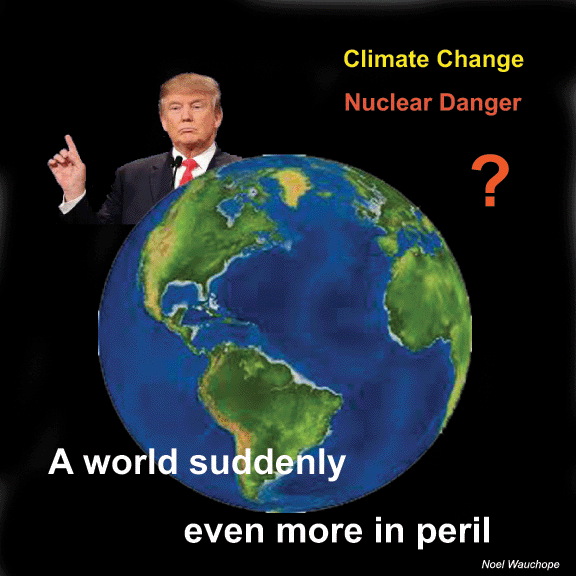
International co-operation can prevent nuclear annihilation – not Donald Trump with his “I alone can fix it”. What does “Denuclearisation” actually mean to Kim Jong Un? to Donald Trump?
MALAYSIA. Malaysia questions why only North Korea, Iran must denuclearise. Why not America, China, Russia, India, Pakistan?
USA.
- Trump so confident about the nuclear summit with Kim Jong Un that he “doesn’t need to prepare”. No surprise that Donald Trump is a no-show at G7 climate meeting.
- USA Congress should decide on controversial nuclear weapons – not let that be decided by Rick Perry all on his own. Barbara Lee Condemns GOP for Embracing Mini Nuclear Weapons. America wasting $billions on unnecessary and dangerous plutonium pits for nuclear weapons. Groups Release Key DOE Documents on Expanded Plutonium Pit Production, DOE Nuclear Weapons Plan Not Supported by Recent Congressional Actions.
- It makes no economic sense – Trump’s new strategy to promote coal and nuclear. FirstEnergy bankrupt, but still spent hundreds of $thousands on lobbying for nuclear power.
- Move to strip Yucca Mountain nuclear waste project funds from Energy spending bill fails. Waste Isolation Pilot Plant (WIPP) resumes its nuclear waste processing. Opposition to shipping nuclear wastes into Idaho for “temporary” storage. Oyster Creek nuclear power station will take 60 years to be closed down.
- MOX nuclear fuel project in deep trouble, but judge rules against suspending its construction.
- Safety risks: American missile officers affected by drugs and alcohol. Increased powers for security guards at Missouri’s nuclear power plants.
- Wildfire season has already begun close to Hanford nuclear reservation.
NORTH KOREA. Even if Kim Jong-un promises to allow nuclear inspections – “complete, verifiable, irreversible dismantlement” is really not possible. A swift verified nuclear disarmament by North Korea is simply not feasible. North Korea’s economic and social health improving – new confidence brings Kim Jong Un to negotiate.
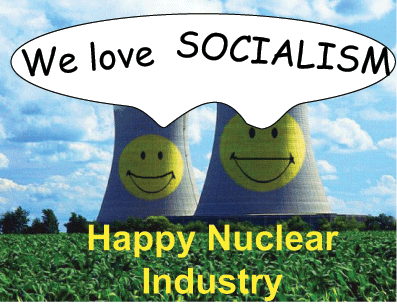
UK. As nations pull out of nuclear power Britain is isolated, in putting taxpayer funds into new nuclear construction. British Conservative govt overturns its previous opposition to socialising the nuclear power industry. Ever multiplying financial costs for building new nuclear reactors are hitting UK, and other countries, too Old, unproven, unreliable nuclear technology planned for Britain’s Wylfa nuclear power station. “Temporary” – or rather STRANDED, nuclear wastes for Sellafield, as Britain has no idea what to do with its radioactive trash. UK now setting up an agreement that will replace the nuclear safeguards lost in leaving Euratom.
JAPAN. Niigata governor election centres on the issue of the world’s largest nuclear power plant. Japan’s divestment campaign from nuclear and coal pits Buddhist priest against banks. Japan High School Peace Envoys Keen to Deliver Voices of Hibakusha .
Fukushima. Study: Cesium from Fukushima flowed to Tokyo Bay for 5 years. PART 1: Radioactive water at Fukushima Daiichi: What should be done? PART 2: Radioactive water at Fukushima Daiichi: What should be done? Is Fukushima doomed to become a dumping ground for toxic waste?
UKRAINE. Despite Ukrainian Prime Minister’s reassurances, Wildfires near Chernobyl are potentially catastrophic. High levels of radioactive Caesium in Ukraine region around Chernobyl a threat to children.
FRANCE. Finally a parliamentary debate on the safety of used nuclear fuel rod pools. Welding defects in the Flamanville EPR nuclear reactor. EDF looks to a profitable industry in decommissioning nuclear reactors.
SOUTH AFRICA. Pelindaba nuclear facility in South Afric a has yet another nuclear safety scare. South Africa: draft Integrated Planning Framework Bill – another attempt to push new nuclear build? South Africa’s Minister of Energy says that S.A. has called off the deal with Russia to develop nuclear power.
BULGARIA. Russian-designed nuclear power plant causes tension in Bulgaria. Russia, France, China compete to develop nuclear power station in Bulgaria.
MIDDLE EAST. Nuclear power at a huge disadvantage in Middle East – but do they want it for nuclear weapons?
AUSTRALIA. Decades overdue Ranger Uranium Mine rehabilitation plan released The world is watching. Ranger mine closure and rehab to cost $1bn.
TEPCO employee dies working inside Japan’s Fukushima nuclear plant

As nations pull out of nuclear power, Britain is isolated in putting tax-payer funds into new nuclear construction

Britain’s nuclear U-turn puts us in a very lonely club, https://www.theguardian.com/commentisfree/2018/jun/08/government-nuclear-dream-north-wales-climate-change Fred Pearce Pumping £5bn into a new plant in north Wales as a way to fight climate change is a solution at odds with the rest of the world
For once, ministers have put their money where their mouth is – into taking another stab at nuclear power. This week the business secretary, Greg Clark, announced plans to pump £5bn into a new nuclear power station at Wylfa in north Wales. It was a reversal of a longstanding Conservative policy not to underwrite nuclear construction. So why the sudden enthusiasm? And what does Clark know that the rest of the world does not?
For almost everywhere else, governments and corporations are pulling the plug on nuclear. Even in a world fearful of climate change, in which nations have promised to wean themselves off fossil fuels by the mid-century, almost no one wants to touch nuclear.
Germany will be nuclear-free by 2022. France – once Europe’s great nuclear advocates – is backtracking. President Macron is committed to cutting nuclear’s contribution to grid power from the 75% to 50%. Seven years after the Fukushima accident, all but a handful of Japan’s 54 nuclear power plants remain closed.
US utilities are shutting reactors fast too, even those with years of their operating licences yet to run. In America’s deregulated energy markets, nuclear cannot compete. Last week President Trump called for the utilities to suspend closures, citing national energy security. He may resort to the law to get his way, but even Trump is not demanding new reactors.
Meanwhile, the state-sponsored nuclear enthusiasm of China, recently the world’s premier builder, has dimmed. Beijing has issued no new construction approvals for over two years. Only Russia keeps up the momentum – which puts Britain in an embarrassing club.
Britain hasn’t completed a new nuclear power station for 23 years. …… renewable sources like solar and wind are both now cheaper, and are becoming cheaper still, while nuclear costs only rise.
Some who call themselves “eco-modernists” argue that nuclear and renewables would make a great mix: nuclear could fill in when the sun goes down and the winds drop. But there is a problem. Any effective stand-in for fickle renewables needs to be available at the flick of a switch. Hydropower or natural gas can do the job, but not nuclear. Its forte is to deliver constant baseload power
If nuclear ticked enough other boxes, it might still have a role to play in keeping the lights on. But it has always been a bad neighbour and troublesome citizen. Some of our fears about radiation may be exaggerated, but they are real fears nonetheless. And nuclear power’s links to nuclear weapons are not just about shared technology – at least not while Britain remains home to the world’s largest stockpile of plutonium.
We are sitting on 130 tonnes of a human-made element that lies at the heart of most nuclear weapons. The stockpile is at a warehouse at Sellafield in Cumbria, in defiance of warnings from scientists at the Royal Society a decade ago that in its present form it poses a major security risk, whether diverted for weapons or breached by terrorists.
The plutonium was manufactured over decades from used power-station reactor fuel. Britain wanted to be at the forefront of a new global industry using plutonium to fuel new designs of reactors. But production continues even though there is no sign of a world market for plutonium. And neither the new Hinkley Point reactor under construction in Somerset, nor the proposed plant at Wylfa, will burn the stuff.
The government seems determined to pursue a nuclear dream, even though it has palpably failed to come to terms with the toxic legacy of the country’s nuclear past.
Next to the site of the planned Wylfa plant sits the shell of an old nuclear power station. It was shut in 2015, but is not scheduled for demolition for almost another century, in 2105. It is one of 11 former plants that sit abandoned around our coastlines, from Dungeness in Kent to Trawsfynydd in Snowdonia, and Sizewell in Suffolk to Hunterston in south-west Scotland.
They are currently being put into what the industry terms “care and maintenance” – mothballed while their radioactivity decays, and until the government’s Nuclear Decommissioning Authority can find somewhere to put their remains.
On present form, that day may never come. Britain is today no nearer agreeing a final resting place for its most dangerous and long-lasting radioactive wastes than it was back in 1976, when the royal commission on environmental pollution said we should build no more nuclear power plants until that problem was resolved. Absurdly, the most recent plan has been to bury the waste in tunnels to be dug beneath the Lake District national park.
Nuclear power today is a largely friendless industry: uneconomic without heavy government support, uninsurable, stuck with a military heritage from hell, overtaken by cleaner competitors, beset by waste problems that no one has resolved, and always vulnerable to public panic after the Chernobyl or Fukushima accidents.
Some believe it may have a future when the waste problems are resolved and if radical new reactor designs emerge. That may be so. But the truth is that in the 60 years since the bomb-makers first promised us “atoms for peace”, nuclear power has gone from a sunrise to a sunset industry. Only the British government seems not to realise it.
Fred Pearce is the author of Fallout: A Journey Through the Nuclear Age, From the Atom Bomb to Radioactive Waste
No surprise that Donald Trump is a no-show at G7 climate meeting
Donald Trump Is Reportedly Skipping The G7 Climate Meeting & It’s No Surprise, Elite Daily By Hannah Golden 9 June 18, The annual Group of 7 (G7) summit of world leaders was just kicking off on Friday afternoon, but for the U.S. president, the conference will be cut short. President Donald Trump is reportedly skipping the G7 climate meetings, the White House announced, per CNN. The announcement came Thursday amid a contentious series of exchanges on trade with his foreign counterparts on Twitter.
The summit — this year held in Canada — begins June 8 and continues through the weekend. This year’s program includes working sessions on oceans, climate change, and clean energy.
The G7 summits began in the 1970s as an informal meeting of the world’s most advanced economies to discuss issues facing them. The U.S. has always been a central fixture in the event, making the president’s decision to forego the meetings a notable one.
Trump reportedly pulled out of the climate meeting following a day of salty Twitter exchanges with French President Emmanuel Macron and Canadian Prime Minister Justin Trudeau. “The American President may not mind being isolated, but neither do we mind signing a 6 country agreement if need be,” tweeted Macron on June 7, referring to recent international policy moves by Trump. “Because these 6 countries represent values, they represent an economic market which has the weight of history behind it and which is now a true international force.”
That Trump decided to leave his international counterparts high and dry on the meeting is no surprise. Just over a year ago, the president pulled out of the international Paris climate accord, setting off a wave of criticism and straining diplomatic leverage. Trump also formally left the Joint Comprehensive Plan of Action (JCPOA), also called the Iran nuclear deal, in May.
Washington Post economic policy reporter Damian Paletta summed up Trump’s drama with world leaders in advance of the summit, showing that it was already making out to be a tense affair……..
……..Trump will be leaving early Saturday prior to the climate portion, CNN reports, and an aide is said to be filling in for him at the meetings.https://www.elitedaily.com/p/donald-trump-is-reportedly-skipping-the-g7-climate-meeting-its-no-surprise-9343750
Even if Kim Jong-un promises to allow nuclear inspections – “complete, verifiable, irreversible dismantlement” is really not possible

North Korean leader Kim Jong Un provides guidance on a nuclear weapons program in this undated photo released by North Korea’s Korean Central News Agency (KCNA) in Pyongyang September 3, 2017. KCNA via REUTERS
Why Donald Trump should stay wary about North Korea’s nuclear plans – even if Kim Jong-un promises to allow inspections
Experts say that the level of know-how and stock of easily concealed materials would make it easy for Pyongyang to start making bombs again, SCMP, Liu Zhenzhen.liu@scmp.com, 08 June, 2018, Experts believe that North Korea has the capability and knowledge to hide hundreds of kilograms of nuclear material from inspectors and could quickly resume its bomb-making programme, even if it agrees to start the denuclearisation process at next week’s summit between Donald Trump and Kim Jong-un.
A recent report by a team led by Siegfried Hecker, a former director of the America’s Los Alamos weapons laboratory, calculated that at the end of last year North Korea’s inventory contained between 250 and 500kg (550-1,000lb) of highly enriched uranium-235 (HEU) and 20 to 40kg of plutonium-239 (Pu-239), the two most important materials for making a bomb.
A single atomic bomb needs about 4-10kg of weapons-grade plutonium, or about 15kg of HEU. With additional fusion materials that are much easier to produce, more powerful hydrogen bombs can be assembled.
“With the material, the knowledge, the experienced scientists, North Korea will be able to make the weapons again,” said an expert with Chinese Academy of Engineering Physics (CAEP), the country’s nuclear weapons research and manufacturing institution, speaking on condition of anonymity. “A system of knowledge is difficult to eliminate.”
Pyongyang’s nuclear programme will be a primary topic of discussion when the US president and the North Korean leader meet in Singapore on Tuesday. Although they may disagree on what “denuclearisation” actually means, from the US perspective, it would likely require the inspection and surrender of all the fissile materials.
However, no one knows exactly how much material North Korea holds, in particular how much HEU, and enrichment facilities are easy to conceal.
“Enrichment of uranium is one capability that can be most easily hidden and made almost impossible to inspect and verify,” said Zhao Tong, a Beijing-based fellow in the nuclear policy programme at the Carnegie Endowment for International Peace.
He said the credibility of North Korea’s “denuclearisation” could be built only on mutual trust and confidence because 100 per cent transparency was impossible.
“Centrifuges can be built underground and covered up in unknown corners of the country,” he said.
…….. The US has said it wants the “complete, verifiable, irreversible dismantlement” of North Korea’s nuclear capabilities, which will require inspections of all aspects of its nuclear programme, ranging from production facilities to test sites……..http://www.scmp.com/news/china/diplomacy-defence/article/2149985/why-donald-trump-should-stay-wary-about-north-koreas
-
Archives
- April 2026 (139)
- March 2026 (251)
- February 2026 (268)
- January 2026 (308)
- December 2025 (358)
- November 2025 (359)
- October 2025 (376)
- September 2025 (257)
- August 2025 (319)
- July 2025 (230)
- June 2025 (348)
- May 2025 (261)
-
Categories
- 1
- 1 NUCLEAR ISSUES
- business and costs
- climate change
- culture and arts
- ENERGY
- environment
- health
- history
- indigenous issues
- Legal
- marketing of nuclear
- media
- opposition to nuclear
- PERSONAL STORIES
- politics
- politics international
- Religion and ethics
- safety
- secrets,lies and civil liberties
- spinbuster
- technology
- Uranium
- wastes
- weapons and war
- Women
- 2 WORLD
- ACTION
- AFRICA
- Atrocities
- AUSTRALIA
- Christina's notes
- Christina's themes
- culture and arts
- Events
- Fuk 2022
- Fuk 2023
- Fukushima 2017
- Fukushima 2018
- fukushima 2019
- Fukushima 2020
- Fukushima 2021
- general
- global warming
- Humour (God we need it)
- Nuclear
- RARE EARTHS
- Reference
- resources – print
- Resources -audiovicual
- Weekly Newsletter
- World
- World Nuclear
- YouTube
-
RSS
Entries RSS
Comments RSS