In the first summit meeting between the leaders of the United States and North Korea, Donald Trump met with Kim Jong-un, on June 12, 2018, in Singapore. The two leaders smiled warmly, posed for cameras as friends, shook hands, and Trump spoke in glowing terms of admiration about Kim at the news conference.
Powerful earthquake north of Tokyo
Powerful quake jolts Gunma north of Tokyo; no injuries http://www.asahi.com/ajw/articles/AJ201806170031.html, THE ASAHI SHIMBUN, June 17, 2018
A strong earthquake shook the northern part of the Kanto region on the afternoon of June 17, the Meteorological Agency said.
The quake registered a lower 5 on the Japanese seismic intensity scale of 7 in Shibukawa, Gunma Prefecture, when it hit at 3:27 p.m. with a focus 14 kilometers from the ground surface. It originated in southern Gunma Prefecture. No injuries have been reported.
The agency said this is the first time a quake originating in the prefecture and measuring a lower 5 or stronger has been recorded since 1923.
The magnitude of the temblor is estimated at 4.6. No tsunami is expected, according to the agency.
Japan commits to reducing its excess of plutonium
 Japan to cap plutonium stockpile to allay U.S. concerns, THE ASAHI SHIMBUN, June 17, 2018
Japan plans to boost measures to curb surplus plutonium extracted from the reprocessing of spent fuel at nuclear power plants, including capping the country’s stockpile of the highly toxic material.
The move followed the U.S. and other countries’ calls for Japan to reduce excess plutonium in light of nuclear nonproliferation and the threat of terrorist attacks involving nuclear materials.
The Cabinet Office’s Japan Atomic Energy Commission will incorporate the measures in the five-point basic nuclear policy expected at the end of this month, the first revision in 15 years.
A reduction in the volume of plutonium held by Japan will also be specified in the government’s basic energy plan, which will be revised next month.
Japan possesses about 10 tons of plutonium inside the country and about 37 tons in Britain and France, the two countries contracted to reprocess spent nuclear fuel. The total amount is equivalent to 6,000 of the atomic bomb that devastated Nagasaki in 1945.
In the policy, announced in 2003, the government vowed not to possess plutonium that has no useful purpose. The government has pledged not to have surplus plutonium to the International Atomic Energy Agency………
Japan can reprocess spent nuclear fuel under the Japan-U.S. Nuclear Cooperation Agreement.
The 30-year pact is expected to be automatically extended beyond its expiration on July 16.
After the expiration, however, the pact will be scrapped six months after either Japan or the United States notifies the other side of its intention to do so.
Foreign Minister Taro Kono has expressed concern about the “unstable” future of the agreement after July, and Japan has worked to meet a request from Washington to clearly spell out steps to reduce Japan’s plutonium stocks.
The government’s draft policy calls for allowing retrieval of plutonium strictly based on the projected amount to be used at conventional nuclear reactors as mixed plutonium-uranium oxide fuel, commonly known as MOX fuel.
It will also step up oversight on utilities with the aim of reducing the amount of plutonium to a level allowing the nuclear reprocessing plant under construction in Rokkasho, Aomori Prefecture, and other facilities to operate properly.
In addition, electric power companies will cooperate with each other in the use of MOX fuel, so that the amount of Japan’s surplus plutonium that is now overseas will be reduced.
For example, Kyushu Electric Power Co. and Kansai Electric Power Co., two utilities that began using MOX fuel ahead of other utilities, will consider using more MOX fuel at their nuclear plants for the benefit of Tokyo Electric Power Co., whose prospect of bringing its Kashiwazaki-Kariwa nuclear power plant in Niigata Prefecture back on line remains uncertain.
When the 2.9 trillion yen ($26.37 billion) reprocessing plant in Rokkasho goes into full operation, about eight tons of new plutonium will be added annually as Japan’s surplus plutonium…..
of nine reactors that have resumed operations following the introduction of more stringent safety standards after the Fukushima No. 1 nuclear disaster in 2011, only four can use MOX fuel.
The operation of the Rokkasho plant will likely be significantly curtailed even if it is completed amid that environment.
(This article was written by Yusuke Ogawa, Rintaro Sakurai and Shinichi Sekine.) http://www.asahi.com/ajw/articles/AJ201806170027.html
Why does Japan persist with dangerous, unnecessary nuclear Rokkasho reprocessing? Is it to enable nuclear weapons?
 The Rokkasho reprocessing plant could ruin everything, Beyond Nuclear, By Kiyohiko Yamada, with additional contributions by Kurumi Sugita and Jon Gomon, 17 June 18
There is a nuclear fuel cycle center in Rokkasho village, located at the tip of Shimokita Peninsula in Aomori Prefecture, in the northernmost part of the main island of Japan.
On April 9, 1985, the governor of Aomori Prefecture gave the green light for the Rokkasho center to proceed. At first, it comprised three facilities:
•a uranium enrichment plant
•a fuel reprocessing plant
•a low-level radioactive waste repository
Later, two more facilities were added:
•a temporary storage facility of high-level radioactive waste returned from overseas after reprocessing,
•a MOX fabrication plant.
The nuclear fuel cycle center of Rokkasho village is operated by Japan Nuclear Fuel Limited (JNFL), notorious for its incompetent management. In October 2017, the Japanese Nuclear Regulation Autority (NRA) reported that JNFL violated safety measures. As the Mainichi Shimbun reported in an October 11, 2017 article, safety records were faked at the unfinished reprocessing plant.
“The NRA concluded on Oct. 11 that Japan Nuclear Fuel Ltd. (JNFL) has violated safety measures after it was learned that the firm failed to carry out the required checks and nevertheless continued to write down “no abnormalities” in safety check records. There has been a spate of incidents such as the flow of rainwater into facility buildings at the plant in the Aomori Prefecture village of Rokkasho.
“The plant, which is scheduled to reprocess spent nuclear fuel, was on the verge of hosting a final-stage NRA safety inspection, but the checkup is likely to be postponed considerably as JNFL now has to prioritize in-house inspections of all facilities at the plant.”The Japanese nuclear fuel cycle collapsed with the fast breeder reactor “Monju”
The Japanese government obstinately pursued a fast breeder reactor program, even though other similar projects had been abandoned elsewhere in the world. An estimated $9 billion was spent on Japan’s Monju prototype breeder reactor, which was so troubled it operated only 250 days during its 22-year existence. It was finally abandoned permanently in December 2016 and the decision was taken to decommission it.
And yet the Japanese government persists in trying to start operation of the Rokkasho reprocessing plant in the first half of 2021, even though the prospect of the fast breeder reactor’s commercialization has become improbable.
There is a contradiction here. Why start a reprocessing plant when there is no usage plan for the end product? One possible reason is that for quite some time, former Liberal Democratic Party (LDP) ministers have been hinting at the possibility of having nuclear weapons. Reprocessing extracts plutonium from irradiated reactor fuel. Perhaps the real intent is to have such a plutonium extraction plant which can produce eight tons of plutonium annually.
Surplus plutonium problem.……..
If the Rokkasho reprocessing plant is put into operation, it will create a surplus of eight tons of plutonium annually. The possession of such an amount of plutonium will most certainly increase tensions in Asia.
Risks involved in the Rokkasho plant
① The reprocessing plant is on a fault line
Japan is riddled with geological faults, and there is no stable stratum including at the Rokkasho reprocessing plant site. A large, active fault about 100 km in length lies on the Pacific Ocean side. Scientists warn that in the case of a big earthquake, a magnitude 8 tremor could seriously damage the reprocessing plant.
The operating company insists that a big earthquake will not occur in Rokkasho, but their seismograph is installed on bedrock, and is set so that it does not indicate more than a seismic intensity of 3. Why? It is because when seismic intensity higher than 3 is detected, it is necessary to make a total inspection of the reprocessing plant.
② Hakkoda and Towada volcanoes are nearby ….
③ Fighter jets fly near Rokkasho …..
Possibility of a serious accident …….
If the plant goes into operation, even without an accident, radiation exposure of the entire Aomori Prefecture, and of the Pacific Ocean, will be far too high
After the Fukushima Daiichi nuclear accident, many tanks were created on the site of the Fukushima nuclear power plant to store the tritium contaminated water after processing the radioactive water by the multi-nuclide removal facility (Advanced Liquid Processing System). In Fukushima prefecture, tritium contaminated water is not discharged into the ocean due to opposition from fishermen. In contrast, the same tritiated water was released in large amounts in Rokkasho during the active testing. Fishermen in Iwate once demanded that the reprocessing plant drainage be discharged into Mutsu Bay and not into the Pacific Ocean. The person in charge in Aomori Prefecture refused, saying, “Mutsu Bay would die”.
An upcoming mayoral election in Rokkasho Village could have important repercussions for the reprocessing plant. One candidate— Junk Endo — is resolutely opposed to opening it. The election takes place on June 24, 2018.
We are calling on our friends and colleagues all around the world to send Ms. Endo messages of support. It is important that Japanese authorities understand that the world is watching these elections. The people of Rokkasho do not need the leukemia clusters or the proliferation risks of a reprocessing plant. The world does not need more carcinogenic radioactive releases from yet another reprocessing plant when those at La Hague, France, and Sellafield, England, have already poisoned the air and seas far from their own lands. https://beyondnuclearinternational.org/2018/06/17/all-that-would-be-destroyed-reprocessing-japan/
How the use of nuclear weapons would drastically reshape the Earth
Why having over 100 nuclear weapons could do more harm than good to a country, The Journal, Órla Ryan@orlaryan orla@thejournal.ie
Experts have looked into the impact using such weapons would have on a nation’s population and resources.
HAVING MORE THAN 100 nuclear weapons in a nation’s arsenal could cause more harm than good for the country itself, according to a new study.
Researchers have said that while countries tend to believe that having access to more weapons is intimidating and makes other countries think twice before attacking them, using such weapons can destabilise the country itself.
The US and Russia, for example, each have thousands of nuclear weapons.
Joshua Pearce, professor at Michigan Technological University, and David Denkenberger, assistant professor at Tennessee State University and director of Alliance to Feed the Earth in Disasters (Allfed), co-authored an article published this week in the journal Safety.
Pearce and Denkenberger examined direct negative physical consequences of the use of nuclear weapons to the nation firing them, including impacts such as starvation and global supply chain disruption as well as the cost to maintain an extensive arsenal.
They found that a country willing to use nuclear weapons against another nation must determine whether it has the ability to survive the problems this will create.
There are nine nuclear-weaponised nations: the US, Russia, the UK, France, China, India, Pakistan, Israel and North Korea. There are approximately 15,000 nuclear weapons globally. Under the disarmament proposed in this research, this number would drop to 900 or fewer.
“With 100 nuclear weapons, you still get nuclear deterrence, but avoid the probable blowback from nuclear autumn that kills your own people,” Pearce said.
He added that defence expenditure post-9/11 shows that the US cares about “protecting Americans”.
If we use 1,000 nuclear warheads against an enemy and no one retaliates, we will see about 50 times more Americans die than did on 9/11 due to the after-effects of our own weapons.
Pearce said that this is the first study to quantitatively demonstrate just how dangerous the use of nuclear weapons is even for the aggressor nation.
……….. Starvation and violence
The consequences of environmental blow-back include a significant drop in global temperature because of soot from nuclear blasts blocking the sunlight from reaching Earth’s surface, decreased precipitation, a drop in food production because of blocked sunlight and less moisture, increased ultraviolet radiation resulting from a badly damaged atmosphere, and non-functioning supply chains.
“We should be clear this analysis represents a severe underestimate on the number of dead Americans,” Pearce said.
We assume severe rationing, which is the best way to keep the most people alive when there is this level of food shortage. It means anyone who would die of starvation is immediately cut off from food.
“I don’t think rationing would go overly smoothly — a lot more people would die in violence internally than what we estimated based on lack of calories.”
100, 1,000 or 7,000 weapons
Pearce and Denkenberger examined the threat-potential of a 7,000-weapon arsenal, a 1,000-weapon arsenal and a 100-weapon arsenal.
Playing out a hypothetical scenario, the researchers explained that if the US used 100 nuclear weapons against China’s most populous cities, for example, initial blasts would likely kill more than 30 million people.
This would kill a higher fraction of the population than even severe pandemics. Sunlight would decrease by 10 to 20% and precipitation by 19% or more.
Pearce and Denkenberger, based on previous work, built a model of the burnable material in cities, how much would burn in a nuclear attack, how much of that would turn into smoke, and how much of that smoke would make it into the upper atmosphere.
Food supply
Then they used the result of climate and crop simulations to predict the impact on food supply. They coupled this with food storage to predict how many people would starve.
The agricultural loss from this so-called ‘nuclear autumn’ would range from 10-20%, enough to cause widespread food shortages in wealthier nations and mass starvation in poorer nations, researchers said.
Starvation could result because nuclear weapons would cause cities to burn, putting smoke into the upper atmosphere and blocking sunlight for years.
This could cause lower rainfall and lower temperatures, potentially causing winter-like weather in the summer, so-called ‘nuclear winter’. Less severe reduction in sunlight, which is called ‘nuclear autumn’, could still cause millions of people to starve.
It is clear that even 100 nuclear weapons is more than enough to dramatically reshape the globe, and Pearce and Denkenberger argue it’s also more than enough to deter other countries.
Maintaining more than that number, the authors state, is not only against the best interest of a nation to protect its people, but also costs a significant amount to maintain.
Denkenberger said the US government “should greatly increase focus on producing alternative food to provide for survivors in the case of nuclear war; with supply chains cut-off, all food Americans eat will have to come from within the nation’s borders”.
Pearse added that it’s “not rational to spend billions of dollars maintaining a nuclear arsenal that would destabilise your country if they were ever used”.
“Other countries are far worse off. Even if they fired off relatively few nuclear weapons and were not hit by any of them and did not suffer retaliation, North Korea or Israel would be committing national suicide,” he said.
Resounding “No” to nuclear waste dump, from Czech rural community
JAROMĚŘICE NAD ROKYTNOU VOTES AGAINST NUCLEAR WASTER STORAGE SITE http://www.radio.cz/en/section/news/jaromerice-nad-rokytnou-votes-against-nuclear-waster-storage-site Ruth Fraňková17-06-2018
The inhabitants of Jaroměřice nad Rokytnou, a village in the Vysočina region between Bohemia and Moravia, voted overwhelmingly against the construction of a nuclear waste storage site on their land in a referendum on Saturday.
Jaroměřice nad Rokytnou is one of nine Czech locations being considered by experts for the purposes of a nuclear waste store. About 45 percent of the village’s inhabitants took part in the vote, which makes the referendum valid.
Best option for Indian Point nuclear power station decommission and clean up the whole site within a reasonable period, such as 20 years
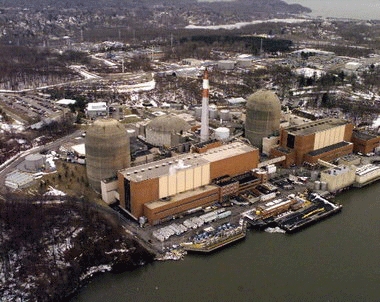 Indian Point site should be cleaned up as quickly as possible: Column https://www.poughkeepsiejournal.com/story/opinion/valley-views/2018/06/17/indian-point-site-should-cleaned-up-quickly-possible-column/699682002/,
Genkai nuclear power station restart sparks protest
 Japan Today 16th June 2018 , A nuclear reactor at a trouble-hit complex in southwestern Japan restarted
operations Saturday for the first time in more than six and a half years
amid lingering safety concerns. The No. 4 unit at the Genkai plant in Saga
Prefecture is the fourth reactor of operator Kyushu Electric Power Co’s to
go back online and the ninth nationwide under stricter safety rules
implemented after the Fukushima crisis in 2011. The utility aims to
generate and supply electricity from Wednesday and start commercial
operations in mid-July. The restart sparked local protests, with around 100
people gathering in front of the plant.
https://japantoday.com/category/national/trouble-hit-nuclear-reactor-in-southwestern-japan-resumes-operations
Govt plan to reuse radioactive soil for agriculture meets opposition
BNA 14th June 2018 Japan’s plan to reuse soil contaminated with radiation from the
Fukushima-Daiichi nuclear power plant accident for agriculture is sparking
something of its own nuclear reaction. Residents and other critics don’t
want any part of it.
https://www.bna.com/blowback-japanese-plan-n73014476527/
Nuclear news to 17 June
 It’s getting hard for comedians, to compete as far as international relations go, with real life becoming more ridiculous. Politicians in Norway and USA are recommending Donald Trump for the Nobel Peace Prize. All sorts of reactions to the much vaunted “Nuclear Summit” between Trump and Kim. My own favourite was Trump’s own proud boast about not preparing for the summit – he makes decisions “by touch and feel”.
Accelerating Sea Level Rise is Being Driven by Rapidly Increasing Melt From Greenland and Antarctica. Leaked UN draft report – world is on track to exceed 1.5C of warming.
Hopes for peace following the Trump-Kim summit are likely to be short-lived. Bulletin of the Atomic Scientists hopes for some SUBSTANCE and scientific expertise in USA- North Korea nuclear negotiations. What’s NOT in the summit agreement ?- that’s the revealing part. What the Donald Trump and Kim Jong-un document actually says.
100 nuclear weapons is the “pragmatic limit” for any country to have in its arsenal.
Economic realities point to a poor future for nuclear power.
USA.
- Tough sanctions will remain on North Korea until its complete denuclearisation – says USA. Donald Trump alienates America’s allies – thus increasing the likelihood of nuclear weapons proliferation.
- The huge danger to Americans of keeping hundreds of nuclear weapons on hair-trigger alert.
- Radioactive Particles Found in Homes of Workers at Major US Nuclear Weapons Facility.
- Guam wants inclusion in radiation exposure compensation program: U.S. Senate considering this.
- Moving radioactive sludge from near Columbia River to the middle of the Hanford nuclear site.
- Natural Resources Defense Council warns against closing Hanford’s underground nuclear waste tanks.
- Federal Energy Regulatory Commission (FERC) rejected Trump Administration’s plan to rescue coal and nuclear industries. A very hard project – Trump trying to bail out coal and nuclear power.
- USA Federal nuclear weapons facilities are getting systems to disable drones.
NORTH KOREA. In North Korea, Kim Jong Un is seen as the tough winner, in Singapore nuclear summit. Completely ignored in nuclear summit talks – the forgotten North Korean victims of 1945 atomic bombs.
JAPAN. The global problem of poisonous plutonium: Japan looks at its options. US demands Japan reduce its plutonium stockpiles. Why TEPCO should quickly close down Fukushima No. 2 nuclear plant. Japan approves 70-year plan to scrap nuclear reprocessing plant. Amazingly High Radiation in Tokyo Bay — 131,000 Bq per Meter Squared.
Why wasn’t TEPCO bankrupted? – Japan’s Citizens’ Nuclear Information Center. Japan’s Citizens’ Nuclear Information Center calls for TEPCO to be liquidated. Japanese anti nuclear group No Nukes Wakayama flexes their muscles.
UK. Nuclear Industry Association still struggling with inconvenient truth that Brexit is bad for their industry. Robots the hope for cleaning up the world’s riskiest and massive nuclear waste storage pool, at Sellafield, UK. Centrica wants to sell its nuclear industry stake, but it’s hard to attract buyers. Fears in Isle of Man community over dangers of new Wylfa nuclear power station. Fundamental problem with Britain’s Wylfa nuclear power programme – it’s a ripoff.
RUSSIA. Safety measure for World Cup – Russia halts nuclear waste transport.
FRANCE. Systemic failures in France’s Flamanville nuclear project.
SAUDI ARABIA. Huge USA weapons purchase by Saudi Arabia was on condition that USA would KILL THE IRAN NUCLEAR AGREEMENT!
JORDAN. Jordan knocks back Russia’s $10 billion nuclear power plant , but contemplates”small floating reactor”
BANGLADESH. Scientists predict millions of climate refugees – but where will they go?
IRAN. Iran says it can’t remain in nuclear deal without benefits.
SPAIN. Thousands protest against uranium mine in Spain.
UKRAINE. Tons of water poured in by planes, to major wildfire inside the Chernobyl ‘dead zone‘.
Donald Trump alienates America’s allies – thus increasing the likelihood of nuclear weapons proliferation
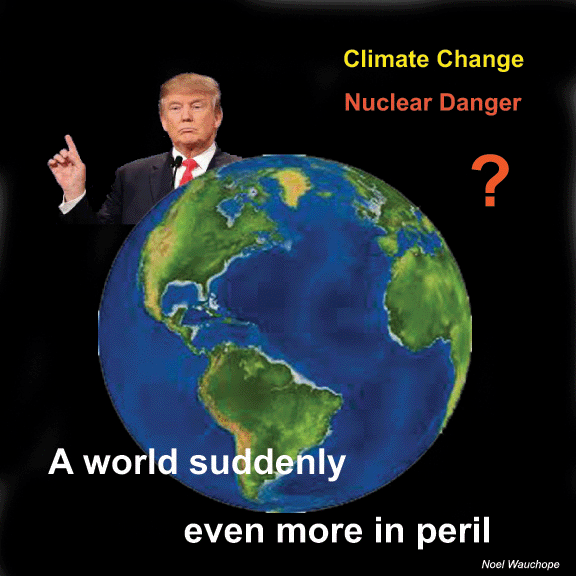 Trump triggers talk of Australia going nuclear , SMH, By Peter Hartcher,
Three former deputy secretaries of Australia’s Defence Department – strategists Hugh White, Paul Dibb and Richard Brabin-Smith – have mooted the idea in the past year. Till these most recent months, it’s been something of a taboo topic in respectable circles.
One big reason? Australia already has the protection of the United States nuclear umbrella. Under this system, the US pledges that if anyone should launch a nuclear strike on one of its allies, Washington would retaliate against the aggressor.
So to suggest that Australia now needs its own atomic arsenal is to suggest that there has been a fundamental breakdown in trust. In short, that the US alliance is dead.
But hold on. Why now? Isn’t this exactly the wrong time to be laying such plans? Doesn’t this week demonstrate that the US can act to deal with a hostile nuclear state? Didn’t Donald Trump’s summit with Kim Jong-un just reduce a threat for the US allies in the region, including Australia, which falls within reach of Kim’s long-range missiles?
There are two key points here. First, the text of the brief document that the leaders signed does say that North Korea “commits to work toward complete denuclearisation of the Korean Peninsula”. But this is neither new nor convincing.
A former US nuclear negotiator with the North Koreans, Republican David Asher, who led the North Korean activities group in the White House of George W. Bush, says: “For the President to say that the nuclear threat has been eliminated is, I think, unwise. If he’s wrong, it’ll be on him.”
Asher, a scholar at the Centre for New American Security, says: “I have hope, but after dealing with the North Koreans for 25 years, it’s not a promise I personally can have great faith in.” Asher has a litany of first-person examples of Kim Dynasty duplicity……….
the first point is that no one can yet know whether Trump has actually de-fanged a dangerous enemy. But the second point is what everyone does know now – that Trump is prepared to trade away the interests of an ally if he thinks it will help him get a deal with an enemy.
Trump announced that he had promised Kim he would stop the big military exercises that the US conducts with South Korea twice a year.
………The problem? The cancellation was news to South Korea’s President, Moon Jae-In. It was news to another keenly interested US ally, Japan’s Shinzo Abe. And it was news to Trump’s own military commanders, who were in the middle of preparations for the next exercises, two months away.
And in announcing the end to the manoeuvres, Trump adopted the language of the North Korean propagandists. Pyongyang has long railed against the exercises as “provocative war games”. The US has never called them war games nor described them as provocative; Trump did both.
It seems that Kim put the demand to Trump in the negotiating room and Trump agreed on the spot. He agreed to a demand by an enemy without consulting his ally. “It is urgent to make bold decision,” Kim told the US leader, in the words of the North Korean official news agency, and Trump bought it.
This was greeted with delighted incredulity in Beijing. Because this is precisely what the Chinese Communist Party has sought for many years. Professor Shi Yinhong, of the People’s University in Beijing, said that Trump’s pledge to halt military manoeuvres was almost “too good to be true” from China’s point of view.
Why does China care? Because one of its greatest strategic aims is to separate the US from its allies. One of America’s greatest assets is that it sits at the centre of a global alliance system embracing more than 40 nations, including most of the world’s major economies. China, by contrast, has a only couple of rather unimpressive allies, Pakistan and North Korea.
Shi drew the connection: If US troops in South Korea were to stop the military exercises, it could cause allies to lose confidence in Washington and undermine the entire US military presence in Asia, he told America’s National Public Radio. For China, this is victory on every level.
“We see a clear pattern of Donald Trump turning against his allies,” says a close student of Trump foreign policy, Tom Wright, a senior fellow at the Brookings Institution in Washington. “He’s generally hung his allies out to dry.”
Just in the last two weeks he has harmed US alliances with Britain, France, Germany and Canada, putting punitive tariffs on their exports and insulting Canada’s Justin Trudeau on top, calling him weak and dishonest.
He upset his allies at the annual G7 summit by proposing that Russia be restored to the group’s meetings, when the G7 is supposed to be ostracising Putin for invading Ukraine.
Trump has inflicted so much political damage to America’s European and Canadian alliances that “the community of North American and European nations forming the nucleus of the alliance that won the Cold War for the West is closer to breaking up now than at any time since the 1940s” in the assessment of Walter Russell Mead, an American scholar.
“And,” says Wright, “he completely sidelined Japan” with this week’s Kim summit. It seems that there was only one US ally who had been able to persuade Trump decisively to change US policy, and even that has turned sour, says Wright.
South Korea’s Moon was the one who persuaded Trump to try directly negotiating with Kim, yet in those very negotiations Trump ended up trading away a South Korean interest. “Moon thought he could ride the tiger, control where he went, but didn’t realise the tiger goes where the tiger wants to go,” as Wright puts it. “He brought Trump into this but then lost control.”
Why does Trump consistently act against the interests of his allies? Wright, who predicted just this pattern of behaviour before Trump was elected, explains: “In his 30-year history of talking and writing about this stuff, Trump has always been more aggravated by America’s friends than its enemies.
“He has been consistent about this for 30 years. It’s not sophisticated or complex, but he is much more ideological than people think: interdependence is a bad deal for America.” Trading partners will cheat America; allies will free ride on America’s military budget.
Australia has been unscathed so far; Wright says that this will likely change only if some disagreement emerges. Trump isn’t so systematic to work down a list of allies he must alienate, but he will “react to what’s in front of him. It’s possible to sneak on by.”
The only time he will turn against a US rival is if he thinks that rival is directly threatening the US with attack, according to Wright. Otherwise, he’s happy to deal with America’s enemies: “He’s open to deals, he worries about commitments.”
Which is how he manages to make concessions to North Korea while sidelining the interests of South Korea. Trump went further, saying that he wanted one day to withdraw the 28,000 US troops that provide an American “trip wire” across the Demilitarised Zone separating North from South.
If the North should invade, the US forces will be engaged automatically, the wire tripped, guaranteeing America will come to Seoul’s defence. Trump said this was a matter for the future; South Korea’s Moon wishes he hadn’t raised it at all.
If Trump’s North Korean gambit works, he will have a serious achievement. If it fails? Says Asher: “The irony of the North Korean denuclearisation deal could be that everybody else decides to go nuclear. If it fails and Kim remains in power and countries doubt our commitment, then what’s to stop Japan or South Korea or Australia going nuclear?”
It could lead to “mass nuclearisation – it’s a very bad position, 20 countries in the region with nukes, like 20 people in a room all pointing guns at each other”.
These are, of course, imponderables, possible futures that no one hopes for but governments need to plan for. Hendy and White and Dibb and Brabim-Smith may be tending towards alarmism, but they want Australians to think about the world after the American-led alliance system has passed into history.
An American journalist, Jeffrey Goldberg, writes in The Atlantic this week that he asked a number of unnamed White House officials whether there is a Trump doctrine in foreign policy. One, described as a senior official with direct access to the President and his thinking, replied that there is. And it is: “We’re America, bitch.” History is in the making. https://www.smh.com.au/politics/federal/trump-triggers-talk-of-australia-going-nuclear-20180615-p4zlsa.html
Hopes for peace following the Trump-Kim summit are likely to be short-lived
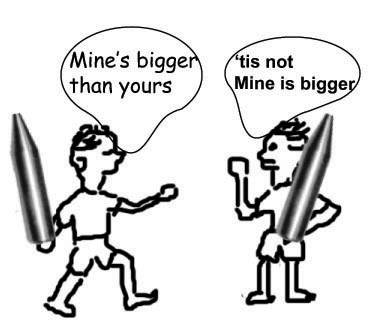 The scary truths about Trump’s nuclear summit https://www.engadget.com/2018/06/15/the-scary-truths-about-trump-s-nuclear-summit/ In which Donald Trump and Kim Jong-un compared the size of their nuclear buttons. Violet Blue
Leaked UN draft report – world is on track to exceed 1.5C of warming
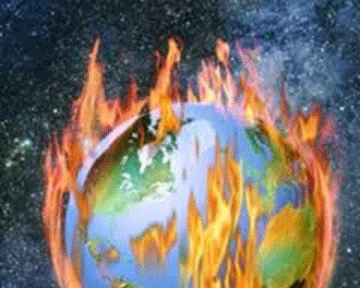 Guardian 15th June 2018 The world is on track to exceed 1.5C of warming unless countries rapidly implement “far-reaching” actions to reduce carbon emissions, according to a draft UN report leaked to Reuters. The final draft report from the UN’s intergovernmental panel on climate change (IPCC) was due for publication in
October. It is the guiding scientific document for what countries must do to combat climate change.
Human-induced warming would exceed 1.5C by about 2040 if emissions continued at their present rate, the report found, but countries could keep warming below that level if they made “rapid and far reaching” changes.
Under the 2015 Paris climate agreement, almost 200 countries signed up to limit global temperature rises to well below 2C above pre-industrial levels and to pursue efforts to limit the temperature increase to 1.5C. Climate scientist and Climate Analytics director Bill Hare said the draft report showed with greater clarity how much faster countries needed to move towards decarbonisation under various temperature situations and that the impacts of climate change greatly increased between 1.5C and 2C of warming.
Necessary actions include making the transition to renewable energy, powering the transport sector with zero carbon electricity, improving agricultural management and stopping deforestation.
https://www.theguardian.com/environment/2018/jun/15/leaked-un-draft-report-warns-of-urgent-need-to-cut-global-warming
100 nuclear weapons is the “pragmatic limit” for any country to have in its arsenal.

This is how many nukes it would take to destroy society https://nypost.com/2018/06/15/it-would-only-take-100-nuclear-weapons-to-destroy-society/, By James Rogers, Fox News, June 15, 2018 New research argues that 100 nuclear weapons is the “pragmatic limit” for any country to have in its arsenal. Any aggressor nation unleashing more than 100 nuclear weapons could ultimately devastate its own society, scientists warn.
The study was published in the journal Safety on Thursday; it was co-authored by Michigan Technological University professor Joshua Pearce and David Denkenberger, assistant professor at Tennessee State University and director of Alliance to Feed the Earth in Disasters.
“The results found that 100 nuclear warheads is adequate for nuclear deterrence in the worst case scenario, while using more than 100 nuclear weapons by any aggressor nation (including the best positioned strategically to handle the unintended consequences) even with optimistic assumptions (including no retaliation) would cause unacceptable damage to their own society,” the scientists wrote.
There are approximately 15,000 nuclear weapons globally, according to the research, with the US and Russia accounting for nearly 90 percent of that total. With nine nuclear weaponized countries, the paper argues for a disarmament proposal that would reduce the number of nuclear weapons in the world to 900 or less.
“100 nuclear warheads is the pragmatic limit and use of government funds to maintain more than 100 nuclear weapons does not appear to be rational,” the paper argues.
The scientists discuss the devastating global environmental impact that would occur when a country deploys more than 100 nuclear weapons.
This “environmental blowback” would involve a significant drop in global temperatures as soot from nuclear blasts prevents sunlight from reaching Earth’s surface. This, combined with reduced precipitation, could severely impact food production, experts warn, potentially resulting in mass starvation.
“If the agricultural productivity reverts to preindustrial yields because of a nuclear strike, most countries would not be able to feed themselves,” the study says.
Researchers also cite conservative estimates that 34 million people would die if 100 nuclear bombs were unleashed on China, the world’s most populous nation.
Why TEPCO should quickly close down Fukushima No. 2 nuclear plant
Editorial: TEPCO should quickly decommission Fukushima No. 2 nuclear plant, https://mainichi.jp/english/articles/20180615/p2a/00m/0na/026000c (Mainichi Japan). Tokyo Electric Power Co. (TEPCO) has finally announced that it will decommission its Fukushima No. 2 Nuclear Power Plant, more than seven years after the outbreak of the ongoing crisis at its tsunami-ravaged Fukushima No. 1 plant. If realized, all 10 nuclear reactors in Fukushima Prefecture would be dismantled.
The presence of the No. 2 power station has offended Fukushima Prefecture residents, many of whom are still living as evacuees, and others who have suffered groundless rumors about radiation contamination. TEPCO needs to swiftly draw up a road map that will enable smooth decommissioning of the complex.
Like the No. 1 plant, the No. 2 complex was also hit by tsunami generated by the March 2011 Great East Japan Earthquake. However, some of its external power sources remained intact, averting meltdowns at the plant.
The No. 2 plant remains offline, but a massive amount of nuclear fuel remains in the complex. Since prefectural residents have deeply rooted concerns about the plant’s safety and its possible reactivation in the future, the prefectural government has urged TEPCO and the national government, which effectively has the largest stake in the utility, to decommission the plant at an early date.
Reactivation of a nuclear plant requires consent from the local municipalities hosting the complex. Therefore, the resumption of operations at the No. 2 power station has always been a politically unfeasible option.
Moreover, more than 30 years have passed since operation of its four reactors began.
To operate the reactors beyond the 40-year limit set under new rules introduced after the outbreak of the nuclear crisis, it is necessary to invest a vast amount of money for additional safety measures. That means there were no merits to keeping the power station open in terms of the utility’s finances.
Nevertheless, TEPCO had delayed the decision to decommission the complex.
Once a utility decides to decommission a nuclear reactor, the operator cannot regard the facility or the nuclear fuel inside it as part of the company’s assets, weakening its financial base. It appears TEPCO may have waited to make the decision until the company had restored its financial strength.
However, even considering the financial strain that TEPCO experienced after the March 2011 disaster, it deserves criticism for its lack of sincerity, failing to provide a sufficient explanation to the public about its plans for the reactors.
TEPCO President Tomoaki Kobayakawa, who notified Fukushima Gov. Masao Uchibori of the decision, has admitted that the No. 2 plant “has hindered disaster recovery.” If so, the utility should promptly begin preparations to decommission the complex.
The power company already faces the extremely difficult task of decommissioning the Fukushima No. 1 nuclear plant. In order to smoothly carry out the decommissioning of the No. 2 plant as well, the company must exercise wisdom in allocating its management resources, such as funds and personnel. We hope TEPCO will cooperate with the government in swiftly materializing its plan for decommissioning the No. 2 power station.
The decommissioning of the Fukushima No. 2 plant would leave the Kashiwazaki-Kariwa Nuclear Power Plant in Niigata Prefecture as TEPCO’s sole atomic power station. This means that TEPCO may step up its efforts to persuade the local municipalities hosting that power plant to accept its reactivation. However, the company must keep in mind that the main priority is to ensure safety at the plant and to obtain the understanding and acceptance of local communities.
Nuclear Industry Association still struggling with inconvenient truth that Brexit is bad for their industry
 Industry body welcomes progress on international nuclear agreement as Brexit looms http://www.timesandstar.co.uk/news/business/Industry-body-welcomes-progress-on-international-nuclear-agreement-as-Brexit-looms-31636156-0808-499c-bb14-5cb07e604c04-ds
But the Nuclear Industry Association says there remains a lot to do to secure Britain’s nuclear sector before it leaves Euratom.
Progress on a voluntary agreement that will continue to allow officials to keep tabs on and inspect UK civil nuclear facilities including Sellafield post-Brexit, has been welcomed by an industry group.
The International Atomic Energy Agency’s (IAEA) board of directors has approved the UK Voluntary Offer Agreement, which if ratified as expected later this summer, will see the UK continue to share information on its civil nuclear facilities and allow inspections by IAEA officials.
The IAEA works to ensure the peaceful use of nuclear energy and has safeguards in place with nuclear weapons states such as the UK. At present the sharing of information and inspections go through the European Commission and its agency Euratom.
The UK is set to leave Euratom in March 2019 at the same time it exits the European Union.
The Nuclear Industry Association (NIA) has been pushing the Government to secure agreements with bodies including the IAEA, to ensure current agreements do not break down post-Brexit.
The NIA’s chief executive Tom Greatrex welcomed the IAEA’s approval of a replacement agreement as a “step in the process towards creating a domestic regime to replace current Euratom functions”.
He said: “It is the first in a series of international agreements which need to be negotiated, agreed and ratified with a number of third countries, and the practical arrangements relating to the UK’s safeguarding regime need to be finalised – including recruitment, training, systems and equipment.
“There has been significant progress over the last few months, but there remains a lot left to do.
“Industry continues to work with government to assist in this process, but it remains of critical importance that the government finalise negotiations on a transitional framework for the UK before it leaves the EU and Euratom in March 2019, to minimise the risk of future arrangements not being ready at the time the UK ceases to be part of Euratom.”
Concerns has also been expressed in Cumbria over the UK’s exist from Euratom.
Barrow and Furness MP, John Woodcock has been a long-standing critic of the move, which he says has potential to hurt the industry in the county.
Prime Minister Teresa May said she is keen to retain some links with Euratom post-Brexit.
In a speech last month Mrs May said she would “willingly” make a financial contribution to allow Britain’s to “fully associate” itself with Euratom’s R&D programme and Horizon Europe research and innovation programme – the successor to Horizon 2020.
1 This Month
Chernobyl: The Lost Tapes – A good documentary on Chernobyl on SBS available On Demand for the next 3 weeks– https://www.sbs.com.au/ondemand/tv-program/chernobyl-the-lost-tapes/2352741955560

of the week–London Campaign for Nuclear Disarmament

Tell the Ukrainian Government to Drop Prosecution of Peace Activist Yurii Sheliazhenko
To see nuclear-related stories in greater depth and intensity – go to https://nuclearinformation.wordpress.com
-
Archives
- April 2026 (139)
- March 2026 (251)
- February 2026 (268)
- January 2026 (308)
- December 2025 (358)
- November 2025 (359)
- October 2025 (376)
- September 2025 (257)
- August 2025 (319)
- July 2025 (230)
- June 2025 (348)
- May 2025 (261)
-
Categories
- 1
- 1 NUCLEAR ISSUES
- business and costs
- climate change
- culture and arts
- ENERGY
- environment
- health
- history
- indigenous issues
- Legal
- marketing of nuclear
- media
- opposition to nuclear
- PERSONAL STORIES
- politics
- politics international
- Religion and ethics
- safety
- secrets,lies and civil liberties
- spinbuster
- technology
- Uranium
- wastes
- weapons and war
- Women
- 2 WORLD
- ACTION
- AFRICA
- Atrocities
- AUSTRALIA
- Christina's notes
- Christina's themes
- culture and arts
- Events
- Fuk 2022
- Fuk 2023
- Fukushima 2017
- Fukushima 2018
- fukushima 2019
- Fukushima 2020
- Fukushima 2021
- general
- global warming
- Humour (God we need it)
- Nuclear
- RARE EARTHS
- Reference
- resources – print
- Resources -audiovicual
- Weekly Newsletter
- World
- World Nuclear
- YouTube
-
RSS
Entries RSS
Comments RSS
 nuclear-news