FPL, speakers clash on plan to run Turkey Point nuclear plant to 2053, Palm Beach Post ByCharles Elmore– Palm Beach Post Staff Writer 1 June 18
Opinions are splitting faster than atoms when it comes to Florida’s oldest nuclear power plant, Turkey Point.
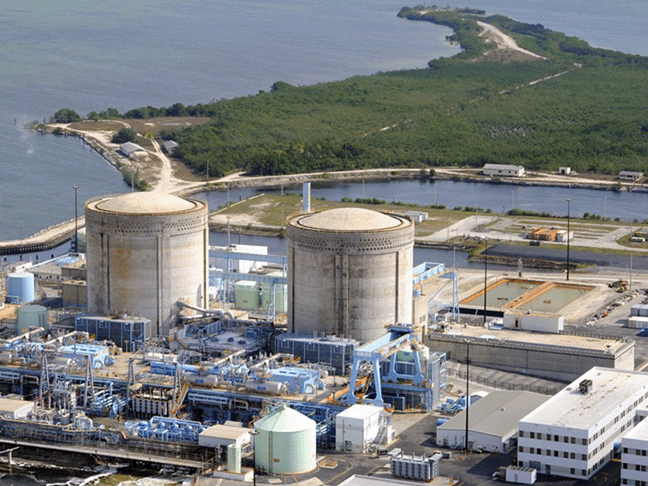
To hear officials working for Juno Beach-based Florida Power & Light tell it, the plant hums along as a money-saving, greenhouse gas-trimming success story that deserves federal regulatory blessing to have its oldest reactor turn 80 years old on the job in 2052. A second reactor would reach the milestone a year later. That would rank among the longest tenures in the nation and double the average of less than 40 years.
But the request for a 20-year extension represents something else entirely to scores of environmentalists, activists, students and others who traveled from places such as West Palm Beach and Boca Raton for a chance to speak at a public meeting near the plant south of Miami.
They see a plant with an outdated canal cooling system threatening fragile ecosystems and water supplies, and a candidate to become the unwanted sequel to Japan’s Fukushima nuclear disaster. They say Turkey Point is in no shape to get an octogenarian’s operating license without big changes to protect South Florida’s environment and guard against threats such as rising seas and stronger hurricanes.
In public hearings, U.S. Nuclear Regulatory Commission officials are weighing those and other points of view.
Public comments can be filed by June 21. An agency decision is expected by October 2019.
“I have a stake in the outcome of this process,” said Laura Stinson, 20, a senior at Florida Atlantic University in Boca Raton, who is pursuing a degree in marine biology. She said it is “imperative these canals be closed” in favor of another solution such as cooling towers, which she and others argue present lower risk for introducing heated water, high salt concentrations, and other disruptions into surface and ground water systems.
Laura Reynolds, a consultant in West Palm Beach for the Southern Alliance for Clean Energy, said FPL must be held to account for a “massive pollution plume” that “has built up under the plant for 45 years.”
……Turkey Point’s two nuclear units began commercial operation in 1972 and 1973, and would operate to 2052 and 2053 under the proposal.
Comment on Turkey Point
Got comments on the plan for the Turkey Point nuclear plant to continue to operate for 80 years? Tell the Nuclear Regulatory Commission by June 21. Include Docket ID NRC-2018-0101 with your comment, via the regulations.govwebsite.
Climate change won’t heat the planet equally, Bulletin of the Atomic Scientists, By Thomas Gaulkin, 1 June 18
“…..In places closer to the equator that usually see only slight variations in temperature, the consequences of global warming are likely to be far more extreme. The outsize vulnerability of the world’s poorest people to damaging effects of climate change like droughts and floods is well established. It’s harder for people to overcome disasters in regions without the resources and infrastructure that are plentiful in wealthier parts of the world.
Now, a new study published in Geophysical Research Letters adds insult to injury. By mapping economic and social development to climate models’ “signal-to-noise ratio”—which compares normal local temperature fluctuation (noise) to overall increases to average local temperatures (signal)—the authors determined that the poorest populations on the planet will experience more perceptible climate change than the richest. In other words, in places with already fragile social and ecological systems, climate change won’t just be harder to deal with, it will actually be more noticeable, and worse.
Not to be outdone, climate researchers at Oxford University offered their own insults this week. Analyzing vehicle use in Scotland, they concluded that top-down efforts to transition society to electric vehicles and phase out vehicle emissions aren’t enough. Without radical changes to lifestyles and increased demand for less harmful transportation systems, the authors say, there’s no chance of hitting the targets set in the Paris climate agreement. …https://thebulletin.org/climate-change-wont-heat-planet-equally11865
Major challenges remain for nuclear transportation in America
Perhaps the most pressing issue is nuclear waste and in particular, excess plutonium, most of which remains at Amarillo’s Pantex plant and will need to be moved to secure disposal facilities in the years to come.
public fears endure about whether moving such materials can ever truly be “safe.”
The Secret ‘White Trains’ That Carried Nuclear Weapons Around the U.S. History, BRIANNA NOFIL 31 May 18 At first glance, the job posting looks like a standard help-wanted ad for a cross-country trucker. Up to three weeks a month on the road in an 18-wheel tractor-trailer, traveling through the contiguous 48 states. Risks include inclement weather, around-the-clock travel, and potentially adverse environmental conditions. But then the fine print: Candidates should have “experience in performing high-risk armed tactical security work…and maneuvering against a hostile adversary.”
The U.S. government is hiring “Nuclear Materials Couriers.” Since the 1950s, this team of federal agents, most of them ex-military, has been tasked with ferrying America’s 6,800 nuclear warheads and extensive supply of nuclear materials across the roads and highways of the United States. America’s nuclear facilities are spread out throughout the country, on over 2.4 million acres of federal real estate, overseen by the Department of Energy (DOE)—a labyrinth of a system the Bulletin of the Atomic Scientists called “highly scattered and fragmented…with few enforceable rules.”
Some sites are for assembly, some are for active weapons, some are for chemicals, some are for mechanical parts. What this means in practice is that nuclear materials have to move around—a lot.
For as long as the United States has had nuclear weapons, it has struggled with the question of how to transport America’s most destructive technology throughout the country without incident. “It’s the weak link in the chain of nuclear security,” said Dr. Edwin Lyman of the Union of Concerned Scientists.
Today the United States relies almost entirely on million-dollar, Lockheed Martin tractor-trailers, known as Safeguard Transporters (SGTs) and Safe Secure Trailers (SSTs) to move nuclear material. But from the 1950s through the 1980s, the great hope for safe transit was so-called “white trains.”
These trains looked entirely ordinary, except for a few key details. They featured multiple heavily armored boxcars sandwiched in between “turret cars,” which protruded above the rest of the train. The turrets had slit windows through which armed DOE guards peered out, prepared to shoot if they needed to defend the train. Some guards had simple rifles, while others reportedly had automatic machine guns and hand-grenade launchers. Known in DOE parlance “safe, secure railcars,” or SSRs, the white trains were highly resistant to attack and unauthorized entry. They also offered “a high degree of cargo protection in event of fire or serious accident,” the DOE assured a wary Congress in 1979.
…….. Today’s nuclear infrastructure—much of which is focused on decommissioning rather than building weapons—is reliant on Safeguard Transporters and their armed drivers. Much like the rest of the America’s nuclear arsenal, many of the trucks are antiquated; about half of the SSTs are over 15 years old. The trucks, which log over three and a half million miles each year, are accompanied by unmarked escort vehicles and their only easily recognizable feature is their U.S. Government license plates.
Transportation of nuclear materials is currently overseen by the Office of Secure Transportation (OST), an agency that has attracted only minimal attention in the years since the fall of the Soviet Union. But a 2017Los Angeles Times investigation suggested problems may lurk beneath the surface. OST is understaffed, with the average courier working about 75 hours a week. Turnover is extremely high. In 2010, a DOE investigation found “widespread alcohol problems” within the agency, including incidents that occurred while couriers were on secure transportation missions. The DOE conceded that these episodes “indicate a potential vulnerability in OST’s critical national security mission.”
Major challenges remain for nuclear transportation in America. Plans to “modernize” America’s nuclear arsenal, supported by both the Obama and Trump administrations, mean that weapons will be taking more trips than ever on American roads. Beginning in 2010, around one thousand W76 warheads traveled from Bangor, Washington back to Amarillo, Texas, for upgrades to extend the life of the weapon by 30 years—a massive undertaking, entirely dependent on the OST’s fleet of Safeguard Transporters. Perhaps the most pressing issue is nuclear waste and in particular, excess plutonium, most of which remains at Amarillo’s Pantex plant and will need to be moved to secure disposal facilities in the years to come.
Whether waste or weapons, trains or trucks, the United States has been remarkably fortunate in avoiding major transportation mishaps. Since the days of the white trains, the government has insisted that nuclear materials are being moved across the American landscape in the safest possible way, persisting through crashes, fires, and interfering nuns. Yet public fears endure about whether moving such materials can ever truly be “safe.”
How artificial intelligence could increase nuclear war threat, according to RAND by Joe Douglass, KATU News 1 June 18 “…..KATU talked with Andrew Lohn, an engineer for the RAND corporation recently bout a new study he co-authored.
“This study is: How might artificial intelligence affect the risk of nuclear war?” said Lohn. “We’re trying to look at it not from the way that pop fiction has looked at it over the decades where artificial intelligence gets control of the nuclear weapons and can launch them at will. But more about how, how could technologies that are a little bit more feasible in the near-ish term affect the way that humans perceive the risks or balances and cause them to make dangerous or improper decisions.”
For input, Lohn said RAND talked with top experts in the nuclear weapons and AI industries on the condition of anonymity.
…….Lohn said over the next couple of decades experts could see a path where AI might also be competitive in war gaming scenarios.
“And in that case generals or presidents would have to think, ‘Well, what do our main advisers say, what does the secretary of defense say?'” he said. “And then ask, ‘What does the computer say?’ And they might be influenced to making decisions that the computer suggests even without the computer being directly connected to any of the launchers.”
The other risk factor: Information overload from technology that may be able to take in and analyze a huge amount of data about an enemy’s arsenal.
“It can potentially be destabilizing if you know where all of your enemy’s launchers are,” Lohn said. “Or even if you don’t know where they are but they think that you know where all of their launchers are they might be pressured into a scenario where they think they’re in a use-it-or-lose-it situation.”
Now That Xcel Won’t Get Its Nuclear Bill, What’s Next? Bulletin of the Atomic Scientists JESSICA COLLINGSWORTH, POLICY ANALYST, CLEAN ENERGY | JUNE 1, 2018 Earlier this month the Xcel Nuclear Plant Costs Bill (SF3504/HF3708) passed the Senate but failed to pass through the Minnesota House. The bill created a system of approving nuclear plant repair costs for Xcel Energy that would have circumvented the normal process of the Minnesota Public Utilities Commission (MN PUC) and left ratepayers to shoulder potentially excessive costs of keeping Xcel’s nuclear plants running.
……So now that the Xcel nuclear bill didn’t pass, what’s next, and what does this all mean for Minnesota’s clean energy future? Trying to keep Xcel’s nuclear fleet in the blackXcel’s nuclear fleet is struggling to stay profitable in the face of cheaper alternatives (like renewable energy and natural gas) and looming upkeep costs. Xcel estimates it will need at least $1.4 billion dollars in repairs over the next 17 years for its Monticello and Prairie Island nuclear plants. To provide certainty that Xcel would be able to recover those costs from ratepayers, they introduced legislation that would have allowed the company to get upfront approval from the PUC for its future nuclear expenses instead of approval after those investments have been made (how it works currently). The legislation would have provided certainty for Xcel that they would be able to recover these maintenance costs from ratepayers.
This is a bad deal for ratepayers because the legislation dilutes the PUC’s authority, and attempts to bypass the PUC’s current process for reviewing costs to determine if they’re prudent. That’s why UCS opposed the bill: it was an attempt to avoid the existing regulatory review process and shift financial risk from Xcel’s shareholders to ratepayers. This is not the first legislative attempt to dilute the power of the MN PUC.
Maintaining the current process for approving costs is important
Xcel is due to file their next Integrated Resource Plan (IRP), also known as their 15-year business plan, in February 2019. The IRP process allows for a comparison of electricity options to make sure consumers are getting the most bang for their ratepayer bucks. The IRP process is where Xcel will detail how they plan to generate and supply power to their customers over the next 15 years, including any expected expenses to keep its nuclear plants up and running.
A successful IRP includes evaluation of existing resources, a robust economic analysis of different supply-side and demand-side options under a range of scenarios and assumptions, including future environmental costs and fuel prices, opportunities for stakeholder engagement, adequate reporting requirements, and a robust set of criteria of which to base approval or denial of utility plans to spend ratepayer dollars.
It’s important to keep the current process because it protects ratepayers from excessive charges. By separating out the nuclear plant upkeep costs, we’re not comparing them to other options that would maintain a reliable and affordable energy supply for less cost to ratepayers. The legislation would have pre-approved these costs, meaning any cost overruns due to mismanagement by Xcel would have been automatically passed on to ratepayers. To protect Minnesota consumers, it’s important to keep the robust IRP process and maintain the PUC’s authority to scrutinize Xcel’s expenditures……..https://blog.ucsusa.org/jessica-collingsworth/xcel-nuclear-bill-whats-next
NIS 31st May 2018 The Environment Agency (EA) have announced that they are planning to
approve the Atomic Weapons Establishment’s (AWE) application to to
increase the quantity of volatile beta emitters that AWE Aldermaston is
permitted to release into the environment.
Beta emitters are radioactive elements that produce beta radiation. Volatile is a chemistry term which
refers to a substance that tends to vaporise and become a gas. AWE’s
application for the increase to the limit was announced in late January,
and there was a consultation on the application which ended in February.
The Environment Agency have now released a draft decision which approves
the proposed increase to the limit. Under their current license AWE are
allowed to release 4.4 megabecquerels (MBq) of volatile beta emitters into
the air as gas every year. The draft decision allows them to increase the
limit to 100 MBq a year, an increase of 22 times, or 2200%. A becquerel is
a measure of the quantity of radioactive material. One bequerel is the
quantity of material where radioactive decay will occur once every second.
A megabecquerel means one million becquerels of material. The EA is running
a consultation on the draft decision, which closes on the 6th June. https://www.nuclearinfo.org/article/awe-aldermaston/environment-agency-plans-approve-2000-increase-awe-discharge-limit
‘Cheap’ power at Wylfa nuclear plant blown away by wind, The Times, Emily Gosden, Energy Editor, 2 June 18 The electricity generated by the Wylfa nuclear plant could be about a fifth
cheaper than Hinkley Point’s but is likely to be much more expensive than
power from the latest offshore wind farms. It is understood that a figure
of close to £75 per megawatt-hour is under discussion as the “strike
price” that Hitachi, the Japanese conglomerate developing the Anglesey
plant, would be guaranteed by the government for the electricity it
produces. The difference between the guaranteed price and the wholesale
price — currently £50 per MWh — would be paid for by consumers through levies on their energy bills.
Ministers are preparing to announce next week
the outline of a deal to fund the proposed Wylfa plant, which could cost in
excess of £15 billion. The twin-reactor plant could generate 2.9 gigawatts
of electricity, enough to power five million homes. It is due to start
generating in the mid 2020s. The government plans to invest directly in
Wylfa, as well as to offer extensive guarantee loans for the project. These
measures are designed to cut the cost of the project and so lower the price
that consumers will have to cover.
Demand for answers over claims of cold war radiation experiments Gibraltar Chronicle Press Association 1 June 18 Politicians have called for answers from the Ministry of Defence (MoD) over claims that British nuclear test pilots were deliberately exposed to radiation in experiments during the Cold War.
The widow of one pilot claims to have obtained secret documents which show her husband was ordered to fly through the cloud of a thermonuclear explosion at Christmas Island in the Pacific.
Shirley Denson, 83, said husband Eric was exposed to so much radiation that it caused crippling headaches that became so bad he later killed himself, the Mirror reports.
Two of their four daughters were also said to have been born with abnormalities.
Deputy Labour leader Tom Watson described the documents as “shocking”, and said the Defence Secretary should issue an unqualified apology to Mrs Denson in the Commons.
He told the paper: “We need answers about what experiments were conducted, and how many of the 22,000 nuke vets were involved in them.”
Shadow defence secretary Nia Griffiths said they were “deeply worrying revelations” and called for them to be investigated by the MoD.
The department has denied claims the pilots were subject to an experiment to test the effects of radiation, and said there was no valid evidence to link the programme with ill health.
According to the Mirror, the documents revealed Flight Lieutenant Denson had flown his Canberra B6 bomber into the mushroom cloud of a 2.8 megaton nuclear explosion on April 28 1958, with X-ray badges on the seat to measure radiation.
He was reportedly exposed to 65 years’ worth of normal background radiation during the six-minute flight.
Left in the wake of this race to nuclear modernity are people harmed and exploited along the way..
Ironically, as nuclear weapon states pursue upgrades to their arsenal, they also insist that countries like North Korea and Iran abandon plans to develop nuclear weapons. The double-standard traps the world in a situation that increase tension and competition between nuclear haves and have-nots.
As world leaders continue to wield nuclear weapons as part of their geopolitical power plays, we should resist automatically accepting the trope that nuclear weapons are custodians of global security.
The Nuclear Industry’s Winners and Losers, The New Republic
As Donald Trump plays chicken with North Korea, it’s worth remembering that this is also a business. Some profit; others suffer. By LOVELY UMAYAM, May 31, 2018 “…. Today, nuclear weapons are having a renaissance, again confronting news consumers with their duality as harbingers of destruction and champions of national security. …….
The American government’s renewed focus on nuclear weapons raises, again, the question taken up by protesters of the 1960s and 70s: of exactly who these weapons protect. Pomp and patriotism can obscure a more specific cast of characters—some who immensely benefit while others unjustly sufferfrom the nuclear weapons enterprise. ….
This venture is dangerous in more ways than one: companies running U.S. nuclear weapons laboratories, including Sandia Corp. (a subsidiary of Lockheed Martin) and Bechtel National among others, were found to have committed egregious safety violations and inadequate training that encouraged workers to circumvent proper procedures. Despite such infractions, the wheels of the military-industrial complex continue to turn. Companies with safety lapses are still considered top contenders to oversee future projects, thus benefiting from the Trump administration’s trillion-dollar decision to revamp the U.S. nuclear arsenal.
One country’s nuclear force improvements will naturally propel others into motion:Russia this spring announced its own exorbitant nuclear force modernization project as a counter to U.S. nuclear buildup, China recently scaled its nuclear simulations in an effort to develop next-generation nuclear weapons, while France and the United Kingdom are spearheading plans to renew their nuclear submarines despite cost concerns. In the UK, proponents argue that it is necessary to bolster nuclear capabilities in the face of an “uncertain security environment,” although it is also uncertain how the government will shore up funds for a possible £2.9 billion gap to complete the project—the lionshare of which will go to four private contractors: AWE Management, BAE Systems, Babcock International, and Rolls Royce (better known for their luxury cars, the company supplies engines for military assets, including the UK’s nuclear submarines).
Left in the wake of this race to nuclear modernity are people harmed and exploited along the way, grievances that date decades back to the inception of the bomb itself. In stark contrast to the romanticized image of military men and scientists tinkering with the bomb in secret laboratories was dirty, unacknowledged work done by uranium miners starting in the early twentieth century—from the pits of the Congo, Australia, and the indigenous lands of Southwest United States—who dug the Earth in horrible conditions in search for the special ingredient. ………
health problems continue to plague the families of miners and those who live around former mining towns. In the Navajo territory, there are still 500 abandoned uranium mines waiting to be cleaned. These sitting mines continue to contaminate local water supply, harming the next generation Navajo.
…… A quick study of nuclear weapons testing overtime reveal a disturbing pattern: from the heart of the Saharan Desert to the rugged terrain in Kazakhstan, tests were primarily conducted in former colonies or territories of nuclear weapon states, where the land and livelihood of people were neglected for a greater national cause. Today, some former test sites are facing health hazards and environmental catastrophe. Recent declassified information divulged that French nuclear testing in Polynesia caused significant radioactive fallout in the region, which was not publicly disclosed for almost four decades. And in the Marshall Islands, where the United States detonated more than a hundred tests in a span of 15 years, rising tides due to climate change are threatening to flood nuclear waste sites and former testing grounds. To date, nuclear weapon states have yet to fully compensate victims and address this growing environmental damage. All the while, they are allocating big budgets for their nuclear arsenals to protect vital national interests.
Ironically, as nuclear weapon states pursue upgrades to their arsenal, they also insist that countries like North Korea and Iran abandon plans to develop nuclear weapons. The double-standard traps the world in a situation that increase tension and competition between nuclear haves and have-nots.
As world leaders continue to wield nuclear weapons as part of their geopolitical power plays, we should resist automatically accepting the trope that nuclear weapons are custodians of global security. A more holistic discussion would acknowledge the many players in the nuclear weapons enterprise, some bound to reap enormous benefits, while others fated to lose without recompense. What would a conversation about nuclear weapons look like if we demanded recognition for those harmed by its production process? Or if we closely scrutinized government spending on these bombs when the world already has thousands—14,000 spread among nine countries, to be precise—pointed at one another? While it seems unrealistic to envision a world free of nuclear weapons, the alternative is to tolerate a broken system that favors the military-industrial complex and exploits communities in exchange for a sense of protection. And if we collectively decide that we can live with this system, and that we are comfortable using fear as our ultimate savior, we must ask ourselves what sort of a society we are now “protecting.”
Beyond Iran and North Korea, the nuclear-armed rivals of India and Pakistan need help to prevent a war. A cease-fire in disputed Kashmir shows progress, but a deeper reconciliation, especially an understanding in their shared history, is needed. May 31, 2018, By the Monitor’s Editorial Board
As long as he is already trying to denuclearize North Korea as well as permanently ban Iran from building a nuclear weapon, President Trump may want to pay heed to India and its neighbor Pakistan. The two nuclear-armed powers have gone to war three times since they achieved independence in 1947. And over the past year, regular skirmishes along their disputed border in Kashmir have killed dozens and displaced 50,000 civilians.
Pakistan and India each recognize a nuclear war would be mutually devastating. Yet they need help in overcoming a deep suspicion and animosity, driven in part by diverging narratives of their shared past, that could someday trigger a full-scale conflict.
With the border fighting in Kashmir getting out of hand in recent months, the two countries agreed May 29 to honor a cease-fire pact that was first put in place 15 years ago. The agreement is a welcome step. Yet it provides only a pause in hostilities without a commitment to a peace dialogue and, more important, the creation of a culture of reconciliation.
Iran and North Korea are still a long way from any attempt to reconcile with their perceived foes. Ending their nuclear threat has required outside pressure. Pakistan and India, however, have tried at times to come to terms with each other since the violent partition of British India into their respective countries, one largely Muslim and the other largely Hindu. Sometimes their leaders talk or the countries share a sports contest. Nonetheless, trade and travel between the two remain minimal given the size of their economies. And the Kashmir dispute as well as terrorist attacks keep them apart.
Religious differences have mattered less in their relations than the role of nationalist politicians who find it convenient to whip up hatred and fear of the other side. The ill will is generated in large part by competing histories of the 1947 partition – who started it, who killed more people, and who were the heroes and villains. Over the decades, the official history textbooks in each country have become political weapons to create an enemy and build up national unity.
Peace between India and Pakistan will require some sort of agreement on their shared history, one that must reduce old grievances and lessen the paranoia that could trigger a nuclear war. In Northeast Asia, Japan, South Korea, and China have tried in the past two decades to write a joint history in hopes of reducing the use of old resentments. The efforts have largely failed.
Yet this past winter, India and Pakistan achieved some success in transcending nationalist histories with the first citizen-level attempt at a joint telling of their shared history. Two history professors, one in Pakistan and the other in India, held a semester-long course titled “Introduction to South Asian History” that included more than 20 students from each country connected online. The teaching took place mainly over Skype and included a visit of 11 Pakistani students to India in May.
The two teachers, Ali Usman Qasmi of the Lahore University of Management Sciences and Pallavi Raghavan at OP Jindal Global University, reported that the students were amazed to discover what they did not know about the other country. They achieved an “overlapping consensus” on historical events with respect and understanding. The success of the course, they wrote, “shows that an alternative imagining of the past conducive to achieving peace and harmony in the region is … possible.”
Cease-fires in Kashmir, even a peace dialogue or a full opening of trade, will help India and Pakistan avoid the worst kind of wars. But much of that may not matter until the two peoples can craft a shared understanding of the past in order to reconcile for a better future.
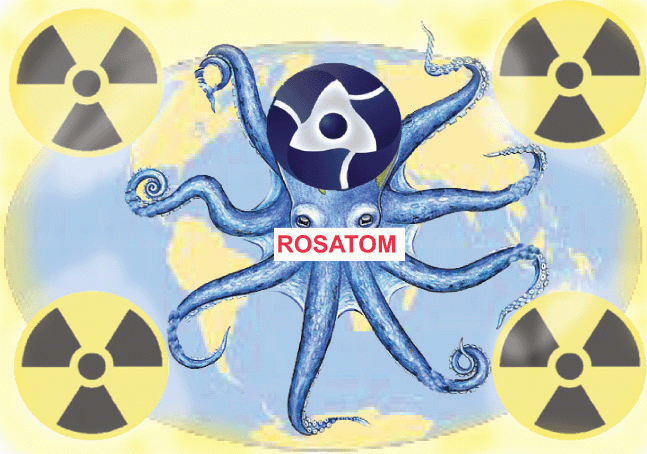
World Nuclear News 29th May 2018, Russia’s Rosatom and the French Alternative Energies and Atomic Energy
Commission (CEA) have signed a strategic document on partnership in the
peaceful uses of nuclear energy.
NEW YORK — Secretary of State Mike Pompeo cited progress Thursday toward salvaging a historic summit between President Trump and North Korean leader Kim Jong Un and what he called the “once in a lifetime opportunity” of ending the nuclear weapons threat from North Korea.
Following two days of talks with Kim’s right-hand aide, Vice Chairman Kim Yong Chol, Pompeo spoke as though the summit Trump had canceled last week was likely to be reinstated, but still framed it as an “expected” first meeting.
Israel ‘is selling nuclear information’ to Saudi Arabia, Middle East Monitor, May 31, 2018
Western security agencies believe that Israel is selling nuclear information to Saudi Arabia, Arabi21 has reported. According to Israeli writer Ami Dor-on, such information will give the government in Riyadh nuclear weapons capabilities. Writing on the News One website, Dor-on said that the joint intention is to make sure that Iran will not be the only country in the region that possesses such weapons which threaten the security and safety of the Kingdom.
“This information should shock us,” he said, “as we see the world is changing for the worse, following the race for the possession of nuclear weapons that pass right over our heads in the Middle East.” Saudi Arabia no longer conceals its wish to develop nuclear weapons, the writer added.
However, General Amos Yadlin, former chief of Israel’s Military Intelligence Directorate, has suggested that the Saudis would not wait to get nuclear capabilities. “They will go to Pakistan, and take whatever they want,” he claimed……..
While Pakistan could clearly simply transfer a nuclear bomb to Saudi Arabia, that would not be Israel’s intention. “Israel may transfer information and nuclear expertise to the Kingdom that would enable it to develop its advanced capabilities in this specific area,” Dor-on clarified. “Yadlin’s comments as a senior Israeli intelligence official gives credibility to the leaks of the Western intelligence services.”
Ex-Israeli spy chief: Netanyahu planned Iran strike in 2011 By ILAN BEN ZION, JERUSALEM (AP) 31 May 18 — Israeli Prime Minister Benjamin Netanyahu gave the order in 2011 for the military to prepare to attack Iran within 15 days, a former Mossad chief said in remarks released on Thursday.
Tamir Pardo, who served as head of the Israeli intelligence agency from 2011 to 2016, told Israeli Keshet TV’s investigative show Uvda that the order was not given “for the sake of a drill,” according to excerpts of the interview released ahead of the broadcast on Thursday evening.
“When he tells you to start the countdown process, you know that he isn’t playing games with you,” Pardo is quoted as saying. “These things have enormous significance.”
There was no immediate comment from Netanyahu’s office on Pardo’s claim.
On Wednesday, Netanyahu said Israel “will not allow Iran to arm itself with nuclear weapons. We will continue to act against its intentions to establish itself militarily in Syria besides us, not just opposite the Golan Heights, but any place in Syria.”
Pardo’s claim comes as archenemies Israel and Iran are fighting a shadow war in Syria, which briefly threatened to burst into full-blown conflagration this month after Israel bombed Iranian positions in Syria, killing Iranian fighters after an alleged Iranian rocket barrage toward the Israeli-controlled Golan Heights…….. https://apnews.com/ff3d8d27040e45f0a24beab254a63e3d
Scaling back of French reactor a blow for nuke fuel reprocessing THE ASAHI SHIMBUN May 31, 2018
Japan’s hopes of keeping its nuclear fuel recycling program alive faces another major obstacle with signs from France that a reactor project there will be scaled back because of swelling construction costs.
After the nuclear fuel recycling program suffered a heavy blow with the decision in late 2016 to decommission the Monju prototype fast-breeder reactor, government officials turned to France’s ASTRID program as an alternative information source for the fuel recycling plan.
But French government officials said the Advanced Sodium Technological Reactor for Industrial Demonstration will have its planned power generation scaled back from the initial plan of 600 megawatts of electricity to between 100 and 200 megawatts.
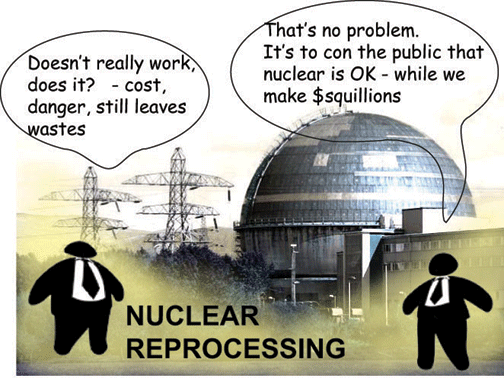
The major aim of the nuclear fuel recycling program is to reprocess spent nuclear fuel to extract plutonium, which would be used to create mixed-oxide fuel that could be burned in nuclear reactors.
Government officials had hoped to use various technologies emerging from the ASTRID program to eventually construct a demonstration fast reactor in Japan. But a scaled-back ASTRID would mean knowledge needed for the demonstration reactor would not be available.
According to several government sources, French government officials informed their Japanese counterparts of the planned reduction in the ASTRID power generation plan due mainly to the high construction costs.
French officials also inquired about the possibility of Japan shouldering half the ASTRID construction burden, which could run anywhere between several hundreds of billions of yen to about 1 trillion yen ($9.2 billion).
Plans call for constructing the ASTRID in France with construction to start sometime after 2023………
Even some officials of the Ministry of Economy, Trade and Industry, which has been promoting the nuclear fuel recycling program, have raised doubts about participating in the ASTRID program.
Concerns are also being raised among lawmakers in the ruling Liberal Democratic Party, with one executive wondering if cooperating with the ASTRID program could end up much like the Monju project, which wasted more than 1 trillion yen following a spate of accidents and other problems.















 nuclear-news