Safecast operates using measurements captured by volunteers. Data is verified and validated when two randomly selected people take the same measurement of the same place. Safecast’s reliable system means local people could count on its data and stay informed. Around 3,000 Safecast devices are deployed worldwide, and 100 to 150 volunteers regularly contribute their time and effort to the project.
As Safecast’s power and influence in society — both inside and outside of Japan — expanded, so did its technologies.
“We are a pro-data group, we are not an activist group,”
Back in 2011, soon after the 3/11 disaster, Safecast was born. Today, the global volunteer-centered citizen science organization is home to the world’s largest open data set of radiation measurements.
Safecast was a response to the lack of publicly available, accurate and trustworthy radiation information. The group initially set out to collect radiation measurements from many sources and put them on a single website. What the volunteers quickly realized was that there was simply not enough official data available.
Soon after the disaster, members attached a homemade Geiger counter to the side of their car and drove around Fukushima taking measurements. They quickly noticed that radiation levels were radically different even between streets, and that the government-issued city averages were far from sufficient as data that could be used by citizens to determine the safety of their areas.
Within weeks the group’s members decided to build their own Geiger counters and collect the data themselves. They picked the name Safecast the following month.
For months after the nuclear disaster began, the government released only very limited information about the spread of radiation. The first informative map of radiation levels in Fukushima, based on aerial surveys, was not available until May 2011. The first map with an adequate level of detail to show contamination in the Tokyo metropolitan area, including infamous “hot spots” in cities such as Kashiwa, Chiba Prefecture, was not released until October that year. As confusion spread and triggered panic among citizens, Safecast was determined to commit itself to one thing: openness. “What Safecast proves is that all the preparation in the world — all the money in the world — still fails if you don’t have a rapid, agile, resilient system,” explains Joi Ito, Safecast co-founder and director of MIT Media Lab, on Safecast’s website.
In 2012, Safecast began working with municipal governments in Fukushima to put Geiger counters on postal delivery cars and collect data. As international attention on the group’s activities grew, Safecast was invited to present its findings at an expert meeting at the International Atomic Energy Agency in February 2014.
Safecast operates using measurements captured by volunteers. Data is verified and validated when two randomly selected people take the same measurement of the same place. Safecast’s reliable system means local people could count on its data and stay informed. Around 3,000 Safecast devices are deployed worldwide, and 100 to 150 volunteers regularly contribute their time and effort to the project. “How do you make a trustworthy system where the people don’t have to trust each other?” Azby Brown, Safecast’s lead researcher, asked during a recent interview at its Shibuya office.
As Safecast’s power and influence in society — both inside and outside of Japan — expanded, so did its technologies. The group’s first mobile device, named “bGeigie” with b standing for bento (boxed lunch), was built and deployed in April 2011. The first of these needed to be tethered to a laptop for data collection. But the group soon developed all-in-one devices. They were gradually shrunk, and the “bGeigie Nano” sold as a kit is now the organization’s main machine. It’s compact and able to accumulate all of the data it captures onto a memory card.
In December, Safecast members were given a special tour of Tokyo Electric Power Co. Holdings’ gutted Fukushima No. 1 nuclear power plant. The operator allowed them, for the first time ever, to bring their sensors on site and openly measure radiation there during the hourlong tour, with the clear understanding that they would publish the data and radiation maps openly online. “We consider it an important step towards transparency on Tepco’s part,” Brown said in an email. Then in January, Safecast managed to install a “Solarcast Nano,” a solar-powered real-time radiation monitor, on the fence of an abandoned facility for the elderly about 2 km from Fukushima No. 1. It is the closest independent real-time data-collection point to the crippled plant. Over the years, the group has collected over 90 million data points worldwide. Each data point comes with a string of data containing the time, GPS coordinates and a radiation measurement.
It’s been seven years since the devastating earthquake and tsunami, and the subsequent meltdown of the nuclear power plant, so why is Safecast’s work still relevant today?
“We are a pro-data group, we are not an activist group,” said Pieter Franken, another Safecast founding member. Safecast is constantly supplying local people with up-to-date information on radiation conditions, allowing them to make crucial decisions such as where and when evacuees can move back. Many locals are also volunteers, motivated by their emotional attachment to the area and determined to do their part in rebuilding their hometown, the group said.
While most of Safecast’s volunteers in Japan are Japanese who wanted to help out as much and as quickly as they could with the skills that were available, the unique composition of the group’s core members — many of whom are non-Japanese and hailing from diverse academic and professional backgrounds — has given the group the advantage of an outside perspective, and an agility that locals lacked. Franken is a computer scientist who has worked in the financial industry for over 25 years, while another founding member, Sean Bonner, has worked in community activism and is currently an associate professor of media and governance at Keio University. And Brown, who is a senior adviser at the Kanazawa Institute of Technology and also teaches at other Japanese universities, is a design and architecture expert. “A true Japanese company would have spent two years making the perfect Geiger counter before they would have released anything,” said Franken. “You need a little bit of extra impulse,” he added. “I think that is where, if you look at the composition of this group, some of us were in a unique position because of our ability to work in Japan, but also work with people outside to provide that spark to go and do it.”
In fact, as Brown explained, they have the ability to work as foreigners in Japan — without facing the social consequences of speaking out, criticizing or breaking rules that have prevented many Japanese and local firms from being able to help out as much as they wanted to. At the same time, most key members of Safecast are long-term residents of Japan and their desire to help amid the disaster was deeply rooted. “Not one of us flew away or would even think of abandoning our home just because there is a disaster. We live in Japan; this is our home,” said Joe Moross, a Safecast engineer and expert on radiation and environmental sensors.
Unfortunately, the environmental effects of the nuclear disaster will persist for decades. Brown believes that because cesium is known to migrate slowly into the soil, there is a possibility that some plants and trees will show higher levels of radioactivity in five to 10 years as the cesium reaches their roots.”We have to keep the pressure up and the only way to do this is to consistently keep on going, even if there is no disaster,” explained Franken. Holding workshops for high school and college students both in Japan and around the world, Safecast is continuing to expand its dominance in the field of independent radiation monitoring. Franken explained that by hosting these events, Safecast hopes to increase its volunteers and people’s awareness about the nuclear issues at hand.
“It’s been an amazing experience to be able to create something positive out of something so negative,” Franken said.
There’s no slowing down for Safecast. “Globally, we still have a lot to fill in,” said Bonner, noting there are still many places that have no or little data, such as Russia and China. “(At the) beginning of last year we started to measure air quality as well, so that’s another effort that we’re starting to reach out to. Between those two things, that’s a significant amount of stuff.
“We haven’t finished what we started,” he said. “We can’t even begin to think of what’s the next thing. We still have a lot of work to do that we’re still deeply engaged in doing.”
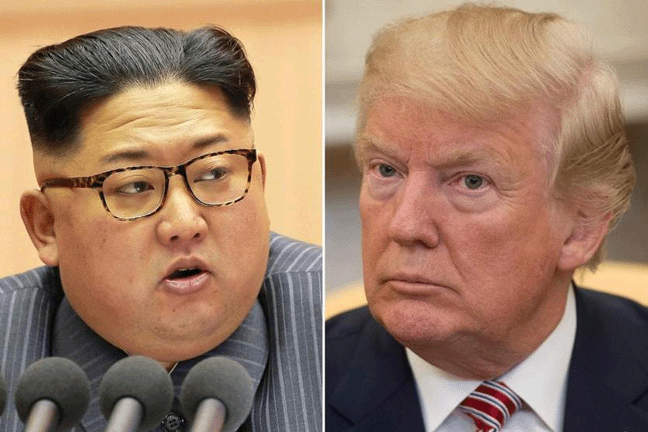
Donald Trump’s historic bet on Kim Jong Un summit shatters decades of orthodoxy Straits Times 9 Mar 18 WASHINGTON (BLOOMBERG) –US President Donald Trump took the biggest gamble of his presidency on Thursday (March 8), breaking decades of US diplomatic orthodoxy by accepting an invitation to meet with North Korean leader Kim Jong Un.
The bet is that Mr Trump’s campaign to apply maximum economic pressure on Mr Kim’s regime has forced him to consider what was previously unthinkable: surrendering the illicit nuclear weapons programme begun by his father.
If the president is right, the US would avert what appeared at times last year (2017) to be a steady march towards a second Korean War………
Regardless of how it turns out, the stunning decision by Mr Trump hands Mr Kim a prize long sought by the regime’s ruling dynasty: the legitimacy conferred by a historic meeting with the sitting president.
So much could go wrong.
…….Senator Brian Schatz, a Hawaii Democrat, applauded Mr Trump’s diplomatic effort.
“Expectations should be low and history demonstrates that scepticism and careful diplomatic work are necessary, but it is better to be talking about peace than recklessly ramping up for a war,” he said on Twitter.
DENUCLEARISATION ‘UNLIKELY’
Mr Adam Mount, a senior fellow at the Federation of American Scientists, said that while the talks would extend the period of relative warmth that began during the Olympics, denuclearisation remained “extremely unlikely”.
Nuclear weapons are fundamental to the Kim family’s grip on power at home.
“Kim Jong Un has rational incentives to keep his nuclear arsenal,” Mr Mount said in a phone interview.
He also cautioned that the meeting was “a massive coup” for a regime that “wants to be seen as a regular nuclear power”.
It could lend Mr Kim insights into how the US and South Korea coordinate, and the regime could test Mr Trump by asking for exorbitant terms in exchange for denuclearisation.
Trump accepts invitation to meet with North Korean leader Kim Jong Un Boston Globe, By Anna FifieldTHE WASHINGTON POST
TOKYO – President Donald Trump has agreed to meet with North Korean leader Kim Jong Un for talks, an extraordinary development following months of heightened nuclear tension during which the two leaders exchanged frequent military threats and insults.
Kim has also committed to stopping nuclear and missile testing, even during joint military drills in South Korea next month, Chung Eui-yong, the South Korean national security adviser, told reporters at the White House on Thursday night after briefing the president on his four-hour dinner meeting with Kim in Pyongyang on Monday.
After a year in which North Korea fired intercontinental ballistic missiles capable of reaching all of the United States and tested what is widely thought to have been a hydrogen bomb, such a moratorium would be welcomed by the United States and the world.
Trump and Kim have spent the past year making belligerent statements about each other, with Trump mocking Kim as ‘‘Little Rocket Man’’ and pledging to ‘‘totally destroy’’ North Korea and Kim calling the American president a ‘‘dotard’’ and a ‘‘lunatic’’ and threatening to send nuclear bombs to Washington, D.C.
But Kim has ‘‘expressed his eagerness to meet President Trump as soon as possible,’’ Chung told reporters.
‘President Trump said he would meet Kim
Jong Un by May,’’ Chung said, but he did not provide any information on where the meeting would be. In Seoul, the presidential Blue House clarified that the meeting would occur by the end of May.
Editorial: 7 years after Fukushima meltdowns, time to review insistence on nuclear power, (Mainichi Japan) Japan has no choice but to make fundamental changes to its energy policy. Weren’t we all convinced of that when the crisis at the Fukushima nuclear power plant broke out seven years ago, and we were faced with the horrors and the massive impact of a nuclear disaster?
And yet, time has passed with little change in policy or society. Rather, whether out of sheer inertia or habit, the past seven years have been spent on maintaining nuclear power plants.
Steps are being taken toward resuming the operation of nuclear reactors that had been halted, and though permitting the continued use of aging reactors had once been an exception, it is becoming more the rule. Japan also keeps holding out hope for the nuclear fuel cycle, which has repeatedly proven to be a failure.
The process by which policy decisions are being made has not changed, which means there is no framework through which to turn the public’s desire to break free from its dependence on nuclear power into reality.
…….. Last year, the global cumulative installed capacity of solar power amounted to a total of around 400 gigawatts, while that of wind-generated power reached approximately 540 gigawatts, which was an increase of 10 times and 2.5 times, respectively, since 2010. The installed capacities of such renewable energy surpass that of not only nuclear power, but also of coal-fired thermal power.
……..Probably the most accurate take of the world’s nuclear power market is that it is on the decline. Even China, which is marginally supporting the nuclear energy market, is increasingly being seen as a major force behind the expansion of renewable energy, more so than nuclear power. Japan, which is stubbornly trying to maintain nuclear power, is already falling behind global trends.
There is, however, a slight hint that change may be afoot within the Japanese government……..
Greenpeace 8th March 2018, The Japanese government has announced that it had accepted all four
recommendations made at the United Nations Human Rights Council (UNHRC) on
the rights of evacuees from the Fukushima Daiichi nuclear accident.
The decision is a victory for the human rights of tens of thousands of
evacuees, and civil society that have been working at the UNHRC and
demanding that Japan accept and comply with UN principles.
The decision means that the Japanese government must immediately change its unacceptable
policies, said Greenpeace.
The announcement by the Ministry of Foreign Affairs was made in a formal submission to the UNHRC. Japan is to give its
formal decision on 16 March at the UNHRC Universal Periodic Review session in Geneva to recommendations made by Austria, Portugal and Mexico on the need to respect the rights of Fukushima, particularly women and children,
and from Germany, which called on Japan to protect citizens from harmful
radiation by dramatically reducing permitted radiation exposure.
At an event held in Tokyo today, where two evacuee mothers, a leading lawyer
representing Fukushima citizens, Human Rights Now, and Greenpeace,
explained the crisis facing many survivors and the multiple violations of
their rights by the government of Shinzo Abe and the implications of its
decision to accept all the four UNHRC recommendations. http://www.greenpeace.org/japan/ja/news/press/2018/pr20180308/
Mikhail Gorbachev was the president of the Soviet Union and is the author of The New Russia.
When I became the leader of the Soviet Union in 1985, I felt during my very first meetings with people that what worried them the most was the problem of war and peace. Do everything in order to prevent war, they said.
By that time, the superpowers had accumulated mountains of weapons; military build-up plans called for “space combat stations,” “nuclear-powered lasers,” “kinetic space weapons” and similar inventions. Thank God, in the end none of them were built. What is more, negotiations between the U.S.S.R. and the United States opened the way to ending the nuclear arms race. We reached agreement with one of the most hawkish U.S. presidents, Ronald Reagan, to radically reduce the arsenals.
Today, those achievements are in jeopardy. More and more, defense planning looks like preparation for real war amid continued militarization of politics, thinking and rhetoric.
The National Security Strategy and Nuclear Posture Review published by U.S. President Donald Trump’s administration in February orients U.S. foreign policy toward “political, economic, and military competitions around the world” and calls for the development of new, “more flexible” nuclear weapons. This means lowering the threshold for the use of nuclear weapons even further.
The Bulletin of Atomic Scientists, published in Chicago, set the symbolic Doomsday Clock half a minute closer to “Midnight” in January. As the scientists see it, we are now within two minutes of a global catastrophe. The last time this level of danger was recorded in 1953.
The alarm that people feel today is fully justified.
How should we respond to this new round of militarization?
Above all, we must not give up; we must demand that world leaders return to the path of dialogue and negotiations.
The primary responsibility for ending the current dangerous deadlock lies with the leaders of the United States and Russia. This is a responsibility they must not evade, since the two powers’ arsenals are still outsize compared to those of other countries.
But we should not place all our hopes on the presidents. Two persons cannot undo all the roadblocks that it took years to pile up. We need dialog at all levels, including mobilization of the efforts of both nations’ expert communities. They represent an enormous pool of knowledge that should be used in the interest of peace.
Things have come to a point where we must ask: Where is the United Nations? Where is its Security Council, its Secretary General? Isn’t it time to convene an emergency session of the General Assembly or a meeting of the Security Council at the level of heads of state? I am convinced that the world is waiting for such an initiative.
There is no doubt in my mind that the vast majority of people both in Russia and in the United States will agree that war cannot be a solution to problems. Can weapons solve the problems of the environment, terrorism or poverty? Can they solve domestic economic problems?
We must remind the leaders of all nuclear powers of their commitment under the Nuclear Non-Proliferation Treaty to negotiate reductions and eventually the elimination of nuclear weapons. Their predecessors signed that obligation, and it was ratified by the highest levels of their government. A world without nuclear weapons: There can be no other final goal.
However dismal the current situation, however depressing and hopeless the atmosphere may seem, we must act to prevent the ultimate catastrophe. What we need is not the race to the abyss but a common victory over the demons of war.
Good news! Commercial fusion power has always been 30 years away no matter what year it is, but now some folks say it’s only 15 years away:
The project, a collaboration between scientists at MIT and a private company, will take a radically different approach to other efforts to transform fusion from an expensive science experiment into a viable commercial energy source.
….A newly available superconducting material — a steel tape coated with a compound called yttrium-barium-copper oxide, or YBCO — has allowed scientists to produce smaller, more powerful magnets. And this potentially reduces the amount of energy that needs to be put in to get the fusion reaction off the ground….The planned fusion experiment, called Sparc, is set to be far smaller — about 1/65th of the volume — than that of the International Thermonuclear Experimental Reactor project, an international collaboration currently being constructed in France.
By 2040 or so, we’ll have robots doing all the work and clean, cheap fusion providing all the power we need. You just gotta believe.
Three firms file disclosures to consult with Saudi Arabia
Deal faces obstacles over fears about uranium enrichment
Saudi Arabia is enlisting blue-chip lobbyists in Washington as it prepares for a fight over its ambition to build nuclear power plants.
Three law firms have filed disclosures saying they’re advising the kingdom on the issue, as American and Saudi leaders negotiate the contours of a possible nuclear technology-sharing agreement that could allow the enrichment of uranium.
The flurry of registrations underscores the high stakes in Saudi Arabia’s bid to build as many as 16 nuclear reactors over the next quarter century. Trump administration officials, eager to revive the moribund American nuclear industry, are pushing the kingdom to consider a consortium of U.S. companies for the job instead of competitors from Russia, China and other countries.
One of the law firms, Pillsbury Winthrop Shaw Pittman LLC, said in a Feb. 20 Justice Department filing that it would be billing the Saudi Arabia Ministry of Energy, Industry and Mineral Resources $890 per hour to give advice on a potential bilateral agreement with the U.S. “concerning peaceful uses of nuclear energy under Section 123 of the Atomic Energy Act of 1954” as well as “related legal matters concerning the development of a commercial nuclear program.”
DOJ Filings
Among the key players is Jeff Merrifield, a former presidential appointee on the Nuclear Regulatory Commission who now leads Pillsbury’s energy practice.
King and Spalding LLP used almost identical language in a Feb. 21 filing with the Justice Department, which maintains registrations of foreign agents in the U.S. The firm said it would be paid as much as $450,000 for an initial 30-day contract, which could be extended.
And in a third registration on Feb. 20, David Kultgen, a lawyer and retired Saudi Arabian Oil Company executive, said he was recruited in early October to provide legal and consulting services to Saudi Arabia, including on its national atomic energy project.
Plutonium Warnings
Lawmakers and nonproliferation experts warn that without strict prohibitions, a deal to supply Saudi Arabia with nuclear power plants could allow spent fuel to be reprocessed into weapons-grade plutonium.
Energy Secretary Rick Perry met with Saudi officials in London last week to discuss the possible nuclear plant deal, even as the Trump administration reluctantly prepares to offer the Saudis an accord that falls short of a so-called “gold standard” prohibition on enriching and reprocessing of uranium that was embedded in a nuclear-sharing agreement with the United Arab Emirates a decade ago.
At least one other such “123 agreement” to share nuclear technology — named after a section of the U.S Atomic Energy Act — contains similar prohibitions, but more than a dozen others fall short of that “gold standard.”
Supporters of a nuclear plant agreement are girding for a fight. Even if the Trump administration agrees to share nuclear technology with Saudi Arabia, the deal faces bipartisan criticism in Congress. Federal law requires congressional approval of and consultation over any 123 agreements laying out the framework for nuclear cooperation, with a special role reserved for the House Committee on Foreign Affairs and the Senate Committee on Foreign Relations.
Netanyahu’s Concerns
Under some scenarios, a 123 agreement can enter into force after 60 days unless Congress adopts a joint resolution disapproving it, according tothe Congressional Research Service.
Israeli Prime Minister Benjamin Netanyahu shared his concerns about Riyadh’s nuclear power goals with the Senate Foreign Relations Committee earlier this week, telling lawmakers he opposed any agreement allowing the Saudis to enrich uranium and reprocess plutonium.
The chairman of that committee, Senator Bob Corker, a Republican from Tennessee, said that “there will be a lot of attention paid as to how this is crafted.”
And that scrutiny is bipartisan. Senator Ed Markey, a Democrat from Massachusetts who also sits on the Foreign Relations panel, said any watering down of the gold standard “would set a negative precedent for the entirety of the Middle East.”
“It would be hard to say to the United Arab Emirates, to the Egyptians, and for that matter other countries around the world, that they shouldn’t also have uranium enrichment and plutonium reprocessing,” Markey said in an interview.
MIT Receives Millions to Build Fusion Power Plant Within 15 Years https://gizmodo.com/mit-receives-millions-to-build-fusion-power-plant-withi-1823644634?IR=T Ryan F. Mandelbaum 10 Mar 18 Nuclear fusion is like a way-more-efficient version of solar power—except instead of harnessing energy from the rays of a distant sun, scientists create miniature suns in power plants here on Earth. It would be vastly more efficient, and more importantly, much cleaner, than current methods of energy production. The main issue is that actually realizing fusion power has been really difficult.
But MIT has announced yesterday that it is working with a new private company called Commonwealth Fusion Systems (CFS) to make nuclear fusion finally happen. CFS recently attracted a $50 million investment from the Italian energy company Eni, which it will use to fund the development.
The goal? “The 15-year timeline is to get a device that puts 200 megawatts on the grid,” CFS CEO and MIT grad Robert Mumgaard told Gizmodo. “That’s a small city.”
Nuclear fusion is the process by which two hydrogen atoms are fused together into helium. This process results in the release of lots of energy. Scientists have been chasing fusion for a long time, perhaps since the 1950s. But there have been technological roadblocks, mainly making a device that outputs more energy than it takes to run. Another fusion device under construction in Europe called ITER, for example, should be ready by 2035 but is far over budget. The US Senate has attempted to pull out of the project, reports Nature.
MIT’s “tokamak” fusion reactor seems to promise much cheaper fusion power. It relies on a non-traditional, higher-temperature superconductor called ytterbium-barium-copper-oxide, a kind of cuprate, to allow electricity to flow efficiently without resistance. These produce strong magnetic fields and high pressures in plasma that confine the fusion reactions inside of the device. The sun confines its own reactions with its immense gravity.
The MIT group has been researching the device for a few years. This infusion of capital should allow them to build magnets four times stronger in the next three years. The planned device, called Sparc, will be a 65th of ITER’s size but release a fifth the power, according to an email sent by MIT’s press office.
Of course, there are challenges. Martin Greenwald, deputy director of MIT’s Plasma Science and Fusion Center, told Gizmodo that they have yet to actually develop these magnets and integrate them into such a machine. They will also need to learn how to build and operate the device, and bring it to a position that it can actually enter the market.
It’s important to note that fusion is way different from fission, the process that powers current nuclear power plants. Fusion can’t cause an explosive runaway chain reaction without some sort of fissile material, and rather than using uranium like fission does, it’s water and lithium in, helium out. This also cuts down on nuclear weapons risks. “There’s no reason to have fissile materials around fusion plants,” said Greenwald. “If you do, you’re up to no good.”
Some, like the folks at the Bulletin of the Atomic Scientists, still worry that the excess neutrons produced in fusion could lead to radioactive waste or contaminants, as well as high costs.
Nature points out that there are plenty others are in the fusion-with-high-temperature-superconductors game, too. Princeton has its own tokamak, and there’s a British company called Tokamak Energy using a similar device to produce fusion energy. But all of the cash towards the MIT effort is significant.
“If MIT can do what they are saying—and I have no reason to think that they can’t — this is a major step forward,” Stephen Dean, head of Fusion Power Associates, in Maryland, told Nature. Perhaps all fusion power needed to become reality was, well, a lot of money. Mumgaard said that CFS’ collaboration with MIT will “provide the speed to take what’s happening in the lab and bring it to the market.”
The 4,800 megawatt Akkuyu plant is a intended to reduce Turkey’s dependence on energy imports but has been beset by delays since Russia was awarded the contract in 2010.
But Turkish companies have been put off by the size of the financing required as well as by concerns they will not receive a sufficient share of the lucrative construction side of the deal, two industry sources said.
The firms are also worried that the guaranteed electricity price could eventually be lowered, reducing future revenue, they said.
Rosatom did not respond to a request for comment. Officials for EUAS and the government declined to comment.
Rosatom last year said it would sell 49 percent of Akkuyu Nukleer AS, the company which will build and operate the plant, to a consortium made up of Kolin Insaat, Kalyon Insaat and Cengiz Holding – Turkish firms that have been awarded major infrastructure projects under Erdogan.
However, the final agreement was never signed and Rosatom said Kolin and Kalyon had decided to pull out of the project.
March 9, 2018, BY ORHAN COSKUN AND CAN Sezer ANKARA/ISTANBUL (Reuters) – Turkey’s first nuclear power plant is likely to miss its 2023 target start-up date as Russian builder Rosatom struggles to find local partners, two people familiar with the matter said.
The $20 billion project is part of President Tayyip Erdogan’s “2023 vision” marking 100 years since the founding of modern Turkey.
Rosatom is looking at four Turkish companies as possible partners, but little progress has been made so far, said one of the sources, both of whom declined to be identified because the information is not yet public.
Rosatom said last month it was in talks with state-owned power producer EUAS after a deal with a consortium of three firms collapsed
“Concrete progress has not been made in the talks so far, and this includes EUAS from the government side,” one source said, adding that Rosatom was keen to have a government entity such as EUAS as a shareholder.
Rosatom is looking for Turkish partners to take a 49 percent stake in the planned Akkuyu nuclear plant in southern Turkey.
But the government is wary of EUAS taking on the 49 percent stake by itself.
“A 49 percent stake still means $10 billion of funding even if it’s spread over years,” the source said. “It is a very big project, there are many details and issues that need to be worked on. We can’t expect this to be resolved soon.”
The project is to be financed by Rosatom and its partners and will involve loans from export-import agencies and banks, Anastasia Polovinkina, director of Rosatom affiliate Rusatom Energy International told a conference in June 2017.
FINANCING
The 4,800 megawatt Akkuyu plant is a intended to reduce Turkey’s dependence on energy imports but has been beset by delays since Russia was awarded the contract in 2010.
But Turkish companies have been put off by the size of the financing required as well as by concerns they will not receive a sufficient share of the lucrative construction side of the deal, two industry sources said.
The firms are also worried that the guaranteed electricity price could eventually be lowered, reducing future revenue, they said.
Rosatom did not respond to a request for comment. Officials for EUAS and the government declined to comment.
Rosatom last year said it would sell 49 percent of Akkuyu Nukleer AS, the company which will build and operate the plant, to a consortium made up of Kolin Insaat, Kalyon Insaat and Cengiz Holding – Turkish firms that have been awarded major infrastructure projects under Erdogan.
However, the final agreement was never signed and Rosatom said Kolin and Kalyon had decided to pull out of the project.
Report says radioactive monitors failed at nuclear plant, abc news, By THE ASSOCIATED PRESS RICHLAND, Wash. — Mar 9, 2018, A new report says mistakes and mismanagement are to blame for the exposure of workers to radioactive particles at the Hanford Nuclear Reservation in Washington state.
Contractor CH2M Hill Plateau Remediation Co. on Thursday released its evaluation of what went wrong in December during demolition of the nuclear reservation’s highly contaminated Plutonium Finishing Plant.
N-power project junked due to Fukushima disaster Gujarat CM. Energy World
The project was proposed to be set up at Mithivirdi village in Bhavnagar district, said Energy Minister Saurabh Patel. March 09, 2018, Gandhinagar: Gujarat Chief Minister Vijay Rupani today told the Assembly the proposal to set up a nuclear power plant in Bhavnagar district has been scrapped owing to a movement by panic-stricken locals following the 2011 Fukushima nuclear accident in Japan.
The project was proposed to be set up at Mithivirdi village in Bhavnagar district, said Energy Minister Saurabh Patel.
He was speaking during a debate on the issue during Question Hour of the Assembly which is having its budget session.
Taking part in the debate, Rupani said though the state government had signed an MoU with Nuclear Power Corporation of India (NPCIL) in 2007, the project was eventually scrapped by the PSU after villagers raised apprehensions about their safety in the wake of radioactive “leak” from the Fukushima nuclear plant following a tsunami.
Rupani was replying to a question by Imran Khedawala (Congress) about the status of the proposed 6,000 MW nuclear power plant, for which the state had signed agreements with NPCIL in 2007 during the Vibrant Gujarat Summit.
“This project has been scrapped permanently by NPCIL. During the UPA rule, then Prime Minister Manmohan Singh had signed a nuclear deal with the USA. After that, a total of six nuclear plants were planned across the country and this plant in Bhavnagar was one of them,” he said.
Russia to help with Ethiopia’s nuclear energy ambitions, African News
Source: Xinhua 2018-03-10 00:32:45
ADDIS ABABA, March 9 (Xinhua) — Ethiopia and Russia agreed on Friday to boost cooperation in nuclear energy during a visit by Russian Foreign Minister Sergey Lavrov.
Speaking to local and international media, Lavrov said Russia will assist Ethiopia’s nuclear energy ambitions as part of efforts to strengthen political, economic and cultural ties between the two nations…..http://www.xinhuanet.com/english/2018-03/10/c_137028152.htm
In Cumbria 9th March 2018, Nuclear Decommissioning Authority funds have helped two UK businesses
develop a small drone to measure radiation levels in the damaged reactor
building of the Fukushima nuclear power plant in Japan. The lightweight
drone uses lasers to self-navigate deep inside hazardous facilities where
GPS signals cannot reach, and has already been used successfully at
Sellafield.
Wang Yi says the moment has arrived to test whether all sides are sincere in wanting to resolve tensions over Pyongyang’s nuclear weapons programme
China called for direct dialogue between North Korea and the United States to defuse tensions on the Korean peninsula and warned there was still the potential for chaos amid the stand-off over Pyongyang’s nuclear weapons programme.
The warning by Chinese Foreign Minister Wang Yi on Thursday came despite the announcement that North and South Korea’s leaders are to meet at a summit, raising hopes that the nuclear crisis might be defused. …….
The South China Morning Post reported that North Korean leader Kim Jong-un may propose sending his sister, Kim Yo-jong, to the US as part of efforts to launch direct talks between Washington and Pyongyang.
This may be one of a number of possible messages South Korean envoy Chung Eui-yong will deliver to US National Security Adviser H.R. McMaster in Washington this week, a South Korean diplomatic source told the Post, speaking on condition of anonymity.
Chung is travelling to Washington with South Korea’s national intelligence service chief Suh Hoon, who, according to multiple South Korean diplomatic sources, will meet his US counterpart Mike Pompeo.
……. The fact that North Korea did not conduct nuclear and missile tests during the Winter Olympics, while South Korea and the United States have suspended their military drills, proved that China’s approach to handle the nuclear crisis was effective, Wang said.









 nuclear-news