Novichok A234 – The facts – Exclusive to nuclear-news.net
Posted to nuclear-news.net by Shaun McGee (aka arclight2011)
Posted on 29th March 2018
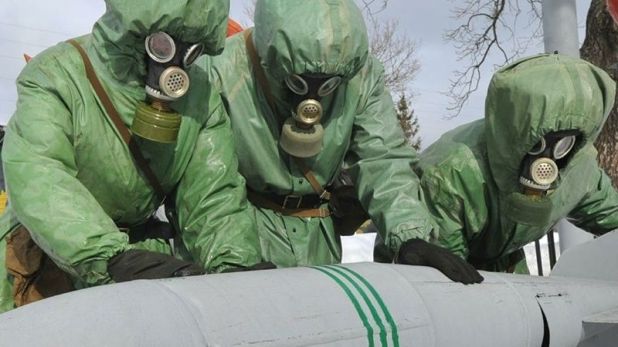
Thanks to Prof. Chris Busby for proofreading the chemical composition from the chemist source materials ( linked here link) and for his input into this article.
After some research on Novichok i discovered that;
1/ Militarised Organophosphates (MOP) can be processed into a sticky oil or a fine powder and there are at least 4 types
2/ New Nuclear, biological and chemical NBC suits were developed before Desert Shield as the Novichok series of chemical agents were designed to circumnavigate the old Noddy suits supplied to the military.
3/ Novichok series compounds are detectable easily with testing equipment developed prior to Desert Shield
4/ It is very likely that an antidote was developed prior to desert shield (especially as Skripals daughter and the policemen are recovering)
5/ By making all references to Novichok series a matter of national security the OPCW was not told that these compounds were so dangerous thus allowing the USA and UK to keep such weapons on their shelves.
6/ Most of the Russian peer reviewed studies on this were done under the guise of fertiliser/insecticide production
7/ Although some of the precursors like SO2 are very nasty making this product difficult to produce a synthetic chemist in a lab could produce it
8/ Concerning the Polonium 210 poisoning of Litvinyenko, this polonium could have been synthesised by reducing radium tubes and dials etc reasonably easily
I have some a posit that these chemicals were not recognised as a chemical weapon because of the need to protect Big Agri profits and their business models (ever wonder why Russia agriculture is mainly organic?)
I decided to see if any country could make this and decided to see if Ukraine (as an example) could have produced this. A 2017 OSCE report cited the need to improve chemical handling, transportation and safety in Ukrainian labs needed to be improved so a 3 year plan was initiated and funded by the EU and USA. Ukraine also sent battalion of chemical trained soldiers to Kuwait before the Iraq invasion. One week after the incident with the Skripals the Ukrainian Gov. sent this message to the UK ;
“…Ukraine is ready to provide Britain with assistance in investigating the case of poisoning of former Russian intelligence agent Sergei Skripal and his daughter, Ukrainian Foreign Minister Pavel Klimkin said….”
Did the UK and USA also hide this product so they could have used it in Iraq or similar?
Ukraine had the basic Potash needed for manufacture of Novichok;
“…John J. McKetta Jr – 1989 – Science
Of the foreign producers, the largest is the USSR, and its producing centers are the Upper Kama Basin of the western Urals, the Starobinsk Basin in Belorussia, and the Ciscarpathian area in the western Ukraine. USSR production has nearly tripled since 1969. Sulfates of potash are produced in the Ukraine, and Muriate Organphosphate is produced at the Upper Kama and Starobinsk basins …”
Some food for thought. Though Ukraine may not have produced this it could have been a criminal crowd in Russia or any secret services etc etc. I used Ukraine as an example and there is no direct proof that Ukraine was responsible though they were capable, thereby, busting the UK and USA government line that it HAD to be Russia!
Sources for quotes;
“…We proudly represent products of leading Russian, Belarus, and Ukrainian fertilizer producers. Member of the International Fertilizer Association. products. MOP / KCl – Muriate of Potash Ammonium Sulphate – granular / crystalline. SOP – Potassium Sulfate Calcium Ammonium Nitrate NPK blends – 15-15-15, 16-16-16…..” http://lushburyfertilizer.com/
From 2017 .. OSCE report with recommendations to have plans in place by 2020 “..2. Objectives
The overall objective of this Decision is to support OSCE projects aiming at strengthening chemical safety and security in Ukraine in line with UNSCR 1540 (2004) and the Association Agreement by providing a significant contribution to the ICSSP in Ukraine. In particular, this Decision aims at reducing the threat posed by the illicit trade of controlled and toxic chemicals in the OSCE region, in particular in Ukraine, thus promoting peace and security in the Union’s neighbourhood…..” https://eur-lex.europa.eu/legal-content/EN/TXT/?uri=CELEX%3A32017D1252
2003 – Kuwait gets a NBC Ukranian battalion trained in NBC protection and cleanup to protect them from Iraq`s “chemical weapons” https://www.kuna.net.kw/ArticlePrintPage.aspx?id=1327966&language=en
13th March 2018 – “…Ukraine is ready to provide Britain with assistance in investigating the case of poisoning of former Russian intelligence agent Sergei Skripal and his daughter, Ukrainian Foreign Minister Pavel Klimkin said.
“The UK is investigating, of course, it will bring it (until the end – IF.) It is already known that the poisoning was due to chemicals that were developed in Russia … We are in solidarity with Britain if we need our help – expert or other – we will provide it, “the minister said to journalists on Tuesday in Kiev….” http://interfax.com.ua/news/general/491334.html
Image source; Crimea: Ukraine notifies NATO of possible chemical weapons supply – http://qha.com.ua/en/politics/crimea-ukraine-notifies-nato-of-possible-chemical-weapons-supply/139605/
Toxic threat from Tiangong-1 Chinese space station crash soon!
Speculation regarding the crash of China’s Tiangong-1 space station has been going on all month, but that will come to an end this week. The space station is set to fall into the Earth within the next few days.
The earliest estimates have Tiangong-1 crashing into Earth on Friday (March 30).
Tiangong-1’s Fall
There has been a lot of news coverage for the better part of a month predicting where Tiangong-1 will fall. Predictions currently have the space station coming down to Earth within the next week. The earliest estimates have the station crashing into the planet by Friday, March 30.
China admitted in January 2018 that it lost control of the space station. It had previously lost contact with the space station in 2016.
The current window for the re-entry of Tiangong-1 has it coming in late on March 30 to the early morning of April 2. Tiangong-1 has been monitored by the Inter-Agency Space Debris Coordination Committee. This agency predicts that it will fall to Earth between 43° N to 43° S latitude.
It is very unlikely that the debris from the space station will strike anyone. No one has ever died from being struck by space debris, there has been one person that has been struck. On its current path, the space station is likely to fall on locations closer to the northern latitudes.
Toxic threat warning!
There is a potentially highly toxic substance called hydrazine aboard the space station that could survive the reentry. People who come across debris from the space station are advised to stay away from it.

Image source; http://www.toxipedia.org/display/toxipedia/Hydrazine
Watching Tiangong-1’s Crash
There will be a webcast of the re-entry of Tiangong-1 on Wednesday (March 28), and it is set to begin at 8:00 a.m. EDT. It will provide views of the space station while it is still out in space. Determining where Tiangong-1 will fall will be complicated.
Since much of the Earth is uninhabited, there is a chance that the space station will land in a remote location such as the ocean. This would make it harder for people to see the crash since no one will be around. Even as little as 7 hours before the crash, there will still be an uncertainty of where Tiangong-1 will fall.
There will be changes in the sky in areas that are able to see the space station crash. Since the space station is tumbling, there will be tracks across the sky, and rapid changes in its brightness.
Plutonium contamination of North west Canada from Kosmos–954 ;
“….The fall of the 4 t satellite over Canada on January 24, 1978 would have been a disaster in urban areas: its nuclear reactor was powered by 31.1 kilograms of 235U. Radioactive waste contaminated an area of over 124,000 km2 in the Northwest. Territories and the provinces of Canada…” http://www.robindesbois.org/wp-content/uploads/2011/06/Space-Waste.pdf
USA has increased production of Plutonium 238 for its future space program;
“…..Jan 1, 2016 – For the first time in 30 years, the United States produced an isotope of plutonium that powers NASA’s deep-space missions. A total of 50 grams of plutonium-238 was produced at the Department of Energy (DOE)’s Oak Ridge National Laboratory (ORNL) in Tennessee….” https://www.space.com/31499-us-makes-plutonium-deep-space-fuel.html
Small Modular Nuclear Reactors – their connection to nuclear weapons development

Although unstated, by far the most likely source for such support is a continuing national civil nuclear programme. And this where the burgeoning hype around UK development of SMRs comes in. Leading designs for these reactors are derived directly from submarine propulsion. British nuclear submarine reactor manufacturer Rolls-Royce is their most enthusiastic champion. But, amid intense media choreography, links between SMRs and submarines remain (aside from reports of our own work) barely discussed in the UK press.
This neglect is odd, because the issues are very clear. Regretting that military programmes are no longer underwritten by civil nuclear research, a heavily redacted 2014 MoD report expresses serious concerns over the continued viability of the UK nuclear submarine industry. And Rolls-Royce itself is clear that success in securing government investment for SMRs would “relieve the Ministry of Defence of the burden of developing and retaining skills and capability” for the UK’s military nuclear sector.
Why is the UK government so infatuated with nuclear power? https://www.theguardian.com/science/political-science/2018/mar/29/why-is-uk-government-so-infatuated-nuclear-power
As the nuclear option looks less and less sensible, it becomes harder to explain Whitehall’s enthusiasm. Might it be to do with the military? Guardian, Andy Stirling and Phil Johnstone, 29 Mar 18,
Against a worldwide background of declining fortunes for nuclear power, UK policy enthusiasm continues to intensify. Already pursuing one of the most ambitious nuclear new-build agendas in the world, Britain is seeking to buck 50 years of experience to develop an entirely new and untested design of small modular reactors (SMRs). In 2016, then energy and climate secretary, Amber Rudd, summed up the government’s position: “Investing in nuclear is what this government is all about for the next 20 years.”
Despite unique levels of long-term policy support, this nuclear new-build programme is severely delayed, with no chance of operations beginning as intended “significantly before 2025”, Costs have mushroomed, with even government figures showing renewables like offshore wind to already be far more affordable. With renewable costs still plummeting, global investments in these alternatives are now already greater than for all conventional generating technologies put together. With worldwide momentum so clear, the scale of UK nuclear ambitions are an international anomaly.
Unswerving British nuclear support contrasts sharply with obstructive national policy on other technologies. In 2015 various strategies supporting renewables and energy efficiency were abandoned, with the cheapest UK low-carbon power(onshore wind), effectively halted. The consequences of these cuts are now clear. The output of community energy projects has fallen by 99.4%. National investment in renewables has halved. Meanwhile, UK industrial strategy continues to prioritise nuclear. Nuclear R&D gets 12 times as much funding as renewables in the Department for Business, Energy and Industrial Strategy’s “Energy Innovation Programme”. Instead of considering alternatives to spiralling nuclear costs, the UK government is looking to accommodate them with entirely new models of public financing. It seems clear that – for some undeclared reason and regardless of comparative costs or global trends – Britain simply must have new nuclear power.
The depth of this Whitehall bias creates a challenging environment for reasoned debate over British energy policy. To many, it seems scarcely believable that UK plans are so massively out of sync with current trends. The sheer weight of UK nuclear incumbency has successfully marginalised the entirely reasonable understanding that – like many technologies before it – nuclear power is simply going obsolete.
With direct reasons for the UK’s eccentric national position still unstated, we should pay attention to body language. Here, clues may be found in the work of the National Audit Office (NAO). Its 2017 report of 2017 points out serious flaws in the economic case for new nuclear – highlighting “unquantified”, “strategic” reasons why the UK still prioritises new nuclear despite the setbacks and increasingly attractive alternatives. Yet the NAO remains uncharacteristically unclear as to what these reasons might be.
An earlier NAO report may shed more light. Their 2008 costing of military nuclear activities states: “One assumption of the future deterrent programme is that the United Kingdom submarine industry will be sustainable and that the costs of supporting it will not fall directly on the future deterrent programme.” If the costs of keeping the national nuclear submarine industry in business must fall elsewhere, what could that other budget be?
Although unstated, by far the most likely source for such support is a continuing national civil nuclear programme. And this where the burgeoning hype around UK development of SMRs comes in. Leading designs for these reactors are derived directly from submarine propulsion. British nuclear submarine reactor manufacturer Rolls-Royce is their most enthusiastic champion. But, amid intense media choreography, links between SMRs and submarines remain (aside from reports of our own work) barely discussed in the UK press.
This neglect is odd, because the issues are very clear. Regretting that military programmes are no longer underwritten by civil nuclear research, a heavily redacted 2014 MoD report expresses serious concerns over the continued viability of the UK nuclear submarine industry. And Rolls-Royce itself is clear that success in securing government investment for SMRs would “relieve the Ministry of Defence of the burden of developing and retaining skills and capability” for the UK’s military nuclear sector. Other defence sources are also unambiguous that survival of the British nuclear submarine industry depends on continuation of UK civil nuclear power. Many new government initiatives focus intently on realising the military and civil synergies.
Some nuclear enthusiasts have called this analysis a conspiracy theory, but these links are now becoming visible. In response to our own recent evidence to the UK Public Accounts Committee, a senior civil servant briefly acknowledged the connections. And with US civil nuclear programmes collapsing, the submarine links are also strongly emphasised by a former US energy secretary. Nuclear submarines are evidently crucial to Britain’s cherished identity as a “global power”. It seems that Whitehall’s infatuation with civil nuclear energy is in fact a military romance.
So why does the UK debate on these issues remain so muted? It is now beyond serious dispute that nuclear power has been overtaken by the extraordinary pace of progress in renewables. But – for those so minded – the military case for nuclear power remains. In a democracy, it might be expected that these arguments at least be tested in public. So, the real irrationality is that an entire policy arena should so comprehensively fail to debate such crucial issues. In the end, all technologies become obsolete. If we are not honest about UK civil nuclear policy, the danger is that British democracy may go the same way.
1 This Month


10 March A LIVE WEBINAR THE REAL EFFECTS OF NUCLEAR POWER
What the Industry Isn’t Telling Us
1:00 PM Mountain, 2 pm Central, 3 pm Eastern. Live on the Keepers of the Water Facebook page


18 March Webinar @ 1 PM EST: An Assessment of SMR Projects: The Case of Canada
register for the zoom:
https://us02web.zoom.us/webinar/register/WN_o8BIIOUvQ2ONJR1nta65DQ#/registration


of the week – STOP SMALL MODULAR REACTORS IN CANADA
To see nuclear-related stories in greater depth and intensity – go to https://nuclearinformation.wordpress.com
-
Archives
- March 2026 (76)
- February 2026 (268)
- January 2026 (308)
- December 2025 (358)
- November 2025 (359)
- October 2025 (376)
- September 2025 (258)
- August 2025 (319)
- July 2025 (230)
- June 2025 (348)
- May 2025 (261)
- April 2025 (305)
-
Categories
- 1
- 1 NUCLEAR ISSUES
- business and costs
- climate change
- culture and arts
- ENERGY
- environment
- health
- history
- indigenous issues
- Legal
- marketing of nuclear
- media
- opposition to nuclear
- PERSONAL STORIES
- politics
- politics international
- Religion and ethics
- safety
- secrets,lies and civil liberties
- spinbuster
- technology
- Uranium
- wastes
- weapons and war
- Women
- 2 WORLD
- ACTION
- AFRICA
- Atrocities
- AUSTRALIA
- Christina's notes
- Christina's themes
- culture and arts
- Events
- Fuk 2022
- Fuk 2023
- Fukushima 2017
- Fukushima 2018
- fukushima 2019
- Fukushima 2020
- Fukushima 2021
- general
- global warming
- Humour (God we need it)
- Nuclear
- RARE EARTHS
- Reference
- resources – print
- Resources -audiovicual
- Weekly Newsletter
- World
- World Nuclear
- YouTube
-
RSS
Entries RSS
Comments RSS
 nuclear-news