They mention Burson-Marsteller but avoid mentioning WPP LLC (Its parent company) who are behind the scenes covering up SCL (Cambridge Analytica) election voting scandals, The BP Gulf Oil Disaster, The Fukushima nuclear disaster etc etc. A great bit of investigative Journalism by Christine Maguire here;
“…Previously, the small firm didn’t have a record of dealing with governments, but has ties to Trump. President Jacob Daniels was chief of staff at Trump’s Michigan campaign and owner Robert Stryk is a Republican operative who represented former Trump campaign manager Corey Lewandowski.
The list of US firms on the Saudi payroll is extensive. Other companies include The Harbour Group, Burson-Marsteller, Hill & Knowlton, King & Spalding, Brownstein Hyatt Farber Schreck LLP, Fleishman-Hillard Inc, Hogan & Hartson. The FT reported in September the kingdom’s information ministry was seeking to set up ‘hubs’ in Europe and Asia “to promote the changing face of KSA to the rest of the world and to improve international perception of the kingdom.”
Despite the best efforts of the multitude of PR firms, Saudi Arabia’s attempts to completely rebrand have fallen short. Bin Salman’s war in Yemen and the subsequent blockade on aid remains a sore point. Then there’s his November crackdown on corruption, which saw hundreds of businessmen and members of the royal family imprisoned in a luxury hotel where accusations of torture soon emerged.
The kingdom’s much-touted reform when it comes to women is the best PR for the country. However, with multiplereports that bin Salman has imprisoned his own mother to prevent her from influencing his father, not to mention the other obstacles imposed on the women of Saudi Arabia, the crown prince has a long way to go before he can truly be considered any sort of feminist, as Amnesty International noted on Thursday….”
May 2011 (Post Fukushima)
“…Crisis management may, in its turn, mitigate the cost and impact of disasters, even those that are the product of mismanagement. Anterooms to the executive suite are suddenly crowded with advisers eager to point out that BP’s bill would have been lower if it had fostered better political connections before, and communicated and lobbied differently after, the Gulf of Mexico catastrophe. ...”
Please note that the extensive articles posted on this blog on this companies connection to industrial disaster crisis management for governments and corporations, that mentioned WPP LLC complicity to the Fukushima nuclear disaster are not accessible as the new Google search algorythm (since July 2017) seems to block much of the content posted on this (and other websites, blogs etc) blog (Shaun aka arclight2011). Some evidence for that here;
During this dangerous time, women are leading the charge to eradicate weapons of mass destruction and forestall nuclear war. We saw this most recently in the 2017 U.N. Treaty to Prohibit the Use of Nuclear Weapons. Approved with 122 states voting for, and one against, it is the first legally binding global ban on nuclear weapons, with the intention of moving toward their complete elimination. The preamble to the treaty recognizes the maltreatment suffered as a result of nuclear weapons, including the disproportionate impact on women and girls, and on indigenous peoples around the world. The treaty has been predominantly championed and promoted by women.
My interest in nuclear issues began nearly 10 years ago when I first uncovered my mother’s work as an antinuclear activist with a group called Women Strike for Peace. I have been following women doing nuclear activism all over the world—writing about them, protesting with them, teaching about them in my university classes—and I often bring my daughter with me. My mother’s story is being passed down through an intergenerational maternal line, and with it, the activism that may help save the world, or at least help shift its view on disastrous weapons. Learning about my mother’s work radically changed my perception of her. It also changed my life.
Between 1945 and 1963, more than 200 atmospheric, underwater, and space nuclear bomb tests were conducted by the U.S., primarily in the Nevada desert and the Marshall Islands. Hundreds more took place around the world. In many instances citizens were not informed of the tests, nor were they warned of their effects. The negative health impacts of the testing and exposure to ionizing radiation turned out to be vast: early death, cancer, heart disease, and a range of other incurable illnesses, including neurological disabilities, weakened immune systems, infertility, and miscarriage. Ionizing radiation damages genes (it is mutagenic), so the health ramifications of exposures are passed down through the generations.
In the 1950s, scientists concerned with the health impacts of bomb testing and the spread of ionizing radiation conducted the St. Louis Baby Tooth Survey. The survey showed that radioactive fallout had traveled far and wide. Cow and breast milk contaminated with the isotope strontium 90 had entered children’s teeth. Strontium 90 metabolizes as calcium and these isotopes remain active in the body for many years. When Dagmar Wilson and Bella Abzug—who went on to become a Congresswoman and co-founder of the National Women’s Political Caucus with Gloria Steinem and Betty Friedan—learned the results of the Baby Tooth Survey, they formed Women Strike for Peace. The group brought together concerned mothers from across the U.S. The women organized. First within their communities. And then, 50,000 mothers protested across the country, and 15,000 descended on Washington, D.C. for Women’s Strike for Peace Lobbying Day on November 1, 1961. My mother was one of those 15,000 protestors. The group’s efforts brought vast political attention to the dire health consequences of radioactive fallout and led to the banning of atmospheric bomb testing by the U.S., Great Britain, and the former Soviet Union in 1963, with the signing of the Limited Nuclear Test Ban Treaty.
Women Strike for Peace reflects a cultural nuclear gender binary—with women constructed as peaceful antinuclear protectors of children and the nation, and men positioned as perpetrators of nuclear war—the designers, planners, and regulators of weapons of mass destruction.
Has this exclusion of women from nuclear decision-making led to our current crisis—a host of locations worldwide contaminated with radioactive waste, and the great potential for nuclear war? Leading anti-nuclear activists seem to think so.
Since the dawn of the nuclear age men have dominated and controlled nuclear weapons design and policy. As Benjamin A. Valentino, Associate Professor of Government, and Coordinator, War and Peace Studies Program, Dickey Center for International Understanding at Dartmouth College says, it is only recently that women have had access to positions of power in the military sphere. This is true in weapons’ sciences and engineering as well. While many women worked on the Manhattan Project, most held administrative roles. Has this exclusion of women from nuclear decision-making led to our current crisis—a host of locations worldwide contaminated with radioactive waste, and the great potential for nuclear war? Leading anti-nuclear activists seem to think so.
Carol Cohn, founding director of the Consortium on Gender, Security and Human Rights at the University of Massachusetts-Boston suggests that nuclear-weapons discourse is deeply rooted in hegemonic patriarchy. In nuclear techno-language metaphors of male sexual activity are used to describe nuclear violence. Nuclear missiles are referred to in phallic terms. The violence of nuclear war is described in abstract and impersonal terms, such as “collateral damage.” In her recent New York Times op-ed, Cohn finds it unsurprising that hypermasculine nuclear language has surfaced so blatantly today with Trump’s tweets about the size of his nuclear button and his overall muscular championing of expanding the nuclear weapons complex.
Following the Women Strike for Peace model, legions of anti-nuclear NGOs worldwide are predominantly led by women, including Women’s Action for Nuclear Disarmament, Women’s International League for Peace and Freedom, Reaching Critical Will, the German Green Party, Mothers for Peace, Just Moms (St. Louis), International Campaign to Abolish Nuclear Weapons (ICAN), Greenham Common Women’s Peace Camp, Green Action Japan, the women of Koondakulam in India, the antinuclear nuns Megan Rice, Ardeth Platte, Carol Gilbert, and many more.
At the U.N. conference to ban nuclear weapons in 2017, I asked Civil Society experts and participants about the importance of women as leaders in the antinuclear movement, and about the hegemony of masculinity in the nuclear weapons complex.
“Of course many men support disarmament and have participated in the treaty and current anti-nuclear efforts in general, but women overwhelmingly lead,” said Tim Wright, of the Australian branch of ICAN. ICAN won the 2017 Nobel Prize for their work on The Treaty to Prohibit the Use of Nuclear Weapons.
Ray Acheson, of Reaching Critical Will, said the proliferation of nuclear weapons is deeply embedded in “a misogynist and hegemonic culture of violence.” She stated this culture is oppressive to women, LGBTQ, the poor, and people of color, and, “we must smash patriarchy.” Such is the feminist cry heard around the world, but in this case, it might actually save us.
Beatrice Fihn, director of ICAN, explained that men are raised to be violent, to think it’s necessary to resolve differences through force, while “women, conversely, are socially trained to negotiate and compromise.”
According to Fihn, the problem in a patriarchal world is that peaceful negotiations are viewed as weak. The U.S. misogynist-in-chief feels we must drop nuclear bombs, expand our nuclear arsenal, and strong-arm competing nations, such as North Korea and Russia. The very act of supporting disarmament efforts in a patriarchal framework places “you in a feminine category,” Fihn stressed. “Those in favor of abolishing nuclear weapons, whether male or female, are characterized in negative, feminized terms. This characterization must be changed. It is not weak to abolish weapons of mass destruction. It is life-affirming.”
Women better understand this because they are the ones in charge of improving quality of life for all. Women most often function as caretakers of children and the elderly, they are aware of the human cost of war and radioactive disaster. When thinking about nuclear war, they wonder, if war breaks out, “How will we feed our children, how will we feed our sick? What will happen to our communities?” Fihn says she fears nuclear violence in respect to the safety of her own children. Fihn’s concern for her children echoes the concerns of my mother and her antinuclear cohort in the 1950s and ’60s. Like Fihn, they worked to save their children—all children—from radiation contamination and nuclear war. I hope I can carry on that legacy, and that my daughter chooses to pick up the cause as well.
For the 2017 UN Treaty to Prohibit the Use of Nuclear Weapons, women helped prepare key elements of the document and gave vital health testimony. Particularly poignant were tales from Australian Indigenous, Marshallese, and Hibakusha (Hiroshima and Nagasaki survivors) women. I interviewed many of these women. Abacca Anjain-Madison, a former Senator of the Republic of the Marshall Islands, told me that between 1946 and 1958, the U.S. conducted 67 nuclear bomb tests on the Atoll Islands. Many babies born during the testing period resembled jellyfish and died quickly after their births. The Marshallese developed very high rates of cancer (and other diseases) as a result of ionizing radiation exposures. Now, with climate change, the radioactive dangers persist. Rising sea levels threaten the Runit Dome—a sealed space that contains large amounts of radioactive contamination. The dome has also begun to crack, and the U.S. has no plans to assist Marshallese with this crisis. They finished the cleanup and sealed the dome in 1979. Abacca Anjain-Madison asserts the clean up was not sufficient and the dome was never meant to be permanent. The Marshallese to do not have the means to protect themselves from the impending disaster.
Mary Olson, Southeast Director of the Nuclear Information and Resource Service, gave a presentation at the UN on the unequal health impacts of radiation exposures. Women remain unaccounted for in nuclear regulatory safety standards. Based on the data set from the BEIR VII report that both Olson and Dr. Arjun Makhijani, President of the Institute for Energy and Environmental Research have studied, women are twice as likely to get cancer, and nearly twice as likely than men to die from cancer associated with ionizing radiation exposures. Children are five to 10 times more likely to develop cancer in their lifetimes from radiation exposures than adult males, and girls are most vulnerable of all. Scientists do not yet understand why there is an age and gender disparity. The standard “reference man” by which radiation safety regulations are set are based on a white adult male. Olson and Makhijani argue that safety regulations must change to account for age and gender disparities. Further studies are needed to assess how people of different races are impacted by radiation exposures. To date, no such completed studies exist.
At the closing of the conference and signing of the 2017 UN Treaty to Prohibit the Use of Nuclear Weapons, two speeches were made—one by Setsuko Thurlow, a Hiroshima survivor, Nobel Peace Prize winner, and leading campaigner for the prohibition of nuclear weapons. Abacca Anjain-Madison of the Marshall Islands also spoke.
Setsuko Thurlow told her story of beholding the bomb dropping on her city in 1945. She described how, as an 13-year-old child, she witnessed the death of her brother, and “unthinkable” violence thrust upon on her people. For Thurlow, the signing of the UN Treaty to ban nuclear weapons is a miracle, but she believes we must rid the world of weapons entirely. She will not give up her efforts until that day comes. Neither will I.
Heidi Hutner is a writer and professor at Stony Brook University in New York. She teaches and writes about ecofeminism, literature, film and environmental studies. Currently, Hutner is working on a narrative nonfiction book manuscript titled, “Accidents Can Happen: Women and Nuclear Disaster Stories From the Field.” Find her @HeidiHutner
GR: In this article, E. O. Wilson gives numerical estimates of the relationship between the protected area of the Earth’s surface and the number of wildlife species saved. Wilson’s estimates are probably very conservative. They probably do not include predicted impacts of global warming.
We have to respond. One thing we can all do is insure that Progressives sweep the upcoming elections. We need them to guide the U. S. and other countries to take action for nature conservation of the drastic intensity needed to protect nature and insure that human civilization can continue to advance.
“DURING the summer of 1940, I was an 11-year-old living with my family in a low-income apartment in Washington, D.C. We were within easy walking distance of the National Zoo and an adjacent strip of woodland in Rock Creek Park. I lived most of my days there, visiting exotic animals and collecting butterflies and other…
Russia just tested its ‘Satan’ nuclear missile amid Putin and Trump taunting an arms race, Business Insider, ALEX LOCKIEMAR 30, 2018, Russia says it has tested a new nuclear-capable intercontinental ballistic missile; Russian President Vladimir Putin has said the missile can defeat any US missile defences.
Russia on Friday said it had tested a new type of nuclear-capable intercontinental ballistic missile known by NATO as the “Satan 2.”
The country’s president, Vladimir Putin, has said the missile can defeat any US missile defences amid growing talk of an arms race with the US and President Donald Trump.
And the feeling of nuclear inadequacy may be mutual.
This is how you get an arms race Putin’s nuclear chest-thumping “really got under the president’s skin,” according to a White House official cited by NBC News on Thursday.
On a recent phone call between the two leaders, which made headlines for Trump’s decision to congratulate Putin on his less-than-democratic reelection, Trump and Putin reportedly butted heads.
“If you want to have an arms race, we can do that, but I’ll win,” Trump told him, according to NBC.
Putin said in his address that Russia was working on more and more-varied nuclear weapon delivery systems than the US. Trump has also planned a few new nuclear weapons for the US, but they show a very different philosophy.
But together, the Kim-Moon meeting serves more as a prelude to the Trump-Kim summit. And if those talks fail, Harry Kazianis, an Asia security expert at the Center for the National Interest think tank, thinks the chances of war might increase.
“We are putting all of our eggs in the summit basket,” he told me. “This is the ultimate Hail Mary.”
The North Korea nuclear standoff: how we went from “fire and fury” to talks in under a yearVox, “North Korea has 100 percent changed its tactics.” By Alex Ward@AlexWardVoxalex.ward@vox.com
Last year, it seemed like war between the United States and North Korea was a real possibility.
“The United States has great strength and patience, but if it is forced to defend itself or its allies, we will have no choice but to totally destroy North Korea,” President Donald Trumpsaid at the United Nations on September 19, 2017. “Rocket Man is on a suicide mission for himself and for his regime,” he continued, using his favored nickname for North Korean leader Kim Jong Un.
Flash-forward to March 29, 2018, when Pyongyang and Seoul announced that Kim and South Korean President Moon Jae-in will meet face to face in April for talks. It’ll be only the third in-person meeting between the heads of both countries, and the first since 2007. But that’s not all: The Kim-Moon summit will lay the groundwork for an even more historic meeting between Kim and Trump sometime in either May or June, although it remains unscheduled.
How did we get here? How did North Korea and the US go from talk of potential nuclear warto actual, well, talks? Here’s one explanation: Experts tell me the war threats may have actually scared leaders like Trump.
“I’d like to believe that while President Trump talks tough,” Leon Panetta, the former defense secretary and CIA director, told me, “deep down, he also is concerned about involving this country in another war that is going to cost thousands of lives.”
But others simply give credit to North Korea. “North Korea has 100 percent changed its tactics,” Sue Mi Terry, a North Korea expert at the Center for Strategic and International Studies think tank, told me. “I think this is all North Korea actually driving this.”
Whatever the reason, top officials want to take advantage of this moment. “We must not let this historic opportunity for diplomacy go to waste,” Sen. Ed Markey (D-MA), a member of the Senate Foreign Relations committee, told me.
What follows is a guide to how the two countries went from a nuclear standoff to a rare moment of cautious optimism.
Kim pivots from bombs to talks………..
The coming Trump-Kim summit made the South Korea meeting possible
On March 8, South Korean envoys who had just met with Kim Jong Un relayed a message to Trump: The North Korean leader wanted to meet with him. Trump reportedly accepted the offer on the spot.
Moon, the South Korean president, seemed relieved by the news. He campaigned in part on easing tensions with North Korea and continually advocated for a diplomatic solution to the US-North Korea standoff. After Trump agreed to meet with Kim, Moon offered three-way talks between him and the other two leaders.
That, however, is not in the works. Instead, Moon and Kim finally set a date for their face-to-face meeting in April. But Terry, the North Korea expert, told me she doesn’t expect much from the Kim-Moon summit. Instead, she said “South Korea’s chief goal is to set up that [the] Trump-Kim meeting goes well.”
As for Kim, he likely wants a greater sense of how badly Moon wants to strike some sort of deal.
Kim is already preparing for both encounters. This week, he took a secret trip to Beijing to meet with Chinese President Xi Jinping. Oriana Skylar Mastro, a China expert at Georgetown University, told me in an interview that Kim wanted to ensure he had China’s support ahead of talks with the US. Having Beijing’s backing could help Kim not concede too much in talks with Moon and Trump.
Kim needs the help. Trump will want Kim to give up his nuclear weapons, but experts are unanimous that Kim won’t agree to do so. Having China’s support allows the North Korean leader to feel more comfortable defying the American president.
“I think the North Korean leader made some very smart moves and has put himself in a good position,” Panetta, the former Obama Cabinet official, told me. “He has given himself greater leverage ahead of these meetings.”
Put together, the Kim-Moon meeting serves more as a prelude to the Trump-Kim summit. And if those talks fail, Harry Kazianis, an Asia security expert at the Center for the National Interest think tank, thinks the chances of war might increase.
Mohammed bin Salman (commonly referred to as MBS) is on a historic visit – the first in nearly 75 years – to Saudi Arabia’s closest ally, the US. In an interview with The Wall Street Journal this week, he called for restrictions that would “create more pressure” on Tehran.
“If we don’t succeed in what we are trying to do [imposing sanctions on Iran], we will likely have war with Iran in 10-15 years,” MBS, who has become the true power behind his aging father, King Salman, said.
Tehran and Riyadh have clashed over various issues in recent years. The Syrian crisis – especially the future of Syria’s government under President Bashar Assad – remains one of the major stumbling blocks.
The trip to the US of the prince’s entourage and meeting with Donald Trump only added fuel to the fire amid already strained relations. Iran sees the whole tour as a cynical exercise in self-promotion ahead of Bin Salman’s assumed ascension to the Saudi throne.
Prior to his coast-to-coast US trip, in which he rubbed shoulders with top politicians and Silicon Valley executives, the 32-year-old Saudi prince said that his country would enter the nuclear arms race if Iran is ever successful in developing a weapon of mass destruction. He also called Iran’s supreme leader the “new Hitler.”
The Iranian Foreign Ministry described MBS as “delusional” and “naïve,” following his allegations that Iran is hosting Al-Qaeda leaders.
The oil-rich kingdom and the US – under President Trump – have repeatedly slammed the landmark 2015 Iranian nuclear deal. Trump seems to be advancing a plan to confront Saudi Arabia’s number 1enemy in the region.
According to Vladimir Sazhin, a senior research associate at the Institute of Oriental Studies of the Russian Academy of Sciences, by withdrawing from the Iranian nuclear agreement, “the US would become a pariah,” since the international community largely approves of the deal and confirms that Tehran is sticking to its obligations.
China pursued nuclear energy even as countries around the world abandoned it. But slowing demand and competition from renewables have halted new approvals. Scroll In , Feng Hao
As countries around the world abandoned nuclear power, China had bucked the trend, embracing nuclear power as a reliable and cheap energy source that would help reduce air pollution from burning coal. Now nuclear development in China is floundering, with the overcapacity in the power sector and fierce price competition with solar, wind and hydropower. Wider concerns about safety and lack of water (of which nuclear power plants demands a huge amount) also play a part.
The tribulations of China’s nuclear industry should be of interest to South Asian countries like India and Pakistan that harbour their own nuclear ambitions, often for similar reasons that China had continued pursuing it. With water availability a growing challenge in these countries, the amount of water that nuclear power plants need will create a three-way demand between need for domestic use, agriculture, and nuclear power. Nor will large centralised plants, with the consequent challenges of distribution of power to remote regions, deal with the problem of providing electricity to the most marginalised regions, something that flexible and distributed energy models using renewable energy do far, far better……….https://scroll.in/article/873386/as-chinas-nuclear-power-industry-flounders-should-india-and-pakistan-take-note
Leaked Memo: EPA Shows Workers How To Downplay Climate Change
Point 5: Suggest that humans are only responsible “in some manner.”, HuffPost, By Alexander C. Kaufman , 30 Mar 18The Environmental Protection Agency on Tuesday evening sent employees a list of eight approved talking points on climate change from its Office of Public Affairs ― guidelines that promote a message of uncertainty about climate science and gloss over proposed cuts to key adaptation programs.
An internal email obtained by HuffPost ― forwarded to employees by Joel Scheraga, a career staffer who served under President Barack Obama ― directs communications directors and regional office public affairs directors to note that the EPA “promotes science that helps inform states, municipalities and tribes on how to plan for and respond to extreme events and environmental emergencies” and “works with state, local, and tribal government to improve infrastructure to protect against the consequences of climate change and natural disasters.”
But beyond those benign statements acknowledging the threats climate change poses are talking points boiled down from the sort of climate misinformation EPA Administrator Scott Pruitt has long trumpeted.
“Human activity impacts our changing climate in some manner,” one point reads. “The ability to measure with precision the degree and extent of that impact, and what to do about it, are subject to continuing debate and dialogue.”
The other states: “While there has been extensive research and a host of published reports on climate change, clear gaps remain including our understanding of the role of human activity and what we can do about it.”
The email was sent under the subject line: “Consistent Messages on Climate Adaptation.” ………
The delivery of the talking points comes a week after Pruitt announced plans to restrict the agency’s use of science in writing environmental rules, barring the use of research unless the raw data can be made public for other scientists and industry to scrutinize. That directive would disqualify huge amounts of public health research conducted on the condition that subjects’ personal information will remain private. Two former top EPA officials called the move an “attack on science” in a New York Times op-ed published Monday.
Last year, the EPA reassigned the four staffers in the policy office who worked on climate adaptation, shuttered its program on climate adaptation and proposed eliminating funding for programs that deal with rising seas and warming temperatures.
Pruitt personally oversaw efforts to scrub climate change from EPA websites, and staunchly defended President Donald Trump’s decision last June to withdraw the United States from the Paris climate accord. In October, Pruitt proposed repealing the Clean Power Plan, one of the only major federal policies to reduce greenhouse gas emissions.
The agency had also suggested zeroing out funding for most of its major climate and regional science grant programs, only to see Congress reject most of the cuts in the budget bill passed last week.
The assertions made in the new EPA talking points are not rooted in science. Ninety-seven percent of peer-reviewed research agrees with the conclusion that emissions from burning fossil fuels, deforestation and industrial farming are enshrouding the planet in heat-trapping gases, and are the primary causes of rising planetary temperatures. A research review published in November 2016 found significant flaws in the methodologies, assumptions or analyses used by the 3 percent of scientists who concluded otherwise.
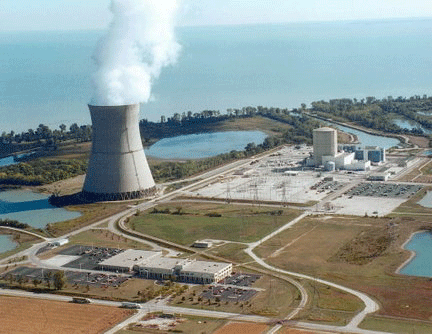
Davis-Besse nuclear power plant to shut down permanently in 2020, The Blade, ByTom Henry | BLADE STAFF WRITER
FirstEnergy Solutions, a subsidiary the corporation founded to manage anticipated bankruptcy filings for its economically failing nuclear and coal divisions, has confirmed in a news release distributed Wednesday that Davis-Besse will be shut down permanently in 2020 and that FirstEnergy’s other nuclear stations will be shut down permanently in 2021 if there are no buyers or remedies found by their respective dates.
The timetable for each permanent closure is determined by refueling schedules.
Commercial-scale nuclear reactors must be refueled every 18 months to two years, depending on the isotope of uranium in their fuel. Davis-Besse emerged this week from what a senior FirstEnergy executive previously described as its last refueling outage.
FirstEnergy Solutions has a Monday deadline looming for a $100 million debt-principal payment.With combined debt estimated at $3.5 billion and losses mounting daily on the competitive side of its business because of the budget drains from its nuclear and coal-fired plants, the utility has turned to a combination of hedge funds managed by four high-powered private investor groups to help move it forward with a regulated growth strategy……..http://www.toledoblade.com/Energy/2018/03/29/Davis-Besse-nuclear-power-plant-to-shut-down-permanently-in-2020.html
Easter – Passover – time for religious observances and/or to be helping that bunny, (or bilby) to hide those chocolate Easter eggs – or something fun like that. Probably bad timing to be talking about climate change, as the news is not good.
Arctic temperatures have skyrocketed to 30 degrees celsius over the long-term average. Warm humid air going into the Arctic hits the dense dome of cold air, and bypasses it, going up into the upper atmosphere, even to the stratosphere. The high altitude Polar Vortex split, and a deep persistent jet stream trough over North America shifts, bringing freezing weather.The high Arctic warming in the spring, autumn, and throughout the winter results in melting ice. The complexity of atmospheric “rivers”brings streams of warm air to the Arctic, carrying water vapour , itself a greenhouse gas, which increases absorption of heat.
If the Planet is Warming, Why am I Freezing?
For a detailed explanation of the Arctic situation, see the youtube videos by Paul Beckwith:
Posted to nuclear-news.net by Shaun McGee (aka arclight2011)
Posted on 29th March 2018
Thanks to Prof. Chris Busby for proofreading the chemical composition from the chemist source materials ( linked here link) and for his input into this article.
After some research on Novichok i discovered that;
1/ Militarised Organophosphates (MOP) can be processed into a sticky oil or a fine powder and there are at least 4 types
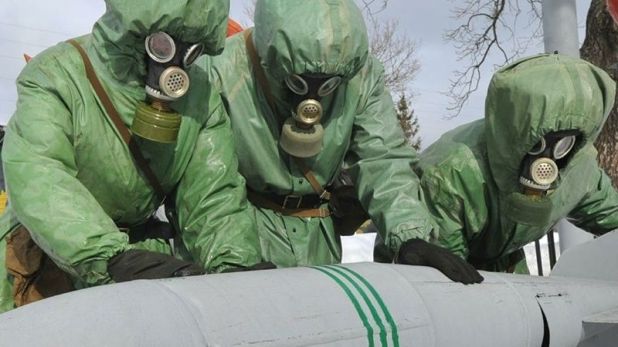
2/ New Nuclear, biological and chemical NBC suits were developed before Desert Shield as the Novichok series of chemical agents were designed to circumnavigate the old Noddy suits supplied to the military.
3/ Novichok series compounds are detectable easily with testing equipment developed prior to Desert Shield
4/ It is very likely that an antidote was developed prior to desert shield (especially as Skripals daughter and the policemen are recovering)
5/ By making all references to Novichok series a matter of national security the OPCW was not told that these compounds were so dangerous thus allowing the USA and UK to keep such weapons on their shelves.
6/ Most of the Russian peer reviewed studies on this were done under the guise of fertiliser/insecticide production
7/ Although some of the precursors like SO2 are very nasty making this product difficult to produce a synthetic chemist in a lab could produce it
8/ Concerning the Polonium 210 poisoning of Litvinyenko, this polonium could have been synthesised by reducing radium tubes and dials etc reasonably easily
I have some a posit that these chemicals were not recognised as a chemical weapon because of the need to protect Big Agri profits and their business models (ever wonder why Russia agriculture is mainly organic?)
I decided to see if any country could make this and decided to see if Ukraine (as an example) could have produced this. A 2017 OSCE report cited the need to improve chemical handling, transportation and safety in Ukrainian labs needed to be improved so a 3 year plan was initiated and funded by the EU and USA. Ukraine also sent battalion of chemical trained soldiers to Kuwait before the Iraq invasion. One week after the incident with the Skripals the Ukrainian Gov. sent this message to the UK ; “…Ukraine is ready to provide Britain with assistance in investigating the case of poisoning of former Russian intelligence agent Sergei Skripal and his daughter, Ukrainian Foreign Minister Pavel Klimkin said….”
Did the UK and USA also hide this product so they could have used it in Iraq or similar?
Ukraine had the basic Potash needed for manufacture of Novichok; “…John J. McKetta Jr – 1989 – Science
Of the foreign producers, the largest is the USSR, and its producing centers are the Upper Kama Basin of the western Urals, the Starobinsk Basin in Belorussia, and the Ciscarpathian area in the western Ukraine. USSR production has nearly tripled since 1969. Sulfates of potash are produced in the Ukraine, and Muriate Organphosphate is produced at the Upper Kama and Starobinsk basins …”
Some food for thought. Though Ukraine may not have produced this it could have been a criminal crowd in Russia or any secret services etc etc. I used Ukraine as an example and there is no direct proof that Ukraine was responsible though they were capable, thereby, busting the UK and USA government line that it HAD to be Russia!
Sources for quotes;
“…We proudly represent products of leading Russian, Belarus, and Ukrainian fertilizer producers. Member of the International Fertilizer Association. products. MOP / KCl – Muriate of Potash Ammonium Sulphate – granular / crystalline. SOP – Potassium Sulfate Calcium Ammonium Nitrate NPK blends – 15-15-15, 16-16-16…..” http://lushburyfertilizer.com/
From 2017 .. OSCE report with recommendations to have plans in place by 2020 “..2. Objectives
The overall objective of this Decision is to support OSCE projects aiming at strengthening chemical safety and security in Ukraine in line with UNSCR 1540 (2004) and the Association Agreement by providing a significant contribution to the ICSSP in Ukraine. In particular, this Decision aims at reducing the threat posed by the illicit trade of controlled and toxic chemicals in the OSCE region, in particular in Ukraine, thus promoting peace and security in the Union’s neighbourhood…..” https://eur-lex.europa.eu/legal-content/EN/TXT/?uri=CELEX%3A32017D1252
13th March 2018 – “…Ukraine is ready to provide Britain with assistance in investigating the case of poisoning of former Russian intelligence agent Sergei Skripal and his daughter, Ukrainian Foreign Minister Pavel Klimkin said.
“The UK is investigating, of course, it will bring it (until the end – IF.) It is already known that the poisoning was due to chemicals that were developed in Russia … We are in solidarity with Britain if we need our help – expert or other – we will provide it, “the minister said to journalists on Tuesday in Kiev….” http://interfax.com.ua/news/general/491334.html
Speculation regarding the crash of China’s Tiangong-1 space station has been going on all month, but that will come to an end this week. The space station is set to fall into the Earth within the next few days.
The earliest estimates have Tiangong-1 crashing into Earth on Friday (March 30).
Tiangong-1’s Fall
There has been a lot of news coverage for the better part of a month predicting where Tiangong-1 will fall. Predictions currently have the space station coming down to Earth within the next week. The earliest estimates have the station crashing into the planet by Friday, March 30.
China admitted in January 2018 that it lost control of the space station. It had previously lost contact with the space station in 2016.
The current window for the re-entry of Tiangong-1 has it coming in late on March 30 to the early morning of April 2. Tiangong-1 has been monitored by the Inter-Agency Space Debris Coordination Committee. This agency predicts that it will fall to Earth between 43° N to 43° S latitude.
It is very unlikely that the debris from the space station will strike anyone. No one has ever died from being struck by space debris, there has been one person that has been struck. On its current path, the space station is likely to fall on locations closer to the northern latitudes.
Toxic threat warning!
There is a potentially highly toxic substance called hydrazine aboard the space station that could survive the reentry. People who come across debris from the space station are advised to stay away from it.
There will be a webcast of the re-entry of Tiangong-1 on Wednesday (March 28), and it is set to begin at 8:00 a.m. EDT. It will provide views of the space station while it is still out in space. Determining where Tiangong-1 will fall will be complicated.
Since much of the Earth is uninhabited, there is a chance that the space station will land in a remote location such as the ocean. This would make it harder for people to see the crash since no one will be around. Even as little as 7 hours before the crash, there will still be an uncertainty of where Tiangong-1 will fall.
There will be changes in the sky in areas that are able to see the space station crash. Since the space station is tumbling, there will be tracks across the sky, and rapid changes in its brightness.
Plutonium contamination of North west Canada from Kosmos–954 ;
“….The fall of the 4 t satellite over Canada on January 24, 1978 would have been a disaster in urban areas: its nuclear reactor was powered by 31.1 kilograms of 235U. Radioactive waste contaminated an area of over 124,000 km2 in the Northwest. Territories and the provinces of Canada…” http://www.robindesbois.org/wp-content/uploads/2011/06/Space-Waste.pdf
USA has increased production of Plutonium 238 for its future space program;
“…..Jan 1, 2016 – For the first time in 30 years, the United States produced an isotope of plutonium that powers NASA’s deep-space missions. A total of 50 grams of plutonium-238 was produced at the Department of Energy (DOE)’s Oak Ridge National Laboratory (ORNL) in Tennessee….” https://www.space.com/31499-us-makes-plutonium-deep-space-fuel.html
As the nuclear option looks less and less sensible, it becomes harder to explain Whitehall’s enthusiasm. Might it be to do with the military? Guardian, Andy Stirling and Phil Johnstone, 29 Mar 18,
The depth of this Whitehall bias creates a challenging environment for reasoned debate over British energy policy. To many, it seems scarcely believable that UK plans are so massively out of sync with current trends. The sheer weight of UK nuclear incumbency has successfully marginalised the entirely reasonable understanding that – like many technologies before it – nuclear power is simply going obsolete.
With direct reasons for the UK’s eccentric national position still unstated, we should pay attention to body language. Here, clues may be found in the work of the National Audit Office (NAO). Its 2017 report of 2017 points out serious flaws in the economic case for new nuclear – highlighting “unquantified”, “strategic” reasons why the UK still prioritises new nuclear despite the setbacks and increasingly attractive alternatives. Yet the NAO remains uncharacteristically unclear as to what these reasons might be.
An earlier NAO report may shed more light. Their 2008 costing of military nuclear activities states: “One assumption of the future deterrent programme is that the United Kingdom submarine industry will be sustainable and that the costs of supporting it will not fall directly on the future deterrent programme.” If the costs of keeping the national nuclear submarine industry in business must fall elsewhere, what could that other budget be?
So why does the UK debate on these issues remain so muted? It is now beyond serious dispute that nuclear power has been overtaken by the extraordinary pace of progress in renewables. But – for those so minded – the military case for nuclear power remains. In a democracy, it might be expected that these arguments at least be tested in public. So, the real irrationality is that an entire policy arena should so comprehensively fail to debate such crucial issues. In the end, all technologies become obsolete. If we are not honest about UK civil nuclear policy, the danger is that British democracy may go the same way.
Kim Dotcom is alleging WikiLeaks founder Julian Assange has had his internet connection within the Ecuadorian embassy in London cut off. He has called on Assange supporters to gather outside the embassy building in solidarity.
Neither WikiLeaks nor Assange has made an official statement regarding the reports. Dotcom demanded that authorities “#ReconnectJulian.” Former Greek Minister of Finance Ioannis Varoufakis also tweeted Wednesday, calling for people to rally around Assange to force the Ecuadorianauthorities to restore his internet connection.
“It is with great concern that we heard that Julian Assange has lost access to the internet and the right to receive visitors at the Ecuadorian London Embassy. Only extraordinary pressure from the US and the Spanish governments can explain why Ecuador’s authorities should have taken such appalling steps in isolating Julian,” Varoufakis wrote in an online statement.
“A world in which whistleblowers are hounded, small countries are forced to violate their cherished principles, and politicians are jailed for pursuing peacefully their political agenda is a deeply troubled world – a world at odds with the one the liberal establishment in Europe and the United States proclaimed as its artifact since the end of the Cold War.”
Assange’s latest tweet before his alleged disconnection and digital isolation came Tuesday, March 27. He responded to an apparent insult during a question and answer session in the UK House of Commons. (VIDEO)
The nuclear lobby is more of a religious cult than a science body. It relies a lot on the prevailing myth about “hard” science being somehow better than “soft science”. The nuclear doctrine is that if you’re not an expert in the “hard”sciences, then you cannot have a valid opinion.
There were no biologists, geneticists, ecologists involved in the origin of nuclear weapons and nuclear power. It seems the same today, even though the most zealous nuclear lobbyists proclaim themselves as “environmentalists”. But their propaganda gives them away – shows their ignorance of those complex, nuanced sciences that are downgraded in the present global drive for unbridled technology development.
One hardly dares mention studies like sociology, anthropology, ethnic studies … even economics – these are dismissed, too, as “soft” .
But all these downgraded subjects are the ones we should be addressing, if the world is to be saved from the twin horrors of nuclear devastation and climate change.










 nuclear-news