 Ken, Eisenhower was the grandaddy of hard-core
  nuclearism in the world today. He was the grandaddy of the military-industrial complex, in spite of the propaganda, put out.
The US started with 1000 nuclear waepons, when he came in. Ended with 22,000, when he came out. He did the most open air, nuclear-bomb testing.
He set the fateful course for using inefficient, deadly nuclear reactors to generate energy. He had a cabinet of millionaires. He set the human race on the path of it’s own destruction. A true evil monky general, as Dr Caldicott says, if there ever was one. http://therealnews.com/t2/story:20753:Undoing-the-New-Deal%3A–Eisenhower-Builds-an-Arsenal-of-Nuclear-Weapons-and-a-Cabinet-of-Millionair
February 12, 2018
Posted by Christina Macpherson |
history, weapons and war, World |
Leave a comment
Conclusion to #Sellafield accident report 2017
The EPA 2016 report is unsafe and cannot be relied upon by the public, the media or administrators. The anonymous authors have shown extraordinary bias in every aspect of the report. They made elementary mistakes in their source term listing of isotopes, by including those which had short half-lives and will clearly not have been present in any significant concentration. They omitted a whole series of nuclides which are present in the tanks and the fuel pools. They choose a source term which is demonstrably too low based on available data, they choose a worst-case accident which involves only one HAST tank and only Caesium-137. They omit mentioning the spent fuel pools which are a highly likely site of a major coolant loss and subsequent fire or explosion. Their air modelling results are extremely unusual with implausibly narrow plumes, whilst a NOAA HYSPLIT model for the same day shows a completely different dispersion covering most of highly populated Ireland. Their surface contamination levels are 200 times lower than a previous computer model by Dr Taylor, which they must have had access to, and they fail to calculate the increased levels of cancer in the exposed population. This has been rectified here.
Historic releases from Sellafield to the Irish Sea have caused measurable increases in cancer and leukemia in coastal populations of Ireland. There is no doubt that the existence of Sellafield represents a potential catastrophic danger to the Irish Republic. A serious accident there could destroy the country and also most of Britain. As the Chernobyl accident effects showed, and the Fukushima accident effects will reveal (and in the case of Thyroid cancer have revealed) the ICRP risk model is unsafe for explaining or predicting health effects from such contamination. The Authors of the EPA 2016 report should be sanctioned in some way for producing such a travesty of the real picture, especially since they will have had access to the earlier study and modelling by Peter Taylor and the details of the COSYMA model employed by him.
Christopher Busby
August 17th 2017
 nuclear-news
Introduction by Shaun McGee (aka arclight2011)
Published exclusive to nuclear-news.net (Creative Commons applies)
2 February 2018
The Irish Sellafield nuclear accident fallout projection report has some issues, in my opinion.
In December 2016 the Irish Environmental Protection Agency (EPA) published in Irish Media Sources a report on radioactive fallout from a “worse case” scenario.
At the time, I was in contact with the Irish EPA concerning new evidence that shows a larger health effect from radiation sources and I was trying to challenge the pro nuclear bias that underestimated the health and environmental problems using mechanisms from the EURATOM nuclear treaty in Europe. I have to say that the Irish EPA were forthcoming in their many responses to my inquiries but eventually we reached a stale mate as the EPA claimed that the specific Isotopes relevant to the Euratom Treaty are not to be found in Ireland with the exception…
View original post 6,123 more words
February 12, 2018
Posted by arclight2011part2 |
Uncategorized |
1 Comment
Why sign this petitition? Who has launched it? Whom are we addressing?
February 12, 2018
Posted by Christina Macpherson |
ACTION |
Leave a comment
 Drone to probe Fukushima N-plant interior, The Japan News , 10 Feb 18 The Yomiuri Shimbun Tokyo Electric Power Company Holdings Inc. plans to use a small unmanned aerial vehicle to closely inspect conditions inside the No. 3 reactor building of the Fukushima No. 1 nuclear power plant as early as this month.
TEPCO will use the drone to examine the location of scattered debris and the level of radiation inside the reactor building, among other things.
It will be the first drone-based research conducted inside the plant’s Nos. 1, 2 and 3 reactor buildings, in which nuclear meltdowns occurred.
……..TEPCO’s plan is for the drone to enter the No. 3 reactor building through a bay for large cargo on the first floor, then fly upward through a series of openings from the first to the fifth floor.
The drone will check areas including the building’s third floor, which has not been sufficiently monitored because radiation levels are too high.
According to TEPCO, key equipment such as that used to cool spent nuclear fuel pools are located on the third floor.
Confirming the location of possible obstacles and the level of radiation is necessary before decommissioning work can progress.
………Work is currently under way to construct a dome-shaped roof over the building to facilitate the removal of fuel that remains in the spent fuel storage pools. http://the-japan-news.com/news/article/0004230028
February 12, 2018
Posted by Christina Macpherson |
Fukushima continuing |
Leave a comment
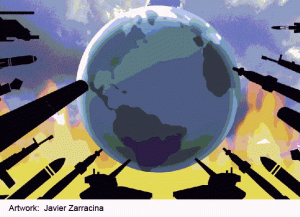 Russian Expert Suslov: The New U.S Nuclear Doctrine Could Lead To A Military Crisis Fraught With A Direct Military Clash Between The U.S. And Russia, MEMRI, Special Dispatch No. 7325 February 11, 2018
On February 2, 2018, the U.S Department of Defense released its Nuclear Posture Review. The new U.S. Nuclear Doctrine states that while Russia initially followed “America’s lead and made similarly sharp reductions in its strategic nuclear forces,” it retained large quantities of non-strategic nuclear weapons. “Today, Russia is modernizing these weapons as well as its other strategic systems. Even more troubling has been Russia’s adoption of military strategies and capabilities that rely on nuclear escalation for their success. These developments, coupled with Russia’s seizure of Crimea and nuclear threats against our allies, mark
Russian Expert Suslov: The New U.S Nuclear Doctrine Could Lead To A Military Crisis Fraught With A Direct Military Clash Between The U.S. And Russia, MEMRI, Special Dispatch No. 7325 February 11, 2018
On February 2, 2018, the U.S Department of Defense released its Nuclear Posture Review. The new U.S. Nuclear Doctrine states that while Russia initially followed “America’s lead and made similarly sharp reductions in its strategic nuclear forces,” it retained large quantities of non-strategic nuclear weapons. “Today, Russia is modernizing these weapons as well as its other strategic systems. Even more troubling has been Russia’s adoption of military strategies and capabilities that rely on nuclear escalation for their success. These developments, coupled with Russia’s seizure of Crimea and nuclear threats against our allies, mark
Moscow’s decided return to Great Power competition,” stated the Nuclear Posture Review.[1]
Dmitry Suslov, a veteran America-watcher and program director of the Valdai Discussion Club noted in his assessment of the review, that a troubling aspect of the new U.S. nuclear doctrine is the “considerable erosion of nuclear employment terms.” Suslov stated: “The current document says that the United States allows the possibility of using nuclear weapons in response to a non-nuclear attack not only against the U.S. itself and its allies but also against its ‘partners,’ a category that can include just about anyone apart from those the US openly calls its adversaries (today these are Russia, China, Iran and North Korea) or unfriendly countries (Syria, Venezuela, etc.). Officially, the United States’ ‘strategic partners’ are Ukraine and Georgia, to name just these two. Does this mean that Washington will seriously contemplate using nuclear weapons if their security is under threat?”
Like many Russian experts Suslov regards the situation as worse than during the Cold War and urges the expert communities in both the U.S. and Russia to share their concerns with the policy makers.
Below are excerpts from Suslov’s article, titled “Militarizing The Confrontation: Risks Of The New U.S. Nuclear Posture Review,” published in the Valdai Discussion Club:[2]
‘The General Strategic Situation Is Much More Complex And Multifaceted Than During The Cold War’
“During the last four years, Russian-American confrontation has been mostly confined to the political, information and economic (sanctions) areas and has been minimal in terms of the military. The military establishments in Russia and America and their proponents among the Russian and U.S. political elite regarded each other as potential adversaries even before the current confrontation. Moscow’s 2010 military doctrine (incidentally, approved at the peak of the Russian-U.S. ‘reset’) described globalization and NATO expansion as the main military threat. NATO’s official pivot in 2014 to the open military and political containment of Russia was until recently of a predominantly declarative and political nature. In the military respect, it was rather modest since the real scale of NATO’s infrastructural expansion in the Baltic and Black Sea areas was not great. In the Middle East, too, the U.S. refrained from creating military obstacles to the Russian operation in Syria, which would have risked a direct clash between the two powers.
“However, the situation may change radically quite soon. On February 2, 2018, Washington presented its new nuclear doctrine (Nuclear Posture Review), which outlined a qualitative change in U.S. nuclear policy. ……..
“The main change in the U.S. nuclear doctrine is that the Trump administration, based on the qualitatively new realities of the great-power confrontation with Russia and China as compared with the period after the Cold War, has decided on a higher role for nuclear weapons and emphasizes them in its defense strategy, whereas the Obama and Bush administrations on the contrary sought to downplay it. ……….
https://www.memri.org/reports/russian-expert-suslov-new-us-nuclear-doctrine-could-lead-military-crisis-fraught-direct
February 12, 2018
Posted by Christina Macpherson |
USA, weapons and war |
Leave a comment

 Radiation Free Lakeland 10th Feb 2018, On the 23rd January 2018 the Swedish Environment Court gave the thumbs down
to the Swedish equivalent (SKB) of the UK’s quango Radioactive Waste Management (RWM previously Managing Radioactive Wastes Safely previously
NIREX) tasked with implementing Geological Dumping of nuclear wastes.
The Swedish court said it could not recommend that their Government agree the application for a Geological Disposal Facility (Nuclear Underground Dump) unless and until the industry can prove that the copper capsules that would contain the spent nuclear fuels would not leak.
Sweden and Finland are regularly put forward by RWM and the UK Government as the fore-runners of the ‘international consensus’ on deep waste repositories. Radiation Free Lakeland have sent a letter of thanks to the Swedish Court and a request to the Environment and Justice Ministers of Sweden that the Courts findings are upheld. We urge our own UK government to abandon the dishonest and dangerous plan for “Implementation” of Geological Disposal. https://mariannewildart.wordpress.com/2018/02/10/a-letter-of-thanks-to-the-swedish-environment-court-for-saying-no-to-geological-disposal-of-nuclear-wastes/
February 12, 2018
Posted by Christina Macpherson |
Sweden, UK, wastes |
Leave a comment
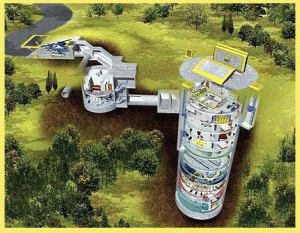 Where might Trump go in a nuclear attack? BBC News, By Tara McKelveyBBC White House reporter, 11 Feb 18, “…….. US officials have made access arrangements for the president and a group of individuals deemed to be at the “top of the food chain”, according to Robert Darling, a Marine who spent part of 9/11 in the White House bunker. He has described who was allowed in.
As Darling pointed out, only a select few are allowed into a presidential bunker, turning social hierarchy into a matter of life or death. Still historians say bunker building is a necessary part of governmental business.
“You have to maintain a chain of command,” says Randy Sowell, an archivist at the Truman President Library in Independence, Missouri. “Or there’d be complete chaos.”
The construction of shelters and bunkers, whether for presidents or ordinary people, serves another purpose – they make it easier for Americans to talk about atomic or nuclear warheads and help make the unthinkable – global nuclear war – thinkable.
President Harry Truman oversaw the establishment of a federal civil defence administration in the 1950s. The overall message from the government, said Christian Appy, a history professor at the University of Massachusetts in Amherst, was that “nuclear war wasn’t necessarily an apocalypse for everyone”.
The civil defence agency helped create the idea of “nuclear citizenship”, says Appy. The US government wanted civilians to adjust to a new reality, he says, paving the way for their “acquiescence to the nuclear arms race”.
A US strategic bombing survey found about 30% of those who died immediately in the US atomic attack on Nagasaki would have been saved by fallout shelters, says Sowell, explaining the rationale behind Truman’s civil defence programme.
Officials at the agency tried to set up a nationwide shelter system. Some shelters were built for government employees and members of the public. Officials oversaw the construction of a large facility in Los Altos, California, in the 1960s, for example.
Mainly, though, private individuals built their own bunkers. Thousands were constructed, as Laura McEnaney, a history professor, discovered while researching her book on the subject. “Nuclear war,” she says, became “the responsibility of the nuclear family”.
One of them, an heiress named Marjorie Merriweather Post, built her bunkers under her estate – the Mar-a-Lago, in Florida.
In the early 1950s, Post was worried about the Korean War and its potential for escalation, and so she built underground shelters. They were dug into the earth below Mar-a-Lago’s main building, according to a US interior department surveyon historic buildings.
Trump bought the property along with the bunker in 1985. He later described the underground facility as sturdy, “anchored into the coral reef with steel and concrete”.
The ceilings are low, says Wes Blackman. The 6ft 5in former project manager had to duck while visiting the place with Trump years ago.
“It was like we were on an archaeological exploration,” he says………
Mount Weather, a 1,754-ft (534m) peak near Bluemont, Virginia, was turned into a giant bunker for the president, his advisers and others to hide in case of nuclear attack.
Members of Congress would be taken to a bunker at Greenbrier resort near White Sulphur Springs, West Virginia. The facility had a code name, Project Greek Island, and operated for decades – until its existence was revealed in the media in 1992 when the bunker was “decommissioned”.
Mount Weather is now run by the Federal Emergency Management Agency (Fema) and was “activated” after the al-Qaeda attacks in September 2001, a Fema director testified to Congress in October of that year. He didn’t provide details. ……
In the autumn of 1961, construction began on another presidential bunker. This one was created for President John F Kennedy in Florida. It’s not far from Mar-a-Lago – the US Navy’s Seabees built the bunker on Peanut Island, a 10-minute journey from a Palm Beach house where Kennedy often stayed. The bunker was known as Detachment Hotel, and it cost $97,000 to construct, according to a 1973 report to Congress. …….http://www.bbc.com/news/world-us-canada-42969877
February 12, 2018
Posted by Christina Macpherson |
politics, USA, weapons and war |
Leave a comment
GDF Watch 10th Feb 2018, Radioactive Waste Management (RWM) have announced the appointment of
Lorraine Baldry OBE as Chair of their new Advisory Council. According to
RWM, “the Advisory Council will provide expertise, balanced perspective
and strategic support to RWM as it moves into a significant phase of its
programme to deliver a geological disposal facility. Its members, including
experienced leaders from a variety of business, engineering, infrastructure
and society backgrounds, will provide vital input to one of the most
complex and important long-term projects ever undertaken in the UK.”
Lorraine Baldry hails from the Financial Services sector, and is also
currently: Chair of the Central London Partnership, a non-profit
organisation that focuses on improving the working environment in central
London Chair of London & Continental Railways Limited, a property
development and land regeneration business within the railway and
infrastructure sectors Chair of Schroder Real Estate Investment Trust
Limited Independent Non-Executive Director at Thames Water She is an
Honorary Member of the Royal Institution of Chartered Surveyors (RICS), a
Past President of the British Property Federation, and was previously
Chairman of the London Thames Gateway Development Corporation.
http://www.gdfwatch.org.uk/2018/02/10/chair-announced-new-rwm-advisory-council/
February 12, 2018
Posted by Christina Macpherson |
UK, wastes |
Leave a comment
 Times 11th Feb 2018, Bringing Britain’s energy system back under public ownership is the best
way of tackling climate change, according to Jeremy Corbyn. In his most
pro-green speech to date, the Labour leader said his government would sweep
away the “centralised system” of energy delivery by private firms in favour
of “new sources of energy large and small”.
Speaking yesterday at a conference in London on alternative models of ownership, Corbyn said: “The
greenest energy is usually the most local but people have been queuing up
to connect renewable energy to the national grid. “With the national grid
in public hands we can put tackling climate change at the heart of our
energy system, committing to renewable generation from tidal to onshore
wind.”
https://www.thetimes.co.uk/edition/news/nationalising-energy-grid-will-help-fight-climate-change-says-corbyn-z93xvqm50
February 12, 2018
Posted by Christina Macpherson |
politics, renewable, UK |
Leave a comment
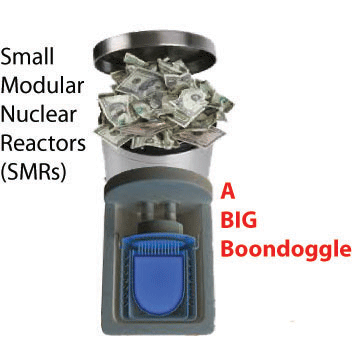
Platts 9th Feb 2018, The budget bill President Donald Trump signed Friday morning to avert a shutdown of the US government includes a broadening of production tax credits for nuclear projects critical for the completion of two reactors at Georgia Power’s Vogtle station and designed to spur development of  the first commercial small modular reactors in the US.
The 2,300-MW Vogtle plant expansion in Waynesboro, Georgia, has experienced delays and cost overruns that threatened its completion. The Georgia Public Service Commission gave the go-ahead for rate recovery, which Georgia Power had said was crucial for completing the nuclear generating units. But the production tax credits were also a key element of the project’s economic case, Georgia Power officials have said.
https://www.platts.com/latest-news/electric-power/washington/us-budget-bill-includes-credits-for-georgia-nuclear-21293499
February 12, 2018
Posted by Christina Macpherson |
politics, Small Modular Nuclear Reactors |
Leave a comment
Chasing nuclear energy could lead to capture – expert https://www.iol.co.za/news/politics/chasing-nuclear-energy-could-lead-to-capture-expert-13222078 11 FEBRUARY 2018 Cape Town – A leading oil and gas lawyer and African entrepreneur has warned South Africa against pursuing nuclear energy, saying any proposed deal might come with political pressure which could lead to “capture”.
NJ Ayuk, who is widely recognised as one of the top influential businessman in the sector globally, said there was no reason for South Africa to consider nuclear energy and instead it should invest in clean renewable energy to create jobs and grow its economy.
Ayuk said the consideration for nuclear could lead to the country succumbing to external pressures.
“We need to stop having short-term fixes to our challenges. If we continue to look to other powers for solutions, we will have to succumb to what they want. Is that what South Africa wants?” he asked.
With South Africa’s bid for a non-permanent seat on the UN’s Security Council this year, Ayuk warned if the country were to consider nuclear energy and partner with another country, this would diminish its position on the influential body.
Speculation about South Africa seeking partnership with Russia has come to the fore over the past year, with the government denying that a deal had been made.
“Do you want a member of the Security Council that’s dependent on another country for its energy security and needs? Africa needs a representative that will articulate its views and not one that will be perceived to be captured by another strong power,” he said.
For decades South Africa relied on coal for electricity and synthetic fuel production but needs to look at other energy sources to meet its climate change commitments.
Recent studies have also shown a decline in global demand for coal.
“Renewable energy must be the core part of the energy mix as it has the potential to alleviate poverty. We need to put in the right investment in it. It will create jobs and allow small businesses to participate in the sector,” he said.
He said the country and other African countries endowed with mineral resources should start looking at establishing an enabling environment for investments and growth in the sector.
Ayuk said the political change in South Africa gave hope that there would be a re-focus on the energy sector and that “homegrown” solutions for energy problems would be found.
“We have to be futuristic. It doesn’t help any country to have big projects and the skills cannot be found within it because jobs are not created or if they are they are low skilled jobs”, Ajuk said.
He also advocated better management of mineral resources throughout the continent and better frameworks to “empower communities”.
“Africa needs to start thinking of sharing skills and expertise to create intra-trade. We have the technology in most of the countries, we need to enhance what we already have.”
February 12, 2018
Posted by Christina Macpherson |
politics, South Africa |
Leave a comment
 Cumbria Trust 10th Feb 2018, Andrew Blowers OBE is Emeritus Professor of Social Sciences at The Open
University and is presently Co-Chair of the Department for Business, Energy and Industrial Strategy/NGO Nuclear Forum. This is one of a series of
articles drawn on his latest book, “The Legacy of Nuclear Power” (Earthscan from Routledge, 2017). The views expressed are personal.
What is Sellafield? Fundamentally, these days, it is the UK’s primary nuclear waste-processing, management and clean-up facility. Concentrated on a
compact site of 1.5 square miles is a jumble of buildings, pipes, roads, railways and waterways, randomly assembled over more than half a dozen decades, which together manage around two-thirds by radioactivity of all the radioactive wastes in the UK.
The Sellafield radioactive waste component includes all the high-level wastes (less than 1% by volume, over half the radioactivity) held in liquid form or stored in vitrified blocks, and half the volume of intermediate-level wastes (the other half being heldat various sites around the country). The nation’s radioactive waste is mainly held at Sellafield and there it must remain, at least until the programme of management and clean-up is concluded.
New production facilities such as for MOX or reprocessing are exceedingly improbable, theproposed new reactors at nearby Moorside are doubtful, and although a GDF, if one is ever developed, might yet be located in West Cumbria, Sellafield will for long be caretaker of the nation’s wastes. Where and when the undertaker will come to bury them remains unclear, and may remain so for the foreseeable future.
https://cumbriatrust.wordpress.com/2018/02/10/sellafield-britains-nuclear-heartland/
February 12, 2018
Posted by Christina Macpherson |
Reference, UK, wastes |
Leave a comment
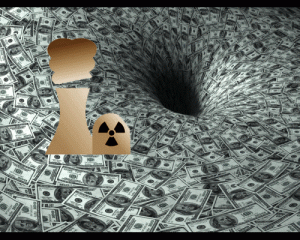
 – excitingly entitled “Central Government Supply Estimates 2017-18” – detailing changes to planned public expenditure since last Autumn’s
Budget 2017. At pages 162-64 you can find the Business, Energy and Industrial Strategy (BEIS) extra expenditure requests and clarification of
perceived liabilities.
These include several covering the privately-owned commercial nuclear industry sector. Below are the sections on nuclear, and
the most common read-out message is how often the liabilities for which the taxpayer is expected to take long term financial responsibility are
described as “unquantifiable.”
That is accurate, but what is omitted is the numbers are – based on accumulated experience to date, likely to be astronomically huge. This worryingly unacceptable situation,- whereby one industry (nuclear) of the electricity generating sector is being promised a massive future bailout from its liabilities- really should be examined in detail by our elected Parliamentarians and peers in several relevant committees and in the Estimates Debate on the floor of the Commons.
http://drdavidlowry.blogspot.co.uk/2018/02/nuclears-unquantifiably-huge-future.html
February 12, 2018
Posted by Christina Macpherson |
business and costs, politics, UK |
Leave a comment
BBC 9th Feb 2018, Russian security officers have arrested several scientists working at a
top-secret Russian nuclear warhead facility for allegedly mining
crypto-currencies. The suspects had tried to use one of Russia’s most
powerful supercomputers to mine Bitcoins, media reports say.
The Federal Nuclear Centre in Sarov, western Russia, is a restricted area. The centre’s
press service said: “There has been an unsanctioned attempt to use computer
facilities for private purposes including so-called mining.” The
supercomputer was not supposed to be connected to the internet – to prevent
intrusion – and once the scientists attempted to do so, the nuclear
centre’s security department was alerted. They were handed over to the
Federal Security Service (FSB), the Russian news service Mash says.
http://www.bbc.co.uk/news/world-europe-43003740
February 12, 2018
Posted by Christina Macpherson |
Russia, secrets,lies and civil liberties |
Leave a comment
Romandie 9th Feb 2018, [Machine Translation] EDF and the director of the Cruas-Meysse nuclear power plant (Ardèche) were sentenced on Friday by the Privas police court to fines of several thousand euros for nuclear waste management problems.
The French energy group has been sentenced to six fines of 1,000 euros and the director of the site to six fines of 500 euros suspended. The network
Outir du Nucléaire, initiator of the lawsuit, criticized EDF and its director for failing to meet several waste management obligations, citing the detection, on November 6, 2015, of nuclear waste in a waste container, conventionals that was about to leave the site.
https://www.romandie.com/news/EDF-condamne-pour-sa-gestion-des-dechets-radioactifs-a-la-centrale-de-Cruas-Ardeche/889092.rom
February 12, 2018
Posted by Christina Macpherson |
France, Legal |
Leave a comment










 nuclear-news