Mark Payne Published: 06:00 Wednesday 03 January 2018
The boss of Hartlepool Power Station says he is confident a replacement to Europe’s nuclear regulator will be secured after Brexit.
The UK is currently part of the European Atomic Energy Community, also known as Euratom, which allows the free movement of nuclear workers and materials between European Union member states.
Minister at the Department for Exiting the European Union, Steve Baker (left) with Craig Dohring station director at Hartlepool Power Station, during the minister’s visit in September Minister at the Department for Exiting the European Union, Steve Baker with Craig Dohring station director at Hartlepool Power Station, during the minister’s visit in September Britain is due to leave Euratom as part of the Brexit process as it comes under the jurisdiction of the European Court of Justice which Prime Minister Theresa May has committed to removing the United Kingdom from.
Last May, the Commons Energy Committee urged the UK to delay leaving Europe’s nuclear regulator warning power supplies could be threatened if a new regulator was not in place. But Craig Dohring, station manager of Hartlepool’s EDF nuclear power station, is more optimistic. He told the Mail:
“It is clear there is a few things we need to have a replacement for including Euratom. “We need something to essentially cover us to a similar level of our Euratom agreement which allows us access into Europe and third part countries to support the power station around some nuclear specific equipment and fuel. “
I’m confident we will get that. There is a positive feeling around the Government trying to cover that.
“I think our role is to help the Government and provide information and advice, and the Government have certainly been open to that.”
The power station spoke about the issue with MP Steve Baker, one of four Brexit ministers, when he visited Hartlepool in September then said the Government had “some work to do” and its job was to get new legislation through to ensure the success of nuclear power stations across the country.
The delay is another setback for China’s ambitious development programme, which aims to raise its installed nuclear power capacity to 58 gigawatts by the end of 2020 from 34.73GW last year, and the world’s hopes for a successful launch of third-generation nuclear reactors.
They are touted by their designers to be safer and more efficient than second-generation ones, a key selling point after the global nuclear industry was dealt a blow by Japan’s Fukushima disaster in 2011.
“The delays reflect our concerns over the high execution risk for CGN in rolling out its aggressive expansion target and its adoption of a new generation of nuclear technology,” Ada Li, senior analyst at Moody’s, wrote in a note on Tuesday.
“The delays also imply the deferral of cash flows from the two nuclear units and potential additional capital expenditure, which would further pressure CGN’s financial metrics.”
She estimated the two reactors to initially make 5 billion yuan in annual revenues, amounting to 7 per cent of the firm’s 2016 revenues, adding its repeated delays are “credit negative”.
CGN said on Friday the first two generating reactors of the plant in Taishan – 136 kilometres west of Hong Kong – has been delayed to 2018 and 2019, from the second half of 2017 and the first half of 2018 respectively.
“As no nuclear power generating unit with the EPR [Evolutionary Power Reactor] technology has been put into commercial operation across the world … Taishan Nuclear has to conduct more experimental verifications in respect of design and equipment,” it added.
The firm in early 2015 cited a “comprehensive evaluation” of the construction plan and risks for its first delay. In the second delay early last year, it said it the needed to conduct “more experimental verifications in respect of its design and equipment”.
The project was originally expected to come on line in 2015.
Moody’s said the latest postponement will not affect its A3 issuer credit rating on CGN, which has already incorporated a six to 12-month delay.
Dennis Ip, head of Hong Kong and China utilities equities research at Daiwa Capital Markets, believes CGN will have difficulty meeting the revised target, saying in a note that he expects the first unit to start up in the first half of 2019.
Ip a year ago projected the Taishan plant’s investment cost to rise to between 22 and 23 yuan per watt from his previous forecast of 21 yuan. The company, meanwhile, had budgeted it at 14 yuan. Each unit has 1.75 billion watt of capacity.
North and South Korean ties linked to resolving nuclear issue: Moon Jae-in, SBS News 2 Jan 18, South Korean President Moon Jae-in says the improvement of inter-Korean relations is linked to resolving North Korea’s nuclear programme, a day after the North offered talks with Seoul but was steadfast on its nuclear ambitions.
“The improvement of relations between North and South Korea cannot go separately with resolving North Korea’s nuclear programme, so the foreign ministry should coordinate closely with allies and the international community regarding this,” Moon said in opening remarks at a cabinet meeting on Tuesday.
Moon’s comments contrasted with those of North Korean leader Kim Jong Un, who said on Monday that Seoul should stop asking foreign countries for help in improving ties between the two Koreas.
“This shows the Moon administration is looking at the situation from a very realistic, rational point of view,” said Jeong Yeung-tae, head of the Institute of North Korea Studies in Seoul.
“It also shows resolving North Korea’s nuclear issue has a bigger priority (than improving inter-Korean relations).”RELATED
‘The nuclear button is always on my table’: North Korea leader Kim Jong-un’s warning
Moon’s comments came after a New Year’s Day speech by Kim who said he was “open to dialogue” with Seoul, and for North Korean athletes to possibly take part in the Winter Games, but steadfastly declared North Korea a nuclear power.
he South Korean president requested the ministries of unification and sports to swiftly create measures to help North Korea participate in the upcoming Pyeongchang Winter Olympics.
with the whole world receding from setting up nuclear plants, by the time this “major powerhouse” is established in 4-6 years, where are the foreign orders for nuclear plant components going to come from? Or, are we planning to use tax-payers’ money to continually prop up the ailing big manufacturing industries in India by giving them nuclear power orders, whether we want nuclear power or not?
India Should Halt Further Expansion of its Nuclear Power Program The Citizen, –-A. GOPALAKRISHNAN[Dr A.Gopalakrishnan is former Chairman, Atomic Energy Regulatory Board,Governmentof India. He welcomes discussions and comments from readers. They can contact him at his e-mail:agk37@hotmail.com]13 NOVEMBER, 2017
Nuclear safety is in jeopardy An overall evaluation of the status of the Indian civilian nuclear power sector, and the government’s uncertain future plans, do cause a great deal of concern for the welfare of the country and the safety of our people. Therefore, it is best to freeze all plans for the further expansion of this sector until Parliament and the public are provided full details of the government’s intentions and rationale and a national consensus is reached.
Background: The Indian civilian nuclear power program is ultimately administered by the Department of Atomic Energy (DAE) which reports to the Prime Minister.
The detailed policies, programs, and projects of both the civilian and military aspects of atomic energy are overseen and approved by a supra-powerful body called the Atomic Energy Commission (AEC).
…… Once this group approves a program or gives a decision, no other entity like the Comptroller & Auditor General (CAG), who should be overseeing financial propriety in the Central Government expenditure or the Atomic Energy Regulatory Board (AERB) which is responsible for project & public safety, will usually dare to question the AEC decision. This top-heavy administration of the nuclear program and the fear that it exudes is at the heart of most of the ailments of the nuclear sector.
Civilian Nuclear Program: In the almost 70 years since the constitution of our AEC in 1948, the total installed capacity of nuclear power in India has reached only 6,780 MWe, comprising 22 nuclear reactors. With a total installed electricity capacity of 315,426 MWe in the country, the nuclear share is thus a minuscule 2.15 % of it.
…….Of the operating reactors, some are very old and partially disabled and others are of dangerously outdated design which DAE is continuing to operate, though recommended by the original supplier to be permanently closed down.
We are still waiting for the very first1000 MWe AP-1000 reactor of Westinghouse and the very first 1650 MWe European Pressurized Reactor (EPR) of Areva to be commissioned anywhere in the world.In the meantime, the Westinghouse Co. has filed for bankruptcy in the US and Areva is in the middle of serious technical &financial difficulties, because of which the company has been sold to the French national electricity utility EDF.However, even before the Indo-US nuclear deal was signed, we had started building two VVER-1000 reactors with Russian collaboration, which have since been commissioned at Kudankulam in South India. The initial performance of the first of these two reactors is still not satisfactory, and the BJP had then agreed that apprehensions of the local population about the plant were genuine and the Centre should address the public’s issues. Notwithstandingthis, thegovernment had entered into an agreement to purchase four (4) more VVER reactors to be set up in the same site at Kudankulam…..
…….As part of the Indo-US nuclear Deal, India agreed in writing to purchase about 10,000 MWe of US power reactors and a similar package of French reactors, in return for the support of US & France at the Nuclear Suppliers’ Group (NSG). The NSG ultimately permitted India to retain part of its military nuclear facilities outside of IAEA safeguards, while being allowed to place the rest under safeguards and regular international inspection
……..Preliminary agreements were discussed with Westinghouse Corporation and the General Electric Co. of the US, as well as with Areva of France as early as in 2009-2010, for purchasing their large light-water reactors (LWRs) which were then under development.
We are still waiting for the very first1000 MWe AP-1000 reactor of Westinghouse and the very first 1650 MWe European Pressurized Reactor (EPR) of Areva to be commissioned anywhere in the world.In the meantime, the Westinghouse Co. has filed for bankruptcy in the US and Areva is in the middle of serious technical &financial difficulties, because of which the company has been sold to the French national electricity utility EDF.
However, even before the Indo-US nuclear deal was signed, we had started building two VVER-1000 reactors with Russian collaboration, which have since been commissioned at Kudankulam in South India. The initial performance of the first of these two reactors is still not satisfactory, and the BJP had then agreed that apprehensions of the local population about the plant were genuine and the Centre should address the public’s issues. Notwithstandingthis, thegovernment had entered into an agreement to purchase four (4) more VVER reactors to be set up in the same site at Kudankulam…..
It should be noted that the delivered unit costs of electricity from solar, wind and other modes of renewable power generation have been falling rapidly in recent years and the PM’s decision could be timely for India. In India, as on March 31, 2017, the total installed solar electric power is 12,288 MW and the total installed wind power capacity is 32,280 MW. As of today, we seem to be on track to achieve PM Modi’s challenging target of 175 GW renewable powers by 2022. [Note that these MW numbers have to be associated with respective system load factors of — roughly 16-19% for solar, 20-23 % for on-shore wind and 30-41 % for off-shore wind, to obtain real-term busbar electricity one gets].
It is, however, not finally confirmed that France will adhere to the 2025 deadline.Taiwan, on the other hand, is definite that all nuclear power in that country will be phased out by 2025. Japan has 54 nuclear reactors of which only 4 are operational now after the Fukushima accident. In view of the serious opposition by local governments and the nearby population, and in view of the tightened safety regulations, not more than 8 more reactors are likely to be re-started. In Russia, Rosatom’s Deputy General Director said in June 2017, that the world market for new nuclear plants is shrinking and possibilities for building new large reactors abroad are almost exhausted.
But, with the whole world receding from setting up nuclear plants, by the time this “major powerhouse” is established in 4-6 years, where are the foreign orders for nuclear plant components going to come from? Or, are we planning to use tax-payers’ money to continually prop up the ailing big manufacturing industries in India by giving them nuclear power orders, whether we want nuclear power or not?
Won’t Dump Westinghouse and Areva Reactors? The Nuclear Power Corporation of India Ltd (NPCIL), DAE and the government appear to be still entertaining periodic proposals and discussions regarding the purchase of the AP-1000 and the EPR reactors. No reactor of either kind has been started anywhere in the world. Today, China is regretting their foray into setting up two French EPRs and four AP-1000 reactors.
………Similarly, a senior representative told NPCIL and DAE that Westinghouse’s plans to set up six AP-1000 reactors in India are contingent on a change in the Nuclear Liability Law. He also said that Westinghouse will no longer take up the risk of building new nuclear plants and instead specialise in supplying parts and reactor engineering. Dr. Sekhar Basu, Secretary DAE, said last month that the Kovaada project in Andhra can still go ahead with Westinghouse supplying the reactor design and a different company taking up the construction. Everyone in the Indian nuclear establishment brims with confidence that India is capable of executing the detailed engineering, construction and commissioning of the complicated AP-1000 reactors in India without any assistance from abroad!……..
The state of nuclear reactor safety in India today is suboptimal to say the least. The agency which should be overseeing nuclear safety in India, the Atomic Energy Regulatory Board (AERB), has no standing as an independent entity, no direct access to the AEC or to any of the Parliamentary committees. The Chairman of the AERB reports to the AEC Chairman, whose instructions finally dictate the AERB’s actions. In contrast, the French nuclear regulatory body (the ASN) is created under a separate Act of the French Parliament and is answerable only to their Parliament. http://www.thecitizen.in/index.php/en/NewsDetail/index/2/12239/India-Should-Halt-Further-Expansion-of-its-Nuclear-Power-Program
Moderation on Iran: Better to improve than scrap nuclear pacthttp://www.post-gazette.com/opinion/editorials/2018/01/02/Moderation-on-Iran-Better-to-improve-than-scrap-nuclear-pact/stories/201712300018 THE EDITORIAL BOARD, Pittsburgh Post-Gazette It shouldn’t seem necessary to make an argument to the American people that the United States should not go to war with a nation of 80 million, located far from our shores, with which America once had a fruitful commercial and political relationship and with which, like other parts of the world, it has entered into a nuclear weapons control agreement.
But here we are, and it is useful to suggest that it would be unwise for America to go to war with Iran, whose regime in recent days has been beset by popular political demonstrations.
The Trump administration has criticized the Iran nuclear agreement repeatedly and could scrap it. However, as far as the agreement having shortcomings, wouldn’t it make more sense to take the agreement — signed not only by Iran and the United States, but also by China, France, Germany, Russia and the United Kingdom — as the basis for negotiating changes, as opposed to threatening to pull out of it and, perhaps, to attack Iran?
The first problem with the current U.S. posture is that the other signatories like the agreement. China, France, Germany, Russia, the United Kingdom and the rest of the world have taken it as a green light to improve trade, including major sales, to Iran. America-based companies have considered the continued U.S. sanctions against Iran, and, particularly the continued political objections to it in the United States, including from Israel and American Christian fundamentalists, as a reason not to put the pedal to the metal in terms of pursuing trade and investment opportunities in Iran.
The second major problem in any thought that the United States might attack Iran militarily is that the results would be catastrophic. Of course, the United States would probably win an all-out war against Iran in the long haul — that is, assuming the American people would be prepared to support such a war. That’s a real question, because it would be hard to persuade them that there was any reason for such a war, and it would cost the Earth.
In the short run, a quick glance at the map is worth the trouble in assessing U.S. vulnerabilities in such a conflict. Iran lies just across the Persian Gulf from Saudi Arabia, Kuwait, the United Arab Emirates, Qatar and Oman, in all of which the U.S. has important military installations, including the headquarters of the U.S. 5th Fleet and the regional headquarters of the U.S. Central Command, a short rocket distance away. Iran also borders on Afghanistan and Iraq, where the U.S. maintains a vulnerable presence as well as long-term investment.
It would be dreamy to imagine that Iran’s first response to a U.S. attack wouldn’t be retaliation against some or all of these key U.S. targets surrounding it. The usual arguments for improving relations with Iran, not worsening them, are otherwise foregone commercial opportunities, the concerns of some of our allies, and regional and world peace in general. Given that President Donald J. Trump’s principal national security affairs advisers are current or retired military officers, it is also worth looking at the military aspects of U.S. relations with Iran with a cold eye, then determining future U.S. policy, in 2018 and beyond.
In a statement Tuesday, Pakistan’s foreign ministry said the 1988 agreement requires each country to hand over the list on Jan. 1 each year, which the representatives of the two countries did on Monday. It has been adhered to every year since 1992, the statement said.
Although neither country is signatory to the Nuclear Non-Proliferation Treaty (NPT), they both became declared nuclear powers after India conducted an underground nuclear weapons test in 1998 and Pakistan followed suit a few weeks later.
Pakistan and India have fought three wars since the 1947 creation of Pakistan from a larger India.
The dry-storage plan OK’ed by the Coastal Commission is the Holtec system: cheaper canisters with 1/2 to 5/8-inch thick stainless steel walls, wildly short of the 10 to 20-inch thick-walled ones used in other countries.
At the controversy’s core is the susceptibility of Holtec canisters to cracking, which could leak radiation into the environment.
Holtec canisters have no seismic rating, are not proven safe for transport, and there is no means to even inspect them for cracks or for existing cracks to be repaired in a safe manner. A crack can’t even be detected until after a radiation leak has occurred.
A highly disturbing report from Sandia National Laboratories states that a crack in a hot canister can penetrate the wall in under 5 years.
Mosko: Ticking Time Bomb at San Onofre Nuclear Plant,https://voiceofoc.org/2018/01/mosko-ticking-time-bomb-at-san-onofre-nuclear-plant/By SARAH “STEVE” MOSKOThe seaside nuclear reactors at the San Onofre Nuclear Generating Station in San Clemente were permanently shut down in 2013 following steam generator malfunction. What to do with the 3.6 million pounds of highly radioactive waste remains an epic problem, however, pitting concerned citizens against Southern California Edison, the California Coastal Commission and the Nuclear Regulatory Commission (NRC). Edison operates San Onofre, the Coastal Commission is charged with protecting the coastline, and the NRC is responsible for long-term storage of spent nuclear fuel and protecting the public.The Problem
A reactor’s spent nuclear fuel must be stored safely for 250,000 years to allow the radioactivity to dissipate. San Onofre’s nuclear waste has been stored in containers 20 feet under water in cooling pools for at least five years, the standard procedure for on-site temporary storage. Long-term storage necessitates transfer to fortified dry-storage canisters for eventual transportation to a permanent national storage site which, under the Nuclear Waste Policy Act of 1982, the federal government is under obligation to construct.
However, the plan to build an underground repository at Yucca Mountain in the Nevadan desert was ditched in 2011 out of concern that deep groundwater could destabilize the canisters, leaving the United States with literally no plan on the horizon for permanent storage of nuclear waste from San Onofre or any other of the country’s nuclear power plants. In fact, under the NRC’s newest plan – the so-called Generic Environmental Impact Statement – nuclear power plant waste might be stored on-site forever.
Given this, informed southern Californians are up in arms about the 2015 permit by the Coastal Commission allowing Edison to build a dry-storage bunker right at San Onofre – near major metropolitan areas and within a few hundred feet of both the I-5 Freeway and the shoreline in a known earthquake zone – using thin-wall canisters never proven safe for storage or transport (Coastal Development Permit No. 9-15-0228). Most other countries, including Germany, France, Japan, Russia and Australia, utilize thick-wall canisters with time proven safety technology.
The Current Plan
The dry-storage plan OK’ed by the Coastal Commission is the Holtec system: cheaper canisters with 1/2 to 5/8-inch thick stainless steel walls, wildly short of the 10 to 20-inch thick-walled ones used in other countries. Each of 72 remaining canisters slated to be converted from wet to dry storage will contain about 50,000 pounds of nuclear waste and as much radiation as was released from Chernobyl.
At the controversy’s core is the susceptibility of Holtec canisters to cracking, which could leak radiation into the environment, both land and sea. Seawater seepage into canisters can produce explosive substances.
Holtec canisters have no seismic rating, are not proven safe for transport, and there is no means to even inspect them for cracks or for existing cracks to be repaired in a safe manner. A crack can’t even be detected until after a radiation leak has occurred.
The Coastal Commission acknowledges these issues but is allowing Edison 20 years to hopefully come up with a solution.
In the meanwhile, loading into dry-canisters already began in December, 2017 and is scheduled to be completed by 2019. Furthermore, Edison plans to empty the cooling pools once the dry transfer is completed, eliminating the only approved method to replace a defective canister.
A highly disturbing report from Sandia National Laboratories states that a crack in a hot canister can penetrate the wall in under 5 years. Notwithstanding, Holtec’s 25-year warranty of their canisters is an absurdity given that nuclear waste radiation takes thousands of years to reach safe levels.
There is also no community evacuation plan in place in the event of radiation leakage at San Onofre. The fear is that failure of even one canister could leave Orange and San Diego counties an uninhabitable wasteland for eons, with exposed humans suffering permanent genetic damage. And, home and business insurance doesn’t cover losses due to radiation contamination.
The very real specter of radiation havoc from a terrorist bomb attack launched from an offshore boat or a truck on the I-5 Freeway looms as well.
In the minds of many, the reckless plan allowed by the NRC and endorsed by the Coastal Commission and Edison creates imminent risk of a “Fukushima” in South Orange County.
The Solution
A lawsuit filed by the San Diego watchdog organization Citizens Oversight in 2015 asserted that the Coastal Commission failed to adequately consider both the special risks of on-site storage in an earthquake zone next to the ocean and the shortcomings of the Holtec system. In a court settlementjust reached on Aug. 25, 2017, Edison agreed to hire a team of experts in hopes of locating an alternative temporary storage site. Edison also agreed to develop a plan for dealing with cracked canisters, though there is no assurance that such a plan is feasible for Holtec canisters.
Though the settlement plan appears a first step toward a saner solution to San Onofre’s nuclear waste problem, the obligations in the plan are far too vague to assuage the concerns of local residents. Their main points are threefold: There are other safer temporary storage sites inland that can be considered; maintaining the cooling pools is imperative until all nuclear waste has been moved off-site; and Holtec canisters should be abandoned in favor of thick-wall options that already have a 40-year track record of safety during both transport and storage in countries across the globe.
Case in point, the thick-wall canisters in place at Fukushima survived both the earthquake and the tsunami.
Take action to protect yourself and your family by signing on to a petition from PublicWatchdogs.orgto revoke the Coastal Commission’s permit to turn San Onofre into a nuclear waste dump.
Will NJ Lawmakers Give Governor Christie a Nuclear Goodbye Gift? NRDC, January 02, 2018Dale BrykThe state’s electric customers may be forced to pay a bigger utility bill to keep something they already have. The New Jersey legislature is expected to begin voting this week to give Chris Christie—the governor with the nation’s lowest approval rating—and his buddies at the state’s largest utility a $300 million annual gift: support for two thriving nuclear plants, piled on the backs of all New Jersey taxpayers.
Sound ridiculous? Of course. But by all accounts, the bill flying through Trenton in the waning days of the Christie administration and the lame-duck legislature almost certainly will become law before the new governor, Phil Murphy, takes office on January 16.
Does this make sense anywhere but in the New Jersey legislature?
It’s true that the electricity produced at the Salem and Hope Creek Nuclear Generating Stations in Salem County can’t compete with cheaper options like natural gas and pollution-free alternatives like wind and solar power. Aging nuclear plants are expensive to run everywhere these days. But even the president of the company that owns the plants, PSEG, admits the plants along the Delaware River in the southwestern part of the state aren’t in financial distress—and won’t be for at least two years.
That gives New Jersey plenty of time to decide whether to prop up the plants, and if so, to narrowly tailor such support to a limited time period. The flawed legislation under consideration establishes subsidies for at least three years, with no mechanism to prevent them from continuing forever. What’s more, the plants would qualify for a bailout based on projected—not actual—costs, and if they make money, there’s no requirement to return the profits to customers. There is no need to rush an overly generous bill through to earn Christie’s signature, especially when the incoming governor says he’s going to look closely at the plants as part of his clean energy plan……https://www.nrdc.org/experts/dale-bryk/will-nj-lawmakers-give-governor-christie-nuclear-goodbye-gift
Challenges ahead for debris removal at Fukushima https://www3.nhk.or.jp/nhkworld/en/news/20180102_05/This year will mark the 7th anniversary of the nuclear accident at the Fukushima Daiichi plant that occurred in March, 2011. The plant’s operator is hoping to eventually remove fuel debris from the damaged reactors.
Fuel debris is a mixture of melted nuclear fuel and broken reactor parts. Removing the debris is considered to be the biggest hurdle to the decommissioning of the reactors.
Last year, Tokyo Electric Power Company, or TEPCO, investigated the inside of the containment vessels of 3 reactors and confirmed, for the first time, the existence of lumps that are believed to be fuel debris in the No.3 reactor.
TEPCO plans to conduct a fresh probe of the No.2 reactor this month to confirm whether a mass on the floor under the reactor, observed last year, is actually fuel debris.
The government and TEPCO aim to begin removing debris in 2021. They are planning to determine which reactor to start with, and how to conduct the procedure, during fiscal 2019.
Workers will try this year to figure out which details need to be considered in order to make the decision.
Removing the debris requires thorough safety measures. For example, radioactive materials must be prevented from spreading and workers must be protected from exposure to radiation.
This autumn, the operator also plans to start removing spent nuclear fuel rods from the storage pool of the No.3 reactor building.
The militants had hoped to transform low-grade radioactive Thorium 232 (Th-232) into deadly Uranium 233 (U-233). When combined with powerful home-made explosive triacetone triperoxide (TATP), the concoction can create a “nuclear bomb”, according to an instruction manual used by the militants and reviewed by Reuters.
IS supporters in Malaysia may build bombs with radioactive materials, Today online 02 JANUARY, 2018, KUALA LUMPUR— Fears are growing that fighters from the Islamic State (IS) group, including their sympathisers in Malaysia, may attempt to build bombs using radioactive materials.
This concern is especially real as the Malaysian police have recorded no less than 20 cases involving radioactive and nuclear materials which have “gone missing” over recent years.While some may have been retrieved, the whereabouts of many others remain unknown.
Perturbed by the combination of “missing radioactive goods and IS”, sources in security agencies said it was crucial for the counter-terrorism division to aggressively trace the missing radioactive materials.Normally, these cases will be investigated by the police’s Criminal Investigation Department. However, it should not be treated as a usual case of theft,” the sources said.
“There is a need to trace who the perpetrators are, their background, contacts and find out their motives. These are all vital information that must be cross-checked to ensure that these dangerous materials do not fall into the wrong hands.”
The sources also warned that terrorists might make use of radioactive and nuclear materials which had not been categorised as “controlled items”.
“There are two groups of radioactive and nuclear materials: those which are controlled and monitored by the authorities, and the others that we cannot control as they are stolen or improperly disposed off.”
Concerns about security threats in South-east Asia intensified when Indonesian security forces recently foiled an attempt by militants to detonate a dirty bomb.A dirty bomb is a conventional bomb that contains radioactive material.
The plot was foiled when police raided homes and arrested five suspects in Bandung, West Java in August last year. After the raids, police spoke of a plan to explode a “chemical” bomb but provided no other details.
The militants had hoped to transform low-grade radioactive Thorium 232 (Th-232) into deadly Uranium 233 (U-233). When combined with powerful home-made explosive triacetone triperoxide (TATP), the concoction can create a “nuclear bomb”, according to an instruction manual used by the militants and reviewed by Reuters.
Malaysia has been on high alert since gunmen linked to the IS launched multiple attacks in Jakarta in January 2016 and has arrested hundreds of people over the past few years for suspected links to militant groups, and has arrested hundreds of people over the past few years for suspected links to militant groups.
Malaysia’s Atomic Energy Licensing Board (AELB) director-general Hamrah Mohd Ali cautioned the authorities against underestimating terrorists’ knowledge and capabilities in utilising radioactive and nuclear materials to produce dirty bombs.
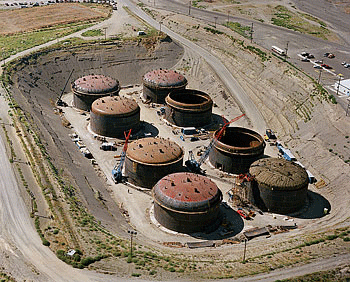
The department says that Tank AY-102 has widespread damage and should not be repaired.
The Tri-City Herald reports that this is the oldest of the double-walled underground tanks at Hanford. The Energy Department in 2012 revealed that waste from the inner shell of the tank was slowly leaking into the space between its inner and outer shells. No waste is known to have breached the outer shell to reach the environment.
The decision means that Hanford will have 27 newer double-walled tanks to hold waste emptied from 149 leak-prone single-walled tanks.
The waste is left from World War II and Cold War production of plutonium for the nation’s nuclear weapons program.
Nuclear subsidy a poorly considered handout, My Central Jersey, Mauricio Gutierrez, president and chief executive officer, NRG Energy, Princeton Jan. 2, 2018 “…..The nuclear subsidy bill (S3560) currently before the Legislature creates only one winner — nuclear plant owners — and many losers, including millions of business and residential electricity customers. By giving a blatant handout to PSE&G and Exelon to prop up three of their aging nuclear facilities, this legislation amounts to a $300-$400 million energy tax on millions of electricity customers across New Jersey every year. It will increase the cost of electricity and take hard-earned taxpayer dollars out of the pockets of average citizens, only to put it in the coffers of two multi-billion dollar corporations. And it won’t create a single job or additional investment in New Jersey along the way.
This legislation is also unnecessary. PSE&G and Exelon have already revealed that these nuclear plants are profitable today. There’s no emergency, and nothing needs to be done right now.
The State of Connecticut just went through a similar situation. Their legislature defeated a similar nuclear subsidy in 2016 and 2017, and instead decided to responsibly study the issue. With one simple study, Connecticut learned that the facts just didn’t support what the nuclear plant owner had told the state’s legislature — as well as the press, the local chambers of commerce, and even their own employees. The subsidy was completely unnecessary.
At the very least, our Legislature should take the time to conduct an independent study on the profitability of these nuclear plants.
https://www.teenvogue.com/story/nuclear-test-ban-treaty This is how you can join. by Sarah Bidgood and Susan le Jeune d’Allegeerschecque In this op-ed, Susan le Jeune d’Allegeershecque, British High Commissioner to Canada, and Sarah Bidgood, Senior Research Associate at the James Martin Center for Nonproliferation Studies, explain how young people are getting involved with the Comprehensive Nuclear Test Ban Treaty Organization to stop nuclear testing.
The atomic age dawned more than 70 years ago, but there is no sense in which the nuclear weapons debate is yesterday’s news. From North Korea’s nuclear program to the ground-breaking Iran Deal, the nuclear arms issue is at the heart of the biggest threats facing the planet and the ways in which governments respond. Anyone under 26 was born after the end of the Cold War, but our youth has inherited the 15,000 nuclear warheads which are its most concrete legacy. And unlike the 70s and 80s, when nuclear policy drove one of the biggest protest movements of the time, it might seem that the opportunities to exert influence today are limited.
The Comprehensive Nuclear Test Ban Treaty Organization (CTBTO) provides a way for the next generation to make their voices heard. The group is the guardian of a 1996 agreement of the same name that bans all nuclear testing. Because of the role that testing plays in the development and improvement of nuclear weapons, the treaty is crucial to limiting their spread. It has not yet entered into force because it has not been ratified by eight countries, including the United States. This means that even though the treaty is already supported by a global monitoring system of more than 300 facilities that can detect nuclear explosions anywhere in the world, the door remains open for countries that have not ratified it to test without legal consequences (as we have seen in North Korea).
In 2016, CTBTO Executive Secretary Dr. Lassina Zerbo launched an initiative to raise awareness about the treaty among the next generation and support for its entry into force. Today, the CTBTO Youth Group is open to all students and recent graduates with an interest in peace and security. From just nine members, the group has grown to more than 300, an international cohort from a wide range of backgrounds and experience levels. Its members are involved in an impressive spread of activities from research and analysis to grassroots advocacy, projects they carry out themselves with support from the CTBTO. Because of the diversity of the group, the projects vary based on members’s interests and the audiences they hope to reach. For graduate students specializing in nonproliferation at the Middelbury Institute of International Studies in Monterey, California, the youth group is a platform for their research on the treaty. Their projects have included analyzing the test ban treaty’s importance to the Treaty on the Nonproliferation of Nuclear Weapons, and presenting their findings at the United Nations in Vienna, Austria. For others, like teachers and students at Dr. Olga Mohan High School in Los Angeles, California, youth group activities are part of a larger effort to achieve a nuclear weapons free world. They joined the group after learning about Treaty at the Center for Nonproliferation Studies’ Critical Issues Forum, and they recently hosted a full-day Youth Disarmament Conference that highlighted the test ban treaty’s contributions to this goal.
Because social media is already a big part of their personal and professional lives, youth group members use it extensively. Their tweets, blogs and posts bring attention to the treaty and the need for ratification. Through hundreds of online interventions, they have introduced their networks to the treaty and explained why it should enter into force. They use these same tools to engage with an ever-younger political class to drive support for ratification. The extraordinary reach the of the youth group through social media demonstrates how much the treaty resonates with their generation once its benefits are understood. This groundswell of support has brought new energy to the debate on the test ban treaty, including for long-time experts who have not seen much progress on the treaty in years.
In many ways, however, it is personal — not virtual — relationships that are at the core of the youth group’s success. Members from India and Pakistan, nuclear rivals that have yet to ratify the treaty, work closely to understand arguments for and against the Comprehensive Nuclear Test Ban Treaty in their two countries. The same holds true for members from Israel, Egypt, and Iran, countries whose security interests place them in frequent conflict. The CTBTO provides a forum for these interactions by giving youth group members the chance to attend international events related to the treaty. These face-to-face meetings help build the trust, understanding and friendships at the heart of successful multilateral diplomacy.
Nearly two years after Dr. Zerbo’s big idea, the CTBTO Youth Group has firmly established itself at the heart of the renewed debate on nuclear issues. It allows a new generation of activists to challenge the status quo by asking tough questions that move the nuclear debate forward. At a time when the risk of a nuclear exchange seems greater than ever, teens and young adults must have a say in the future of these weapons. Activities like the youth group make them a constituency that is more and more difficult to ignore.
If you or someone you know would be interested in joining the CTBTO Youth Group, click here.
In a decision released Friday, the Ontario Energy Board orders the province’s largest electricity generator to cut “excessive” costs associated with pensions and benefits from its nuclear business’ administration, operations and maintenance budget by $100 million a year until 2021.
The decision comes after OPG, in May 2016, asked for $16.8 billion from the board for a period between 2017 and 2021 — a request that would ultimately lead to an increase in rates. OPG says the request is intended to, in part, help offset the cost of a major nuclear refurbishment project at the Darlington Nuclear Station and the continued operation of the Pickering Nuclear Station past 2020.
The OEB’s decision approves a request for $4.8 billion in costs related to the Darlington refurbishments and $292 million in fees associated with Pickering and says rate increase associated with the request will be retroactively effective from June 1, 2017.
While the final impact will be determined in early 2018, OPG estimated that its application would cost the average ratepayer an additional 65 cents a month over the five-year-period.
The decommissioning process at the site, which closed in December 2015, has been hit by delays following problems with machinery.
About half of the fuel has been removed from the plant and work to remove fuel was expected to be completed by the end of 2018.
Operator Magnox has now said it will not be completed until November 2019. The site’s two reactors held 49,000 fuel elements which have to be cleared as part of the decommissioning process.
But the work has been delayed because the 50-year-old machine used to remove them needed new parts.
Wylfa is the last of Magnox’s 12 UK power stations to be switched off and, across the firm’s sites, the cost of the process has almost doubled to an estimated £6bn.
It will take more than 100 years for the site to be fully cleared.
Horizon wants to build a replacement nuclear plant, Wylfa Newydd, next to the site, which would operate for 60 years and generate electricity for around five million homes.
But the proposals have to overcome planning and cost hurdles – the “strike price” for the electricity generated – before the plant can get the go ahead.







 nuclear-news