A NUCLEAR officer once responsible for pushing the button to launch 50 devastating missiles has revealed his biggest fear and said the “globe is on a hairpin trigger”.
EVERY day for two years, Peter Hefley would drive through Wyoming farmland to work, hoping he wouldn’t be called upon to act.
The nuclear launch officer, then 25, was one of two people who worked in an Air Force command and control centre deep underground from 2005 to 2007, maintaining a squadron of 50 of the world’s most devastating missiles and waiting for instructions to launch.
“If you imagine a hardened bunker 60 feet below the ground, that’s what we were doing,” he told news.com.au.
“Each [missile] had up to three nuclear warheads on it. Any one of those warheads would just destroy a city regardless of size.”
But while he used to have confidence in the fact Commander-in-Chief at the time, George W. Bush, would follow an escalation process from diplomacy to a declaration of war and use of conventional weapons first, now he has no such confidence.
“It’s fear,” he said when asked what led him to speak out given his critical former role. “It’s being afraid that not only can I picture myself, now there are kids doing what I did and the atmosphere is completely different.
“I’m nervous as a citizen because this is scary. Something that can devastate a good portion of the globe is on the hairpin trigger.”
The former college space hacker who ended up on the Air Force’s missile program said he now wants people to realise just how quickly a disaster could occur.
“The most important thing everybody can understand is how quick that process can happen because everybody is trained to do it as fast as possible,” he said about the system that can take just four minutes from the President’s order until the first missiles leave their silos.
The stark warning comes as a leaked draft of the Trump Administration’s Nuclear Posture Review (NPR) showed plans to increase “low yield weapons” that will not rely on host nations for support and are designed to ensure a “prompt response”.
Separately, US Air Force psychiatrist Steven Buser told the New York Times “warning signs abound” when thinking about whether Trump would pass the military’s strict Personnel Reliability Program (PRP) for fitness to serve in that role.
While the White House has said the NPR does not represent official policy, the report describes “low yield weapons” — the same force as those dropped on Hiroshima and Nagasaki — as a “low cost and near term modification that will help counter any mistaken perception of an exploitable ‘gap’ in US regional deterrence capabilities”.
Critics, including Mr Hefley, argue it could lead to a terrifying proliferation of the weapons the world is supposed to be eradicating, in the context of an unstable political environment.
“This is the first time I’ve heard in my lifetime [an argument for] restocking the nuclear armament. Everything has been a take down because they realise the devastation. This is ‘let’s add to this and let them do more things that will let us use more nuclear weapons’.”
The comments come after President Trump’s escalating rhetoric with North Korean leader Kim Jong-un and brags that his “nuclear button” is bigger and readily available. Trump supporters claim his hardline approach has helped force North Korean concessions including diplomatic talks with South Korea.
Hefley is one of 17 former nuclear launch officers who has recently signed an open letter stating President Trump is “worse than we feared” when it comes to his temperament to be Commander-in-Chief.
Global Zero executive director Derek Johnson, who wants to see nuclear weapons abolished, said the Nuclear Posture Review’s new stance takes the country closer to the “point of no return”.
“Trump’s plan to develop so-called ‘low-yield’ nuclear weapons and loosen restrictions on their use is a dramatic departure from longstanding US policy that makes nuclear war more likely. The world is about to get a whole lot more dangerous,” he said.
“Once we cross the nuclear threshold, all bets are off. If a nuclear weapon is used, nobody on the receiving end is going to stop to measure the mushroom cloud before retaliating. This plan paves a road to disaster.”
There’s a mad dash for a vital radioactive isotope that’s used in about 50,000 medical procedures every day in the US, including spotting deadly cancers and looming heart problems. Currently, access to it hinges on a shaky supply chain and a handful of aging nuclear reactors in foreign countries. But federal regulators and a few US companies are pushing hard and spending millions to produce it domestically and shore up access, Kaiser Health News reports.
The isotope, molybdenum-99 (Mo-99), decays to the short-lived Technetium-99m (Tc-99m) and other isotopes, which are used as radiotracers in medical imaging. Injected into patients, the isotopes spotlight how the heart is pumping, what parts of the brain are active, or if tumors are forming in bones.
But, to get to those useful endpoints, Mo-99 has to wind through a fraught journey. According to KHN, most Mo-99 in the US is made by irradiating Cold War-era uranium from America’s nuclear stockpile. The US Department of Energy’s National Nuclear Security Administration secretly ships it to aging reactors abroad. The reactors—and five subsequent processing plants—are in Australia, Canada, Europe (Netherlands, Belgium, Poland, and the Czech Republic), and South Africa, according to a 2016 report by The National Academies of Sciences, Engineering and Medicine. Private companies then rent irradiation time at the reactors, send the resulting medley of isotopes to processing plants, book the final Mo-99 on commercial flights back to the US, and distribute it to hospitals and pharmacies.
With just a 66-hour half-life, Mo-99’s trip has to be fast. “It’s like running through the desert with an ice cream cone,” Ira Goldman, senior director of global strategic supply at Lantheus Medical Imaging in North Billerica, Massachusetts, told KHN.
But things often don’t go smoothly—or quickly. The international shipping can run into mundane travel delays. Jittery pilots may refuse to transport radioactive material. And then there are problems at the reactors. A curious baboon once wandered into the reactor hall in South Africa, causing an unexpected shutdown, for instance.
But a more common problem is maintenance at the reactors, some of which are more than 50 years old. Facing $70 million in repairs, the Canadian government decided to call off Mo-99 production at its Chalk River, Ontario, reactor in 2016. It will permanently shut down the reactor at the end of this year.
Decaying chain
And those disruptions and shutdowns mean shortages. In 2009 and 2010, there was a shortage of Mo-99 after two reactors went down at once. Doctors were forced to used more expensive, more toxic imaging agents. With the permanent shuttering of the Canadian reactor, the National Academies judged there to be a greater than 50-percent chance of impending “severe” shortages.
The imperiled supply and the ever-present concern of uranium getting into the wrong hands led President Obama to pass legislation in 2013 to push companies into the business of Mo-99. The handful of companies that have now risen to the challenge have received millions in federal funds to jumpstart efforts to make Mo-99 domestically and, importantly, without highly-enriched uranium.
One of those is NorthStar Medical Radioisotopes of Beloit, Wisconsin, which received $50 million in funding and is working on a safe way to make Mo-99.
Likewise, SHINE Medical Technologies received $25 million from the DOE to help build a $100 million facility in Janesville, Wisconsin. SHINE got construction approval from the Nuclear Regulatory Agency last year and has designed eight particle accelerators for the site. They still need to raise additional capital and navigate a tangle of regulations.
But the company’s founder and CEO, Greg Piefer, a nuclear engineer, is optimistic. He promised the company will have Mo-99 production up and running by 2020, a deadline pushed back form 2015.
“If we don’t have significant production soon, we will continue to export highly enriched uranium,” Piefer said. “And the National Nuclear Security Administration will have failed their mission.”
MPs have demanded guarantees that UK cancer patients will not lose access to new radiotherapy treatments because of the UK’s withdrawal from the EU’s treaty on nuclear materials.
In a report published on Monday (15 January), the European Scrutiny committee called on UK ministers to set out “what arrangements will apply to the import of medical isotopes from the EU during any post-Brexit implementation period”.
The question of whether UK patients will lose access to new cancer treatments has exorcised the UK medical community ever since Prime Minister Theresa May set out the UK’s plans to leave the European Atomic Energy Community (Euratom) in her letter to European Council President Donald Tusk which began the Article 50 process of the UK’s withdrawal from the EU.
Brexit Secretary David Davis has indicated that the UK will instead seek to set up its own nuclear regulator.
But that has prompted concerns about the possibility of new customs controls on the transport of radio isotopes, which is already tightly regulated.
In November, Dr. John Buscombe, President of the British Nuclear Medicine Society, told the House of Lords that each year close to a million patients in the UK receive radiotherapies or scans, around 80% of which use materials imported from EU manufacturers.
UK Energy Minister Richard Harrington had however “emphatically confirmed that the UK’s ability to import medical isotopes from the EU or the rest of the world will not be affected by withdrawal from Euratom”, noted MPs.
Oncologists and radiologists are worried about a repeat of the two year shortage in radio isotopes between 2008 and 2010 caused by shutdowns of supply reactors in Canada and the Netherlands which produce Molybdenum-99 – the isotope most commonly used in medicine. Around 90% of Molbdenum-99 and its decay product (Technetium-99m) is used in the medical interventions involving radioisotopes. It is not produced in the UK.
“I was working as a Breast Cancer surgeon during the Technetium shortage which lasted well over a year. During that time we were faced with having to ration bone scans to only the most urgent or worrying cases,” said Dr. Philippa Whitford MP, a member of the European Scrutiny committee.
The Nuclear Industry Association (NIA) has called for a transitional arrangement during which the UK would keep its current arrangements under Euratom after March 2019, giving time for a new agreement for nuclear cooperation to be struck with the EU.
For its part, the Exiting the EU committee will hold its own hearing with Cancer Research UK at its Cambridge University headquarters on Thursday (18 January) to discuss the UK’s continued involvement in EU-wide agencies and access to research funding post-Brexit.
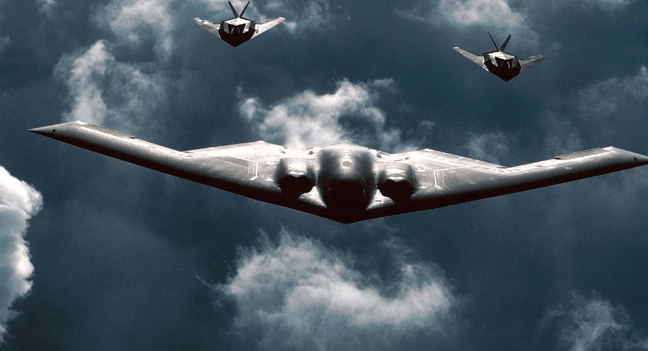
The US has stepped up its bomber presence in Guam to include the nuclear-capable B-2 and B-52 bombers.
The deployment comes as part of a mission to keep bombers in Guam constantly, but it’s still rare to see all three US strategic bombers in Guam at once.
North Korea has specifically threatened the bomber fleet in Guam, and the recent deployment marks the clearest possible signal ling between Washington and Pyongyang.
The US deployed every type of strategic and nuclear-capable bomber to Guam amid soaring tensions between the Washington and Pyongyang in a move sure to rattle North Korea.
The B-1B Lancer bomber, the B-2 Spirit stealth bomber, and the B-52H — the workhorse bomber that dropped tens of thousands of tons of munitions during the Vietnam War — will be in Guam, the Pentagon has confirmed to Business Insider.
North Korea can’t stand US bomber deployments to Guam, where the US hosts massive military bases in relative proximity to Pyongyang. North Korean media statements usually react strongly and issue threats in response to the US flying B-1 training missions over the Korean Peninsula.
In statements, North Korea refers to the B-1 bomber as a nuclear asset, although the plane has been modified not to carry nuclear weapons as the result of an arms control pact with Russia. The B-2 and B-52 do have nuclear capability, and make up the air-launched component of the US’s nuclear triad.
Unlike in-ground nuclear silos and under-sea secretive submarines, the nuclear-capable bombers in the US Air Force’s fleet enable the US to signal its resolve and intentions during times of high tensions.
While some may interpret the deployment of the nuclear-side of the bomber fleet as an escalation, the deployment is part of a mission called Continuous Bomber Presence, wherein the US has maintained a bomber presence in the Pacific at all times to assure allies, enable readiness, and promote regional stability since 2004.
But it’s still rare to find all three in Guam at once. The three bombers first flew together in Guam in August 2016, and this deployment is the first time since that they’ve all been gathered together in the South Pacific.
Sending all three strategic bombers to Guam sends the strongest message bomber deployments could possibly spell out.
Pentagon confirms existence of Russian ‘doomsday’ weapon, A NEW weapon of immense destructive power is now in Russia’s hands — and the rest of the world should be worried, particularly the United States. News.com.au, James Law@JournoLawJ 17 Jan 18
THE Pentagon has confirmed that Russia has developed an unmanned underwater nuclear drone that has the potential to devastate US ports and harbours, according to a leaked government report.
The paper, published by the Huffington Post, argues that America has been left exposed because Russia has continued to develop nukes since the end of the Cold War, while the US has reduced their role in its security strategy.
The US Defence Department cites this risk — combined with growing military threats from China, North Korea and Iran — to argue for increased spending on nuclear weapons.
Russia has embarked on a “comprehensive modernisation” of its nuclear arsenal, the paper says.
“Russia’s strategic nuclear modernisation has increased and will continue to increase its warhead delivery capacity, and provides Russia with the ability to rapidly expand its deployed warhead numbers,” the draft paper states.
“In addition to modernising ‘legacy’ Soviet nuclear systems, Russia is developing and deploying new nuclear warheads and launchers.
“These efforts include multiple upgrades for every leg of the Russian nuclear triad of strategic bombers, sea-based missiles, and land-based missiles.
“Russia is also developing at least two new intercontinental range systems, a hypersonic glide vehicle and a new intercontinental nuclear-armed undersea autonomous torpedo.”
The mention of the “torpedo” is the first time the Pentagon has publicly confirmed the existence of the weapon, referred to elsewhere in the document as a “AUV”, or autonomous underwater vehicle.
Russia first teased that it was working on the weapon in 2015 when blueprints of the drone were filmed over the shoulder of general during a meeting with President Vladimir Putin and broadcast on state television.
Experts argued at the time that the exposure of the plans wasn’t an accident; it was a deliberate warning to Washington and the rest of the West.
The Russian blueprint claims that the weapon, known officially as Ocean Multipurpose System Status-6, has a range of 10,000km, can descend 1km below sea level and can reach a top speed faster than 56 knots. It is designed to carry a 100-megaton nuclear warhead.
According to a BBC translation of the plans, the drone is designed to “destroy important economic installations of the enemy in coastal areas and cause guaranteed devastating damage to the country’s territory by creating wide areas of radioactive contamination, rendering them unusable for military, economic or other activity for a long time”.
While the Pentagon has admitted the risks of the Russians having this technology, there is no mention in the Nuclear Posture Review of the US developing a similar nuclear-tipped weapon.
US intelligence agencies detected that Russia tested the drone when it was launched from a Sarov-class submarine in 2016, The Washington Free Beacon reported.
“Status-6 is designed to kill civilians by massive blast and fallout,” former Pentagon official Mark Schneider told the Free Beacon at the time.
“The Russian government daily Rossiyskaya Gazeta reported that to achieve ‘extensive radioactive contamination’ the weapon ‘could envisage using the so-called cobalt bomb, a nuclear weapon designed to produce enhanced amounts of radioactive fallout compared to a regular atomic warhead.
“A cobalt bomb is a ‘doomsday’ weapons concept conceived during the Cold War, but apparently never actually developed.”
The weapon could be used to threaten the US’s two nuclear missile submarine bases in Georgia and Washington state………
The paper ultimately argues for increased investment in the US’s nuclear triad — which consists of land-based intercontinental ballistic missiles (ICBMs), strategic bombers and submarine-launched ballistic missiles.
The Defence Department’s “top priority” is to secure an additional 3 to 4 per cent of its budget to maintain its nuclear arsenal, which it says is essential to deter attacks from enemies.
“Our goal is to convince adversaries they have nothing to gain and everything to lose from the use of nuclear weapons,” Mr Mattis writes.
He suggests continuing the weapons modernisation program started by the Obama administration to replace nuclear ballistic missile submarines, strategic bombers, nuclear air-launched cruise missiles and ICBMs. He also expresses the aim to boost investment in nuclear weapons laboratories, fighter bombers and F-35A fighter jets.
Japan Broadcaster Joins Hawaii in Issuing False Missile Alert, Bloomberg, By Gareth Allan,
Error days after U.S. state caused panic with similar mistake
NHK apologizes on evening broadcast for erroneous warning
Japanese national broadcaster NHK issued a false alert about a North Korean missile launch, adding to questions about the reliability of early-warning systems after a similar incident in Hawaii.
Nuclear red herring thrown into Euratom Exit debate by desperate nuclear sector seeing significant subsidies disappearing
The nuclear industry lobby is desperate for the UK to remain in Euratom, as it would mean the massive subsidies they receive for research and development via Euratom would be lost. But they don’t believe such concerns would really bother most politicians, but claiming Brexatom would result in loss of radioactive isotope supplies for medical diagnoses, which does concern the public and politicians. So they have made a huge song and dance – successfully- over this red herring claim, to keep the UK in Euratom. Below is the latest in this ongoing saga.
Nuclear research and medical isotopes, European Scrutiny Committee, 15 January 2018
…….Summary and Committee’s conclusions……..While the substance of the proposal was not controversial, its political context is—of course—Brexit. The Prime Minister’s formal notification of the UK’s withdrawal from the EU under Article 50 of the Treaty on European Union (TEU) also included Euratom.17 Nuclear industry stakeholders have expressed concerns that the two-year negotiating period under Article 50 is insufficient for the UK to replicate Euratom’s existing regulatory safeguards regime for nuclear facilities domestically and agree new cooperation agreements with the EU, the IAEA and third countries. In addition, the medical establishment has warned that withdrawal from Euratom could impact on the availability and cost of medical isotopes in the UK post-Brexit……
On 28 July, the new Minister for Energy (Richard Harrington) replied to our predecessors’ letter of 25 April. He noted that the Government had not conducted a formal impact assessment on leaving Euratom, but emphatically confirmed that the UK’s ability to import medical isotopes from the EU or the rest of the world “will not be affected by withdrawal from Euratom”.
He also acknowledged the nuclear industry’s broader concerns about the UK’s exit from Euratom, noting that an “unsatisfactory withdrawal risks significant impacts for the nuclear sector”.
…….With respect to the supply of medical isotopes post-Brexit, we have taken note of the Minister’s assurance that the UK’s ability to import medical isotopes from the EU or the rest of the world will not be affected by withdrawal from Euratom.
……the UK currently does not produce any molybdenum-99 (99Mo), the decay product of which (technetium-99m or Tc-99m) is ultimately used for 90% of medical interventions involving radio isotopes.29 The UK is entirely reliant on import from other countries. The material cannot be stockpiled as it has a half-life of only 66 hours……..http://drdavidlowry.blogspot.com.au/2018/01/nuclear-red-herring-thrown-into-euratom.html
IT was the site of the world’s worst ecological disaster, but Chernobyl has risen from the ashes of its nuclear meltdown and is undergoing a massive makeover. News Corp Australia Network JANUARY 15, 2018AT ground zero of Ukraine’s Chernobyl tragedy, workers in orange vests are busy erecting hundreds of dark-coloured panels as the country gets ready to launch its first solar plant to revive the abandoned territory.
The new one-megawatt power plant is located just a hundred metres from the new “sarcophagus”, a giant metal dome sealing the remains ofthe 1986 Chernobyl accident, the worst nuclear disaster in the world.
“This solar power plant can cover the needs of a medium-sized village”, or about 2,000 flats, Yevgen Varyagin, the head of the Ukrainian-German company Solar Chernobyl which carried out the project, told AFP.
Eventually, the region is to produce 100 times the initial solar power, the company says.
The amount of sunshine “here is the same as in the south of Germany,” says Varyagin.
Ukraine, which has stopped buying natural gas from Russia in the last two years, is seeking to exploit the potential of the Chernobyl uninhabited exclusion zone that surrounds the damaged nuclear power plant and cannot be farmed.
CHERNOBYL EXCLUSION ZONE ‘SUITABLE FOR SCIENCE’
Reactor Number Four of the Chernobyl plant exploded April 26, 1986 and the fallout contaminated up to three quarters of Europe, according to some estimates, especially hitting Russia, Ukraine and Belarus.
Following the disaster, Soviet authorities evacuated hundreds of thousands of people and this vast territory, over 2,000 square kilometres wide, has remained abandoned.
The plant continued to operate the remaining reactors, the last of which was shut down in 2000, ending industrial activity in the area.
People cannot return to live in the zone for “more than 24,000 years”, according to the Ukrainian authorities, who nevertheless argue that a prudent industrial use can be possible again.
“This territory obviously cannot be used for agriculture, but it is quite suitable for innovative and scientific projects,” Ostap Semerak, Ukrainian Minister of the Environment and one of the promoters of placing solar projects in Chernobyl, told AFP in 2016.
The installation of a huge dome above the ruins of the damaged reactor just over a year ago made the realisation of the solar project possible.
Funded by the international community, it covered the old concrete structure which had become cracked and unstable, to ensure greater isolation of the highly radioactive magma in the reactor.
As a result, radiation near the plant plummeted to just one-tenth of previous levels, according to official figures
Even so, precautions are still necessary: the solar panels are fixed onto a base of concrete blocks rather than placed on the ground.
The soil remains contaminated, explains Varyagin, whose group is a joint venture between the Ukrainian firm Rodina Energy Group and Germany’s Enerparc AG.
“We can not drill or dig here because of the strict safety rules,” he says.
Last year the consortium completed a 4.2-megawatt solar power plant in the irradiated zone in neighbouring Belarus, not far from Chernobyl.
Ukrainian authorities offered investors nearly 2,500 hectares (25 square kilometres) for potential construction of solar power plants in Chernobyl.
Kiev has received about 60 proposals from foreign companies — including American, Chinese, Danish and French — who are considering participating in future solar developments in the area, according to Olena Kovalchuk, spokeswoman of the State Administration for the zone of Chernobyl.
Investors are attracted by the price that Ukraine has set for solar electricity, which “exceeds on average by 50 per cent of that in Europe”, Oleksandr Kharchenko, executive director of the Energy Industry Research Center, told AFP
He adds that cheap land and the proximity of the power grids makes Chernobyl particularly attractive, though there is still no rush of western investors to the region.
Safety concerns and Ukraine’s notorious bureaucracy and corruption has put some off.
“It is very important to have guarantees that working in the Chernobyl zone will be safe for those who will be doing it,” says Anton Usov, adviser to the European Bank for Reconstruction and Development (EBRD).
The bank does not currently foresee any investment to Ukraine in this field.







 nuclear-news