Age-related decay plagues Rokkasho project, stalled for 20 years, December 23, 2017
TOKYO — The Japanese company building a reprocessing plant for spent nuclear fuel pushed back the planned completion date by another three years Friday, further clouding prospects for realizing the nuclear fuel cycle sought by the energy-poor country.
Japan Nuclear Fuel said it now expects to finish the facility in Rokkasho, Aomori Prefecture, in the first half of fiscal 2021, citing problems with aging equipment that forced the suspension of safety checks by the Nuclear Regulation Authority. The deadline has been postponed 23 times from the original target of 1997.
Executive President Kenji Kudo apologized Friday to Aomori Vice Gov. Ikuo Sasaki and said his company would work as one to follow the new timetable at all costs.
Sasaki warned that the series of problems at the plant, stemming from age-related deterioration and insufficient inspections, “could cause residents to lose trust in the facility’s safety.”
The reprocessing plant is meant to extract uranium and plutonium from spent nuclear fuel for reuse in reactors, making it a key link in the envisioned nuclear fuel cycle. Work on the Rokkasho facility began in 1993, but it has sat idle for more than two decades, and many parts are deteriorating with age. Rainwater leaked into a building housing an emergency power supply, and corrosion ate holes in exhaust pipes at a uranium enrichment facility.
The cost of the Rokkasho plant, including operating expenses, has climbed to 13.9 trillion yen ($122 billion), and repair costs may push the total even higher. The necessary funds are provided by the big power companies that are Japan Nuclear Fuel’s main shareholders, feeding growing criticism that the burden falls indirectly on consumers.
The government decided last year to scrap the Monju experimental fast-breeder nuclear reactor, another part of the fuel-cycle plan.
Kudo acknowledged the excessive number of delays and said he would accept the criticism levied at his company. “We want to complete [the facility] at the earliest possible date,” he said.
But it remains unclear whether three additional years will be enough to bring the plant in line with tough new standards imposed after the Fukushi
Executives from Atlanta-based Southern Company defended their long delayed and way over-budget nuclear construction project, the Vogtle plant, before the Georgia Public Service Commission. But this time, Anthony Quinn won. The Georgia PSC commissioners gave Southern the ok to keep building.
The PSC had a choice: recommend cancellation of the huge project or let it proceed. But cancellation would require still another unpleasant discussion and decision: who foots the bill for the incomplete plant? Not the sort of decisions politicians like to make on their watch.
So the PSC ruled that power-generating alternatives to nuclear, such as combined cycle combustion turbines, would cost more than completing the plant (a conclusion that requires judgment about gas prices). And it made some modifications that will supposedly cut $700 million off what the plant will cost Southern’s consumers (that’s $18 million per year over the projected life of the plant, so no big deal.)
Economists warn decision makers to ignore sunk costs. But those sunk costs apparently did weigh on regulators. Explaining to the governor and to voters that the billions of dollars of plant investment made on their watch is now worthless… well, that’s a decision few regulators would choose to make.
The public reasoning behind today’s Georgia PSC decision involved assumptions about future energy costs, the company’s need for a diverse energy mix, and the desirability of adding low carbon emitting generating resources.
For all the attention this decision received, probably didn’t play a significant role. Nobody we’ve ever met could accurately forecast trends in energy consumption, power technology and costs at the same time over any reasonable planning horizon. To accurately forecast these over the 40-60 year projected life of the Vogtle plant turns an impossible task ridiculous. That is the key to the problem regulators faced today, and the reason why a decision to build a large nuclear plant is so risky.
Two Greentech Media journalists saw today’s PSC decision as an “infusion of hope for large-scale nuclear… and the last chance to prove the viability of the industry” in the U.S. The verdict of the financial community was far more muted. The common shares of Southern Company fell 1 percent.
How will an over-budget, late and marginally economic nuclear power generating facility encourage others to dive into the nuclear new-build game?
Georgia regulators cited other reasons to approve this project, including the need to reduce carbon omissions and to maintain America’s nuclear power generating capability. But the big question is why should the electricity consumers of Georgia, alone, bear the burden of meeting relatively high-cost national energy goals?
Given the size and risks inherent in building new nuclear projects, especially with relatively new designs, shouldn’t the risk be spread throughout the nation? There’s something bizarre about the electricity consumers of Georgia and South Carolina (where an identical project was recently canceled) incurring possibly $25-$50 billion of financial risk for the sake of the nation’s nuclear power generating capability.
Given the size and risks inherent in new nuclear projects, shouldn’t the risk be spread throughout the nation, if—as the regulators imply—the entire nation actually benefits? The electricity consumers in Georgia and South Carolina shouldn’t incur significant financial risk for the sake of the nation’s nuclear capability—especially when no other domestic utility management appears ready to follow suit.
As a supposedly patriotic gesture, we can certainly applaud the sentiment. But the economics remain shaky.
Citing the latest issue of the U.S. Energy Information Administration’s (EIA) “Electric Power Monthly” report (with data through Oct. 31), the group says U.S. renewables increased by 14.6% during the first 10 months of this year compared to the same period in 2016 and provided 17.7% of the nation’s electrical generation.
For the first time, solar has topped 2.0% of U.S. electrical output while wind exceeded 6.0%, reaching 6.14%, according to the SUN DAY Campaign. Hydropower accounted for 7.6% of total generation while biomass contributed 1.6% and geothermal 0.4%.
Thus, the group notes, solar and wind combined now account for a greater share of U.S. electrical generation than hydropower.
According to the group, U.S. electrical production by all renewable energy sources grew during the first 10 months of 2017, with solar up by 43.3%, hydroelectric by 13.8%, wind by 12.6%, biomass by 2.2%, and geothermal by 1.9%.
By comparison, electrical generation by oil dropped by 15.9%, natural gas by 9.4%, coal by 2.3%, and nuclear power by 0.6%, the SUN DAY Campaign concludes.
Scott Pruitt, head of the Environmental Protection Agency, promised this month that he would arrive at a decision in January about how to remediate the West Lake Landfill. To citizens of St. Louis who are not familiar with the situation, here’s a quick summary.
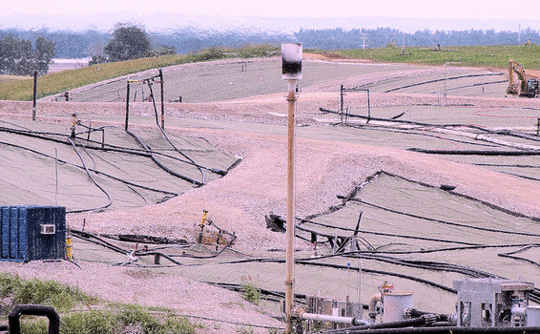
Republic Services, the second largest waste-management company in the country, owns the West Lake and Bridgeton landfills in north St. Louis County near Lambert airport. The West Lake Landfill lies in a former quarry, and huge amounts of radioactive material dating to the Manhattan Project were illegally dumped there in 1973. Much of the waste is low-level radioactive material, but evidence exists that highly toxic radionuclides such as Thorium-230 and Uranium-235 are mixed in.
The landfill is unlined, sits on a porous aquifer in a floodplain less than two miles from the Missouri River, upstream from a main water-treatment plant supplying drinking water to St. Louis. It’s located in a region prone to tornadoes and periodic devastating earthquakes, both having the potential to cause significant disruption to the landfill.
The Bridgeton Landfill lies adjacent and has a smoldering subsurface fire that’s currently 600 feet from the known radioactive portion of the West Lake Landfill. A smaller hotspot appears to be even closer. It’s uncertain what will happen if fire reaches the radioactive waste, though thankfully, an atomic explosion is highly unlikely if not impossible. Of greater concern is the possibility of a persistent low-grade fire involving the radioactive material and potentially, a toxic plume of smoke. Concern is great enough to have led St. Louis County to publish an emergency operations plan in 2014 in the event of a “catastrophic event” at the landfill.
At this point, the EPA is considering two possible interventions, and this is where Republic Services comes in. One option would be to “cap” the site — the option favored by Republic. The second would be to remove the radioactive waste, not favored by Republic because they fear they’ll be ordered to bear a good portion of the cost of this more expensive alternative.
So what is Republic doing? They’ve stepped up a disinformation campaign to deceive the public that the Russian government would be impressed by. They’ve set up a shill organization, Coalition to Keep Us Safe, posing as a grass-roots organization, to spread false information and advocate for the absurd solution of capping. Why absurd? Because the material will be radioactive for millions of years. Caps don’t last millions of years and, importantly, the landfills sit in unlined quarries over a porous aquifer. You can’t put a cap underneath the waste; by definition, it sits on top.
The phony coalition website has earnest citizens of Missouri expressing their preference for capping so that the waste won’t be hauled on Missouri highways and rails. However, radioactive waste has been and continues to be safely hauled in Missouri.
The website links to several opinion pieces published in recent months that appear suspiciously coordinated. Several are written by women, all of whom attack the JustMomsSTL group that has battled to get the dumpsite remediated. All three assert that the JustMoms group is a front for or has questionable ties to the Teamsters. All have misleading titles like “Just Moms STL Has the Right Idea.”
Two are written by women from Washington, D.C.; why would they care about this issue? One of the D.C.-based writers, Jean Card, had an opinion piece published in the Missouri Times that’s filled with untruths and attacks the JustMoms organization. Her business website www.jeancardink.com, lists “Persuasive op eds and letters to the editor” first in services she offers.
If this is what Republic Services is doing in the light of day, I worry about what it is doing behind the scenes. Lobbyists must be exerting strong pressure on Pruitt to choose capping. So what can St. Louisans do? First, recognize this problem is a threat to the entire region, not just to those who live near the landfill. Second, call Scott Pruitt at 202-564-4700. Tell him not to listen to the Republic Services lobbyists who must be knocking at his door. Let him know the only reasonable solution is to remove the waste.
Dr. Stuart Slavin is a professor of pediatrics at St. Louis University School of Medicine.
In Central Texas Where Wind Power Means Jobs, Climate Talk Is Beside the Point, Wind turbines bring jobs, tax dollars for new schools, income security for farmers and energy independence. To these Texans, climate change has little to do with it. BY MEERA SUBRAMANIAN, INSIDECLIMATE NEWS
DEC 26, 2017 “……….. Wind’s Ascent
Wind energy development in Nolan County dates back to 2001, when the first wind farmswere constructed in the area. A perfect confluence of events led to the growth of the industry since then.
There was a supportive state government, led by Republicans George W. Bush and then Rick Perry, pushing for wind by putting the regulatory and infrastructure pieces in place to make it successful. The state’s nearly autonomous electric grid meant no troublesome cross-border or federal approval was needed to get wind electricity from places like Sweetwater to the green-leaning urban markets clamoring for renewable energy. And then there were the Texans themselves, ever eager to use their land and diversify their revenue sources, especially as recurring droughts killed off the cotton and the livestock, and oil fields were either going dry or failing to pay for themselves. At the same time, federal incentives came (and went, and came again) in the form of production tax credits that helped the wind industry offset large investment costs.
If Texas were a nation, it would be the sixth-largest wind energy producer in the world. The bulk of that power is coming from the Nolan County region. And so the reddest parts of Texas are responsible for supplying upwards of 12 percent of the state’s energy needs every month with clean, green kilowatts. Occasionally, as happened one day in the blustery month of October this year (a time when those energy-sucking A/C units are switched off and electricity usage is low), it provided more than half of the electricity to the state’s power grid.
The Lure of Wind Industry Jobs
As the wind industry grew through the early 2000s, so did a desperate need for skilled labor. What emerged was the 2008 launch of TSTC’s Wind Energy Technology program, where James enrolled in 2010 and where he returned to teach in 2013 after working in the field for a couple of years.
According to the Bureau of Labor Statistics, wind technician is currently the second-fastest growing job in America (beat out only by solar photovoltaic installer). By the end of last year, there were more than 100,000 jobs related to the wind industry nationwide, at least one-fifth of them in Texas. When the American Wind Energy Association (AWEA) launched a seal of approval for wind technician programs in 2011, TSTC was one of only three schools in the U.S. to receive it.
The students James teaches are a slice of the next generation of wind workers for an industry that, at least in this part of the country, has already established itself. They include veterans and women, those leaning politically right and left, environmentalists and climate change skeptics, the civically engaged and those who never vote. The clean energycomponent seems to be a bonus for some, but it was not the primary reason they chose this field. There is the laid-off gas worker who noticed all the wind turbines on the horizon and thought there must be an opportunity there. The English major who couldn’t find a job and remembered how much she liked the outdoor work on her family’s farm in the Texas panhandle. The two veterans who liked the element of risk and heights and the sweet spot of job independence and camaraderie………..
wind energy had bolstered the local economy.
“In pre-wind, our county taxable value was $500 million,” Ken explained. “In 2008, it was $2.8 billion,” a five-fold increase that translated to new schools and grand expansions at the local hospital. That’s money for the town, but also a steady income for local landowners, some of whom earn up to $1,000 per month from having a single commercial turbine on their property—and most of the region’s world-class wind farms are dotted across private land. Many say they’re “not sure they’d even have the ranch today if the wind didn’t come on,” Ken told me……..
complementary industries are the ecosystem that wind power belongs to—and its reach is growing. Repowering, which vastly increases efficiency by either replacing old turbines for more powerful ones or upgrading components, means more megawatts with the same footprint. It also means a whole new category of jobs. While I was there, evidence of these peripheral industries was everywhere. I watched 80-foot blades swapped out for ones twice as long. (The production tax credits helped these efforts, too.) I visited Global Fiberglass Solutions of Texas, which was setting up shop in an old aluminum recycling plant to process the decommissioned blades—which were being amassed in a 10-acre field—into building panels and other materials…….
The best places for wind are often the places that are struggling to keep rural communities alive.
What was happening in Nolan County proved that the debate about how we generate our kilowatts doesn’t have to be about climate change. It could be about embracing whatever clean energy options are available to help make small-town America economically viable. In this deeply red place, it was the embodiment of President Barack Obama’s all-of-the-above strategy. At the close of 2016, 86 percent of the country’s onshore wind turbines were located in Republican districts, according to the 2016 U.S. Wind Industry Annual Market Report. Indeed, Republican Sens. Rob Portman of Ohio and John Thune of South Dakota were some of the primary advocates responsible for keeping the PTC in place in the final version of the tax overhaul bill, which was signed Dec. 22…….. https://insideclimatenews.org/news/26122017/wind-energy-jobs-booming-texas-clean-renewable-power-climate-change
North Korea plans ‘satellite’ launch for space program, amid UN sanctions News Corp Australia Network, DECEMBER 27, 2017AS North Korea plans a “satellite” space launch, observers have warned, amid UN sanctions, the rogue nation could be using it as a cover for more weapons tests.Fox News NORTH Korea’s regime is planning to launch a satellite that observers warn could be a Trojan horse for more weapons tests, a South Korean newspaper reports.
North Korea is being sanctioned by the United Nations over its nuclear and missile launches and is currently not allowed to carry out any launches using ballistic missile technology, which includes satellites, reports Fox News.
“Through various channels, we’ve recently learned that the North has completed a new satellite and named it Kwangmyongsong-5,” the Joongang Ilbo daily reported, quoting a South Korean government source.
The isolated North Korean regime has called the sanctions an “act of war” that’s been “rigged up the US.”
The South Korean newspaper reports that the communist regime’s plan is to put a satellite with cameras and telecommunication devices into orbit.
Pyongyang launched its Kwangmyongsong-4 satellite in February 2016, which much of the international community viewed as a disguised ballistic missile test.
Ed. note. Incidentally, this is the period during which Professor Ernest Titterton managed to cancel testing of of radioactive fallout to the East coast of Australia
France to study nuclear test veterans, https://www.radionz.co.nz/international/pacific-news/347025/france-to-study-nuclear-test-veteransReports from French Polynesia say the French government will launch an epidemiological study of 21,000 nuclear test veterans. According to Radio1 in Tahiti, the defence ministry will test all those whose exposure to radiation was measured between 1966 and 1996 – the period during which France tested 193 atomic bombs.
The study is to update the findings of two previous studies into mortality and morbidity.
The first found that by the end of 2008 more than 5,500 had died.
The study of the remaining 21,000 veterans is to help improve assessing their health care risks.
China’s plans to expand in the South China Sea with a floating nuclear power plant continue,news.com.au, News Corp Australia Network DECEMBER 26, 2017CHINA’S expansion in the South China Sea continues with plans for a floating nuclear plant. But that’s not all. They’re also using ‘magical machines’.AFP CHINA’S large-scale land reclamation around disputed reefs and shoals in the South China Sea is “moving ahead steadily”, state media has reported, and is on track to use giant “island-builders” to transform even more of the region.
Beijing claims nearly all of the sea and has been turning reefs in the Spratly and Paracel chains into islands, installing military facilities and equipment in the area where it has conflicting claims with neighbours……….The report noted that with last month’s introduction of the new super-dredger Tianjing, a “magical island building machine”, and other “magical machines” soon to come, “the area of the South China Sea’s islands and reefs will expand a step further”.
Funds sought for cleanup at UA nuclear reactor test site, The Commercial, Pine Bluff 26 Dec 17 FAYETTEVILLE — Cleanup at a nuclear reactor test site built in the late 1960s began this year after three decades of waiting. Thousands of pounds of low-level radioactive waste have since been trucked away from rural Washington County to specialized waste facilities outside the state.
Now the University of Arkansas-Fayetteville, the site owner, faces the possibility of another delay as it awaits news of federal funding to finish the cleanup of the Southwest Experimental Fast Oxide Reactor, often referred to as SEFOR.
“We need $10.1 million dollars in FY 18 appropriations,” said Mike Johnson, UA’s associate vice chancellor for facilities, referring to the federal fiscal year.
If the money comes through by mid-January, the final stage of remediation — removal of the reactor core, the radioactive heart of the site — will begin without interruption, he said. …….
Future work scheduled through March includes cutting away sections of a containment shield designed to prevent radiation from escaping into the atmosphere and also cutting down portions of a thick wall that shielded workers from radiation. The schedule calls for a temporary roof and weather shield to be affixed to what remains. The reactor, built with funding from the U.S. Atomic Energy Commission, according to UA, never was hooked up to turbine equipment so no electricity was produced, but it did work as planned.
Kyodo News 25th Dec 2017, Radiation cleanup work began Monday in Futaba to make the town that
co-hosts the crisis-hit Fukushima Daiichi nuclear power plant inhabitable again by around spring 2022 under a government-led reconstruction project.
Cleanup work has been carried out in areas contaminated with radioactive substances released from the nuclear plant in the aftermath of the March 2011 huge earthquake and tsunami, with the plant operator Tokyo Electric
Power Company Holdings Inc. being responsible for the cost.
But the latest work in Futaba is the first of the government-led project to make areas designated as special reconstruction zones livable again. The government plans to carry out cleanup work and promote infrastructure development
intensively at national expense in those areas.
New York Times 25th Dec 2017,Germany has spent $200 billion over the past two decades to promote cleaner
sources of electricity. That enormous investment is now having an unexpected impact — consumers are now actually paid to use power on occasion, as was the case over the weekend.
Power prices plunged below zero for much of Sunday and the early hours of Christmas Day on the EPEX Spot, a
large European power trading exchange, the result of low demand, unseasonably warm weather and strong breezes that provided an abundance of wind power on the grid.
Such “negative prices” are not the norm in Germany, but they are far from rare, thanks to the country’s effort to
encourage investment in greener forms of power generation. Prices for electricity in Germany have dipped below zero — meaning customers are being paid to consume power — more than 100 times this year alone, according to EPEX Spot. https://www.nytimes.com/2017/12/25/business/energy-environment/germany-electricity-negative-prices.html
“The Arctic Circle cuts right through Santa Claus Village. A white line denoting the Arctic Circle (at its position in 1865) is painted across the park. Visitors officially enter the Arctic area when they cross the line.” https://en.wikipedia.org/wiki/Santa_Claus_Village Tsar Bomba and Santa Claus Village Locations Exported from Wikipedia. Tsar Bomba site is on Novaya Zemlya. The third location is the site of Russia’s new radioactive waste processing facility.
Around 18 above ground nuclear weapons were tested in Novaya Zemlya from September 1st 1961, when Russia first broke the moratorium on nuclear weapons testing, until Tsar Bomba was exploded on October 30, 1961. Many others were tested in Kazakhstan: “Over its history as a nuclear test site, Novaya Zemlya hosted 224 nuclear detonations with a total explosive energy equivalent to 265 megatons of TNT. For comparison, all explosives used in World War II, including the detonations of two…
Thanks to all those who work with us – to cut through the corporate spin, and aim for freeing this planet from the nuclear horror, and from disastrous climate change. We cannot afford to give up hope.
Toshiba Corp. unveiled a pan-tilt camera which it jointly developed with the International Research Institute for Nuclear Decommissioning (IRND), to inspect the interior of the damaged primary containment vessel of Fukushima Dai-ichi Nuclear Power Station Unit 2 in Yokohama, Friday, Dec. 22, 2017. The device shown to media Friday is 13 meters (43 feet) long and designed to give officials a deeper view into the nuclear plant’s Unit 2 primary containment vessel, where details on melted fuel damage remain largely unknown.
By Mari Yamaguchi | AP December 22 at 10:10 AM
YOKOHAMA, Japan — Toshiba Corp.’s energy systems unit on Friday unveiled a long telescopic pipe carrying a pan-tilt camera designed to gather crucial information about the situation inside the reactor chambers at Japan’s tsunami-wrecked Fukushima nuclear plant.
The device is 13 meters (43 feet) long and designed to give officials a deeper view into the nuclear plant’s Unit 2 primary containment vessel, where details on melted fuel damage remain largely unknown.
The Fukushima plant had triple meltdowns following the 2011 quake and tsunami. Finding details about the fuel debris is crucial to determining the right method and technology for its removal at each reactor, the most challenging process to safely carry out the plant’s decades-long decommissioning.
Japan’s stricter, post-Fukushima safety standards also require nuclear plant operators elsewhere to invest more time and money into safety measures.
On Friday, Kansai Electric Power Co. announced that it would decommission two idle reactors at the Ohi Nuclear Power Plant in western Japan, citing the difficulty of adding all the safety requirements at the nearly 40-year-old reactors that would be needed to get approval for their restart.
Reports have said it would cost about 58 billion yen ($500 million) and take 30 years to decommission a reactor, about half the estimated cost to restart one.
Also Friday, Japan Nuclear Fuel said that it was postponing the planned launch of its trouble-plagued spent fuel reprocessing plant by three more years until 2021. It cited delayed approval by the authorities. It also said it was postponing the planned manufacturing of fuel from recycled plutonium and uranium.
The mission involving Toshiba’s new probe at Fukushima’s Unit 2 reactor could come as soon as late January. Company officials said the new device will be sent inside the pedestal, a structure directly below the core, to investigate the area and hopefully to find melted debris.
The device looks like a giant fishing rod about 12 centimeters (4.7 inches) in diameter, from which a unit housing the camera, a dosimeter and thermometer slowly slides down. The probe, attached by a cable on the back, can descend all the way to the bottom of the reactor vessel if it can avoid obstacles, officials said.
Two teams of several engineers will be tasked with the mission, which they will remotely operate from a radiation-free command center at the plant.
A simpler predecessor to the pipe unveiled Friday had captured a limited view of the vessel during a preparatory investigation in February. A crawling robot sent in later in February struggled with debris on the ground and stalled in the end due to higher-than-expected radiation, its intended mission incomplete.
The upgraded probe has been co-developed by Toshiba ESS and International Research Institute for Nuclear Decommissioning, a government-funded unit of construction and nuclear technology companies over the past nine months.








 nuclear-news