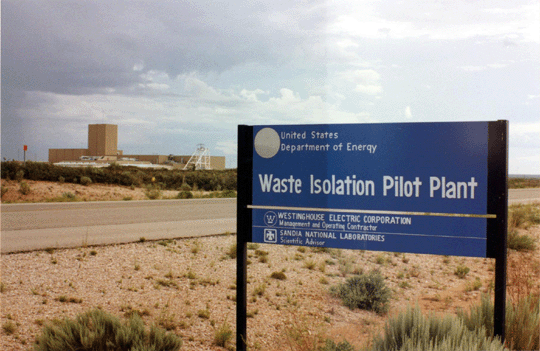
 Official: WIPP deficiencies stem from lack of funds, By Rebecca Moss | The New Mexican, 7 Dec 17
December 9, 2017
Posted by Christina Macpherson |
safety, USA, wastes |
Leave a comment
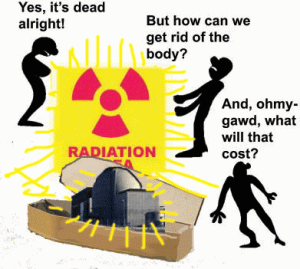 S. Korea strives to build up nuclear decommissioning industry, By Kim Eun-jung SEOUL, Dec. 8 (Yonhap) — South Korea will ramp up efforts to develop technologies related to nuclear decommissioning as the country’s oldest reactor is undergoing the lengthy, costly process of being dismantled, the energy ministry said Friday.
The Ministry of Trade, Industry and Energy launched a consultative body composed of state-run utilities, construction companies and research institutes to put concerted efforts toward developing the nation’s nuclear decommissioning industry,
The ministry said it aims to develop technologies needed to dismantle nuclear reactors by 2021 that will make such sites free of radioactive hazards and establish a research institute to pave the way for entering the global market by 2030…….
A total of 11 reactors will be retired one by one by 2030 as their operational life cycles expire as the government said it won’t extend their operation.
As part of the nuclear phase-out plan, the government is also pushing for an early closure of Wolsong-1, now the nation’s oldest operating reactor, as soon as possible.
According to the International Atomic Energy Agency (IAEA), 34 nations have built 611 reactors and 449 were in operation as of April 2017. Among 160 reactors permanently shut down, the decommissioning process has been completed for 19. ejkim@yna.co.kr http://english.yonhapnews.co.kr/news/2017/12/08/95/0200000000AEN20171208001551320F.html
December 9, 2017
Posted by Christina Macpherson |
decommission reactor, South Korea |
Leave a comment
Northampton activists travel to Norway to attend Nobel peace prize conference, lobby for nuclear disarmament agreement, Mass LiveDec 8, By Lucas Ropek
NORTHAMPTON – Northampton area activists traveled to Norway Thursday to attend the Nobel Peace Prize conference in Oslo, hoping to use the trip as an opportunity to promote a nuclear non-proliferation treaty.
Jeff Napolitano, the Executive Director of The Resistance Center for Peace and Justice, and Sabine Merz, who sits on the Center’s Board of Directors, will stay in Oslo for a week.
The Resistance Center was born out of the Northampton chapter of the American Friends Service Committee that closed earlier this year, and focuses on promoting a progressive agenda locally and globally.
Napolitano and Merz hope to use the conference as an opportunity to participate in a conversation about the Treaty on the Prohibition of Nuclear Weapons, an international agreement supported by 122 United Nations (UN) member states that, if adopted, would be a legally binding means of banning nuclear weapons throughout the world.
The treaty is the result of years of activism on the part of a coalition of countries pushing for disarmament, according to the activists. Much of the work was accomplished by the International Campaign to Abolish Nuclear Weapons (ICAN), which is being awarded the Nobel peace prize for its work in establishing the treaty. …….
The U.S. has so far declined to sign the ICAN treaty and the U.S. ambassador has also declined to attend the Oslo conference, said Napolitano. http://www.masslive.com/news/index.ssf/2017/12/northampton_activists_travel_t.html
December 9, 2017
Posted by Christina Macpherson |
USA, weapons and war |
Leave a comment
 The media-mogul’s Santa Monica vineyard was saved from wildfire destruction, but the world may yet burn thanks to his climate views, says Richard Schiffman New Scientist, By Richard Schiffman, 9 Dec 17
A wildfire has ripped through one of the wealthiest neighbourhoods in the US, damaging Rupert Murdoch’s $28.8 million vineyard estate in the Santa Monica mountains at the edge of Los Angeles.
The media-mogul’s palatial house was saved, thanks to firefighters who spent the afternoon and night battling the conflagration. Others weren’t so lucky. Hundreds of homes and scores of lives have been lost in both northern and southern California in a spate of recent wildfires that were fiercer and moved faster than any in recent memory.
Such fires are made more likely as the world warms. California has just had its hottest summer on record, and the recent wildfires came much later in the year than normal. We also know that seven of California’s 10 largest recorded wildfires have occurred in the last 14 years.
California isn’t alone. Wildfires are occurring with greater… subscribers only https://www.newscientist.com/article/will-wildfires-finally-change-rupert-murdochs-climate-stance/
December 9, 2017
Posted by Christina Macpherson |
general |
Leave a comment
The Nobel Laureates take center stage in Stockholm on 10 December, when they receive the Nobel Medal and Diploma from King Carl XVI Gustaf of Sweden.
ICAN is, of course, hoping the prize will convince more people to back its bomb ban.
But it also wants more public debate about the pace of nuclear disarmament — many nuclear experts agree things have moved too slowly, for too long.
“I would hope [ICAN’s work] generates some momentum within existing processes for disarmament,” Mr Dall said.
“If it doesn’t, then the long-term impact could be that nothing is going to happen and that really is the worst possible long-term impact.”
Regardless, the prize, the controversy and “ambassador boycott” is all invaluable for ICAN itself.
Anything that prompts more global coverage of nuclear weapons and the destruction they can unleash, is much more useful to it than any number of diplomatic niceties in Norway this weekend.
December 8, 2017
Posted by Christina Macpherson |
2 WORLD, weapons and war |
Leave a comment
 Can Humans Survive? Nuclear weapons and climate change both threaten our existence, but with different time scales and probability.
Closer to the nuclear brink: American air drills begin over the Korean peninsula. The human consequences of nuclear war: a new medical plea against war.
Nuclear news in America is getting more intriguing – with more being revealed about the shady nuclear deals done by Trump’s former National Security Adviser Michael Flynn. It’s enough for Trump’s lawyers to be concerned, as Flynn is now co-operating with the FBI investigation into the Trump campaign and Russia.
On the climate front – when it comes to climate predictions – the most accurate ones are turning out to be the worst case scenarios. Even in rich countries, climate change is already costing us all financially, and it’s going to get worse.
The illegality of a plan for a nuclear attack.
Hanford, USA and Mayak, Russia – their hidden radioactive megapollution.
Media to blame for focussing on Trump trivia, minimising climate change.
ANTARCTICA. Antarctica – so remote, but so significant in climate science.– An immense glacier is melting, in Antarctica.
NORTH KOREA. United Nations’ political chief makes rare visit to North Korea. North Korea says nuclear war on Korean Peninsula inevitable. U.S. ex-envoy Robert Gallucci urges Washington and Pyongyang to consider China’s ‘freeze to freeze’ compromise. Environmental dangers from North Korea’s nuclear bomb tests. North Korean nuclear tests sickening residents with ‘ghost disease,’ defectors say.
UK. Electricity from Small Modular Nuclear Reactors (SMRs) would be much more expensive than from ‘conventional’ reactors. Small Modular Nuclear Reactors not economically viable, but UK govt is funding them anyway. Energy and Climate Intelligence Unit calls for windfarms: wind energy now cheapest form of electricity.
USA.
JAPAN. Tokyo 2020 Olympics costs skyrocket because of Fukushima nuclear reconstruction. Tokyo 2020 to feed IOC food from disaster-hit regions. The Japanese Government Is Lying to the International Community: the Radiological Situation in and around Fukushima is NOT Safe.
Failure of Monju fast-breeder nuclear reactor leaves Japan with a huge spent fuel problem. UN General Assembly endorses a Japanese anti-nuclear resolution. Proposal for Japan to ‘rent’ nuclear weapons from USA.
Fukushima dome roof takes shape, but radiation remains high. Tepco officials warned workers and journalists not to stand too long next to Fukushima nuclear reactor storage pool. Japan struck by two earthquakes.
RUSSIA. Incident at Russia’s Mayak nuclear reprocessing plant may have caused radiation cloud over Europe. Fundamental problems with the Russian nuclear industry. Russia’s deception, denial and propaganda over the nuclear event at Mayak. Russia slams North Korea’s nuclear gambling and US’ provocative conduct.
CANADA. Search narrowed for place to store used nuclear fuel. Just say no to a nuclear waste dump anywhere near the Great Lakes: the message from many officials and residents. Candu nuclear reactor to be buried.
UKRAINE. Risk of Chernobyl sarcophagus collapsing – radiation danger to workers now sealing it Solar power to take over, on Chernobyl’s nuclear wasteland.
FRANCE. Drones still buzz around France’s nuclear power plants! France to reduce its use of nuclear power as soon as possible, and discredit the myth of “cheap” nuclear energy. European citizens lodge a complaint against EDF and French govt on nuclear unsafety.
ARMENIA. Armenia considers plan to abandon nuclear power and go for renewables.
December 8, 2017
Posted by Christina Macpherson |
Christina's notes |
Leave a comment
 Power from mini nuclear plants ‘would cost more than from large ones’
UK government study finds electricity would be nearly one-third pricier than it would from plants such as Hinkley Point C, Guardian, Adam Vaughan, 7 Dec 17, Electricity from the first mini nuclear power stations in Britain would be likely to be more expensive than from large atomic plants such as Hinkley Point C, according to a government study.
Power from small modular reactors (SMRs) would cost nearly one-third more than conventional large ones in 2031, the report found, because of reduced economies of scale and the costs of deploying first-of-a-kind technology.
The analysis by the consultancy Atkins for the Department for Business, Energyand Industrial Strategy said there was “a great deal of uncertainty with regards to the economics” of the smaller reactors.
However, the authors said such reactors should be able to cut costs more quickly than large ones because they could be built and put into service in less time.
Advocates have argued that the reactors could be built in factories and achieve savings through their modular nature.
While the report covers the technology being used by several of the international companies seeking government support, it does not apply to the design being pushed by businesses including Rolls-Royce.
A government source said nuclear companies had told officials that the cost of the technology had come down since the report, which was finished in July last year but only published on Thursday.
As revealed by the Guardian earlier this week, ministers confirmed that SMR developers would receive £56m of public funding for research and development over three years. A further £86m was announced for work on nuclear fusion.
Greg Clark, the business secretary, said the backing would help the nuclear sector compete globally………
The government also defended Britain’s need for new nuclear power in the face of falling renewable costs.
Richard Harrington, the energy minister, said the record low subsidies recently awarded to offshore windfarms emphasised the challenge for the French, Korean, Chinese and Japanese companies building the UK’s new generation of nuclear plants to be competitive on price………
green groups and politicians accused the government of talking down renewables.
Doug Parr, the policy director at Greenpeace UK, said: “Instead of downplaying the rapid advancement of UK renewables, the government should concentrate on the export opportunities for this UK success story.”
Caroline Lucas, the Green party co-leader, called the UK’s energy policy a mess. “Ministers are ploughing huge sums of money into supporting overpriced nuclear, while retaining a de facto ban on onshore wind and failing to give solar the support the sector needs,” she said……. https://www.theguardian.com/environment/2017/dec/07/power-mini-nuclear-plants-cost-more-hinkley-point-c
December 8, 2017
Posted by Christina Macpherson |
Small Modular Nuclear Reactors, technology, UK |
Leave a comment
 Mining Awareness +
“Whistleblower Provides Key Info About Flynn Text to Business Colleague During Trump Inauguration Dec 6, 2017 Press Release
Whistleblower Provides Key Info About Flynn Text to Business Colleague During Trump Inauguration
Cummings Asks Gowdy to Stop Blocking Flynn Investigation and Finally Subpoena White House and Others
Washington, D.C. (Dec. 6, 2017)—Today, Rep. Elijah E. Cummings, the Ranking Member of the House Committee on Oversight and Government Reform, sent a letter informing Chairman Trey Gowdy about a whistleblower who has come forward with evidence that Lt. General Michael Flynn—within minutes of Donald Trump being sworn in as President—was communicating directly with his former business colleague about their plan to work with Russia to build nuclear reactors in the Middle East.
According to the whistleblower, Alex Copson, the managing partner of ACU Strategic Partners—which funded Flynn’s trip to the Middle East in 2015—attended an event on Inauguration Day during…
View original post 505 more words
December 8, 2017
Posted by Christina Macpherson |
Uncategorized |
Leave a comment
Legal scholar George Delf’s Humanizing Hell! The Law V. Nuclear Weapons is concise, bold, and direct. “[A]rmed forces are committed by military, domestic and international law not to attack non-combatants. Any government which adopts a defense policy implying such an attack is therefore inciting its own forces to commit war crimes on a gigantic and suicidal scale.”
 Counter Information

By John Laforge
US general says order to launch nuclear weapons can be refused if illegal
—Chicago Tribune, Nov. 18
US nuclear commander would balk at any “illegal” order
—MSNBC, Nov. 18
General heading Strategic Command says illegal nuclear launch order can be refused
—NBC News, Nov. 18
Top general says he would resist “illegal” nuke order from Trump
—CBS News, Nov. 18
Top US general says he would resist illegal nuclear strike order from Donald Trump
—The Independent, Nov. 18
All these headlines give the direct impression that a nuclear attack could be legal in some circumstances. But is this possible?
Air Force General John Hyten, commander of Strategic Command, told the Halifax International Security Forum Nov. 18, that an order from the president to launch nuclear weapons can be refused if that order is determined to be illegal. In the face of an unlawful order, Gen. Hyten said…
View original post 1,214 more words
December 8, 2017
Posted by arclight2011part2 |
Uncategorized |
Leave a comment
Published December 7, 2017 at 4:40 PM
Construction of the main stadium for the Tokyo 2020 Olympics is underway in Japan, despite the fact that the final budget for the games still hasn’t been locked down. Recent estimates have put the total Tokyo Olympic bill at around $13 billion, but now it looks like that figure will soon be cut drastically.
CGTN’s Steve Ross reports.
“We were already able to reduce the venue cost by more than $2 billion,” Maya Takaya of the Tokyo Organizing Committee said.
The Tokyo 2020 Olympics and Paralympics originally unveiled an audacious main stadium design by renowned architect Zaha Hadid, but the design was ultimately rejected as too costly. Sustainability has also become a key issue for taxpayers, with the committee expanding the use of existing venues from 40 to 60 percent.
A key problem is that various costs, including anti-terrorism security and augmented transportation facilities, were not reflected in Tokyo’s original Olympic bid.
“The IOC requested Tokyo to show a budget of the Olympics on specific points, but not all. But, by their explanation, we thought the budget was for all Olympic costs,” University of Kokushikan University Law Professor Tomoyuki Suzuki said. “After the Fukushima March 11 disaster, building material costs and contractors’ fees have gone up and up. The Olympic budget requires more and more.”
The Tokyo 2020 Olympic Organizing Committee promises to announce revised costs by year’s end, when Japanese citizens are likely to be looking not only for a lower “bottom line,” but greater budget transparency, as well.
Video and article link https://america.cgtn.com/2017/12/07/tokyo-2020-olympics-costs-skyrocket-budget-cuts-expected-by-years-end
Further reading;
“To finish this summary of his talk it would seem that the recent drive for tourism in the nuclear damaged Fukushima prefecture would actually be impacted during and after the Olympics. As the deadline for the games approaches clean up from the tsunami and nuclear disaster would be diverted into the Olympic infrastructure program as the tough IOC deadline approaches for July 2020.” https://nuclear-news.net/2017/07/26/tokyo-2020-olympic-fukushima-fallacies-and-fallout/
2020 Tokyo Olympics to Be Held Amidst “Hot Particles”
Katsuta said that the Fukushima evacuees are “extremely worried” that their plight will be overshadowed by the Olympics. He believes the Japanese government is using the Olympics to demonstrate to the world that Japan is now a “safe” country and that the Fukushima disaster “has been solved.”
“In Japan, the people are really forgetting the Fukushima accident as … the news of the Olympics increases,” he said.
Arnie Gundersen doesn’t think it makes sense to have some of the Olympic venues (soccer, baseball and possibly surfing) in Fukushima Prefecture itself. https://nuclear-news.net/2017/07/17/fukushima-radiation-and-the-2020-tokyo-olympics/
Tokyo 2020 organisers have been keen to include the disaster-hit areas in the preparation for the Games.
In March, Fukushima won formal approval to host baseball and may have the honour of putting on the opening game.
December 7, 2017
Posted by arclight2011part2 |
Uncategorized |
2 Comments

“And that plan called, in our first strike, for hitting every city—actually, every town over 25,000—in the USSR and every city in China. A war with Russia would inevitably involve immediate attacks on every city in China. In the course of doing this—pardon me—there were no reserves. Everything was to be thrown as soon as it was available—it was a vast trucking operation of thermonuclear weapons—over to the USSR, but not only the USSR. The captive nations, the East Europe satellites in the Warsaw Pact, were to be hit in their air defenses, which were all near cities, their transport points, their communications of any kind. So they were to be annihilated, as well.”
“To start with, even if it were only the president, no one man—really, no one nation—should have the ability—the ability even—to threaten or to carry out a hundred Holocausts at his will. That machinery should never have existed. And it does exist right now, and every president has had that power, and this president does have that power.”
“How many fingers are on buttons? Probably no president has ever really known the details of that. I knew, in ’61, for example, that Admiral Harry D. Felt in CINCPAC, commander-in-chief of Pacific, for whom I worked as a researcher, had delegated that to 7th Fleet, down to various commanders, and they, in turn, had delegated down to people. So when you say, “How many altogether feel authorized?””
“The other thing I learned was that in the course of these maneuvers, we came within a hair’s breadth of blowing the world up, of having the plans I’ve just described go into action. A nuclear submarine—I should say, a submarine that was armed with nuclear torpedoes had the two top commanders, who thought they were being—going to go down, actually, as a result of these mock depth charges that were actually meant to force them to the surface. The commander, Savitsky, ordered the nuclear torpedo armed and ready for action against the destroyers or the cruiser. The second-in-command, whose assent was needed, agreed with him. And they were ready to go.”
“Why are we hitting Moscow? How do you possibly ever get the war stopped? How can you possibly get it limited? How could they surrender or the war end in any way, if you’ve hit their central command?” And that seemed to make some sense, and there was a withhold option against that—never implemented. When Cheney came in, years later, he was amazed to discover how many weapons were still targeted on Moscow. And we’re talking about hundreds here, which seemed crazy to me.”
“And that is what both U.S. and Russia have still on hair triggers, with the delegation, with launch on warning, with ICBMs on both sides that are vulnerable to attack by the other, and therefore have the incentive to use them or lose them if there’s warning of an attack on the way.”
“I would say to people who are in her position or Ed Snowden’s position, especially in a high position right now, if you are aware of documents—and I am certain these documents exist, in the Pentagon, in CIA, in the White House—that show the true scale of the horrors, the damage, the devastation that would occur if President Trump were to carry out his threats of armed conflict, armed action against this nuclear state, against North Korea—I’m sure, by the way, that these estimates exist”
“OK, if you knew this, consider revealing that to Congress and the press, whatever the cost to you, even if the cost is what I faced, life in prison, what Chelsea Manning was charged with, actual possible life in prison. A world’s worth of lives are at stake here. And I would say, do what I wish I had done in ’61, which is put out those documents then, or in ’64, before the Pentagon war actually got started in a big way. Don’t wait. As Martin Luther King says, there is such a thing as too late. And he talked of the fierce urgency of now. This crisis right now may awaken people in the Pentagon and in the public to the dangers we’ve been living with secretly for so long”
Quotes from Interview on Democracy Now. Full interview here;
https://www.democracynow.org/2017/12/6/doomsday_machine_daniel_ellsberg_reveals_he
December 7, 2017
Posted by arclight2011part2 |
Uncategorized |
Leave a comment
 Climate change is the story you missed in 2017. And the media is to blame https://www.theguardian.com/commentisfree/2017/dec/07/climate-change-media-coverage-media-matters Lisa Hymas
Some of Trump’s tweets generate more national coverage than devastating disasters. As the weather gets worse, we need journalism to get better,
December 7, 2017
Posted by Christina Macpherson |
climate change, media, USA |
Leave a comment
 The Worst-Case Climate Predictions Seem To Be the Most Accurate Ones http://www.popularmechanics.com/science/environment/a14380947/worst-case-scenario-climate-predictions/
The climate models that predict the most warming over the next century were the best at predicting climate change over the past decade. Avery Thompson, Dec 8, 2017
It’s hard to predict the exact effects of climate change over the course of a few decades. Even while broad trends appear, the litany complex interactions between the air, the water, polar ice, land masses, and so on, make exact predictions elusive. To deal with this problem, scientists develop models that simulate a few of these elements at one time and see which models are the most accurate.
This variety of climate models is the reason long-term predictions tend to be all over the place, with some models predicting only a few degrees of warming while other models predict a lot more. While some people have been pointing to the more milder predictions as evidence that climate change might not be that bad, there is some bad news. A team of researchers from the Carnegie Institution for Science has found that the most accurate models so far also tend to be the most severe ones.
The new study, published in Nature, compared more than a decade’s worth of data from climate satellites to a wide range of different climate models. This data included the amount of sunlight reflected back into space, how much heat is leaving the Earth, and how much total energy is entering and leaving the atmosphere. Scientists then analyzed various climate models for that period to see which ones came closest to predicting reality.
The researchers found that the most accurate models were the ones that predicted the most warming over the next century. This means that rather than see only a few degrees of warming—as predicted by some of the milder models—we’re much more likely to see almost twice that.
According to the paper, there’s a good chance we could see 5 degrees C of warming by 2100, and a 95 percent chance of more than 4 degrees of warming, assuming we do nothing to stop it. The goal set by the Paris agreement in 2015—to keep warming below 2 degrees C by the end of the century—is looking increasingly impossible. Source: MIT Technology Review
December 7, 2017
Posted by Christina Macpherson |
2 WORLD, climate change |
Leave a comment
 Japan Times 6th Dec 2017, The operator of the Monju prototype fast-breeder nuclear reactor submitted
a plan Wednesday to decommission the trouble-plagued facility located in
Fukui Prefecture. The most recent plan presented to the Nuclear Regulation
Authority lays out a 30-year time frame to complete the project despite a
number of problems that remain unresolved, including where to store the
spent nuclear fuel.
The government had originally hoped the Monju reactor
would serve as a linchpin for its nuclear-fuel-recycling efforts as it was
designed to produce more plutonium than it consumed. But it experienced a
series of problems, including a leakage of sodium coolant in 1995 and
equipment failures in 2012. The plant has only operated intermittently over
the past two decades.
https://www.japantimes.co.jp/news/2017/12/06/national/nuclear-reactor-operator-submits-30-year-plan-scrap-trouble-prone-monju-facility/
December 7, 2017
Posted by Christina Macpherson |
Japan, reprocessing, wastes |
Leave a comment
 Japan Times, 7 Dec 17 KYODO, WASHINGTON – A former U.S. envoy has urged the Washington to hold talks with Pyongyang without preconditions to break the impasse over North Korea’s nuclear weapons and ballistic missile threats.
“I am of the view that the two sides should agree to have ‘talks about talks’ without any preconditions,” Robert Gallucci, chief negotiator for the now-defunct 1994 nuclear freeze struck with North Korea, said in an interview.
Gallucci’s view is at odds with U.S. President Donald Trump’s policy of imposing “maximum pressure” on North Korea in concert with the international community to compel the hermit country halt its provocative acts and engage in credible talks for denuclearization.
Gallucci also questioned Prime Minister Shinzo Abe’s emphasis on pressuring North Korea, pointing out Abe’s insistence that now is not the time to talk to the country, given that it hasn’t changed its provocative behavior.
“I can’t believe refusing to talk with North Korea is in the best interests of Japan,” he said, referring to Abe’s resolve to address Pyongyang’s abduction of Japanese nationals in the 1970s and 1980s. “I think an effort at lowering tensions would be. That he does not see it that way, I regret.”………
In a separate interview, Joshua Pollack, a senior research associate at the Middlebury Institute of International Studies at Monterey, California, said he does not believe pressure and sanctions alone will achieve the Trump administration’s goal of denuclearizing North Korea.
Pollack described the relationship as a seemingly endless cycle of provocations and pressure.
“Both countries are stuck in this loop where we increasingly are looking for additional increments of punishment and pressure, and they’re looking for additional increments of pressure through a sense of danger,” he said…….https://www.japantimes.co.jp/news/2017/12/07/national/politics-diplomacy/u-s-ex-envoy-robert-gallucci-urges-washington-pyongyang-consider-chinas-freeze-freeze-compromise/#.Wint99KWbGh
December 7, 2017
Posted by Christina Macpherson |
North Korea, politics international, USA |
Leave a comment








 nuclear-news