Construction of the main stadium for the Tokyo 2020 Olympics is underway in Japan, despite the fact that the final budget for the games still hasn’t been locked down. Recent estimates have put the total Tokyo Olympic bill at around $13 billion, but now it looks like that figure will soon be cut drastically.
CGTN’s Steve Ross reports.
“We were already able to reduce the venue cost by more than $2 billion,” Maya Takaya of the Tokyo Organizing Committee said.
The Tokyo 2020 Olympics and Paralympics originally unveiled an audacious main stadium design by renowned architect Zaha Hadid, but the design was ultimately rejected as too costly. Sustainability has also become a key issue for taxpayers, with the committee expanding the use of existing venues from 40 to 60 percent.
A key problem is that various costs, including anti-terrorism security and augmented transportation facilities, were not reflected in Tokyo’s original Olympic bid.
“The IOC requested Tokyo to show a budget of the Olympics on specific points, but not all. But, by their explanation, we thought the budget was for all Olympic costs,” University of Kokushikan University Law Professor Tomoyuki Suzuki said. “After the Fukushima March 11 disaster, building material costs and contractors’ fees have gone up and up. The Olympic budget requires more and more.”
The Tokyo 2020 Olympic Organizing Committee promises to announce revised costs by year’s end, when Japanese citizens are likely to be looking not only for a lower “bottom line,” but greater budget transparency, as well.
“To finish this summary of his talk it would seem that the recent drive for tourism in the nuclear damaged Fukushima prefecture would actually be impacted during and after the Olympics. As the deadline for the games approaches clean up from the tsunami and nuclear disaster would be diverted into the Olympic infrastructure program as the tough IOC deadline approaches for July 2020.” https://nuclear-news.net/2017/07/26/tokyo-2020-olympic-fukushima-fallacies-and-fallout/
2020 Tokyo Olympics to Be Held Amidst “Hot Particles”
Katsuta said that the Fukushima evacuees are “extremely worried” that their plight will be overshadowed by the Olympics. He believes the Japanese government is using the Olympics to demonstrate to the world that Japan is now a “safe” country and that the Fukushima disaster “has been solved.”
“In Japan, the people are really forgetting the Fukushima accident as … the news of the Olympics increases,” he said.
“And that plan called, in our first strike, for hitting every city—actually, every town over 25,000—in the USSR and every city in China. A war with Russia would inevitably involve immediate attacks on every city in China. In the course of doing this—pardon me—there were no reserves. Everything was to be thrown as soon as it was available—it was a vast trucking operation of thermonuclear weapons—over to the USSR, but not only the USSR. The captive nations, the East Europe satellites in the Warsaw Pact, were to be hit in their air defenses, which were all near cities, their transport points, their communications of any kind. So they were to be annihilated, as well.”
“To start with, even if it were only the president, no one man—really, no one nation—should have the ability—the ability even—to threaten or to carry out a hundred Holocausts at his will. That machinery should never have existed. And it does exist right now, and every president has had that power, and this president does have that power.”
“How many fingers are on buttons? Probably no president has ever really known the details of that. I knew, in ’61, for example, that Admiral Harry D. Felt in CINCPAC, commander-in-chief of Pacific, for whom I worked as a researcher, had delegated that to 7th Fleet, down to various commanders, and they, in turn, had delegated down to people. So when you say, “How many altogether feel authorized?””
“The other thing I learned was that in the course of these maneuvers, we came within a hair’s breadth of blowing the world up, of having the plans I’ve just described go into action. A nuclear submarine—I should say, a submarine that was armed with nuclear torpedoes had the two top commanders, who thought they were being—going to go down, actually, as a result of these mock depth charges that were actually meant to force them to the surface. The commander, Savitsky, ordered the nuclear torpedo armed and ready for action against the destroyers or the cruiser. The second-in-command, whose assent was needed, agreed with him. And they were ready to go.”
“Why are we hitting Moscow? How do you possibly ever get the war stopped? How can you possibly get it limited? How could they surrender or the war end in any way, if you’ve hit their central command?” And that seemed to make some sense, and there was a withhold option against that—never implemented. When Cheney came in, years later, he was amazed to discover how many weapons were still targeted on Moscow. And we’re talking about hundreds here, which seemed crazy to me.”
“And that is what both U.S. and Russia have still on hair triggers, with the delegation, with launch on warning, with ICBMs on both sides that are vulnerable to attack by the other, and therefore have the incentive to use them or lose them if there’s warning of an attack on the way.”
“I would say to people who are in her position or Ed Snowden’s position, especially in a high position right now, if you are aware of documents—and I am certain these documents exist, in the Pentagon, in CIA, in the White House—that show the true scale of the horrors, the damage, the devastation that would occur if President Trump were to carry out his threats of armed conflict, armed action against this nuclear state, against North Korea—I’m sure, by the way, that these estimates exist”
“OK, if you knew this, consider revealing that to Congress and the press, whatever the cost to you, even if the cost is what I faced, life in prison, what Chelsea Manning was charged with, actual possible life in prison. A world’s worth of lives are at stake here. And I would say, do what I wish I had done in ’61, which is put out those documents then, or in ’64, before the Pentagon war actually got started in a big way. Don’t wait. As Martin Luther King says, there is such a thing as too late. And he talked of the fierce urgency of now. This crisis right now may awaken people in the Pentagon and in the public to the dangers we’ve been living with secretly for so long”
Quotes from Interview on Democracy Now. Full interview here;
Some of Trump’s tweets generate more national coverage than devastating disasters. As the weather gets worse, we need journalism to get better,
Which story did you hear more about this year – how climate change makes disasters like hurricanes worse, or how Donald Trump threw paper towels at Puerto Ricans?
If you answered the latter, you have plenty of company. Academic Jennifer Good analyzed two weeks of hurricane coverage during the height of hurricane season on eight major TV networks, and found that about 60% of the stories included the word Trump, and only about 5% mentioned climate change.
Trump doesn’t just suck the oxygen out of the room; he sucks the carbon dioxide out of the national dialogue. Even in a year when we’ve had string of hurricanes, heatwaves, and wildfires worthy of the Book of Revelation – just what climate scientists have told us to expect – the effect of climate change on extreme weather has been dramatically undercovered. Some of Trump’s tweets generate more national coverage than devastating disasters.
Good’s analysis lines up with research done by my organization, Media Matters for America, which found that TV news outlets gave far too little coverage to the well–documentedlinks between climate change and hurricanes. ABC and NBC both completely failed to bring up climate change during their news coverage of Harvey, a storm that caused the heaviest rainfall ever recorded in the continental US. When Irma hit soon after, breaking the record for hurricane intensity, ABC didn’t do much better.
Coverage was even worse of Hurricane Maria, the third hurricane to make landfall in the US this year. Not only did media outlets largely fail to cover the climate connection; in many cases, they largely failed to cover the hurricane itself.
The weekend after Maria slammed into Puerto Rico, the five major Sunday political talkshows devoted less than one minute in total to the storm and the humanitarian emergency it triggered. And Maria got only about a third as many mentions in major print and online media outlets as did Harvey and Irma, researchers at the MIT Media Lab found.
When Trump visited Puerto Rico on 3 October, almost two weeks after Maria assailed the island, he got wall-to-wall coverage as journalists reported on his paper-towel toss and other egregious missteps. But after that trip, prime-time cable news coverage of Puerto Rico’s recovery plummeted, Media Matters found, even though many residents to this day suffer from electricity outages and a lack of clean water, a dire situation that deserves serious and sustained coverage.
Scientists have been telling us that climate change will make hurricanes more intense and dangerous, an unfortunate reality made all too clear by this year’s record-busting hurricane season. “These are precisely the sort of things we expect to happen as we continue to warm the planet,” climate scientist Michael Mann, a distinguished professor of atmospheric science at Penn State, told Huffington Post.
But while nearly three-quarters of Americans know that most scientists are in agreement that climate change is happening, according to recent poll, only 42% of Americans believe climate change will pose a serious threat to them during their lifetimes. Too many still believe – wrongly – that climate disasters are just something that will happen in the future. They are happening now.
In the first nine months of 2017, the US was assailed by 15 weather and climate disasters that each did more than a billion dollars in damage – in the case of the hurricanes, much more. The combined economic hit from Harvey, Irma and Maria could end up being $200bn or more, according to Moody’s Analytics. And then in October, unprecedented wildfires in northern California did an estimated $3bn in damage.
But an extreme weather event is a moment when people can see and feel climate change – and if they’re unlucky, get seriously hurt by it. When those disasters happen, media outlets need to cover them as climate change stories. And when a number of them happen in quick succession, as they did this year, the media have an even greater responsibility to report the big-picture story about climate change and help the public understand the immediacy of the threat.
If we are to fend off the worst possible outcomes of climate change, we need to shift as quickly as possible to a cleaner energy system. We could expect more Americans to get on board with that solution if they more fully understood the problem – and that’s where the critical role of the media comes in. As the weather gets worse, we need our journalism to get better.
Lisa Hymas is the climate and energy program director at Media Matters
The climate models that predict the most warming over the next century were the best at predicting climate change over the past decade. Avery Thompson, Dec 8, 2017
It’s hard to predict the exact effects of climate change over the course of a few decades. Even while broad trends appear, the litany complex interactions between the air, the water, polar ice, land masses, and so on, make exact predictions elusive. To deal with this problem, scientists develop models that simulate a few of these elements at one time and see which models are the most accurate.
This variety of climate models is the reason long-term predictions tend to be all over the place, with some models predicting only a few degrees of warming while other models predict a lot more. While some people have been pointing to the more milder predictions as evidence that climate change might not be that bad, there is some bad news. A team of researchers from the Carnegie Institution for Science has found that the most accurate models so far also tend to be the most severe ones.
The new study, published in Nature, compared more than a decade’s worth of data from climate satellites to a wide range of different climate models. This data included the amount of sunlight reflected back into space, how much heat is leaving the Earth, and how much total energy is entering and leaving the atmosphere. Scientists then analyzed various climate models for that period to see which ones came closest to predicting reality.
The researchers found that the most accurate models were the ones that predicted the most warming over the next century. This means that rather than see only a few degrees of warming—as predicted by some of the milder models—we’re much more likely to see almost twice that.
According to the paper, there’s a good chance we could see 5 degrees C of warming by 2100, and a 95 percent chance of more than 4 degrees of warming, assuming we do nothing to stop it. The goal set by the Paris agreement in 2015—to keep warming below 2 degrees C by the end of the century—is looking increasingly impossible. Source: MIT Technology Review
Japan Times 6th Dec 2017, The operator of the Monju prototype fast-breeder nuclear reactor submitted
a plan Wednesday to decommission the trouble-plagued facility located in
Fukui Prefecture. The most recent plan presented to the Nuclear Regulation
Authority lays out a 30-year time frame to complete the project despite a
number of problems that remain unresolved, including where to store the
spent nuclear fuel.
Japan Times, 7 Dec 17 KYODO, WASHINGTON– A former U.S. envoy has urged the Washington to hold talks with Pyongyang without preconditions to break the impasse over North Korea’s nuclear weapons and ballistic missile threats.
“I am of the view that the two sides should agree to have ‘talks about talks’ without any preconditions,” Robert Gallucci, chief negotiator for the now-defunct 1994 nuclear freeze struck with North Korea, said in an interview.
Gallucci’s view is at odds with U.S. President Donald Trump’s policy of imposing “maximum pressure” on North Korea in concert with the international community to compel the hermit country halt its provocative acts and engage in credible talks for denuclearization.
Gallucci also questioned Prime Minister Shinzo Abe’s emphasis on pressuring North Korea, pointing out Abe’s insistence that now is not the time to talk to the country, given that it hasn’t changed its provocative behavior.
“I can’t believe refusing to talk with North Korea is in the best interests of Japan,” he said, referring to Abe’s resolve to address Pyongyang’s abduction of Japanese nationals in the 1970s and 1980s. “I think an effort at lowering tensions would be. That he does not see it that way, I regret.”………
In a separate interview, Joshua Pollack, a senior research associate at the Middlebury Institute of International Studies at Monterey, California, said he does not believe pressure and sanctions alone will achieve the Trump administration’s goal of denuclearizing North Korea.
Pollack described the relationship as a seemingly endless cycle of provocations and pressure.
The foreign ministry said the military exercises involving hundreds of South Korean and U.S warplanes made the outbreak of war an “established fact.” It also blamed high-ranking U.S. officials, including CIA Director Mike Pompeo, for “bellicose remarks.”
Pompeo said Saturday that U.S. intelligence agencies believe North Korean leader Kim Jong Un doesn’t have a good idea about how tenuous his situation is domestically and internationally as he pushes ahead with North Kore’s nuclear weapons program.
We do not wish for a war but shall not hide from it, and should the U.S. miscalculate our patience and light the fuse for a nuclear war, we will surely make the U.S. dearly pay the consequences with our mighty nuclear force which we have consistently strengthened,” North Korea, which regularly threatens the U.S. and its allies, said.
The comments were consistent with the tone of Pyongyang’s previous confrontational remarks and statements condemning Washington and Seoul.
The U.S. Air Force arrived in South Korea Saturday and plans to participate in a joint aerial drill this week in South Korea. The drill is known as “Vigilant Ace” and it comes just a week after North Korea launched its most destructive ballistic missile. For more on the story here is Zachary Devita. Buzz60
South Korea’s military said the drills — a Guam-based bomber simulated land strikes at a field near South Korea’s eastern coast — “displayed the allies’ strong intent and ability to punish North Korea when threatened by nuclear weapons and missiles.”
Flyovers have become an increasingly familiar show of force to North Korea, which after three intercontinental ballistic missile tests and six nuclear tests has moved closer toward building a nuclear arsenal that could viably target the U.S. mainland.
Chernobyl’s nuclear wasteland primed for solar power explosion. Bellona, by Charles Digges, Some would be rightly spooked by the idea of electricity produced by a glowing source emanating from Chernobyl, but thanks to a €100 million investment plan, that’s exactly what’s could happen.
It’s not, however, what you think. The electricity will come from a solar park sprouting in the middle of the carcinogenic wastelands surrounding the site of the 1986 nuclear disaster as part of a joint project between a Kiev engineering firm called Rodina Energy Group and Enerparc, a clean energy company based in Hamburg, Germany.
Ukraine’s minister of ecology, Ostap Semerak, announced a plan last July to revitalize the nearly 2000-kilometer swathe of land encircling the plant that gave nuclear disaster its name.
Long lasting radiation in the area makes farming, forestry, hunting, and just about anything else too dangerous, so renewable energy is seen as something productive to do with the huge empty area.
Luckily, all of the transmission lines that were laid to carry electrons from the notorious plant to Ukraine’s major cities – and that helped feed what is now the country’s 50 percent reliance on nuclear energy – remain largely intact.
When it’s done, the solar park could provide half the energy that originally flowed from Chernobyl, marking an inspiring comeback for an area inhabited by dystopian radioactive wild boar……..
the Chernobyl area could end up producing 2.5 gigawatts of solar produced electricity, pumping out half of what Chernobyl uses to produce before it melted down and exploded – with absolutely none of the danger……..
The European Bank for Reconstruction and Development – which financed Chernobyl’s New Containment Structure – is understandably wary of bankrolling projects in a radioactive exclusion zone. The solar farms, after all, are installed and maintained by people.
This poses some very real difficulties. Workers can only spend a limited amount of time in the exclusion zone, so their shifts are short, which means a bigger workforce is required – as is more money to pay them.
Yet they are challenges worth grappling with. If Ukraine manages to create a renewable energy rebirth on the site of the nuclear disaster that helped fell the Soviet Union, it would be a revolution of an altogether different kind.
New York City’s watchdog sets her sights on climate change, Grist, By Justine Calmaon Dec 7, 2017As New York City’s public advocate, Letitia James is first in line to succeed Mayor Bill de Blasio. The first woman of color to be elected to hold citywide office in the Big Apple, she investigates complaints against city agencies and introduces legislation in the city council. Effectively, she’s the city’s official watchdog. And she recently set her sights on climate change, which she regards as an imminent threat to New Yorkers.
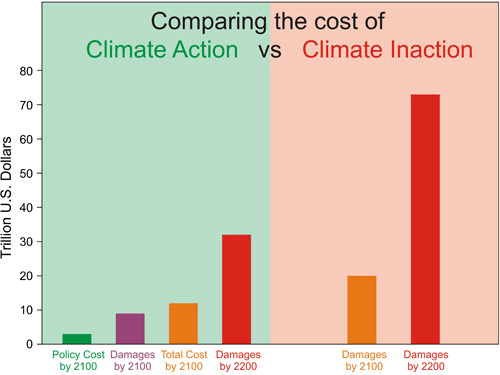
Last week, James held a public hearing to discuss what she called “the catastrophic consequences” of a warming planet. New Yorkers hoping the city would take the lead on climate-related matters — at a time when the federal government has all but abdicated responsibility — gathered at the Borough of Manhattan Community College in Tribeca, a neighborhood that James pointed out would be completely underwater by 2200 — if the world continues warming at its current rate.
Climate change already costs us all money, and it’s going to get worse https://arstechnica.com/science/2017/12/weve-all-managed-to-end-up-paying-the-costs-of-climate-change/ When it comes to floods and wildfires, the damage is shared with the public.JOHN TIMMER – Tuesday evening, Columbia University’s Earth Institute hosted a panel that was meant to focus on an issue we’re likely to be facing with increasing frequency: the need to move entire communities that are no longer viable due to rising seas or altered weather. But the discussion ended up shifting to how people in at-risk locations aren’t moving, and the entire governmental structure in the US is focused on keeping them right where they are.As a result, the entire US population is already paying for climate change, whether we accept the science behind it or not. And things will almost certainly get worse.
Staying put
That’s not to say that climate-driven migrations aren’t an issue. They’ve happened in a number of countries, and the panel noted that China, in particular, has been fairly aggressive about moving communities that the government feels cost too much to support. It’s also happening a bit in the US with coastal villages in Alaska and Louisiana. But the wildfires on the edge of urban areas in California provided the panel with a perfect backdrop: climate risks in areas we’re not just going to walk away from.
here was also the perfect panelist for this: Lisa Dale has tracked climate-related issues in the Western US. She said a number of trends are colliding out west. One of these is the warming and drying climate, which has led to a hotter fire season and produced fires that reach higher temperatures. As a result, the amount of the US Forest Service budget that goes toward firefighting has more than tripled from 16 percent to half the agency’s budget. That drains its ability to take preventative actions on fire risks, even as many western states are seeing development on lands that border wilderness managed by the federal government.
Despite all that (and the steady flow of images of destroyed homes), development isn’t slowing down, and people who are living on the wildland-urban interface aren’t thinking of leaving. Dale said that surveys of people who had actually lost their homes to fire indicated that more than 90 percent preferred to rebuild.
Michael Gerrard said the responses to increasing flood risks aren’t much different. Climate change is enhancing these through rising ocean levels, changing patterns of rainfall, and increased intensity of storms. But the Federal Emergency Management Agency, which handles this issue, only evaluates flood risks based on historical events, even though climate change is altering those risks. Gerrard also called the results of FEMA’s evaluations “perverse,” since declaring an area high-risk allows its residents to obtain federally subsidized flood insurance, in effect “subsidizing continued development in high-risk areas.”
A few years back, the government actually considered bringing the insurance costs up to something closer to market rates. But a huge outcry from those living in these areas caused Congress to back down, leaving this subsidy in place. And, as panel member Alex de Sherbininnoted, FEMA does not have the ability to do anything other than offer post-disaster response.
No change in sight
Overall, the panel saw little hope of the market or government shifting matters so that our housing better reflected changing risks—”markets haven’t yet processed what’s inevitable,” as moderator Radley Horton put it. Mortgages “are a barrier to property prices reflecting reality,” Gerrard argued. Local governments don’t want to deal with relocating anyone out of harm’s way because it means they’ll lose tax revenue. And the federal government has generally acted to block restrictions on land use.
Which means that we’re going to be stuck paying these costs for the indefinite future. Dale said that there had been some successes when it came to fire risks. Private insurance companies have brought rates up to match risks and compelled owners to take measures like clearing underbrush, while local communities have rolled out fire-education programs.
But flood risks have proven much harder. There have been a few relocation programs, but Gerrard called them “very few and very expensive.” Yet, unlike the erratic danger of wildfires, the rising oceans can’t really be handled in a way that minimizes risk. Horton said that it’s estimated that about two million US residents will need to be relocated before the century’s out due to rising oceans, and, if that rise accelerates faster than we expect, we could be looking at situations like the complete loss of far-southern Florida.
At that point, the societal costs for our policy decisions get quite a bit larger.
Armenia Debates Shift Away From Nuclear Power, Eurasia Net December 6, 2017 – Oksana Musaelyan
With its aged nuclear power plant scheduled to close in a decade, Armenians are discussing the feasibility of a shift to renewable energy.
A new Comprehensive and Enhanced Partnership Agreement with the European Union has helped catalyze the renewables discussion. Metsamor, the only nuclear plant in the Caucasus, provides about one-third of Armenia’s energy needs, but it is already past its original retirement date. As of now it is scheduled to close in 2026.
A provision in the EU partnership document calls for: “the closure and safe decommissioning of Metzamor [sic] nuclear power plant and the early adoption of a road map or action plan to that effect, taking into consideration the need for its replacement with new capacity to ensure the energy security of the Republic of Armenia and conditions for sustainable development.”
Armenia’s Justice Minister Davit Harutyunyan recently raised eyebrows by suggesting, contra previous government assurances, that the country wasn’t necessarily committed to nuclear power………
Advocates of renewable energy say that it is particularly well suited for Armenia because of its particular geopolitical situation: its borders with Azerbaijan and Turkey are closed, and its dependence on natural gas and uranium from Russia has led to an uncomfortable degree of political dependence on Moscow.
Armenia was the first country in the region to easily offer permits to construct small solar, wind, and hydro power generation plants, and today renewable energy accounts for about 12 percent of Armenia’s total power consumption. That’s projected to grow to up to 18 percent in the next two years, according to Astghine Pasoyan, head of the Armenian Foundation to Save Energy.
Most of Armenia’s renewable energy today comes from small hydropower plants; solar and wind represent only a tiny portion of Armenia’s total electricity generation. But that portion is growing: Solar panels with a capacity of 3.5 megawatts have been installed over the last 10 years, with more than two-thirds of that total built only over the last year, Pasoyan said.
Further expansion is in the cards: in May, Armenia’s Energy Ministry issued a tender for a 55 megawatt solar power facility and a contractor, Arpi Solar, said in December that it will start work on the plan “very soon.”
“We started with a very small number and the trend is huge,” Pasoyan said. “I hope that the growth is not just in large-scale generation, but in average individual families, taking control of their energy needs and by doing that also helping the country strengthen its energy security.”
Pending changes in legislation would further liberalize the energy market. “For a lot of local communities and local businesses this will be a good opportunity to invest in renewable energy,” said Alen Amirkhanyan, director of the Acopian Center for the Environment at the American University of Armenia.
Amirkhanyan said that with sufficient investment in renewables, “there will no longer be a rationale for investing in very expensive technology, like building a new power plant.”……… http://www.eurasianet.org/node/86381
Power companies and developers added 41.8 megawatts of storage systems, including a 30-megawatt utility-scale project in Texas, according to a report Thursday from GTM Research and the Energy Storage Association. California added 8.4 megawatts of residential and commercial systems. The industry installed 28.6 megawatts in the third quarter of 2016.
Driven by regulatory demands and sharp price declines, energy-storage is becoming more common. Prices for lithium-ion battery packs have fallen 24 percent from 2016 levels, according to Bloomberg New Energy Finance. Utilities including Exelon Corp., Duke Energy Corp. and American Electric Power Co., meanwhile, are increasingly receptive to storage projects, which potentially will facilitate wider adoption of wind and solar power.
GTM forecasts that 295 megawatts will be in operation in the U.S. by year-end, up 28 percent from 2016. And more is coming. GTM projects the U.S. energy-storage market will be worth $3.1 billion in 2022, a seven-fold increase from this year.
“Energy storage is increasingly acknowledged in utilities’ long term resource planning across the country,” Ravi Manghani, GTM Research’s director of energy storage, said in a statement.
While women are leading the resistance, the halls of power in D.C. and states across the country lag pathetically behind. We saw this perhaps most vividly when Trump gathered an all-male group of politicians at the White House to discuss his efforts to gut women’s health care. In a single photograph, the gross underrepresentation of women’s voices in government and on issues directly impacting their lives was crystal clear.
And it was exactly that photograph — and the utterly out-of-sync gender dynamics it laid bare — that stuck in our minds this month as we sat in a hearing of the Senate Foreign Relations Committee on Trump’s unrestrained power to wage nuclear war. A committee with a 20:1 male-to-female ratio heard testimony from three men on whether one man should have total, unchecked power to start a nuclear war and blow up the planet. This is a system that, as Senator Ed Markey (D-MA) said, “boggles the rational mind.”
Apparently, the Senate has a one-woman limit when it comes to foreign policy.
To read the full article at Teen Vogue, https://www.teenvogue.com/story/women-leaders-arent-making-enough-foreign-policy-decisions-and-its-a-problem
Will Japan ‘rent’ nukes from US to counter North Korean threat?
‘Dual key’ nuclear weapons-sharing with Washington would save Tokyo trouble of developing own arsenal, protect alliance, Asia Times, DOUG TSURUOKADECEMBER 6, 2017, “……the unthinkable has become publicly thinkable. There’s widespread debate in Japan about whether the country should go nuclear – either by developing its own arsenal, or sharing such weapons with the US under a “dual key” arrangement, popularly known as “rent-a-nukes,” to counter the growing threat from North Korea……. http://www.atimes.com/article/will-japan-rent-nukes-us-counter-north-korean-threat/









 nuclear-news