The British Ministry of Defence (MoD) has published several reports over the last few years. They discuss geopolitics and related themes, one of which is the likelihood of nuclear war or accident, including what it means for long-term survival.
Experts say that even a so-called limited exchange or accident would be catastrophic. For example, a recent paper in Earth’s Futurec alculates that the most optimistic scenario of a “small,” regional nuclear war between India and Pakistan would wipe out millions of people through famine and result in a nuclear winter. An exchange between the USA and Russia, for instance, could be even bigger and more devastating.
America’s ongoing “Asia Pivot” encourages China to build up its arsenals. Proxy wars in Syria and Ukraine with Russia and continuing tensions with North Korea also increase the risk of brinkmanship and miscalculation between those nuclear powers.
Britain’s Role
By training rebels in Syria and armed forces in Ukraine, the UK is particularly responsible for contributing to escalating tensions. Britain remains one of the USA’s closest allies and enjoys a “special relationship” with the US. It serves as a proxy for US Trident nuclear weapons systems. The UK’s Vanguard submarines host US-supplied Trident II D5 Intercontinental Ballistic Missiles. In 2016, a dummy ICBM was launched by the UK at a test target off the coast of Africa. It self-destructed and headed for Florida, according to news reports. The event took place a time when the British government voted to upgrade Trident in violation of Britain’s Non-Proliferation Treaty obligations and at a time when the newly-appointed Prime Minister, Theresa May (not yet elected), answered “Yes,” when asked by a member of Parliament if she would launch a nuclear missile and kill hundreds of thousands of civilians.
Let’s look at some examples of the UK MoD’s admissions that: 1) the world is getting more dangerous, 2) it is likely that some states will use nuclear weapons at some point, 3) brinksmanship increases the risk of miscalculation, and 4) that such events threaten human existence. These admissions are startling for a number of reasons: the MoD possesses nuclear weapons, yet acknowledges their danger; the media fail to report on these matters, despite their coming from establishment sources; and governments are not inherently compelled by this information to de-escalate.
“Doomsday Scenarios.”
Every few years, the MoD updates its studies concerning the nature of global developments. The third edition of the Strategic Trends Programme predicts trends between the years 2007-2036. It states (MoD’s emphases):
Accelerating nuclear proliferation will create a more complex and dangerous strategic environment, with the likely clustering of nuclear-armed states in regions that have significant potential for instability or have fears about foreign intervention. For example, North Korean, Pakistani and potentially, Iranian nuclear weapon capability will increase significantly the risks of conflict in Asia if a system of mutual deterrence does not emerge. In addition, nuclear possession may lead to greater adventurism and irresponsible conventional and irregular behaviour, to the point of brinkmanship and misunderstanding. Finally, there is a possibility that neutron technologies may reemerge as potential deterrent and warfighting options.
Neutron weapons supposedly kill living things but do not harm property. The report also notes a potential “revival of interest” among “developed states” in “neutron and smarter nuclear technologies.” Neutron bombs could become “a weapon of choice for extreme ethnic cleansing in an increasingly populated world.” The document concludes rather casually, stating: “Many of the concerns over the development of new technologies lie in their safety, including the potential for disastrous outcomes, planned and unplanned.” Note the word planned. It goes on to say: “Various doomsday scenarios arising in relation to these and other areas of development present the possibility of catastrophic impacts, ultimately including the end of the world, or at least of humanity.”
Will the US or Israel get impatience and attack Iran or North Korea? The now-archived Future of Character of Conflict (2010) predicts trends out to 2035 and states:
The risk of Chemical, Biological, Radiological and Nuclear (CBRN) use will endure; indeed increase, over the long term. The strategic anxiety and potential instability caused by CBRN proliferation is typified by international frustration over Iran and North Korea, with the risks of pre-emptive action and regional arms races, and where soft power alone has not been notably successful.
Soft power refers to economic and diplomatic coercion. As the US expands its global reach, other countries might seek possession of nuclear weapons to deter the USA: “[t]he possession of nuclear weapons, perceived as essential for survival and status, will remain a goal of many aspiring powers.”
Unless enforcement mechanisms are imposed, will arms controls and treaties be effective? Out to the year 2040, says the MoD’s fourth edition of its now-withdrawn Strategic Trends Programme, “[t]he likelihood of nuclear weapons usage will increase.” It goes on (MoD’s emphases):
Broader participation in arms control may be achieved, although this is unlikely to reduce the probability of conflict. Effective ballistic missile defence systems will have the long-term potential to undermine the viability of some states’ nuclear deterrence.
Could that last statement refer to ICBMs being integrated into a so-called defense shield and used by the few countries that possess them against ones that do not? What is the likelihood of nuclear weapons being used for warfighting? Finally, Future Operating Environment 2035 states:
Some commentators believe it is increasingly likely that a range of state actors may use tactical nuclear weapons as part of their strategy against non-nuclear and conventional threats coming from any environment, severe cyber attacks. Limited tactical nuclear exchanges in conventional conflicts by 2035 also cannot be ruled out, and some non-Western states may even use such strikes as a way of limiting or de-escalating conflict.
Conclusion
These analyses and admissions on behalf of the UK MoD and its reliance on US-produced weapons systems should serve as enough of a warning to scholars and anti-nuclear weapons campaigners to suggest that, as long as weapons of mass destruction exist and as long as international treaties have no enforcement mechanisms with regards the powerful countries, the clock to midnight will continue ticking.
PARIS, Nov 21 (Reuters) – EDF said on Tuesday it had been informed about shortcomings found in quality controls on a small number of rods installed at its French nuclear sites.
EDF said the discovery was made by nuclear equipment manufacturer Areva on 14 of 2,600,000 rods installed at its reactors across France.
“Areva notified the EDF Group of quality control deviations on certain rods used to manufacture fuel assemblies. The supplier is not able to demonstrate that quality control substantiating leak tightness of these rods has been properly performed,” EDF said in a statement.
The rods involved are in use at the Golfech 2, Flamanville 1 and Cattenom 3 reactors, while 11 others were not installed. EDF said the findings would have no operational impact.
France depends on nuclear power for more than 75 percent of its electricity, and EDF union members have warned of a risk of blackouts this winter due to nuclear reactor outages.
Last week, EDF said future nuclear reactor maintenance outages could be longer than expected and that these could weigh on its 2018 core earnings.
EDF lowered its 2018 core earnings forecast to a range of 14.6-15.3 billion euros ($17.2-$18 billion) from at least 15.2 billion.
Just weeks after Russia’s nuclear energy corporation said radiation levels were normal, the country’s meteorological service said it had registered extreme levels of radiation in the Urals two months ago.
European radiation monitors detected a cloud of radioactive material originating in Russia’s southern Urals over two dozen European countries in late September and early October. The material could have come from “a spent nuclear fuel reprocessing or the production of radioactive sources.
Russia’s state nuclear corporation Rosatom said the release of the radioactive material, Ruthenium 106 or Ru-106, was in line with natural background radiation, the state-run RIA Novosti news agency reported at the time.
On Monday, Russia’s Federal Meteorological Service said it had registered extreme levels of Ru-106 across several locations in late September. The highest levels of the radioisotope — 986 times the norm — were located in Chelyabinsk region, the site of the Mayak nuclear facility.
Mayak makes components for nuclear weapons and processes spent nuclear fuel. One of its storage facilities exploded in 1957 — a fact that went unreported until three decades later.
In a statement issued Tuesday, Mayak said it was not the source of the excess Ru-106 concentration.
Greenpeace in Russia said it planned to ask prosecutors to launch an inquiry into whether officials concealed a nuclear incident.
“Even taking into account that the observed concentration over Europe is small, tens of millions of people were impacted, and some of them will no doubt have health problems,” it said in a statement Monday.
Meanwhile, Chelyabinsk officials played down the dangers of excess radiation, saying they would have been ordered to evacuate if the levels were dangerous.
“The sources of this damaging information are in France, where there’s a nuclear waste processing facility that competes with our Mayak,” Yevgeny Savchenko, the region’s public security minister, told the regional news website Ura.news on Tuesday.
Originally published November 21, 2017 MOSCOW (AP) — Russian authorities have confirmed reports of a spike in radioactivity in the air over the Ural Mountains.
France’s nuclear safety agency earlier this month recorded radioactivity in the area between the Volga River and the Ural Mountains from a suspected accident involving nuclear fuel or the production of radioactive material. It said the release of the isotope Ruthenium-106 posed no health or environmental risks to European countries.
The Russian Meteorological Service said in a statement Tuesday that it recorded the release of Ruthenium-106 in the southern Urals in late September and classified it as “extremely high contamination.”
After the first reports, Russia’s state-controlled Rosatom corporation said in a statement last month that it hadn’t come from its facilities.
Radiation Free Lakeland 19th Nov 2017, West Cumbria was ruled out as a site to bury nuclear waste 20 years ago because the geology was unsafe. The plan this time round is ten times as big and to include high level nuclear wastes, so not surprisingly Cumbria County Council said NO in January 2013.
However, in order to build new nuclear plants the industry and government need to be seen to have a
“final solution” to the problem, no matter if that “final solution” is dangerous to life in Cumbria and on planet earth. The ducks are being lined up.
To soften the public up in West Cumbria deep mining is once again being promoted as a “good thing” no matter that it is for coal, the mining expertise and infrastructure is being aggressively put into place
creating a “demand”. Companies like Eden Nuclear and Environment are sprouting up like toxic mushrooms and promoting their services: “Our team has undertaken work for a range of disposal facilities including the Geological Disposal Facility” (the one that is planned for Cumbria?) https://mariannewildart.wordpress.com/2017/11/19/geological-dumping-of-nuclear-waste-where-why/
The Sway of the Nuclear Arms Industry Over Donald Trump and Congress Is Terrifying
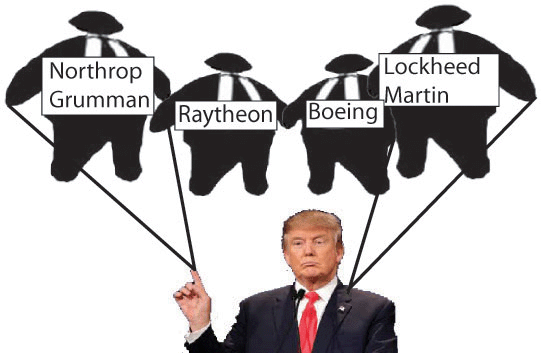
“The devastation is very important to me.” Mother Jones WILLIAM HARTUNGNOV. 18, 2017 This story originally appeared on TomDispatch.com. ……… in every sense of the term, our nuclear arsenal already represents overkill on an almost unimaginable scale. Independent experts from US war colleges suggest that about 300 warheads would be more than enough to deter any country from launching a nuclear attack on the United States.It may not surprise you to learn that there’s nothing new about the influence the nuclear weapons lobby has over Pentagon spending priorities. The successful machinations of the makers of strategic bombers and intercontinental ballistic missiles, intended to keep tax dollars flowing their way, date back to the dawn of the nuclear age and are the primary reason President Dwight D. Eisenhower coined the term “military-industrial complex” and warned of its dangers in his 1961 farewell address.
Without the development of such weapons, that complex simply would not exist in its present form. The Manhattan Project, the vast endeavor that produced the first workable nukes during World War II, was one of the largest government-funded research and manufacturing projects in history. Today’s nuclear warhead complex is still largely built around facilities and locations dating back to that time…….
Eisenhower couldn’t have been more clear-eyed about all of this. He saw the missile gap for the fiction it was or, as he put it, a “useful piece of political demagoguery” for his opponents. “Munitions makers,” he insisted, “are making tremendous efforts towards getting more contracts and in fact seem to be exerting undue influence over the senators.”
Once Kennedy took office, it became all too apparent that there was no missile gap, but by then it hardly mattered. The damage had been done. Billions of dollars more were flowing into the nuclear-industrial complex to build up an American arsenal of ICBMs already unmatched on the planet.
The techniques that the arms lobby and its allies in government used more than half a century ago to promote sky-high nuclear weapons spending continue to be wielded to this day. The 21st-century arms complex employs tools of influence that Kennedy and his compatriots would have found familiar indeed—including millions of dollars in campaign contributions that flow to members of Congress and the continual employment of 700 to 1,000 lobbyists to influence them; that’s nearly two arms lobbyists for every member of Congress. Much of this sort of activity remains focused on ensuring that nuclear weapons of all types are amply financed and that the funding for the new generations of the bombers, submarines, and missiles that will deliver them stays on track.
When traditional lobbying methods don’t get the job done, the industry’s argument of last resort is jobs—in particular, jobs in the states and districts of key members of Congress. This process is aided by the fact that nuclear weapons facilities are spread remarkably widely across the country. There are labs in California and New Mexico; a testing and research site in Nevada; a warhead assembly and disassembly plant in Texas; a factory in Kansas City, Missouri, that builds nonnuclear parts for such weapons; and a plant in Oak Ridge, Tennessee, that produces weapon-grade uranium. There are factories or bases for ICBMs, bombers, and ballistic missile submarines in Connecticut, Georgia, Washington State, California, Ohio, Massachusetts, Louisiana, North Dakota, and Wyoming. Such a nuclear geography ensures that a striking number of congressional representatives will automatically favor more spending on nuclear weapons.
In reality, the jobs argument is deeply flawed. As the experts know, virtually any other activity into which such funding flowed would create significantly more jobs than Pentagon spending. A study by economists at the University of Massachusetts, for example, found infrastructure investment would create one and one-half times as many jobs as Pentagon funding and education spending twice as many.
In most cases it hasn’t seemed to matter that the jobs claims for weapons spending are grotesquely exaggerated and better alternatives litter the landscape. The argument remains remarkably potent in states and communities that are particularly dependent on the Pentagon. Perhaps unsurprisingly, members of Congress from such areas are disproportionately represented on the committees that decide how much will be spent on nuclear and conventional weaponry………. http://www.motherjones.com/politics/2017/11/devastation-very-important-nuclear-weapons-industry-donald-trump-1/
Is the Trump Administration Planning a First Strike on North Korea? Saturday, November 18, 2017 By Gareth Porter, Truthout | News Analysis Ever since the Trump administration began a few months ago to threaten a first strike against North Korea over its continued missile tests, the question of whether it is seriously ready to wage war has loomed over other crises in US foreign policy.
The news media have avoided any serious effort to answer that question, for an obvious reason: The administration has an overriding interest in convincing the North Korean regime of Kim Jong-un that Trump would indeed order a first strike if the regime continues to test nuclear weapons and an intercontinental ballistic missile (ICBM). Therefore, most media have shied away from digging too deeply into the distinction between an actual policy of a first strike and a political ruse intended to put pressure on Pyongyang.
The use of military threat for “diplomatic coercion” is such a basic tool of US policy in dealing with weaker adversaries that it is almost taken for granted in Washington. Even diplomats who have been deeply involved in negotiating with North Korea are supportive of using that threat as part of a broader diplomatic strategy. Robert Gallucci, the State Department official who negotiated the “Agreed Framework” with North Korean officials in 1994, noted in an email to Truthout, “We do want the North to understand that their actions could lead the US to a preventive strike — wise or not.”
The linkage between the Trump administration’s threat of a “military option” and US diplomatic pressure on North Korea was clear from its first suggestion that it might carry out a first strike. That suggestion came on April 13, immediately upon the completion of the administration’s policy review on North Korea, when NBC News reported that “multiple senior intelligence officials” had said that the administration was “prepared to launch a preemptive strike” if officials “became convinced that North Korea is about to follow through with a nuclear weapon test.” A story in the Washington Post published the following day offered a slightly different version: The administration was “prepared to respond to another North Korean nuclear test” and had “a range of options at its disposal” but would not “telegraph its response in advance.”
However, an unnamed military official told the Associated Press that same day that the policy that had been approved by the National Security Council did not envision the use of force in response to a nuclear or missile test, thus revealing that the leaks involving the threat of a preemptive or retaliatory attack over North Korean testing were part of a clumsy effort at “coercive diplomacy.”……
The Trump administration could seek to increase the pressure on North Korea still further by making one or more moves preparing for — but short of — war. For example, it could bring more US ground troops into South Korea or Japan. However, the North Korean regime might well interpret that move as a signal that the US intends to attack and invade the North, since that would seem to be precisely the purpose of moving reinforcements into the theater. In fact, according to Jackson, the North Koreans told US diplomats during the 1994 crisis that they had studied carefully the US large-scale troop movements in preparation for the first Gulf War in 1990-91, and warned that they would respond to a move like that one in their region by launching their own preemptive attack.
It isn’t yet possible to know definitely whether the Trump administration intends to strike first against North Korea. The official threats of such a strike can be discounted as obviously related to an elaborate — if somewhat crude — psychological warfare campaign. But more twists and turns in US policy can be expected in the coming months, and the desperate desire to coerce Pyongyang may also have given rise to wishful thinking on the part of McMaster and, more dangerously, Trump himself, about deterring that regime’s response to a US first strike. That in turn could still pose a grave threat of yet another unnecessary and terrible war. http://www.truth-out.org/news/item/42640-is-the-trump-administration-planning-a-first-strike-on-north-korea
North Korea is often righteously condemned for being the only nation to have conducted five nuclear tests and a barrage of missile tests in the 21st century. Led by a young chubby dictator with a bad haircut, we have long been told that the paranoid hermit kingdom known for its undeniably bombastic, intensely patriotic and anachronistic rhetoric is evil, unhinged and dangerous.
While not to advocate for family dynastic rule in any way, the way in which North Korea has been mediated for mainstream audiences in advanced industrial democratic countries over decades demonstrates a consistent narrative pattern of Orientalist imagery that play on variants of immaturity, cunning and treachery in a legacy going back to Fu Manchu. Complexities tend to be reduced to a simplistic ‘us or them’ binary and seem to trigger intuitive reactions hard-wired by more than enough movies and sensationalist media journalism. No further discussion or reading required.
In the significant amount of digital space recently awarded to speculation on North Korea’s purported nuclear-capable ICBM tests on 4 and 28 July that could strike parts of continental U.S.A., few mainstream media reports bothered to include that since May 2017 the U.S. military tested 4 ICBMs from Vandenberg Air Force base to Kwajalein Atoll and conducted 11-12 drills over the Korean peninsula involving B-1B, B-2 and B-52 bombers (the latter two are nuclear capable). The current Ulchi Freedom Guardian reiteration on 21-31 August 2017 and the previous Foal Eagle Key Resolve operation involving 67,000 troops in March 2017 are based on years of biannual U.S.-ROK military drills, giving substance to the recent statement by Secretary of Defense James Mattis: “combined allied militaries now possess the most precise, rehearsed and robust defensive and offensive capabilities on Earth.”
Certainly, North Korea staged the longer reach of a new Hwasong-14 missile which demonstrated staged rocketry, better re-entry cladding and guidance systems. Yet we were expected to take at face-value a Washington Postreport of claims by unnamed US Defense Intelligence Agency officials that North Korea had achieved sufficient warhead miniaturisation to fit on ICBMs. This was supposed to support US President Trump’s apparently unprompted threat of ‘fire and fury the likes of which the world has never seen’, holding much of the population of North Korea hostage as he sat down to lunch. Yet days earlier Senator Lindsey Graham had stated that he had discussed a plan with the President to “destroy the North Korean nuclear program and North Korea itself”. Moreover, National Security Adviser McMaster had already declared that United States could launch a ‘preventive war’ to prevent North Korea from attaining nuclear weapons cabability – a paradoxical pursuit if ever there was one.
Mainstream channels continued to interpret this ‘tough line’ corrective to the former Obama administration’s ‘strategic patience’, as necessary to force North Korea to the negotiating table. Incidentally, preventive war was the defence used by lawyers at the Nuremberg Trials in their attempt to justify Nazi Germany’s invasion of Poland.
In response, the North Korean Strategic Force stated that it was calculating an operational plan to create an ‘enveloping fire’ with 4 IRBM (Hwasong-12) missiles in areas 30-40 km off Guam which had to be approved by leader Kim Jong-un. Subsequently Kim suspended the operation for the meantime. Clearly intended to demonstrate credible intention to strike Guam’s huge U.S. naval and airforce installations from where pre-emptive strikes could be launched and which include 8,000 U.S. troops, anti-ballistic missile defence systems, and signals intelligence infrastructure, this was aimed at military targets. Media reports did not emphasise this point, ignoring the North Korean caveat that this launch would be a warning not an attack. It remains unclear whether or not the IRBMs would be nuclear-tipped. The Foreign Minister Ri Yong-ho at the recent ASEAN meeting stated that North Korea was not prepared to negotiate with its nuclear weapons and ballistic rockets unless “the hostile policy and nuclear threat of the U.S. against the DPRK are fundamentally eliminated”. The Korean People’s Army (KPA) listed U.S. hostile actions as: ‘decapitation operations’ and ‘pre-emptive’ attack (as rehearsed in U.S.-ROK drills); ‘preventive war’; and/or ‘secret operations’ for stealthy regime change (CIA coordinated Special Operations).
While indicating its preference for de-escalation and negotations toward de-nuclearisation of the Korean peninsula, China declared it would defend North Korea if it was pre-emptively attacked by the United States and it would not do so if North Korea struck first. Determining who exactly fired first may be difficult, however, if it was a matter of minutes between detection of a pre-emptive attack (such as B-1B bombers firing missiles at distance) and North Korea launching conventional attacks on U.S. bases in South Korea and IRBM missiles to Guam (nuclear or non-nuclear).
From a North Korean strategic perspective informed by decades of various forms of hostility from the U.S. and some of its allies including the refusal to negotiate and preparations for regime change, such missile capability would seem to provide a desperately needed means of self-defence. In fact, with regard to these latest U.S. nuclear threats listed above (which are not new), North Korea could invoke Article 51 of the UN Charter which maintains the right to self-defence when a sovereign state is under direct attack by a foreign power. It could also invoke the Caroline standard of pre-emptive self-defence in the case of likely attack being ‘instant, overwhelming and without other means, and no moment for deliberation’.
As it would be suicidal for North Korea to provoke U.S.-led retaliation with a pre-emptive strike and considering its historical context, it is reasonable to see the North Korean nuclear program as intended to achieve a second-strike retaliatory capability. Although the U.S. would be unlikely to strike if China (and possibly Russia) was to intervene, North Korea would still seek such a deterrent as a means to negotiate its security terms with the United States and others and to protect its fundamental sovereignty which it regards under threat.
It has been official U.S. policy to refuse to countenance a North Korean nuclear weapons state and to negotiate with it on these terms which it now frames as threatening the lives of millions of ordinary Americans in continental U.S.A.. Yet U.S. leadership does not hesitate from threatening millions of lives in North Korea and on the Korean peninsula. This is not very strategic, as it undermines South Korean sovereign agency and perceptions of and trust in the U.S.-ROK alliance as a deterrent and to the contrary that it might drag the South Korean population into a destructive conflict.
In short, with China’s ‘dual suspension’ suggestion as the most sensible and statesman-like so far, North Korea conceivably would suspend its nuclear program in return for a freeze in U.S. military hostile actions to create the mechanism for direct negotiations to begin. North Korea would then seek an end to the Armistice Agreement of 1953, the terms of which the U.S. never honoured in full, and the establishment of a formal Peace Treaty. North Korea would also seek independent negotiations with South Korea for increased trade, exchange and communications.
Compared to the spike in stocks in Raytheon, Lockheed Martin, Northrop Grumman and Boeing and as some U.S. allies push for increased military spending, including anti-ballistic missile systems and ‘pre-emptive strike’ capabilities, the potential losses of millions of lives in a conventional and/or nuclear confrontation on the Korean peninsula and to the global economy in trade would not seem to be worth it. Diplomacy and dialogue between North Korea and the United States and/or other concerned parties toward demilitarisation and de-nuclearisation would seem the safest and cheapest form of defence to be investing in. Perhaps a normalised Korean peninsula which would benefit China’s economic plans, are what the U.S. and its allies fear most, and so they are starting fires to revivify a military containment policy.
Dr Adam Broinowski is a visiting research fellow and recent ARC DECRA fellow at the College of Asia and the Pacific, Australian National University. His research and teaching are in contemporary history, politics and society in Japan and Northeast Asia. He is the author of Cultural Responses to Occupation in Japan: The Performing Body during and after the Cold War (London and Sydney: Bloomsbury Academic, 2016).
US nuclear general says would resist ‘illegal’ Trump strike order, CNBC, 19 Nov 17 The top U.S. nuclear commander said on Saturday that he would resist President Donald Trump if he ordered an “illegal” launch of nuclear weapons.
Air Force General John Hyten, commander of the U.S. Strategic Command (STRATCOM), told an audience at the Halifax International Security Forum in Nova Scotia, Canada that he had given a lot of thought to what he would say if he received such an order.
“I think some people think we’re stupid,” Hyten said in response to a question about such a scenario. “We’re not stupid people. We think about these things a lot. When you have this responsibility, how do you not think about it?”
Hyten, who is responsible for overseeing the U.S. nuclear arsenal, explained the process that would follow such a command.
As head of STRATCOM “I provide advice to the president, he will tell me what to do,” he said in his remarks, retransmitted in a video posted on the forum’s Facebook page.
“And if it’s illegal, guess what’s going to happen? I’m going to say, ‘Mr. President, that’s illegal.’ And guess what he’s going to do? He’s going to say, ‘What would be legal?’ And we’ll come up with options, of a mix of capabilities to respond to whatever the situation is, and that’s the way it works. It’s not that complicated.”……. https://www.cnbc.com/2017/11/19/us-nuclear-general-says-would-resist-illegal-trump-strike-order.html
Ambassador to U.K. Liu Xiaoming speaks in interview with ITV
China has “done everything” it can to resolve crisis
China’s Ambassador to the U.K. Liu Xiaoming says he’s “cautiously optimistic” that a diplomatic solution can be found to stop North Korea from developing further nuclear weaponry.
Liu, who was China’s ambassador to North Korea for more than three years, said that his government “had done everything” it could to persuade the country to halt its nuclear program. He spoke in a television interview with ITV.
“I am still cautiously optimistic,” Liu said in the interview that was broadcast on Sunday. “I still believe that if all parties engage with each other and we encourage North Korea to return to the negotiating table, we can still find a diplomatic solution to this problem.”
Chinese President Xi Jinping recently sent Song Tao, head of the Communist Party’s International Liaison Department, to North Korea a week after hosting U.S. President Donald Trump, stoking speculation that Song may carry a message from the Xi-Trump talks. South Korea’s Yonhap News Agency reported there was a good chance that the Chinese envoy would meet leader Kim Jong Un on Sunday, citing unidentified diplomats in Beijing.
Liu said Sunday that North Korea had “legitimate concerns” about trust and security and blamed South Korea’s close relationship with the U.S. as the “root cause” of the problem. While China “strictly abides” by United Nations sanctions against North Korea, resolutions must also be about negotiations, he told ITV.
The Sway of the Nuclear Arms Industry Over Donald Trump and Congress Is Terrifying “The devastation is very important to me.” Mother Jones WILLIAM HARTUNGNOV. 18, 2017 This story originally appeared on TomDispatch.com. “……..Another way the nuclear weapons industry (and the rest of the military-industrial complex) tries to control and focus public debate is by funding hawkish think tanks. The advantage to weapons makers is that those institutions and their “experts” can serve as front groups while posing as objective policy analysts. Think of it as intellectual money laundering.
One of the most effective industry-funded think tanks in terms of promoting costly, ill-advised policies has undoubtedly been Frank Gaffney’s Center for Security Policy. In 1983, when President Ronald Reagan first announced his Strategic Defense Initiative (a.k.a. “Star Wars”), the high-tech space weapons system that was either meant to defend the country against a future Soviet first strike or—depending on how you looked at it—free the country to use its nuclear weapons without fear of retaliation, Gaffney was its biggest booster. More recently, he has become a prominent purveyor of Islamophobia, but the impact of his promotional work for Star Wars continues to be felt in weapons contracts to this day.
Just as George W. Bush was entering the White House, another industry-backed think tank, the National Institute for Public Policy, released a report on nuclear weapons policy that would be adopted almost wholesale for the new administration’s first key nuclear posture review. It advocated such things as increasing the number of countries targeted by US nukes and building a new, more “usable” bunker-busting nuclear weapon. At that time, NIPP had an executive from Boeing on its board. Its director was Keith Payne, who would become infamous in the annals of nuclear policy for co-authoring a 1980 article at Foreign Policy entitled “Victory Is Possible,” suggesting that the United States could actually win a nuclear war, losing “only” 30 million to 40 million people. This is the kind of expert the nuclear weapons complex funded to promulgate its views.
Then there’s the Lexington Institute, a think tank that never met a weapons system it didn’t like. Lexington front man Loren Thompson is frequently quoted in news stories on defense issues, but it is rarely disclosed that he is funded by Lockheed Martin, Northrop Grumman, and other nuclear weapons contractors.
Just as George W. Bush was entering the White House, another industry-backed think tank, the National Institute for Public Policy, released a report on nuclear weapons policy that would be adopted almost wholesale for the new administration’s first key nuclear posture review. It advocated such things as increasing the number of countries targeted by US nukes and building a new, more “usable” bunker-busting nuclear weapon. At that time, NIPP had an executive from Boeing on its board. Its director was Keith Payne, who would become infamous in the annals of nuclear policy for co-authoring a 1980 article at Foreign Policy entitled “Victory Is Possible,” suggesting that the United States could actually win a nuclear war, losing “only” 30 million to 40 million people. This is the kind of expert the nuclear weapons complex funded to promulgate its views.
Then there’s the Lexington Institute, a think tank that never met a weapons system it didn’t like. Lexington front man Loren Thompson is frequently quoted in news stories on defense issues, but it is rarely disclosed that he is funded by Lockheed Martin, Northrop Grumman, and other nuclear weapons contractors.
Examples include Secretary of Defense James Mattis, a former board member at General Dynamics; White House Chief of Staff John Kelly, who worked for a number of defense firms and was an adviser to DynCorp, a private security firm that has done everything from (poorly) training the Iraqi police to contracting with the Department of Homeland Security; former Boeing executive and now Deputy Secretary of Defense Patrick Shanahan; former Lockheed Martin executive John Rood, nominated as undersecretary of defense for policy; former Raytheon Vice President Mark Esper, newly confirmed as secretary of the Army; Heather Wilson, a former consultant to Lockheed Martin, who is now secretary of the Air Force; Ellen Lord, a former CEO for the aerospace company Textron, who is undersecretary of defense for acquisition; and National Security Council Chief of Staff Keith Kellogg, a former employee of the major defense and intelligence contractor CACI, where he dealt with “ground combat systems” among other things.
Keep in mind that these high-profile industry figures are just the tip of the iceberg when it comes to the corporate revolving door that has been installed in the Pentagon for decades, as journalist Lee Fang has documented in the Intercept.
Given the composition of his national security team and Trump’s love of all things nuclear, what can we expect from his administration on this front? In addition to the $1.7 trillion nuclear build-up, Trump’s impending nuclear posture review seems to include proposals for dangerous new weapons like a “low-yield,” purportedly more usable nuclear warhead. He’s spoken privately with his team about expanding the arsenal in a staggering fashion—the equivalent of a 10-fold increase. He’s wholeheartedly embraced missile defense spending, pledging to put billions of dollars more into that overfunded, under-producing set of programs. And of course, he is assiduously trying to undermine the Iran nuclear deal, one of the most effective arms control agreements of recent times, and so threatening to open the door to a new nuclear arms race in the Middle East.
Unless the nuclear spending spree being pushed by President Trump as the best thing since the invention of golf is stopped thanks to public opposition, the rise of an antinuclear movement, or congressional action, we’re in trouble. The nuclear weapons lobby will again have won the day—just as it did almost 60 years ago, despite the opposition of a popular president and decorated war hero.
And Donald Trump, “bone spurs” and all, is no Dwight D. Eisenhower.
Problems persist a decade after discovery of chronic radioactive leaks Chicago Sun Times, 11/19/2017, Brett Chase and Madison Hopkins | Better Government Association More than a decade after the discovery of chronic leaks led to national outrage, a $1.2 million government settlement and a company vow to guard against future accidents, an investigation by a government watchdog group found.
Since 2007, there have been at least 35 reported leaks, spills or other accidental releases in Illinois of water contaminated with radioactive tritium, a byproduct of nuclear power production and a carcinogen at high levels, a Better Government Association review of federal and state records shows.
No fines were issued for the accidents, all of which were reported by the company.
The most recent leak of 35,000 gallons occurred over two weeks in May and June at Exelon’s Braidwood plant, southwest of Chicago. The same facility was the focus of a community panic in the mid-2000s after a series of accidents stirred debate over the safety of aging nuclear plants.
A 2014 incident at Exelon’s Dresden facility in Grundy County involved the release of about 500,000 gallons of highly radioactive water. Contamination was later found in the plant’s sewer lines and miles away in the Morris, Ill., sewage treatment plant……..
Industry watchdogs and government whistleblowers contend oversight is compromised by a cozy relationship between companies and the NRC.
Government regulators concede they must balance the safety needs of aging plants, which require more maintenance, versus ordering cost-prohibitive upgrades at facilities that inherently are just a slip-up away from catastrophe.
No player in the nuclear industry is bigger than Exelon, the Chicago-based energy company that last year reported $31 billion in revenue and operates 14 nuclear plants in Illinois, New York, New Jersey, Pennsylvania and Maryland.
Five of the six Illinois plants reported leaks over the last decade, records show. Clinton, in DeWitt County, had no leaks and Byron, in Ogle County, reported only one that contained low levels of radioactivity…….
At least seven of the 35 documented accidents since 2007 involved contamination of groundwater. Other contamination was found in sewers and other water systems where it isn’t supposed to be………
The BGA investigation also found:
Of the 35 documented incidents, 27 occurred at Dresden. Following the big 2014 leak, which emanated from an aboveground storage tank, Exelon asked a state inspector whether the public would have access to the incident report under open records laws, a state report showed.
An NRC report on the 2007 Quad Cities leak noted radiation levels went “well beyond that seen anywhere else in the industry” and that plant staff estimated the leak had been active for years before it was discovered.
In 2010, Exelon’s Marseilles generating plant in LaSalle County reported a spill from a storage tank, initially estimated at more than 150 gallons but later classified as “unknown.” Groundwater tritium tests later showed levels 59 times the EPA’s drinking water limit. Exelon said no tritium left the plant’s boundaries, but records show plant workers continued to monitor a body of highly contaminated groundwater sitting on plant property at least five years after the accident.
In 2009, Dresden reported another hole in a storage tank led to a leak of as much as 272,000 gallons of radioactive water. Onsite groundwater testing showed levels of tritium 160 times higher than allowed under federal standards for drinking water.
Six Years After Fukushima, Robots Finally Find Reactors’ Melted Uranium The Japanese government and companies used radiation-hardened machines to search for the fuel that escaped the plant’s ruined reactors. By MARTIN FACKLER. NY Times 19 Nov 17 “……As officials became more confident about managing the disaster, they began a search for the missing fuel. Scientists and engineers built radiation-resistant robots like the Manbo and a device like a huge X-ray machine that uses exotic space particles called muons to see the reactors’ innards.
Now that engineers say they have found the fuel, officials of the government and the utility that runs the plant hope to sway public opinion. Six and a half years after the accident spewed radiation over northern Japan, and at one point seemed to endanger Tokyo, the officials hope to persuade a skeptical world that the plant has moved out of post-disaster crisis mode and into something much less threatening: cleanup……..
Tepco is keen to portray the plant as one big industrial cleanup site. About 7,000 people work here, building new water storage tanks, moving radioactive debris to a new disposal site, and erecting enormous scaffoldings over reactor buildings torn apart by the huge hydrogen explosions that occurred during the accident…….
The government admits that cleaning up the plant will take at least another three to four decades and tens of billions of dollars. A $100 million research center has been built nearby to help scientists and engineers develop a new generation of robots to enter the reactor buildings and scoop up the melted fuel.
At Chernobyl, the Soviets simply entombed the charred reactor in concrete after the deadly 1986 accident. But Japan has pledged to dismantle the Fukushima plant and decontaminate the surrounding countryside, which was home to about 160,000 people who were evacuated after accident.
Many of them have been allowed to return as the rural towns around the plant have been decontaminated. But without at least starting a cleanup of the plant itself, officials admit they will find it difficult to convince the public that the accident is truly over.
They also hope that beginning the cleanup will help them win the public’s consent to restart Japan’s undamaged nuclear plants, most of which remain shut down since the disaster……..
Engineers are developing the new radiation-resistant robots at the Naraha Remote Technology Development Center. It includes a hangar-sized building to hold full-scale mock-ups of the plant and a virtual-reality room that simulates the interiors of the reactor buildings, including locations of known debris.
West Cumbria was ruled out as a site to bury nuclear waste 20 years ago because the geology was unsafe. The plan this time round is ten times as big and to include high level nuclear wastes, so not surprisingly Cumbria County Council said NO in January 2013. However, in order to build new nuclear […]









 nuclear-news