Nuclear arms industry controls public discussion on weapons – funding “think tanks”
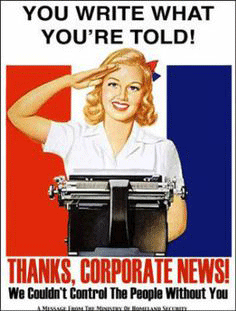 The Sway of the Nuclear Arms Industry Over Donald Trump and Congress Is Terrifying “The devastation is very important to me.” Mother Jones NOV. 18, 2017 This story originally appeared on TomDispatch.com. “……..Another way the nuclear weapons industry (and the rest of the military-industrial complex) tries to control and focus public debate is by funding hawkish think tanks. The advantage to weapons makers is that those institutions and their “experts” can serve as front groups while posing as objective policy analysts. Think of it as intellectual money laundering.
One of the most effective industry-funded think tanks in terms of promoting costly, ill-advised policies has undoubtedly been Frank Gaffney’s Center for Security Policy. In 1983, when President Ronald Reagan first announced his Strategic Defense Initiative (a.k.a. “Star Wars”), the high-tech space weapons system that was either meant to defend the country against a future Soviet first strike or—depending on how you looked at it—free the country to use its nuclear weapons without fear of retaliation, Gaffney was its biggest booster. More recently, he has become a prominent purveyor of Islamophobia, but the impact of his promotional work for Star Wars continues to be felt in weapons contracts to this day.
Just as George W. Bush was entering the White House, another industry-backed think tank, the National Institute for Public Policy, released a report on nuclear weapons policy that would be adopted almost wholesale for the new administration’s first key nuclear posture review. It advocated such things as increasing the number of countries targeted by US nukes and building a new, more “usable” bunker-busting nuclear weapon. At that time, NIPP had an executive from Boeing on its board. Its director was Keith Payne, who would become infamous in the annals of nuclear policy for co-authoring a 1980 article at Foreign Policy entitled “Victory Is Possible,” suggesting that the United States could actually win a nuclear war, losing “only” 30 million to 40 million people. This is the kind of expert the nuclear weapons complex funded to promulgate its views.
Then there’s the Lexington Institute, a think tank that never met a weapons system it didn’t like. Lexington front man Loren Thompson is frequently quoted in news stories on defense issues, but it is rarely disclosed that he is funded by Lockheed Martin, Northrop Grumman, and other nuclear weapons contractors.
Just as George W. Bush was entering the White House, another industry-backed think tank, the National Institute for Public Policy, released a report on nuclear weapons policy that would be adopted almost wholesale for the new administration’s first key nuclear posture review. It advocated such things as increasing the number of countries targeted by US nukes and building a new, more “usable” bunker-busting nuclear weapon. At that time, NIPP had an executive from Boeing on its board. Its director was Keith Payne, who would become infamous in the annals of nuclear policy for co-authoring a 1980 article at Foreign Policy entitled “Victory Is Possible,” suggesting that the United States could actually win a nuclear war, losing “only” 30 million to 40 million people. This is the kind of expert the nuclear weapons complex funded to promulgate its views.
Then there’s the Lexington Institute, a think tank that never met a weapons system it didn’t like. Lexington front man Loren Thompson is frequently quoted in news stories on defense issues, but it is rarely disclosed that he is funded by Lockheed Martin, Northrop Grumman, and other nuclear weapons contractors.
Examples include Secretary of Defense James Mattis, a former board member at General Dynamics; White House Chief of Staff John Kelly, who worked for a number of defense firms and was an adviser to DynCorp, a private security firm that has done everything from (poorly) training the Iraqi police to contracting with the Department of Homeland Security; former Boeing executive and now Deputy Secretary of Defense Patrick Shanahan; former Lockheed Martin executive John Rood, nominated as undersecretary of defense for policy; former Raytheon Vice President Mark Esper, newly confirmed as secretary of the Army; Heather Wilson, a former consultant to Lockheed Martin, who is now secretary of the Air Force; Ellen Lord, a former CEO for the aerospace company Textron, who is undersecretary of defense for acquisition; and National Security Council Chief of Staff Keith Kellogg, a former employee of the major defense and intelligence contractor CACI, where he dealt with “ground combat systems” among other things.
Keep in mind that these high-profile industry figures are just the tip of the iceberg when it comes to the corporate revolving door that has been installed in the Pentagon for decades, as journalist Lee Fang has documented in the Intercept.
Given the composition of his national security team and Trump’s love of all things nuclear, what can we expect from his administration on this front? In addition to the $1.7 trillion nuclear build-up, Trump’s impending nuclear posture review seems to include proposals for dangerous new weapons like a “low-yield,” purportedly more usable nuclear warhead. He’s spoken privately with his team about expanding the arsenal in a staggering fashion—the equivalent of a 10-fold increase. He’s wholeheartedly embraced missile defense spending, pledging to put billions of dollars more into that overfunded, under-producing set of programs. And of course, he is assiduously trying to undermine the Iran nuclear deal, one of the most effective arms control agreements of recent times, and so threatening to open the door to a new nuclear arms race in the Middle East.
And Donald Trump, “bone spurs” and all, is no Dwight D. Eisenhower.
This article was adapted from the author’s essay “Nuclear Politics” in the collection Sleepwalking to Armageddon: The Threat of Nuclear Annihilation, edited by Helen Caldicott. http://www.motherjones.com/politics/2017/11/devastation-very-important-nuclear-weapons-industry-donald-trump-1/
1 Comment »
1 This Month
26 April – Chernobyl: Inside the Meltdown airs on National Geographic on Sunday 26th April from 4pm


29 April – Nuclear Expert Webinar #1 – Radiation Impacts on Families with Mary Olson and Cindy Folkers
- 12:15 PM MT – 1:45 PM MT
- Location: Virtual – REGISTER TODAY

4 May -West Suburban Peace Coalition to discuss Iran war at May Educational Forum
Monday, May 4, 7:00 – 8:00 PM Central Standard Time
Title: : How Trump’s Narrative Tries to Shape the Reality of the War on Iran.
Contact Walt Zlotow, zlotow@hotmail.com 630 442 3045 for further information
14 May – online event From Bombs to Data Centres: the Face of Nuclear Colonialism

Pine Ridge Uranium is the real threat, not Tehran- Tell Burgum: Stop the Extraction.
Chernobyl: The Lost Tapes – A good documentary on Chernobyl on SBS available On Demand for the next 3 weeks– https://www.sbs.com.au/ondemand/tv-program/chernobyl-the-lost-tapes/2352741955560
To see nuclear-related stories in greater depth and intensity – go to https://nuclearinformation.wordpress.com
-
Archives
- April 2026 (356)
- March 2026 (251)
- February 2026 (268)
- January 2026 (308)
- December 2025 (358)
- November 2025 (359)
- October 2025 (376)
- September 2025 (257)
- August 2025 (319)
- July 2025 (230)
- June 2025 (348)
- May 2025 (261)
-
Categories
- 1
- 1 NUCLEAR ISSUES
- business and costs
- climate change
- culture and arts
- ENERGY
- environment
- health
- history
- indigenous issues
- Legal
- marketing of nuclear
- media
- opposition to nuclear
- PERSONAL STORIES
- politics
- politics international
- Religion and ethics
- safety
- secrets,lies and civil liberties
- spinbuster
- technology
- Uranium
- wastes
- weapons and war
- Women
- 2 WORLD
- ACTION
- AFRICA
- Atrocities
- AUSTRALIA
- Christina's notes
- Christina's themes
- culture and arts
- Events
- Fuk 2022
- Fuk 2023
- Fukushima 2017
- Fukushima 2018
- fukushima 2019
- Fukushima 2020
- Fukushima 2021
- general
- global warming
- Humour (God we need it)
- Nuclear
- RARE EARTHS
- Reference
- resources – print
- Resources -audiovicual
- Weekly Newsletter
- World
- World Nuclear
- YouTube
-
RSS
Entries RSS
Comments RSS
 nuclear-news
[…] https://nuclear-news.net/2017/11/19/nuclear-arms-industry-controls-public-discussion-on-weapons-fund… […]
Pingback by Nuclear arms industry controls public discussion on weapons – funding “think tanks” | nuclear-news – leftwingnobody | November 20, 2017 |