Construction of new nuclear plants stopped in South Korea
Continuing Conflict S. Korean Gov’t Stops Virtually Construction of New Nuclear Power Plants Seoul, Korea, Business Korea, 17 November 2017 , Choi Mun-hee
Korea Hydro & Nuclear Power (KHNP) held a board meeting on November 16 and decided to stop the construction of the third and fourth units of the Shin Hanul Nuclear Power Plant and the first and second units of the Cheonji Nuclear Power Plant. Controversies are likely to continue with hundreds of billions of won already invested in the construction projects and the government having yet to prepare a plan for compensation.
Those in favor of the construction of the nuclear power plants are claiming that nuclear power plants are safe tools for power generation as seen in the case of those that endured the magnitude 5.4 earthquake in Pohang on November 15. Those opposed to the construction are claiming that South Korea is not an earthquake-free zone and, as such, no more nuclear power plant should be allowed.
Earthquake in South Korea raises new doubts about nuclear power
Environmental groups that support the current administration’s nuclear energy phaseout policy have based their arguments on the potential dangers posed by natural disasters like earthquakes.
In a statement made yesterday, the Korean Federation for Environmental Movement reiterated the need to scale back nuclear energy operations in southeastern Korea, saying, “On the heels of the Gyeongju earthquake last year, there has been a quake on the Yansan fault line.”
Last September’s 5.8-magnitude earthquake in Gyeongju was the most powerful recorded in South Korean history. With the November 15 earthquake in nearby Pohang, only about 20 km away, the Yeongnam region has seen record-setting natural disasters in successive years.
Green energy group Energy Justice Actions issued its own statement, calling for a concerted anti-nuclear power administrative policy and a halt to all ongoing reactor construction before “a bigger accident happens”. ……http://koreabizwire.com/debate-over-nuclear-power-phaseout-rears-its-head-once-more-after-earthquake/101591
South Carolina Electric & Gas Company (SCE&G) has new proposal for solar and gas generation
SCE&G proposes gas, solar for Summer replacement , WNN, 17 November 2017
South Carolina Electric & Gas Company (SCE&G) has unveiled a proposal that would see some of the capacity that should have been provided by the VC Summer nuclear power plant project replaced with gas and solar generation. The company’s shareholders would absorb the net construction costs of the abandoned nuclear project.
The proposal issued yesterday by the Scana Corporation subsidiary provides about $4.8 billion in benefits to SCE&G customers, and will require approval from South Carolina’s Public Service Commission (PSC).
SCE&G proposes acquiring a 540 MWe gas-fired power plant to replace “more than” 40% of the power that was projected to be provided from the two-unit Summer plant. The $180 million purchase price of the gas-fired plant will be borne by Scana shareholders, who will also forego any shareholder return over the life of the plant. The company said it will also add about 100 MWe of large-scale solar capacity to its system.
Electric rates for SCE&G’s customers – commercial, industrial and residential – will roll back to where they would have been in March 2015, which represents a reduction of about 3.5%. Scana shareholders will absorb the net nuclear construction costs through lower earnings over 50 years, which the company says will account for about $2.9 billion of the total $4.8 billion.
SCE&G owns 55% of the Summer project, with the remainder owned by Santee Cooper…… http://www.world-nuclear-news.org/C-Gas-solar-proposed-by-SCEG-for-Summer-replacement-1711178.html
Defense Nuclear Facilities Safety Board warns about Hanford nuclear site
Nuclear safety board warns of trouble ahead at Hanford, but could lose role under Trump, Seattle Times Nuclear safety board report finds serious problems persist with a massive facility to help treat Hanford’s chemical and radioactive wastes. The report comes as the Trump administration considers a proposal to downsize or do away with the independent oversight board. By Hal Bernton An unfinished $16.8 billion complex to treat chemical and radioactive waste at the Hanford site in Central Washington continues to suffer design problems that risk explosions and radioactive releases from unintended nuclear reactions, according to a Defense Nuclear Facilities Safety Board report.
Planned new nuclear power station for Bradwell-on-Sea, Essex, meets with opposition

 Design for planned nuclear power plant in Essex unveiled Designs for a new nuclear power station close to the site of a former plant in Essex have been revealed. BBC, 17 Nov 17 The reactor and buildings – designed by EDF and China General Nuclear (CGN) – could be built at Bradwell-on-Sea.
Planners are now set to consider environmental and safety issues, but any full approval for the site is expected to take at least four years.
It could power up to one million homes but campaigners oppose it on “health, environment and safety” grounds.
The design for the new “Bradwell B” reactor has passed the first step of a four-step process, and will be assessed by UK nuclear regulators.
But the Blackwater Against New Nuclear Group has warned about “the risks and dangers of radioactivity” posed by its construction and operation……. http://www.bbc.com/news/uk-england-essex-42026375
Legal action in South Africa’s High Court against government’s rushed nuclear energy deal
 Two NGOs launch urgent High Court application against nuclear energy deal https://www.businesslive.co.za/bd/national/2017-11-17-two-ngos-launch-urgent-high-court-application-against-nuclear-energy-deal/ 17 NOVEMBER 2017 KYLE COWAN On Thursday, two non-governmental organisations (NGOs) launched an urgent court application to halt what they are calling a “rush by government in decision-making on the nuclear energy deal”.Earthlife Africa Johannesburg and the Southern African Faith Communities’ Environment Institute said in a statement on Friday that they have approached the High Court to ask for an order to stay the process.
Last week, the same NGOs sent a request to Public Enterprises Minister Lynne Brown and Energy Minister David Mahlobo‚ as well as the National Energy Regulator of SA (Nersa)‚ asking for a commitment to follow legal processes and allow public consultation on proposed nuclear deals.
The three parties had not responded to the request by Wednesday‚ the statement said.
Earthlife’s Makoma Lekalakala said: “We are part of an international movement against dirty nuclear energy‚ where we have seen governments enter into nuclear deals that are not in the interests of their people. That must not happen in SA.”
According to Earthlife‚ Mahlobo’s recent “utterances in the press” suggested that the finalisation of the integrated resource plan and the nuclear programme was being fast-tracked, “yet government has failed to implement the necessary public participation required by the court judgement that was delivered on 26 April 2017”.
The NGOs will ask the court to declare that:
• No steps‚ including the issuing of requests for proposals or request for information‚ be taken for the procurement of new electricity-generation capacity‚ derived from nuclear power.
• Steps not be taken in the absence of a lawful determination in terms of s34 of the Electricity Regulation Act‚ in concurrence with Nersa‚ following a procedurally fair public participation process.
“This determination would have to specify that new, nuclear energy electricity generation is needed‚ and what percentage of SA’s energy mix it would fulfil.”
Finance Minister Malusi Gigaba has also indicated that the country may not be able to afford the nuclear programme‚ which is estimated will cost upwards of R1-trillion.
The court will also be asked to direct Mahlobo and Eskom to provide written reports on what steps they have taken, or plan to take, on plans for nuclear power. Should evidence exist that they have taken steps to forge ahead with the nuclear programme‚ the court will be asked to declare Mahlobo and Eskom in contempt of court for violating the April court order.
“We cannot have unaccountable government,” said Liz McDaid of the faith communities’ institute. “We have now seen overwhelming evidence emerging in the public arena that shows how state institutions have been captured and how money that is meant to deliver services to South Africans has gone into the pockets of looters.”
“The nuclear deal‚ purportedly worth more than R1-trillion‚ is yet another one of these deals. SA cannot afford‚ nor does it need, new nuclear power-generation capacity. I think South Africans have had enough.”
Japan Atomic Power in dire straits after diverting funds
By TSUNEO SASAI/ Staff Writer
November 17, 2017 a
Japan Atomic Power Co. has diverted so much of its decommissioning funds to build new reactors that it now lacks enough cash to scrap its aging units or even resume operations of existing ones.
The problem-plagued company is banking on a decision by the Nuclear Regulation Authority, but even that might not be sufficient to save it financially.
The Ministry of Economy, Trade and Industry requires nuclear power plant operators to accumulate decommissioning funds every year based on their estimated costs to scrap reactors.
The ministry’s guidelines, however, do not prohibit the companies from temporarily using the accumulated money for other purposes.
According to calculations, Japan Atomic Power should have saved around 180 billion yen ($1.6 billion) to decommission its four nuclear reactors.
The company declined to give details about how much of decommissioning fund was used for other purposes.
However, a person familiar with the situation said the operator “diverted the majority.”
That leaves Japan Atomic Power without the necessary funds to carry out its plans to decommission its one-reactor Tokai nuclear plant in Ibaraki Prefecture, and the No. 1 reactor at its Tsuruga nuclear plant in Fukui Prefecture.
The company’s two other reactors–the reactor at the Tokai No. 2 nuclear plant and the No. 2 reactor at the Tsuruga plant–are off-line.
To survive the financial crunch, Japan Atomic Power will soon apply to the NRA to extend the operating life of the idled Tokai No. 2 nuclear plant reactor.
That reactor will reach its 40th year of operation in November 2018.
Even if the NRA approves the 20-year extension, the company does not have the 174 billion yen needed to improve safety measures at the reactor to bring it online.
An active geological fault line was found running directly beneath the No. 2 reactor building at the Tsuruga nuclear plant, meaning a resumption of reactor operations there is nowhere in sight.
Japan Atomic Power decided to use decommissioning funds to cover costs to build the Tsuruga No. 3 and No. 4 reactors in a bid to curb borrowing from financial institutions, according to several sources.
However, that decision was made before disaster struck at the Fukushima No. 1 nuclear power plant in March 2011.
After the triple meltdown at the Fukushima plant, all reactors in the nation, including those of Japan Atomic Power, were suspended.
With its reactors offline and its revenue drying up, Japan Atomic Power continued diverting money from the decommissioning fund to cover its losses.
A Japan Atomic Power official told The Asahi Shimbun that the diversion of funds was not a problem because the operator “used the money appropriately in light of various circumstances and future forecasts.”
However, the company’s plight has officials in the economy ministry considering imposing limits on diverting decommissioning funds. With deregulations in the electric power industry moving forward, the risk of a sudden collapse of an electric power utility has increased.
With all of its reactors off-line, Japan Atomic Power would find it difficult to obtain loans from financial institutions.
In addition, residents around its nuclear facilities could oppose any restarts in light of the company’s inability to prepare sufficient safety expenses.
Japan Atomic Power had only 18.7 billion yen on hand at the end of March for immediate use in an emergency.
If the company is forced to decommission its Tokai No. 2 nuclear power plant, the finances of other major electric companies would be affected.
To provide financing for Japan Atomic Power, financial institutes set certain loan conditions, one of which requires the company to be guaranteed by a major utility.
Tokyo Electric Power Co., which hold shares in Japan Atomic Power, has come under fire over the disaster at its Fukushima No. 1 plant. Public criticism would certainly erupt if TEPCO, which is funded by the government, were to support a bailout of Japan Atomic Power.
A source with TEPCO described Japan Atomic Power’s situation as: “Stuck between a rock and a hard place.”
U.N. body calls on Japan to improve protection of press freedoms and Fukushima residents rights

 GENEVA
A U.N. body has called on Japan to take steps to better protect press freedoms as concerns about the country’s laws aimed at curtailing leaks of state secrets could hinder the work of journalists.
In another of the 218 non-legally binding recommendations on Japan’s human rights record released by the U.N. Human Rights Council’s working group, Tokyo was urged to apologize and pay compensation to “comfort women” forced to work in Japan’s World War II military brothels.
The recommendations reflected the views of some 105 countries. Of the issues raised, the U.N. council will adopt those that have been accepted by the country in question at a plenary session around March 2018.
In relation to freedom of the press in Japan, the recommendation called on the country to amend Article 4 of the broadcasting law that gives the government authority to suspend broadcasting licenses of TV stations not considered “politically fair.”
Japan had already attracted criticism, in particular from David Kaye, U.N. special rapporteur on the right to freedom of opinion and expression, over its law called the Act on the Protection of Specially Designated Secrets, which came into force in 2014.
Under the law, civil servants or others who leak designated secrets could face up to 10 years in prison, and those who instigate leaks, including journalists, could be subject to prison terms of up to five years.
In his report, Kaye noted that the law may be arbitrarily enforced as subcategories under which information may be designated as secret are “overly broad.”
On the issue of “comfort women,” raised at the request of South Korea and China, the recommendation urged Japan to promote fair and accurate historical education, including the women’s stories, and to apologize and compensate victims.
The recommendation also said Japan should abolish or suspend the death penalty, reflecting calls from European Union countries, and continue to provide support to those affected by the Fukushima nuclear crisis caused by the massive 2011 earthquake and tsunami. In particular, a directive to address health issues faced by pregnant mothers and children was noted.
The U.N. Rights Council is mandated to “undertake a universal periodic review” of whether countries are meeting their human rights obligations and commitments.
The examination is conducted on all 193 members of the United Nations in periodic cycles of a few years. The latest review was the third for Japan.
Nuclear-news.net exclusive report from yesterday on the UN meeting;
As the world struggles with immediate dangers, NASA focuses on nuclear electricity for Mars
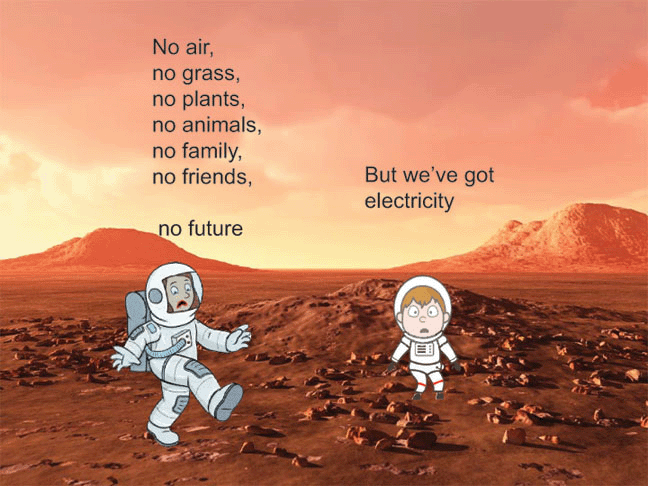
NASA reveals ‘nuclear engine’ that could provide power to the first humans on Mars
 NASA plans to test the Kilopower engines on Earth this year
- Will use a uranium rector the size of a toilet roll to create heat
- High efficiency Stirling engine would then convert this to electricity, By Mark Prigg For Dailymail.com, 15 November 2017 |NASA’s Space Technology Mission Directorate (STMD) has provided multi-year funding to the Kilopower project.
The technology could produce from one to 10 kilowatts of electrical power, continuously for 10 years or more. The average U.S. household runs on about five kilowatts of power.
Testing is due to start in November and go through early next year, with NASA partnering with the Department of Energy’s (DOE) Nevada National Security Site to appraise fission power technologies.
‘The Kilopower test program will give us confidence that this technology is ready for space flight development.
‘We’ll be checking analytical models along the way for verification of how well the hardware is working,’ said Lee Mason, STMD’s principal technologist for Power and Energy Storage at NASA Headquarters.
NASA is set to begin testing a radical ‘nuclear engine’ that could provide power for astronauts on the Martian surface.
Dubbed the ‘Kilopower’ it would use a uranium rector the size of a toilet roll to create heat.
A high efficiency Stirling engine would then convert this to electricity, in a system that works in a similar way to a car engine……http://www.dailymail.co.uk/sciencetech/article-5083265/Nuclear-engines-provide-power-humans-Mars.html

As Bonn climate negotiations finish, scientists fear that the planned actions are not enough

As Climate Negotiators Debate Nations’ Pledges, Scientists Worry It’s Not Enough https://www.npr.org/sections/thetwo-way/2017/11/16/564384950/as-climate-negotiators-debate-nations-pledges-scientists-worry-it-s-not-enough Governments are wrapping up a meeting in Bonn, Germany, to figure out how to implement a global climate agreement.
The conference has focused on the pledges to reduce greenhouse gas emissions, which nations made two years ago in Paris. But even as negotiators debate the details, scientists are warning that carbon dioxide levels are again on the rise, and the efforts in Paris may not be enough.
President Trump has vowed that the U.S. will pull out of the Paris deal. The final withdrawal will take a few years, and the government sent a small delegation to Bonn. It made one presentation on the value of clean coal that was disrupted by protesters.
U.S. cities and states sent their own delegations as well. California Gov. Jerry Brown attended to talk about his state’s commitment to climate change.
“In the United States,” he explained, “we have a federal system, and states have real power, as do cities. And when cities and states combine together and then join with powerful corporations, that’s how stuff gets done.”
At that point protesters shouted over him, telling him to keep fossil fuels in the ground. But Brown’s message — that states and cities have agreed to meet the Paris targets for reducing emissions on their own — has been welcomed as a stand-in for a federal effort.
The Paris agreement set a goal not to let the planet warm more than 3.6 degrees F above what is was before the industrial revolution. This latest analysis echoes others: the pledges made by countries in Paris to reduce emissions aren’t enough, and that current energy policies aren’t going to make even the Paris pledges possible. Fekete says the Carbon Action Tracker analysis shows that the climate is currently headed for an increase of at least 6 degrees F by the end of the century.Another study released this week adds more bad news. Global emissions of carbon dioxide, the main greenhouse gas, are going up. That’s after three years where they remained fairly flat. Environmental scientist Robert Jackson at Stanford University is one of the study’s authors and says the increase is mostly from China. “This year for several reasons their coal use has ticked back up by about 3 percent,” Jackson says, “and their oil and gas use has risen even faster.”
China is the world’s largest emitter of greenhouse gases. Emissions in the U.S., the second-largest emitter, went down this year, but not by much. And while emissions from India were lower than expected — a growth rate of only 2 percent — Jackson says it looks like that won’t last. “I expect India’s emissions to rise faster again.” He says, “They still have hundreds of millions of people without electricity. It’s a tough nut to crack.”
One thing the delegates in Bonn appear to agree on is that the pledges made in Paris will have to get tougher.
It is still worth acting to prevent extreme changes, but climate change impacts are already locked in

Climate Change Impacts Already Locked In — But The Worst Can Still Be Avoided http://www.enn.com/pollution/article/53180 From: University of Exeter
November 16, Some impacts of global warming – such as sea level rise and coastal flooding – are already locked in and unavoidable, according to a major research project.
Global temperatures have already risen by around 1°C, and a further 0.5°C warming is expected. The full impacts of current warming have not yet been seen, since ice sheets and oceans take many decades to fully react to higher temperatures.
But more severe impacts can still be avoided if global greenhouse gas emissions are reduced.
More than 50 scientists from 16 institutions in 13 countries have worked on the HELIX project (High-End Climate Impacts and Extremes), which has just finished after four years. The project examined the possible effects of warming of 1.5°C, 2°C, 4°C and 6°C compared to pre-industrial levels.
Read more at University of Exeter
China tries to cool dangerous situation – asks USA to stop military exercises off North Korea

 World War 3: China orders the US to STOP carrying out military exercises off North Korea https://www.express.co.uk/news/world/880506/World-War-3-military-USA-North-Korea-China-Donald-Trump-Kim-Jong-Un-Xi-Jinping
CHINA has demanded the US military stops carrying out exercises on the Korean peninsula in a bid to cool off tensions between North Korea state and the Trump administration.By VINCENT WOODOfficials from Xi Jinping’s government have told their US and South Korean counterparts to stop carrying out joint drills in the region – exercises that are often used as a show of force in response to military tests carried out by Kim Jong-un’s nuclear cronies.
In return they believe they can negotiate a stop to the tyrant’s nuclear and missile provocations amid fears tensions could trigger the start of World War 3 on the Korean peninsula.
Geng Shuang, China’s foreign ministry spokesman, claims freezing military drills in exchange for a freeze on North Korean missile testing was the best means of achieving peace in the region.
He said: “China sees the freeze-for-freeze scheme is the most reasonable way.”
The official’s comments follow a 12-day tour of Asia by President Trump, in which the Republican firebrand met with China’s newly emboldened leader Xi Jinping to discuss bringing an end to the North Korean threat.
However, on Wednesday the US President claimed he “would not accept” freeze for freeze plans “like those that have consistently failed in the past”.
Mr Geng added: ”The freeze-for-freeze move is just for a breakthrough and the first step.
“The final objective is to peacefully resolve the North’s nuclear problem and realise long-term stability on the Korean Peninsula.”
It comes as the United States deploys 14,000 troops on aircraft carriers and destroyers off the coast of North Korea for a series of war games with Japan in drills likely to infuriate Kim Jong-un.
More than 14,000 servicemen will take part in the ten-day exercise, which will see US and Japanese troops performing war games in the waters off Okinawa.
The US Navy said the drills, which began on Thursday, are “designed to increase the defensive readiness and interoperability of Japanese and American forces through training in air and sea operations”.
And they also include aircraft carrier the USS Ronald Reagan, and the guided-missile destroyers USS Stethem, USS Chafee and USS Mustin, among others – the first such deployment of three US carriers since 2007.
A US Navy spokesman: “The exercise follows more than a week of scenario-based training ashore.”
The display of military force is meant to pressure North Korea and make it clear to Pyongyang the US can rapidly mobilise a potent military force.
USA-Japan escalate tensions, with naval drills off Korean Peninsula

In a show of power, Japan, US begin joint naval drills off Korean Peninsula Trump’s harsh rhetoric, coupled with the North Korean regime’s ongoing weapons tests, have escalated regional tension to unprecedented levels
IANS | Tokyo Business Standard, November 16, 2017Japan and the US on Thursday began joint naval drills south of the Korean Peninsula in a show of power against North Korea.
Union of Concerned Scientists urge Congress to pass Bill Establishing Policy that US Will Not Use Nuclear Weapons First
Congress Should Pass Bill Establishing Policy that US Will Not Use Nuclear Weapons First, Statement by Lisbeth Gronlund, Union of Concerned Scientists http://www.ucsusa.org/press/2017/congress-should-pass-bill-establishing-policy-us-will-not-use-nuclear-weapons-first#.Wg34BNKWbGg WASHINGTON (November 15, 2017)—Ranking member of the House Armed Services Committee Rep. Adam Smith (D-Wash.) introduced a bill today that would establish a policy that the United States will not use nuclear weapons first.
Below is a statement by Lisbeth Gronlund, senior scientist and co-director of the Global Security Program at the Union of Concerned Scientists.
“I strongly support this effort to change U.S. nuclear weapons policy. The United States should take all steps possible to prevent a nuclear war—by increasing the threshold for deliberate use and reducing the risk of accidental use.
“Under current policy, the United States would consider using nuclear weapons first against Russia, China and North Korea. Deliberately starting a nuclear war with any of these countries would be disastrous. The United States would increase its own security and that of the rest of the world by eliminating the option of using nuclear weapons first and declaring that the only purpose of its nuclear weapons is to deter—and, if necessary, respond to—nuclear attacks on itself and its allies.”
If war breaks out on Korean peninsula, Japan must be ready for influx of evacuees
North Korea nuclear crisis: Japan bracing itself for influx of evacuees if war erupts
Coast Guard readies plans to escort boats from peninsula to designated ports as brinkmanship continues between Pyongyang and Washington The Independent, 16 Nov 17 Japan is studying plans to cope with an influx of perhaps tens of thousands of North Korean evacuees if a military or other crisis breaks out on the peninsula, including ways to weed out spies and terrorists, a domestic newspaper said.
The Japan Coast Guard would escort boats fleeing North Korea to designated ports, where police would screen them by checking their identity and possible criminal records and expel those deemed a threat, The Yomiuri newspaper said on Thursday.
It did not say where those people would be sent, however.
Evacuees granted temporary entrance would be transferred to emergency detention centres, probably in southern Japan, after completing quarantine and other procedures.
Officials would then decide whether they were eligible to remain in Japan, The Yomiuri said.
Regional tension over Pyongyang’s missile and nuclear arms programmes remain high.
A senior Chinese diplomat was to visit the North from Friday as a special envoy of Chinese President Xi Jinping, just a week after US President Donald Trump met Xi in Beijing and pressed for greater action to rein in Pyongyang……..http://www.independent.co.uk/news/world/asia/north-korea-crisis-latest-japan-evacuees-influx-nuclear-war-shinzo-abe-kim-jong-un-missile-tests-a8058151.html
1 This Month

of the week – Shut Down Drone Warfare!


Tell the Ukrainian Government to Drop Prosecution of Peace Activist Yurii Sheliazhenko

Petition to revoke the licensing of the Near Surface Nuclear Disposal Facility (NSDF) at Chalk River. https://www.ourcommons.ca/petitions/en/Petition/Details?Petition=e-7247
To see nuclear-related stories in greater depth and intensity – go to https://nuclearinformation.wordpress.com
-
Archives
- April 2026 (57)
- March 2026 (251)
- February 2026 (268)
- January 2026 (308)
- December 2025 (358)
- November 2025 (359)
- October 2025 (376)
- September 2025 (257)
- August 2025 (319)
- July 2025 (230)
- June 2025 (348)
- May 2025 (261)
-
Categories
- 1
- 1 NUCLEAR ISSUES
- business and costs
- climate change
- culture and arts
- ENERGY
- environment
- health
- history
- indigenous issues
- Legal
- marketing of nuclear
- media
- opposition to nuclear
- PERSONAL STORIES
- politics
- politics international
- Religion and ethics
- safety
- secrets,lies and civil liberties
- spinbuster
- technology
- Uranium
- wastes
- weapons and war
- Women
- 2 WORLD
- ACTION
- AFRICA
- Atrocities
- AUSTRALIA
- Christina's notes
- Christina's themes
- culture and arts
- Events
- Fuk 2022
- Fuk 2023
- Fukushima 2017
- Fukushima 2018
- fukushima 2019
- Fukushima 2020
- Fukushima 2021
- general
- global warming
- Humour (God we need it)
- Nuclear
- RARE EARTHS
- Reference
- resources – print
- Resources -audiovicual
- Weekly Newsletter
- World
- World Nuclear
- YouTube
-
RSS
Entries RSS
Comments RSS
 nuclear-news