Special Report: Revolt at Trump’s Pro-Coal, Pro-Nuclear & Pro-Gas Panel Rocks U.N. Climate Summit NOVEMBER 14, 2017, Democracy Now! was there when activists and Democratic lawmakers at the U.N. climate summit in Bonn, Germany, staged a full-fledged revolt Monday when the Trump administration made its official debut at this year’s conference with a forum pushing coal, gas and nuclear power. The presentation was entitled “The Role of Cleaner and More Efficient Fossil Fuels and Nuclear Power in Climate Mitigation.” The panel was the only official appearance by the U.S. delegation during this year’s U.N. climate summit. Of the four corporate representatives pushing nuclear, gas and coal, Lenka Kollar of NuScale Power and Amos Hochstein of Tellurian told Amy Goodman that they disagreed with Trump’s decision to pull the U.S. out of the climate agreement.
Transcript This is a rush transcript. Copy may not be in its final form.
AMYGOODMAN: This is Democracy Now!, democracynow.org, The War and Peace Report. We’re broadcasting live from the U.N. climate summit here in Bonn, Germany. Close to 200 countries are gathered. The U.S. says that it is pulling out of the climate accord. Well, on Monday night, activists and Democratic lawmakers staged a full-fledged revolt as the Trump administration made its official debut at this year’s COP at a forum pushing coal, gas and nuclear power. The presentation was entitled “The Role of Cleaner and More Efficient Fossil Fuels and Nuclear Power in Climate Mitigation.” It included speakers from coal company Peabody Energy, the nuclear engineering firm NuScale Power and a gas exporter. The panel was the only official appearance by the U.S. delegation during this year’s U.N. climate summit.
Well, Democracy Now! was there Monday night as the U.S. delegation made its official debut. It didn’t go too well. At least, it didn’t begin well, with a White House consultant telling Democracy Now! we could not film him……..https://www.democracynow.org/2017/11/14/special_report_revolt_at_trumps_pro
Senators deadlock in debate over whether to restrain Trump’s nuclear launch authority Chicago Tribune,Karoun Demirjian, Washington Post, 14 Nov 17
Senators trying to prevent President Donald Trump from launching an unprovoked nuclear attack were stymied Tuesday, after a panel of experts warned them against rewriting laws to restrain a commander in chief many worry is impulsive and unpredictable enough to start a devastating international crisis.
Senate Foreign Relations Committee chairman Bob Corker, R-Tenn., who has said Trump’s threats to global rivals could put the country “on the path to World War III,” began Tuesday’s session warning of the inherent danger in a system where the president has “sole authority” to give launch orders there are “no way to revoke.” By the time Corker emerged from the hearing — the first to address the president’s nuclear authority in over four decades — he was at a loss for what to do next.
Don’t Count on the Cabinet to Stop a Trump-Ordered Nuclear Strike, James Mattis and Rex Tillerson can’t stop a nuclear war if President Trump wants one, says former Defense Secretary Bill Perry. Politico By EDWARD-ISAAC DOVERE, November 14, 2017Stop counting on Secretary of Defense James Mattis or Secretary of State Rex Tillerson to stop a nuclear war if Donald Trump wants one, says Bill Perry. They couldn’t.
Perry, who served as secretary of defense for President Bill Clinton, is a 90-year-old arm-waving apostle of doom—“the possibility of an apocalypse thrust itself upon me,” he told me in an interview for POLITICO’s Off Message podcast. He says nuclear war has “become more probable in the last year, partly because of President Trump,” and partly due to events beyond the president’s control. He thinks Trump doesn’t understand the North Koreans, and doesn’t understand what his rhetoric is doing.
That the president and his Cabinet secretaries are so often putting out conflicting messages makes the situation worse. And though Perry subscribes to the idea that Mattis and Tillerson are a “stabilizing influence,” he said that with this president, “I’m not really comfortable with anybody.”
While bills by Rep. Ted Lieu (D-Calif.) and Sen. Ed Markey (D-Mass.) to restrict first use of nuclear weapons have stalled in Congress, Senate Foreign Relations Committee Chairman Bob Corker (R-Tenn.) is set to put some muscle behind his very public anxiety about Trump’s leadership. On Tuesday, Corker will hold a committee hearing on nuclear authorization—the first on the topic since Gerald Ford was president—prompted by concerns he’s heard from members both on and off the committee over letting one person, and this person in particular, have the unfettered ability to launch a nuclear war.
Perry knows Mattis well—while Perry was defense secretary in the 1990s, Mattis worked for him directly, and they both ended up at Stanford University in recent years. The two still talk, and Perry thinks Mattis understands the nuclear threat well—he just doesn’t think Mattis would necessarily be able to do anything if Trump decided to go ahead with a strike.
Perry’s heard the story of Richard Nixon’s final days in the White House, when Defense Secretary James Schlesinger supposedly told generals that any nuclear strike order from the clearly distressed president be run by him first.
But that’s not really the way it works, Perry said.
“The order can go directly from the president to the Strategic Air Command. The defense secretary is not necessarily in that loop. So, in a five- or six- or seven-minute kind of decision, the secretary of defense probably never hears about it until it’s too late. If there is time, and if he does consult the secretary, it’s advisory, just that,” Perry explained. “Whether [the president] goes with it or doesn’t go with it—[the secretary] doesn’t have the authority to stop it.”
Perry lived through two nuclear apocalypse scares. The first lasted for days, when as a consultant, he was brought by the CIAto help sort through intelligence during the Cuban missile crisis. The second lasted for a split second, when as a lower-ranking Pentagon official during Jimmy Carter’s term, he was woken by a phone call warning him that it looked as if 200 nuclear missiles were already in the air—but it was immediately explained to him that this was a computer error. The experiences were searing, and left him convinced that only good luck and a little bit of good management saved the world from ending under John F. Kennedy, and that the context of lower tensions during that 1979 computer error stopped the situation from spiraling out of hand………. https://www.politico.com/magazine/story/2017/11/14/jim-mattis-rex-tillerson-cabinet-stop-trump-nuclear-weapon-war-215824
Students have been lured by money and other rewards to attend government events to promote public understanding linked to hosting final disposal sites for high-level radioactive nuclear waste, one of the organizers said Tuesday.
The revelation of a possible attempt to manipulate the participants in the events may serve as a blow to the government’s renewed efforts to select final nuclear waste disposal sites after seeing little progress on the issue over the past 20 years or so.
The Nuclear Waste Management Organization of Japan, which along with the industry ministry has organized the events, admitted that 39 students were offered rewards in exchange for their attendance, but blamed the matter on mismanagement by a Tokyo-based marketing company that has engaged in publicity work.
“We weren’t supposed to solicit participants by paying money, but the idea was not thoroughly shared inside the company,” an official of the organizer known as NUMO said, adding it confirmed that no rewards had actually been handed to the participants.
On Nov. 6, the marketing company in question, Oceanize Inc., promised a dozen students it would pay them 10,000 yen ($88) each in exchange for their participation in an event held in the city of Saitama targeting local residents.
The event capacity was set at 100 people and 86 including the 12 students took part.
In similar events held between October and early November in Tokyo and Aichi, Osaka and Hyogo prefectures, Oceanize mobilized 27 students by promising them printing services and venues for their club activities.
The company also sought to encourage the participation in gatherings in five other prefectures, but no students took part in them, according to NUMO.
Oceanize said it could not comment on the issue because a person in charge was absent.
The series of events started in October after the government unveiled a map in July indicating potential deep-underground disposal sites for high-level radioactive nuclear waste, identifying some 70 percent of the country’s land as suitable.
In the events, officials of the Economy, Trade and Industry Ministry and NUMO explained about the map in the hope to earn public understanding on the issue and move on to the next stage of conducting research for potential candidate sites.
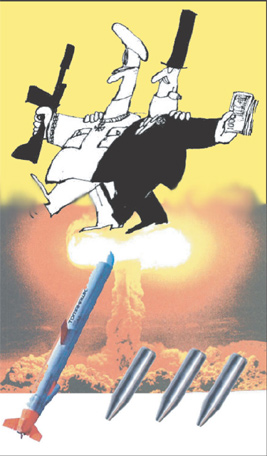
Why the desire for so many nukes? There is, in fact, a dirty little secret behind the massive US arsenal: It has more to do with the power and profits of this country’s major weapons makers than it does with any imaginable strategic considerations.
It may not surprise you to learn that there’s nothing new about the influence the nuclear weapons lobby has over Pentagon spending priorities. The successful machinations of the makers of strategic bombers and intercontinental ballistic missiles, intended to keep taxpayer dollars flowing their way, date back to the dawn of the nuclear age and are the primary reason President Dwight D. Eisenhower coined the term “military-industrial complex” and warned of its dangers in his 1961 farewell address.
Without the development of such weapons, that complex simply would not exist in the form it does today. The Manhattan Project, the vast scientific-industrial endeavor that produced the first such weaponry during World War II, was one of the largest government-funded research and manufacturing projects in history. Today’s nuclear warhead complex is still largely built around facilities and locations that date back to that time.
The Manhattan Project was the first building block of the permanent arms establishment that came to rule Washington. In addition, the nuclear arms race against that other superpower of the era, the Soviet Union, was crucial to the rationale for a permanent war state. In those years, it was the key to sustaining the building, funding, and institutionalizing of the arms establishment.
As Eisenhower noted in that farewell address of his, “a permanent arms industry of vast proportions” had developed for a simple enough reason. In a nuclear age, America had to be ready ahead of time. As he put it, “We can no longer risk emergency improvisation of national defense.” And that was for a simple enough reason: In an era of potential nuclear war, any society could be destroyed in a matter of hours. There would be no time, as in the past, to mobilize or prepare after the fact.
In addition, there were some very specific ways in which the quest for more nuclear weapons and delivery vehicles drove Eisenhower to give that farewell address. One of his biggest fights was over whether to build a new nuclear bomber. The Air Force and the arms industry were desperate to do so. Eisenhower thought it a waste of money, given all the other nuclear delivery vehicles the United States was building at the time. He even cancelled the bomber, only to find himself forced to revive it under immense pressure from the arms lobby. In the process, he lost the larger struggle to rein in the nation’s nuclear buildup and corral the burgeoning military-industrial complex.
At the same time, there were rumblings in the intelligence community, the military establishment, the media, and Congress about a “missile gap” with the Soviet Union. The notion was that Moscow had somehow jumped ahead of the United States in developing and building intercontinental ballistic missiles (ICBMs). There was no definitive intelligence to substantiate the claim (and it was later proved to be false). However, a wave of worst-case scenarios leaked by or promoted by intelligence analysts and eagerly backed by industry propaganda made that missile gap part of the everyday news of the time.
Such fears were then exaggerated further, thanks to hawkish journalists of the era like Joseph Alsop and prominent Democratic senators like John F. Kennedy and Lyndon Johnson, as well as Stuart Symington, who just happened to be a friend and former colleague of an executive at the aircraft manufacturing company Convair, which, in turn, just happened to make ICBMs. As a result, he lobbied hard on behalf of a Pentagon plan to build more of that corporation’s Atlas ballistic missiles, while Kennedy would famously make the nonexistent missile gap a central theme of his successful 1960 campaign for the presidency.
Eisenhower couldn’t have been more clear-eyed about all of this. He saw the missile gap for the fiction it was or, as he put it, a “useful piece of political demagoguery” for his opponents. “Munitions makers,” he insisted, “are making tremendous efforts towards getting more contracts and in fact seem to be exerting undue influence over the Senators.”
Once Kennedy took office, it became all too apparent that there was no missile gap, but by then it hardly mattered. The damage had been done. Billions of dollars more were flowing into the nuclear-industrial complex to build up an American arsenal of ICBMs already unmatched on the planet.
The techniques that the arms lobby and its allies in government used more than half a century ago to promote sky-high nuclear weapons spending continue to be wielded to this day. The twenty-first-century arms complex employs tools of influence that Kennedy and his compatriots would have found familiar indeed—including millions of dollars in campaign contributions that flow to members of Congress and the continual employmentof 700 to 1,000 lobbyists to influence them. At certain moments, in other words, there have been nearly two arms lobbyists for every member of Congress. Much of this sort of activity remains focused on ensuring that nuclear weapons of all types are amply financed and that the funding for the new generations of the bombers, submarines, and missiles that will deliver them stays on track.
When traditional lobbying methods don’t get the job done, the industry’s argument of last resort is jobs—in particular, jobs in the states and districts of key members of Congress. This process is aided by the fact that nuclear weapons facilities are spread remarkably widely across the country. There are nuclear weapons labs in California and New Mexico; a nuclear weapons testing and research site in Nevada; a nuclear warhead assembly and disassembly plant in Texas; a factory in Kansas City, Missouri, that builds nonnuclear parts for such weapons; and a plant in Oak Ridge, Tennessee, that enriches uranium for those same weapons. There are factories or bases for ICBMs, bombers, and ballistic missile submarines in Connecticut, Georgia, Washington State, California, Ohio, Massachusetts, Louisiana, North Dakota, and Wyoming. Such a nuclear geography ensures that a striking number of congressional representatives will automatically favor more spending on nuclear weapons.
In reality, the jobs argument is deeply flawed. As the experts know, virtually any other activity into which such funding flowed would create significantly more jobs than Pentagon spending. A study by economists at the University of Massachusetts, for example, found infrastructure investment would create one and one-half times as many jobs as Pentagon funding and education spending twice as many.
In most cases it hasn’t seemed to matter that the jobs claims for weapons spending are grotesquely exaggerated and better alternatives litter the landscape. The argument remains remarkably potent in states and communities that are particularly dependent on the Pentagon. Perhaps unsurprisingly, members of Congress from such areas are disproportionately represented on the committees that decide how much will be spent on nuclear and conventional weaponry…….. https://www.thenation.com/article/whos-really-driving-nuclear-weapons-production/
Image courtesy of Javier Zarracina, Graphics Editor, Vox
How climate change could lead to more wars in the 21st century, Vox, A new book offers a dark picture of humanity’s future. by Sean Illing@seanillingsean.illing@vox.com“My belief is that we will see a renaissance of violent conflict in the 21st century, and that many of these conflicts will spring from climate change.”
That’s what Harald Welzer, author of Climate Wars: Why People Will Be Killed in the 21st Century, told me in a recent interview. A professor at the University of Flensburg in Germany, Welzer studies the cultural and political implications of climate change. His book, first published in 2012, was rereleased in paperback in October.
After a new report by the Environmental Justice Foundation warning that climate change is likely to cause the largest refugee crisis in human history, I reached out to Welzer to discuss his book, which is a foreboding look at humanity’s future in a world shaped, increasingly, by climate change.
Twentieth-century wars were fought over land, religion, and economics. But Welzer argues that the wars of the 21st century will be fought over something quite different: climate change, and the shortages of water and food that will come from it.
“Ideology will always be a surface-level justification for conflict,” he told me. “But if you look deeply at the source of future conflicts, I think you’ll see a basic resource conflict at the bottom of it all.”
Senator Chris Murphy made a damning assessment of US President Donald Trump on Tuesday as Congress discussed if the country’s leader should have the authority to launch a nuclear attack.
Mr Trump has recently been taunting North Korea and vowed to unleash “fire and fury like the world has never seen” on the rogue nation if its nuclear armament program was not pulled back.
While the hearing was not about Mr Trump specifically, Connecticut Democrat Chris Murphy appeared to refer to the 45th president as “unstable” and “volatile” when discussing concerns over his ability to launch a missile attack.
“We are concerned that the president is so unstable, is so volatile, has a decision-making process that is so quixotic that he might order a nuclear weapons strike that is wildly out of step with US national-security interests,” Mr Murphy said in Congress.
“Let’s just recognise the exceptional nature of this moment.”
Senate Foreign Relations Committee Chairman Bob Corker said the examination was about the structure that allows presidents to make critical decisions.
“Making the decision to go to war of any sort is a heavy responsibility for our nation’s elected leaders,” Senator Corker said.
“And the decision to use nuclear weapons is the most consequential of all.”
The topic on the US president’s authority to launch a nuclear missile has not been discussed in nearly four decades since a four-day hearing.
Mr Corker has broken publicly with Trump, warning last month that the president was setting the nation “on the path to World War III” with his statements about North Korea and verbal jousting with Kim.
Robert Kehler, who headed US Strategic Command from 2011 to 2013, referred to a basic military precept: “The military is obligated to follow legal orders, but is not obligated to follow illegal orders.”
So, what constitutes a legal order? Kehler, a retired US Air Force general, said the military principles of “necessity” and “proportionality” also apply to decisions about nuclear weapons.
But when asked what he would do if he determined that a presidential nuclear order was illegal, Kehler hesitated about such a hypothetical.
“I don’t know exactly,” he responded. “The human factor kicks in.”
In such a situation, said Bryan McKeon, a former undersecretary of defense under Barack Obama, the president could replace the commander in question, or even the secretary of defense.
“But you’d have a real constitutional crisis on your hands,” McKeon said.
The discomfort among some Republican senators was visible.
“…………A FIELD GUIDE TO INFLUENCING NUCLEAR THINKING IN WASHINGTON
Another way the nuclear weapons industry (like the rest of the military-industrial complex) tries to control and focus public debate is by funding hawkish, right-wing think tanks. The advantage to weapons makers is that those institutions and their associated “experts” can serve as front groups for the complex, while posing as objective policy analysts. Think of it as an intellectual version of money laundering.
One of the most effective industry-funded think tanks in terms of promoting costly, ill-advised policies has undoubtedly been Frank Gaffney’s Center for Security Policy. In 1983, when President Ronald Reagan first announced his Strategic Defense Initiative (which soon gained the nickname “Star Wars”), the high-tech space weapons system that was either meant to defend the country against a future Soviet first strike or—depending on how you looked at it—free the country to use its nuclear weapons without fear of being attacked, Gaffney was its biggest booster. More recently, he has become a prominent purveyor of Islamophobia, but the impact of his promotional work for Star Wars continues to be felt in contracts for future weaponry to this day.
He had served in the Reagan-era Pentagon, but left because even that administration wasn’t anti-Soviet enough for his tastes, once the president and his advisers began to discuss things like reducing nuclear weapons in Europe. It didn’t take him long to set uphis center with funding from Boeing, Lockheed, and other defense contractors.
Another key industry-backed think tank in the nuclear policy field is the National Institute for Public Policy (NIPP). It released a report on nuclear weapons policy just as George W. Bush was entering the White House that would be adopted almost wholesale by his administration for its first key nuclear posture review. It advocated such things as increasing the number of countries targeted by the country’s nuclear arsenal and building a new, more “usable,” bunker-busting nuke. At that time, NIPP had an executive from Boeing on its board and its director was Keith Payne. He would become infamous in the annals of nuclear policy for co-authoring a 1980 article at Foreign Policy entitled “Victory Is Possible,” suggesting that the United States could actually win a nuclear war, while “only” losing 30 million to 40 million people. This is the kind of expert the nuclear weapons complex chose to fund to promulgate its views.
Then there is the Lexington Institute, the think tank that never met a weapons system it didn’t like. Their key front man, Loren Thompson, is frequently quoted in news stories on defense issues. It is rarely pointed out that he is funded by Lockheed Martin, Northrop Grumman, and other nuclear weapons contractors.
And these are just a small sampling of Washington’s research and advocacy groups that take money from weapons contractors, ranging from organizations on the right like the Heritage Foundation to Democratic-leaning outfits like the Center for a New American Security, co-founded by former Obama administration Under Secretary of Defense for Policy Michèle Flournoy (who was believed to have the inside track on being appointed secretary of defense had Hillary Clinton won the 2016 election).
And you may not be surprised to learn that Donald Trump is no piker when it comes to colluding with the weapons industry. His strong preference for populating his administration with former arms industry executives is so blatant that Senator John McCain recently pledged to oppose any new nominees with industry ties. Examples of Trump’s industry-heavy administration include Secretary of Defense James Mattis, a former board member at General Dynamics; White House Chief of Staff John Kelly, who worked for a number of defense firms and was an adviser to DynCorp, a private security firm that has done everything from (poorly) training the Iraqi police to contracting with the Department of Homeland Security; former Boeing executive and now Deputy Secretary of Defense Patrick Shanahan; former Lockheed Martin executive John Rood, nominated as undersecretary of defense for policy; former Raytheon vice president Mark Esper, newly confirmed as secretary of the Army; Heather Wilson, a former consultant to Lockheed Martin, who is secretary of the Air Force; Ellen Lord, a former CEO for the aerospace company Textron, who is undersecretary of defense for acquisition; and National Security Council Chief of Staff Keith Kellogg, a former employee of the major defense and intelligence contractor CACI, where he dealt with “ground combat systems” among other things. And keep in mind that these high-profile industry figures are just the tip of the iceberg when it comes to the corporate revolving door that has for decades been installed in the Pentagon (as documented by Lee Fang of The Intercept in a story from early in Trump’s tenure).
Given the composition of his national security team and Trump’s love of all things nuclear, what can we expect from his administration on the nuclear weapons front? As noted, he has already signed on to the Pentagon’s budget-busting $1.7 trillion nuclear build-up and his impending nuclear posture review seems to include proposals for dangerous new weapons like a “low-yield,” purportedly more usable nuclear warhead. He’s spoken privately with his national security team about expanding the American nuclear arsenal in a staggering fashion, the equivalent of a ten-fold increase. He’s wholeheartedly embraced missile defense spending, pledging to put billions of dollars more into that already overfunded, under-producing set of programs. And of course, he is assiduously trying to undermine the Iran nuclear deal, one of the most effective arms control agreements of recent times, and so threatening to open the door to a new nuclear arms race in the Middle East.
Unless the nuclear spending spree long in the making and now being pushed by President Trump as the best thing since the invention of golf is stopped thanks to public opposition, the rise of an antinuclear movement, or Congressional action, we’re in trouble. And of course, the nuclear weapons lobby will once again have won the day, just as it did almost 60 years ago, despite the opposition of a popular president and decorated war hero. And needless to say, Donald Trump, “bone spurs” and all, is no Dwight D. Eisenhower. https://www.thenation.com/article/whos-really-driving-nuclear-weapons-production/
From the Everglades to Kilimanjaro, climate change is destroying world wonders
Number of natural world heritage sites at serious risk from global warming has doubled in three years, says the IUCN, including the Great Barrier Reef and spectacular karst caves in Europe, Guardian, Damian Carrington 14 Nov 17, From the Everglades in the US to the Great Barrier Reef in Australia, climate change is destroying the many of the greatest wonders of the natural world.
Those at high risk include iconic places from the Galapagos Islands to the central Amazon and less well known but equally vibrant and unique sites such as the karst caves of Hungary and Slovakia and the monarch butterfly reserves in Mexico.
Coral reefs are particularly badly affected by rising ocean temperatures, from the Seychelles to Belize, where the northern hemisphere’s biggest reef is situated. Global heating is also causing mountain glaciers to rapidly shrink, from Kilimanjaro in Tanzania to the Rocky Mountains in Canada and the Swiss Alps Jungfrau-Aletsch – home to the largest Alpine glacier.
Other ecosystems being damaged are wetlands, such as the Everglades, where sea level is rising as the ocean warms and salt water is intruding. In the Sundarbans mangrove forest on the delta of the Ganges, Brahmaputra and Meghna rivers on the Bay of Bengal, two islands have already been submerged and a dozen more are threatened. Fiercer storms are also increasing the risk of devastation.
Rising numbers of wildfires are damaging the beautiful Fynbos flowerscapes in the Cape region of South Africa and the Monarch butterfly site in Mexico. Elsewhere, warming is melting the permafrost in the newly declared Qinghai Hoh Xil heritage site, which is at 4,500m altitude in the Qinghai-Tibetan Plateau.
Australia is especially exposed as it has 10 natural heritage sites where climate change damage is rated as high or very high risk, from its Gondwana rainforests to Shark Bay in western Australia and islands such as Fraser and Macquarie.
The new IUCN report was launched at the UN climate summit being held in Bonn, Germany, where the world’s nations are working to put the 2015 landmark Paris agreement into operation.
“Protection of world heritage sites is an international responsibility of the same governments that have signed up to the Paris agreement,” said Inger Andersen, IUCN director general. “This report sends them a clear message: climate change acts fast and is not sparing the finest treasures of our planet. This underlines the need for urgent and ambitious national commitments and actions to implement the Paris agreement.”
Climate Change and Water Woes Drove ISIS Recruiting in Iraq Battered by shifting resources, desperate farmers were driven into terror recruiters’ clutches. Can it happen again?, National Geographic, Peter Schwartzstein, 14 Nov 17, SHIRQAT, IRAQIt was a few weeks after the rains failed in the winter of 2009 that residents of Shirqat first noticed the strange bearded men.
Circling like vultures among the stalls of the town’s fertilizer market in Iraq’s northern Salahaddin governorate, they’d arrow in on the most shabbily dressed farmers, and tempt them with promises of easy riches. “Join us, and you’ll never have to worry about feeding your family,” Saleh Mohammed Al-Jabouri, a local tribal sheikh, remembers one recruiter saying.
With every flood or bout of extreme heat or cold, the jihadists would reappear, often supplementing their sales pitches with gifts. When a particularly vicious drought struck in 2010, the fifth in seven years, they doled out food baskets. When fierce winds eviscerated hundreds of eggplant fields near Kirkuk in the spring of 2012, they distributed cash. As farming communities limped from one debilitating crisis to another, the recruiters—all members of what soon became the Islamic State—began to see a return on their investment.
Two agricultural laborers in Azwai, a blink-and-you’ll-miss-it farming community just south of Shirqat, ran off to join the jihadists in December 2013. Seven more from outlying villages followed a month later. By the time the Islamic State (also known as ISIS) seized this swath of Iraq—along with most of the country’s west and north—in a brutal summer-long blitzkrieg in 2014, few locals were surprised to see dozens of former fertilizer market regulars among its ranks.
“We said just wait until the next harvest, life will get better, life will become easier,” Jabouri said. “But things just weren’t getting better. There was always another disaster.”
Across rural Iraq and Syria, farmers, officials, and village elders tell similar stories of desperate farmhands swapping backhoes for assault rifles. Already battered by decades of shoddy environmental policies, which had hobbled agriculture and impoverished its dependents, these men were in no state to navigate the extra challenges of climate change. And so when ISIS came along, propelled in large part by sectarian grievances and religious fanaticism, many of the most environmentally damaged Sunni Arab villages quickly emerged as some of the deep-pocketed jihadists’ foremost recruiting grounds.
Around Tikrit, Saddam Hussein’s northern Iraqi hometown, ISIS appears to have attracted much more support from water-deprived communities than from their better-resourced peers. In Tharthar subdistrict, a semi-arid expanse west of the Tigris, farmers with fields closest to the encroaching sands joined the jihadists in greater numbers than their counterparts near the river valley. Throughout 100 plus interviews conducted over three years, farmers and agricultural officials alike sometimes wondered aloud: if only we’d received a little more assistance, might this entire blood-soaked mess have been averted?
“This beast [ISIS] has many causes, but in the countryside these new problems just pushed people over the edge,” said Omar, a former agriculture ministry administrator from Mosul, who fled as the jihadists seized his city three years ago and who wished to withhold his surname for security reasons………
RIPE FOR RADICALIZATION
By 2011, much of the Iraqi countryside was in desperate financial straits. Some 39 percent of people in rural areas were living in poverty, according to the World Bank. That’s two and a half times the country’s urban rate. Almost half lacked safe drinking water. The problems were so devastating in 2012-13 that tens of thousands of villagers ditched their fields altogether, preferring to try their luck in the slum districts of nearby cities instead………
Soaring temperatures also began playing into these [jihadists’] groups’ hands. Amid unprecedented heatwaves, farmers pumped more water in order to keep their crops alive, but in so doing merely added to the burden on the aquifers, many of which were already struggling to keep pace with demand that had previously been met by the rains and rivers. After several years of energetic groundwater extraction near the oil refining town of Baiji, Samir Saed’s two wells ran dry in early 2014, forcing him to lay off the two young men he employed as farm laborers. Jobless and angry, he suspects they soon joined ISIS.
“There are many stories like this; they were frustrated and just saw it as another type of work,” he says.
Summer temperatures in the Middle East are set to soar twice as fast as the global average, possibly threatening the inhabitability of the region by the end of the century, researchers say………
WHAT’S NEXT?
For the moment at least, ISIS is mostly defeated in Iraq. From a high of 40 percent of Iraq’s territory in late 2014, it now only controls a few isolated villages, and small chunks of largely featureless desert. But the conditions that contributed to its success in the countryside are, if anything, more pronounced than ever.
The jihadists adopted scorched earth tactics as they were beaten back, laying waste to hundreds of thousands of acres of prime farmland. And so for returning farmers, climate change and shoddy governance are now among the least of their worries. ISIS fighters ripped up buried irrigation pipes to mold makeshift mortars. They poisoned wells, blew up water canals, and carted off everything that was of any value, notably generators, tractors, and water pump parts……. https://news.nationalgeographic.com/2017/11/climate-change-drought-drove-isis-terrorist-recruiting-iraq/
Pacific Island nations urge world leaders to act as islands expected to sink
AUSTRALIA’S tropical island neighbours may exist today, but their leaders have urged us to help them from sinking.news.com.au, Matt Young@MattYoung 14 Nov 17A LARGE swath of Pacific Island nations are slowly being eaten away until residents will be forced to evacuate and the islands eventually sink into the sea — and it’s coming sooner than we think.
This modern-day Atlantis is thanks to sea levels across small island nations that have seen a dramatic rise over the past few decades, a rate of up to 3-4 times larger than the global average. Tuvalu, in the western Pacific Ocean, will reportedly be uninhabitable by 2050, while its island neighbour Kiribati, is expected to be fully submerged by 2100.
The Maldives, which has the lowest elevation in the world and a population of 427,000, may also have sunk by the end of the century.
It has led experts — including Professor Tim Flannery, climate change expert and Professor at La Trobe University — to believe we are “on a trajectory that will see those nations compromised”.
Iran undertook to curb its uranium enrichment program in return for relief from international sanctions that crippled its economy, and U.N. nuclear inspectors have repeatedly verified Tehran’s adherence to the key aspects of the accord.
Trump has called the agreement between Iran, the United States, Britain, France, Germany, Russia, China and the European Union “the worst deal ever” and he disavowed Iran’s compliance last month. His decision did not constitute a U.S. exit from the accord but raised concern about its staying power.
Trump’s move, at odds with the commitment of the other parties to the deal, meant the U.S. Congress must decide by mid-December whether to reimpose economic sanctions lifted under the accord, reached under his predecessor Barack Obama.
If Congress reimposes the sanctions, the United States would in effect be in violation of the deal and it would likely fall apart. If lawmakers do nothing, the deal remains in place.
In response, Iranian Supreme Leader Ayatollah Ali Khamenei has said Tehran will stick to the nuclear accord as long as the other signatories respected it, but would “shred” the deal if Washington pulled out.
If the deal unravels, it would strengthen hardline opponents of Hassan Rouhani, Iran’s pragmatist president who opened up diplomatic channels to Western powers to enable nuclear diplomacy after years of worsening confrontation.
Iran’s stock of low-enriched uranium as of Nov. 5 was 96.7 kg (213.2 pounds), well below a 202.8-kg limit set by the deal, and the level of enrichment did not exceed a maximum 3.67 percent cap, said the confidential International Atomic Energy Agency report sent to IAEA member states and seen by Reuters.
Iran’s stock of so-called heavy water, a moderator used in a type of reactor that can produce plutonium, a potential nuclear bomb fuel, stood at 114.4 metric tonnes, below a 130-tonne limit agreed by the parties to the deal.
The 3.67 percent enrichment and 202-kg stockpile limit on uranium, and the 130-tonne cap on heavy water, aim to ensure that Iran does not amass enough material of sufficient fissile purity to produce a nuclear bomb. Such a device requires uranium to be refined to around 90 percent purity.
IAEA Director General Yukiya Amano told Reuters in September he would welcome clarification from the powers on how the agency should monitor Iran’s implementation of the so-called Section T of the nuclear pact that deals with certain technologies that could be used to develop an atom bomb.
Russia had been critical of the agency’s monitoring of Section T provisions, but Monday’s report said the IAEA had verified Iran’s commitment to the section.
Reporting by Shadia Nasralla; editing by Mark Heinrich
Evidence Mounts That Coal, Nuclear Interests Influenced Perry’s Grid Resiliency Rule
The political pressures behind DOE’s request to declare coal and nuclear power plants as vital to a reliable grid. GreenTech Media, JEFF ST. JOHN NOVEMBER 13, 2017 Energy Secretary Rick Perry’s effort to change federal energy regulations to favor coal and nuclear power plants in the name of grid resilience has received a barrage of criticism for misstating the facts, ignoring the evidence, and attempting to ram through a major disruption in interstate energy markets on an emergency timeframe.
While Perry insists the initiative is necessary to “rebalance the market” and “keep our families warm,” there’s mounting evidence the proposal was taken from an industry playbook.
The accelerated timeline for DOE’s notice of proposed rulemaking (NOPR) is outside of the norm for such a radical market shift, but it does match up with a major political ask from one of President Donald Trump’s key supporters in the coal industry: Robert Murray, CEO of Murray Energy.
Over the past week, new details have emerged linking efforts by the outspoken private coal company owner to obtain federal financial aid for the industry, as well as the DOE’s highly unusual decision in September to directly ask the Federal Energy Regulatory Commission for an emergency intervention in the country’s interstate energy markets.
The interests of Murray Energy run through FirstEnergy, the Ohio-based utility that’s facing near-term financial challenges in managing money-losing coal plants in the region served by grid operator PJM — the same region that would be most heavily hit by DOE’s proposal. As the Houston Chronicle noted in a Sunday article, more than 70 percent of Murray Energy’s coal delivered to U.S. power plants went to PJM.
And the timeline for FirstEnergy to seek relief is fast approaching. In its third-quarter 2017 earnings report late last month, the company noted that it has cash on hand to fund operations through March 2018. But starting in the second quarter, with $515 million of maturing debt that will “likely to be difficult to refinance” coming due, and absent any moves by Ohio state regulators to re-regulate its plants, the company’s power generation division, FirstEnergy Solutions, may be forced to “restructure debt and other financial obligations with its creditors and/or seek protection under U.S. bankruptcy laws” — a move that could push FirstEnergy to do the same. …….
Appointees with long connections to Murray, FirstEnergy and coal industry
PUCO recently joined a long list of state regulators, former FERC commissioners, and other energy-sector insiders in coming out against the NOPR on the grounds that it will raise costs and prop up inefficient resources to the detriment of cheaper, less polluting alternatives. A collection of 14 different energy industry trade groups — ranging from wind and solar, to oil and natural gas — have argued that the NOPR’s proposed payments go beyond those provided to so-called “reliability must-run” power plants, amounting to a bailout to keep certain units running.
FERC has said it will vote on the NOPR in a December 11 meeting. Most observers, including former FERC members, don’t believe that FERC will be able to turn the vague NOPR document into a final rule by next month. But with coal industry allies playing major roles in the agencies tasked with reviewing and implementing the NOPR, opponents are worried that FERC could take some action to prop up coal plants in the short term, while leaving the NOPR’s larger challenges to a future date.
Longtime FirstEnergy lobbyist Sean Cunningham, now executive director of DOE’s office of energy policy and systems analysis, has been the sole DOE representative outside of Perry himself to speak publicly in support of the NOPR. In a debate last month, Cunningham repeated the assertion that coal and nuclear plants weren’t being valued properly and that failing to act on the NOPR could jeopardize grid reliability in the short term.
Meanwhile, FERC acting chairman Neil Chatterjee, a Trump appointee and former aide to Senate Majority Leader Mitch McConnell (R-Ken), said last week that he’s working on an interim plan to “rescue” FirstEnergy’s ailing coal plants, based largely on the utility’s proposals in comments before FERC.
Chatterjee said he has met with FirstEnergy Corp. CEO Chuck Jones to “really kick the tires on what they proposed and challenge them on some of what they had put forward.” Under FirstEnergy’s plan, plants would receive a monthly payment from grid operators that fully offsets operation costs and includes a “fair return on equity.”https://www.greentechmedia.com/articles/read/murray-energy-firstenergy-doe-coal-nuclear-nopr#gs.Rt5kXnk
North Korea nuclear arsenal too developed to destroy quickly, says Moon, Christine Kim, 14 Nov 17, SEOUL (Reuters) – South Korean President Moon Jae-in said on Tuesday it would not be easy for reclusive North Korea to destroy its nuclear arsenal quickly, even if wanted to, given its weapons programs were so developed. North Korea is under heavy international pressure to end its weapons programs, pursued in defiance of U.N. Security Council resolutions. But it has vowed never to give up its nuclear arsenal.
Speaking to reporters in the Philippines, Moon said that if North Korea agreed to hold talks, negotiations could be held with all options open.
“If talks begin to resolve the North Korea nuclear issue, I feel it will be realistically difficult for North Korea to completely destroy its nuclear capabilities when their nuclear and missile arsenal are at a developed stage,” Moon said in a briefing.
“If so, North Korea’s nuclear program should be suspended, and negotiations could go on to pursue complete denuclearization.”…….
The North defends the programs as a necessary defense against U.S. plans to invade. The United States, which has 28,500 troops in South Korea, a legacy of the 1950-53 Korean war, denies any such intention.
U.S. President Donald Trump has traded insults and threats with North Korean leader Kim Jong Un as North Korea races toward its goal of developing a nuclear-tipped missile capable of reaching the United States.
Trump threatened in his maiden U.N. address to “totally destroy” North Korea if the United States was threatened and has said the time for talking, the policy of previous U.S. administrations, is over.
Moon reiterated his stance that now was the time to increase pressure on North Korea so that it would come to talks……..
He said differences in understanding between South Korea and China, North Korea’s lone major ally, regarding the deployment of the U.S. Terminal High Altitude Area Defense (THAAD) system on South Koran soil had not been resolved.
Labour vows to factor climate change risk into economic forecasts
Shadow chancellor John McDonnell to say ‘overwhelming challenge of climate change’ must be addressed from very centre of government, Guardian, Jessica Elgot, 14 Nov 17, The risk posed by climate change would be factored into projections from the government’s independent economic forecaster if Labour took office, the shadow chancellor will announce on Tuesday.
John McDonnell will highlight the human and economic costs of manmade climate change, calling it the “greatest single public challenge” and say the government should include the fiscal risks posed by global warming in future forecasts.
The landmark change would, for the first time, put climate change on an equal footing with other complex challenges affecting the public finances such as demography.
Under a Labour government, the Office for Budget Responsibility would be given total independence, McDonnell will announce, saying the forecaster would report directly to parliament rather than the Treasury.
Speaking at the Institute for Public Policy Research on Tuesday, McDonnell will say that meeting the challenges of climate change will require “a transformation of our institutions and how our economies are run”.
McDonnell said that Labour “wants to ensure that the overwhelming challenge of climate change is addressed from the very centre of government. This includes the potential losses to the public finances.











 nuclear-news