nuclear-news

The News That Matters about the Nuclear Industry Fukushima Chernobyl Mayak Three Mile Island Atomic Testing Radiation Isotope

Mainstream media mindlessly regurgitates pro nuclear propaganda

Mainstream media in various places continues to regurgitate pro nuclear propaganda without any attempt to examine it critically
In the example below – of course – they didn’t say that the reasons for Bill Gates’ doing this in China:
1. Because China does not have the strict safety regulations that USA has – so Gates can’t do this in USA
2. Because China’s nukes are tax-payer funded – so no worries about getting funding – (in USA there’s quite an outcry about the govt funding nukes)
3. The article made a virtue out of the reactor using ‘waste fuel’ from conventional reactors –  ignoring all the transport safety problems etc.
4 The article brushed over the fact that even this new reactor leaves long-lasting radioactive trash –   smaller in volume, yes, but so toxic that it need equal space to safely store
The article glosses over the fuel “waste uranium”  “depleted uranium” as if that’s fine.
There’s an area that I find ambiguous:
This joint venture aims to design and construct multiple nuclear power plants generating around 1150 megawatts over the next two decades which utilise this fourth generation nuclear technology. ….”    “the reactor would only need eight tonnes of this material to power 2.5 million homes for a year.”
Do they mean that ONE reactor would provide all this power?  They might. But as I understand it, the Travelling Wave Reactor is a small model, that would need to be set up as  a bunch of multiples –  (further making it difficult to market, as a country would have to order them en masse.  I say a country, because apart from Gates and a few mates, private enterprise is unwilling to take this huge financial risk)

Bill Gates and China partner on world-first nuclear technology , Cole Latimer SMH, The Age, and global media outlets, 8 November 17 

Bill Gates’ nuclear firm TerraPower and the China National Nuclear Corporation have signed an agreement to develop a world-first nuclear reactor, using other nuclear reactors’ waste

TerraPower chairman Bill Gates and Chinese premier Li Keqiang signed a joint venture agreement to create the Global Innovation Nuclear Energy Technology company, which will build a Travelling Wave Reactor and commercialise the technology……   http://www.smh.com.au/business/energy/bill-gates-and-china-partner-on-worldfirst-nuclear-technology-20171106-gzfrf0.html

November 8, 2017 Posted by | AUSTRALIA, spinbuster | Leave a comment

Costly task to clean up New York’s highly radioactive thorium contaminated site

Trump’s E.P.A. Pledges to Clean Up NYC’s ‘Most Radioactive Site’ – But Funding Is in Question WNYC News, Nov 6, 2017, By Sarah Stein Kerr and Annie Nova

The Trump administration is taking on its first Superfund cleanup in New York City – that is, assuming it has the money.

Last month, a $40 million plan to remediate a radioactive site in Queens where highly toxic materials were once poured into city sewers was unveiled by local officials of the Environmental Protection Agency. Known as Wolff-Alport for the chemical firm that was once located there, the site sits on an industrial stretch in the Ridgewood neighborhood of Queens. About three-quarters of an acre in size, the site currently houses a deli, an auto-shop and four other businesses. The E.P.A. counts a public school, a bar and some 300 residences within the site’s immediate vicinity.

Wolff-Alport, the newest of the city’s three designated Superfunds, was added to the E.P.A.’s Superfund priority list in 2014. The move came after surveys identified radioactivity throughout the property, including below public sidewalks and streets and in nearby sewers.

Going after such sites has been declared a priority for new E.P.A. administrator Scott Pruitt, a former attorney general of Oklahoma whose views on the environment make him one of the President’s most controversial appointees. Before assuming the post, Pruitt sued the agency repeatedly and still maintains that climate change is not the result of human activity.

But if he’s a climate change doubter, Pruitt has proclaimed himself a Superfund believer. In a memo this summer, Pruitt wrote: “My goal as Administrator is to restore the Superfund program to its rightful place at the center of the agency’s core mission.”

Judith Enck, former regional E.P.A. administrator for New York who pushed to get Wolff-Alport on the Superfund list, said she remains skeptical of Pruitt’s public declarations in support of cleaning up these hazardous waste sites.

“You can’t be the E.P.A. administrator and not stand for anything,” Enck said. “So he’s latched on to Superfunds. But at the same time, he’s cutting the budget, so it kind of rings hollow.”

President Donald J. Trump has proposed cutting $327 million – or around a third – of the nation’s annual Superfund budget. At the same time, Pruitt is also seeking to end the E.P.A.’s financial support to the Department of Justice, which holds the polluters of these hazardous waste sites accountable.

Regardless, spokeswoman for the E.P.A Tayler Covington, said that the agency is committed to cleaning up Wolff-Alport.

“There are no plans to change any of the cleanups for the three New York City Superfund sites,” said Covington. “We are in the budgetary process and final funding levels will not be settled until Congress acts.”

But experts on the Superfund program contend that even the current funding levels are still well below what is needed to clean up the nation’s many contaminated sites.

The E.P.A. announced the cleanup plan for Wolff-Alport in late September. The site’s remediation calls for all tenants to be permanently relocated, all buildings to be demolished and sewers to be replaced. The contaminated soil will be transported to a waste landfill.

All told, the cleanup will cost $39.9 million. But exactly where those funds will come from remains a question.

The E.P.A. maintains an account for each Superfund site in which money allocated for the cleanup is held. The Wolff-Alport-designated bank account currently holds just a little over $650,000, Thomas Mongelli, E.P.A. project manager of the site, told WNYC.

Usually, it’s the original polluters who are responsible for picking up the tab for cleanups. At Newtown Creek, a heavily polluted waterway that borders Brooklyn and Queens, six potentially responsible polluters have been identified. The Gowanus Canal in southern Brooklyn has more than 30 known polluters. Wolff-Alport, on the other hand, is considered in E.P.A. terminology an “orphan,” which means that the original polluter is defunct and can’t be relied upon for payment.

“There is a good chance that most of this money is going to need to come from the federal Superfund program and federal Superfund is running on fumes,” Enck said.

Beginning in the 1980s, a tax on Superfund polluters amassed funds for cleanup in a trust account. But that provision expired around 1995, and the account has since languished. Although there are no official estimates of the cost to clean up all of the country’s polluted sites, Kate Probst, author of a report to Congress, “Superfund’s Future: What Will It Cost?,” said the $280 million account balance is woefully insufficient.

Although annual congressional appropriations for Superfunds were meant to compensate for the trust account’s decline, these appropriations have also steadily dwindled. Federal contributions for Superfund cleanup have fallen from $2.1 billion in 1999, to an annual budget of $1.2 billion by 2013, according to the Office of Government Accountability.

This shortfall has stunted the cleanup work at the nation’s most contaminated sites,   Probst said. “If they had more money, they probably would have cleaned up more sites, or gotten construction completed on more sites. We know the number of cleanups are slowing,” she said, adding that she expects there will be more disruptions due to the funding shortages. “That is the tip of the iceberg,” Probst said.

City officials are also worried that the feds may be low-balling the costs of cleaning up Wolff-Alport. In an August letter to the E.P.A., Haley Stein, a lawyer with the  city’s law department, stated that the city “believes that E.P.A. significantly underestimates the cost and feasibility of implementing its preferred alternative.”

City officials declined to detail the reasons for their skepticism.

At an E.P.A. meeting about the site in Queens this summer, a handful of residents also expressed concerns about the Trump administration’s plan to cut the Superfund budget and how that would affect Wolff-Alport’s cleanup.

Walter Mugdan, acting deputy regional administrator for E.P.A. region 2, was frank in his response.

“Do I know how this site will rank against others? I don’t,” Mugdan told residents, according to a transcript of the meeting. “But I do know radioactive materials are [a] serious concern and what we do know is that people are actually being exposed.”

Indeed, The New Yorker, citing government findings, dubbed Wolff-Alport, “The most radioactive place in New York City,” in a 2014 video storywhich recounts the site’s fascinating history.

In the 1920s,  business partners Harry Wolff and Max Alport founded the Wolff-Alport Chemical Company. At the factory, workers processed monazite sand to extract rare earth metals – a highly toxic procedure. By the 1940s, the Atomic Energy Commission, the successor of the Manhattan Project, started buying radioactive thorium from the site. In the 1950s, the factory shuttered.

Norman Kleiman, director of the Eye Radiation and Environmental Research Laboratory at Columbia University, said the E.P.A. had an obligation to clean up the site. Radiation there is “well above the average terrestrial exposure even in New York City,” Kleinman told WNYC.

“People are especially concerned about exposure,” Kleinman added, “and from a public policy and public health point of view, it’s important to allay fear.”

He said risks to passersby and casual visitors to the site are likely minimal, however. “We get radiation from the sun, from the stars, so we live and are bathed in a radioactive world,”Kleinman said.

But for those who labor at the site everyday, the risks associated with Wolff-Alport’s radiation are higher…….http://www.wnyc.org/story/trumps-ep-pledges-clean-nycs-most-radioactive-site-funding-question/

November 8, 2017 Posted by | environment, thorium, USA | Leave a comment

Georgia Power knew for years about nuclear contractor’s flaws that doomed S.C. project

Georgia Power knew for years about nuclear contractor’s flaws that doomed S.C. project http://www.postandcourier.com/business/georgia-power-knew-for-years-about-nuclear-contractor-s-flaws/article_550d04cc-c302-11e7-9332-3fa0cc0bdb47.html, By Andrew Brown abrown@postandcourier.com

    Nov 6, 2017 COLUMBIA — Georgia Power has known for years about an internal 2011 report that warned Westinghouse officials that the Pennsylvania-based company wasn’t prepared to finish two nuclear projects in Georgia and South Carolina, company officials said Monday.

The document itself was drafted by a Westinghouse engineer in Pittsburgh, and was first described in a story by The Post and Courier in September.

The revelation during a Monday hearing with Georgia regulators could raise serious questions about the two unfinished Westinghouse reactors at Plant Vogtle near Augusta as a coalition of utilities push forward with the project that is estimated to cost $25 billion.

The disclosure comes more than three months after a sister project in South Carolina was canceled in late July, a decision partly shaped by Westinghouse’s inexperience in managing large construction projects. The company was the main contractor on both nuclear projects.

The internal Westinghouse document outlined how the company didn’t have the staff, structure or experience needed to manage the engineering and construction work required to build its new AP1000 reactors, which were scheduled to be used in South Carolina and Georgia.

It suggested the projects in Georgia and South Carolina were “at risk” and warned Westinghouse officials that the decision to disregard state engineering laws could lead to lawsuits. And it predicted the company would lose hundreds of millions of dollars in its quest to develop and build a new generation of nuclear power plants.

That critical analysis was reportedly shared with Westinghouse’s former chairman in 2011. But until Monday, there was no evidence that the document was seen in past years by anyone outside of Westinghouse’s staff and leadership.

That changed with the Monday testimony of officials with Georgia Power, one of the primary owners of two partially-built reactors at Plant Vogtle.

Attorneys for Georgia Power, a subsidiary of Atlanta-based Southern Co., obtained the document through litigation with Westinghouse in 2014, according to the testimony. That’s roughly three years before Westinghouse filed for bankruptcy and the future of the projects in Georgia and South Carolina were thrown into doubt.

Georgia regulators wanted to know Monday why the utility didn’t disclose that document to the state’s five-member Public Service Commission when they received it.

David McKinney, vice president of nuclear development for Southern Co., said Georgia Power didn’t share that information with state officials because it obtained the document through a lawsuit and couldn’t share it without Westinghouse’s permission.

“This was one of thousands of documents that were exchanged,” McKinney said.

 During the lengthy hearing, Georgia Power and the other utilities partnering on the Vogtle Plant said they planned to continue construction on the unfinished reactors next to the Savannah River.

“We are committed. We are moving forward,” Georgia Power CEO Paul Bowers said.

It remains to be seen whether the Georgia utility commission will approve plans for finishing the reactors. Like the abandoned reactors at V.C. Summer Nuclear Station in South Carolina, the nuclear power plants in Georgia have been plagued by design problems and construction delays, though construction is ongoing under a new construction management team.

Georgia’s utility regulators questioned whether Georgia Power can meet the latest schedule, which calls for the reactors to be finished by 2022.

“We’re supposed to believe after the budget busting and schedule changes in past years that this is going to be a schedule we can work with?” said Stan Wise, the chairman of the Georgia utility commission.

The fate of the Georgia reactors is expected to become more clear early next year.

“This is probably one of the most serious issues that this commission has faced,” Wise said.

 Reach Andrew Brown at 843-708-1830 or follow him on Twitter @andy_ed_brown.

November 8, 2017 Posted by | secrets,lies and civil liberties, USA | Leave a comment

UK public being asked for views on Wylfa nuclear waste management

Wales Online 6th Nov 2017, The public are being asked for the views on how the radioactive waste from
the new nuclear power station at Wylfa is managed and disposed of. Natural
Resources Wales (NRW) is asking people for their views on Horizon Nuclear
Power’s application for an environmental permit.

The application is for a radioactive substances regulation permit which details how Horizon will
manage, discharge, transfer and dispose of radioactive material and waste
from the power station. As part of the process NRW is holding a public
consultation on the content of application. It’s the first in a series of
permits that the company needs to operate its planned Wylfa Newydd power
station at Tregele, Anglesey. To be granted this permit Horizon must
demonstrate how it will minimise the amount of radioactive waste it
generates and discharges.
http://www.walesonline.co.uk/business/business-news/youre-worried-nuclear-waste-your-13863171

November 8, 2017 Posted by | UK, wastes | Leave a comment

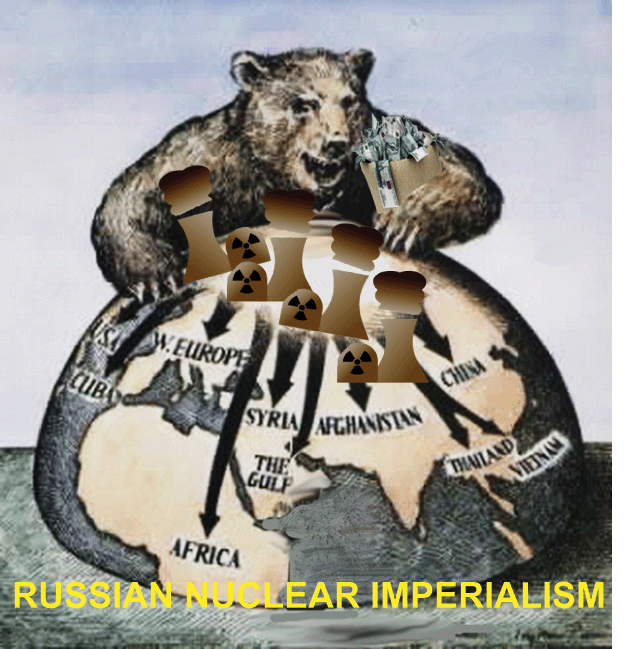
Russia’s nuclear corporation talking up wind, solar power – (doubts about nuclear future?)

Rosatom talks up wind, solar power in quest for ‘diversified portfolio’ By Frédéric Simon | EURACTIV.com 7 Nov 17Nuclear power remains the cornerstone of Rosatom’s expansion strategy, notably in emerging countries. But the Russian state-owned energy conglomerate is now also talking up renewables, citing wind, solar and batteries as part of a diversified low-carbon energy portfolio.

November 8, 2017 Posted by | renewable, Russia | Leave a comment

Japan will continue to reject nuclear weapons

Three reasons why Japan will likely continue to reject nuclear weapons, WP,  November 6 President Trump is visiting Tokyo on Monday at a time of renewed national security debates within Japan. North Korea’s recent missile launches and nuclear tests have again prompted discussion in Tokyo on Japan’s policy against becoming a nuclear state.

Although Japan has long had the technical ability to develop nuclear weapons — its “nuclear hedge” — it has refrained from doing so. Japan instead remains firmly committed to its 1967 Three Non-Nuclear Principles of not developing, not possessing and not introducing nuclear weapons.

This is not the first time that Japan has reexamined those principles. Similar debates transpired after China’s hydrogen bomb test in 1967, the Soviet Union’s deployment of medium-range nuclear missiles in Siberia during the 1980s and North Korea’s first nuclear test in 2006.

Is this time different? Reacting to North Korea’s threatening behavior, former Japanese defense minister Shigeru Ishiba stated in September that Japan should at least debate the decision not to permit the introduction of nuclear weapons on Japanese territory. Ishiba implied that Tokyo should consider asking Washington to deploy tactical nuclear weapons in Japan.

This latest debate is likely to end in the same way as previous debates, however. Japan will continue to adhere to its Three Non-Nuclear Principles and forswear nuclear weapons. Here are three reasons for that:

1) Staying non-nuclear is part of Japan’s national identity

The Three Non-Nuclear Principles are a clear part of Japan’s national identity, not simply a policy preference. Repeated polls indicate overwhelming popular support for the three principles in Japan. A 2014 Asahi newspaper poll revealed that support for the principles had risen to 82 percent, compared with 78 percent in a 1988 poll. Despite growing concerns about North Korea’s nuclear program and China’s military power during this period, Japanese support for remaining non-nuclear actually increased…….

2) Powerful players in Japanese politics can block nuclear acquisition

In addition to public opposition to nuclear weapons, Japan has significant “veto players” — crucial political or economic actors that are likely to block efforts to develop nuclear weapons.

Japan has a robust nuclear energy industry. But public acceptance of nuclear energy in the 1950s resulted from a fundamental political bargain: nuclear energy, but no nuclear weapons……

 3) Japan has good national security reasons to stay non-nuclear

There’s also a realist security calculation to consider. North Korean nuclearization is alarming, but it does not pose such an acute danger that Japanese leaders will be motivated to pay the high political costs necessary to weaken, much less revoke, the Three Non-Nuclear Principles.

North Korea acquiring the ability to deliver a nuclear weapon against the United States may weaken the protective U.S. nuclear umbrella somewhat, but U.S. nuclear and conventional military capabilities should be adequate to deter a North Korean nuclear attack on Japan……

And there’s a final consideration: A Japanese bomb would probably destabilize the country’s relations with China and South Korea. At a time when North Korea is making the international politics of the region complicated, Japan is likely to stay its non-nuclear course rather than make a disruptive nuclear move of its own. https://www.washingtonpost.com/news/monkey-cage/wp/2017/11/06/japan-is-likely-to-retain-its-non-nuclear-principles-heres-why/

November 8, 2017 Posted by | Japan, weapons and war | Leave a comment

11/11 Rally-Speak Out At SF Japan Consulate-Stop Abe Government From Restarting NUKE Plants

11/11 Rally-Speak Out At SF Japan Consulate-Stop Abe Government From Restarting NUKE Plants & Defend the Children and Families of Fukushima https://www.indybay.org/newsitems/2017/11/07/18804266.php

Rally Speak Out
Saturday November 11, 2017 3:00 PM
San Francisco Japanese Consulate
275 Battery St. near California St.
San Francisco

Despite the denials by the Japanese Abe government, Fukushima continues to contaminate the population of the area and the world. The government has declared that the area has been decontaminated but the radioactive water continues to accumulate in thousands of tanks. The clean-up has failed to even remove the radioactive material from the reactors that melted down due to the deadly high level of radiation that has even destroyed robots. There is already 22 million cu. meters of contaminated waste yet the government continues to claim that it is safe to return and is pushing to restart additional nuclear reactors.
The government is also pushing ahead to demand that the residents including families return to Fukushima or face the removal of their subsidies. This despite the fact that the courts have ruled that TEPCO now controlled by the government is financially responsible for the costs of this disaster for the people.
The government at the same time has declared that it is preparing for a massive Nankai Trough earthquake on Japan’s Pacific coast that according to even the government’s own estimate might kill 320,000 people yet it is planning to reopen nuclear plants in the very places it says there is a danger of a major historic quake that would create many nuclear meltdowns and a massive nuclear cloud of radioactive contamination threatening not just Japan but entire humanity and the environment.

The effort to reopen the nuclear plants is now combined with growing repression of the people with a secrecy bill and conspiracy law that will allow the government to charge journalists and citizens with crimes who are working to get information out about the dangers of Fukushima and the nuclear power industry.
The Abe government is now working with Trump to remilitarize and remove Article 9 of the constitution which forbids offensive war and Trump is demanding that Japan buy more military equipment and weapons. Over 40,000 people marched in Tokyo last weekend to oppose war and militarization yet the government is pushing ahead despite mass opposition.

It is time to speak out to defend the people of Fukushima and oppose the restarting of Japan’s nuclear plants and oppose militarization of Japan including the development of nuclear weapons.

Make sure your voice be heard.

Speak Out and Rally initiated by
No Nukes Action Committee
http://nonukesaction.wordpress.com/

November 8, 2017 Posted by | ACTION | Leave a comment

Cost of decommissioning Pilgrim nuclear power station – $25 million a year

$25 million a year decommissioning fee proposed for Pilgrim nuclear plant  Andy Metzger, State House News Service, Nov 6, 2017 BOSTON — Without sufficient funds for safely decommissioning the Pilgrim Nuclear Power Station, the state could be left holding the proverbial (glowing) bag once the plant ceases operations, environmental activists warned lawmakers Monday, asking them to impose a $25 million annual fee on the station if it misses deadlines.

The plant is set to close in a year and a half and its owner, Entergy, said the timetable for completing the decommissioning five years after closing is unrealistic.

“Physically it’s impossible to decommission in five years,” Tom Joyce, a lobbyist for Entergy, told the Committee on Telecommunications, Utilities and Energy. The fuel that was delivered to the power plant on the Plymouth coast about six months ago is “very hot and being used now to fuel the reactor and produce electricity, which will stay in the pool and can’t be touched for five years,” Joyce said.

Pilgrim went into operation in 1972, and it has been a source of major safety concern for residents of the South Shore and Cape Cod, especially after the meltdown in Fukushima, Japan, demonstrated the devastation that can follow a nuclear disaster……..

The plant, which is rated one notch above the Nuclear Regulatory Commission’s ranking of unacceptable, is set to close at the end of May 2019, and federal regulators will oversee the decommissioning process.

Pilgrim has a fund to pay for decommissioning that Joyce said stands at around $1 billion and anti-Pilgrim activists said was recently priced at about $960 million. Activists say that amount won’t be enough to cover the cost of safely securing the spent fuel and other decommissioning responsibilities.

Decommissioning Vermont Yankee, a smaller plant, had an estimated cost of $1.23 billion, according to Claire Miller, a community organizer for Toxics Action Center.

“If there’s not enough money the reactor could be mothballed for 60 years, and during that time obviously the workforce would be reduced to a skeleton [crew], offsite emergency planning would be eliminated, and offsite environmental monitoring eliminated or reduced,” Miller told the committee. “If Entergy … skips town, we are left holding the bag, along with lots of radioactive waste.”

Legislation filed by Plymouth Republicans Sen. Vinny deMacedo and Rep. Mathew Muratore would establish a Nuclear Power Station Post-Closure Trust Fund financed with $25 million annual payments by any nuclear plant that is not completely decommissioned five years after it stops making electricity. Pilgrim is the only remaining nuclear plant in Massachusetts.

“This is a detriment to our community,” deMacedo told the committee about the soon-to-be shuttered plant…… http://plymouth.wickedlocal.com/news/20171106/25-million-year-decommissioning-fee-proposed-for-pilgrim-nuclear-plant

November 8, 2017 Posted by | business and costs, decommission reactor, USA | Leave a comment

Hungary to borrow from Russia, to build Paks nuclear station

Hungary to tap Russian loan to finance Paks nuclear costs https://www.reuters.com/article/us-usa-election/democrats-win-bitter-virginia-governors-race-in-setback-for-trump-idUSKBN1D71D7 Reuters Staff, BUDAPEST (Reuters) – Hungary will first tap a Russian loan to finance initial expenditure worth about 98 million euros ($113.36 million) related to the expansion of its Paks nuclear power plant, state secretary Attila Aszodi said on Tuesday.

“We have not yet drawn on the Russian loan, but this will change in the coming hours,” Aszodi told an energy conference organized by financial news website portfolio.hu.

Russian company Rosatom will build two nuclear reactors in Hungary in a 12.5 billion euro project that has been delayed by at least a year as Hungary ironed out regulatory and financing issues with European regulators.

November 8, 2017 Posted by | marketing, Russia | Leave a comment

New record low for solar PV in Chile energy auction

Renew Economy 7th Nov 2017, The latest energy auction in Chile has set a new record low for solar PV,
with one bid by the local subsidiary of Italian outfit, Enel, coming in at
just $US21.48/MWh The result beats the previous record low of $US24.20 set
in the United Arab Emirates earlier this year, although it could be beaten
by Saudi Arabia’s first auction, should the early results of a tender
that secured an offer of $US17.90/MWh be verified later this month. Either
way, the Chile government is happy with the result, which secured an
average price of $US32.5/MWh for 600MW of solar and wind capacity, expected
to produce around 2,200GWh. This is a 75 per cent fall since its auction
program began in 2015. The Chile government says it will mean consumer
prices fall by nearly 50 per cent once all the new projects are completed
and online in 2024.
http://reneweconomy.com.au/chile-solar-auction-sets-new-record-low-for-solar-pv-85114/

November 8, 2017 Posted by | business and costs, renewable, SOUTH AMERICA | Leave a comment

Swiss government worried about obsolescent cooling circuits of nearby French nuclear reactors

TV5Monde 4th Nov 2017, [Machine Translation] The French nuclear power plant Bugey is located only
70 km from Geneva. The Swiss Federal Government of Geneva is concerned
about the obsolescence of the cooling circuits of the four reactors of this
nuclear power plant, one of the oldest in the French park. Interview with
Antonio Hidgers, Minister of Energy of Geneva.
http://information.tv5monde.com/info/surete-nucleaire-geneve-s-inquiete-de-la-centrale-de-bugey-201543

November 8, 2017 Posted by | safety, Switzerland | Leave a comment

European energy companies accuse EU of slacking in the fight against climate change

FT 5th Nov 2017, Some of Europe’s largest energy companies have accused the EU of lacking
ambition in the fight against climate change and urged more aggressive
targets for growth in renewable power. The declaration, by companies
including Iberdrola of Spain, Enel of Italy and SSE of the UK, came as
negotiators gathered in Bonn for the latest round of international talks on
tackling global warming. A proposed target for renewables to meet 27 per
cent of EU energy consumption by 2030, up from 16.7 per cent in 2015,
“lacks ambition and would slow down the current rate of renewables
deployment” in Europe, the companies said.
https://www.ft.com/content/4d39bd72-c20c-11e7-a1d2-6786f39ef675

November 8, 2017 Posted by | climate change, EUROPE | Leave a comment

UK energy experts recognise that renewable technologies are far cheaper than nuclear

University of Manchester 7th Nov 2017, ‘Business as usual’ is not an option for the UK’s nuclear energy
sector; our energy companies’ ‘regressive and unjust funding
approach’ is causing fuel poverty, and the Northern Powerhouse could play
a key role in shaping the UK’s climate change future. These are just some
of the opinions in a new publication, ‘On Energy: How can evidence inform
future energy policy?’, by The University of Manchester.

It is being launched on Wednesday 8th November at the House of Commons. The report
brings together some of the country’s leading energy, policy, and climate
change scientists, academics and experts to offer their opinions and
solutions for the UK’s most pressing energy issues. The publication draws
on expertise from across The University of Manchester and external
collaborators, including Lord Jim O’Neill, Director of the Dalton Nuclear
Institute, Professor Francis Livens, leading climate change researcher,
Professor Alice Larkin and SUPERGEN Bioenergy HubDirector, Professor
Patricia Thornley.

On the UK’s nuclear policy, Professor Livens and his
co-authors from DNI, Professors Tim Abram, Juan Matthews and Richard
Taylor, say the industry needs to recognise that its competitors in the
renewable sector, such as wind, solar and wave, are substantially cheaper.
To combat this he says more innovation is needed to reduce the cost if it
is to be taken seriously as an alternative to fossil fuels.
http://www.manchester.ac.uk/discover/news/is-the-uks-energy-policy-fit-for-purpose/

November 8, 2017 Posted by | ENERGY, UK | Leave a comment

Nuclear Disarmament Conference hosted by the Vatican

Vatican to host nuclear disarmament conference, CNA, By Hannah Brockhaus,  .– The Vatican is preparing for a conference on nuclear disarmament this week in the wake of an international effort to ban nuclear weapons.

Hosted by the Dicastery for the Promotion of Integral Human Development, the Nov. 10-11 conference will explore solutions and prospects for a world free of nuclear weapons and integral disarmament, in cohesion with Pope Francis’ emphasis on promoting peace.

In a Nov. 7 Vatican communique Cardinal Peter Turkson, prefect of the dicastery, said the event “responds to the priorities of Pope Francis to take action for world peace and to use the resources of creation for a sustainable development and to improve the quality of life for all, individuals and countries, without discrimination.”

At the International Atomic Energy Agency conference in Vienna in September, department secretary Msgr. Bruno Marie Duffé also emphasized the importance of the “moral responsibility of the States” and the challenge of a “common strategy of dialogue” invoked by Pope Francis.

The international symposium represents “the first global gathering on Atomic Disarmament” after the approval of the Treaty on the Prohibition of Nuclear Weapons was passed in New York July 7.

Until the treaty, nuclear weapons were the only weapons of mass destruction not explicitly banned by any international document.

The treaty passed with 122 votes in favor and one abstention, Singapore. However, 69 countries – all the nuclear weapon states and NATO members except the Netherlands –  did not take part in the vote.

One of the conference’s speakers Saturday will be Masako Wada, one of the last survivors of the Hiroshima nuclear attack and an assistant secretary general of Nihon Hidankyo, a confederation of nuclear weapons and experiments victims.

Other attendees include 11 Nobel Peace Laureates, representatives from the United Nations and NATO, diplomats from Russia, the United States, South Korea, and Iran, experts on armaments and weapons and leaders from foundations engaged in the topic……. https://www.catholicnewsagency.com/news/vatican-to-host-nuclear-disarmament-conference-55175

November 8, 2017 Posted by | 2 WORLD, Religion and ethics, weapons and war | Leave a comment

Not much support for USA Dept of Energy plan to prop up failing nuclear and coal industries

DOE Plan to Prop Up Coal and Nuclear Gets Little Support, NRDC,  

The clock is ticking for the Federal Energy Regulatory Commission (FERC), the agency in charge of national electricity markets, to make a decision on a rushed proposal from the Trump-run Department of Energy (DOE) to massively subsidize underperforming coal and nuclear power plants, costing consumers billions. Today marks the close of the very short public comment period on the bailout, which has generated an overwhelmingly negative reaction.

Groups across the energy industry are responding to one another’s initial comments submitted two weeks ago in response to DOE’s proposal to FERC, which plans to make its decision by Dec. 11 (our initial comments are discussed here). NRDC is joining with Earthjustice, Environmental Defense Fund, Sierra Club and others in these “reply” comments (a link will be posted here after they are filed). As our comments emphasize, while a handful of interested parties linked to the coal and nuclear industries supported the proposal, none successfully countered its fundamental flaw: it orders customers to pay coal and nuclear plants extra money simply because they can keep 90 days’ worth of energy supply onsite (a requirement designed precisely because it benefits coal and nuclear), notbecause they are necessary to provide reliable or “resilient” grid service.

DOE’s proposal is a distraction

As my colleague Jennifer Chen laid out in a separate set of initial comments from NRDC (discussed here), a real process to investigate resilience would entail defining the term in a way that distinguishes it from reliability already accounted for by market rules, establishing metrics to measure it, and allowing resources to compete to deliver it in a technology-neutral manner.

The data indicates that resilience primarily depends on power delivery infrastructure like substations and power lines, so bailing out coal and nuclear units is the wrong approach. ……..

The best next steps? Just say no

Ultimately, DOE’s proposal is nothing more than an illegal plan to advance an expensive and ineffective solution to solve a non-existent crisisConsumersgrid operators, and major sectors of the energy industry have overwhelmingly rejected the DOE’s blatant attempt to prop up uncompetitive coal and nuclear power. The proposed rule’s few supporters have failed to provide any evidence that FERC should move forward with this ill-considered scheme.

FERC should simply reject this proposal and other ideas that are fundamentally based on a desire to save expensive coal and nuclear generators rather than to better serve customers.https://www.nrdc.org/experts/miles-farmer/doe-plan-prop-coal-and-nuclear-gets-little-support

November 8, 2017 Posted by | politics, USA | Leave a comment