Pilgrim operators reduced the reactor’s power to 70 percent of its maximum Thursday due to rising ocean water temperatures. The temperature of the seawater used to cool the reactor cannot exceed 75 degrees under standards set by the Nuclear Regulatory Commission.
“We took action when it reached 71 degrees to ensure we did not challenge the limit,” said Patrick O’Brien, spokesman for Entergy, Pilgrim’s owner and operator.
Pilgrim draws up to 500 million gallons daily from Cape Cod Bay. The water cools the reactor and the turbine, passing through a network of thousands of tubes.
The seawater being discharged by the nuclear reactor is considerably hotter than the water drawn in — as much as 30 degrees hotter. The locations of the water intake structure and discharge structure at Pilgrim are separated by a jetty to help prevent the warm discharge water from migrating to the intake area and boosting the water temperature there.
“Previously, during storm monitoring, operations identified the potential for ocean conditions that would require preemptive actions and a power reduction as salt service water temperatures rose,” O’Brien said in his email. “Once predetermined criteria were met, operators commenced power reduction.”
Nuclear plants are about one-third efficient, explained David Lochbaum, director of the Nuclear Safety Program for the Union of Concerned Scientists.
“Of the three units of energy produced by the reactor core, one third goes out onto the transmission lines as electricity, and two thirds gets rejected to the nearby body of water,” Lochbaum said. “Reducing the reactor power level reduces the amount of heat energy carried away by the discharge flow, thus also reducing the amount of warm water sneaking around the jetty to re-enter the plant.”
The reactor will remain at reduced power until ocean temperatures allow for its return to full power operation, O’Brien said. — Follow Christine Legere on Twitter: @ChrisLegereCCT.
The presidents of Japan and South Korea welcomed Trump’s announcement of new sanctions against North Korea but privately questioned whether his threat to “totally destroy” the country would lead to the diplomacy they prefer.
Arab and Iranian leaders sat stone-faced during Trump’s bellicose address on Tuesday — while several other world leaders reacted with bemusement, chagrin and confusion to his often-contradictory comments.
Netanyahu could be observed laughing and grinning as Trump described the hard-fought international nuclear accord with Iran as the “worst deal ever” and an “embarrassment” to the United States.
Far from taming his enemies, Trump seems to have inflamed tensions further as the world faces a nuclear-armed North Korea and worries about a deal designed to prevent Iran from building a bomb.
South Korea’s Yonhap News Agency reported Thursday night that North Korea’s foreign minister, Ri Yong Ho, said in New York that his country may test a hydrogen bomb in the Pacific Ocean to fulfill leader Kim Jong Un’s vow to take the “highest level” action.
The Partial Nuclear Test Ban Treaty, which the United States and the Soviet Union signed in 1963, forbade atmospheric and underwater testing of nuclear weapons. No confirmed ocean tests have occurred since then, but North Korea is not a signatory.
North Korea conducted an underground test of what it called a hydrogen bomb on Sept. 3. An ocean test could severely damage the environment as well as expand the security crisis…….
During the weeklong General Assembly, Trump, invoking his reality-TV flair for drama, said he had made a decision on whether to walk away from the Iranian deal, but he would not yet reveal it.
His administration recently continued lifting sanctions against Iran, which was part of the agreement. But next month, Trump must issue a separate certification to Congress on whether Iran is complying with the deal, an every-90-day requirement under U.S. law.
Several administration officials have suggested Trump will not certify compliance even though the U.N.’s nuclear watchdog, the International Atomic Energy Agency, has found Iran in compliance eight times since the deal was signed in 2015. http://www.latimes.com/nation/la-fg-trump-un-assess-20170922-story.html
Many people have bought the argument that nuclear energy is carbon-free, even though it isn’t, and they have accepted the promise from the nuclear industry that there will be no more nuclear catastrophes because all the “lessons have been learned” and nothing of the kind will ever, ever happen again. They say that after every nuclear mistake big or small. The public also accepts without too much inquiry that nuclear reactors could exist in this world alongside a hypothetical abolition of nuclear weapons. Enough people seem persuaded of these arguments, so a passive acceptance of nuclear energy is the norm in most countries that still depend on it.
The issue that ought to be the real deal-breaker is none of the above-mentioned objections, even though they are each, individually, sufficient to make any nation reject nuclear energy. The most serious problem with nuclear energy is that no one, since the time when nuclear power plants were first switched on, has found a way to dispose of irradiated uranium and plutonium, commonly known as “nuclear waste.”
The public has been told that it can be safely buried as soon as nuclear reactor operators find a suitable geological disposal site and a “willing host community” to take it. So far both of these conditions have not been met. Willing host communities are extremely hard to produce, and reluctant host communities have exposed the fact that no proposed disposal site can be guaranteed to be safely sealed off from the ecosystem for the thousands of years into the future.
Over the last five years I have followed the opposition that has arisen to France’s plan to bury its nuclear waste in an enormous facility in northeastern France near the town of Bure. The articles I translated previously can be found at the links at the end of this article. The translation that follows this introduction describes what is happening to opponents in September 2017 as their movement has grown and their lawsuits and legal challenges have been rejected. The state has finally decided to crack down. When a group of people decide to stand up and protect future generations, this is the thanks they get.
Events in France illustrate the serious flaws in our civilization’s approach to energy policy. Any solution that imposes destruction on a local people cannot be called the product of a democratic process. One can say that this is a majority decision, or the nation requires this sacrifice, but any such abuse of a minority is incompatible with democracy because anyone, and thus everyone, becomes susceptible to such tyranny in different times and circumstances.
Some nations are aware of this dilemma so they are content to delay indefinitely the quest for a final resting place for irradiated fuel rods. They hope to someday find the appropriate host community, but it doesn’t matter if they never succeed. As long as they talk of having this intent and pretend a solution is possible, they can continue operating their reactors. France, on the other hand, seems to have been foolish enough to take the idea of building a permanent disposal site seriously. They proceeded to build it over the objections of citizens and in spite of evidence that it would jeopardize future generations.
On Wednesday September 20, police raided several locations in Bure (Meuse region) and surrounding areas inhabited by opponents of the nuclear waste disposal project. For many of them, this operation seems to be “the main focus of police pressure that has become widespread and permanent.” Gatherings of support are being organized throughout France.
La maison de résistance in Bure, the place where opponents of CIGEO meet and organize, was raided for the first time on September 20 at about 06:15.
Bought in 2005 by French and Germn antinuclear activists from belonging to Bure Zone Libre (BZL), this old farm today welcomes activists of many kinds on a regular and permanent basis. “Raiding la maison de resistance is very symbolic. They are getting serious now,” remarks Joel, a resident of Mandres and opponent of the nuclear waste repository. Over almost ten hours, officers went through everything in the building, and seized numerous objects. Joel explained, “They didn’t have enough boxes to seal everything up properly, so they had to have more brought to them. They came with a moving truck, ready to empty the house.”
It was about 6:20 in the morning when officers started their raids at the maison de resistance, in Bure, the grounds of the station at Lumeville, and a residence in Commercy. They also went to an apartment in Mandres-en-Barrois, near Verdun. These places are occupied by people opposed to the burial of nuclear waste in Bure. Managed by ANDRA (l’Agence Nationale pour la gestion des Déchets RAdioactifs), this project was baptized as CIGEO (Centre Industriel de stockage GEologique)
The forces of public order justified their entry into the maison de resistance with a warrant from a commission of inquiry formed to investigate an attack on the hotel-restaurant of the ANDRA laboratory last June.
According to the website MVC.Camp maintained by the activists on the site, “There were forty officers, and they made their entry violently. Equipped with a crowbar, they broke the door and, it seems, some car windows.”
At the train station, about fifteen officers were present, accompanied by a prosecutor and drug-sniffing dogs. They came in with a warrant from the commission allowing a search for drugs. In Commercy, they also arrived about 6:00 and seized a computer, a hard drive and a portable phone. During this time, roadblocks were put up at Ribeaucourt and at Mandres.
“The people here are exhausted and afraid”
According to the prosecutor in Bar-le-Duc, Olivier Glady, interviewed by AFP (Agence France Presse), officers seized helmets, gas masks and fireworks, 140 grams of “packaged” cannabis resin, ten cannabis plants, as well as data and phones. They were pursuing three different investigations:
The one ordered by the commission of inquiry mentioned above.
Another investigation was launched after confrontations that occurred at a protest on August 15, according to Mr. Glady.
Some raids were related to “infractions of drug laws,” he added.
For the organization Sortir du Nuléaire, “this raid comes after many months of permanent police harassment in the villages around Bure, with constant patrols by police cars and helicopters, and roadblocks where both protesters and farmers have to show identification.”
In a press release, the group denounced “these unacceptable methods and the escalation in this strategy of tension. It is shameful that the State chooses targeting of opponents rather than abandoning this dangerous project that imposes a danger on future generations.” The group is calling for protests throughout the country (see list below.)
A resident of Mandres, an opponent of the CIGEO project, told Reporterre, “It’s the first time we’ve seen an operation of this scale in Bure.” For him, it’s the main focus of a police pressure that is now diffuse and permanent. “Officers patrol daily in the streets and villages, filming and harassing, controlling everything in a pervasive manner. They are raising the tension in order to discourage people, making people afraid, and pushing them to the margins, but all they’re doing is motivating people to mobilize more.”
Michel Labat, another resident of Mandres told Reporterre he was revolted. “It’s incredible. So many police everywhere. Today there is no more opposition. As soon as we do something, they call in the police. Then they insult and harass us regularly. They have no respect. People here are exhausted and afraid.”
For Jean-Francois Bodenreider, a physiotherapist, a resident of Bonnet, and president of the group Habitants Vigilants de Gondrecourt said, “These raids are a way of destabilizing the struggle, a way of focusing on other things. While we are pointing out the dangers of CIGEO, they are conducting disciplinary operations, portraying opponents as druggies and criminals. This makes people stop talking about the real problems. They don’t know what to say or do to defend le nucléaire, so they talk about something else.
“They are pushing us to our limits to make us do something irreparable”
On September 17, this physiotherapist who established himself in Gondrecourt twenty-five years ago, experienced another of many provocations by police. He was in his yard when a black 4×4 stopped in front of his house. Mr. Bodenreider said, “I approached and the passenger in the front took out his phone to take some photos. He told me he was looking for houses to buy in the area. I asked him to leave because our house is not for sale, then his tone changed. Suddenly, one of the passengers shouted, ‘Go! He has a hammer!’” Mr. Bodenreider’s son, Leonard, a medical student, was in the garage gathering supplies for a camping trip. “Out of fear for his father, and in anger” he threw a rubber hammer toward the vehicle. Then the family was shocked to see the passengers in the 4×4 identify themselves as police officers. They handcuffed Leonard and took him away. The spouses of father and son went to the police station in Gondrecourt and waited patiently until they were finally listened to as witnesses. Mr. Bodenreider recounted, “The officers were talking about attempted manslaughter charges, but some local officers who knew us were there and they defused the situation, and they finally got our son released that evening.”
Leonard will have to appear in court on charges of destruction of property because the hammer slightly struck the vehicle.
“After the incident, I told myself that if I reacted like that it was because I was irritated,” said the physiotherapist. I don’t live under daily pressure, not like the residents of Mandres who are patrolled eight times a day. But this pressure exerted by police patrols affects all of us.” He describes himself as “moderate” in the struggle, but he is sure of one thing: “They are pushing us so that we’ll do something irreparable.”
“Once you are identified as an opponent, you are presumed to be guilty”
Joel, an opponent of the CIGEO project, recently relived the experience of his house arrest during the COP21 summit: “At 6 AM, ten officers came to the door of the friend I was staying with in Commercy. They went through everything for the next hour. One of them had a Taser gun. They left with papers, my computer, and my phone. As a bonus question, the forces of public order asked before leaving, “Do you have anything else to declare regarding Bure?”
As in the other locations that were raided, one of which was Joel’s apartment in Mandres, officers indicated that they were investigating the attack on the hotel-restaurant of the ANDRA laboratory. One catch: Joel was on vacation in Greece at the time. He adds indignantly, “Once you are identified as an opponent, in my case since the COP21, you’re a target and presumed guilty.”
For Joel, this is all proof that the operations this Wednesday were not aimed solely at finding who is responsible for the acts committed this summer. He observes, “They are creating permanent tension in order to break people.”
List of protest events being organized by Sortir du Nucleaire this Wednesday:
Paris à 18h, appel à rassemblement au marché aux fleurs, métro Cité, à 18h. En solidarité également avec les camarades en procès de la voiture brûlée.
devant la Préfecture de Bar-le-Duc à 17h30
Nantes, rdv 18h à Commerce dans le cadre du Front social.
Grenoble, 17h30, au pied de la tour Perret, parc Paul Mistral, par le comité local de soutien contre les GPII.
Nancy place Stanislas à 18h.
Angers, 18h, devant la Préfecture d’Angers.
Épinal, 18h, devant la Préfecture.
Colmar, 18h, devant la Préfecture, Champ-de-Mars.
Dijon, 18h, devant la Préfecture. Événement ici.
Rassemblement en cours d’organisation en Alsace, on vous tient au courant dès que possible.
Rassemblement en cours d’organisation à Reims, idem.
Une conférence de presse commune du mouvement de résistance se tiendra jeudi 21 septembre à 11h à la Maison de résistance à la poubelle nucléaire, à Bure.
More articles about Bure, CIGEO and French nuclear history:
Superphénix (some history of the French anti-nuclear movement) Very valuable information for the anglophone world. We are constantly being told of how popular and successful is the nuclear industry in France. This is a timely counter to the pro nuclear English language propaganda
Moon and Trump agree on South Korea purchase of state-of-the-art US weaponry during summit
Hankyoreh Sep.22,2017The deal is reportedly set to include nuclear powered submarines
South Korean President Moon Jae-in and US President Donald Trump agreed on Sept. 21 on a plan for South Korea to introduce state-of-the-art US weaponry or develop its own to counter North Korea’s recent nuclear and missile provocations. Later the same day, Moon had a luncheon and trilateral summit with Trump and Japanese Prime Minister Shinzo Abe, where the three agreed that the entire international community “must apply the maximum intensity sanctions and pressure so that North Korea cannot withstand it anymore and must come to the table for dialogue.” ……http://english.hani.co.kr/arti/english_edition/e_northkorea/812155.html
North Korea: Trump and Kim call each other mad, BBC, 22 September 2017
Kim Jong-un has said remarks by “deranged” US President Donald Trump have convinced him he is right to develop weapons for North Korea.
In an unprecedented personal statement, Mr Kim said Mr Trump would “pay dearly” for a UN speech where he threatened to “totally destroy” the North if the US was forced to defend itself.
Mr Trump responded that the “madman… will be tested like never before”.
The two countries have engaged in ever more heated rhetoric in recent months.
Mr Kim ended his statement by saying he would “surely and definitely tame the mentally deranged US dotard with fire”.
China responded to the war of words, warning that the situation was “complicated and sensitive”.
“All relevant parties should exercise restraint instead of provoking each other,” said Foreign Minister spokesman Lu Kang.
Russia also urged restraint, with Foreign Minister Sergei Lavrov describing the rhetoric between the two leaders as a “kindergarten fight between children”……http://www.bbc.com/news/world-asia-41356836
the theories behind many of the proposed systems aren’t new and often date back to the 1950s and ’60s. Some experimental plants have been built, such as the fast breeder reactors in the U.K. and U.S. Most suffered from crippling cost or design problems or were abandoned after nuclear accidents.
“Most if not all of these so-called advanced reactor designs have been around for decades,”
“Different designs have different problems. I don’t think anyone can be or should be confident that these problems can be resolved merely by throwing money and hiring engineers and scientists.”
Nuclear Experts Head to China to Test Experimental Reactors, Bloomberg By
Stephen Stapczynski China is becoming the testing ground for a new breed of nuclear power stations designed to be safer and cheaper, as scientists from the U.S. and other Western nations find it difficult to raise enough money to build experimental plants at home.
China National Nuclear Power Co. this month announced a joint venture to build and operate a “traveling wave reactor” in Hebei province, designed by Bellevue, Washington-based TerraPower LLC, whose chairman is Microsoft Corp. founder Bill Gates. The development follows Canada’s SNC-Lavalin, which has agreed to build a new recycled-fuel plant with China National Nuclear Corp. and Shanghai Electric Group, and Oak Ridge National Laboratory, which is working with the Shanghai Institute of Applied Physics on a salt-cooled system……..
“The outlook for nuclear power is brighter there than anywhere else in the world,” said M. V. Ramana, a professor at the Liu Institute for Global Issues at the University of British Columbia. “It is not so difficult for a company developing a nuclear reactor design to find a partner.”
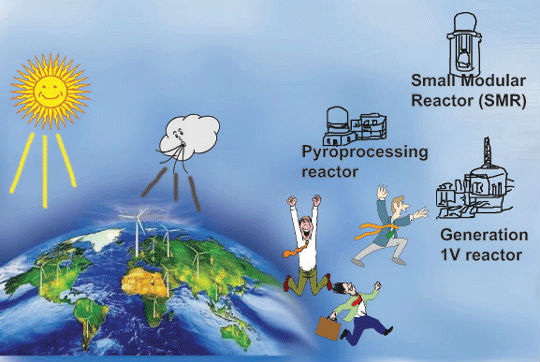
The systems proposed belong to the so-called fourth generation of reactors. The current generation under construction include enhanced safety features following the Fukushima disaster in Japan in 2011, but still typically use traditional fuel rods, cooled by water under pressure. Both Areva SA and Westinghouse Electric Co. are slated to turn on their current-generation nuclear reactors in the next year in China — well ahead of any other nation, despite delays.
Recycled Fuel
Some Generation IV designs aim to cut construction costs by using coolants that work at atmospheric pressure — reducing the need for massive containment structures. Many recycle their fuel, reducing the need for uranium, and in some cases are fail-safe without intervention if something goes wrong…….
Coolants include liquid sodium, gases and molten metal. Some use thorium instead of uranium to power the reaction.
Still, the theories behind many of the proposed systems aren’t new and often date back to the 1950s and ’60s. Some experimental plants have been built, such as the fast breeder reactors in the U.K. and U.S. Most suffered from crippling cost or design problems or were abandoned after nuclear accidents.
“Most if not all of these so-called advanced reactor designs have been around for decades,” said Ramana at the Liu Institute. “Different designs have different problems. I don’t think anyone can be or should be confident that these problems can be resolved merely by throwing money and hiring engineers and scientists.”
Computer Models
TerraPower’s traveling-wave design is based on research by Saveli Feinberg, a physicist who first proposed it in the 1950s. Levesque says that advancements in computing in the last decade have revolutionized the ability to develop these technologies. “You couldn’t get it near the concept without the computer modeling,” he said.
Yet computers alone won’t prove the technology without a working plant.
“What they really need is to construct research reactors,” said Allison Macfarlane, former head of the U.S. Nuclear Regulatory Commission. “And that is really expensive.”………
Areva is not currently working with Chinese teams to develop a fourth generation reactor, spokesman Mathias Schuch said in an email. Westinghouse didn’t respond to requests for comment on next-generation reactors………
“Nuclear can be a difficult industry and it needs to be heavily regulated,” Macfarlane said. “You can make rather a big expensive mess if you don’t get it right. Only one accident will seriously affect the entire industry. There are very few industries like that.”
Developers say the industry is over-regulated. Michael F. Keller, president of Hybrid Power Technologies LLC said the NRC is a “bureaucratic straight jacket” that creates a massive financial burden on the deployment of advanced reactors. “As advanced reactors are generally passively fail-safe, there is no rational reason to apply the grossly overly-complex regulations currently in use,” he said.
It is the second time a court has ruled against Tokyo Electric Power Company Holdings Inc. in a suit filed by residents forced to abandon their homes when three reactor cores melted following the deadly 2011 earthquake and tsunami, which knocked out their cooling systems.
The triple meltdown spewed massive amounts of radioactive material into the air.
The Chiba District Court awarded ¥376 million to 42 of the 45 plaintiffs who fled Fukushima Prefecture for Chiba Prefecture and filed the suit in March 2013, seeking around ¥2.8 billion in damages from the government and Tepco.
The focal point of the Chiba case was whether the government and Tepco were able to foresee the huge tsunami that hit the seaside plant on March 11, 2011, and take preventive measures beforehand. Conflicting claims were made by the parties regarding the government’s long-term earthquake assessment, which was made public in 2002.
The assessment, made by the earthquake research promotion unit, predicted a 20 percent chance of a magnitude 8 earthquake occurring along the Japan Trench in the Pacific Ocean, including the area off Fukushima, within 30 years.
Based on the assessment, the plaintiffs argued that, with the plant standing on ground roughly 10 meters above sea level, a tsunami higher than that level striking the plant could have been predicted.
They claimed the disaster was therefore preventable by placing emergency generators on higher ground, and that the government should have made Tepco take such measures by exercising its regulatory powers.
The government and Tepco, for their part, claimed the assessment was not established knowledge, and that even if they had foreseen a tsunami higher than the elevation of the plant and taken measures against it, they cannot be held liable as the actual tsunami was much higher, at around 15.5 meters.
The government also argued that it obtained regulatory powers to force Tepco to take anti-flooding measures only after a legislative change following the disaster.
In Friday’s ruling, the court found the state not liable, saying that while the government indeed has such powers, not exercising them was not too unreasonable.
The Chiba case is among around 30 similar lawsuits brought by groups of people forced to evacuate by the nuclear disaster.
In March, the Maebashi District Court in Gunma recognized negligence on the part of not just Tepco, but also the government, saying they were able to foresee a tsunami high enough to inundate the plant.
At the time, it was the first such ruling issued among around 30 similar suits and the first to rule in favor of plaintiffs.
The Maebashi court acknowledged the state had regulatory authority over Tepco even before 3/11, noting that “failing to exercise it is strikingly irrational and illegal.”
But because the court awarded to 62 of 137 plaintiffs a total of ¥38.55 million in damages — far less than the ¥1.5 billion sought in total — many of the plaintiffs have appealed the district court decision.
In the Chiba suit, the 45 plaintiffs, including four who evacuated voluntarily, sought ¥20 million each in compensation for their evacuations and the loss of their hometowns, jobs and personal relationships because their lives were uprooted.
The magnitude 9.0 earthquake and ensuing tsunami struck northeastern Japan on March 11, 2011, causing multiple meltdowns and hydrogen blasts at the nuclear plant.
As of the end of August 2017, around 55,000 people who lived in Fukushima Prefecture at the time of the disaster remained at the locations where they evacuated, both within and outside the prefecture.
President Trump at the United Nations: Editorial Board Roundtable, Cleveland,com 22 Sept 17
“…………The reception to Trump’s speech fell along political lines. Nile Gardiner, an analyst at the conservative Heritage Foundation, told CNN that it was a “groundbreaking speech,” while Democratic Sen. Dianne Feinstein of California panned it as “missing an opportunity” to deal with North Korea.
So was Trump on the mark? The edtorial board roundtable offers its opinions and we wait to hear yours in the comments.
If only every international problem could be solved by flicking a red button and unilaterally turning belligerent nations into a pile of radioactive rubble. They can’t be. The world does better when nations work together. The path forward is slow, frustrating, often annoying diplomacy with our allies — and our enemies. Trump’s bluster is dangerous.
Thomas Suddes, editorial writer:
The speech was an embarrassment to our country.
Ted Diadiun, editorial board member:
There’s nothing wrong with a nationalist approach from a U.S. president. Donald Trump was elected at least in part by people who were weary of eight years of Barack Obama’s “Blame America First” posturing. As for the rest of Trump’s speech, the only thing more troubling than believing he is descending to schoolyard belligerence in threatening something he has no intention of carrying out — is that he is not.
Elizabeth Sullivan, director of opinion, cleveland.com:
Tighter sanctions on North Korea could have a harsh humanitarian impactThe Conversation Donald Trump has announced even more sanctions on North Korea, this time targeting anyone who does business there. His move comes hot on the heels of UN Security Council Resolution 2375, passed in response to North Korea’s sixth nuclear test, which marks a new stage in the world’s attempts to squeeze the Pyongyang government.
The resolution takes what was already a tough sanctions regime focused on nuclear and military-related trade and tries to exert broader pressure on the country’s economy, embargoing North Korean textile exports, capping the dispatch of additional North Korean workers overseas, and limiting exports of refined petroleum and crude oil to North Korea.
The US mission to the UN claimed that these measures amount to the “strongest sanctions ever”. But the measures contained within sit at odds with a claim made in the resolution’s article 26, namely that the measures “are not intended to have adverse humanitarian consequences for the civilian population of the DPRK”………
Hit hard
Restricting North Korean energy imports, for one, cannot but have an impact on the North Korean people themselves. A recent report by the Nautilius Institute argues that the military is likely to have access to considerable stockpiles of oil, even as ordinary North Korean citizens do not.
Similarly, the textile sector is a significant provider of jobs: the most recent North Korean census in 2008 showed that nearly 400,000 workers were employed in the textile manufacturing sector – and that was before the rapid growth of Chinese outsourcing to the North……….
Tipping the balance
Because North Korea is the world’s lowest-spending nuclear state, the level of economic stress needed to halt funding to the country’s nuclear weapons programme probably cannot be applied without severe human costs. There is also no guarantee that even extreme levels of hardship brought about by effective sanctions will produce a popular North Korean revolution. During the mass starvation of the 1990s, for example, there were no recorded incidents of significant civil unrest and the regime seemed resilient……..
Tipping the balance
Because North Korea is the world’s lowest-spending nuclear state, the level of economic stress needed to halt funding to the country’s nuclear weapons programme probably cannot be applied without severe human costs. There is also no guarantee that even extreme levels of hardship brought about by effective sanctions will produce a popular North Korean revolution. During the mass starvation of the 1990s, for example, there were no recorded incidents of significant civil unrest and the regime seemed resilient…….
To be sure, not all sanctions are ill-advised. But as the scope of multilateral sanctions is extended to target everyday North Koreans’ livelihoods, it’s crucial to ask whether this approach is likely to succeed. Given just how resilient the North Korean regime has so far been in the face of intense international pressure, the chances seem slim. https://theconversation.com/tighter-sanctions-on-north-korea-could-have-a-harsh-humanitarian-impact-84299
“That’s just common sense,” Haley said, responding to a question on what Trump meant by the comment. “We don’t want war. That’s the last thing anyone wants. We don’t want loss of life.”
Trump turned heads during his first address to the United Nations on Tuesday, calling Kim Jong Un “Rocket Man” and saying if pushed to defend itself or our allies the U.S. “will have no choice but to totally destroy North Korea.”
However, the ambassador echoed the president’s remarks during a press briefing Thursday, saying that if the rogue nation were to attack the U.S. or one of its allies, “The U.S. will respond. Period.”
Haley added the new sanctions announced earlier in the day against North Korea were the latest attempt at a diplomatic solution and push for them to come to the negotiating table: “Until then, that’s just the reality. If they were to strike the United States, of course, we would have to respond back.”
The president signed an executive order Thursday placing new sanctions on the Kim Jong Un-led nation. “A new executive order will cut off sources of revenue that fund North Korea’s efforts to develop the deadliest weapons known to humankind,” Trump said while announcing the order.
HAWAII READYING FOR NUCLEAR ATTACK IN SECRET MEETING TO AVOID PANIC, NewsWeek, BY CHRISTAL HAYESThe state of Hawaii prepped for a nuclear attack in a meeting this week, but wouldn’t allow the public to attend and kicked out a photojournalist who snapped a picture.
Dozens of lawmakers met behind closed doors and talked about how to ready the state for an attack, including planned tests of alarms that would notify people they had 12 to 15 minutes to seek shelter, according to the Honolulu Civil Beat.
The presentation given at the meeting was marked “for official use only” and showed where North Korea could target and how bad the impact would be, Hawaii Representative Gene Ward told the news organization.
Ward added that officials don’t “want to spook any of the public”—which includes 1.4 million residents and 8 million tourists who visit the state annually.
Hawaii has been preparing for an attack for months, as military experts estimate a missile would take 20 minutes to reach the island from North Korea.
Hawaii Emergency Management Agency officials have said the chances of a nuclear attack are still “extremely small,” but the “unpredictable leadership” of North Korea means they should be prepared. They plan to have a public meeting and will start testing the attack alarms in November, but there are no plans to build any fallout shelters……..http://www.newsweek.com/nuclear-hawaii-trump-north-korea-kim-jong-un-669502
The Oscar winner, 42, met with then-president-elect Trump, 71, in December, only to have the POTUS disregard their conversation once he took office.
“We presented him with a comprehensive plan to tackle climate change, while also simultaneously harnessing the economic potential of green jobs,” DiCaprio recalled at the Yale Climate Conference on Tuesday (via The Hartford Courant). “We talked about how the United States has the potential to lead the world in clean-energy manufacturing and research and development.”
Once in office, Trump pledged to withdraw from the Paris climate accord, which regulates greenhouse emissions, and appointed climate change skeptic Scott Pruitt to head the Environmental Protection Agency.
The moves left staunch environmentalist DiCaprio nonplussed.
“We should not have people in office who do not believe in facts and truths and modern science that are able to manipulate and risk the entire future of this entire generation,” he fumed. “We are at that turning point right now, and we are going to look back at this point in history, and frankly this administration, and certain people are going to be vilified for not taking action. They really are. And it’s up to this generation, it’s up to all of you to get involved and make a difference.”
This year’s version of the World Nuclear Industry Status Report (WNISR) is out, and its message is not a happy one for nuclear power proponents. As former Tennessee Valley Authority chairman S. David Freeman notes in a foreword, “The report makes clear, in telling detail, that the debate is over. Nuclear power has been eclipsed by the sun and the wind. These renewable, free-fuel sources are no longer a dream or a projection—they are a reality [and] are replacing nuclear as the preferred choice for new power plants worldwide.”
As in previous years, the report—coordinated by Paris-based independent nuclear consultant Mycle Schneider—provides an almost-daunting array of data on almost every aspect of nuclear power plant construction and operation. This year’s report also includes an assessment of what it calls “the financial crisis of the nuclear sector,” a status update on the Fukushima nuclear situation, and a chapter that compares investments in, capacity of, and generation from nuclear, solar, and wind energy installations on a worldwide basis.
Doubtless, nuclear power supporters will argue against some (and perhaps many) of the conclusions that Schneider and co-author Antony Froggatt express in the report. But the data the report presents—data underlying the Global Nuclear Power Database, an interactive visualization that the WNISR developed for the Bulletin—are truly comprehensive. Anyone interested in nuclear power will likely find the report worth at least a first look, and probably a second and third.
Extract-a-fact, By Quentin Parrinello 18th Sept 2017, In 2014, Niger announced it had successfully renegotiated uranium
extraction contracts with French state-owned company Areva to secure a
greater share of the wealth deriving from their uranium resources.











 nuclear-news
“…………The reception to Trump’s speech fell along political lines. Nile Gardiner, an analyst at the conservative Heritage Foundation, told CNN that it was a “groundbreaking speech,” while Democratic Sen. Dianne Feinstein of California panned it as “missing an opportunity” to deal with North Korea.
So was Trump on the mark? The edtorial board roundtable offers its opinions and we wait to hear yours in the comments.
Sharon Broussard, chief editorial writer, cleveland.com:
If only every international problem could be solved by flicking a red button and unilaterally turning belligerent nations into a pile of radioactive rubble. They can’t be. The world does better when nations work together. The path forward is slow, frustrating, often annoying diplomacy with our allies — and our enemies. Trump’s bluster is dangerous.
Thomas Suddes, editorial writer:
The speech was an embarrassment to our country.
Ted Diadiun, editorial board member:
There’s nothing wrong with a nationalist approach from a U.S. president. Donald Trump was elected at least in part by people who were weary of eight years of Barack Obama’s “Blame America First” posturing. As for the rest of Trump’s speech, the only thing more troubling than believing he is descending to schoolyard belligerence in threatening something he has no intention of carrying out — is that he is not.
Elizabeth Sullivan, director of opinion, cleveland.com:
President Trump isn’t putting America first when his rhetoric and actions push us toward war with a nuclear-armed state. …….. http://www.cleveland.com/opinion/index.ssf/2017/09/president_trump_at_the_united.html